
Italy Smart Appliances Market (2025-2030)

The Italy Smart Appliances Market was valued at $779.5 Million in 2025 and projected to reach to $1193.6 Million by 2030, representing a compound annual growth rate of 8.9%. Italy's smart appliances market is poised for steady expansion through 2030, driven by a confluence of factors including rising disposable incomes, heightened environmental awareness, and regulatory support for energy-efficient technologies.


| Market Size in | USD 26.32 MN |
| Market Forecast in | |
| CAGR | |
| Forecast Period | |
| Units Considered | Value (USD MN) |
Italy Smart Appliances Market Trends and Insights
- This 8.9% compound annual growth rate reflects Italy's increasing consumer adoption of connected home technologies and energy-efficient appliances.
- Italy's market expansion is driven by rising disposable incomes, growing environmental awareness, and government incentives promoting smart home adoption across residential and commercial sectors. The Italian smart appliances landscape is characterized by strong demand for IoT-enabled kitchen and laundry appliances, with consumers prioritizing sustainability and remote control capabilities.
- Italy's position within the European market benefits from established manufacturing infrastructure and a tech-savvy consumer base.
- Between 2025 and 2030, Italy is expected to see accelerated penetration of AI-powered appliances and voice-controlled devices, supported by improving broadband connectivity and digital literacy across urban and suburban regions..
Key Market Statistics
- CAGR (2025-2030) 8.9% CAGR
- Market Size, 2025 ~USD 779.5 Million
- Forecast, 2030 ~USD 1193.6 Million
- Country Italy
Italy Smart Appliances Market Overview
Market Valuation Growth :
Italy's smart appliances market is valued at USD 779.5 million in 2025, with projections reaching USD 1,193.6 million by 2030, representing a robust 8.9% CAGR over the forecast period.
Energy Efficiency Adoption :
Italian consumers are increasingly prioritizing energy-efficient smart appliances driven by environmental consciousness and EU sustainability regulations, positioning Italy as a key market for eco-friendly connected home solutions.
Rising Disposable Incomes :
Growing purchasing power among Italian households is accelerating the adoption of premium smart appliances, with middle and upper-income segments driving demand for connected kitchen and laundry solutions.
Connected Home Integration :
Italy's smart appliances market benefits from increasing consumer familiarity with IoT technologies and smart home ecosystems, supported by improved broadband infrastructure across urban and suburban regions.
Italy Smart Appliances Market Dynamics
- The 8.9% CAGR reflects moderate but consistent growth as Italian consumers increasingly embrace connected home solutions that offer convenience and sustainability benefits. While Italy's growth rate of 8.9% trails the global CAGR of 11%, the market remains strategically important within Europe.
- Future growth will be supported by EU green initiatives, smart city developments in major metropolitan areas, and the integration of AI-powered appliances.
- Manufacturers targeting Italy should emphasize energy savings, ease of use, and compatibility with existing European smart home standards to capture this expanding market opportunity..
Market Ecosystem
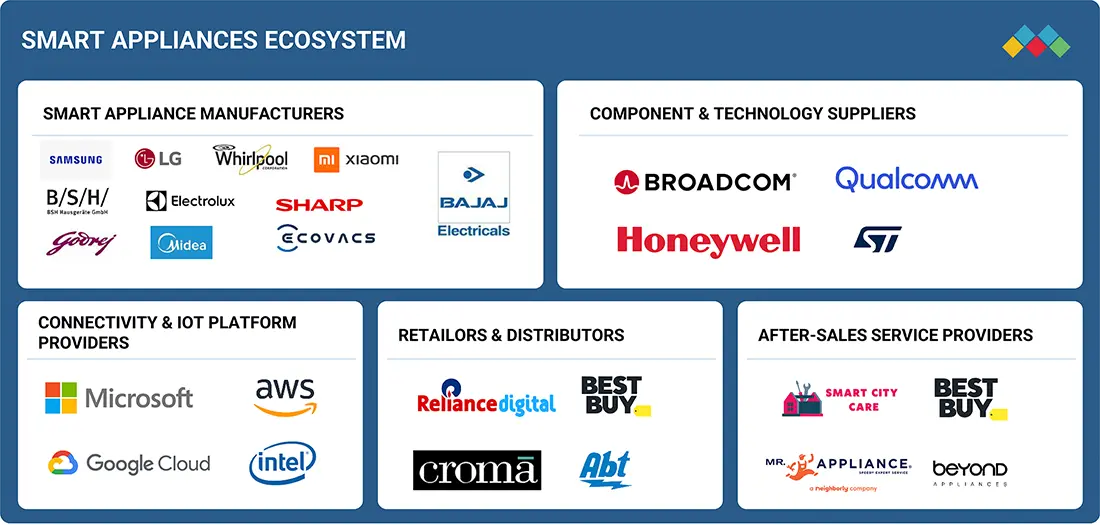
Smart Appliances Market: COMMERCIAL USE CASES ACROSS INDUSTRIES
| COMPANY | USE CASE DESCRIPTION | BENEFITS |
|---|---|---|
 |
Panasonic introduced a facial recognition system at Denmark’s football stadium to enhance security by identifying and preventing troublemakers from entering. | Improved stadium safety | Reduced manual checks | Encouraged fans and families to return to matches |
 |
Haier implemented IoT-based Smart Laundry solutions in China, integrating mobile apps for cycle monitoring and predictive maintenance. | Reduced equipment downtime | Improved customer experience | Lowered operational costs for service providers |
 |
Whirlpool partnered with Amazon Alexa and Google Assistant to enable voice-controlled smart ovens, dishwashers, and washing machines. | Increased consumer convenience | Seamless integration with connected home ecosystems | Better appliance efficiency monitoring |
 |
LG Electronics introduced ThinQ-enabled AI smart refrigerators in Europe, providing automated grocery tracking and energy-saving modes. | Enhanced food management | Reduced energy consumption | Improved sustainability by minimizing food waste |
 |
Miele rolled out Wi-Fi–enabled dishwashers and ovens with remote diagnostics and smart cooking programs in Germany. | Boosted customer satisfaction through predictive maintenance | Better food preparation outcomes | Reduced servicing delays |
Logos and trademarks shown above are the property of their respective owners. Their use here is for informational and illustrative purposes only.
Related Ecosystem
Electrical System And Components
- Natural Language Processing (NLP)
- Sensors
- Machine Learning
- Temperature Sensors
- Actuators
- ABB India Limited
- Siemens ag
- SCHNEIDER ELECTRIC SE
- Eaton Corporation plc
- General Electric Company
Electronics System And Components
- Sensors
- Temperature Sensors
- Pressure Sensors
- Actuators
- Image Sensors
- Lenovo
- Samsung
- Texas Instruments Incorporated
- HONEYWELL INTERNATIONAL INC.
- Teledyne Technologies Incorporated
Key Takeaways
- Italy's smart appliances market will grow from USD 779.5M (2025) to USD 1,193.6M (2030) at an 8.9% CAGR.
- Italy demonstrates strong consumer preference for energy-efficient and IoT-enabled kitchen and laundry appliances.
- Government sustainability incentives and EU regulations are accelerating smart appliance adoption across Italy.
- Italy's established manufacturing base and digital infrastructure position it as a key European smart appliances hub.
Smart Appliances Market Report Scope
| Report Metric | Details |
|---|---|
| Base Year | 2025 |
| Fastest Growing Segment | VACUUM CLEANING ROBOTS (Product) |
| Forecast Period | 2025-2030 |
| Growth Rate | CAGR of 11% from 2025 to 2030 |
| Largest Segment | WI-FI (Connectivity) |
| Market Size Base Year (Billions) | ~USD 42.3 (2025) |
| Revenue Forecast (Billions) | ~USD 71.28 (2030) |
| Segments Covered | Product, Vertical, Sales Channel, Connectivity |
Italy Smart Appliances Market Report Segmentation
4 segment dimensions are covered across the global market.
By Product
- Air Conditioners
- Air Purifiers
- Coffee Makers
- Cookers/Cooking Robots
- Dishwashers
- Microwaves
- Other Smart Appliances
- Ovens & Cooktops
- Refrigerators
- Vacuum Cleaning Robots
- Washing Machines & Dryers
- Water Heaters
By Vertical
- Commercial
- Residential
By Sales Channel
- Offline
- Online
By Connectivity
- Bluetooth
- Wi-Fi
- Wifi
Target Audience
- Smart Appliance Manufacturers : Manufacturers need Italy-specific market data to develop localized product strategies, identify distribution channels, and allocate R&D resources for the Italian smart appliances segment.
- Market Entry Strategists : Companies planning expansion into Italy require detailed market sizing and growth forecasts to assess market viability, competitive intensity, and investment requirements for Italian operations.
- Investment & Private Equity Firms : Investors evaluating opportunities in Italian smart home and appliance sectors need precise market valuations and CAGR data to assess portfolio companies and identify acquisition targets.
- Retail & Distribution Partners : Retailers and distributors in Italy need market outlook data to optimize inventory planning, negotiate supplier agreements, and forecast sales performance in the smart appliances category.
- Business Consultants & Analysts : Consultants advising Italian clients on market entry, competitive positioning, or strategic planning require authoritative Italy-specific market intelligence to support client recommendations.
Reasons to Buy this Report
- Precise Italy Market Sizing : Access validated market valuation data specific to Italy (USD 779.5M in 2025), enabling accurate financial forecasting and investment decisions for the Italian smart appliances segment.
- Growth Trajectory Insights : Understand Italy's 8.9% CAGR trajectory through 2030, allowing strategic planning for market entry, expansion, or product portfolio adjustments tailored to Italian consumer demand patterns.
- Competitive Positioning : Benchmark Italy's 8.9% growth against the global 11% CAGR to identify market gaps, competitive advantages, and localization opportunities specific to the Italian market landscape.
- Consumer Behavior Analysis : Gain insights into Italian consumer preferences for energy-efficient and connected appliances, supporting targeted marketing strategies and product development aligned with local environmental values.
- Regulatory & Sustainability Context : Understand how EU sustainability regulations and Italian environmental policies shape market dynamics, informing compliance strategies and product positioning for the Italian market.
Frequently asked questions
What is the current size of Italy's smart appliances market?
Italy's smart appliances market is valued at USD 779.5 million in 2025, with expectations to reach USD 1,193.6 million by 2030.
What is the projected growth rate for smart appliances in Italy?
Italy's smart appliances market is projected to grow at a compound annual growth rate (CAGR) of 8.9% from 2025 to 2030.
Which appliance categories are driving growth in Italy?
In Italy, IoT-enabled kitchen appliances, smart refrigerators, washing machines, and dishwashers are leading market growth due to consumer demand for energy efficiency and remote control features.
What factors are supporting smart appliance adoption in Italy?
Italy's smart appliance growth is supported by government sustainability incentives, EU energy efficiency regulations, rising disposable incomes, and increasing digital literacy among consumers.
How does Italy's market compare to other European countries?
Italy represents a significant European smart appliances market with strong manufacturing capabilities and established consumer demand, positioning it competitively within the broader European landscape.
RESEARCH METHODOLOGY
The study used four major activities to estimate the market size of smart appliances. Exhaustive secondary research was conducted to gather information on the market and its peer and parent markets. The next step was to validate these findings, assumptions, and sizing with industry experts across the value chain through primary research. Both top-down and bottom-up approaches were employed to estimate the total market size. Finally, market breakdown and data triangulation methods were utilized to estimate the market size for different segments and subsegments.
Secondary Research
The research methodology used to estimate and forecast the size of the smart appliances market began with the acquisition of data related to the revenues of key vendors in the market through secondary research. Various secondary sources have been referred to in the secondary research process to identify and collect information for this study. Secondary sources include annual reports, press releases, and investor presentations of companies; white papers, journals, certified publications, and articles by recognized authors; websites; directories; and databases. Secondary research has mainly been used to obtain key information about the value chain of the smart appliances market, key players, market classification, and segmentation according to the industry trends to the bottom-most level, geographic markets, and key developments from both market and technology-oriented perspectives. The secondary research referred to for this research study involves various white papers, such as User Interface Design for Smart Appliances, Study on Smart Appliances, Next-Generation Smart Home: Building for the Future, and various other sources. Moreover, the study involved extensive use of secondary sources, directories, and databases, such as Hoovers, Bloomberg Businessweek, and Factiva, to identify and collect valuable information for a technical, market-oriented, and commercial study of the smart appliances market.
Primary Research
In the primary research process, various primary sources from both the supply and demand sides have been interviewed to obtain the qualitative and quantitative information relevant to this report. Primary sources from the supply side include key industry participants, subject-matter experts (SMEs), and C-level executives and consultants from various key companies and organizations in the smart appliances ecosystem. After the complete market engineering (including calculations for the market statistics, the market breakdown, the market size estimations, the market forecasting, and the data triangulation), extensive primary research has been conducted to verify and validate the critical market
numbers obtained. Several primary interviews have been conducted with market experts from the demand and supply-side players across key regions: North America, Europe, Asia Pacific, and the Rest of the World (Middle East, Africa, and South America).
Primary data has been collected through questionnaires, emails, and telephone interviews. In the canvassing of primaries, various departments within organizations, such as sales, operations, and administration, were covered to provide a holistic viewpoint in our report. This and the opinions of in-house subject matter experts have led us to the findings described in the remainder of this report.
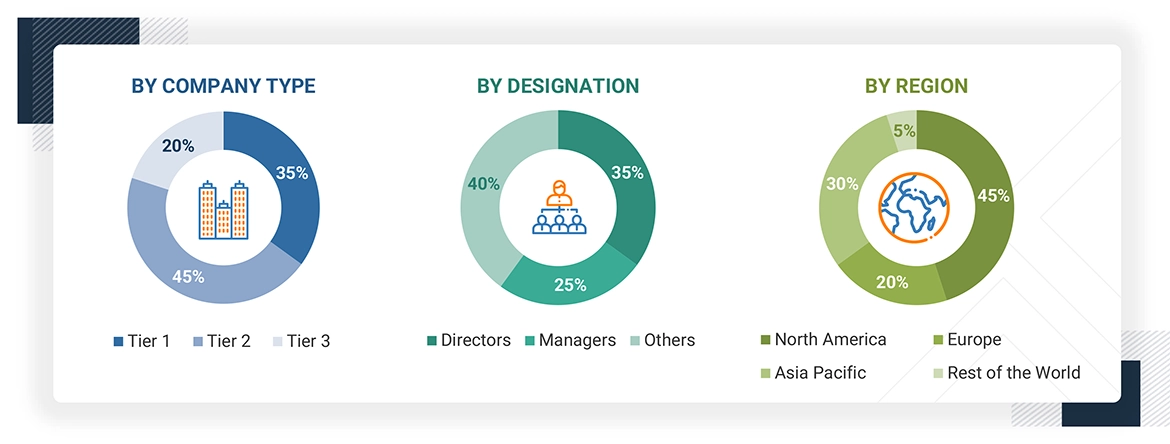
Note: The three tiers of the companies are defined based on their total revenue in 2024: Tier 1 - revenue greater than or equal to USD 1 billion; Tier 2 - revenue between USD 100 million and USD 1 billion; and Tier 3 revenue less than or equal to USD 100 million. Other designations include sales managers, marketing managers, and product managers.
To know about the assumptions considered for the study, download the pdf brochure
Market Size Estimation
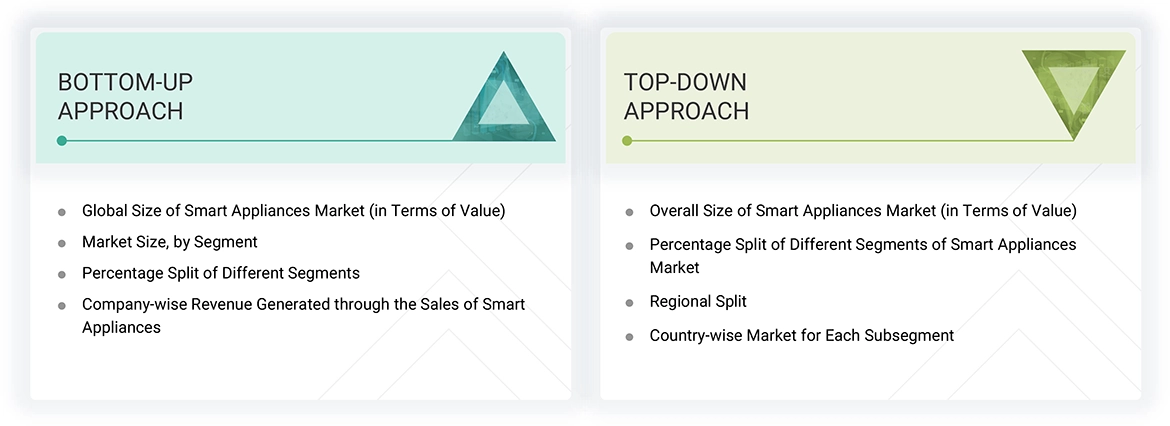
Both top-down and bottom-up approaches were utilized to estimate and validate the size of the smart appliances market and its submarkets. Secondary research was conducted to identify the key players in the market, and primary and secondary research were used to determine their market share in specific regions. The entire process involved studying top players' annual and financial reports and conducting extensive interviews with industry leaders such as CEOs, VPs, directors, and marketing executives. Secondary sources were used to determine all percentage shares and breakdowns, which were verified through primary sources. All parameters that could impact the markets covered in this research study were accounted for, analyzed in detail, verified through primary research, and consolidated to obtain the final quantitative and qualitative data.
Smart Appliances Market : Top-Down and Bottom-Up Approach
Data Triangulation
Once the overall size of the smart appliances market was determined using the methods described above, it was divided into multiple segments and subsegments. Market engineering was performed for each segment and subsegment using market breakdown and data triangulation methods, as applicable, to obtain accurate statistics. To triangulate the data, various factors and trends from the demand and supply sides were studied. The market was validated using both the top-down and bottom-up approaches.
Market Definition
The smart appliances market comprises a wide range of connected and intelligent household and commercial devices that enhance convenience, efficiency, and energy management. These offerings are designed to simplify daily tasks, optimize energy consumption, and provide seamless user experiences. Smart appliances are segmented by product type into refrigerators, washing machines and dryers, dishwashers, ovens and cooktops, air conditioners, water heaters, microwaves, coffee makers, vacuum cleaning robots, air purifiers, cookers/cooking robots, and other smart appliances.
By connectivity type, these appliances leverage Wi-Fi and Bluetooth to enable remote control, automation, and integration into broader smart home ecosystems. Through online and offline sales channels, smart appliances are accessible to both residential and commercial consumers, supporting daily operations, convenience, and energy efficiency. Smart appliances contribute to sustainable living, smarter energy usage, and more connected, intuitive environments, driving adoption across urban and emerging markets globally.
Key Stakeholders
- Manufacturers and suppliers
- Component Suppliers
- Software & Platform Providers
- Distributors & Retailers
- System Integrators & Service Providers
- Telecom & Connectivity Providers
- Regulatory & Standards Bodies
- End-user industries
- Research & Development Firms
Report Objectives
- To estimate and forecast the size of the smart appliances market, in terms of value, based on product, connectivity, sales channel, vertical, and region
- To describe and forecast the market size, in terms of value, for four major regions - North America, Europe, Asia Pacific, and the Rest of World (RoW)
- To provide detailed information regarding major factors such as drivers, restraints, opportunities, and challenges influencing market growth
- To provide a detailed overview of the smart appliances value chain
- To strategically analyze micromarkets regarding individual market trends, growth prospects, and contributions to the total market
- To strategically profile key players and comprehensively analyze their market position in terms of ranking and core competencies, along with a detailed competitive landscape for the market leaders
- To analyze major growth strategies such as product launches/developments and acquisitions adopted by the key market players to enhance their market position
- To assess the impact of AI on the growth and adoption of the smart appliances market
Available Customizations
With the given market data, MarketsandMarkets offers customizations according to the specific requirements of companies. The following customization options are available for the report:
- Detailed analysis and profiling of additional market players (up to 5)
- Additional country-level analysis of the smart appliances market
Product Analysis
- Product matrix, which provides a detailed comparison of the product portfolio of each company in the smart appliances market.
Get the Full Smart Appliances Market Report
Full forecast, segment splits, and company analysis for all Smart Appliances Market.
- Canada Smart Appliances Market
- Mexico Smart Appliances Market
- US Smart Appliances Market
- France Smart Appliances Market
- Germany Smart Appliances Market
- Rest Of Europe Smart Appliances Market
- UK Smart Appliances Market
- China Smart Appliances Market
- India Smart Appliances Market
- Japan Smart Appliances Market
- Rest Of Asia Pacific Smart Appliances Market
- South Korea Smart Appliances Market
Need a Tailored Report?
Customize this report to your needs
Get 10% FREE Customization
Customize This Report
