
China Smart Gas Meter Market (2025-2030)

The China Smart Gas Meter Market was valued at $884.9 Million in 2025 and projected to reach to $1453.9 Million by 2030, representing a compound annual growth rate of 10.4%. China's smart gas meter market is poised for sustained expansion through 2030, driven by aggressive government digitalization initiatives and infrastructure modernization programs.


| Market Size in | USD 26.32 MN |
| Market Forecast in | |
| CAGR | |
| Forecast Period | |
| Units Considered | Value (USD MN) |
China Smart Gas Meter Market Trends and Insights
- This expansion reflects China's commitment to modernizing its energy infrastructure and advancing digital metering technologies across residential and commercial sectors.
- China's smart gas meter adoption is driven by government mandates for smart utility deployment, urbanization trends, and the need for real-time consumption monitoring. The 10.4% compound annual growth rate (CAGR) positions China as a high-growth market within the Asia Pacific region, outpacing global averages.
- China's investment in IoT-enabled metering solutions and integration with smart city initiatives are accelerating market penetration.
- By 2030, China is expected to solidify its position as a leading adopter of smart gas metering technology, supported by regulatory frameworks and utility company partnerships. China's market dynamics are shaped by increasing energy efficiency regulations, rising consumer awareness of consumption tracking, and the transition toward smart grid ecosystems.
- The competitive landscape in China features both domestic manufacturers and international players adapting solutions to local requirements and standards..
Key Market Statistics
- CAGR (2025-2030) 10.4% CAGR
- Market Size, 2025 ~USD 884.9 Million
- Forecast, 2030 ~USD 1453.9 Million
- Country China
China Smart Gas Meter Market Overview
Market Valuation Growth :
China's smart gas meter market is valued at USD 884.9 million in 2025, with a projected CAGR of 10.4% through 2030, reaching USD 1,453.9 million. This growth significantly outpaces the global CAGR of 8.5%, positioning China as a key growth driver in the smart metering sector.
Government Mandates & Policy Support :
China's smart gas meter adoption is accelerated by government mandates for smart infrastructure modernization. National policies prioritizing digital transformation in energy distribution and consumption monitoring are creating favorable conditions for market expansion across residential and commercial segments.
Infrastructure Modernization Initiative :
China is actively modernizing its energy infrastructure through widespread deployment of smart metering technologies. This initiative encompasses both urban and rural areas, with utilities investing heavily in IoT-enabled gas meters to improve operational efficiency and reduce non-technical losses.
Residential & Commercial Sector Expansion :
Dual growth in residential and commercial smart gas meter adoption is driving market expansion. Increasing urbanization, rising consumer awareness about energy efficiency, and commercial sector digitalization are creating sustained demand for advanced metering solutions across China's diverse geographic regions.
China Smart Gas Meter Market Dynamics
- The 10.4% CAGR reflects strong policy support, increasing utility investments, and growing consumer adoption of smart energy management solutions.
- Urbanization trends and rising energy consumption awareness further accelerate market penetration across residential and commercial sectors. The forecast growth to USD 1.45 billion by 2030 underscores China's strategic focus on energy efficiency and digital transformation.
- Integration of IoT technologies, 5G connectivity, and AI-powered analytics in smart gas metering systems will enhance operational capabilities for utilities.
- Continued government backing, coupled with declining technology costs and expanding smart city initiatives, positions China as a critical market for smart gas meter manufacturers and solution providers globally..
Market Ecosystem
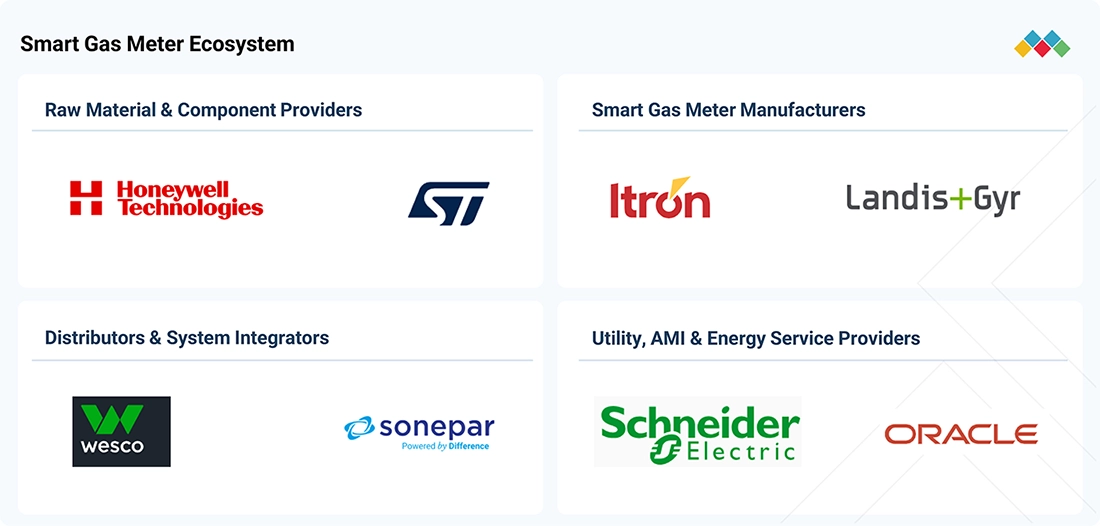
SMART GAS METER MARKET: COMMERCIAL USE CASES ACROSS INDUSTRIES
| COMPANY | USE CASE DESCRIPTION | BENEFITS |
|---|---|---|
 |
Itron's Intelis ultrasonic gas meter is being deployed by gas utilities as part of AMI-enabled gas distribution modernization. The platform combines ultrasonic metrology with connected communications, pressure and flow monitoring, and remote internal-valve actuation. Itron highlights its deployment with Spire, which uses Intelis gas meters to strengthen gas-safety management across its customer network. | Enables utilities to improve gas-network visibility and safety, detect high-flow, high-/low-pressure, temperature, and air-in-pipe conditions, and remotely actuate shutoff valves | Supports automated meter reading, more accurate billing, reduced manual investigations, and lower meter-operation costs |
 |
Apator manufactures gas meters that support accurate consumption measurement and remote management of gas-supply access. Its smart-gas portfolio is designed to connect metering with utility-management systems, supporting the transition from conventional gas metering toward remotely managed infrastructure. Apator also provides proprietary software and utility-management solutions alongside its metering portfolio. | Supports remote consumption monitoring and gas-supply management, reducing dependence on manual meter reading and enabling utilities to improve operational control | Supports utility digitalization, data management, and more efficient management of distributed gas-metering assets |
 |
Landis+Gyr provides smart gas metering solutions for utilities through its Surent ultrasonic gas meter and retrofit communication modules. Its G480 ultrasonic smart gas meter combines solid-state measurement with two-way cellular communication, while the M225 Commercial & Industrial Gas Communications Module enables two-way AMI communication for large diaphragm gas meters. These solutions allow utilities to collect consumption and interval data remotely and integrate gas metering with broader AMI and IoT infrastructure. | Supports accurate gas measurement, remote meter operations, automated data collection, and improved visibility into consumption patterns| Supports capacity planning, flexible rate structures, safety monitoring, and operational efficiency | Allows utilities to modernize existing gas-meter infrastructure through retrofit communication modules |
Logos and trademarks shown above are the property of their respective owners. Their use here is for informational and illustrative purposes only.
Related Ecosystem
Power Infrastructure
- Geographical Information System (GIS)
- Cogeneration
- Battery Electric Vehicle (BEV)
- Cellular Network
- Fuel Cell
- Siemens ag
- ABB India Limited
- SCHNEIDER ELECTRIC SE
- General Electric Company
- Eaton Corporation plc
Smart Energy And Digital Solutions
- Cellular Network
- Analytics Software
- Geographical Information System (GIS)
- Meter Data Management (MDM)
- Smart Meters
- Siemens ag
- SCHNEIDER ELECTRIC SE
- ABB India Limited
- General Electric Company
- Eaton Corporation plc
Industrial Iot
- Sensors
- Pressure Sensors
- Flow Sensors
- Gas Sensors
- Image Sensors
- Siemens ag
- ABB India Limited
- HONEYWELL INTERNATIONAL INC.
- Emerson Electric Co.
- SCHNEIDER ELECTRIC SE
Key Takeaways
- China's smart gas meter market will grow from USD 884.9 million in 2025 to USD 1,453.9 million by 2030, representing a 10.4% CAGR.
- China's government-mandated smart utility deployment and smart city initiatives are primary growth catalysts for the market.
- China's market growth outpaces the global average of 8.5% CAGR, reflecting strong regional demand and infrastructure investment.
- China's competitive landscape includes both domestic innovators and international vendors adapting technologies to meet local regulatory standards.
Smart Gas Meter Market Report Scope
| Report Metric | Details |
|---|---|
| Base Year | 2025 |
| Fastest Growing Segment | SOFTWARE (Component) |
| Forecast Period | 2025-2030 |
| Growth Rate | CAGR of 8.5% from 2025 to 2030 |
| Largest Segment | RESIDENTIAL (End User) |
| Market Size Base Year (Billions) | ~USD 2.69 (2025) |
| Revenue Forecast (Billions) | ~USD 4.04 (2030) |
| Segments Covered | Technology, Type, Component, End User, Technology Type, By End User |
China Smart Gas Meter Market Report Segmentation
6 segment dimensions are covered across the global market.
By Technology
- Ami
- Amr
By Type
- Smart Diaphragm Gas Meter
- Smart Ultrasonic Gas Meter
- Smart Ultrasonic Meter
By Component
- Hardware
- Software
By End User
- Commercial
- Industrial
- Residential
By Technology Type
- Ami
- Amr
By By End User
- Commercial
- Industrial
- Residential
CHINA: SMART GAS METER MARKET, BY END USER, 2025–2030
| Segment | 2025 | 2026 | 2027 | 2028 | 2029 | 2030 | CAGR (%) |
|---|---|---|---|---|---|---|---|
| COMMERCIAL | 75.6 | 82 | 89.1 | 97 | 105.9 | 115.9 | 8.9 |
| INDUSTRIAL | 43.9 | 47.4 | 51.3 | 55.6 | 60.4 | 65.8 | 8.5 |
| RESIDENTIAL | 765.4 | 843.2 | 931 | 1030.4 | 1143.4 | 1272.2 | 10.7 |
| TOTAL | 884.9 | 972.6 | 1071.3 | 1183 | 1309.7 | 1453.9 | 10.4 |
Target Audience
- Utility Companies & Energy Providers : Chinese utilities and energy distribution companies need market intelligence to plan smart meter deployment strategies, optimize capital expenditure, and align infrastructure investments with government mandates. This data supports operational efficiency improvements and customer service enhancements.
- Smart Meter Manufacturers & Suppliers : Equipment manufacturers and technology suppliers require detailed market insights to identify growth opportunities, assess demand trends, and develop products tailored to China's regulatory requirements and customer specifications. Market data informs production planning and market positioning.
- Investment & Private Equity Firms : Investors evaluating opportunities in China's energy technology sector need comprehensive market analysis to assess growth potential, competitive dynamics, and return on investment. This report provides due diligence support for M&A activities and portfolio company valuations.
- Government & Policy Agencies : Chinese government bodies, regulatory agencies, and policy makers use market research to evaluate smart metering program effectiveness, track infrastructure modernization progress, and inform future energy policy decisions. Data supports evidence-based policy development and program assessment.
- Technology & IoT Solution Providers : Software developers, IoT platform providers, and digital solution companies need market insights to identify integration opportunities, develop compatible solutions, and understand adoption timelines. Market intelligence guides product development and partnership strategies in China's smart metering ecosystem.
Reasons to Buy this Report
- Market Size & Growth Validation : Obtain precise market valuation data for China's smart gas meter sector with verified CAGR of 10.4% through 2030. Validate investment decisions and business expansion strategies with comprehensive market sizing and forecasting specific to China's unique regulatory and economic landscape.
- Government Policy Intelligence : Understand China's government mandates and policy frameworks driving smart meter adoption. Gain insights into regulatory requirements, compliance standards, and incentive programs that shape market dynamics and create opportunities for market entry and partnership development.
- Competitive Positioning Strategy : Benchmark your offerings against market growth trends and identify competitive advantages in China's rapidly expanding smart metering sector. Develop targeted go-to-market strategies for residential and commercial segments with data-driven insights on market penetration rates and customer preferences.
- Investment & Expansion Planning : Make informed capital allocation decisions for China operations with reliable market forecasts through 2030. Identify high-growth segments, emerging opportunities in smart city initiatives, and optimal timing for facility expansion, R&D investments, and strategic partnerships.
- Risk Mitigation & Market Understanding : Reduce market entry risks by understanding China-specific dynamics, infrastructure modernization timelines, and utility adoption patterns. Gain competitive intelligence on market drivers, barriers to entry, and emerging technologies shaping the smart gas meter landscape in China.
Frequently asked questions
What is the projected market size of smart gas meters in China by 2030?
China's smart gas meter market is projected to reach USD 1,453.9 million by 2030, up from USD 884.9 million in 2025.
What is the CAGR for China's smart gas meter market?
China's smart gas meter market is expected to grow at a compound annual growth rate (CAGR) of 10.4% between 2025 and 2030.
What are the main drivers of growth in China's smart gas meter market?
Key drivers include government mandates for smart utility deployment, urbanization, smart city initiatives, energy efficiency regulations, and increased consumer awareness of consumption tracking.
How does China's smart gas meter market compare to global growth rates?
China's 10.4% CAGR exceeds the global average of 8.5%, positioning China as a high-growth market within the Asia Pacific region.
Who are the main competitors in China's smart gas meter market?
China's market features both domestic manufacturers and international players who adapt their solutions to meet local regulatory requirements and standards.
RESEARCH METHODOLOGY
The study involved major activities to estimate the current size of the smart gas meter market. Exhaustive secondary research was done to collect information on the peer and parent markets. The next step was to validate these findings, assumptions, and sizing with industry experts across the value chain through primary research. Both top-down and bottom-up approaches were employed to estimate the total market size. Thereafter, market breakdown and data triangulation were used to estimate the market size of the segments and subsegments.
Secondary Research
This research study on the smart gas meter market involved the use of extensive secondary sources, directories, and databases, such as Hoover's, Bloomberg, Factiva, IRENA, International Energy Agency, and Statista Industry Journal, to collect and identify information useful for a technical, market-oriented, and commercial study of the market. The other secondary sources included annual reports, press releases & investor presentations of companies, white papers, certified publications, articles by recognized authors, manufacturer associations, trade directories, and databases, articles by recognized authors, manufacturer associations, trade directories, and databases.
Primary Research
The smart gas meter market comprises several stakeholders, such as equipment providers, service providers, and technical providers in the supply chain. The rising demand for smart gas meters of various types, such as smart ultrasonic gas meters and smart diaphragm gas meters, characterizes this market's demand side. The supply side is characterized by rising demand for contracts from the industrial sector and mergers & acquisitions among big players. Various primary sources from both the supply and demand sides of the market were interviewed to obtain qualitative and quantitative information.
In the complete market engineering process, the top-down and bottom-up approaches and several data triangulation methods were extensively used to perform the market size estimations and forecasts for all segments and subsegments listed in this report. Extensive qualitative and quantitative analyses were conducted to complete the market engineering process and list key information/insights throughout the report.
The following is the breakdown of primary respondents:
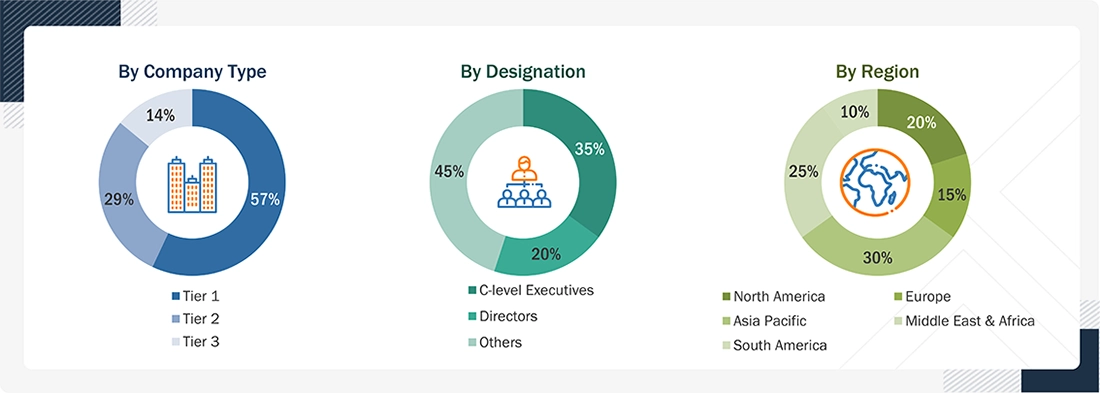
To know about the assumptions considered for the study, download the pdf brochure
Tier 1 Company Revenue> USD 5 billion, Tier 2 Company Revenue between USD 1 and USD 5 billion, and Tier 3 Company Revenue < USD 1 billion.
Note: Others include sales managers, engineers, and regional managers.
Market Size Estimation
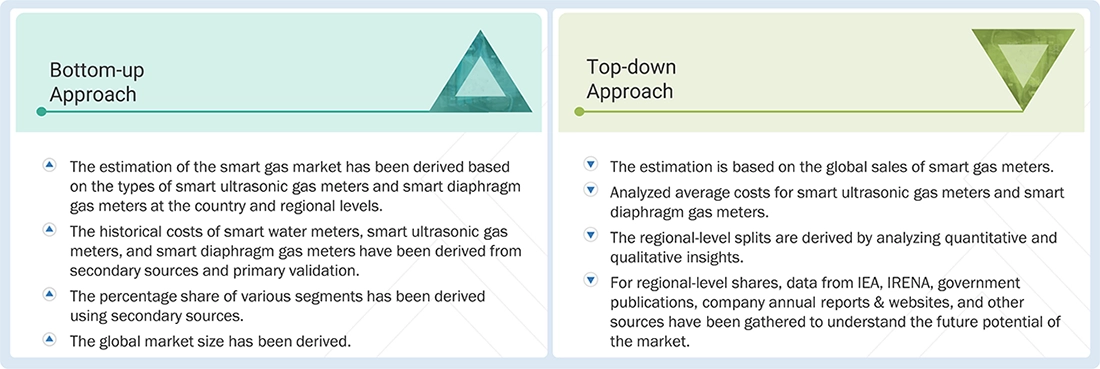
Both top-down and bottom-up approaches were used to estimate and validate the total size of the smart gas meter market. These methods were also used extensively to estimate the size of various subsegments in the market. The research methodology used to estimate the market size includes the following.
Bottom-up Approach
- The smart gas meter market estimation has been done at the country and regional level based on the types of smart gas meters, such as smart diaphragm gas meters and smart ultrasonic gas meters.
- The historical cost of smart gas meters, such as smart diaphragm gas meters and smart ultrasonic gas meters, has been obtained from secondary sources and verified through primary research.
- The market share of different types of smart gas meters, technologies, applications, and end users has been calculated based on secondary sources and primary research.
- To determine the market size for smart gas meters, estimates for the country and regional markets were consolidated.
Top-down Approach
- The estimation is based on the global sales of smart gas meters, considering the adoption of smart metering technologies in residential, commercial, and industrial gas applications.
- Average cost has been analyzed by type for smart gas meters, such as smart diaphragm gas meters and smart ultrasonic gas meters, to estimate the overall market value.
- Based on quantitative and qualitative information regarding the deployment of smart gas meters, adoption of AMR/AMI, communication technologies, utility modernization, and the replacement of traditional gas meters, the overall market has been segmented into its key components.
- Regional-level shares have been analyzed using data from the International Energy Agency (IEA), government sources, gas utilities, metering associations, company annual reports, company websites, and other credible sources to gain an understanding of how many smart gas meters could be expected to be installed in key regions and how big those numbers are.
Smart Gas Meter Market : Top-Down and Bottom-Up Approach
Data Triangulation
After arriving at the overall market size from the above estimation process, the total market has been split into several segments and subsegments. Data triangulation and market breakdown processes have been employed to complete the overall market engineering process and arrive at the exact statistics for all the segments and sub-segments, wherever applicable. The data has been triangulated by studying various factors and trends from both the demand and supply sides. Along with this, the market has been validated using both the top-down and bottom-up approaches.
Market Definition
A smart gas meter is equipment used for measuring the amount of gas consumed in intervals on an hourly or daily basis at homes, buildings, or industrial facilities. Smart gas meters are next-generation metering devices that allow remote data collection related to consumers' usage and periodic communication with the utility. They use wireless communication to connect to wide-area networks, allowing remote monitoring and automatic billing. Implementing smart gas meters in utilities helps increase energy efficiency and effectively monitor and integrate new utility resources. For consumers, smart gas meters offer a better understanding of their usage or consumption patterns and help with easier supplier switching, fault detection, and clearance. There are two major types of smart gas meter technologies: Automatic Meter Reading (AMR) and Advanced Metering Infrastructure (AMI). Smart gas meters are mainly implemented globally in the residential, commercial, and industrial sectors.
Key Stakeholders
- Government and research organizations
- Energy service providers (private/government)
- Utilities & retail gas suppliers
- Original equipment manufacturers (OEMs)
- Independent service providers (ISPs)
- Asset owners/operators
- Technology providers
- Spare parts suppliers & logistics
- Consultants/consultancies/advisory firms
- Environmental research institutes
- Private or investor-owned utilities
- State and national regulatory authorities
- Investors/shareholders
Report Objectives
- _Hlk18346556To define and describe the smart gas meter market, based on technology, type, component, and end user, in terms of value and volume
- To provide detailed information on the major factors influencing the growth of the smart gas meter market (drivers, restraints, opportunities, and challenges)
- To strategically analyze the smart gas meter market with respect to individual growth trends, prospects, and contribution of each segment to the market
- To analyze market opportunities for stakeholders and details of a competitive landscape for market leaders
- To forecast the growth of the smart gas meter market with respect to the major regions (Asia Pacific, Europe, North America, South America, the Middle East, & Africa), in terms of value
- To strategically profile key players and comprehensively analyze their market share and core competencies
- To track and analyze competitive developments, such as new product launches, contracts & agreements, investments & expansions, and mergers & acquisitions, in the smart gas meter market
Customization Options
MarketsandMarkets offers customizations according to the specific needs of the companies with the given market data.
The following customization options are available for the report:
Product Analysis
- Product matrix, which gives a detailed comparison of the product portfolio of each company
Regional Analysis
- Further breakdown of the energy as a service market, by country
Company Information
- Detailed analysis and profiling of additional market players (up to five)
Get the Full Smart Gas Meter Market Report
Full forecast, segment splits, and company analysis for all Smart Gas Meter Market.
- Canada Smart Gas Meter Market
- Mexico Smart Gas Meter Market
- US Smart Gas Meter Market
- France Smart Gas Meter Market
- Germany Smart Gas Meter Market
- Italy Smart Gas Meter Market
- Poland Smart Gas Meter Market
- Spain Smart Gas Meter Market
- UK Smart Gas Meter Market
- Australia Smart Gas Meter Market
- India Smart Gas Meter Market
- Japan Smart Gas Meter Market
- South Korea Smart Gas Meter Market
- Saudi Arabia Smart Gas Meter Market
- UAE Smart Gas Meter Market
- Israel Smart Gas Meter Market
- South Africa Smart Gas Meter Market
- Turkey Smart Gas Meter Market
- Rest Of Europe Smart Gas Meter Market
- Rest Of Asia Pacific Smart Gas Meter Market
- GCC Smart Gas Meter Market
Need a Tailored Report?
Customize this report to your needs
Get 10% FREE Customization
Customize This Report
