
Europe Smart Greenhouse Market (2020-2025)

The Europe Smart Greenhouse Market was valued at $584 Million in 2020 and projected to reach to $836 Million by 2025, representing a compound annual growth rate of 7.4%. Europe's smart greenhouse market is positioned for steady growth through 2025, with the region's advanced technological infrastructure and regulatory environment supporting continued adoption.


| Market Size in | USD 26.32 MN |
| Market Forecast in | |
| CAGR | |
| Forecast Period | |
| Units Considered | Value (USD MN) |
Europe Smart Greenhouse Market Trends and Insights
- Europe leads in adoption of advanced greenhouse technologies, driven by stringent environmental regulations, labor cost pressures, and strong investment in agricultural innovation.
- The region's commitment to sustainable farming practices and climate-neutral food production has accelerated demand for IoT-enabled climate control, automated irrigation, and data analytics solutions across Europe. Key European markets including the Netherlands, Spain, and France are pioneering smart greenhouse deployments to optimize crop yields while reducing water and energy consumption.
- Europe's established horticultural sector, combined with digital transformation initiatives and EU funding for agritech, positions the region as a critical growth engine.
- Between 2020 and 2025, Europe is expected to see increased integration of AI, machine learning, and precision farming technologies within greenhouse operations, supported by favorable regulatory frameworks and growing consumer demand for locally-grown, sustainably-produced vegetables and flowers..
Key Market Statistics
- CAGR (2020-2025) 7.4% CAGR
- Market Size, 2020 ~USD 584 Million
- Forecast, 2025 ~USD 836 Million
- Geography Europe
Europe Smart Greenhouse Market Overview
Regulatory Compliance Driver :
Europe's stringent environmental regulations and EU sustainability directives are accelerating smart greenhouse adoption, making compliance-ready solutions essential for growers across the region.
Labor Cost Pressures :
Rising agricultural labor costs across Europe are pushing farmers toward automation and IoT-enabled greenhouse systems to optimize operations and reduce dependency on manual workforce.
Innovation Investment Hub :
Europe hosts significant R&D investments in agricultural technology, with leading companies and startups developing cutting-edge climate control, crop monitoring, and precision farming solutions.
Sustainable Farming Commitment :
Strong European commitment to sustainable and organic farming practices is driving demand for smart greenhouses that enable resource efficiency, reduced chemical use, and carbon footprint reduction.
Europe Smart Greenhouse Market Dynamics
- The market's 7.4% CAGR reflects strong demand from both large-scale commercial operations and smaller farms transitioning to precision agriculture.
- Key growth drivers include EU green policies, labor shortages, and increasing consumer demand for locally-grown, sustainably-produced crops.
- Investment in vertical farming and controlled environment agriculture (CEA) is particularly robust in Western Europe, while Eastern European markets present emerging opportunities as modernization accelerates..
Market Ecosystem
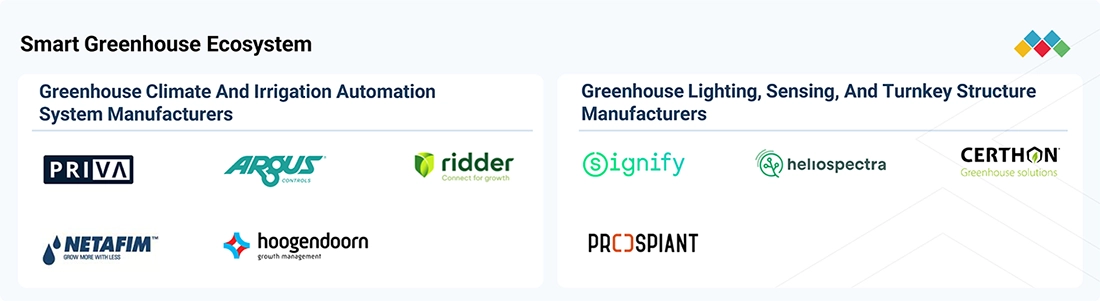
SMART GREENHOUSE MARKET SIZE, SHARE & GROWTH, 2036: COMMERCIAL USE CASES ACROSS INDUSTRIES
| COMPANY | USE CASE DESCRIPTION | BENEFITS |
|---|---|---|
 |
Denso deploys automated agricultural solutions, including Profarm climate controllers and harvesting robotic systems. The hardware automates indoor climate regulation, monitors greenhouse ambient parameters, and manages crop handling across commercial tomato and vegetable cultivation facilities. | Automates internal climate conditions without manual labor intervention | Delivers continuous monitoring of microclimate fluctuations | Reduces operational labor expenses across harvesting workflows | Improves overall commercial crop yield through consistent climate maintenance |
 |
Orbia provides precision drip irrigation and fertigation systems through its Netafim business group. The infrastructure automates the injection of liquid nutrients, manages water distribution pipelines, and measures real-time soil moisture levels in commercial covered crop facilities. | Lowers total water consumption compared to overhead watering | Delivers uniform distribution of fertilizers directly to plant root zones | Prevents nutrient leaching and ground contamination | Increases crop uniformity across large scale cultivation areas |
 |
Signify supplies Philips GreenPower LED horticultural lighting modules and grow control software. The luminaires provide tailored light recipes with specific spectral outputs, automated photoperiod timing, and dynamic dimming for high-wire vegetables and leafy greens. | Provides customized light spectrums suited for specific crop growth phases | Accelerates plant growth cycles while reducing overall electrical draw | Delivers lower heat emissions compared to conventional high pressure sodium fixtures | Extends operational production seasons during low sunlight winter months |
 |
Ridder delivers greenhouse drive systems, climate screens, and Synopta climate management software. The integrated equipment regulates greenhouse shading curtains, ventilation window positioning, and heating cycles to stabilize internal temperature and humidity. | Regulates solar radiation penetration and thermal heat retention | Delivers precise mechanical window positioning for uniform airflow distribution | Lowers facility heating costs through dual-layer thermal screens | Protects delicate commercial crops from excessive external heat exposure |
 |
Gibraltar supplies engineered greenhouse structures and automated growing systems through its Prospiant brand. The company fabricates heavy-duty commercial glass and polycarbonate greenhouses integrated with environmental control equipment, benching systems, and air circulation units. | Delivers structural durability against extreme wind and snow load conditions | Provides scalable modular floorplans for broad commercial expansion | Maximizes natural daylight transmission across growing areas | Integrates mechanical ventilation seamlessly with structural frameworks |
Logos and trademarks shown above are the property of their respective owners. Their use here is for informational and illustrative purposes only.
Related Ecosystem
Sensors And Control
- Sensors
- Temperature Sensors
- Image Sensors
- Pressure Sensors
- Flow Sensors
- BAUMER ELECTRIC AG
- HONEYWELL INTERNATIONAL INC.
- Stmicroelectronics
- Lenovo
- Texas Instruments Incorporated
Key Takeaways
- Europe's smart greenhouse market is projected to grow from $584.0M (2020) to $836.0M (2025) at a 7.4% CAGR, outpacing global average growth in adoption of controlled environment agriculture.
- Stringent EU environmental regulations and carbon neutrality targets are driving European growers to invest in smart greenhouse automation and energy-efficient climate control systems.
- The Netherlands, Spain, and France lead European smart greenhouse adoption, leveraging advanced IoT, AI, and data analytics to maximize yields while minimizing resource consumption.
- Between 2020 and 2025, Europe is experiencing accelerated digital transformation in horticulture, supported by EU funding, skilled labor availability, and strong consumer demand for sustainable local produce.
Smart Greenhouse Market Report Scope
| Report Metric | Details |
|---|---|
| Base Year | 2020 |
| Fastest Growing Segment | SOUTH AMERICA (Americas) |
| Forecast Period | 2020-2030 |
| Growth Rate | CAGR of 9.2% from 2020 to 2030 |
| Largest Segment | NORTH AMERICA (Americas) |
| Market Size Base Year (Billions) | ~USD 1.35 (2020) |
| Revenue Forecast (Billions) | ~USD 3.26 (2030) |
| Segments Covered | Type, Covering Material Type, Offering, Component, End User, Americas |
Europe Smart Greenhouse Market Report Segmentation
6 segment dimensions are covered across the global market.
By Type
- Hydroponics
- Non-Hydroponics
By Covering Material Type
- Polycarbonate
- Polyethylene
By Offering
- Hardware
- Services
- Software
- Software & Services
By Component
- Control Systems & Sensors
- Hvac Systems
- Led Grow Lights
By End User
- Commercial Growers
- Research & Educational Institutes
- Retail Gardens
By Americas
- South America
Target Audience
- Agricultural Technology Vendors : Manufacturers and solution providers need Europe-specific market data to develop localized products, navigate regulatory requirements, and identify high-growth country markets for expansion.
- Commercial Greenhouse Operators : Large-scale growers and farming enterprises require market intelligence on technology ROI, competitive offerings, and adoption benchmarks to make informed investment decisions.
- Investment & Private Equity Firms : Investors evaluating European agtech opportunities need detailed market sizing, growth forecasts, and competitive dynamics to assess portfolio companies and identify acquisition targets.
- Government & Policy Organizations : EU and national agricultural agencies use market data to design subsidy programs, evaluate policy effectiveness, and support sustainable farming initiatives across member states.
- Consulting & Strategy Firms : Business consultants advising agricultural clients require Europe-focused market research to develop go-to-market strategies, competitive positioning, and long-term growth plans.
Countries within Europe - compare and drill down
| Country | 2025 size (native) |
|---|
Country market size visualization
Reasons to Buy this Report
- Regional Market Sizing & Forecasts : Accurate 2020-2025 projections specific to Europe enable precise budget allocation and investment planning tailored to regional growth trajectories and market dynamics.
- Regulatory & Compliance Insights : Understand how EU environmental regulations and sustainability mandates shape market opportunities and influence technology adoption patterns across European agricultural sectors.
- Competitive Landscape Analysis : Identify leading European smart greenhouse providers, emerging players, and technology gaps to inform partnership strategies and market entry decisions.
- Country-Level Opportunity Assessment : Evaluate growth potential across major European markets including Netherlands, Germany, France, Spain, and Poland to prioritize expansion and resource deployment.
- Technology Adoption Trends : Gain insights into which smart greenhouse technologies (IoT sensors, AI analytics, climate control) are gaining traction in Europe to align product development and marketing strategies.
Frequently asked questions
What is the current size of Europe's smart greenhouse market?
Europe's smart greenhouse market was valued at $584.0 million in 2020 and is forecast to reach $836.0 million by 2025, growing at a 7.4% CAGR.
Which European countries are leading smart greenhouse adoption?
The Netherlands, Spain, and France are the primary drivers of smart greenhouse adoption in Europe, leveraging advanced automation and precision farming technologies to enhance productivity and sustainability.
What factors are driving growth in Europe's smart greenhouse market?
Key growth drivers include EU environmental regulations, labor cost pressures, sustainability mandates, digital transformation initiatives, and increasing consumer demand for locally-produced, sustainably-grown crops.
What technologies are most prevalent in European smart greenhouses?
IoT-enabled climate control systems, automated irrigation, AI-powered crop monitoring, machine learning analytics, and energy-efficient HVAC solutions are the most widely deployed technologies across Europe's smart greenhouse sector.
How does Europe's smart greenhouse market growth compare to global trends?
Europe's 7.4% CAGR (2020-2025) is slightly below the global 9.2% CAGR, reflecting Europe's mature market position and focus on sustainability over rapid expansion, compared to emerging markets with higher growth rates.
RESEARCH METHODOLOGY
The research process for this study involved the systematic gathering, recording, and analysis of data on customers and companies operating in the smart greenhouse market. This process involved the extensive use of secondary sources, directories, and databases (Factiva and OANDA) to identify and collect valuable information for a comprehensive, technical, market-oriented, and commercial study of the market. In-depth interviews were conducted with primary respondents, including experts from core and related industries, as well as preferred manufacturers, to obtain and verify critical qualitative and quantitative information and assess growth prospects. Key players were identified through secondary research, and their market rankings were determined through a combination of primary and secondary research. This research involved studying the annual reports of top players and conducting interviews with key industry experts, including CEOs, directors, and marketing executives.
Secondary Research
Various sources were utilized in the secondary research process to identify and collect information relevant to this study. These include company annual reports, press releases, investor presentations, white papers, technology journals, certified publications, articles by recognized authors, directories, and databases. Secondary research was primarily used to gather key information on the industry’s value chain, the total pool of market players, market classification by industry trends at the most detailed level, regional markets, and key developments from market- and technology-oriented perspectives.
Primary Research
Primary research was also conducted to identify the segmentation types, key players, competitive landscape, and key market dynamics, including drivers, restraints, opportunities, challenges, and industry trends, as well as key strategies adopted by players operating in the smart greenhouse market. Extensive qualitative and quantitative analyses were conducted across the complete market engineering process to present key information and insights throughout the report.
Extensive primary research has been conducted following the acquisition of knowledge about the market scenarios through secondary research. Several primary interviews were conducted with experts from the demand side and the supply side across four major geographic regions: North America, Europe, Asia Pacific, and RoW. Approximately 60% and 40% of the primary interviews were conducted from the supply and demand sides, respectively. These primary data have been collected through questionnaires, emails, and telephonic interviews.
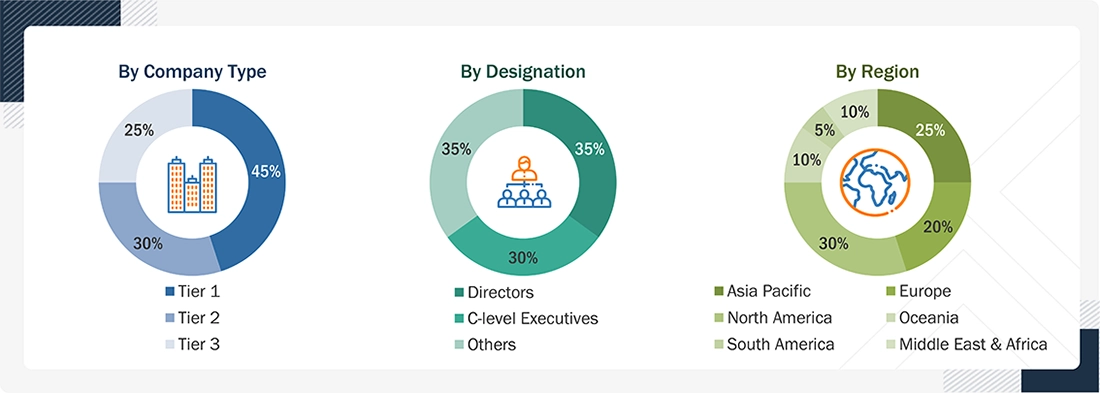
Notes: The three tiers of companies have been defined based on their total/segmental revenue as of 2025: Tier 1 = > USD 1 billion, Tier 2 = USD 1 billion–USD 500 million, and Tier 3 = < USD 500 million.
To know about the assumptions considered for the study, download the pdf brochure
Market Size Estimation
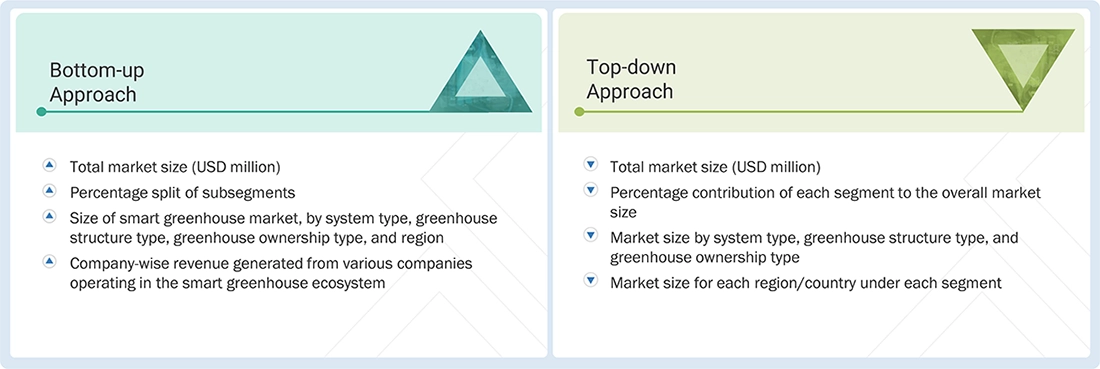
In the complete market engineering process, the top-down and bottom-up approaches, along with several data triangulation methods, were used to estimate and validate the size of the smart greenhouse market and various other dependent submarkets. Key players were identified through secondary research, and their market share in each region was determined through a combination of primary and secondary research. This research methodology involved analyzing the annual and financial reports of the top players and conducting interviews with experts (CEOs, VPs, directors, and marketing executives) to gather key insights (both quantitative and qualitative).
All percentage shares, splits, and breakdowns were determined using secondary sources and verified through primary sources. All possible parameters affecting the markets covered in this study were accounted for, examined in detail, verified through primary research, and analyzed to obtain final quantitative and qualitative data. This data was consolidated and supplemented with detailed inputs and analysis from MarketsandMarkets and presented in this report.
Data Triangulation
After determining the overall market size through the estimation process, as explained above, the total market was divided into several segments and subsegments. To complete the overall market engineering process and obtain precise statistics for all segments and subsegments, the data triangulation procedure was employed, as applicable. The data were triangulated by studying various factors and trends from the demand and supply sides. Additionally, the market has been validated using both top-down and bottom-up approaches.
Market Definition
Greenhouses that independently maintain the conducive microclimate required for crop cultivation without any human intervention are called smart greenhouses. They regulate light, air temperature, soil moisture, and humidity level to enable healthy plant growth. A number of smart greenhouses capture solar energy for electricity generation without impacting crop growth. Hydroponics and non-hydroponics are the techniques used in smart greenhouses for the cultivation of fruits, flowers, and vegetables. Increased demand for food worldwide, owing to the continuously growing population, is driving the smart greenhouse market.
Key Stakeholders
- Raw material and hardware manufacturing equipment suppliers
- Original equipment manufacturers (OEMs)
- Original design manufacturing (ODM) and original equipment manufacturing (OEM) technology solution providers
- Sensor providers
- Individual and large growers
- Research organizations
- Technology standard organizations, forums, alliances, and associations
- Technology investors
- Governments, financial institutions, and investment communities
- Analysts and strategic business planners
- End users
Report Objectives
- To describe and forecast the smart greenhouse market, based on system type, greenhouse structure type, and greenhouse ownership type, in terms of value
- To define and forecast the market size with regard to four main regions: North America, Europe, Asia Pacific, and RoW, in terms of value
- To provide detailed information regarding drivers, restraints, opportunities, and challenges influencing the market growth
- To understand the impact of artificial intelligence (AI) on the market
- To strategically analyze micromarkets with respect to individual growth trends, prospects, and contributions to the total market
- To provide a qualitative overview of different smart greenhouse technologies
- To analyze opportunities for various stakeholders by identifying high-growth segments of the market
- To strategically profile key players and comprehensively analyze their market position in terms of ranking and core competencies, along with detailing the competitive landscape of the market
- To analyze competitive developments, such as acquisitions, product launches, developments, and partnerships in the market
- To provide a detailed overview of the ecosystem analysis, case study analysis, patent analysis, trade analysis, technology analysis, average selling price (ASP) analysis, AI/Gen AI impact analysis, Porter’s five forces analysis, macroeconomic outlook, and regulatory landscape pertaining to the market
Available customizations:
With the given market data, MarketsandMarkets offers customizations according to the company’s specific needs. The following customization options are available for the report:
Company Information
- Detailed analysis and profiling of additional market players (up to 5)
Get the Full Smart Greenhouse Market Report
Full forecast, segment splits, and company analysis for all Smart Greenhouse Market.
Need a Tailored Report?
Customize this report to your needs
Get 10% FREE Customization
Customize This Report