
India Smart Sensors Market (2024-2029)

The India Smart Sensors Market was valued at $2013.6 Million in 2024 and projected to reach to $4894.1 Million by 2029, representing a compound annual growth rate of 19.4%. India's smart sensors market is positioned for exceptional growth, driven by the country's transformation into a global electronics manufacturing hub and accelerating digital infrastructure development.


| Market Size in | USD 26.32 MN |
| Market Forecast in | |
| CAGR | |
| Forecast Period | |
| Units Considered | Value (USD MN) |
India Smart Sensors Market Trends and Insights
- This accelerated growth trajectory reflects South Korea's position as a global semiconductor and electronics hub, driven by strong demand from automotive, industrial IoT, and consumer electronics sectors.
- South Korea's advanced manufacturing infrastructure and R&D capabilities position the country as a critical player in the global smart sensors ecosystem. The forecast period through 2029 underscores South Korea's commitment to digital transformation and Industry 4.0 adoption.
- South Korea's investments in smart city initiatives, autonomous vehicle development, and smart factory technologies are propelling sensor innovation and deployment across multiple verticals.
- South Korea's competitive advantage in semiconductor fabrication and sensor miniaturization continues to attract both domestic and international manufacturers, solidifying its market leadership in the Asia Pacific region..
Key Market Statistics
- CAGR (2024-2029) 19.4% CAGR
- Market Size, 2024 ~USD 2013.6 Million
- Forecast, 2029 ~USD 4894.1 Million
- Country India
India Smart Sensors Market Overview
Rapid Market Expansion :
India's smart sensors market is valued at USD 2,013.6 million in 2024 and is projected to reach USD 4,894.1 million by 2029, demonstrating a robust CAGR of 19.4%, significantly outpacing the global average of 17.1%.
Manufacturing Hub Growth :
India's emergence as a semiconductor manufacturing destination, supported by government initiatives like the Production-Linked Incentive (PLI) scheme, is driving increased adoption of smart sensors across domestic electronics production.
IoT and Smart City Initiatives :
Government-backed smart city projects and rising industrial IoT adoption across manufacturing sectors are creating substantial demand for advanced sensor technologies in India's industrial landscape.
Automotive and Consumer Electronics Surge :
Growing automotive electrification, smartphone manufacturing expansion, and increasing consumer electronics production are key drivers propelling smart sensor demand across India's technology ecosystem.
India Smart Sensors Market Dynamics
- The 19.4% CAGR reflects strong momentum from automotive electrification, industrial automation, and IoT deployments across manufacturing sectors.
- Government initiatives promoting semiconductor self-sufficiency and smart city development are creating favorable conditions for market expansion. The forecast period through 2029 will witness increased localization of sensor production, reduced import dependency, and expanded applications across consumer electronics, automotive, and industrial segments.
- Rising investments in R&D, coupled with growing smartphone and wearable device manufacturing, will further strengthen India's position as a critical smart sensors market in the Asia-Pacific region..
Market Ecosystem
Related Ecosystem
Sensors And Control
- Sensors
- Image Sensors
- Temperature Sensors
- Pressure Sensors
- Flow Sensors
- BAUMER ELECTRIC AG
- HONEYWELL INTERNATIONAL INC.
- Stmicroelectronics
- Lenovo
- Texas Instruments Incorporated
Automotive Systems
- Light Commercial Vehicles (LCVs)
- Battery Electric Vehicle (BEV)
- Hybrid Electric Vehicle (HEV)
- Agricultural Tractors
- Fuel Cell Electric Vehicle (FCEV)
- BOSCH LIMITED
- DENSO Corporation
- Continental ag
- ZF FRIEDRICHSHAFEN AG
- GORKOVSKY AVTOMOBILNY ZAVOD
Analytics
- Natural Language Processing (NLP)
- Machine Learning
- Supply Chain Management
- Predictive Analytics
- Image Sensors
- International Business Machines Corporation
- MICROSOFT CORPORATION
- Oracle Corporation
- SAP SE
Key Takeaways
- South Korea's smart sensors market will nearly double from USD 2,013.6M (2024) to USD 4,894.1M (2029) at a 19.4% CAGR.
- South Korea's automotive and industrial IoT sectors are primary growth drivers for smart sensor adoption and innovation.
- South Korea's semiconductor manufacturing expertise and R&D infrastructure provide competitive advantages in sensor technology development.
- South Korea's digital transformation initiatives and smart city projects accelerate demand for advanced sensing solutions through 2029.
Smart Sensors Market Report Scope
| Report Metric | Details |
|---|---|
| Base Year | 2024 |
| Fastest Growing Segment | CONSUMER ELECTRONICS (End-User Industry) |
| Forecast Period | 2024–2029 |
| Growth Rate | CAGR of 17.1% from 2024 to 2029 |
| Largest Segment | ANALOG-TO-DIGITAL CONVERTERS (Component) |
| Market Size Base Year (Billions) | ~USD 61.9 (2024) |
| Revenue Forecast (Billions) | ~USD 136.3 (2029) |
| Segments Covered | Type, Technology, End-User Industry, Component, Application |
India Smart Sensors Market Report Segmentation
5 segment dimensions are covered across the global market.
By Type
- Dissolved Oxygen Sensors
- Flow Sensors
- Image Sensors
- Level Sensors
- Light Sensor
- Light Sensors
- Motion & Occupancy Sensors
- Other Sensors
- Ph Sensors
- Position Sensor
- Position Sensors
- Pressure Sensors
- Soil Moisture Sensors
- Temperature & Humidity Sensors
- Touch Sensors
- Turbidity Sensors
- Ultrasonic Sensor
- Ultrasonic Sensors
- Water Sensors
By Technology
- Cmos
- MEMS
- Other Technologies
By End-User Industry
- Aerospace & Defense
- Automotive
- Biomedical & Healthcare
- Building Automation
- Consumer Electronics
- Industrial Automation
- Other Industries
- Others Industrie
By Component
- Amplifiers
- Analog-To-Digital Converters
- Digital-To-Analog Converters
- Microcontrollers
- Other Components
- Transceivers
By Application
- Access Control Systems
- Communications & It
- Entertainment
- Home Appliances
- Hvac Systems
- Lighting Control Systems
- Other Applications
- Rfid Tags
- Security & Surveillance Systems
- Wearable Electronics
Target Audience
- Electronics Manufacturers : Manufacturers expanding operations in India need market data to understand sensor demand trends, supply chain opportunities, and competitive positioning within the rapidly growing domestic electronics sector.
- Automotive OEMs & Suppliers : Automotive companies investing in India's EV and electrification initiatives require insights into smart sensor adoption rates, technology requirements, and supplier ecosystems to optimize product development.
- IoT & Smart City Solution Providers : Companies developing IoT platforms and smart city solutions need India-specific market intelligence to identify deployment opportunities, customer segments, and growth potential in government-backed initiatives.
- Semiconductor & Sensor Manufacturers : Global and domestic sensor manufacturers require detailed market analysis to assess India's production capacity, localization opportunities, and demand forecasts for strategic manufacturing decisions.
- Investment & Strategy Consultants : Investment firms and business consultants advising clients on India expansion need comprehensive market data, growth drivers, and competitive analysis to support due diligence and strategic recommendations.
Key Companies in the India Smart Sensors Market
| Company | HQ | Ownership | Strongest segments |
|---|---|---|---|
| KORE WIRELESS GROUP | United States | Public Company | Temperature & Humidity Sensor–linked IoT services,Pressure Sensor–linked IoT services,Motion & Occupancy Sensor–linked IoT services, |
| X-FAB | Germany | Public Company | MEMS-based smart sensors (pressure, inertial, flow, gas),CMOS smart sensor ICs (temperature, image, photodiodes),Silicon carbide and GaN sensor-adjacent power and interface ICs, |
| UNITED MICROELECTRONICS CORP | Taiwan | Public Company | Motion & Occupancy Sensor platforms (CMOS/MEMS),Pressure Sensor platforms,Temperature & Humidity Sensor platforms, |
| LENOVO | China | Public Company | Motion & Occupancy Sensor–enabled endpoints,Temperature & Humidity Sensor–enabled endpoints,Pressure Sensor–enabled endpoints, |
| FIRST SENSOR AG | Germany | Public Company | Pressure Sensors,Motion & Occupancy Sensors,Temperature & Humidity Sensors, |
| SOMFY GROUP | France | Private Company | Motion & Occupancy Sensors (for openings, access, security),Temperature & Humidity Sensors (environmental and comfort control),Pressure and Wind/Solar-Linked Sensors, |
| ANALOG DEVICES, INC. | United States | Public Company | Temperature & Humidity Sensor-related ICs and signal chain,Pressure Sensor and Industrial Sensing ICs,Motion & Occupancy (MEMS inertial, IMUs, and interfaces), |
| TE CONNECTIVITY | Switzerland | Public Company | Pressure Sensors,Temperature & Humidity Sensors,Motion & Occupancy Sensors, |
| INFINEON TECHNOLOGIES AG | Germany | Public Company | Motion & Occupancy Sensors (Radar, 3D ToF, Presence),Pressure, Gas & Environmental Sensors,Temperature & Humidity Sensors, |
| STMICROELECTRONICS | Switzerland | Public Company | Motion & Occupancy Sensors (MEMS accelerometers, gyros, presence),Pressure Sensors,Temperature & Humidity Sensors, |
| ABB | India | Public Company | Temperature & Humidity Sensors,Pressure Sensors,Motion & Occupancy Sensors, |
| MICROCHIP TECHNOLOGY INC. | United States | Public Company | Microcontrollers for smart sensor nodes,Analog and mixed-signal front ends (amplifiers, power, interface),Transceivers and connectivity for sensor networks, |
| NXP SEMICONDUCTORS | Netherlands | Public Company | Motion & Occupancy Sensors (inertial, magnetic, gyroscopic),Pressure & Environmental Sensors,Temperature & Humidity Sensors, |
| SIEMENS | Germany | Public Company | Temperature & Humidity Sensors,Pressure Sensors,Motion & Occupancy Sensors, |
| ROBERT BOSCH GMBH | Germany | Private Company | Pressure Sensors,Motion & Occupancy Sensors,Temperature & Humidity Sensors, |
| HONEYWELL INTERNATIONAL INC. | United States | Public Company | Pressure Sensors,Temperature & Humidity Sensors,Motion & Occupancy Sensors, |
| TDK CORPORATION | Japan | Public Company | Temperature & Humidity Sensors,Pressure Sensors,Motion & Occupancy Sensors, |
| EATON CORPORATION | Ireland | Public Company | Motion & Occupancy Sensors (incl. in wiring devices, emergency lighting, safety systems),Pressure Sensors (aerospace, hydraulics, fuel, and utility systems),Temperature & Humidity Sensors (power, hazardous-duty, thermal management), |
| EMERSON ELECTRIC CO. | United States | Public Company | Temperature & Humidity Sensors,Pressure Sensors,Motion & Occupancy Sensors, |
| GENERAL ELECTRIC | United States | Public Company | Temperature & Humidity Sensors,Pressure Sensors,Motion & Occupancy Sensors, |
| LEGRAND | France | Public Company | Motion & Occupancy Sensors (standalone and embedded in wiring devices, lighting, and building controls),Temperature & Humidity Sensors (environmental and comfort control in connected home, UPS, and data center solutions),Pressure Sensors (niche building and industrial applications), |
KORE WIRELESS GROUP
Kore Wireless Group is a publicly traded U.S. company founded in 2002 with 403 employees, providing wireless connectivity and IoT solutions.
X-FAB
X-FAB is a German public semiconductor foundry established in 1992 with 4,300 employees, providing analog and mixed-signal semiconductor manufacturing services.
UNITED MICROELECTRONICS CORP
United Microelectronics Corp is a Taiwanese public semiconductor manufacturer founded in 1980 with 20,000 employees, offering foundry services for integrated circuit production.
LENOVO
Lenovo is a Chinese public company founded in 1984 that is a global leader in personal computers, servers, and consumer electronics.
FIRST SENSOR AG
First Sensor AG is a German public company founded in 1991 with 538 employees, specializing in sensor technology and measurement solutions.
SOMFY GROUP
Somfy Group is a French private company established in 1969 with 6,433 employees, a leading manufacturer of motorized window coverings and smart home automation systems.
ANALOG DEVICES, INC.
Analog Devices, Inc. is a U.S. public semiconductor company founded in 1965 with 24,500 employees, specializing in analog, mixed-signal, and digital signal processing technology.
TE CONNECTIVITY
TE Connectivity is a Swiss public company founded in 1941 with 80,000 employees, a global leader in connectivity and sensor solutions for multiple industries.
INFINEON TECHNOLOGIES AG
Infineon Technologies AG is a German public semiconductor manufacturer founded in 1952 with 56,500 employees, specializing in automotive, industrial, and IoT semiconductor solutions.
STMICROELECTRONICS
STMicroelectronics is a Swiss public semiconductor company founded in 1987 with 48,000 employees, producing microcontrollers, sensors, and analog chips for diverse applications.
ABB
ABB is an Indian public multinational company founded in 1883 with 112,700 employees, providing power and automation technologies and services globally.
MICROCHIP TECHNOLOGY INC.
Microchip Technology Inc. is a U.S. public semiconductor company founded in 1989 with 17,900 employees, manufacturing microcontrollers, analog semiconductors, and embedded systems.
NXP SEMICONDUCTORS
NXP Semiconductors is a Dutch public company founded in 2006 with 32,169 employees, specializing in automotive, industrial, and IoT semiconductor solutions.
SIEMENS
Siemens is a German public multinational conglomerate founded in 1847 with 310,312 employees, providing electrification, automation, and digitalization solutions across multiple sectors.
ROBERT BOSCH GMBH
Robert Bosch GmbH is a German private multinational company founded in 1886 with 412,774 employees, a leading supplier of automotive components, industrial technology, and consumer goods.
HONEYWELL INTERNATIONAL INC.
Honeywell International Inc. is a U.S. public multinational conglomerate founded in 1885 with 101,000 employees, providing aerospace, building technologies, and industrial automation solutions.
TDK CORPORATION
TDK Corporation is a Japanese public company founded in 1935 with 106,545 employees, manufacturing electronic components including capacitors, inductors, and magnetic materials.
EATON CORPORATION
Eaton Corporation is an Irish public multinational company founded in 1911 with 97,303 employees, providing electrical, hydraulic, and mechanical power management solutions.
EMERSON ELECTRIC CO.
Emerson Electric Co. is a U.S. public company founded in 1890 with 71,000 employees, specializing in process management, climate technologies, and industrial automation.
GENERAL ELECTRIC
General Electric is a U.S. public multinational conglomerate founded in 1892 with 57,000 employees, operating in aviation, power, renewable energy, and healthcare sectors.
LEGRAND
Legrand is a French public company founded in 1865 with 35,410 employees, a global specialist in electrical and digital building infrastructure solutions.
Reasons to Buy this Report
- Market Size & Growth Validation : Obtain precise market valuation data for India (USD 2,013.6M in 2024) with detailed 5-year forecasts to support investment decisions, business planning, and competitive positioning in this high-growth market.
- Segment & Application Insights : Access detailed breakdowns of smart sensor applications across automotive, industrial IoT, consumer electronics, and smart city sectors specific to India's market dynamics and growth drivers.
- Competitive Landscape Analysis : Identify key players, market share distribution, and competitive strategies tailored to India's manufacturing ecosystem, enabling informed partnership and expansion strategies.
- Government Policy & Regulatory Context : Understand India-specific policy frameworks including PLI schemes, Make in India initiatives, and smart city programs that directly impact market growth and investment opportunities.
- Regional Opportunity Assessment : Benchmark India's 19.4% CAGR against global trends (17.1%) to identify relative growth potential and prioritize resource allocation for market entry or expansion strategies.
Frequently asked questions
What is the current market size of smart sensors in South Korea?
South Korea's smart sensors market was valued at USD 2,013.6 million in 2024.
What is the projected market size for smart sensors in South Korea by 2029?
South Korea's smart sensors market is forecast to reach USD 4,894.1 million by 2029.
What is the CAGR for South Korea's smart sensors market?
South Korea's smart sensors market is expected to grow at a compound annual growth rate of 19.4% from 2024 to 2029.
Which industries are driving smart sensor demand in South Korea?
South Korea's automotive, industrial IoT, consumer electronics, and smart city sectors are primary drivers of smart sensor market growth.
Why is South Korea a key market for smart sensors?
South Korea's advanced semiconductor manufacturing capabilities, strong R&D ecosystem, and digital transformation initiatives position it as a critical hub for smart sensor innovation and deployment.
RESEARCH METHODOLOGY
The study involved four major activities in estimating the current size of the smart sensors market —exhaustive secondary research collected information on the market and its peer and parent markets. The next step was to validate these findings, assumptions, and sizing with industry experts across the value chain through primary research. Both top-down and bottom-up approaches were employed to estimate the total market size. After that, market breakdown and data triangulation were used to estimate the market size of segments and subsegments.
Secondary Research
Various secondary sources have been referred to in the secondary research process for identifying and collecting information important for this study. These secondary sources include high-speed data converter technology journals and magazines, annual reports, press releases, investor presentations of companies, white papers, certified publications and articles from recognized authors, and directories and databases such as Factiva, Hoovers, and OneSource.
Primary Research
Various primary sources from both supply and demand sides have been interviewed in the primary research process to obtain qualitative and quantitative information important for this report. The primary sources from the supply side included industry experts such as CEOs, VPs, marketing directors, technology and innovation directors, and related executives from key companies and organizations operating in the smart sensors market. After complete market engineering (including calculations regarding market statistics, market breakdown, market size estimations, market forecasting, and data triangulation), extensive primary research was conducted to gather information as well as to verify and validate the critical numbers arrived at.
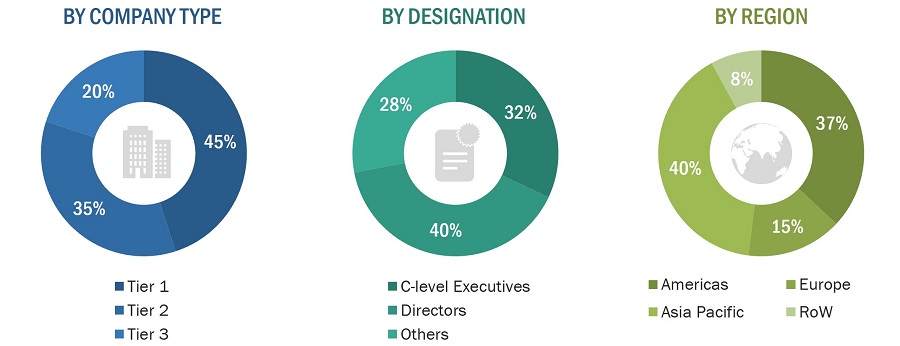
To know about the assumptions considered for the study, download the pdf brochure
Market Size Estimation
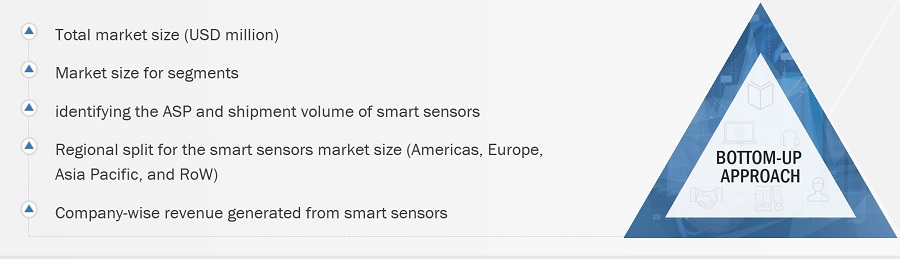
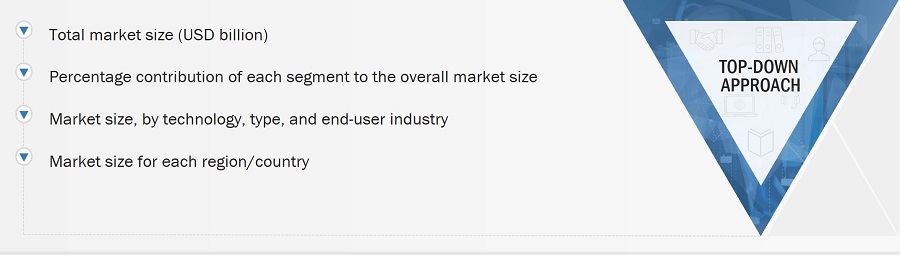
In the complete market estimation process, both top-down and bottom-up approaches have been implemented, along with several data triangulation methods, to estimate and validate the size of the smart sensors market and other dependent submarkets listed in this report.
- Extensive secondary research has identified key players in the industry and market.
- In terms of value, the industry’s supply chain and market size have been determined through primary and secondary research processes.
- All percentage shares, splits, and breakdowns have been determined using secondary sources and verified through primary sources.
Smart Sensors Market: Bottom-Up Approach
Smart Sensors Market: Top-Down Approach
Data Triangulation
After arriving at the overall market size from the estimation process explained above, the global market has been split into several segments and subsegments. Market breakdown and data triangulation procedures have been employed wherever applicable to complete the overall market engineering process and arrive at exact statistics for all segments and subsegments. The data has been triangulated by studying several factors and trends identified from both the demand and supply sides.
Market Definition
A sensor detects, measures, and controls physical properties such as light, humidity, motion, moisture, temperature, and pressure. It converts data such as light and sound into a practical format for the user. On the other hand, a smart sensor has built-in circuitry for a designer. For instance, the motion sensor has an operational amplifier (op-amp) and digital circuitry built into the sensor module, making it ready to use once plugged in. A smart sensor can produce an electrical output when combined with a sensing element, an analog interface circuit, an Analog-to-Digital Converter (ADC), and a bus interface under one housing. It is a combination of sensing elements with a microprocessor or microcontroller providing processing capabilities. A smart sensor is capable of multi-sensing, multi-tasking, and communication. The smart sensors market is expected to grow significantly during the forecast period, with consumer electronics and industrial automation being the major end-user industries. The growing popularity of IoT devices and the increasing need for energy conservation are among the major factors contributing to the market's growth. Since the circuitry of digital sensors is similar to that of smart sensors, all digital sensors are considered smart sensors for this study.
Key Stakeholders
- Raw material suppliers
- Component manufacturers and providers
- Sensor manufacturers and providers
- Original Equipment Manufacturers (OEMs)
- Technology solution providers
- Application providers
- System integrators
- Middleware providers
- Assembly, testing, and packaging vendors
- Market research and consulting firms
- Associations, organizations, forums, and alliances related to the smart sensor industry
- Technology investors
- Governments, regulatory bodies, and financial institutions
- Venture capitalists, private equity firms, and start-ups
- End users
Report Objectives
The following are the primary objectives of the study.
- To forecast the size of the smart sensors market, in terms of value, based on type, technology, component, end-user industry, and region
- To define, describe, and forecast the smart sensors market size, in terms of volume, based on type
- To describe and forecast the market, in terms of value, for various segments across four main regions: Americas, Asia Pacific, Europe, and Rest of the World (RoW)
- To provide detailed information regarding drivers, restraints, opportunities, and challenges influencing the growth of the market
- To study the complete value chain and related industry segments and conduct a value chain analysis of the smart sensors market landscape
- To strategically analyze the ecosystem, regulatory landscape, patent landscape, Porter’s Five Forces, import and export scenarios for products covered under HS code 902690 trade landscape, and case studies pertaining to the market under study
- To strategically analyze micromarkets1 with respect to individual growth trends, prospects, and their contributions to the overall market
- To analyze opportunities for stakeholders by identifying high-growth segments in the market
- To strategically profile the key players and provide a detailed competitive landscape of the smart sensors market
- To analyze strategic approaches adopted by the leading players in the smart sensors market, including product launches/developments and acquisitions
Available Customizations
With the given market data, MarketsandMarkets offers customizations according to a company’s specific needs. The following customization options are available for the report:
Company Information:
- Detailed analysis and profiling of additional market players (up to 5)
Get the Full Smart Sensors Market Report
Full forecast, segment splits, and company analysis for all Smart Sensors Market.
Need a Tailored Report?
Customize this report to your needs
Get 10% FREE Customization
Customize This Report
