
Rest Of Europe Solid State Relay Market (2025-2030)

The Rest Of Europe Solid State Relay Market was valued at $49.5 Million in 2025 and projected to reach to $55.6 Million by 2030, representing a compound annual growth rate of CAGR 2.4%. Rest Of Europe's solid state relay market demonstrates steady but modest growth, driven by gradual industrial automation adoption across smaller manufacturing economies.


| Market Size in | USD 26.32 MN |
| Market Forecast in | |
| CAGR | |
| Forecast Period | |
| Units Considered | Value (USD MN) |
Rest Of Europe Solid State Relay Market Trends and Insights
- Rest Of Europe encompasses a diverse industrial base with varying adoption rates of solid state relay technology across manufacturing, automation, and power management applications.
- The moderate growth trajectory reflects steady demand from established industrial sectors, though Rest Of Europe faces competitive pressures from mature markets and slower digital transformation compared to Western European economies. Rest Of Europe's solid state relay market is characterized by incremental expansion driven by modernization of legacy industrial equipment and gradual adoption in renewable energy and smart grid applications.
- Between 2025 and 2030, Rest Of Europe is expected to see increased integration of solid state relays in industrial automation and HVAC systems, supported by regional manufacturing growth.
- The region's market growth is constrained by price sensitivity and the prevalence of traditional electromechanical relay solutions, though Rest Of Europe continues to benefit from cross-border supply chain integration within the broader European semiconductor ecosystem..
Key Market Statistics
- CAGR (2025-2030) CAGR 2.4%
- Market Size, 2025 ~USD 49.5 Million
- Forecast, 2030 ~USD 55.6 Million
- Country Rest Of Europe
Rest Of Europe Solid State Relay Market Overview
Moderate Growth Trajectory :
Rest Of Europe's solid state relay market is expanding at 2.4% CAGR, significantly below the global average of 6.3%, reflecting slower industrial modernization in smaller European economies compared to major manufacturing hubs.
Market Size Expansion :
The market is projected to grow from USD 49.5 million in 2025 to USD 55.6 million by 2030, adding approximately USD 6.1 million in value over the five-year forecast period.
Diverse Industrial Base :
Rest Of Europe encompasses varied manufacturing sectors with inconsistent solid state relay adoption rates, creating fragmented demand patterns across automation, power management, and industrial control applications.
Regional Adoption Challenges :
Lower growth rates indicate barriers to solid state relay technology adoption in smaller European markets, including cost sensitivity, legacy system prevalence, and limited awareness of advanced relay solutions.
Rest Of Europe Solid State Relay Market Dynamics
- The 2.4% CAGR reflects a maturing market with selective technology uptake in power management and automation applications, particularly in countries with developing industrial infrastructure. The region's growth outlook is constrained by cost-conscious purchasing decisions, prevalence of traditional relay systems, and limited capital investment in modernization.
- However, increasing energy efficiency regulations and gradual digital transformation initiatives present opportunities for solid state relay penetration in emerging industrial sectors throughout the region..
Market Ecosystem
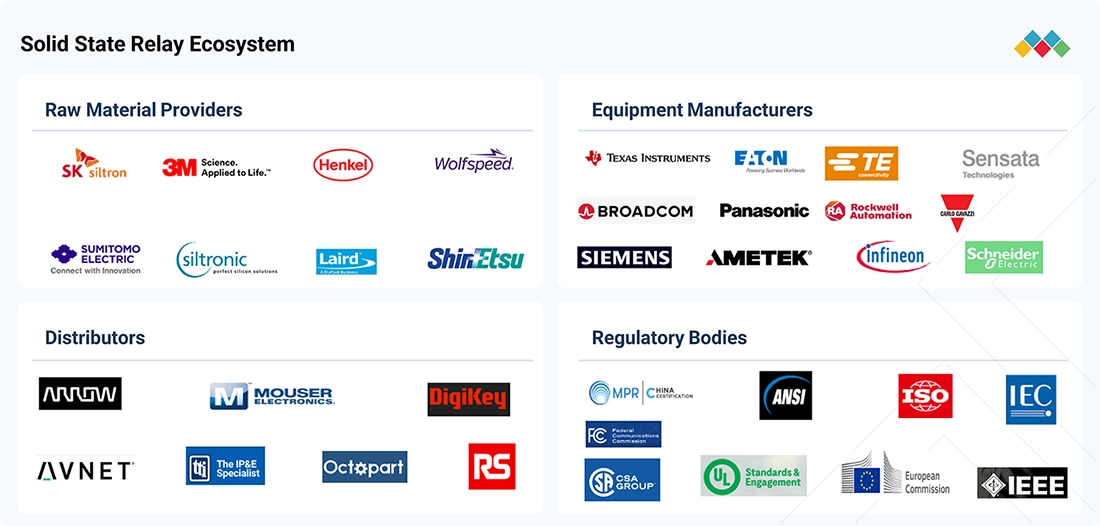
SOLID STATE RELAY MARKET SIZE, SHARE & TRENDS: COMMERCIAL USE CASES ACROSS INDUSTRIES
| COMPANY | USE CASE DESCRIPTION | BENEFITS |
|---|---|---|
 |
TE Connectivity deploys Potter & Brumfield SSR and SSRDC series relays for industrial motion control, commercial heating elements, and automated power distribution setups. The solid-state devices provide continuous electrical switching inside factory-floor automation panels and heating control cabinets. | Eliminates acoustic switching noise through all solid-state architecture | Delivers high operational lifespan with zero moving parts | Resists structural degradation caused by severe vibration and mechanical shock | Features aluminum-clad baseplates to assist heat dissipation during heavy continuous cycling |
 |
Infineon integrates solid-state relay modules and coreless transformer-isolated switches into automotive battery management circuits, electric vehicle onboard charging units, and auxiliary power distribution grids. The components switch high-voltage direct-current loads in energy infrastructure. | Unifies galvanic isolation, integrated gate drive circuitry, and power MOSFETs into a single module | Delivers operating durability exceeding one million switching cycles | Lowers operational conduction losses across elevated voltage levels | Eliminates mechanical contact degradation and electrical arc formation |
 |
Broadcom supplies ASSR series opto-coupled solid-state relays for automated test equipment, data acquisition modules, and industrial input/output interfaces. The semiconductor packages route test signals and switch low- to medium-voltage electrical circuits on dense printed circuit boards. | Provides transient voltage withstand capabilities via optical isolation barriers | Prevents mechanical contact bounce to ensure consistent signal integrity | Requires low input drive current from standard logic controllers | Delivers compact surface mount packaging to reduce printed circuit board space requirements |
 |
Panasonic incorporates PhotoMOS series optically isolated solid-state relays into precision measurement instruments, medical diagnostics systems, and smart building thermostats. The devices handle low-level analog instrumentation signals alongside direct current switching paths. | Delivers low on-resistance to minimize instrumentation signal loss | Ensures stable on-resistance without mechanical wear over lifetime | Achieves fast switching actuation speeds down to twenty microseconds | Operates with minimal off-state leakage current across extreme operational temperature ranges |
 |
Eaton installs D93, D99, and Moeller HLR series solid state relays across industrial process machinery, commercial packaging lines, and heating control installations. The hockey puck and DIN rail units regulate alternating-current motor loads and industrial resistive heating elements. | Incorporates internal snubber circuitry for transient overvoltage protection | Provides integrated heat sink options for direct DIN rail mounting without auxiliary brackets | Features zero crossing voltage switching to suppress electromagnetic interference | Supplies finger safe terminal covers to enhance plant operator safety |
Logos and trademarks shown above are the property of their respective owners. Their use here is for informational and illustrative purposes only.
Related Ecosystem
Electrical System And Components
- Natural Language Processing (NLP)
- Sensors
- Machine Learning
- Temperature Sensors
- Actuators
- ABB India Limited
- Siemens ag
- SCHNEIDER ELECTRIC SE
- Eaton Corporation plc
- General Electric Company
Key Takeaways
- Rest Of Europe's solid state relay market will grow from USD 49.5M (2025) to USD 55.6M (2030) at a 2.4% CAGR, reflecting moderate but steady regional demand.
- Rest Of Europe's growth is driven by industrial modernization and renewable energy adoption, though price sensitivity limits faster market expansion.
- Rest Of Europe faces competition from established Western European suppliers and must balance cost pressures with technology advancement.
- Rest Of Europe's market benefits from regional manufacturing integration and cross-border supply chains within the broader European semiconductor sector.
Solid State Relay Market Report Scope
| Report Metric | Details |
|---|---|
| Base Year | 2025 |
| Fastest Growing Segment | AUTOMOTIVE (Application) |
| Forecast Period | 2025-2030 |
| Growth Rate | CAGR of 6.3% from 2025 to 2030 |
| Largest Segment | OPTO-COUPLED SSR (Type) |
| Market Size Base Year (Billions) | ~USD 1.74 (2025) |
| Revenue Forecast (Billions) | ~USD 2.36 (2030) |
| Segments Covered | Current Rating, Application, Mounting Type, Output Voltage, Type |
Rest Of Europe Solid State Relay Market Report Segmentation
5 segment dimensions are covered across the global market.
By Current Rating
- High
- Low
- Medium
By Application
- Automotive
- Building Equipment
- Communication
- Energy & Infrastructure
- Food & Beverages
- Industrial Automation
- Industrial OEM
- Medical
- Transportation
- Water Pumps
By Mounting Type
- Din Rail
- Din-Rail
- Other Mounting Types
- Panel
- Pcb
By Output Voltage
- Ac
- Ac/Dc
- Dc
By Type
- Opto-Coupled Ssr
- Other Types
- Reed-Relay Coupled Ssr
- Reed-Relay-Coupled Ssr
- Transformer-Coupled Ssr
Target Audience
- Solid State Relay Manufacturers : Manufacturers need Rest Of Europe-specific market data to identify growth opportunities, assess regional demand patterns, and develop localized product strategies for smaller European economies.
- Industrial Automation Suppliers : Automation solution providers require regional market insights to understand solid state relay adoption rates, competitive dynamics, and customer requirements across Rest Of Europe's fragmented industrial base.
- Investment and Private Equity Firms : Investors evaluating opportunities in European semiconductor and industrial automation sectors need accurate regional market forecasts to assess growth potential and risk profiles in Rest Of Europe.
- Strategic Business Planners : Corporate strategists developing European expansion plans require Rest Of Europe-specific market intelligence to benchmark performance, identify market gaps, and prioritize regional investments.
- Electrical Equipment Distributors : Distributors and resellers need regional market data to forecast demand, optimize inventory management, and develop targeted sales strategies for solid state relay products in Rest Of Europe.
Reasons to Buy this Report
- Regional Market Segmentation : Gain detailed insights specific to Rest Of Europe's solid state relay market dynamics, distinct from broader European trends, enabling targeted market entry and localized strategy development.
- Competitive Positioning Intelligence : Understand market gaps and growth opportunities in smaller European economies where solid state relay adoption lags global averages, identifying underserved segments for competitive advantage.
- Investment Decision Support : Access accurate market sizing and five-year forecasts to support capital allocation decisions, partnership evaluations, and expansion planning in Rest Of Europe's industrial automation sector.
- Adoption Barrier Analysis : Identify specific challenges limiting solid state relay penetration in Rest Of Europe, including cost sensitivity and legacy system prevalence, to develop effective market penetration strategies.
- Regulatory and Trend Insights : Stay informed on energy efficiency regulations and digital transformation initiatives driving gradual technology adoption across Rest Of Europe's diverse industrial base.
Frequently asked questions
What is the market size of solid state relays in Rest Of Europe in 2025?
Rest Of Europe's solid state relay market is estimated at USD 49.5 million in 2025.
What is the projected market size for Rest Of Europe by 2030?
Rest Of Europe's solid state relay market is forecast to reach USD 55.6 million by 2030.
What is the CAGR for Rest Of Europe's solid state relay market?
Rest Of Europe's solid state relay market is expected to grow at a CAGR of 2.4% from 2025 to 2030.
What factors are driving growth in Rest Of Europe's solid state relay market?
Rest Of Europe's market growth is driven by industrial modernization, renewable energy adoption, smart grid development, and increased automation in manufacturing sectors.
What challenges does Rest Of Europe's solid state relay market face?
Rest Of Europe faces challenges including price sensitivity, competition from traditional electromechanical relays, slower digital transformation rates, and competitive pressures from Western European suppliers.
RESEARCH METHODOLOGY
The research process for this study involved the systematic gathering, recording, and analysis of data on customers and companies operating in the solid state relay market. This process involved the extensive use of secondary sources, directories, and databases (Factiva and OANDA) to identify and collect valuable information for the comprehensive, technical, market-oriented, and commercial study of the market. In-depth interviews were conducted with primary respondents, including experts from core and related industries, as well as preferred manufacturers, to obtain and verify critical qualitative and quantitative information and assess growth prospects. Key players were identified through secondary research, and their market rankings were determined through a combination of primary and secondary research. This research involved studying the annual reports of top players and conducting interviews with key industry experts, including CEOs, directors, and marketing executives.
Secondary Research
Various sources were utilized in the secondary research process to identify and collect information relevant to this study. These include company annual reports, press releases, investor presentations, white papers, technology journals, certified publications, articles by recognized authors, directories, and databases. Secondary research was primarily used to gather key information on the industry’s value chain, the total pool of market players, market classification by industry trends at the most detailed level, regional markets, and key developments from both market- and technology-oriented perspectives.
Primary Research
Primary research was conducted to identify the segmentation types, key players, competitive landscape, and key market dynamics, including drivers, restraints, opportunities, challenges, and industry trends, as well as the key strategies adopted by players operating in the solid state relay market. Extensive qualitative and quantitative analyses were conducted across the complete market engineering process to present key information and insights throughout the report.
Extensive primary research has been conducted following the acquisition of knowledge about the solid state relay market scenarios through secondary research. Several primary interviews were conducted with experts from the demand side (end-use application and region) and the supply side (type, mounting type, current rating, output voltage, and application) across four major geographic regions: North America, Europe, Asia Pacific, and RoW. Approximately 60% and 40% of the primary interviews were conducted from the supply and demand sides, respectively. These primary data have been collected through questionnaires, emails, and telephonic interviews.
Following is the breakdown of primary respondents:
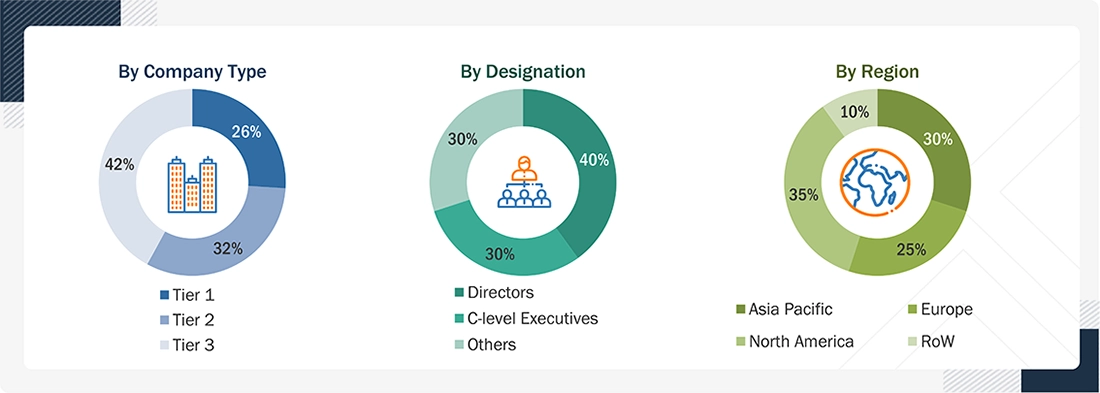
Notes: The three tiers of companies have been defined based on their total/segmental revenue as of 2025: Tier 1 = > USD 1 billion, Tier 2 = USD 1 billion–USD 500 million, and Tier 3 = < USD 500 million.
Other designations include sales, marketing, and product managers.
To know about the assumptions considered for the study, download the pdf brochure
Market Size Estimation
In the complete market engineering process, top-down and bottom-up approaches, along with several data triangulation methods, were used to estimate and validate the size of the solid state relay market and various other dependent submarkets. Key players were identified through secondary research, and their market share in each region was determined through a combination of primary and secondary research. This research methodology involved analyzing the annual and financial reports of the top players and conducting interviews with experts (including CEOs, VPs, directors, and marketing executives) to gather key insights (both quantitative and qualitative).
All percentage shares, splits, and breakdowns were determined using secondary sources and verified through primary sources. All possible parameters affecting the markets covered in this study were accounted for, examined in detail, verified through primary research, and analyzed to obtain final quantitative and qualitative data. These data were consolidated and supplemented with detailed inputs and analysis from MarketsandMarkets and presented in this report.
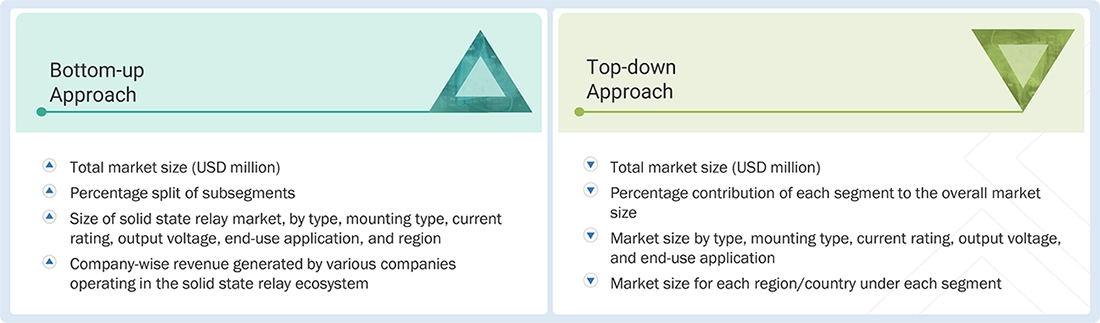
Data Triangulation
After determining the overall market size through the estimation process, as explained above, the total market was divided into several segments and subsegments. To complete the overall market engineering process and obtain precise statistics for all segments and subsegments, the data triangulation procedure was employed, as applicable. The data were triangulated by studying various factors and trends from the demand and supply sides. Additionally, the market has been validated using both top-down and bottom-up approaches.
Market Definition
A solid-state relay (SSR) is a semiconductor device that is used to switch electricity to a load when a small external voltage is applied across control terminals. The SSR can be designed to switch either AC or DC to the load. SSRs have no movable contacts. They, however, employ semiconductor switching elements, such as thyristors, TRIACS, diodes, and transistors. The different types through which SSRs can be mounted in a circuit include panel mount, PCB mount, DIN-Rail mount, and others.
The solid state relay ecosystem with a power system includes various electronic components such as a generator, transformers, transmission lines, isolators, circuit breakers, bus bars, cables, relays, instrument transformers, distribution feeders, and various loads. The market is diversified, with more than 30 companies competing across the value chain to sustain their position in the market and increase market share. The solid state relay market is likely to witness significant growth in the coming years in the automotive & transportation segment, owing to the increasing complexity in the circuits of electric vehicles
Key Stakeholders
- Raw material suppliers
- Technology investors
- Solid-state relay designers, manufacturers, and suppliers
- Solid-state relay integrators and service providers
- Research laboratories
- In-house testing laboratories
- System integrators
- Distributors, resellers, and traders
- Research institutions and organizations
- Optoelectronics and electronic component forums, alliances, consortia, and associations
- Market research and consulting firms
- End users
Report Objectives
- To describe and forecast the solid state relay market, by type, mounting type, current rating, output voltage, and end-use application, in terms of value
- To define and forecast the market size with regard to four main regions, namely North America, Europe, Asia Pacific, and RoW, along with their country-level analyses, in terms of value
- To describe and forecast the market, by current rating, in terms of volume
- To provide detailed information regarding drivers, restraints, opportunities, and challenges influencing the market growth
- To understand the impact of artificial intelligence (AI) on the market
- To strategically analyze micromarkets with respect to individual growth trends, prospects, and contributions to the total market
- To provide a qualitative overview of different technologies of solid-state relays
- To analyze opportunities for various stakeholders by identifying high-growth segments of the market
- To strategically profile key players and comprehensively analyze their market position in terms of ranking and core competencies, along with detailing the competitive landscape of the market
- To analyze competitive developments, such as acquisitions, product launches, developments, and partnerships, in the market
- To provide a detailed overview of the ecosystem analysis, case study analysis, patent analysis, trade analysis, technology analysis, average selling price (ASP) analysis, AI/Gen AI impact analysis, Porter’s five forces analysis, macroeconomic outlook, and regulatory landscape pertaining to the market
Available customizations:
With the given market data, MarketsandMarkets offers customizations according to the company’s specific needs. The following customization options are available for the report:
Company Information
- Detailed analysis and profiling of additional market players.
Get the Full Solid State Relay Market Report
Full forecast, segment splits, and company analysis for all Solid State Relay Market.
- US Solid State Relay Market
- Canada Solid State Relay Market
- Mexico Solid State Relay Market
- Germany Solid State Relay Market
- UK Solid State Relay Market
- France Solid State Relay Market
- Italy Solid State Relay Market
- China Solid State Relay Market
- Japan Solid State Relay Market
- South Korea Solid State Relay Market
- India Solid State Relay Market
- Rest Of Asia Pacific Solid State Relay Market
Need a Tailored Report?
Customize this report to your needs
Get 10% FREE Customization
Customize This Report
