
UK Solid State Relay Market (2025-2030)

The UK Solid State Relay Market was valued at $80.3 Million in 2025 and projected to reach to $108.3 Million by 2030, representing a compound annual growth rate of 6.2%. The UK Solid State Relay market is positioned for steady growth at a 6.2% CAGR through 2030, supported by ongoing industrial digitalization and the UK's green energy transition.


| Market Size in | USD 26.32 MN |
| Market Forecast in | |
| CAGR | |
| Forecast Period | |
| Units Considered | Value (USD MN) |
UK Solid State Relay Market Trends and Insights
- The UK market benefits from strong demand across industrial automation, renewable energy, and telecommunications sectors, where solid state relays provide superior reliability and switching performance compared to traditional electromechanical alternatives.
- The UK's commitment to industrial modernization and energy transition initiatives continues to drive adoption of advanced relay technologies in manufacturing and power distribution applications. Key growth drivers in the UK include increasing investments in smart grid infrastructure, rising automation in manufacturing facilities, and the expansion of data center operations across the country.
- The UK market is characterized by a mix of established semiconductor manufacturers and specialized relay component suppliers competing to meet stringent quality and performance standards.
- Between 2025 and 2030, the UK is expected to see accelerated adoption driven by regulatory compliance requirements and the need for energy-efficient switching solutions in critical infrastructure applications..
Key Market Statistics
- CAGR (2025-2030) 6.2% CAGR
- Market Size, 2025 ~USD 80.3 Million
- Forecast, 2030 ~USD 108.3 Million
- Country UK
UK Solid State Relay Market Overview
Market Valuation :
The UK Solid State Relay market is valued at $80.3 million in 2025, with projected growth to $108.3 million by 2030, driven by industrial modernization and energy transition initiatives across the country.
Industrial Automation Demand :
UK manufacturing and industrial automation sectors are increasingly adopting solid state relays for enhanced reliability, reduced maintenance costs, and improved switching performance in critical applications.
Renewable Energy Integration :
The UK's commitment to renewable energy targets is accelerating solid state relay adoption in solar, wind, and energy storage systems, where precise switching and durability are essential for grid stability.
Telecommunications Infrastructure :
UK telecommunications providers are upgrading network infrastructure with solid state relays to support 5G deployment and improve system reliability in data centers and switching stations.
UK Solid State Relay Market Dynamics
- Key drivers include increased automation in manufacturing, expansion of renewable energy capacity, and modernization of telecommunications infrastructure.
- The market benefits from strong regulatory support for energy efficiency and industrial competitiveness.
- However, supply chain considerations and competition from alternative switching technologies may present moderate headwinds.
- Overall, the UK market reflects broader European trends while maintaining distinct characteristics driven by local industrial policy and energy commitments..
Market Ecosystem
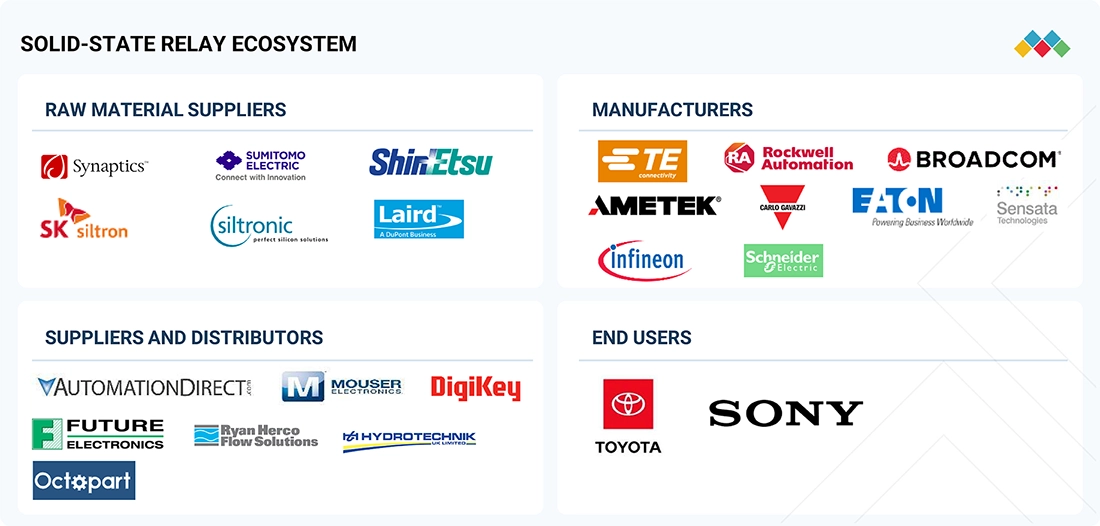
Solid State Relay Market: COMMERCIAL USE CASES ACROSS INDUSTRIES
| COMPANY | USE CASE DESCRIPTION | BENEFITS |
|---|---|---|
 |
High current SSR for industrial automation, automotive, industrial OEM, etc. | High-reliability components | Wide product portfolio for industrial and transportation | Robust global supply chain |
 |
Reliable SSRs for HVAC, medical devices, and industrial automation where silent, long-life switching is critical | Broad integration of SSRs into power management and automation solutions | Strong presence in industrial OEMs and infrastructure | Global customer base |
 |
PCB-mount SSRs for signal isolation, instrumentation, and low-to-medium power electronic switching | Optocoupler-based SSR technology | Strong R&D in communications and industrial applications | Solid IP portfolio |
 |
Advanced SSRs for industrial automation, high-voltage distribution, and rad-hard space/aerospace systems | Advanced semiconductor expertise driving energy-efficient SSRs | Strong foothold in automotive and power electronics | Wide global presence |
 |
Compact SSRs for home appliances, heating control, and renewable energy systems like solar inverters | Well-established global brand | Diverse SSR offerings for automation, building equipment, and automotive | Strong base in Asia Pacific |
Logos and trademarks shown above are the property of their respective owners. Their use here is for informational and illustrative purposes only.
Related Ecosystem
Electrical System And Components
- Natural Language Processing (NLP)
- Sensors
- Machine Learning
- Temperature Sensors
- Actuators
- ABB India Limited
- Siemens ag
- SCHNEIDER ELECTRIC SE
- Eaton Corporation plc
- General Electric Company
Key Takeaways
- The UK Solid State Relay market is valued at $80.3 million in 2025 and will grow to $108.3 million by 2030 at a 6.2% CAGR.
- The UK market is driven by industrial automation, renewable energy integration, and smart grid modernization initiatives.
- The UK benefits from strong demand in telecommunications, data centers, and critical infrastructure applications requiring high reliability.
- The UK market is expected to see increased competition and innovation as manufacturers develop energy-efficient and compact relay solutions.
Solid State Relay Market Report Scope
| Report Metric | Details |
|---|---|
| Base Year | 2025 |
| Fastest Growing Segment | AUTOMOTIVE (Application) |
| Forecast Period | 2025-2030 |
| Growth Rate | CAGR of 6.3% from 2025 to 2030 |
| Largest Segment | OPTO-COUPLED SSR (Type) |
| Market Size Base Year (Billions) | ~USD 1.74 (2025) |
| Revenue Forecast (Billions) | ~USD 2.36 (2030) |
| Segments Covered | Current Rating, Application, Mounting Type, Output Voltage, Type |
UK Solid State Relay Market Report Segmentation
5 segment dimensions are covered across the global market.
By Current Rating
- High
- Low
- Medium
By Application
- Automotive
- Building Equipment
- Communication
- Energy & Infrastructure
- Food & Beverages
- Industrial Automation
- Industrial OEM
- Medical
- Transportation
- Water Pumps
By Mounting Type
- Din Rail
- Din-Rail
- Other Mounting Types
- Panel
- Pcb
By Output Voltage
- Ac
- Ac/Dc
- Dc
By Type
- Opto-Coupled Ssr
- Other Types
- Reed-Relay Coupled Ssr
- Reed-Relay-Coupled Ssr
- Transformer-Coupled Ssr
UK: SOLID-STATE RELAY MARKET, BY APPLICATION, 2025–2030
| Segment | 2025 | 2026 | 2027 | 2028 | 2029 | 2030 | CAGR (%) |
|---|---|---|---|---|---|---|---|
| AUTOMOTIVE | 6.2 | 6.7 | 7.3 | 7.9 | 8.6 | 9.3 | 8.4 |
| BUILDING EQUIPMENT | 16.4 | 17.4 | 18.6 | 19.8 | 21.1 | 22.6 | 6.6 |
| COMMUNICATION | 2.6 | 2.6 | 2.7 | 2.8 | 2.9 | 3 | 3.3 |
| ENERGY & INFRASTRUCTURE | 8.1 | 8.4 | 8.8 | 9.2 | 9.7 | 10.2 | 4.8 |
| FOOD & BEVERAGES | 4.8 | 5 | 5.2 | 5.3 | 5.5 | 5.7 | 3.5 |
| INDUSTRIAL AUTOMATION | 19.3 | 20.6 | 22 | 23.6 | 25.4 | 27.3 | 7.2 |
| INDUSTRIAL OEM | 9.8 | 10.3 | 10.9 | 11.5 | 12.1 | 12.8 | 5.5 |
| MEDICAL | 8.5 | 9 | 9.5 | 10.1 | 10.8 | 11.5 | 6.3 |
| TRANSPORTATION | 2.1 | 2.2 | 2.4 | 2.6 | 2.8 | 3 | 7.2 |
| WATER PUMPS | 2.5 | 2.6 | 2.7 | 2.8 | 2.9 | 3 | 3 |
| TOTAL | 80.3 | 85 | 90.1 | 95.7 | 101.7 | 108.3 | 6.2 |
Target Audience
- UK Manufacturing Executives : Need market data to justify automation investments and understand competitive positioning in industrial relay adoption across UK manufacturing facilities and supply chains.
- Renewable Energy Project Developers : Require UK-specific market insights to evaluate solid state relay specifications, supplier availability, and cost structures for solar, wind, and energy storage projects.
- Telecommunications Infrastructure Planners : Seek market intelligence on relay technology trends and UK supplier capabilities to support 5G rollout and data center modernization initiatives across the country.
- Electronics Component Distributors : Need UK market forecasts and sector demand analysis to optimize inventory, negotiate supplier contracts, and identify high-growth customer segments in the British market.
- Strategic Business Consultants : Require comprehensive UK market data to advise clients on market entry strategies, acquisition targets, and growth opportunities in the solid state relay sector.
Reasons to Buy this Report
- UK-Specific Market Sizing : Obtain precise market valuation data exclusive to the UK, including 2025 baseline ($80.3M) and 2030 forecast ($108.3M), enabling accurate budget allocation and investment planning for UK operations.
- Sector-Focused Insights : Gain detailed analysis of UK demand drivers across industrial automation, renewable energy, and telecommunications—the three primary growth sectors—with actionable intelligence for market positioning.
- Competitive Landscape Analysis : Understand UK-specific competitive dynamics, supplier strategies, and market consolidation trends to identify partnership opportunities and competitive advantages in the British market.
- Regulatory & Policy Context : Access insights into UK energy policy, industrial standards, and regulatory frameworks influencing solid state relay adoption, critical for compliance and strategic planning.
- Growth Trajectory Planning : Leverage the 6.2% CAGR forecast to develop realistic expansion strategies, resource allocation, and revenue projections specific to the UK market through 2030.
Frequently asked questions
What is the current size of the UK Solid State Relay market?
The UK Solid State Relay market is valued at $80.3 million in 2025.
What is the projected size of the UK Solid State Relay market by 2030?
The UK Solid State Relay market is projected to reach $108.3 million by 2030.
What is the growth rate of the UK Solid State Relay market?
The UK Solid State Relay market is expected to grow at a compound annual growth rate (CAGR) of 6.2% from 2025 to 2030.
Which industries drive demand for solid state relays in the UK?
The UK market is primarily driven by industrial automation, renewable energy, telecommunications, data centers, and critical infrastructure sectors.
What factors are contributing to growth in the UK Solid State Relay market?
Key growth factors in the UK include smart grid investments, manufacturing automation, energy efficiency requirements, and the expansion of data center operations.
RESEARCH METHODOLOGY
The research process for this study included systematic gathering, recording, and analysis of data about customers and companies operating in the solid state relay market. This process involved extensive use of secondary sources, directories, and databases (Factiva and OANDA) to identify and collect valuable information for a comprehensive, technical, market-oriented, and commercial study of the solid state relay market.
In-depth interviews were conducted with primary respondents, including experts from core and related industries and preferred manufacturers, to gather and verify critical qualitative and quantitative information and assess growth prospects. Key players in the solid state relay market were identified through secondary research, and their market standings were determined through both primary and secondary research. This process involved reviewing annual reports of top companies and interviewing key industry experts, such as CEOs, directors, and marketing executives.
Secondary Research
Various sources were utilized in the secondary research process to gather information important for this study. These include company annual reports, press releases, investor presentations, white papers, technology journals, certified publications, articles by recognized authors, directories, and databases.
Secondary research was primarily used to gather essential information about the industry’s value chain, the overall pool of market players, market classification based on industry trends down to the most detailed level, regional markets, and significant developments from both market and technology perspectives.
Primary Research
Primary research was also carried out to identify segmentation types, key players, the competitive landscape, and important market dynamics such as drivers, restraints, opportunities, challenges, and industry trends, along with key strategies adopted by companies in the solid state relay market. Extensive qualitative and quantitative analyses were conducted on the entire market engineering process to gather key information and insights throughout the report.
Extensive primary research was conducted after gathering insights into the solid state relay market scenarios through secondary research. Several primary interviews were carried out with experts from both the demand side (application and region) and the supply side (solution type) across four major geographic regions: North America, Europe, Asia Pacific, and RoW. About 60% of the interviews were from the supply side, and 40% from the demand side. These primary data were collected through questionnaires, emails, and telephonic interviews.
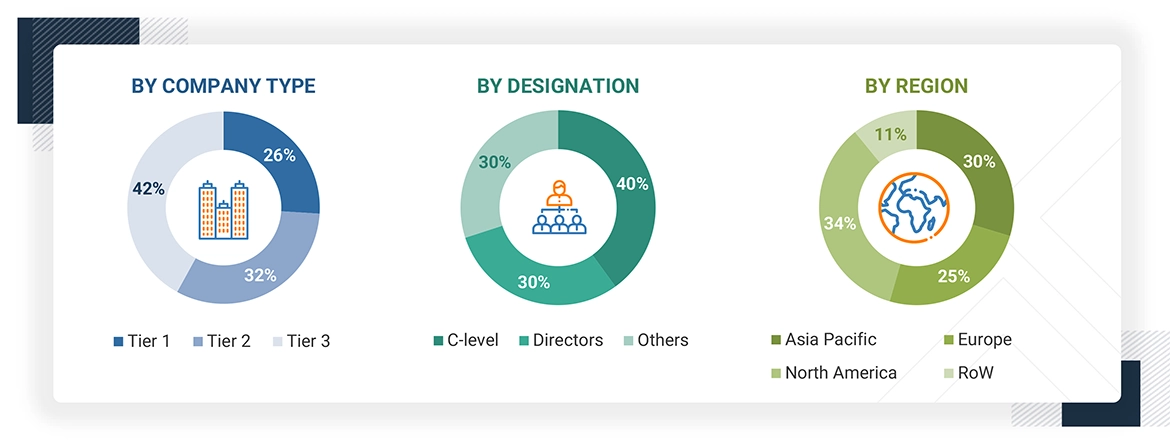
Note: The three tiers of the companies have been defined based on their total/segmental revenue as of 2024: Tier 1 = >USD 1 billion, Tier 2 = USD 1 billion–USD 500 million, and Tier 3 = USD 500 million. ‘Others’ include sales, marketing, and product managers.
To know about the assumptions considered for the study, download the pdf brochure
Market Size Estimation
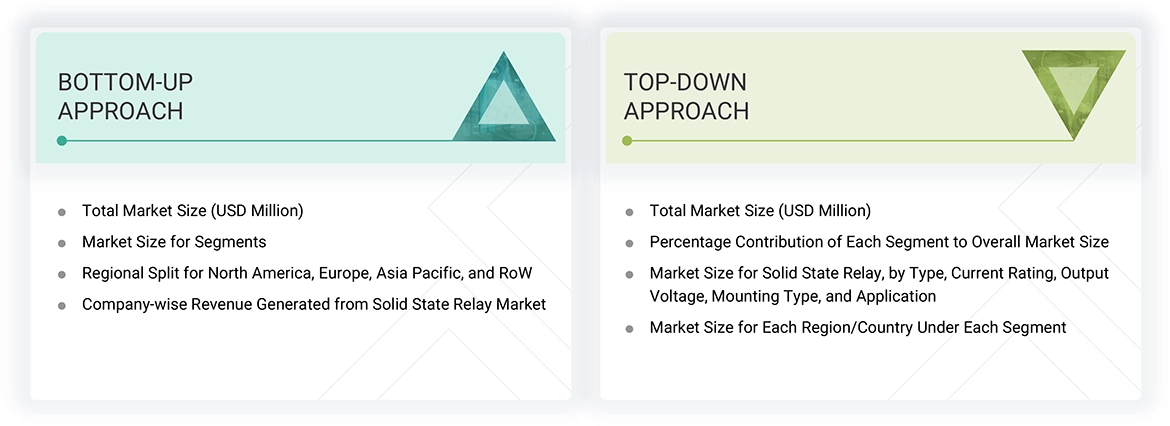
In the full market engineering process, both top-down and bottom-up approaches, along with several data triangulation methods, were used to estimate and validate the size of the solid state relay market and other related submarkets. Key market players were identified through secondary research, and their market shares in different regions were determined via primary and secondary research. This entire methodology involved analyzing the annual and financial reports of leading companies and conducting interviews with experts such as CEOs, VPs, directors, and marketing executives to gather key insights, both quantitative and qualitative.
All percentage shares, splits, and breakdowns were determined using secondary sources and verified through primary sources. All relevant parameters affecting the markets covered in this research were thoroughly examined, verified through primary research, and analyzed to produce final quantitative and qualitative data. This data was consolidated and enhanced with detailed inputs and analysis from MarketsandMarkets and presented in this report.
Solid State Relay Market : Top-Down and Bottom-Up Approach
Data Triangulation
After determining the overall market size through the estimation process, as explained above, the total market has been divided into several segments and subsegments. To complete the overall market analysis and obtain precise statistics for all segments and subsegments, market breakdown and data triangulation methods have been used where applicable. The data have been triangulated by examining various demand and supply factors and trends. Additionally, the market has been validated using top-down and bottom-up approaches.
Market Definition
A solid state relay (SSR) is an electronic switching device that utilizes semiconductor components—such as thyristors, triacs, MOSFETs, or IGBTs—in place of mechanical contacts to activate or deactivate electrical loads. SSRs are generally controlled by a low-voltage input signal and offer electrical isolation between the control circuit and the load, frequently through optical coupling. In contrast to electromechanical relays, SSRs lack moving parts, which affords them benefits including faster switching speeds, extended operational lifespan, silent operation, and increased resistance to shock, vibration, and mechanical deterioration. They are extensively employed in applications demanding dependable and maintenance-free switching, such as industrial automation, temperature control, motor drives, renewable energy systems, electric vehicles, medical apparatus, and communication equipment.
Key Stakeholders
- Suppliers of raw materials
- Technology investors
- Designers, manufacturers, and suppliers of solid state relays
- Integrators, suppliers, and service providers of solid state relays
- In-house testing laboratories
- System integrators
- Distributors, resellers, and traders
- Research institutions and organizations
- Solid state relay forums, alliances, consortiums, and associations
- Market research and consulting firms
- End users
Report Objectives
- To describe and forecast the solid state relay market, in terms of value, based on type, current rating, output voltage, mounting type, application, and region
- To describe and forecast the solid state relay market, in terms of volume, by current rating
- To forecast the market, in terms of value, for various segments with regard to four main regions: North America, Europe, Asia Pacific, and Rest of the World (RoW)
- To provide detailed information regarding the major factors, such as drivers, restraints, opportunities, and challenges, influencing the growth of the solid state relay market
- To analyze micromarkets with respect to individual growth trends, prospects, and contributions to the total market
- To study the complete supply chain and allied industry segments of the solid state relay landscape
- To strategically analyze the regulatory landscape, tariffs, standards, patents, Porter’s Five Forces, import and export scenarios, trade values, and case studies pertaining to the market under study
- To analyze opportunities in the market for various stakeholders by identifying the high-growth segments
- To profile key players and comprehensively analyze their market position in terms of ranking and core competencies, along with detailing the competitive landscape for market leaders
- To analyze competitive developments, such as product launches, acquisitions, partnerships, and expansions, in the solid state relay market
Customization Options:
With the given market data, MarketsandMarkets offers customizations according to the company’s specific needs. The following customization options are available for the report:
Get the Full Solid State Relay Market Report
Full forecast, segment splits, and company analysis for all Solid State Relay Market.
- US Solid State Relay Market
- Canada Solid State Relay Market
- Mexico Solid State Relay Market
- Germany Solid State Relay Market
- France Solid State Relay Market
- Italy Solid State Relay Market
- China Solid State Relay Market
- Japan Solid State Relay Market
- South Korea Solid State Relay Market
- India Solid State Relay Market
- Rest Of Europe Solid State Relay Market
- Rest Of Asia Pacific Solid State Relay Market
Need a Tailored Report?
Customize this report to your needs
Get 10% FREE Customization
Customize This Report
