
Japan System-on-Chip (SoC) Market (2024-2029)

The Japan System-on-Chip (SoC) Market was valued at $9180.2 Million in 2024 and projected to reach to $14077.3 Million by 2029, representing a compound annual growth rate of 8.9%. Japan's System-on-Chip market is poised for sustained expansion, driven by accelerating digital transformation across automotive, industrial IoT, and consumer electronics sectors.


| Market Size in | USD 26.32 MN |
| Market Forecast in | |
| CAGR | |
| Forecast Period | |
| Units Considered | Value (USD MN) |
Japan System-on-Chip (SoC) Market Trends and Insights
- Japan's semiconductor industry, driven by advanced manufacturing capabilities and strong demand from consumer electronics and automotive sectors, is a critical hub for SoC innovation in Asia Pacific.
- The 8.9% compound annual growth rate reflects Japan's strategic investments in next-generation chip design and production technologies. Japan's SoC market benefits from the country's leadership in mobile devices, gaming consoles, and automotive electronics.
- Japan's established ecosystem of semiconductor manufacturers and design firms positions the nation as a key player in global SoC supply chains.
- Between 2024 and 2029, Japan is expected to capture increasing market share through investments in AI-enabled chips, IoT solutions, and energy-efficient processors tailored for industrial applications. The competitive landscape in Japan remains dynamic, with domestic players leveraging technological expertise and regional partnerships to maintain growth momentum.
- Japan's commitment to semiconductor self-sufficiency and advanced packaging technologies will continue to drive SoC market expansion through the forecast period..
Key Market Statistics
- CAGR (2024-2029) 8.9% CAGR
- Market Size, 2024 ~USD 9180.2 Million
- Forecast, 2029 ~USD 14077.3 Million
- Country Japan
Japan System-on-Chip (SoC) Market Overview
Market Valuation & Growth :
Japan's SoC market reached USD 9,180.2 million in 2024 with a projected CAGR of 8.9% through 2029, outpacing the global growth rate of 8.3% and demonstrating Japan's strengthening position in semiconductor innovation.
Automotive & Consumer Electronics Demand :
Japan's robust automotive and consumer electronics sectors are primary drivers of SoC adoption, with manufacturers like Toyota, Sony, and Panasonic fueling demand for advanced chip integration in EVs, IoT devices, and smart appliances.
Advanced Manufacturing Capabilities :
Japan's world-class semiconductor fabrication infrastructure, including facilities from Sony Semiconductor Solutions and Renesas Electronics, positions the country as a critical hub for cutting-edge SoC design and production in Asia Pacific.
Asia Pacific Leadership :
As a key innovation center in Asia Pacific, Japan's SoC market expansion reflects regional demand for high-performance chips, establishing the nation as a strategic supplier for regional and global technology markets.
Japan System-on-Chip (SoC) Market Dynamics
- The country's commitment to semiconductor self-sufficiency and government initiatives supporting chip manufacturing will further strengthen market growth through 2029.
- Japan's established ecosystem of design expertise and manufacturing excellence positions it to capture growing demand for specialized SoCs in autonomous vehicles, 5G infrastructure, and edge computing applications. The forecasted growth to USD 14,077.3 million by 2029 reflects Japan's strategic importance in global semiconductor supply chains and its ability to innovate in high-value SoC segments.
- Collaboration between Japanese tech giants and emerging fabless companies will accelerate product development cycles.
- Investment in advanced process nodes and specialized chip architectures will enable Japan to maintain competitive advantages in premium SoC markets, particularly in automotive and industrial applications..
Market Ecosystem
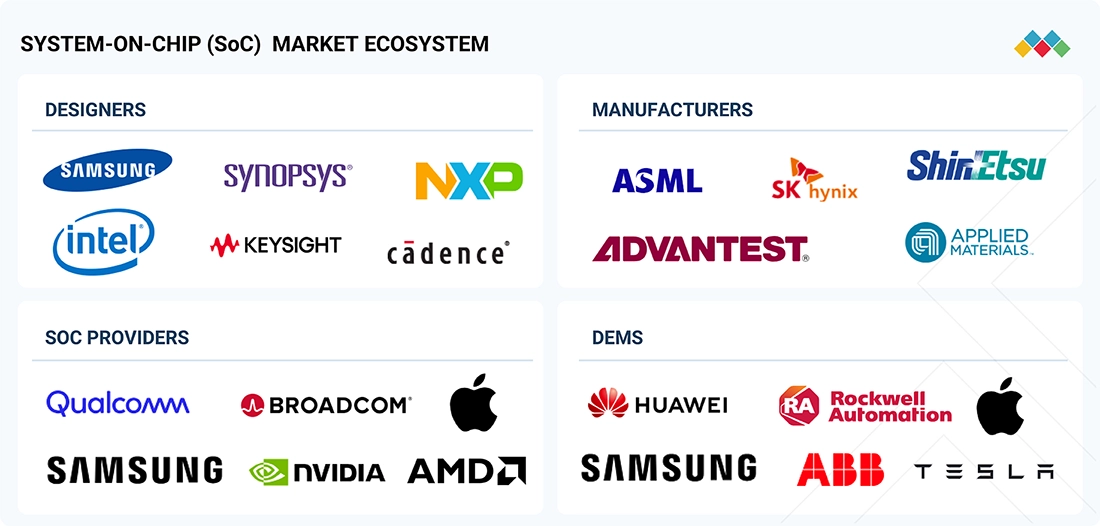
SYSTEM-ON-CHIP (SOC) MARKET SHARE, SIZE AND TRENDS, 2025: COMMERCIAL USE CASES ACROSS INDUSTRIES
| COMPANY | USE CASE DESCRIPTION | BENEFITS |
|---|---|---|
 |
AMD’s Zynq UltraScale+ MPSoC is integrated into Lauterbach GmbH’s TRACE32 PowerDebug modules to enable high-performance, adaptable multicore debugging with support for evolving chip architectures and advanced trace requirements. | The solution delivers faster debugging response times, high-bandwidth trace capabilities up to 80 Gb/s, and improved power efficiency, enabling Lauterbach to rapidly support new devices and meet advanced customer debugging needs. |
|
|
AMD’s Zynq UltraScale+ RFSoC is used by SiLC Technologies, Inc. to develop advanced FMCW LiDAR-based vision sensors by integrating RF data converters and processing on a single adaptive SoC. | The solution reduces system complexity and power consumption while enabling sub-millimeter precision, long-range LiDAR performance, and a scalable platform to support future vision-sensor innovations. |
|
|
AMD’s Zynq-7000S SoC is used by Tektronix, Inc. to modernize its entry-level TBS1000 oscilloscope family with enhanced software-defined acquisition and processing capabilities at a competitive cost. | The SoC-enabled design increases record length by 8× and waveform capture rate by 10×, while reducing system cost and time-to-market and ensuring long-term platform reliability. |
Logos and trademarks shown above are the property of their respective owners. Their use here is for informational and illustrative purposes only.
Related Ecosystem
Automotive Electronics And Electrical Equipment
- Battery Electric Vehicle (BEV)
- Light Commercial Vehicles (LCVs)
- Fuel Cell Electric Vehicle (FCEV)
- Sensors
- Hybrid Electric Vehicle (HEV)
- BOSCH LIMITED
- DENSO Corporation
- Continental ag
- Panasonic Holdings Corporation
- Texas Instruments Incorporated
Communication And Connectivity Technology
- Sensors
- Smart Card & Readers
- Cellular Network
- Femtocell
- Image Sensors
- Cisco Systems, Inc.
- HUAWEI TECHNOLOGIES CO LTD
- Lenovo
- CommScope Holding Company, Inc.
- Texas Instruments Incorporated
Electronics System And Components
- Sensors
- Temperature Sensors
- Pressure Sensors
- Actuators
- Image Sensors
- Lenovo
- Samsung
- Texas Instruments Incorporated
- HONEYWELL INTERNATIONAL INC.
- Teledyne Technologies Incorporated
Key Takeaways
- Japan's SoC market is valued at USD 9,180.2 million in 2024 and will reach USD 14,077.3 million by 2029, representing an 8.9% CAGR.
- Japan's automotive and consumer electronics sectors are primary growth drivers for SoC demand and innovation.
- Japan's semiconductor manufacturers are investing heavily in AI chips, IoT processors, and advanced packaging to maintain competitive advantage.
- Japan's strategic focus on semiconductor self-sufficiency positions the country as a resilient and critical node in global SoC supply chains.
System-on-Chip (SoC) Market Report Scope
| Report Metric | Details |
|---|---|
| Base Year | 2024 |
| Fastest Growing Segment | OTHER VERTICALS (Vertical) |
| Forecast Period | 2024-2029 |
| Growth Rate | CAGR of 8.3% from 2024 to 2029 |
| Largest Segment | ARM (Core Architecture) |
| Market Size Base Year (Billions) | ~USD 138.25 (2024) |
| Revenue Forecast (Billions) | ~USD 205.97 (2029) |
| Segments Covered | Core Count, Core Architecture, Vertical, Type |
Japan System-on-Chip (SoC) Market Report Segmentation
4 segment dimensions are covered across the global market.
By Core Count
- Dual-Core
- Hexa-Core
- Octa-Core
- Quad-Core
- Single-Core
By Core Architecture
- Arm
- Risc-V
- X86
By Vertical
- Automotive
- Computing & Data Storage
- Consumer Electronics
- Healthcare
- Industrial
- Network Infrastructure
- Other Verticals
By Type
- ADAS
- Gateways
- Infotainment Systems
- Laptops
- Macro Cells
- Routers
- Small Cells
- Smart Tvs & Set-Top Boxes
- Smartphones
- Smartwatches & Fitness Trackers
- Tablets
- Telematics & Connectivity
- Wifi Access Points
JAPAN: SYSTEM-ON-CHIP MARKET, BY VERTICAL, 2024–2029
| Segment | 2024 | 2025 | 2026 | 2027 | 2028 | 2029 | CAGR (%) |
|---|---|---|---|---|---|---|---|
| AUTOMOTIVE | 1012.2 | 1215.4 | 1387.3 | 1574.3 | 1775.3 | 1988.2 | 14.5 |
| COMPUTING & DATA STORAGE | 129.9 | 151.3 | 175.7 | 202.4 | 232.6 | 264.7 | 15.3 |
| CONSUMER ELECTRONICS | 6235.1 | 6722.5 | 7231.8 | 7756.4 | 8217.7 | 8662.5 | 6.8 |
| HEALTHCARE | 541.2 | 601 | 661.4 | 722.5 | 784 | 846.1 | 9.3 |
| INDUSTRIAL | 516.5 | 577.7 | 644.1 | 715.7 | 792.6 | 874.9 | 11.1 |
| NETWORK INFRASTRUCTURE | 349.2 | 423.6 | 492.9 | 561 | 600.9 | 641.5 | 12.9 |
| OTHER VERTICALS | 396.1 | 456 | 524.9 | 604.5 | 699.7 | 799.3 | 15.1 |
| TOTAL | 9180.2 | 10147.4 | 11118.1 | 12136.7 | 13102.9 | 14077.3 | 8.9 |
Target Audience
- Semiconductor Manufacturers : Japanese and international SoC producers need detailed market data to optimize product portfolios, identify growth segments, and benchmark performance against competitors in Japan's high-value automotive and industrial markets.
- Automotive OEMs & Suppliers : Japanese automotive manufacturers and Tier-1 suppliers require SoC market insights to source advanced chips for EVs and autonomous vehicles, ensuring supply chain resilience and technology roadmap alignment.
- Electronics & Appliance Manufacturers : Consumer electronics and smart appliance makers in Japan need market forecasts to plan SoC procurement strategies, evaluate emerging technologies, and maintain competitive product offerings.
- Investment & Private Equity Firms : Investors targeting Japan's semiconductor sector require comprehensive market data to evaluate acquisition targets, assess growth potential, and make informed capital allocation decisions in the SoC space.
- Technology Consultants & System Integrators : Consulting firms and integrators advising Japanese enterprises need localized SoC market intelligence to guide digital transformation initiatives, technology selection, and supply chain optimization strategies.
Reasons to Buy this Report
- Japan-Specific Market Sizing : Access precise valuation data for Japan's SoC market (USD 9,180.2M in 2024) with country-level forecasts through 2029, enabling accurate budgeting and investment decisions tailored to the Japanese market.
- Competitive Landscape Intelligence : Understand Japan's unique competitive dynamics, including major players like Renesas Electronics, Sony Semiconductor Solutions, and Rohm, with insights into their market positioning and strategic initiatives specific to Japan.
- Sector-Specific Demand Analysis : Gain detailed insights into Japan's automotive and consumer electronics sectors driving SoC adoption, including OEM requirements, supply chain relationships, and regional purchasing patterns.
- Growth Opportunity Identification : Identify high-growth segments within Japan's SoC market, including emerging applications in EVs, industrial IoT, and 5G infrastructure, with localized growth projections and market entry strategies.
- Strategic Partnership & Expansion Planning : Leverage Japan-focused market intelligence to identify partnership opportunities, distribution channels, and manufacturing collaborations with Japanese semiconductor firms and technology leaders.
Frequently asked questions
What is the current market size of the SoC industry in Japan?
Japan's System-on-Chip market was valued at USD 9,180.2 million in 2024 and is expected to grow to USD 14,077.3 million by 2029.
What is the projected growth rate for Japan's SoC market?
Japan's SoC market is projected to grow at a compound annual growth rate (CAGR) of 8.9% from 2024 to 2029.
Which industries drive SoC demand in Japan?
Japan's automotive, consumer electronics, gaming, and industrial IoT sectors are the primary drivers of SoC market demand.
What technological trends are shaping Japan's SoC market?
AI-enabled processors, energy-efficient chip designs, advanced packaging technologies, and IoT-focused solutions are key trends in Japan's SoC market.
How does Japan's SoC market compare to other Asia Pacific countries?
Japan maintains a significant share of the Asia Pacific SoC market through its advanced manufacturing capabilities, established semiconductor ecosystem, and strong domestic demand from high-tech industries.
RESEARCH METHODOLOGY
The research study involved the extensive use of secondary sources, directories, and databases (annual reports or presentations of companies, industry association publications, directories, technical handbooks, World Economic Outlook (WEO), trade websites, Hoovers, Bloomberg Businessweek, Factiva, and OneSource) to identify and collect information useful for this technical, market-oriented, and commercial study of the system-on-chip (SoC) market. Primary sources mainly comprise several experts from the core and related industries, along with preferred suppliers, manufacturers, distributors, service providers, system providers, technology developers, alliances, and standards and certification organizations related to various phases of this industry's value chain.
Secondary Research
In the secondary research process, various secondary sources were used to identify and collect information for this study. These include annual reports, press releases, and investor presentations of companies, whitepapers, certified publications, and articles from recognized associations and government publishing sources. Research reports from a few consortiums and councils were also consulted to structure qualitative content. Secondary sources included corporate filings (such as annual reports, investor presentations, and financial statements); trade, business, and professional associations; white papers; Journals and certified publications; articles by recognized authors; gold-standard and silver-standard websites; directories; and databases. Data was also collected from secondary sources, such as the International Trade Centre (ITC) (Switzerland), and the International Monetary Fund (IMF).
Primary Research
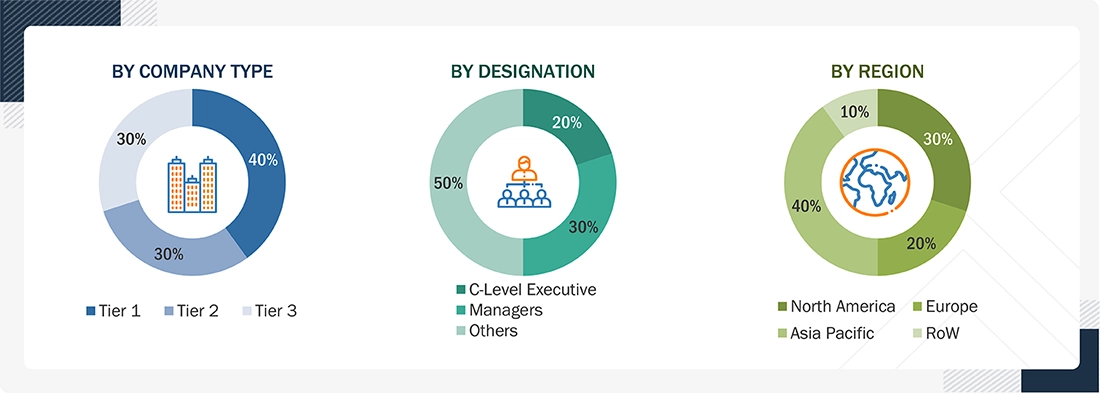
Extensive primary research was accomplished after understanding and analyzing the System-on-Chip (SoC) market scenario through secondary research. Several primary interviews were conducted with key opinion leaders from both demand- and supply-side vendors across four major regions-North America, Europe, Asia Pacific, and RoW. The primary interviews were conducted with the demand side to the extent of 40% and with the supply side to the extent of 60%. Primary data collected through questionnaires, emails, telephonic interviews, through the contact of various departments in organizations, sales, operations, and administration are considered to provide a holistic viewpoint in the report.
Note: The three tiers of companies are based on their total revenue as of 2023: Tier 1 - equal to or more than USD 1,000 million; Tier 2 - between USD 500 million and USD 1,000 million; and Tier 3 - less than or equal to USD 500 million. Other designations include managers and academicians.
About the assumptions considered for the study, To know download the pdf brochure
Market Size Estimation
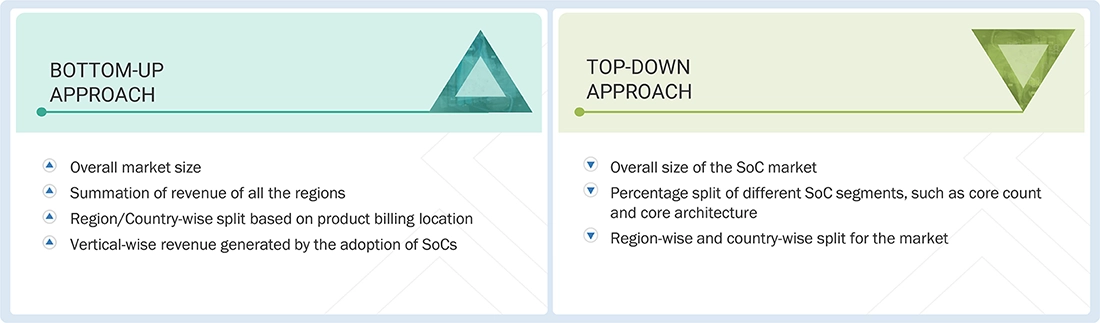
In the complete market engineering process, both top-down and bottom-up approaches were used, along with several data triangulation methods, to estimate and forecast the size of the market and its segments and subsegments listed in the report. Extensive qualitative and quantitative analyses were carried out on the complete market engineering process to list the key information/insights pertaining to System-on-Chip (SoC) market.
The key players in the market were identified through secondary research, and their rankings in the respective regions determined through primary and secondary research. This entire procedure involved the study of the annual and financial reports of top players, and interviews with industry experts such as chief executive officers, vice presidents, directors, and marketing executives for quantitative and qualitative key insights. All percentage shares, splits, and breakdowns were determined using secondary sources and verified through primary sources. All parameters that affect the markets covered in this research study were accounted for, viewed in extensive detail, verified through primary research, and analyzed to obtain the final quantitative and qualitative data. This data was consolidated, supplemented with detailed inputs and analysis from MarketsandMarkets, and presented in this report.
Data Triangulation
After arriving at the overall market size from the market size estimation process explained above, the total market was split into several segments and subsegments. Data triangulation and market breakdown procedures were employed, wherever applicable, to complete the overall market engineering process and arrive at the exact statistics for all segments and subsegments. The data was triangulated by studying various factors and trends from both demand and supply sides. Along with this, the market size was validated using both top-down and bottom-up approaches.
Market Definition
A System-on-Chip is an integrated circuit or an IC that integrates an entire electronic or computer system on a single chip instead of its use with individual components. The typical components usually found within this IC include the central processing unit, memory interfaces, I/O ports, and other specialized functions, like graphics processing units, NPU, and wireless communication modules. Therefore, SoCs are designed for such miniature systems where the design can provide a complete system solution on one chip in a compact form and will result in reduced power consumption, smaller device sizes, and better performance. Thus, they prove to be very practical for major applications in mobile devices, embedded systems, Internet of Things (IoT), and industrial applications.
This market will encompass all types of cargo ships, passenger ships, as well as other commercial vessels that can be turned into a methanol-fueled vessel due to its combustion profile, storage properties, and scalability. Green methanol has the highest potential for long-haul routes because it offers energy density, potentially being significantly more efficient than battery- or hydrogen-based fuel.
Stakeholders
- Government and financial institutions and investment communities
- Analysts and strategic business planners
- Semiconductor product designers and fabricators
- Application providers
- SoC providers
- Business providers
- Professional service/solution providers
- Research organizations
- Technology standard organizations, forums, alliances, and associations
- Technology investors
Report Objectives
- To define, describe, segment, and forecast the size of the System-on-Chip (SoC) market, in terms of value, based on core count, core architecture, vertical, and region
- To forecast the size of the market segments for four major regions—North America, Europe, Asia Pacific, and the Rest of the World (RoW)
- To define, describe, segment, and forecast the size of the System-on-Chip (SoC) market, in terms of volume, based on vertical
- To provide detailed information regarding drivers, restraints, opportunities, and challenges influencing the growth of the market
- To provide an ecosystem analysis, case study analysis, patent analysis, technology analysis, pricing analysis, Porter's five forces analysis, investment and funding scenario, and regulations pertaining to the market
- To provide a detailed overview of the value chain analysis of the system-on-chip ecosystem
- To strategically analyze micromarkets1 with regard to individual growth trends, prospects, and contributions to the total market
- To analyze opportunities for stakeholders by identifying high-growth segments of the market
- To strategically profile the key players, comprehensively analyze their market positions in terms of ranking and core competencies2, and provide a competitive market landscape.
- To analyze strategic approaches such as product launches, acquisitions, agreements, and partnerships in the System-on-Chip (SoC) market
Available Customizations
With the given market data, MarketsandMarkets offers customizations according to the company’s specific needs. The following customization options are available for the report:
Company Information:
- Detailed analysis and profiling of additional market players (up to 7)
Get the Full System-on-Chip (SoC) Market Report
Full forecast, segment splits, and company analysis for all System-on-Chip (SoC) Market.
- US System-on-Chip (SoC) Market
- Canada System-on-Chip (SoC) Market
- Mexico System-on-Chip (SoC) Market
- UK System-on-Chip (SoC) Market
- Germany System-on-Chip (SoC) Market
- France System-on-Chip (SoC) Market
- Italy System-on-Chip (SoC) Market
- China System-on-Chip (SoC) Market
- India System-on-Chip (SoC) Market
- South Korea System-on-Chip (SoC) Market
- Rest Of Europe System-on-Chip (SoC) Market
- Rest Of Asia Pacific System-on-Chip (SoC) Market
Need a Tailored Report?
Customize this report to your needs
Get 10% FREE Customization
Customize This Report
