
India Space Sensors and Actuators Market (2025-2030)

The India Space Sensors and Actuators Market was valued at $95.5 Million in 2025 and projected to reach to $227.4 Million by 2030, representing a compound annual growth rate of 19.0%. India's space sensors and actuators market is poised for exceptional growth over the next five years, driven by substantial government investments in space exploration and satellite technology.


| Market Size in | USD 26.32 MN |
| Market Forecast in | |
| CAGR | |
| Forecast Period | |
| Units Considered | Value (USD MN) |
India Space Sensors and Actuators Market Trends and Insights
- This exceptional growth trajectory, driven by India's ambitious space exploration programs and satellite development initiatives, positions India as a high-growth market within the Asia Pacific region.
- India's investments in indigenous space capabilities, including the Chandrayaan and Mangalyaan missions, are catalyzing demand for advanced sensor and actuator technologies. The 19.0% compound annual growth rate reflects India's strategic focus on self-reliance in space technology and the expansion of its commercial space sector.
- India's growing constellation of Earth observation and communication satellites necessitates sophisticated sensing and actuation systems for mission-critical applications.
- Between 2025 and 2030, India is expected to strengthen its position as a key player in space technology manufacturing, supported by government initiatives and private sector participation in the aerospace and defence ecosystem..
Key Market Statistics
- CAGR (2025-2030) 19.0% CAGR
- Market Size, 2025 ~USD 95.5 Million
- Forecast, 2030 ~USD 227.4 Million
- Country India
India Space Sensors and Actuators Market Overview
Rapid Market Expansion :
India's space sensors and actuators market is projected to grow from USD 95.5 million in 2025 to USD 227.4 million by 2030, representing a robust 19% CAGR—more than double the global growth rate of 8.6%.
Government-Backed Space Initiatives :
India's ambitious space exploration programs, including Chandrayaan and Mangalyaan missions, coupled with the Indian Space Research Organisation's (ISRO) satellite development initiatives, are primary drivers of market growth and indigenous technology development.
Indigenous Technology Development :
India is increasingly investing in developing homegrown space sensor and actuator technologies, reducing dependency on imports and creating opportunities for domestic manufacturers and technology providers in the aerospace and defence sector.
Asia Pacific Leadership Position :
India's exceptional growth trajectory positions it as a high-growth market within the Asia Pacific region, attracting significant investments from global and regional players seeking to capitalize on India's space sector expansion.
India Space Sensors and Actuators Market Dynamics
- The country's commitment to developing indigenous space capabilities through ISRO's flagship missions and the emerging commercial space sector creates sustained demand for advanced sensor and actuator solutions.
- With a 19% CAGR significantly outpacing global averages, India represents a compelling growth opportunity for technology providers and manufacturers. The market's expansion is further supported by India's strategic focus on self-reliance in space technology and the growing participation of private sector companies in satellite manufacturing and launch services.
- As India strengthens its position in global space markets and develops next-generation satellite systems, the demand for high-performance sensors and actuators will continue to accelerate, creating substantial opportunities for both established players and emerging innovators in the aerospace and defence ecosystem..
Market Ecosystem
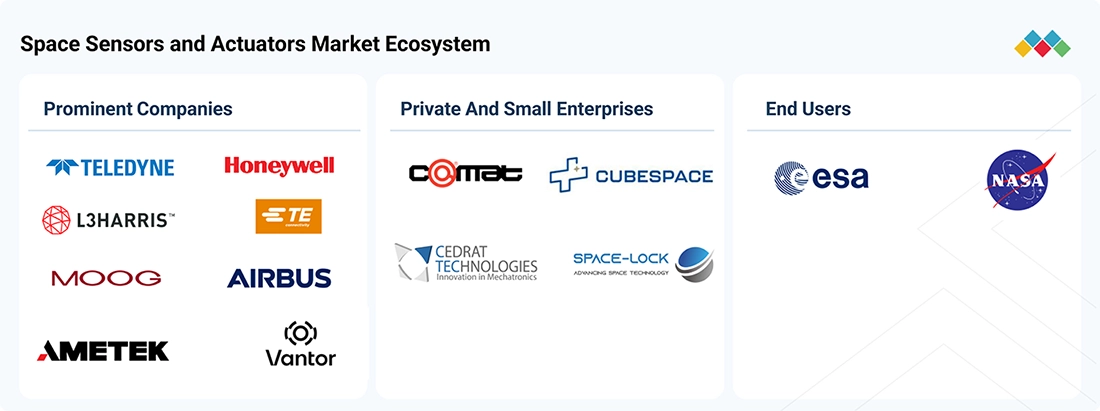
SPACE SENSORS AND ACTUATORS MARKET SIZE, SHARE, & FORECAST: COMMERCIAL USE CASES ACROSS INDUSTRIES
| COMPANY | USE CASE DESCRIPTION | BENEFITS |
|---|---|---|
 |
Development of high-reliability radiation-hardened image sensors and precision actuator systems for spaceborne scientific instruments and deep space observation missions; Teledyne’s CMOS and infrared sensor arrays are integrated into NASA and ESA payloads to deliver ultra-high-resolution imaging with low power consumption and extended operational life in extreme radiation environments. | Component Manufacturing & System Integration – Design, fabrication, and qualification of advanced space-grade imaging sensors and electromechanical actuators for optical payloads, planetary probes, and astrophysics missions. |
 |
Implementation of AI-based health monitoring for actuator assemblies to predict component wear, optimize torque distribution, and prevent mission-critical failures in spacecraft systems. | Integration & Operations – Real-time actuator diagnostics and predictive maintenance across propulsion and control subsystems. |
 |
Use of sensor fusion and AI algorithms for autonomous spacecraft guidance and adaptive mission planning in GNSS-denied deep-space missions. | Systems Integration – Combining multi-sensor data streams for intelligent navigation and in-orbit decision-making. |
Logos and trademarks shown above are the property of their respective owners. Their use here is for informational and illustrative purposes only.
Related Ecosystem
Space
- C-Band
- Small Satellite
- Antennas
- Ka-Band
- Microsatellite
- AIRBUS
- L3Harris Technologies, Inc.
- Thales group
- Northrop Grumman Corporation
- LOCKHEED MARTIN CORPORATION
Key Takeaways
- India's space sensors and actuators market is valued at USD 95.5 million in 2025 and is forecast to grow to USD 227.4 million by 2030, representing a 19.0% CAGR.
- India's ambitious space exploration programs and satellite development initiatives are primary drivers of market growth in the sensors and actuators segment.
- India's focus on indigenous space technology development and self-reliance is accelerating demand for advanced sensing and actuation systems across government and commercial sectors.
- India's expanding commercial space ecosystem and private sector participation are expected to create new opportunities for space sensors and actuators manufacturers through 2030.
Space Sensors and Actuators Market Report Scope
| Report Metric | Details |
|---|---|
| Base Year | 2025 |
| Fastest Growing Segment | CREWED SPACECRAFT OR HUMAN SPACE FLIGHT (Capsule/Cargo Type) |
| Forecast Period | 2025–2030 |
| Growth Rate | CAGR of 8.6% from 2025 to 2030 |
| Largest Segment | SATELLITES (Platform) |
| Market Size Base Year (Billions) | ~USD 4.81 (2025) |
| Revenue Forecast (Billions) | ~USD 7.26 (2030) |
| Segments Covered | Product Type, Sensor Type, Attitude & Navigation Sensor Type, Environmental Sensor Type, Image Sensor Type, Actuator Type, Linear Actuator Type, Rotary Actuator Type, Platform, Satellite Type, Small Satellite Type, Capsule/Cargo Type, Launch Vehicle Type, Application, End User, Commercial End User, Government & Defense End User |
India Space Sensors and Actuators Market Report Segmentation
17 segment dimensions are covered across the global market.
By Product Type
- Actuators
- Sensors
By Sensor Type
- Attitude & Navigation Sensors
- Environmental Sensors
- Image Sensors
- Other Sensors
- Proximity, Position, And Ranging Sensors
- Scientific Sensors
By Attitude & Navigation Sensor Type
- Accelerometers
- Earth Horizon Sensors
- Gnss Receivers
- Gyroscopes
- Magnetometers
- Star Sensors
- Sun Sensors
By Environmental Sensor Type
- Atmospheric/Gas Sensors
- Electrical Current/Voltage Sensors
- Flow Meters
- Pressure Sensors
- Radiation Dosimeters
- Temperature Sensors
By Image Sensor Type
- Electro-Optical Sensors
- Radar Imaging Sensors
- Thermal Imaging Sensors
By Actuator Type
- Linear Actuators
- Rotary Actuators
By Linear Actuator Type
- Electric
- Hydraulic
- Pneumatic
- Smart Materials
By Rotary Actuator Type
- Electric
- Hydraulic
- Pneumatic
- Smart Materials
By Platform
- Capsules/Cargo
- Capsules/Cargos
- Interplanetary Spacecraft And Probes
- Launch Vehicles
- Rovers/Spacecraft Landers
- Satellites
By Satellite Type
- Cubesats
- Large Satellites
- Medium Satellites
- Small Satellites
By Small Satellite Type
- Micro Satellite
- Mini Satellite
- Nano Satellite
By Capsule/Cargo Type
- Crewed Spacecraft Or Human Space Flight
- Uncrewed Or Unmanned Spacecraft
By Launch Vehicle Type
- Medium To Heavy Launch Vehicles (>350,000 Kg)
- Small Launch Vehicles (<350,000 Kg)
By Application
- Attitude & Orbital Control System
- Attitude & Orbital Control Systems
- Communication Pointing & Rf Switching
- Deployment & Separation Systems
- Instrument Pointing & Opto-Mechanisms
- Propulsion & Fluid Systems
- Proximity, Berthing, And Docking Systems
- Proximity, Berthing, And Docking Systems
- Robotic Arms/Manipulator Systems
- Solar Array Drive Mechanisms
- Surface Mobility And Navigation Systems
- Thermal Control Systems
- Thrust Vector Control Systems
By End User
- Commercial
- Government & Defense
By Commercial End User
- Commercial Operators & Owners
- In-Orbit Service Provider
- In-Orbit Services Providers
- Payload Providers
- Payload/Instrument Primes
- Satellite And Launch Vehicle Manufacturers
By Government & Defense End User
- Academia & Research
- Department Of Defense
- Departments Of Defense
- National Space Agencies
INDIA: SPACE SENSORS AND ACTUATORS MARKET, BY END USER, 2025–2030
| Segment | 2025 | 2026 | 2027 | 2028 | 2029 | 2030 | CAGR (%) |
|---|---|---|---|---|---|---|---|
| COMMERCIAL | 29.9 | 37.6 | 35.2 | 61 | 67.7 | 74.6 | 20.1 |
| GOVERNMENT & DEFENSE | 65.6 | 81.4 | 75.2 | 128.4 | 140.6 | 152.8 | 18.4 |
| TOTAL | 95.5 | 119.1 | 110.4 | 189.4 | 208.4 | 227.4 | 19 |
Target Audience
- ISRO & Government Agencies : Government space organizations need detailed market intelligence to plan procurement strategies, identify qualified domestic suppliers, and support India's self-reliance objectives in space sensor and actuator technologies.
- Aerospace & Defence Manufacturers : Indian and international aerospace companies require market insights to understand growth opportunities, competitive positioning, and technology requirements for satellite and space vehicle development programs in India.
- Technology & Component Suppliers : Sensor and actuator manufacturers need India-specific data to identify market entry opportunities, assess demand from ISRO and private space companies, and develop localized product offerings for the Indian market.
- Private Space Companies & Startups : Emerging Indian space startups and commercial satellite operators require market analysis to understand growth potential, funding opportunities, and technology partnerships needed to compete in India's expanding space sector.
- Investment & Venture Capital Firms : Investors evaluating opportunities in India's aerospace and defence sector need comprehensive market data to assess growth potential, identify promising companies, and make informed investment decisions in space technology ventures.
Key Companies in the India Space Sensors and Actuators Market
| Company | HQ | Ownership | Strongest segments |
|---|---|---|---|
| LEONARDO S.P.A. | Italy | Public Company | Helicopters (military and civil, plus support),Defense electronics, C4, radars, optronics, EW, and air traffic management,Aircraft (trainers, fighters, multi-mission transport/surveillance), |
| L3HARRIS TECHNOLOGIES, INC. | United States | Public Company | Communications & Spectrum Dominance (CSD),Space & Mission Systems (SMS),Missile Solutions (MSL), |
| RTX | United States | Public Company | Collins Aerospace (avionics, interiors, mission systems, aftermarket),Pratt & Whitney (commercial and military engines, APU, MRO),Raytheon (sensors, effectors, command-and-control, space systems), |
| TEXAS INSTRUMENTS INCORPORATED | United States | Public Company | Analog – Power,Analog – Signal Chain,Embedded Processing, |
| AMETEK.INC. | United States | Public Company | Electronic Instruments Group (EIG) – process, analytical, and power quality,Aerospace and defense sensors, embedded computing, and MRO,Engineered medical components and single-use devices, |
| RUAG GROUP | Switzerland | Private Company | Aerostructures – civil aircraft,Aerostructures – military aircraft and services,Beyond Gravity – payload fairings and separation systems, |
| ANALOG DEVICES, INC. | United States | Public Company | Data converters and signal chain ICs,Power management and reference ICs,RF and microwave ICs, |
| BAE SYSTEMS | United Kingdom | Public Company | Air (combat air systems, Eurofighter, related services),Electronic Systems (EW, avionics, sensors, space electronics),Maritime (submarines, ship build, support), |
LEONARDO S.P.A.
Leonardo S.p.A. is an Italian defense and aerospace company founded in 1948, operating as a publicly traded enterprise. With 65,455 employees, the company is a major player in the global defense and security sector.
L3HARRIS TECHNOLOGIES, INC.
L3Harris Technologies, Inc. is a U.S.-based public company founded in 1895, employing 45,000 people. The company operates in defense, aerospace, and security technology sectors.
RTX
RTX is a publicly traded American company founded in 1934 with 180,000 employees. The company is a major defense and aerospace contractor serving global markets.
TEXAS INSTRUMENTS INCORPORATED
Texas Instruments Incorporated is an American public company founded in 1930, employing 33,000 people. The company is a leading manufacturer of semiconductors and analog integrated circuits.
AMETEK.INC.
AMETEK, Inc. is a U.S.-based public company established in 1930 with 22,500 employees. The company manufactures electronic instruments and electromechanical devices for industrial and commercial applications.
RUAG GROUP
RUAG Group is a Swiss private company founded in 1999, employing 1,813 people. The company operates in the aerospace and defense sectors.
ANALOG DEVICES, INC.
Analog Devices, Inc. is an American public company founded in 1965 with 24,500 employees. The company designs and manufactures analog, mixed-signal, and digital signal processing integrated circuits.
BAE SYSTEMS
BAE Systems is a British public company founded in 1979, employing 111,400 people. The company is a major global defense, aerospace, and security contractor.
Reasons to Buy this Report
- High-Growth Market Opportunity : With a 19% CAGR, India's market is growing more than twice as fast as the global average, offering exceptional ROI potential for investors and businesses entering or expanding in the Indian space sector.
- Government Support & Policy Backing : ISRO's ambitious missions and India's 'Make in India' initiative create a favorable regulatory environment and guaranteed demand from government contracts, reducing market entry risks for suppliers and manufacturers.
- Indigenous Technology Localization : Understand the shift toward domestic manufacturing and technology development in India, enabling businesses to identify partnership opportunities, joint ventures, and supply chain integration points with Indian aerospace companies.
- Competitive Intelligence & Market Positioning : Gain detailed insights into India-specific market dynamics, competitive landscape, and emerging players to develop targeted strategies for market penetration and competitive differentiation in this high-growth segment.
- Future-Ready Strategic Planning : Leverage comprehensive India market data to forecast demand trends, identify technology gaps, and align product development roadmaps with India's evolving space sector requirements through 2030 and beyond.
Frequently asked questions
What is the current market size of space sensors and actuators in India?
India's space sensors and actuators market was valued at USD 95.5 million in 2025, according to verified market data.
What is the projected market size for India's space sensors and actuators market by 2030?
India's space sensors and actuators market is projected to reach USD 227.4 million by 2030, growing at a 19.0% CAGR.
What is driving growth in India's space sensors and actuators market?
India's space sensors and actuators market growth is driven by ambitious space exploration programs, satellite development initiatives, and government focus on indigenous space technology development.
How does India's market growth compare to global trends?
India's space sensors and actuators market is growing at 19.0% CAGR, significantly outpacing the global market CAGR of 8.6%, reflecting India's strategic investments in space capabilities.
What sectors are driving demand for space sensors and actuators in India?
India's government space agencies, commercial satellite operators, and private aerospace companies are primary drivers of demand for advanced sensors and actuators in the space sector.
RESEARCH METHODOLOGY
The space sensors and actuators market is estimated to be USD 5.75 billion in 2026 and is projected to reach USD 9.04 billion by 2031 at a CAGR of 9.5%. This research study involved the use of extensive secondary sources, directories, and databases (e.g., Hoovers, Bloomberg Business, Factiva, and OneSource) to identify and collect information useful for this technical, market-oriented, and commercial study of the space sensors and actuators market. Primary sources included several industry experts from the core and related industries and preferred suppliers, manufacturers, distributors, technology developers, IP vendors, standards, and organizations related to all the segments of this industry’s value chain. In-depth interviews were conducted with various primary respondents, including key industry participants, subject matter experts (SMEs), C-level executives of key market players, and industry consultants to obtain and verify critical qualitative and quantitative information, as well as to assess the prospects.
Secondary Research
In the secondary research process, various secondary sources were referred to for identifying and collecting information for this study. The secondary sources included annual reports, press releases, and investor presentations of companies; white papers, journals, and certified publications; articles from recognized authors; and websites, directories, and databases. Secondary research was mainly used to obtain key information about the industry’s supply chain, the market’s value chain, major players, market classification, and segmentation according to industry trends to the bottommost level, geographic markets, and key developments from both market- and technology-oriented perspectives. The secondary data was collected and analyzed to arrive at the overall market size, which was further validated by primary research.
Primary Research
Extensive primary research was conducted after acquiring information on the space sensors and actuators market through secondary research. Several primary interviews were conducted with market experts from the demand and supply sides across major countries of North America, Europe, Asia Pacific, the Middle East, and the Rest of the World. Primary data were collected through questionnaires, emails, and telephonic interviews.
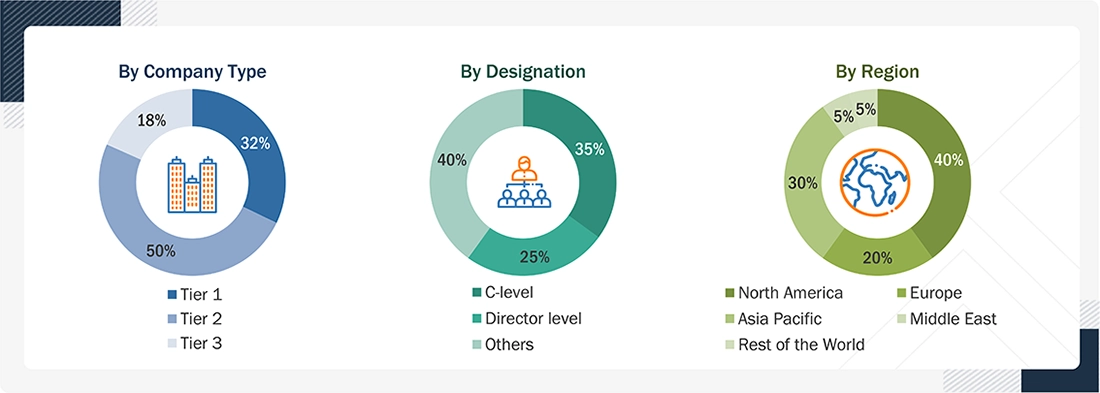
To know about the assumptions considered for the study, download the pdf brochure
Market Size Estimation
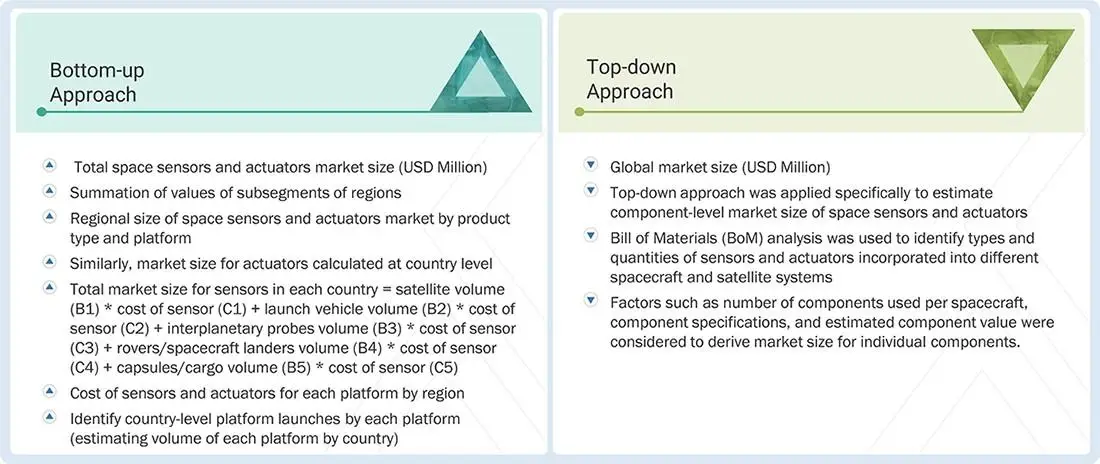
Top-down and bottom-up approaches were used to estimate and validate the size of the space sensors and actuators market. The research methodology used to estimate the size of the market included the following details:
- Key players in the space sensors and actuators market were identified through secondary research, and their market shares were determined through a combination of primary and secondary research. This included a study of the annual and financial reports of the top market players, as well as extensive interviews with leaders, including directors, engineers, marketing executives, and other key stakeholders of leading companies operating in the market.
- All percentage shares, splits, and breakdowns were determined using secondary sources and verified through primary sources.
- All possible parameters that affect the markets covered in this research study were accounted for, viewed in extensive detail, verified through primary research, and analyzed to obtain the final quantitative and qualitative data on the space sensors and actuators market. This data was consolidated, enhanced with detailed input, analyzed by MarketsandMarkets, and presented in this report.
Space Sensors and Actuators Market : Top-Down and Bottom-Up Approach
Data Triangulation
After determining the overall market size, the total market was classified into several segments and subsegments. The data triangulation and market breakdown procedures explained below were implemented, wherever applicable, to complete the overall market engineering process and arrive at the estimated market numbers for the market segments and subsegments. The data were triangulated by examining various factors and trends on both the demand and supply sides. Additionally, the market size was validated using top-down and bottom-up approaches.
Market Definition
Space sensors and actuators are the fundamental components that enable spacecraft, satellites, and planetary systems to perceive their environment and interact with it effectively. Sensors detect parameters such as temperature, radiation, position, pressure, or light, converting them into electrical signals for onboard processing. Actuators respond to these signals by generating physical movement or control actions such as adjusting orientation, deploying solar panels, or steering thrusters. Together, they form the core of spacecraft control, navigation, and mission execution systems. This domain covers technologies used in attitude control, propulsion, thermal regulation, robotics, and payload operation, making sensors and actuators essential for the safe, accurate, and autonomous functioning of all modern space missions.
Key Stakeholders
- Satellite Manufacturers
- Satellite Integrators
- Space Agencies and Government Bodies
- Sensor and Actuator Component Manufacturers
- Launch Vehicle and Propulsion Companies
- Research Institutions
- Component and Subsystem Suppliers
Report Objectives
- To define, describe, segment, and forecast the size of the space sensors and actuators market based on product type, platform, application, end user, and region
- To forecast the sizes of various segments of the market with respect to four major regions: North America, Europe, Asia Pacific, the Middle East, and the Rest of the World, along with major countries in each of these regions
- To identify and analyze the drivers, restraints, opportunities, and challenges influencing the growth of the market
- To identify industry trends, market trends, and technology trends currently prevailing in the market
- To analyze micromarkets with respect to growth trends, prospects, and their contribution to the overall market
- To analyze opportunities in the market for stakeholders by identifying key market trends
- To profile key market players and comprehensively analyze their market share and core competencies
- To evaluate the degree of competition in the market by analyzing recent developments, such as contracts, agreements, and acquisitions adopted by leading market players
- To identify detailed financial positions, key products, and unique selling points of leading companies in the market
- To provide a detailed competitive landscape of the market, along with market share analysis and revenue analysis of key players
Customization Options
MarketsandMarkets offers the following customizations for this market report:
- Additional country-level analysis of the space sensors and actuators market
- Profiling of other market players (up to five)
Product Analysis
- Product matrix, which gives a detailed comparison of the product portfolio of each company
Product Analysis
- Product matrix, which provides a detailed comparison of the product portfolios of each company in the space sensors and actuators market
Get the Full Space Sensors and Actuators Market Report
Full forecast, segment splits, and company analysis for all Space Sensors and Actuators Market.
- Canada Space Sensors and Actuators Market
- US Space Sensors and Actuators Market
- France Space Sensors and Actuators Market
- Germany Space Sensors and Actuators Market
- Italy Space Sensors and Actuators Market
- Russia Space Sensors and Actuators Market
- UK Space Sensors and Actuators Market
- China Space Sensors and Actuators Market
- Japan Space Sensors and Actuators Market
- South Korea Space Sensors and Actuators Market
- Australia Space Sensors and Actuators Market
- Saudi Arabia Space Sensors and Actuators Market
- UAE Space Sensors and Actuators Market
Need a Tailored Report?
Customize this report to your needs
Get 10% FREE Customization
Customize This Report
