
Asia Pacific Space Situational Awareness Market (2025-2030)

The Asia Pacific Space Situational Awareness Market was valued at $301.5 Million in 2025 and projected to reach to $619.1 Million by 2030, representing a compound annual growth rate of CAGR 15.5%. The Asia Pacific Space Situational Awareness Market is poised for exceptional growth through 2030, projected to reach USD 619.1 million with sustained 15.5% CAGR.


| Market Size in | USD 26.32 MN |
| Market Forecast in | |
| CAGR | |
| Forecast Period | |
| Units Considered | Value (USD MN) |
Asia Pacific Space Situational Awareness Market Trends and Insights
- Asia Pacific's market growth significantly outpaces the global average of 10% CAGR, driven by increasing satellite proliferation, rising geopolitical tensions, and accelerated space infrastructure investments across the region.
- Nations including India, Japan, South Korea, and Australia are prioritizing space domain awareness capabilities to protect critical orbital assets and enhance national security. Asia Pacific's 15.5% compound annual growth rate reflects heightened demand for advanced tracking systems, collision avoidance technologies, and real-time space object monitoring solutions.
- The region's expanding commercial space sector, coupled with government initiatives to develop indigenous space surveillance networks, creates substantial opportunities for technology providers and defense contractors.
- By 2030, Asia Pacific is expected to consolidate its position as a critical hub for space situational awareness innovation and deployment, supporting both military and civilian space operations..
Key Market Statistics
- CAGR (2025-2030) CAGR 15.5%
- Market Size, 2025 ~USD 301.5 Million
- Forecast, 2030 ~USD 619.1 Million
- Geography Asia Pacific
Asia Pacific Space Situational Awareness Market Overview
Rapid Market Expansion :
Asia Pacific Space Situational Awareness Market is valued at USD 301.5 million in 2025, with a robust 15.5% CAGR—significantly outpacing the global average of 10%, reflecting the region's strategic importance in space infrastructure development.
Geopolitical Drivers :
Rising geopolitical tensions across Asia Pacific, particularly in the Indo-Pacific region, are accelerating demand for advanced space surveillance and tracking capabilities to monitor satellite activities and ensure national security.
Satellite Proliferation :
Exponential growth in satellite launches and mega-constellation deployments by regional players and international operators are creating urgent demand for comprehensive space situational awareness solutions to manage orbital congestion and collision avoidance.
Infrastructure Investment Surge :
Major Asia Pacific nations are substantially increasing space program budgets and establishing dedicated space agencies, driving investments in ground-based tracking systems, data analytics platforms, and integrated SSA networks.
Asia Pacific Space Situational Awareness Market Dynamics
- This acceleration is underpinned by critical factors including satellite constellation expansion, heightened space domain awareness requirements, and regional competition in space capabilities.
- Countries across Asia Pacific are prioritizing space security as a strategic imperative. Key growth catalysts include increased military and civilian space operations, emerging space debris management needs, and collaborative regional initiatives for space monitoring.
- Investment in advanced sensor technologies, AI-driven analytics, and integrated command centers will define market evolution.
- The region's young space industry, combined with geopolitical dynamics, positions Asia Pacific as the fastest-growing market segment globally, attracting significant technology providers and creating substantial opportunities for specialized SSA solution vendors..
Market Ecosystem
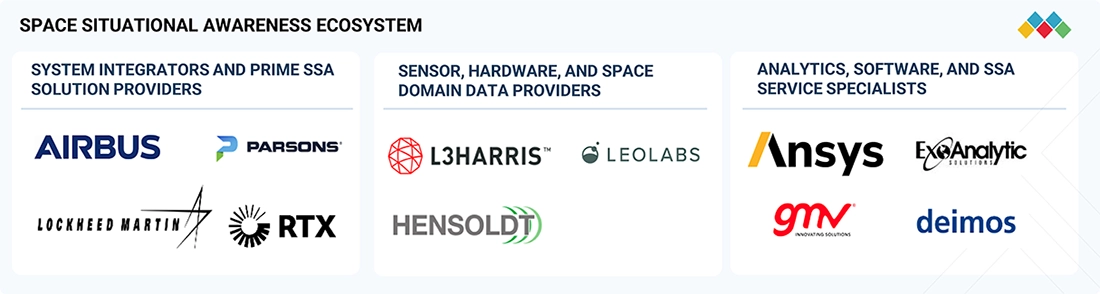
SPACE SITUATIONAL AWARENESS MARKET: COMMERCIAL USE CASES ACROSS INDUSTRIES
| COMPANY | USE CASE DESCRIPTION | BENEFITS |
|---|---|---|
 |
Satellite operators in congested LEO environments require frequent, precise tracking to manage rising collision risks from active satellites and debris | LeoLabs provides high-refresh-rate tracking and conjunction assessment using its global ground-based radar network | Improves visibility into collision risk, supports timely maneuver decisions, and reduces unnecessary fuel consumption | Enhances operational safety and mission continuity |
 |
Large satellite constellations need scalable SSA solutions to monitor thousands of satellites and manage high volumes of conjunction events | COMSPOC delivers automated SSA analytics that integrate multiple data sources for fleet-wide monitoring | Enables automated collision risk management, faster decision making, and seamless integration of SSA insights into mission operations at scale |
 |
Space agencies and satellite operators face rising long-term risks from inactive satellites and fragmentation debris, especially small objects with limited visibility | ESA delivers debris monitoring and orbital environment assessment by combining radar, optical sensors, and analytical models | Improves understanding of debris density and collision risk, supports safer mission planning, and enables regulatory compliance for sustainable space operations |
Logos and trademarks shown above are the property of their respective owners. Their use here is for informational and illustrative purposes only.
Related Ecosystem
Space
- C-Band
- Small Satellite
- Antennas
- Ka-Band
- Microsatellite
- AIRBUS
- L3Harris Technologies, Inc.
- Thales group
- Northrop Grumman Corporation
- LOCKHEED MARTIN CORPORATION
Key Takeaways
- Asia Pacific Space Situational Awareness Market valued at USD 301.5 million in 2025, doubling to USD 619.1 million by 2030.
- Asia Pacific's 15.5% CAGR significantly exceeds the global growth rate of 10%, reflecting accelerated regional demand.
- Geopolitical tensions and satellite proliferation are primary drivers of Asia Pacific space domain awareness investments.
- India, Japan, South Korea, and Australia lead Asia Pacific adoption of advanced space surveillance and tracking technologies.
Space Situational Awareness Market Report Scope
| Report Metric | Details |
|---|---|
| Base Year | 2025 |
| Fastest Growing Segment | COMMERCIAL (End User) |
| Forecast Period | 2025–2030 |
| Growth Rate | CAGR of 10% from 2025 to 2030 |
| Largest Segment | GOVERNMENT & DEFENSE (End User) |
| Market Size Base Year (Billions) | ~USD 1.73 (2025) |
| Revenue Forecast (Billions) | ~USD 2.79 (2030) |
| Segments Covered | Solution, Object Type, Orbit Type, Capability, End User |
Asia Pacific Space Situational Awareness Market Report Segmentation
5 segment dimensions are covered across the global market.
By Solution
- Payload Systems
- Services
- Software
By Object Type
- Debris
- Payloads
- Rocket Bodies
- Uncategorized Objects
By Orbit Type
- Deep Space/Beyond Geostationary Earth Orbit
- Near-Earth Orbit
By Capability
- Catalog & Object Data Management
- Event Detection & Characterization
- Observation & Detection
- Re-Entry Assessment
- Risk Prediction & Threat Assessment
- Tracking, Orbit Determination, & Custody
By End User
- Commercial
- Government & Defense
Target Audience
- Defense & Military Agencies : Asia Pacific defense ministries and space commands require comprehensive SSA market intelligence to inform procurement strategies, capability development, and space security policy in response to regional threats.
- Space Technology Vendors : SSA solution providers, satellite manufacturers, and ground station operators need detailed Asia Pacific market segmentation and growth forecasts to prioritize R&D investments and identify partnership opportunities.
- Government Space Agencies : National space agencies across Asia Pacific require market analysis to benchmark their SSA capabilities, understand competitive positioning, and justify budget allocations for space domain awareness infrastructure.
- Investment & Private Equity Firms : Investors targeting the high-growth Asia Pacific space sector need market sizing, CAGR projections, and country-level analysis to evaluate portfolio opportunities in SSA technology and services companies.
- Satellite Operators & Constellation Providers : Commercial and government satellite operators require SSA market insights to understand demand for collision avoidance services, orbital debris tracking, and space traffic management solutions in Asia Pacific.
Key Companies in the Asia Pacific Space Situational Awareness Market
| Company | HQ | Ownership | Strongest segments |
|---|---|---|---|
| SES S.A. | Luxembourg | Public Company | Observation & Detection (as a user/data partner),Orbit Determination & Object Data Management,Event Detection & Re-entry Assessment, |
| KLA-TENCOR CORPORATION | United States | Public Company | Observation & Detection–enabling inspection and metrology,Object Data Management and analytics-enabling software,Event Detection and Risk Prediction–reliability and process control, |
| LOCKHEED MARTIN CORPORATION | United States | Public Company | Observation & Detection,Orbit Determination,Object Data Management, |
| L3HARRIS TECHNOLOGIES, INC. | United States | Public Company | Observation & Detection,Orbit Determination,Object Data Management, |
| PARSONS CORPORATION | United States | Public Company | Observation & Detection,Orbit Determination,Object Data Management, |
| AIRBUS | United States | Public Company | Observation & Detection,Orbit Determination,Object Data Management, |
| RTX | United States | Public Company | Observation & Detection,Orbit Determination,Object Data Management, |
| KRATOS DEFENSE & SECURITY SOLUTIONS, INC. | United States | Public Company | Observation & Detection,Orbit Determination,Object Data Management, |
| QINETIQ | United Kingdom | Public Company | Observation & Detection,Orbit Determination,Object Data Management, |
| HENSOLDT AG | Germany | Public Company | Observation & Detection,Orbit Determination,Object Data Management, |
| AGI | United States | Public Company | Observation & Detection (software layer only),Orbit Determination,Object Data Management, |
SES S.A.
SES S.A. is a Luxembourg-based public company founded in 2007 with 1,937 employees.
KLA-TENCOR CORPORATION
KLA-Tencor Corporation is a United States public company founded in 1975 with 15,100 employees.
LOCKHEED MARTIN CORPORATION
Lockheed Martin Corporation is a major United States defense contractor founded in 1912 with 123,000 employees and operates as a public company.
L3HARRIS TECHNOLOGIES, INC.
L3Harris Technologies, Inc. is a United States-based public company founded in 1895 with 45,000 employees.
PARSONS CORPORATION
Parsons Corporation is a United States public company founded in 1944 with 21,000 employees.
AIRBUS
Airbus is a public company founded in 1998 in the United States with 166,876 employees.
RTX
RTX is a United States public company founded in 1934 with 180,000 employees.
KRATOS DEFENSE & SECURITY SOLUTIONS, INC.
Kratos Defense & Security Solutions, Inc. is a United States public company founded in 1994 with 4,300 employees.
QINETIQ
QinetiQ is a United Kingdom-based public company founded in 2001 with 7,378 employees.
HENSOLDT AG
Hensoldt AG is a Germany-based public company founded in 2020 with 9,362 employees.
AGI
AGI is a United States public company founded in 1999 with 18,000 employees.
Countries within Asia Pacific - compare and drill down
| Country | 2025 size (native) |
|---|---|
| China | USD 360.6 Million |
| India | USD 57.5 Million |
| Japan | USD 110.1 Million |
| Australia | USD 64.6 Million |
| South Korea | USD 26.3 Million |
Country market size visualization
Reasons to Buy this Report
- Regional Growth Opportunity : Capture insights into Asia Pacific's 15.5% CAGR—the fastest-growing SSA market globally—with detailed forecasts through 2030 to identify high-potential investment and expansion opportunities in the region.
- Geopolitical Risk Assessment : Understand how rising Indo-Pacific tensions and regional space competition are reshaping demand for advanced space surveillance capabilities, enabling strategic positioning in this security-critical market segment.
- Country-Level Market Intelligence : Access granular market data for China, India, Japan, Australia, South Korea, and other key Asia Pacific nations to tailor go-to-market strategies and identify priority markets for SSA solutions.
- Technology & Infrastructure Trends : Analyze emerging trends in ground-based tracking systems, AI analytics, satellite constellations, and space debris management specific to Asia Pacific's unique operational environment and regulatory landscape.
- Competitive Landscape Mapping : Benchmark against regional and global competitors with detailed analysis of market share, technology capabilities, and strategic partnerships shaping the Asia Pacific SSA ecosystem through 2030.
Frequently asked questions
What is the current market size of Space Situational Awareness in Asia Pacific?
The Asia Pacific Space Situational Awareness Market is valued at USD 301.5 million in 2025 and is projected to grow to USD 619.1 million by 2030.
What is the growth rate for Asia Pacific Space Situational Awareness Market?
Asia Pacific's Space Situational Awareness Market is growing at a compound annual growth rate (CAGR) of 15.5% from 2025 to 2030.
Which countries are driving growth in Asia Pacific's Space Situational Awareness Market?
India, Japan, South Korea, and Australia are the primary drivers of Asia Pacific's Space Situational Awareness Market growth through government space initiatives and defense investments.
What factors are accelerating Asia Pacific Space Situational Awareness adoption?
Key drivers include increasing satellite proliferation, geopolitical tensions, critical orbital asset protection needs, and government-led space surveillance network development across Asia Pacific.
How does Asia Pacific's growth compare to the global Space Situational Awareness Market?
Asia Pacific's 15.5% CAGR significantly outpaces the global market CAGR of 10%, indicating faster regional adoption and investment in space domain awareness capabilities.
RESEARCH METHODOLOGY
The study involved four major activities in estimating the current size of the space situational awareness market. Exhaustive secondary research was done to collect information on the space situational awareness market, its adjacent markets, and its parent market. The next step was to validate these findings, assumptions, and sizing with industry experts across the value chain through primary research. Demand-side analysis was conducted to estimate the overall market size. After that, market breakdown and data triangulation procedures were employed to estimate the sizes of various segments and subsegments within the space situational awareness market.
Secondary Research
During the secondary research process, various sources were consulted to identify and collect information for this study. The secondary sources included government sources, such as SIPRI; corporate filings, including annual reports, press releases, and investor presentations from companies; white papers, journals, and certified publications; and articles from recognized authors, directories, and databases.
Primary Research
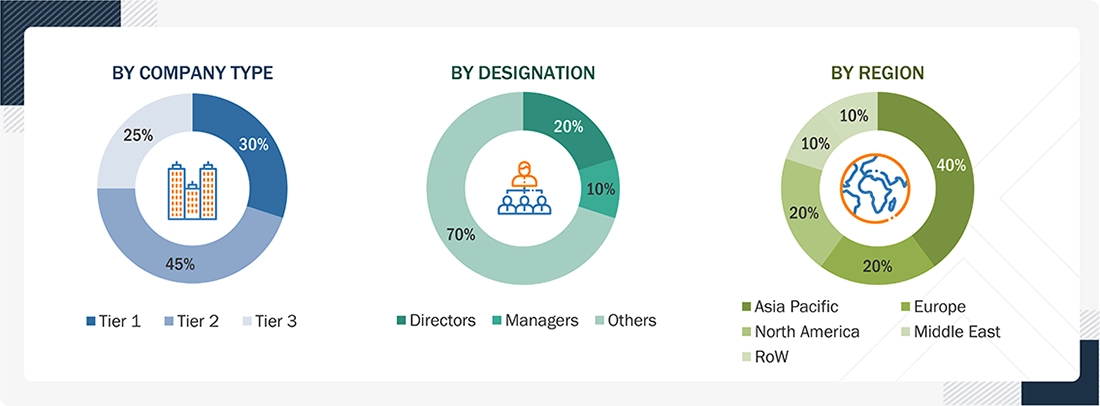
Extensive primary research was conducted after acquiring information regarding the space situational awareness market scenario through secondary research. Several primary interviews were conducted with market experts from the demand and supply sides across major countries of North America, Europe, Asia Pacific, and the Rest of the World. Primary data was collected through questionnaires, emails, and telephonic interviews.
To know about the assumptions considered for the study, download the pdf brochure
Market Size Estimation
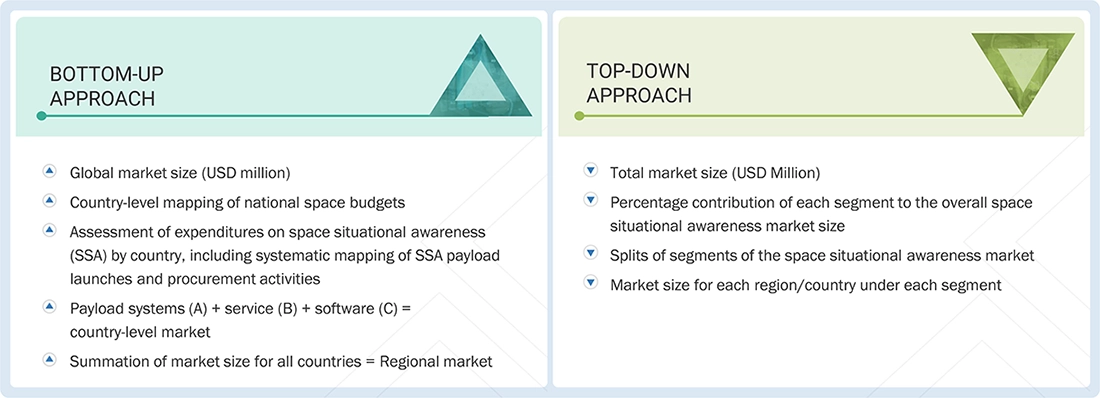
The top-down and bottom-up approaches were used to estimate and validate the size of the space situational awareness market. The research methodology used to estimate the size of the market included the following details:
- Key players in the space situational awareness market were identified through secondary research, and their market shares were determined through a combination of primary and secondary research. This included a study of the annual and financial reports of the top market players, as well as extensive interviews with leaders, including directors, engineers, marketing executives, and other key stakeholders of leading companies operating in the market.
- All percentage shares, splits, and breakdowns were determined using secondary sources and verified through primary sources.
- All possible parameters that affect the markets covered in this research study were accounted for, viewed in extensive detail, verified through primary research, and analyzed to obtain the final quantitative and qualitative data on the space situational awareness market. This data was consolidated, enhanced with detailed inputs, analyzed by MarketsandMarkets, and presented in this report.
Space Situational Awareness Market Size: Bottom-up & Top-down Approach
Data Triangulation
After determining the overall market size, the total market was divided into several segments and subsegments. The data triangulation and market breakdown procedures explained below were implemented, wherever applicable, to complete the overall market engineering process and arrive at the estimated market numbers for the market segments and subsegments. The data was triangulated by studying various factors and trends from the demand and supply sides. Additionally, the market size was validated using top-down and bottom-up approaches.
Market Definition
Space situational awareness (SSA) involves detecting and cataloguing active satellites, inactive spacecraft, and space debris, monitoring their positions and movements, and predicting close approaches or abnormal behavior that could threaten space missions. SSA systems combine data from ground-based radars, optical telescopes, and space-based sensors with advanced analytics to generate collision warnings, re-entry forecasts, and anomaly alerts. These insights enable satellite operators, governments, and commercial users to make informed operational decisions, protect critical space assets, and reduce the risk of collisions in an increasingly congested orbital environment.
Key Stakeholders
- Government and Research Organizations
- Space Situational Awareness System Manufacturers
- Defense and National Security Agencies
- Civil Space Agencies
- Commercial Satellite Operators
- Space Traffic Management Authorities
- Ground-Based Sensor and Radar Infrastructure Providers
- Data Analytics and SSA Software Providers
- Launch Service Providers
- Academic Institutions and Research Universities
Report Objectives
- To define, describe, and forecast the size of the space situational awareness market based on solution, object type, capability, end user, and region
- To forecast the size of the various segments of the space situational awareness market based on four regions—North America, Europe, Asia Pacific, and the Rest of the World, along with key countries in each of these regions
- To identify and analyze key drivers, restraints, opportunities, and challenges influencing the growth of the market
- To identify industry trends, market trends, and technology trends prevailing in the market
- To analyze micromarkets with respect to individual technological trends, prospects, and their contribution to the overall market
- To provide a detailed competitive landscape of the market and analyze competitive growth strategies such as product launches and developments, contracts, partnerships, agreements, and collaborations adopted by key players in the market
- To identify the detailed financial positions, product portfolios, and key developments of leading companies in the market
- To strategically profile key market players and comprehensively analyze their market rank analysis and core competencies
Available customizations:
MarketsandMarkets offers the following customizations for this market report:
- Additional country-level analysis of the Space situational awareness Market
- Profiling of other market players (up to 5)
Product Analysis
- Product matrix, which provides a detailed comparison of the product portfolio of each company in the space situational awareness market.
Get the Full Space Situational Awareness Market Report
Full forecast, segment splits, and company analysis for all Space Situational Awareness Market.
- Germany Space Situational Awareness Market
- France Space Situational Awareness Market
- Italy Space Situational Awareness Market
- Russia Space Situational Awareness Market
- China Space Situational Awareness Market
- India Space Situational Awareness Market
- Japan Space Situational Awareness Market
- Australia Space Situational Awareness Market
- South Korea Space Situational Awareness Market
- US Space Situational Awareness Market
- Canada Space Situational Awareness Market
- UK Space Situational Awareness Market
Need a Tailored Report?
Customize this report to your needs
Get 10% FREE Customization
Customize This Report
