
Europe Specialty Enzymes Market (2024-2029)

The Europe Specialty Enzymes Market was valued at $1440.4 Million in 2024 and projected to reach to $2100.6 Million by 2029, representing a compound annual growth rate of 7.84%. Europe's specialty enzymes market is positioned for sustained growth through 2029, driven by increasing regulatory pressures for clean-label products and sustainable food processing solutions.


| Market Size in | USD 26.32 MN |
| Market Forecast in | |
| CAGR | |
| Forecast Period | |
| Units Considered | Value (USD MN) |
Europe Specialty Enzymes Market Trends and Insights
- This represents a compound annual growth rate (CAGR) of 7.84%, driven by increasing demand for enzyme-based solutions across food processing, beverage production, and biotechnology applications throughout Europe.
- The region's stringent food safety regulations and consumer preference for clean-label products are accelerating adoption of specialty enzymes as natural processing aids and functional ingredients. Europe's mature food and beverage sector, combined with strong investment in enzyme research and development, positions the continent as a key growth market.
- Between 2024 and 2029, Europe is expected to capture significant market share through innovations in enzyme technology and expanding applications in plant-based food production.
- The region's commitment to sustainability and circular economy principles further supports specialty enzyme adoption, as manufacturers seek efficient, environmentally friendly processing solutions..
Key Market Statistics
- CAGR (2024-2029) 7.84% CAGR
- Market Size, 2024 ~USD 1440.4 Million
- Forecast, 2029 ~USD 2100.6 Million
- Geography Europe
Europe Specialty Enzymes Market Overview
Market Valuation & Growth :
Europe's specialty enzymes market is valued at USD 1,440.4 million in 2024, with a projected expansion to USD 2,100.6 million by 2029, representing a robust 7.84% CAGR over the forecast period.
Regulatory Compliance Driving Adoption :
Europe's stringent food safety and quality regulations are accelerating the adoption of enzyme-based solutions, as manufacturers seek compliant alternatives to traditional processing methods across food and beverage production.
Diverse Application Base :
Specialty enzymes are increasingly utilized across food processing, beverage production, and biotechnology applications throughout Europe, creating multiple revenue streams and market opportunities for suppliers.
Regional Market Leadership :
Germany leads European demand with USD 576.4 million in market size, followed by France at USD 429.3 million, reflecting strong industrial enzyme adoption in Western Europe's advanced manufacturing sectors.
Europe Specialty Enzymes Market Dynamics
- The region's mature food and beverage industry is actively transitioning toward enzyme-based alternatives, supported by strong R&D investments and biotechnology infrastructure.
- Western European countries, particularly Germany and France, are spearheading innovation in enzyme applications for dairy, brewing, and baking sectors. The forecast period will see accelerated adoption across Eastern and Southern European markets as manufacturing capabilities expand and regulatory harmonization increases.
- Growing consumer demand for naturally processed foods and beverages, combined with cost efficiencies offered by enzyme solutions, will sustain the 7.84% CAGR.
- Investment in enzyme production facilities and strategic partnerships between European manufacturers and biotechnology firms will further strengthen market penetration across the region..
Market Ecosystem
Related Ecosystem
Fandb Additives
- Dairy Products
- Bakery Products
- Polyglycerol Esters
- Microorganism
- Carbohydrates
- AZELIS HOLDINGS SA
- Archer-Daniels-Midland Company
- Amway
- UNILEVER PLC
- DuPont de Nemours, Inc.
Key Takeaways
- Europe's specialty enzymes market is valued at USD 1,440.4 million in 2024 and will reach USD 2,100.6 million by 2029, growing at a 7.84% CAGR.
- Stringent EU food safety regulations and clean-label consumer demand are primary drivers of specialty enzyme adoption across Europe.
- Europe leads in enzyme innovation and R&D investment, supporting advanced applications in plant-based and sustainable food production.
- The region's focus on circular economy and sustainability principles creates strong tailwinds for enzyme-based processing solutions through 2029.
Specialty Enzymes Market Report Scope
| Report Metric | Details |
|---|---|
| Base Year | 2024 |
| Fastest Growing Segment | DIAGNOSTICS (Application) |
| Forecast Period | 2024-2029 |
| Growth Rate | CAGR of 8.5% from 2024 to 2029 |
| Largest Segment | MICROORGANISMS (Source) |
| Market Size Base Year (Billions) | ~USD 6.12 (2024) |
| Revenue Forecast (Billions) | ~USD 9.2 (2029) |
| Segments Covered | Type, Subtype, Application, Source, Sub-Application |
Europe Specialty Enzymes Market Report Segmentation
5 segment dimensions are covered across the global market.
By Type
- Carbohydrase
- Carbohydrases
- Lipase
- Lipases
- Other Enzymes
- Other Types
- Polymerase & Nuclease
- Polymerases & Nucleases
- Protease
- Proteases
- -Amylases
- -Cellulases
- -Other Carbohydrases
By Subtype
- Amylase
- Amylases
- Cellulase
- Cellulases
- Other Carbohydrases
By Application
- Biocatalysts
- Bioethanol
- Detergents
- Diagnostics
- Feed
- Food & Beverages
- Oil Treatment
- Other Applications
- Paper & Pulp
- Pharmaceuticals
- Research & Biotechnology
- Soil Treatment
- Textiles & Leather
- Wastewater Treatment
By Source
- Animals
- Microorganisms
- Plants
By Sub-Application
- Bakery & Confectionery Products
- Beverages
- Dairy Products
- Meat Processing Products
- Nutraceuticals
- Other Food & Beverages Products
- Sugar
EUROPE: SPECIALTY ENZYMES MARKET, BY APPLICATION, 2024–2029
| Segment | 2024 | 2025 | 2026 | 2027 | 2028 | 2029 | CAGR (%) |
|---|---|---|---|---|---|---|---|
| BIOCATALYSTS | 129.6 | 139.9 | 151.2 | 163.4 | 176.7 | 190.6 | 8.01 |
| DIAGNOSTICS | 230.1 | 250.2 | 272.3 | 296.4 | 322.7 | 351.7 | 8.85 |
| PHARMACEUTICALS | 636.9 | 680.8 | 728 | 778.7 | 833.2 | 891.6 | 6.96 |
| RESEARCH & BIOTECHNOLOGY | 443.8 | 480.9 | 521.3 | 565.4 | 613.5 | 666.8 | 8.48 |
| TOTAL | 1440.4 | 1551.9 | 1672.8 | 1803.9 | 1946.1 | 2100.6 | 7.84 |
REST OF EUROPE: SPECIALTY ENZYMES MARKET, BY APPLICATION, 2024–2029
| Segment | 2024 | 2025 | 2026 | 2027 | 2028 | 2029 | CAGR (%) |
|---|---|---|---|---|---|---|---|
| BIOCATALYSTS | 11.1 | 11.8 | 12.4 | 13.1 | 13.8 | 14.6 | 5.6 |
| DIAGNOSTICS | 19.5 | 20.7 | 22.1 | 23.5 | 24.9 | 26.4 | 6.28 |
| PHARMACEUTICALS | 54.2 | 56.7 | 59.2 | 61.9 | 64.6 | 67.4 | 4.45 |
| RESEARCH & BIOTECHNOLOGY | 37.1 | 39.4 | 41.8 | 44.3 | 47 | 49.8 | 6.02 |
| TOTAL | 122 | 128.6 | 135.6 | 142.8 | 150.3 | 158.2 | 5.34 |
Target Audience
- Food & Beverage Manufacturers : European F&B producers need market intelligence to optimize enzyme sourcing strategies, understand competitive positioning, and identify cost-efficiency opportunities in processing operations across the region.
- Enzyme Producers & Suppliers : Specialty enzyme manufacturers require detailed European market segmentation, country-level demand forecasts, and regulatory insights to guide production capacity investments and geographic expansion priorities.
- Biotechnology & R&D Companies : Biotech firms developing novel enzyme solutions need comprehensive European market data to validate product-market fit, identify application opportunities, and prioritize commercialization efforts by country.
- Investment & Private Equity Firms : Investors evaluating European enzyme sector opportunities require market sizing, growth trajectory analysis, and regional competitive dynamics to assess portfolio companies and acquisition targets.
- Regulatory & Compliance Consultants : Consultants advising European manufacturers need market context on how regulations drive enzyme adoption, enabling them to provide strategic guidance on product reformulation and process optimization.
Countries within Europe - compare and drill down
| Country | 2025 size (native) |
|---|---|
| UK | USD 312 Million |
| France | USD 429.3 Million |
| Germany | USD 576.4 Million |
| Italy | USD 149 Million |
| Spain | USD 245.5 Million |
| Denmark | USD 136 Million |
| Netherlands | USD 94.2 Million |
| Rest Of Europe | USD 158.2 Million |
Country market size visualization
Reasons to Buy this Report
- Country-Level Market Insights : Access detailed market sizing and growth projections for six major European markets including Germany, France, UK, Spain, Italy, and Denmark, enabling targeted market entry and expansion strategies.
- Regulatory & Compliance Intelligence : Understand how Europe's stringent food safety regulations are reshaping enzyme adoption patterns, helping businesses align product development with regional compliance requirements and market opportunities.
- Competitive Landscape Analysis : Identify market leaders and growth opportunities across Western and Eastern European segments, with insights into regional manufacturing capabilities and biotechnology infrastructure development.
- Application-Specific Demand Trends : Gain clarity on enzyme utilization across food processing, beverage production, and biotechnology sectors, enabling precise product positioning and customer targeting within Europe's diverse industrial base.
- Strategic Growth Forecasting : Leverage 2024-2029 CAGR projections and market expansion data to inform investment decisions, partnership strategies, and capacity planning for European market penetration and revenue growth.
Frequently asked questions
What is the current market size of specialty enzymes in Europe?
Europe's specialty enzymes market was valued at USD 1,440.4 million in 2024 and is projected to grow to USD 2,100.6 million by 2029.
What is the growth rate for specialty enzymes in Europe?
Europe's specialty enzymes market is expected to grow at a compound annual growth rate (CAGR) of 7.84% from 2024 to 2029.
What are the main drivers of specialty enzyme demand in Europe?
Key drivers include stringent EU food safety regulations, consumer preference for clean-label products, innovation in plant-based foods, and Europe's commitment to sustainable manufacturing practices.
Which sectors in Europe are driving specialty enzyme adoption?
The food processing, beverage production, plant-based food manufacturing, and biotechnology sectors are the primary growth drivers for specialty enzymes across Europe.
How does Europe's specialty enzymes market compare to global trends?
Europe's 7.84% CAGR is slightly below the global 8.5% CAGR, but the region maintains leadership in enzyme innovation, R&D investment, and regulatory-driven adoption through 2029.
RESEARCH METHODOLOGY
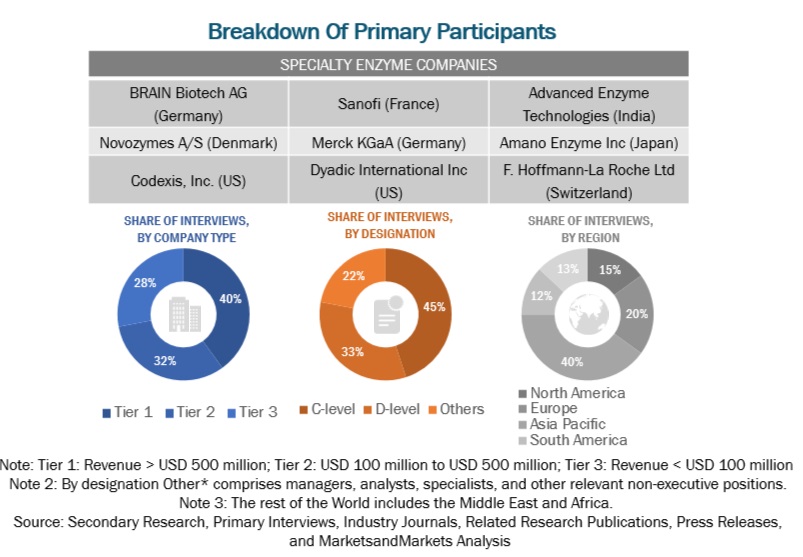
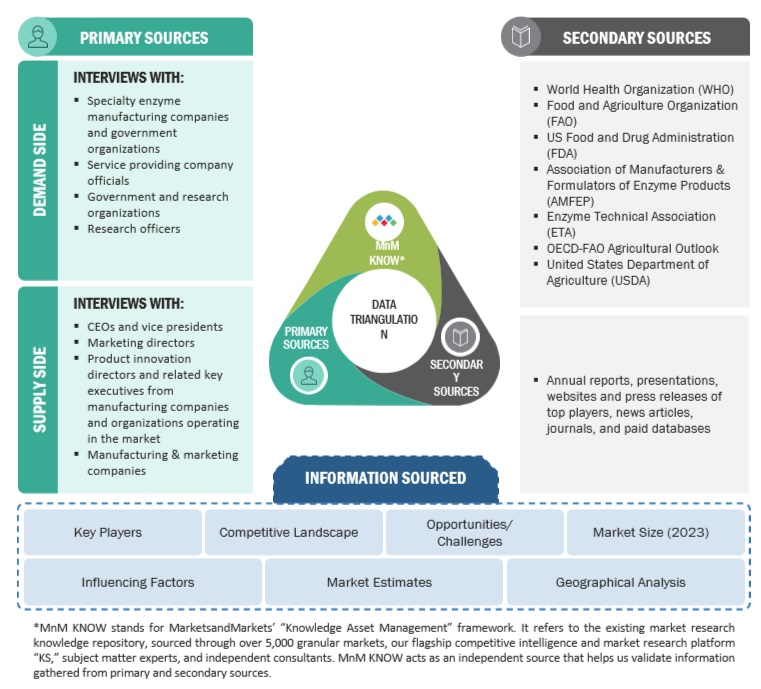
This research involves the extensive use of secondary sources; directories; and databases (Bloomberg and Factiva) to identify and collect information useful for a technical, market-oriented, and commercial study of the Specialty enzymes market. In-depth interviews were conducted with various primary respondents, such as key industry participants, Subject Matter Experts (SMEs), C-level executives of key market players, and industry consultants, to obtain and verify critical qualitative and quantitative information and to assess prospects.
Secondary Research
In the secondary research process, various sources, such as the European Federation of Biotechnology (EFB), American Chemical Society (ACS), Association of Manufacturers and Formulators of Enzyme Products (AMFEP), Enzyme Technical Association (ETA), International Union of Biochemistry and Molecular Biology (IUBMB), Food and Drug Administration (FDA) , Environmental Protection Agency (EPA), European Chemicals Agency (ECHA), Food Safety and Standards Authority of India (FSSAI), Ministry of Health, Labour and Welfare (MHLW) Japan associations were referred to identify and collect information for this study. The secondary sources also include journals, press releases, investor presentations of companies, whitepapers, certified publications, articles by recognized authors and regulatory bodies, trade directories, and paid databases.
Primary Research
The Specialty enzymes market encompasses various stakeholders involved in the supply chain, raw material manufacturers, raw material suppliers, regulatory organizations, and research institutions. To gather comprehensive information, primary sources from both the supply and demand sides were engaged. Primary interviewees from the supply side consisted of manufacturers, distributors, importers, and technology providers involved in the production and distribution of Enzymes. On the demand side, key opinion leaders, executives, and CEOs of companies in the Enzymes industry were approached through questionnaires, emails, and telephonic interviews. This approach ensured a comprehensive and well-rounded understanding of the Specialty enzymes market from various perspectives.
Market Size Estimation
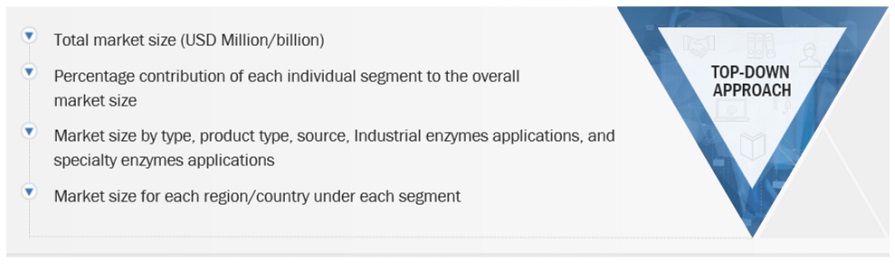
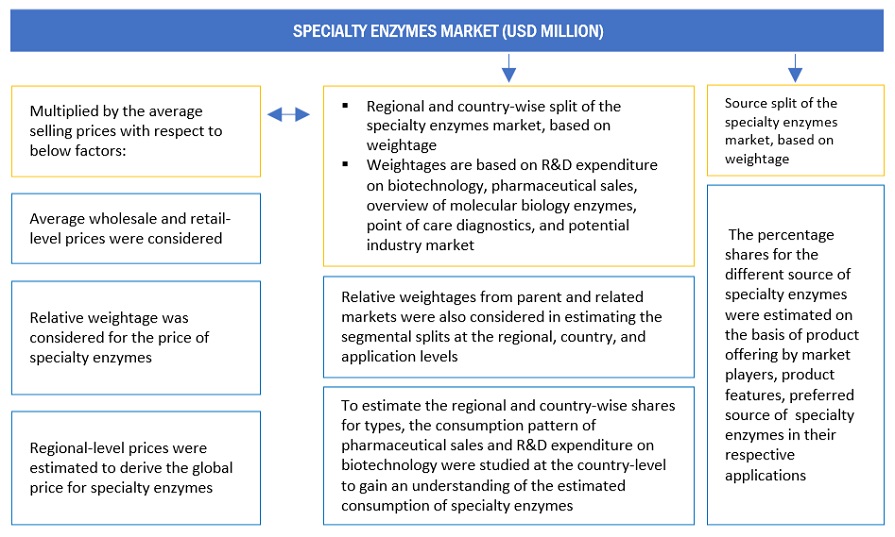
The top-down and bottom-up approaches were used to estimate and validate the market’s and various dependent submarkets’ size. The research methodology used to estimate the market size includes extensive secondary research of key players, reports, reviews, and newsletters of top market players, along with extensive interviews from leaders, such as CEOs, directors, and marketing executives.
Global Specialty Enzymes Market Size: Top-Down Approach
To know about the assumptions considered for the study, Request for Free Sample Report
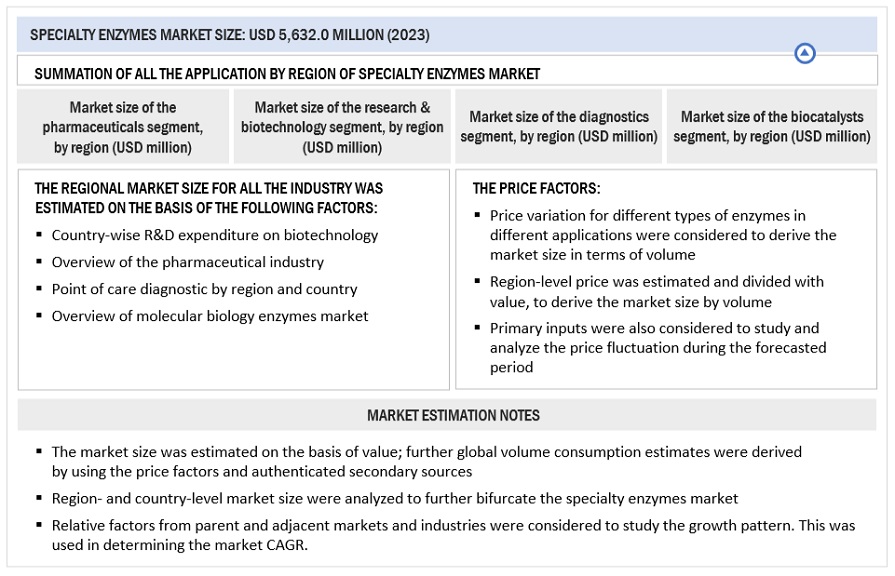
Data Triangulation
Market Definition
Enzymes are proteins that are composed of amino acids and have the capability to convert a compound (substrate) into another product by catalytic reaction. These catalytic proteins assist in the performance of biochemical reactions. They lower the activation energy of the reaction and then induce it.
Specialty enzymes are primarily utilized to produce pharmaceuticals, and diagnostics solutions, as well as in bio-catalysts and research & biotechnology. They are highly selective catalysts and function in metabolic reactions and in the interconversion of complex molecules to smaller ones.
Stakeholders
- Specialty enzyme raw material suppliers
- Specialty enzyme manufacturers
- Intermediate suppliers such as traders and distributors of specialty enzymes
- Manufacturers of pharmaceuticals, research & biotechnology, diagnostics, and fine chemicals
- Government and research organizations
-
Associations, regulatory bodies, and other industry-related bodies:
- European Communities
- World Health Organization (WHO)
- Association of Manufacturers & Formulators of Enzyme Products (AMFEP)
- OECD-FAO Agricultural Outlook
- United States Department of Agriculture (USDA)
- European Union (EU)
- European Medicine Agency
- European Federation of Pharmaceutical Industry Associations (EFPIA)
- Medicines and Healthcare products Regulatory Agency (MHRA)
- Central Drugs Standard Control Organization (CDSCO)
- Ministry of Health, Labour and Welfare (MHLW)
- National Medical Products Administration (NMPA)
- Health Canada
- Therapeutic Goods Administration (TGA)
- Swiss Agency for Therapeutic Products (Swissmedic)
- Brazilian Health Regulatory Agency (ANVISA)
Report Objectives
- To define and measure the global specialty enzymes market with respect to type, source, application, and geography
- Determining and projecting the size of the specialty enzymes market, with respect to product type, source, type, application, and regional markets, over a five-year period, ranging from 2024 to 2029.
- Identifying the attractive opportunities in the market by determining the largest and fastest-growing segments across regions
- Providing detailed information about the key factors influencing the growth of the market (drivers, restraints, opportunities, and industry-specific challenges)
- Analyzing the micro markets, with respect to individual growth trends, prospects, and their contribution to the total market
- To strategically profile key players of the global specialty enzymes market and comprehensively analyze their core competencies in each segment
- To track and analyze competitive developments, such as alliances, joint ventures, new product developments, mergers, and acquisitions in the global specialty enzymes market
Available Customizations:
With the given market data, MarketsandMarkets offers customizations according to company-specific scientific needs.
The following customization options are available for the report:
Product Analysis
- Product Matrix, which gives a detailed comparison of the product portfolio of each company
Geographic Analysis
With the given market data, MarketsandMarkets offers customizations according to the company-specific scientific needs.
- Further breakdown of the Rest of the European Probiotics market, by key country
- Further breakdown of the Rest of the Asia Pacific Probiotics market, by key country
- Further breakdown of the Rest of South America Probiotics market, by key country
Company Information
- Detailed analyses and profiling of additional market players (up to five)
Get the Full Specialty Enzymes Market Report
Full forecast, segment splits, and company analysis for all Specialty Enzymes Market.
- US Specialty Enzymes Market
- Canada Specialty Enzymes Market
- Mexico Specialty Enzymes Market
- UK Specialty Enzymes Market
- France Specialty Enzymes Market
- Germany Specialty Enzymes Market
- Italy Specialty Enzymes Market
- Spain Specialty Enzymes Market
- Denmark Specialty Enzymes Market
- Netherlands Specialty Enzymes Market
- China Specialty Enzymes Market
- India Specialty Enzymes Market
- Japan Specialty Enzymes Market
- South Korea Specialty Enzymes Market
- Brazil Specialty Enzymes Market
- Argentina Specialty Enzymes Market
- Rest Of Europe Specialty Enzymes Market
- Middle East Specialty Enzymes Market
- Rest Of Asia Pacific Specialty Enzymes Market
- Rest Of South America Specialty Enzymes Market
- Africa Specialty Enzymes Market
Need a Tailored Report?
Customize this report to your needs
Get 10% FREE Customization
Customize This Report
