
Indonesia Submarine Cable Systems Market (2025-2030)

The Indonesia Submarine Cable Systems Market was valued at $211.5 Million in 2025 and projected to reach to $375.2 Million by 2030, representing a compound annual growth rate of 12.1%. Indonesia's submarine cable systems market is poised for sustained expansion, driven by the nation's archipelagic geography requiring extensive undersea connectivity infrastructure.


| Market Size in | USD 26.32 MN |
| Market Forecast in | |
| CAGR | |
| Forecast Period | |
| Units Considered | Value (USD MN) |
Indonesia Submarine Cable Systems Market Trends and Insights
- This 12.1% compound annual growth rate reflects Indonesia's strategic importance as a maritime hub and its increasing demand for international connectivity infrastructure.
- Indonesia's archipelagic geography and growing digital economy are driving substantial investments in undersea telecommunications networks to support regional data traffic and cross-border communications. The submarine cable sector in Indonesia is benefiting from rising internet penetration, expanding cloud services adoption, and government initiatives to enhance digital infrastructure.
- Indonesia's position as a critical transit point for Asia-Pacific submarine cable routes amplifies market opportunities.
- By 2030, Indonesia is expected to consolidate its role as a key player in regional submarine cable deployment, with enhanced capacity to support e-commerce, financial services, and content delivery networks across Southeast Asia..
Key Market Statistics
- CAGR (2025-2030) 12.1% CAGR
- Market Size, 2025 ~USD 211.5 Million
- Forecast, 2030 ~USD 375.2 Million
- Country Indonesia
Indonesia Submarine Cable Systems Market Overview
Archipelagic Infrastructure Demand :
Indonesia's 17,000+ islands create critical demand for submarine cable connectivity to bridge geographic gaps and enable inter-island digital infrastructure development.
Digital Economy Acceleration :
Rapid growth in e-commerce, fintech, and cloud services across Indonesia is driving unprecedented demand for high-capacity international bandwidth and reliable submarine cable systems.
Strategic Maritime Hub Position :
Indonesia's location along major Asia-Pacific trade routes positions it as a critical node for submarine cable routing, attracting significant investment from global telecom operators.
Government Digital Initiatives :
National broadband expansion programs and digital transformation policies are accelerating submarine cable deployment to underserved regions and supporting 5G infrastructure rollout.
Indonesia Submarine Cable Systems Market Dynamics
- The 12.1% CAGR through 2030 reflects growing investments from international telecom operators and tech giants establishing regional data centers.
- Increasing internet penetration, rising data consumption, and government initiatives to bridge the digital divide across islands are key growth catalysts. The market will benefit from Indonesia's role as a critical Asia-Pacific connectivity hub and its participation in major submarine cable projects linking Southeast Asia to global networks.
- Strategic partnerships between local operators and international cable consortiums, combined with regulatory support for infrastructure development, will further accelerate market growth and enhance Indonesia's digital competitiveness..
Market Ecosystem
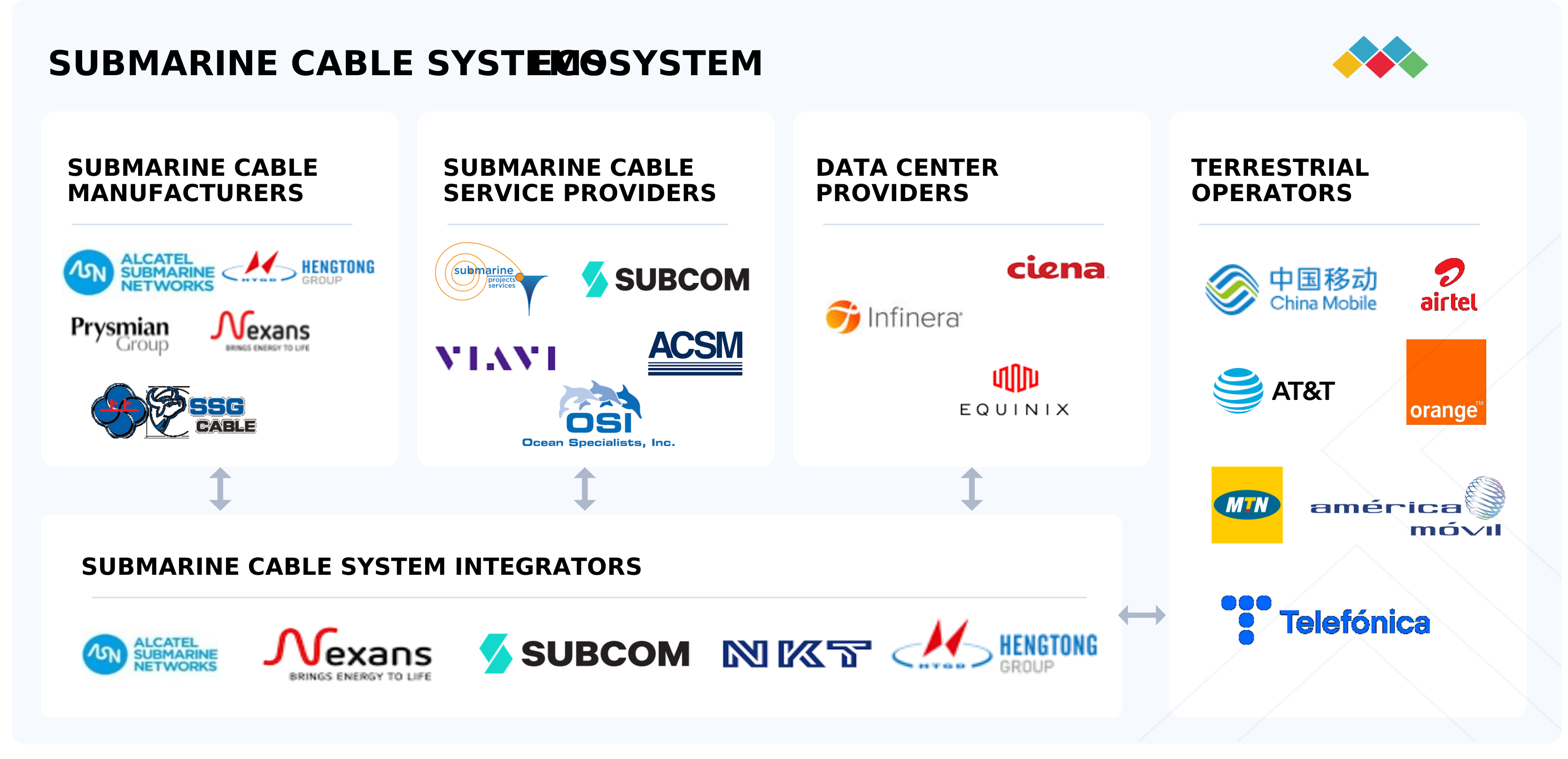
Submarine Cable Systems Market Trends: COMMERCIAL USE CASES ACROSS INDUSTRIES
| COMPANY | USE CASE DESCRIPTION | BENEFITS |
|---|---|---|
 |
Deployment of private subsea cable systems to expand global cloud infrastructure and handle increasing data demand | Improved global connectivity | Reduced latency| Reliable cloud services | Scalable network capacity |
 |
High-capacity transatlantic subsea cable to support Azure, Office 365, and other cloud-based services | Lower latency | Increased bandwidth | Enhanced global cloud performance | Spport for data-heavy applications |
 |
Undersea cable connecting mainland India to the Andaman & Nicobar Islands for telecom and high-speed internet | Reliable remote area connectivity | Improved telecom infrastructure | Regional digital growth |Economic development |
 |
Subsea interconnectors such as North Sea Link and Viking Link for cross-border electricity transfer and renewable energy integration | Optimized power distribution | Enhanced energy security | Better renewable energy utilization | Reduced emissions |
 |
Secure subsea cable systems managed by NAVFAC for defense communications, sensor networks, and operations | Secure and reliable military communications | Uninterrupted missions | Strengthened maritime surveillance |
Logos and trademarks shown above are the property of their respective owners. Their use here is for informational and illustrative purposes only.
Related Ecosystem
Key Takeaways
- Indonesia's submarine cable systems market is valued at USD 211.5 million in 2025 and will reach USD 375.2 million by 2030, representing a 12.1% CAGR.
- Indonesia's archipelagic geography and strategic location make it a critical hub for Asia-Pacific submarine cable infrastructure and international connectivity.
- Rising digital adoption, e-commerce growth, and cloud service expansion are primary drivers of submarine cable demand in Indonesia.
- Indonesia's government digital transformation initiatives and regional trade partnerships are accelerating submarine cable system investments through 2030.
Submarine Cable Systems Market Report Scope
| Report Metric | Details |
|---|---|
| Base Year | 2025 |
| Fastest Growing Segment | RESIN-IMPREGNATED SYNTHETIC (RIS) (Insulation) |
| Forecast Period | 2025-2030 |
| Growth Rate | CAGR of 11.1% from 2025 to 2030 |
| Largest Segment | POWER CABLES (Cable Type) |
| Market Size Base Year (Billions) | ~USD 19.94 (2025) |
| Revenue Forecast (Billions) | ~USD 33.75 (2030) |
| Segments Covered | Cable Type, Component, Component Type, Service Offering, Type, Voltage, Insulation, End-Use Application |
Indonesia Submarine Cable Systems Market Report Segmentation
8 segment dimensions are covered across the global market.
By Cable Type
- Communication Cables
- Power Cables
By Component
- Dry Plant Products
- Wet Plant Products
By Component Type
- Branching Units
- Cables
- Repeaters
By Service Offering
- Installation & Commissioning
- Maintenance
- System Update
- System Upgrade
- System Upgrades
By Type
- Multicore
- Single Core
By Voltage
- High-Voltage
- Medium-Voltage
By Insulation
- Cross-Linked Polyethylene (Xlpe)
- Oil-Impregnated Paper (Oip)
- Resin-Impregnated Paper (Rip)
- Resin-Impregnated Synthetic (Ris)
By End-Use Application
- Intercountry & Island Connection
- Intercountry & Island Connections
- Offshore Oil & Gas Plant
- Offshore Oil & Gas Plants
- Offshore Wind Power Generation Plant
- Offshore Wind Power Generation Plants
Target Audience
- Telecom Operators & ISPs : Indonesian and international telecom providers need market intelligence to plan submarine cable investments, assess competitive positioning, and identify inter-island connectivity expansion opportunities.
- Infrastructure Investment Firms : Private equity and infrastructure funds require detailed market sizing and growth forecasts to evaluate submarine cable project ROI and identify strategic acquisition targets in Indonesia.
- Technology & Data Center Companies : Tech giants and data center operators need insights into Indonesia's submarine cable capacity, latency profiles, and connectivity roadmaps to optimize regional infrastructure placement.
- Government & Policy Makers : Indonesian government agencies and regulators require market analysis to inform broadband expansion policies, infrastructure investment priorities, and digital economy development strategies.
- Cable Equipment & Service Providers : Submarine cable manufacturers and installation service providers need market forecasts and project pipelines to plan capacity, resource allocation, and business development in Indonesia.
Reasons to Buy this Report
- Archipelago-Specific Market Insights : Gain detailed understanding of how Indonesia's unique 17,000-island geography drives submarine cable demand patterns, infrastructure requirements, and deployment strategies distinct from continental markets.
- Investment Opportunity Identification : Identify high-potential submarine cable projects, regional operator partnerships, and government-backed initiatives offering investment and partnership opportunities in Indonesia's growing connectivity sector.
- Competitive Landscape Analysis : Understand key players, market consolidation trends, and competitive positioning of international and local operators in Indonesia's submarine cable ecosystem through 2030.
- Digital Economy Growth Correlation : Access data linking Indonesia's e-commerce, fintech, and cloud adoption to submarine cable infrastructure needs, enabling strategic alignment with digital transformation trends.
- Regulatory & Policy Framework : Stay informed on Indonesian government broadband initiatives, spectrum policies, and infrastructure regulations shaping submarine cable deployment and market growth trajectories.
Frequently asked questions
What is the current market size of submarine cable systems in Indonesia?
Indonesia's submarine cable systems market is valued at USD 211.5 million in 2025, with expectations to grow to USD 375.2 million by 2030.
What is the projected growth rate for Indonesia's submarine cable market?
Indonesia's submarine cable systems market is projected to grow at a compound annual growth rate (CAGR) of 12.1% from 2025 to 2030.
Why is Indonesia important for submarine cable infrastructure?
Indonesia's archipelagic geography, strategic location in Asia-Pacific, and role as a regional connectivity hub make it essential for submarine cable routing and international data transmission.
What factors are driving growth in Indonesia's submarine cable market?
Key drivers include rising internet penetration, expanding e-commerce and cloud services, government digital transformation initiatives, and increasing regional data traffic demands.
How will Indonesia's submarine cable market evolve by 2030?
By 2030, Indonesia is expected to strengthen its position as a regional submarine cable hub with enhanced capacity to support digital services, cross-border communications, and Asia-Pacific connectivity.
RESEARCH METHODOLOGY
The study involved four major activities in estimating the current size of the submarine cable systems market. Exhaustive secondary research was conducted to gather information on the market, adjacent markets, and the overall submarine cable system landscape. These findings, assumptions, and projections were validated through primary research involving interviews with industry experts and key stakeholders across the value chain. Both top-down and bottom-up approaches were utilized to estimate the overall market size. Subsequently, market breakdown and data triangulation techniques were applied to determine the sizes of various segments and subsegments. Two key sources, secondary and primary, were leveraged to conduct a comprehensive technical and commercial assessment of the submarine cable systems market.
Secondary Research
The secondary research process referred to various secondary sources to identify and collect necessary information for this study. The secondary sources included annual reports, press releases, and investor presentations of companies; white papers; journals and certified publications; and articles from recognized authors, websites, directories, and databases. Secondary research was conducted to obtain key information about the industry’s supply chain, the market’s value chain, the total pool of key players, market segmentation according to the industry trends (to the bottom-most level), regional markets, and key developments from market- and technology-oriented perspectives. The secondary data was collected and analyzed to determine the overall market size, further validated by primary research.
Primary Research
Extensive primary research was conducted after gaining knowledge about the current scenario of the submarine cable systems market through secondary research. Several primary interviews were conducted with experts from the demand and supply sides across four major regions—North America, Europe, Asia Pacific, and RoW. This primary data was collected through questionnaires, emails, and telephonic interviews.
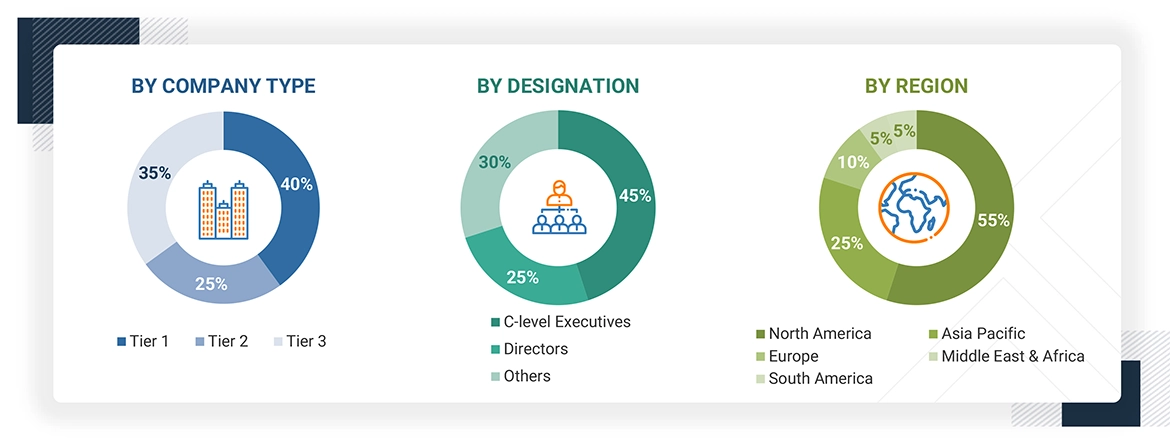
Note: Three tiers of companies have been defined based on their total revenue as of 2024: tier 3: revenue less than USD 500 million; tier 2: revenue between USD 500 million and USD 1 billion; and tier 1: revenue more than USD 1 billion. Other designations include sales managers, marketing managers, and product managers.
To know about the assumptions considered for the study, download the pdf brochure
Market Size Estimation
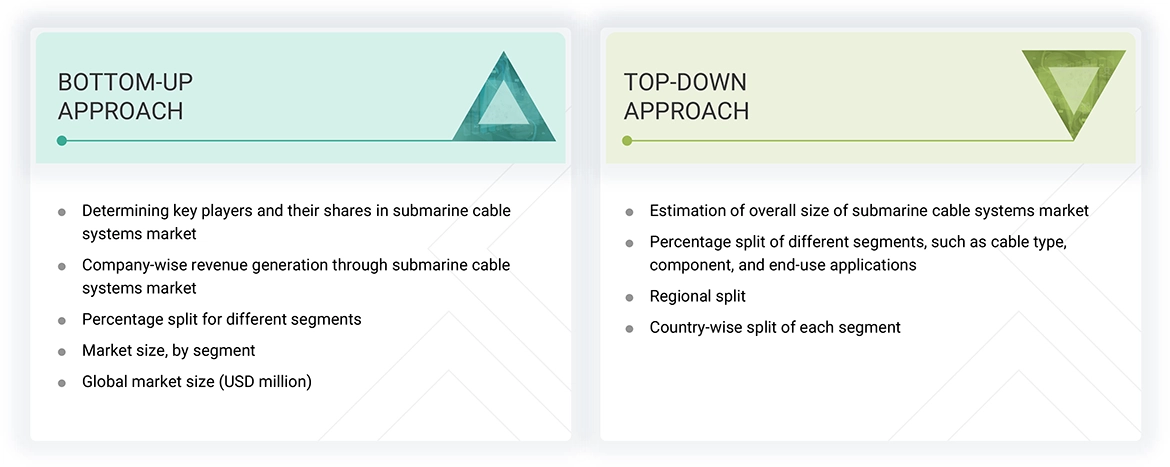
Both top-down and bottom-up approaches were used to estimate and validate the total size of the submarine cable systems market. These methods have also been used extensively to estimate the size of various subsegments in the market. The following research methodology was used to estimate the market size:
- Major players in the industry and markets were identified through extensive secondary research
- The industry’s value chain and market size (in terms of value) were determined through primary and secondary research processes
- All percentage shares, splits, and breakdowns were determined using secondary sources and verified through primary sources
Submarine Cable Systems Market : Top-Down and Bottom-Up Approach
Data Triangulation
After arriving at the overall size of the submarine cable systems market using the market size estimation process explained above, the total market was split into several segments and subsegments. Data triangulation and market breakdown procedures were employed, wherever applicable, to complete the overall market engineering process and arrive at the exact statistics for all segments and subsegments of the market. The data was triangulated by studying various factors and trends from the demand and supply sides. The market size was also validated using top-down and bottom-up approaches.
Market Definition
Submarine cable systems are widely used for communication and power transmission. These cables are laid on the seabed to carry telecommunication signals from one land-based station to another across oceans. Submarine power cables are laid on ocean beds, straits, or rivers to transmit electricity at high voltages over long distances. They are primarily used to connect the mainland with large islands, power grids with oil & gas platforms, and to transmit electricity across countries or islands.
Key Stakeholders
- Telecommunication service providers
- Electricity providers
- Submarine cable system manufacturers
- Technology investors
- Research institutes and organizations
- Small and large technology centers
- Renewable energy solution providers
- Market research and consulting firms
Report Objectives
- To define, describe, and forecast the submarine cable systems market, in terms of cable type, component, service offering, type, end-use application, voltage, insulation, and region, in terms of value
- To forecast the market, by cable type, in terms of volume
- To describe and forecast the market with regard to five main regions: North America, Europe, Asia Pacific, the Middle East & Africa, and South America, along with their respective countries, in terms of value
- To provide detailed information regarding major factors, such as drivers, restraints, opportunities, and challenges, influencing the market growth
- To provide a detailed overview of the submarine cable systems value chain
- To strategically analyze micromarkets with respect to individual growth trends, prospects, and contributions to the submarine cable systems market
- To analyze opportunities in the market for stakeholders by identifying high-growth segments of the submarine cable systems market
- To strategically profile key players and comprehensively analyze their market position in terms of ranking and core competencies, along with detailing the competitive landscape for market leaders
- To analyze competitive strategies, such as product launches, expansions, and mergers & acquisitions, adopted by key players in the submarine cable systems market
Available customizations:
With the given market data, MarketsandMarkets offers customizations according to the company’s specific needs. The following customization options are available for the report:
Company Information:
- Detailed analysis and profiling of additional market players (up to 5)
Get the Full Submarine Cable Systems Market Report
Full forecast, segment splits, and company analysis for all Submarine Cable Systems Market.
- US Submarine Cable Systems Market
- Canada Submarine Cable Systems Market
- Mexico Submarine Cable Systems Market
- UK Submarine Cable Systems Market
- Germany Submarine Cable Systems Market
- Denmark Submarine Cable Systems Market
- Netherlands Submarine Cable Systems Market
- Norway Submarine Cable Systems Market
- France Submarine Cable Systems Market
- China Submarine Cable Systems Market
- Japan Submarine Cable Systems Market
- South Korea Submarine Cable Systems Market
- Malaysia Submarine Cable Systems Market
- Vietnam Submarine Cable Systems Market
- UAE Submarine Cable Systems Market
- Saudi Arabia Submarine Cable Systems Market
- Brazil Submarine Cable Systems Market
- Argentina Submarine Cable Systems Market
- Rest Of Europe Submarine Cable Systems Market
- Rest Of Asia Pacific Submarine Cable Systems Market
- Angola Submarine Cable Systems Market
- Rest Of South America Submarine Cable Systems Market
Need a Tailored Report?
Customize this report to your needs
Get 10% FREE Customization
Customize This Report
