
Rest Of Asia Pacific Terminal Tractor Market (2026-2031)

The Rest Of Asia Pacific Terminal Tractor Market was valued at $228 Million in 2026 and projected to reach to $328 Million by 2031, representing a compound annual growth rate of 5.3%. Rest Of Asia Pacific's terminal tractor market is poised for steady expansion driven by accelerating port infrastructure investments and logistics modernization across emerging economies in the region.


| Market Size in | USD 26.32 MN |
| Market Forecast in | |
| CAGR | |
| Forecast Period | |
| Units Considered | Value (USD MN) |
Rest Of Asia Pacific Terminal Tractor Market Trends and Insights
- The region is projected to experience steady growth through 2031, reaching $328.0 million as port infrastructure investments and logistics modernization accelerate across emerging economies.
- Rest Of Asia Pacific's terminal tractor market is driven by increasing containerized cargo volumes and the expansion of regional distribution hubs. The 5.3% compound annual growth rate reflects Rest Of Asia Pacific's growing adoption of automated and fuel-efficient terminal tractors in port operations.
- Rest Of Asia Pacific benefits from rising e-commerce activity and supply chain optimization initiatives that demand more efficient cargo handling equipment.
- Between 2026 and 2031, Rest Of Asia Pacific is expected to see heightened competition among equipment manufacturers and rental operators seeking to capture market share in this developing region..
Key Market Statistics
- CAGR (2026-2031) 5.3% CAGR
- Market Size, 2026 ~USD 228 Million
- Forecast, 2031 ~USD 328 Million
- Country Rest Of Asia Pacific
Rest Of Asia Pacific Terminal Tractor Market Overview
Market Size & Growth Trajectory :
Rest Of Asia Pacific terminal tractor market valued at $228.0 million in 2026, expanding to $328.0 million by 2031, representing a robust 5.3% CAGR aligned with global growth trends.
Port Infrastructure Expansion :
Emerging economies across Rest Of Asia Pacific are investing heavily in port modernization and logistics infrastructure, driving demand for advanced terminal tractor solutions and fleet upgrades.
Logistics Modernization Wave :
Regional logistics operators are transitioning to automated and efficient terminal handling equipment, with terminal tractors becoming essential for optimizing cargo movement and reducing operational costs.
Competitive Regional Dynamics :
Rest Of Asia Pacific presents untapped opportunities for both established OEMs and emerging manufacturers, with growing adoption rates among smaller ports and developing maritime hubs.
Rest Of Asia Pacific Terminal Tractor Market Dynamics
- The $100 million growth projected between 2026 and 2031 reflects increasing containerization rates and rising trade volumes through secondary and tertiary ports.
- Supply chain resilience initiatives and regional trade agreements are encouraging port operators to upgrade terminal equipment and improve operational efficiency.
- The 5.3% CAGR demonstrates consistent demand momentum as developing nations prioritize maritime infrastructure development.
- Key growth catalysts include rising e-commerce activities, expanding manufacturing sectors, and government initiatives to enhance port competitiveness.
- Market players should focus on cost-effective solutions tailored to emerging market requirements and flexible financing options to capture growth opportunities in this dynamic region..
Market Ecosystem
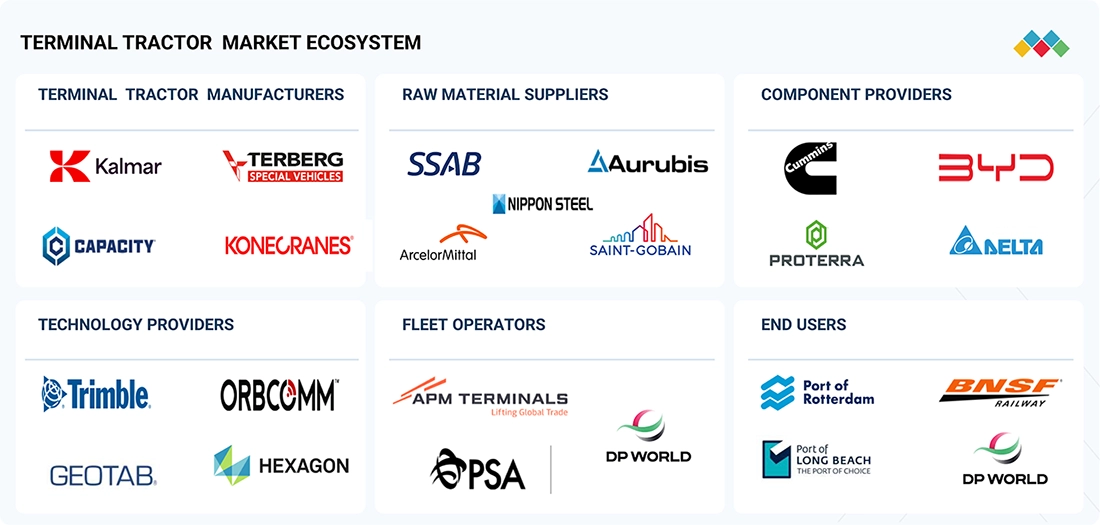
TERMINAL TRACTOR MARKET SIZE, SHARE & ANALYSIS: COMMERCIAL USE CASES ACROSS INDUSTRIES
| COMPANY | USE CASE DESCRIPTION | BENEFITS |
|---|---|---|
 |
Provides diesel, electric, and automation ready terminal tractors for container ports, intermodal terminals, distribution centers, warehouses, and RoRo operations. The TT and Ottawa product portfolio supports trailer shunting, container movement, and high frequency yard operations, while Kalmar Insight enables fleet monitoring and predictive maintenance.. | Improves trailer turnaround time | Increases fleet utilization, supports zero-emission yard operations | Reduces maintenance downtime through connected fleet management | Enhances terminal productivity and operational efficiency |
 |
Offers electric and automation compatible terminal tractors integrated with the company's Port Solutions portfolio for container terminals, intermodal facilities, and logistics operations. The solutions are designed to operate alongside automated cranes, digital terminal systems, and connected yard equipment. | Supports integrated port automation | Improves cargo handling efficiency | Enhances fleet connectivity | Reduces emissions | Increases operational reliability through lifecycle service and digital maintenance solutions |
 |
Supplies diesel, electric, and semi autonomous terminal tractors for ports, logistics hubs, industrial facilities, airports, and RoRo terminals. The YT Series supports intensive trailer movement, heavy duty yard operations, and multi shift logistics applications, with Terberg Connect providing remote diagnostics and fleet management capabilities. | Enables continuous heavy-duty operations | Reduces operating costs | Improves equipment availability through predictive maintenance | Supports fleet electrification | Enhances operator productivity and safety |
 |
Provides highly customizable tow tractors, platform trucks, and terminal transport solutions for warehouses, manufacturing facilities, airports, automotive plants, and logistics centers. The product portfolio includes electric and fuel cell powered industrial vehicles tailored to demanding internal transport operations. | Improves internal material flow | Increases operator safety and comfort | Reduces emissions through electric and hydrogen technologies | Enhances productivity | Lowers total operating costs across industrial logistics applications |
 |
Specializes in terminal tractors for ports, intermodal rail yards, warehouses, distribution centers, and industrial logistics operations. The product portfolio includes diesel, LPG, battery electric, and hydrogen ready terminal tractors designed for intensive trailer spotting and yard management, with enhanced operator ergonomics and advanced safety systems. | Delivers reliable trailer handling in demanding yard operations | Reduces fuel and maintenance costs through alternative fuel technologies | Improves driver comfort and safety | Increases fleet uptime | Supports fleet modernization and sustainability initiatives |
Logos and trademarks shown above are the property of their respective owners. Their use here is for informational and illustrative purposes only.
Related Ecosystem
Electric Hybrid Vehicles
- Battery Electric Vehicle (BEV)
- Fuel Cell Electric Vehicle (FCEV)
- Light Commercial Vehicles (LCVs)
- Hybrid Electric Vehicle (HEV)
- Agricultural Tractors
- Visteon Corporation
- BOSCH LIMITED
- Byd company ltd.
- Tesla, Inc.
- FORD MOTOR COMPANY
Logistics And Transportation
- Internal Combustion Engine (ICE)
- Crawler Excavator
- Fuel Cell
- Light Commercial Vehicles (LCVs)
- Sensors
- Siemens ag
- Alstom s.a.
- Hitachi, Ltd.
- Godrej Industries Limited
- Toshiba Corporation
On Highway Off Highway Vehicles
- Internal Combustion Engine (ICE)
- Agricultural Tractors
- Crawler Excavator
- Battery Electric Vehicle (BEV)
- Excavators
- Visteon Corporation
- Deere & Company
- AB VOLVO PENTA
- Honda Motor Co., Ltd.
- LIEBHERR-INTERNATIONAL AG
Key Takeaways
- Rest Of Asia Pacific terminal tractor market valued at $228.0M in 2026, expanding to $328.0M by 2031
- Rest Of Asia Pacific exhibits a 5.3% CAGR, driven by port modernization and containerized trade growth
- Rest Of Asia Pacific's market growth is supported by e-commerce expansion and supply chain digitalization
- Rest Of Asia Pacific faces increasing competition from both established OEMs and emerging regional manufacturers
Terminal Tractor Market Report Scope
| Report Metric | Details |
|---|---|
| Base Year | 2026 |
| Fastest Growing Segment | LITHIUM IRON PHOSPHATE (LFP) (Battery Chemistry) |
| Forecast Period | 2026-2031 |
| Growth Rate | CAGR of 5.4% from 2026 to 2031 |
| Largest Segment | 4X2 (Drive) |
| Market Size Base Year (Billions) | ~USD 1.65 (2026) |
| Revenue Forecast (Billions) | ~USD 2.15 (2031) |
| Segments Covered | Type, Application, Drive, Propulsion, Tonnage, Logistics Industry, Motor Power Output, Battery Chemistry |
Rest Of Asia Pacific Terminal Tractor Market Report Segmentation
8 segment dimensions are covered across the global market.
By Type
- Automated
- Manual
By Application
- Airport
- Airports
- Marine Ports
- Oil & Gas
- Warehouse & Logistics
By Drive
- 4X2
- 4X4
- 6X4
By Propulsion
- Cng/Lng
- Diesel
- Electric
By Tonnage
- 50-100 Tons
- <50 Tons
- >100 Tons
By Logistics Industry
- Food & Beverages
- Inland Waterways & Marine Service
- Inland Waterways & Marine Services
- Rail Logistics
- Retail
- Roro
By Motor Power Output
- 150-250 Kw
- <150 Kw
- >250 Kw
By Battery Chemistry
- Lithium Iron Phosphate (Lfp)
- Nickel Manganese Cobalt (Nmc)
Target Audience
- Terminal Tractor OEMs & Manufacturers : Require detailed Rest Of Asia Pacific market data to identify expansion opportunities, assess regional demand patterns, and develop localized product strategies for emerging port markets.
- Port Operators & Terminal Managers : Need market insights to benchmark equipment investments, understand regional growth trends, and make informed procurement decisions aligned with port modernization initiatives across Rest Of Asia Pacific.
- Logistics & Supply Chain Companies : Seek regional market intelligence to optimize fleet planning, evaluate equipment upgrade timelines, and capitalize on logistics modernization opportunities in Rest Of Asia Pacific emerging markets.
- Investment & Private Equity Firms : Require comprehensive market analysis of Rest Of Asia Pacific to evaluate investment opportunities in port infrastructure, terminal equipment, and logistics modernization ventures with growth potential.
- Equipment Distributors & Dealers : Need region-specific market forecasts and growth drivers to develop distribution strategies, identify high-potential markets, and align inventory planning with demand trends in Rest Of Asia Pacific.
Reasons to Buy this Report
- Regional Market Sizing & Forecasts : Obtain precise market valuations specific to Rest Of Asia Pacific ($228M in 2026, $328M in 2031) with detailed CAGR analysis to support strategic planning and investment decisions in this high-growth region.
- Emerging Economy Opportunity Assessment : Identify untapped growth pockets across developing nations in Rest Of Asia Pacific where port modernization and logistics upgrades are creating new demand for terminal tractor solutions.
- Competitive Landscape Intelligence : Understand regional competitive dynamics, market entry barriers, and positioning strategies specific to Rest Of Asia Pacific to optimize go-to-market approaches and partnership opportunities.
- Infrastructure Investment Tracking : Monitor port infrastructure projects and logistics modernization initiatives across Rest Of Asia Pacific to anticipate equipment demand cycles and align sales pipelines with regional development timelines.
- Localized Growth Driver Analysis : Analyze region-specific factors including trade volumes, containerization rates, and government policies driving terminal tractor adoption in Rest Of Asia Pacific markets.
Frequently asked questions
What is the current market size of terminal tractors in Rest Of Asia Pacific?
Rest Of Asia Pacific's terminal tractor market is estimated at $228.0 million in 2026 and is projected to grow to $328.0 million by 2031.
What is the growth rate for terminal tractors in Rest Of Asia Pacific?
Rest Of Asia Pacific's terminal tractor market is expected to grow at a compound annual growth rate (CAGR) of 5.3% from 2026 to 2031.
What factors are driving growth in Rest Of Asia Pacific's terminal tractor market?
Rest Of Asia Pacific's market growth is driven by increasing containerized cargo volumes, port infrastructure investments, e-commerce expansion, and supply chain modernization initiatives.
Which segments dominate Rest Of Asia Pacific's terminal tractor market?
Rest Of Asia Pacific's market is primarily dominated by diesel-powered terminal tractors used in port and intermodal logistics operations, with growing interest in electric and hybrid variants.
What challenges does Rest Of Asia Pacific's terminal tractor market face?
Rest Of Asia Pacific faces challenges including high capital costs, regulatory compliance variations across countries, and the need for skilled operator training in emerging markets.
RESEARCH METHODOLOGY
The research study involved extensive use of secondary sources, such as company annual reports/presentations, industry association publications, automotive magazine articles, directories, technical handbooks, the World Economic Outlook, trade websites, technical articles, and databases, to identify and collect information on the terminal tractor market. Primary interviews were conducted to obtain and verify critical qualitative and quantitative information, as well as assess the prospects of the industry. Primary sources include experts from core and related industries, suppliers, manufacturers, distributors, service providers, technology developers, and organizations related to various segments of the market value chain. Detailed interviews were conducted with various primary respondents that include key industry participants, subject-matter experts, C-level executives of key market players, and industry consultants.
Secondary Research
Secondary sources referred to in this research study include the Port Equipment Manufacturers Association (PEMA), Industrial Truck Association, Container Dealers Association (CDA), and Container Owners Association (COA); corporate filings (such as annual reports, investor presentations, and financial statements); and trade, business, and terminal tractor associations. The secondary data was collected and analyzed to arrive at the overall market size, which was further validated by primary research.
Primary Research
Extensive primary research was conducted after acquiring an understanding of the terminal tractor market scenario through secondary research. Several primary interviews were conducted with market experts from terminal tractor providers, component/system providers, and end user organizations across three major regions, namely, North America, Europe, and Asia Pacific. Approximately 90% of the primary interviews were conducted with the terminal tractor manufacturers and component/system providers, and 10% with the end user organizations. Primary data was collected through questionnaires, emails, and telephonic interviews. Various departments within organizations, including sales, operations, and administration, were contacted to provide a holistic viewpoint in the report while canvassing primary sources.
Primary interviews were conducted to gather insights, including market sizing estimation and forecast, future trends, and upcoming technologies in the market. Data triangulation of all these points was done using the information gathered from secondary research and model mapping. Stakeholders from the demand and supply sides were interviewed to understand their views on the aforementioned points.
Breakdown of Primaries
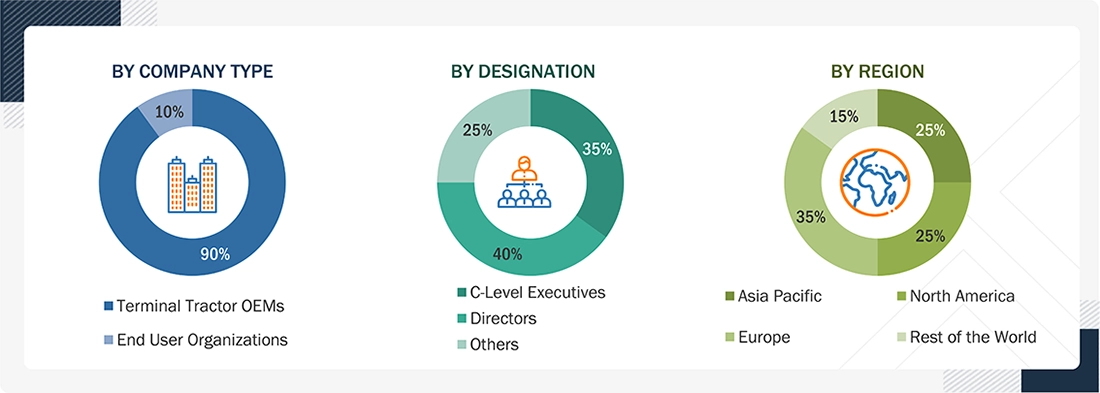
Note: Tiers of companies are based on the supply chain of the terminal tractor market; companies’ revenues have not been considered.
To know about the assumptions considered for the study, download the pdf brochure
Market Size Estimation
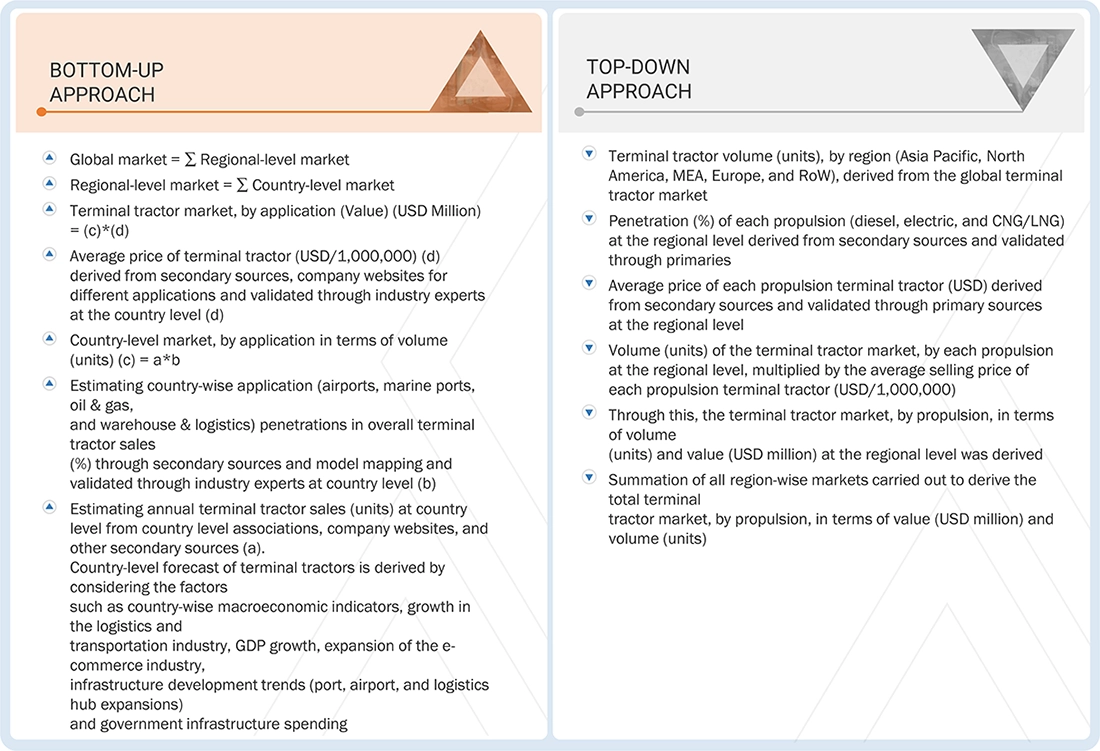
Both top-down and bottom-up approaches were used to estimate and validate the total size of the terminal tractor market. These methods were also used extensively to estimate the size of various subsegments in the market.
Bottom-up Approach: Estimating annual terminal tractor sales (units) at country level from various secondary sources, such as terminal tractor manufacturing associations, company annual reports, and investor presentations. Country-level forecast of terminal tractors is derived by considering factors such as country-wise macroeconomic indicators, growth in the logistics and transportation industry, GDP growth, expansion of the e-commerce industry, infrastructure development trends (port, airport, and logistics hub expansions), and government infrastructure spending.
Estimating country-wise application (airports, marine ports, oil & gas, and warehouse & logistics) penetrations in overall terminal tractor sales (%) through secondary sources and validated through industry experts at the country level. To get the terminal tractor market in terms of volume (units) by application, country-level sales of terminal tractors are multiplied by penetration of various applications (airports, marine ports, oil & gas, and warehouse & logistics).
Country-level ASP of terminal tractors used in various applications (airports, marine ports, oil & gas, and warehouse & logistics) was derived through various secondary sources and validated from industry experts. The country-level market based on application by volume was multiplied by the country-level average selling price (ASP) for each application to get the market for each application by value.
The summation of the country-level market would give the regional level, with further addition providing the global market by application (warehouse & logistics, marine port, airport, and oil & gas). The total value of each country has then been summed up to derive the total value of the market by application. All key macro indicators affecting the revenue growth of the market segments and subsegments were accounted for, viewed in extensive detail, verified through primary research, and analyzed to get the validated and verified quantitative and qualitative data.
Top-down Approach: The top-down approach was used to estimate and validate the market by propulsion in terms of volume and value. The terminal tractor market volume (units) and value (USD million) by region
(Asia Pacific, North America, the Middle East & Africa, Europe, and the Rest of the World) were derived from the global market.
The penetration of each propulsion (diesel, electric, and CNG/LNG) at the regional level and forecast was derived from secondary sources and validated through primaries.
The penetration of each propulsion (diesel, electric, and CNG/LNG) was multiplied by the regional market to get the market volume (units) and value (USD million) by propulsion for each region.
A summation of all region-wise markets was carried out to derive the total terminal tractor market volume (units) and value (USD million) by propulsion. The top-down approach was followed by drive, type, tonnage, and logistics by industry segments.
- Key players in the global market were identified through secondary research, and their global market shares were determined through primary and secondary research.
- The research methodology included the study of the annual and quarterly financial reports & regulatory filings of major market players as well as interviews with industry experts for detailed market insights.
- All major penetration rates, percentage shares, splits, and breakdowns for the global market were determined by using secondary sources and verified through primary sources.
- All key macroindicators affecting the revenue growth of the market segments and subsegments were accounted for, viewed in extensive detail, verified through primary research, and analyzed to get the validated and verified quantitative & qualitative data.
- The market data gathered was consolidated and added with detailed inputs, analyzed, and presented in this report.
Terminal Tractor Market : Top-Down and Bottom-Up Approach
Data Triangulation
After arriving at the overall size of the terminal tractor market through the above-mentioned methodology, the market was split into several segments and subsegments. The data triangulation and market breakdown procedures were employed, wherever applicable, to complete the overall market engineering process and arrive at the exact data of the market by volume and value for the key segments and subsegments. The extrapolated market data was triangulated by studying various macro indicators and regional trends from both the supply and demand sides.
Market Definition
A terminal tractor is a specialized vehicle designed for the short-distance movement and positioning of semitrailers, container chassis, and other trailers within confined operating facilities. For this study, the terminal tractor market includes vehicles used across warehouse and logistics facilities, marine ports, airports, and oil and gas facilities. The equipment considered includes manual and automated terminal tractors with 4x2, 4x4, and 6x4 drive configurations, powered by diesel, electric, CNG/LNG, and hydrogen propulsion systems.
Key Stakeholders
- Terminal Tractor & Port Equipment Manufacturers
- Battery and Other Component Suppliers for Electric Terminal Tractors
- Tier I/II Component Suppliers
- Port Operators
- Container Handling Equipment Traders and Distributors
- Manufacturing Associations (North American Council for Freight Efficiency, American Trucking Associations, and Others)
Report Objectives
-
To define, describe, and forecast the size of the terminal tractor market, in terms of volume and value, for the following categories:
- By Type (Manual, Automated)
- By Application (Warehouse & Logistics, Marine Port, Airport, Oil & Gas)
- By Drive (4x2, 4x4, 6x4)
- By Propulsion (Diesel, Electric, CNG/LNG)
- By tonnage (< 50 Tons, 50–100 Tons, > 100 Tons)
- By End Use (Retail, Food & Beverages, Inland Waterways & Marine Service, Rail Logistics, RoRo)
- Electric Terminal Tractor Market, By Motor Power Output (<150 kW, 150–250 kW, >250 kW)
- Electric Terminal Tractor Market, By Battery Chemistry (LFP, NMC, Others)
- By Region (Asia Pacific, North America, Middle East & Africa [MEA], Europe, Rest of the World [RoW])
- To understand the dynamics (Drivers, Restraints, Opportunities, and Challenges) of the market
- To analyze the market share analysis/ranking of key players operating in the terminal tractor market.
- To study the market with supply chain analysis, ecosystem analysis, trade analysis, case study analysis, pricing analysis, patent analysis, trends/disruptions impacting buyers, technology analysis and regulatory analysis
- To analyze the competitive landscape, prepare a company evaluation matrix for the players operating in the global market, evaluate the share/ranking based on product footprints of leading market players, and position them on the quadrant.
- To analyze the recent developments, including product launches, deals, expansions, and other developments, carried out by the key participants in the market.
- To analyze recent developments, including supply contracts, product launches, expansion, and other activities undertaken by key industry participants in the market
-
To study the following with respect to the market
- Trends/Disruptions Impacting Customer Business
- Ecosystem Analysis
- Technology Analysis
- Supply Chain Analysis
- Patent Analysis
- Regulatory Landscape
- Case Study Analysis
- Key Stakeholders and Buying Criteria
- Key Conferences and Events
- Trade Analysis
- Pricing Analysis
- Impact of AI/Gen AI
- Impact of EU-FTA Trade Deal
- Impact of the Israel-Iran War
Available customizations:
Along with the given market data, MarketsandMarkets offers customizations in accordance with a company’s specific needs. The following customization options are available:
- Terminal tractor market, by propulsion country
- Terminal tractor vs. body carriers market, by country
Get the Full Terminal Tractor Market Report
Full forecast, segment splits, and company analysis for all Terminal Tractor Market.
- China Terminal Tractor Market
- Japan Terminal Tractor Market
- South Korea Terminal Tractor Market
- India Terminal Tractor Market
- Germany Terminal Tractor Market
- France Terminal Tractor Market
- UK Terminal Tractor Market
- Spain Terminal Tractor Market
- Russia Terminal Tractor Market
- Mexico Terminal Tractor Market
- Canada Terminal Tractor Market
- UAE Terminal Tractor Market
- Saudi Arabia Terminal Tractor Market
- South Africa Terminal Tractor Market
- Brazil Terminal Tractor Market
- Chile Terminal Tractor Market
- Argentina Terminal Tractor Market
- US Terminal Tractor Market
- Rest Of Europe Terminal Tractor Market
Need a Tailored Report?
Customize this report to your needs
Get 10% FREE Customization
Customize This Report
