
Asia Pacific Gesture Recognition and Touchless Sensing Market (2025-2030)

The Asia Pacific Gesture Recognition and Touchless Sensing Market was valued at $15087.2 Million in 2025 and projected to reach to $32409.3 Million by 2030, representing a compound annual growth rate of 24.8%. Asia Pacific stands as the fastest-growing region for gesture recognition and touchless sensing technologies, driven by unprecedented smartphone adoption, manufacturing excellence, and digital infrastructure investments.


| Market Size in | USD 26.32 MN |
| Market Forecast in | |
| CAGR | |
| Forecast Period | |
| Units Considered | Value (USD MN) |
Asia Pacific Gesture Recognition and Touchless Sensing Market Trends and Insights
- The region is experiencing accelerated adoption driven by rapid digitalization, smartphone penetration, and increasing demand for contactless interfaces across consumer electronics, automotive, and healthcare sectors.
- Asia Pacific's market is projected to expand significantly to $32,409.3 million by 2030, representing a compound annual growth rate of 24.8%—outpacing global trends. The expansion in Asia Pacific is fueled by major technology hubs in China, Japan, South Korea, and India, where semiconductor manufacturers and consumer electronics companies are investing heavily in gesture and touchless sensing technologies.
- Asia Pacific's young, tech-savvy population and rising disposable incomes are accelerating adoption in smart devices, gaming, and IoT applications.
- Government initiatives supporting semiconductor manufacturing and AI integration further strengthen Asia Pacific's competitive position in this high-growth market segment..
Key Market Statistics
- CAGR (2025-2030) 24.8% CAGR
- Market Size, 2025 ~USD 15087.2 Million
- Forecast, 2030 ~USD 32409.3 Million
- Geography Asia Pacific
Asia Pacific Gesture Recognition and Touchless Sensing Market Overview
Rapid Market Expansion :
Asia Pacific's gesture recognition and touchless sensing market is projected to grow from $15,087.2 million in 2025 to $32,409.3 million by 2030, representing a robust 24.8% CAGR, outpacing the global average of 23.7%.
Smartphone & Consumer Electronics Dominance :
The region's massive smartphone penetration and consumer electronics manufacturing base drive adoption of gesture and touchless interfaces, with leading OEMs integrating these technologies into flagship devices.
Healthcare & Automotive Integration :
Post-pandemic demand for contactless solutions has accelerated adoption across Asia Pacific's healthcare facilities and automotive sector, with hospitals and vehicle manufacturers prioritizing touchless interfaces for safety and hygiene.
Digital Transformation Catalyst :
Rapid digitalization across emerging economies in Asia Pacific, coupled with increasing IoT deployment and smart city initiatives, creates substantial opportunities for gesture recognition and touchless sensing solutions.
Asia Pacific Gesture Recognition and Touchless Sensing Market Dynamics
- The region's young, tech-savvy population and rising disposable incomes fuel demand for innovative human-machine interfaces across consumer, automotive, and healthcare applications. Government initiatives supporting smart cities and Industry 4.0 transformation further accelerate market penetration.
- With major semiconductor and electronics manufacturers headquartered in the region, Asia Pacific benefits from localized innovation, competitive pricing, and rapid commercialization cycles.
- The convergence of 5G deployment, AI integration, and contactless interface preferences positions Asia Pacific as the primary growth engine for the global gesture recognition market through 2030..
Market Ecosystem
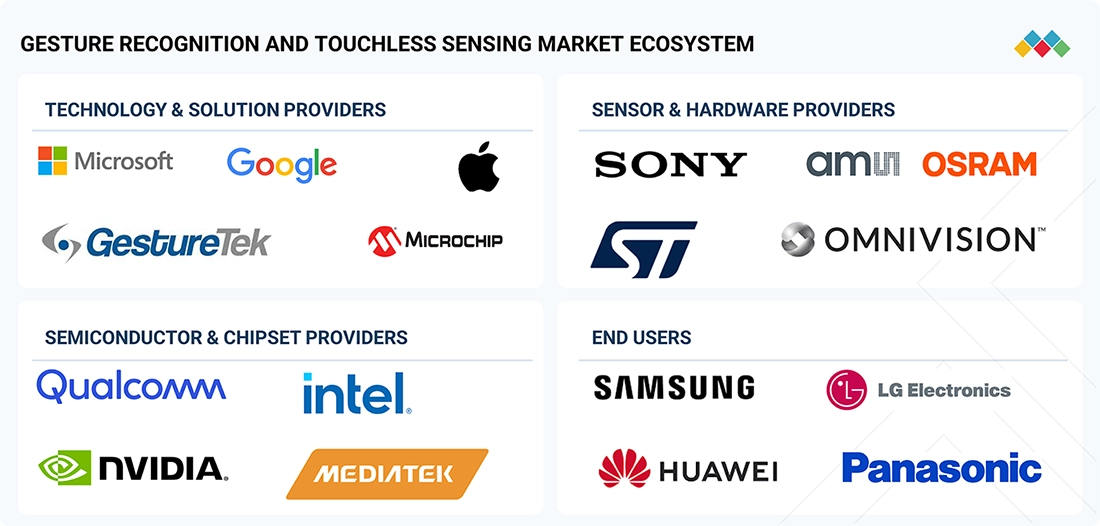
GESTURE RECOGNITION AND TOUCHLESS SENSING MARKET SIZE, SHARE & GROWTH: COMMERCIAL USE CASES ACROSS INDUSTRIES
| COMPANY | USE CASE DESCRIPTION | BENEFITS |
|---|---|---|
 |
Apple deployed gesture recognition and touchless sensing in its consumer electronics ecosystem, including Face ID facial recognition for iPhone and iPad devices, touchless gesture controls in watchOS, and spatial computing interactions in Vision Pro headset for immersive AR/VR experiences. | The technology enabled seamless biometric authentication, improved user privacy and security, enhanced accessibility for users with mobility limitations, reduced physical contact with devices, and created intuitive spatial computing experiences with natural hand tracking and eye-gaze interactions. |
 |
Microsoft implemented gesture recognition and touchless sensing through Azure Kinect DK and HoloLens mixed reality platform for enterprise applications, including hands-free surgical guidance in healthcare, touchless industrial equipment control in manufacturing, and gesture-based collaboration tools in corporate environments. | The deployment improved workplace hygiene and safety by eliminating physical touch requirements, enhanced productivity through natural gesture-based interactions, enabled innovative mixed reality training and simulation programs, and supported social distancing requirements in healthcare and manufacturing facilities. |
 |
Microchip Technology deployed GestIC 3D gesture recognition controllers and touchless sensor solutions for automotive human-machine interfaces, smart home devices, and consumer electronics, enabling mid-air gesture control for infotainment systems, touchless light switches, and proximity sensing for appliances. | The technology reduced driver distraction through intuitive gesture controls in vehicles, improved hygiene in public spaces and high-traffic environments, extended product lifespan by minimizing mechanical wear from physical buttons, and enhanced user convenience with contactless operation of everyday devices. |
 |
Google implemented gesture recognition and touchless sensing through Project Soli, a radar-based motion sensing technology, in Pixel smartphones and Nest smart home devices. This enabled touchless music control, call management, alarm snoozing, and presence detection for automated lighting and security systems. | The system enabled hands-free device control for improved accessibility and convenience, reduced unnecessary device interactions to extend battery life, enhanced privacy through on-device processing without cameras, and created more intuitive smart home automation with presence and motion-based triggers. |
 |
Infineon Technologies deployed 60GHz radar sensors and Time-of-Flight (ToF) solutions for gesture recognition and touchless sensing in automotive cabin monitoring systems, smart retail displays with gesture-based navigation, and industrial robotics with touchless human-machine collaboration interfaces. | The deployment improved automotive safety through driver attention monitoring and child presence detection. It enhanced retail customer engagement with interactive touchless displays, enabled safer human-robot collaboration in industrial settings, and provided reliable performance in challenging environmental conditions, including varying lighting and temperature ranges. |
Logos and trademarks shown above are the property of their respective owners. Their use here is for informational and illustrative purposes only.
Related Ecosystem
Automotive Electronics And Electrical Equipment
- Battery Electric Vehicle (BEV)
- Light Commercial Vehicles (LCVs)
- Fuel Cell Electric Vehicle (FCEV)
- Sensors
- Hybrid Electric Vehicle (HEV)
- BOSCH LIMITED
- Continental ag
- DENSO Corporation
- Texas Instruments Incorporated
- Panasonic Holdings Corporation
Augmented Virtual Reality
- Sensors
- Virtual Reality Devices
- Augmented Reality
- Virtual Reality
- Augmented Reality Devices
- MICROSOFT CORPORATION
- Lenovo
- VIVITEK CORPORATION
- Apple Inc.
Security And Surveillance
- Face Recognition
- Video Surveillance as A Service (VSaaS)
- Voice Recognition
- Fingerprint Recognition
- IRIS Recognition
- HONEYWELL INTERNATIONAL INC.
- Thales group
- HID-GLOBAL
- Lenovo
- AXIS COMMUNICATIONS
Key Takeaways
- Asia Pacific gesture recognition market valued at $15.1B in 2025, forecast to reach $32.4B by 2030 at 24.8% CAGR
- China, Japan, South Korea, and India lead Asia Pacific adoption through semiconductor innovation and consumer electronics integration
- Contactless interfaces in healthcare, automotive, and smart home sectors are primary growth drivers across Asia Pacific
- Asia Pacific's tech-savvy population and government semiconductor initiatives position the region as a global market leader
Gesture Recognition and Touchless Sensing Market Report Scope
| Report Metric | Details |
|---|---|
| Base Year | 2025 |
| Fastest Growing Segment | CAMERA-BASED (Touchless Technology Type) |
| Forecast Period | 2025–2030 |
| Growth Rate | CAGR of 23.7% from 2025 to 2030 |
| Largest Segment | TOUCHLESS TECHNOLOGY (Technology) |
| Market Size Base Year (Billions) | ~USD 28.41 (2025) |
| Revenue Forecast (Billions) | ~USD 82.28 (2030) |
| Segments Covered | Technology, Touch-Based Technology Type, Touchless Technology Type, Camera Type, Proximity Sensor Type, Type, Vertical, Product, Touchless Sanitary Equipment Type, Touchless Biometric Equipment Type |
Asia Pacific Gesture Recognition and Touchless Sensing Market Report Segmentation
10 segment dimensions are covered across the global market.
By Technology
- Touch-Based Technology
- Touchless Technology
By Touch-Based Technology Type
- Motion Gesture
- Multi-Touch
By Touchless Technology Type
- Camera Based
- Camera-Based
- Other Touchless Technologies
- Proximity Sensors
- Rfid
- Voice Assistance
By Camera Type
- 2D
- 3D
By Proximity Sensor Type
- Capacitive
- Infrared
- Ultrasonic
By Type
- Offline
- Online
By Vertical
- Advertisement & Communications
- Automotive
- Consumer Electronics
- Defense
- Finance & Banking
- Government
- Healthcare
- Other Verticals
By Product
- Other Touchless Sensing Products
- Touchless Biometric Equipment
- Touchless Sanitary Equipment
By Touchless Sanitary Equipment Type
- Touchless Faucets
- Touchless Hand Dryers
- Touchless Soap Dispensers
- Touchless Towel Dispensers
- Touchless Trash Cans
By Touchless Biometric Equipment Type
- Face Recognition Systems
- Fingerprint Recognition Systems
- Iris Recognition Systems
- Voice Recognition Systems
Target Audience
- Electronics Manufacturers & OEMs : Require detailed Asia Pacific market data to guide product development, feature prioritization, and regional launch strategies for gesture-enabled devices and touchless interfaces.
- Semiconductor & Component Suppliers : Need market forecasts and adoption trends across Asia Pacific to optimize production capacity, supply chain planning, and customer engagement with regional device makers.
- Automotive & Mobility Companies : Seek insights into touchless interface adoption in Asia Pacific vehicles, competitive offerings, and regulatory requirements to enhance in-cabin user experience and safety features.
- Healthcare & Medical Device Providers : Require market intelligence on contactless technology adoption in Asia Pacific hospitals and clinics to develop compliant, market-ready solutions for infection control and operational efficiency.
- Investors & Strategic Consultants : Need comprehensive Asia Pacific market analysis, growth drivers, and competitive dynamics to evaluate investment opportunities and advise clients on market entry and expansion strategies.
Key Companies in the Asia Pacific Gesture Recognition and Touchless Sensing Market
| Company | HQ | Ownership | Strongest segments |
|---|---|---|---|
| LIPS CORPORATION | Hong Kong | ||
| OCULUS VR | United States | ||
| METHODE ELECTRONICS | United States | ||
| IBM CORPORATION | United States | ||
| JABIL | United States | ||
| META PLATFORMS, INC. | United States | ||
| MICROSOFT | United States | ||
| MICROCHIP TECHNOLOGY INC. | United States |
LIPS CORPORATION
LIPS Corporation is a Hong Kong-based technology company.
OCULUS VR
Oculus VR is a United States-based virtual reality company.
METHODE ELECTRONICS
Methode Electronics is a United States-based electronics manufacturer.
IBM CORPORATION
IBM Corporation is a United States-based information technology and consulting company.
JABIL
Jabil is a United States-based electronics manufacturing services provider.
META PLATFORMS, INC.
Meta Platforms, Inc. is a United States-based technology company focused on social media and metaverse technologies.
MICROSOFT
Microsoft is a United States-based software and cloud computing company.
MICROCHIP TECHNOLOGY INC.
Microchip Technology Inc. is a United States-based semiconductor manufacturer.
Countries within Asia Pacific - compare and drill down
| Country | 2025 size (native) |
|---|
Country market size visualization
Reasons to Buy this Report
- Regional Market Sizing & Forecasts : Obtain precise market valuations for Asia Pacific with detailed 2025-2030 projections, enabling accurate budget allocation and investment planning specific to this high-growth region.
- Competitive Landscape Intelligence : Identify key players, market share distribution, and competitive strategies unique to Asia Pacific's gesture recognition ecosystem, from OEMs to emerging startups.
- Sector-Specific Opportunity Analysis : Understand adoption patterns across consumer electronics, automotive, healthcare, and IoT segments in Asia Pacific, with actionable insights for vertical-specific market entry.
- Regulatory & Technology Trends : Stay informed on Asia Pacific-specific regulations, standards, and emerging technology preferences that shape product development and go-to-market strategies.
- Investment & Partnership Roadmap : Leverage detailed market intelligence to identify high-potential countries, distribution channels, and partnership opportunities within Asia Pacific's rapidly evolving ecosystem.
Frequently asked questions
What is the current market size of gesture recognition in Asia Pacific?
Asia Pacific's gesture recognition and touchless sensing market is valued at $15,087.2 million in 2025, with strong growth momentum across the region.
What is the projected market size for Asia Pacific by 2030?
Asia Pacific's market is projected to reach $32,409.3 million by 2030, driven by increasing adoption of touchless technologies and semiconductor innovation.
What is the CAGR for gesture recognition in Asia Pacific?
Asia Pacific's gesture recognition market is expected to grow at a compound annual growth rate of 24.8% from 2025 to 2030.
Which countries are leading the gesture recognition market in Asia Pacific?
China, Japan, South Korea, and India are the primary drivers of Asia Pacific's gesture recognition market, leveraging advanced semiconductor capabilities and consumer electronics manufacturing.
What applications are driving growth in Asia Pacific's gesture recognition market?
Smart devices, gaming, automotive interfaces, healthcare systems, and IoT applications are the key segments accelerating gesture recognition adoption across Asia Pacific.
RESEARCH METHODOLOGY
The research process for this technical, market-oriented, and commercial study of the gesture recognition & touchless sensing market included systematic gathering, recording, and analysis of data about companies operating in the market. It involved the extensive use of secondary sources, directories, and databases (Factiva, Oanda) to identify and collect relevant information. In-depth interviews were conducted with various primary respondents, including experts from core and related industries and preferred manufacturers, to obtain and verify critical qualitative and quantitative information as well as to assess the growth prospects of the market. Key players in the gesture recognition & touchless sensing market were identified through secondary research, and their market rankings were determined through primary and secondary research. This included studying annual reports of top players and interviewing key industry experts, such as CEOs, directors, and marketing executives.
Secondary Research
In the secondary research process, various secondary sources have been referred to for identifying and collecting information relevant to this study. Secondary sources include annual reports, press releases, and investor presentations of companies; white papers, certified publications, and articles from recognized authors; directories; and databases. Secondary research has been mainly conducted to obtain key information about the supply of the industry; a total pool of key players; segmentation of the market according to industry trends, geographic markets, and key developments from market- and technology-oriented perspectives.
Primary Research
In the primary research process, primary sources from the supply and demand sides have been interviewed to obtain qualitative and quantitative information for this report. Primary sources from the supply side include experts, such as CEOs, vice presidents, marketing directors, technology and innovation directors, subject-matter experts, consultants, and related key executives from major companies and organizations operating in the gesture recognition & touchless sensing market.
After the complete market engineering process (market statistics calculations, market breakdown, market size estimations, market forecasting, and data triangulation), extensive primary research has been conducted to gather information and verify and validate the critical market numbers.
Several primary interviews have been conducted with experts from the demand and supply sides across four major regions—North America, Europe, Asia Pacific, and RoW. Approximately 25% of the primary interviews were conducted with the demand side and 75% with the supply side. This primary data has been collected through questionnaires, emails, and telephonic interviews.
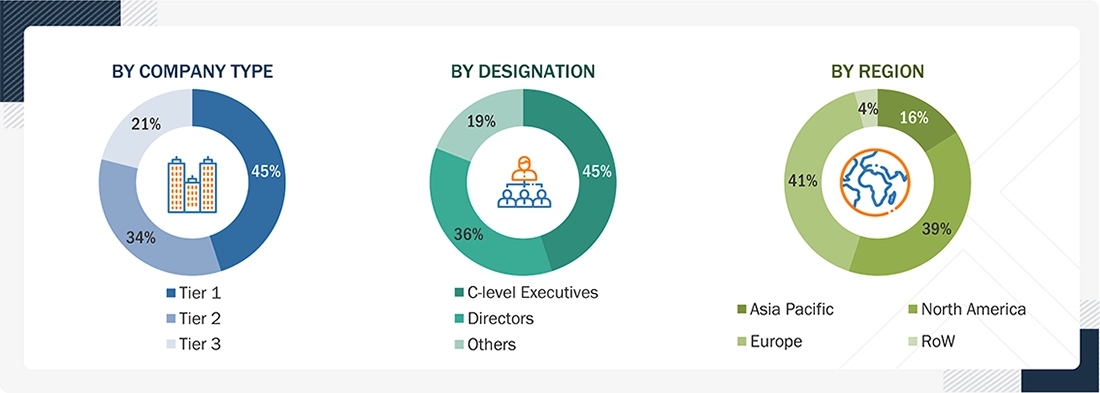
Notes: Tier 1 companies include market players with revenues above USD 500 million; tier 2 companies earn revenues between USD 100 million and USD 500 million; and tier 3 companies earn revenues up to USD 100 million.
To know about the assumptions considered for the study, download the pdf brochure
Market Size Estimation
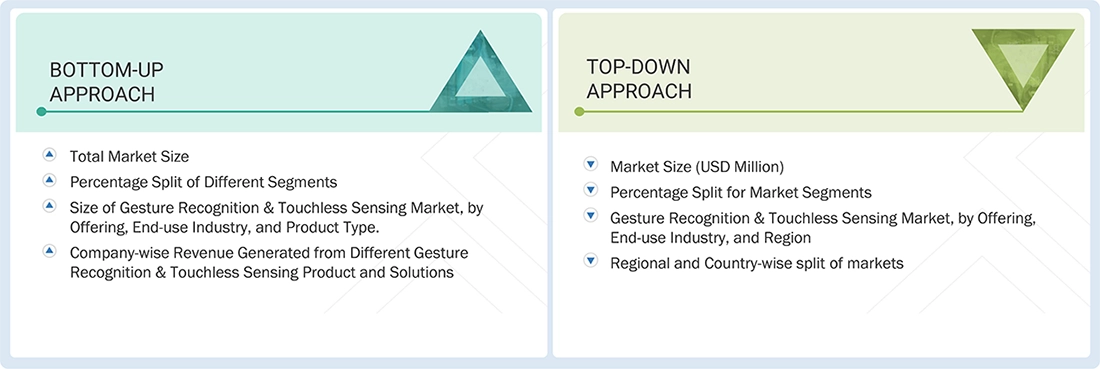
In the complete market engineering process, both top-down and bottom-up approaches were used, along with several data triangulation methods, to estimate and forecast the size of the market and its segments and subsegments listed in the report. Extensive qualitative and quantitative analyses were carried out on the complete market engineering process to list the key information/insights pertaining to the gesture recognition and touchless sensing market.
The key players in the market were identified through secondary research, and their rankings in the respective regions were determined through primary and secondary research. This entire procedure involved the study of the annual and financial reports of top players, as well as interviews with industry experts such as chief executive officers, vice presidents, directors, and marketing executives for quantitative and qualitative key insights. All percentage shares, splits, and breakdowns were determined using secondary sources and verified through primary sources. All parameters that affect the markets covered in this research study were accounted for, viewed in extensive detail, verified through primary research, and analyzed to obtain the final quantitative and qualitative data. This data was consolidated and enhanced with detailed inputs and analysis from MarketsandMarkets and presented in this report.
BOTTOM-UP APPROACH
- Identifying various verticals using or are expected to use gesture recognition and touchless sensing products and components
- Analyzing each vertical and application, along with related major companies and gesture recognition and touchless sensing providers, and identifying service providers for gesture recognition and touchless sensing products
- Understanding the demand generated by companies operating across different verticals
- Tracking the ongoing and upcoming implementation of gesture recognition and touchless sensing projects by verticals and forecasting the market size based on developments and other critical parameters considered by end users from these verticals
- Carrying out multiple discussions with key opinion leaders to understand the type of technology and products developed by the end-use industries; this information would help analyze the breakdown of the scope of work carried out by each major company in the gesture recognition and touchless sensing market.
- Arriving at the market estimates by analyzing the gesture recognition and touchless sensing companies based in each country; subsequently, these market estimates are combined to arrive at the market estimates by region.
- Verifying and cross-checking the estimates at every level through discussions with key opinion leaders, including CXOs, directors, and operation managers, and finally, with the domain expert at MarketsandMarkets
- Studying various paid and unpaid sources of information, such as annual reports, press releases, white papers, and databases, for this process
TOP-DOWN APPROACH
- Focusing on top-line investments and expenditures being made in the ecosystems of various verticals; additionally, listing key developments, analyzing updated technology and software in the marketplace, as well as evaluating the market by further splitting it into various connectivity technologies
- Building and developing the information related to the market revenue generated by the key gesture recognition and touchless sensing product providers
- Conducting multiple on-field discussions with key opinion leaders involved in the development of gesture recognition and touchless sensing and products in various verticals
- Estimating geographic splits by using secondary sources based on various factors such as the number of players in a specific country and region, type of gesture recognition and touchless sensing, level of services offered, and type of software implemented across various applications in several verticals
Data Triangulation
After arriving at the overall market size from the market size estimation process explained above, the total market has been split into several segments and subsegments. To complete the overall market engineering process and obtain the exact statistics for all segments and subsegments, the market breakdown and data triangulation procedures have been employed where applicable. The data has been triangulated by studying various factors and trends from both the demand and supply sides. In addition, the market size has been validated using both top-down and bottom-up approaches.
Market Definition
Gesture recognition and touchless sensing are two radical technologies that facilitate users by getting rid of physical connections in order to operate any smart device. The idea of gesture recognition and touchless sensing underwent a sea change in the last decade. Intelligence in electronic devices is very technology-oriented, efficient, and assures high HMI. The growth in the market can be attributed to the easy adoption of gesture recognition and touchless sensing due to low technical complexity and increased digitalization. Gesture recognition and touchless sensing use various mathematical algorithms in computing devices to translate human gestures or movements. These systems help humans interact with machines without using any mechanical devices. Gesture recognition and touchless sensing technology use human gestures, such as the movement of the head, fingers, arms, hands, and the entire body. The gesture recognition market is segmented based on technology, type, industry, and geography, whereas the touchless sensing market is segmented by technology, product type, end-use industry, and region.
Key Stakeholders
- Gesture recognition and touchless sensing hardware and software providers
- Analysts and strategic business planners
- Venture capitalists and startups
- Research laboratories and intellectual property (IP) companies
- Technology standards organizations, forums, alliances, and associations
- Government bodies such as regulatory authorities and policymakers
- Raw material suppliers and manufacturers of gesture recognition and touchless sensing products
- Installation & maintenance service providers
- End customers from the consumer electronics, automotive, healthcare, and banking & finance sector
Report Objectives
- To define, describe, segment, and forecast the gesture recognition and touchless sensing market based on vertical, technology, and region
- To describe, segment, and forecast the gesture recognition market by type
- To describe, segment, and forecast the touchless sensing market by product in terms of value and volume
- To forecast the size of various segments with respect to four main regions—North America, Europe, Asia Pacific, and Rest of the World (RoW)
- To provide a detailed analysis of the gesture recognition and touchless sensing supply chain
- To analyze the macroeconomic indicators in the gesture recognition and touchless sensing market
- To strategically analyze the micromarkets with respect to individual growth trends and prospects, and their contributions to the total market
- To analyze competitive developments such as expansions, agreements, partnerships, acquisitions, product developments, and research and development (R&D) in the gesture recognition & touchless sensing market
- To analyze the opportunities for market players and provide details of the competitive landscape of the market
- To benchmark the market players using the proprietary company evaluation matrix framework, which analyzes the market players on various parameters within the broad categories of business strategy excellence and strength of product portfolios
- To strategically profile the key players and comprehensively analyze their market positions in terms of ranking and core competencies, along with a detailed competitive landscape of the market
Available customizations:
With the given market data, MarketsandMarkets offers customizations according to the specific requirements of companies.
Product analysis
- Detailed analysis and profiling of additional market players
The following customization options are available for the report:
- Market sizing and forecast for additional countries
- Additional five companies profiling
Get the Full Gesture Recognition and Touchless Sensing Market Report
Full forecast, segment splits, and company analysis for all Gesture Recognition and Touchless Sensing Market.
- US Gesture Recognition and Touchless Sensing Market
- Canada Gesture Recognition and Touchless Sensing Market
- Mexico Gesture Recognition and Touchless Sensing Market
- Germany Gesture Recognition and Touchless Sensing Market
- UK Gesture Recognition and Touchless Sensing Market
- France Gesture Recognition and Touchless Sensing Market
- Italy Gesture Recognition and Touchless Sensing Market
- Rest Of Europe Gesture Recognition and Touchless Sensing Market
- China Gesture Recognition and Touchless Sensing Market
- Japan Gesture Recognition and Touchless Sensing Market
- India Gesture Recognition and Touchless Sensing Market
- South Korea Gesture Recognition and Touchless Sensing Market
- Rest Of Asia Pacific Gesture Recognition and Touchless Sensing Market
- GCC Gesture Recognition and Touchless Sensing Market
- Saudi Arabia Gesture Recognition and Touchless Sensing Market
- UAE Gesture Recognition and Touchless Sensing Market
- Rest Of GCC Gesture Recognition and Touchless Sensing Market
- Rest Of Middle East Gesture Recognition and Touchless Sensing Market
- Africa Gesture Recognition and Touchless Sensing Market
Need a Tailored Report?
Customize this report to your needs
Get 10% FREE Customization
Customize This Report
