
Canada Veterinary Monoclonal Antibodies Market (2025-2030)

The Canada Veterinary Monoclonal Antibodies Market was valued at $67.47 Million in 2025 and projected to reach to $110.88 Million by 2030, representing a compound annual growth rate of 10.4%. Canada's veterinary monoclonal antibodies market is positioned for sustained expansion through 2030, supported by increasing pet healthcare spending and growing adoption of immunotherapy solutions across companion animal and livestock sectors.


| Market Size in | USD 26.32 MN |
| Market Forecast in | |
| CAGR | |
| Forecast Period | |
| Units Considered | Value (USD MN) |
Canada Veterinary Monoclonal Antibodies Market Trends and Insights
- This 10.4% compound annual growth rate reflects Canada's strengthening commitment to advanced animal healthcare and immunotherapy solutions.
- Canada's market is driven by increasing pet ownership, rising demand for precision diagnostics in livestock management, and growing adoption of biologics in veterinary practice across companion and production animals. The Canadian veterinary sector is increasingly integrating monoclonal antibody therapies to address chronic diseases, immune disorders, and cancer in animals.
- Canada's regulatory environment and veterinary infrastructure support the deployment of innovative immunotherapeutic products.
- Between 2025 and 2030, Canada is expected to see accelerated investment in veterinary biotechnology, expanded clinical applications, and strengthened partnerships between domestic and international manufacturers, positioning the country as a key growth market within North America's broader veterinary immunotherapy landscape..
Key Market Statistics
- CAGR (2025-2030) 10.4% CAGR
- Market Size, 2025 ~USD 67.47 Million
- Forecast, 2030 ~USD 110.88 Million
- Country Canada
Canada Veterinary Monoclonal Antibodies Market Overview
Market Valuation Growth :
Canada's veterinary monoclonal antibodies market is valued at $67.47 million in 2025, with projections reaching $110.88 million by 2030, representing a robust 10.4% CAGR driven by advanced immunotherapy adoption.
Pet Ownership Surge :
Rising pet ownership across Canada is fueling demand for premium veterinary treatments, with pet owners increasingly willing to invest in advanced diagnostic and therapeutic solutions for their animals.
Precision Diagnostics Expansion :
Canadian veterinary clinics are rapidly adopting precision diagnostic tools utilizing monoclonal antibodies, improving disease detection accuracy and enabling targeted treatment protocols for companion and livestock animals.
Regulatory Support & Innovation :
Canada's favorable regulatory environment and investment in veterinary biotechnology research are accelerating the development and commercialization of novel monoclonal antibody therapies for animal health applications.
Canada Veterinary Monoclonal Antibodies Market Dynamics
- The market benefits from Canada's advanced healthcare infrastructure, strong veterinary research institutions, and rising consumer awareness of precision medicine for animals.
- Key growth drivers include expanding diagnostic capabilities, development of novel therapeutic applications, and strategic partnerships between Canadian biotech firms and international veterinary pharmaceutical companies.
- The 10.4% CAGR reflects steady market maturation as veterinarians increasingly integrate monoclonal antibody-based treatments into standard clinical practice, particularly for oncology, immunological disorders, and infectious disease management in both domestic and agricultural settings..
Market Ecosystem
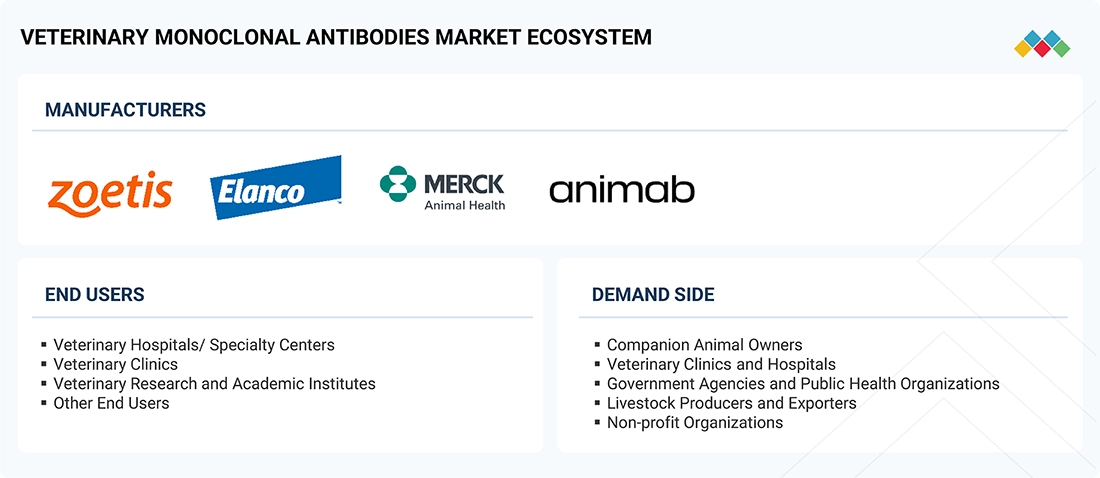
Veterinary Monoclonal Antibodies Market: COMMERCIAL USE CASES ACROSS INDUSTRIES
| COMPANY | USE CASE DESCRIPTION | BENEFITS |
|---|---|---|
 |
Approved veterinary monoclonal antibodies: Cytopoint (lokivetmab, canine atopic dermatitis), Librela (bedinvetmab, canine osteoarthritis), and Solensia (frunevetmab, feline osteoarthritis) | Clear market leader in veterinary monoclonal antibodies; first-to-market advantage; strong biologics R&D; trusted brand among veterinarians and pet owners |
 |
Monoclonal anibodies for infectious and chronic conditions: Canine Parvovirus Monoclonal Antibody | Expanding biologics pipeline through M&A; focus on life-threatening infectious diseases and chronic conditions; ability to scale via Elanco’s global distribution |
 |
Licensing and developing monoclonal antibodies for canine and feline diseases; collaborations with MabGenesis for species-specific antibodies | Strong mid-size animal health company; flexible licensing model; pipeline diversification beyond traditional small molecules and vaccines |
 |
Partnering with MabGenesis for discovery of novel veterinary monoclonal antibodies | Global animal health presence; leveraging human biologics expertise; early but strategic investments in species-specific antibodies |
 |
Investing in biologics and immunology; partnerships and acquisitions to expand antibody capabilities | Global scale, extensive distribution, strong R&D capabilities; ability to rapidly scale veterinary biologics market presence once pipeline matures |
Logos and trademarks shown above are the property of their respective owners. Their use here is for informational and illustrative purposes only.
Related Ecosystem
Animal Health
- Polymerase Chain Reaction (PCR) Tests
- Porcine
- Immunodiagnostics
- Lateral Flow Assays
- Microarrays
- Zoetis Inc.
- Patterson Companies, Inc.
- Virbac
- Elanco Animal Health Incorporated
- BOEHRINGER INGELHEIM GMBH
Key Takeaways
- Canada's veterinary monoclonal antibodies market is valued at $67.47 million in 2025 and will reach $110.88 million by 2030, representing a 10.4% CAGR.
- Canada's market growth is driven by rising pet ownership, increased livestock health management demands, and adoption of advanced immunotherapies in veterinary clinics.
- Canada's regulatory framework and veterinary infrastructure enable rapid deployment of monoclonal antibody innovations across companion and production animal segments.
- Canada is positioned as a key North American growth hub, with expanding biotech partnerships and clinical applications expected through 2030.
Veterinary Monoclonal Antibodies Market Report Scope
| Report Metric | Details |
|---|---|
| Base Year | 2025 |
| Fastest Growing Segment | BEDINVETMAB (LIBRELA) (Product) |
| Forecast Period | 2025-2030 |
| Growth Rate | CAGR of 12.4% from 2025 to 2030 |
| Largest Segment | SUBCUTANEOUS ROUTE OF ADMINISTRATION (Route Of Administration) |
| Market Size Base Year (Billions) | ~USD 1.71 (2025) |
| Revenue Forecast (Billions) | ~USD 3.06 (2030) |
| Segments Covered | Animal Type, Product, Route Of Administration, Therapy Area, End User, Animal Type 2023-2030 |
Canada Veterinary Monoclonal Antibodies Market Report Segmentation
6 segment dimensions are covered across the global market.
By Animal Type
- Canines
- Felines
- Other Animal Types
- Other Animals
By Product
- Bedinvetmab (Librela)
- Canine Parvovirus Monoclonal Antibody (Cpma)
- Frunevetmab (Solensia)
- Gilvetmab
- Lokivetmab (Cytopoint)
- Other Products
By Route Of Administration
- Intravenous (Iv) Route Of Administration
- Intravenous Route Of Administration
- Oral Route Of Administration
- Subcutaneous (Sc) Route Of Administration
- Subcutaneous Route Of Administration
By Therapy Area
- Dermatology
- Infectious Diseases
- Oncology
- Other Therapy Areas
- Pain Management
By End User
- Other End Users
- Veterinary Clinics
- Veterinary Hospitals/ Specialty Centers
- Veterinary Hospitals/Specialty Clinics
- Veterinary Research & Academic Institutes
By Animal Type 2023-2030
- Canines
- Felines
- Other Animals
CANADA: VETERINARY MONOCLONAL ANTIBODIES MARKET, BY END USER, 2023–2030
| Segment | 2023 | 2024 | 2025 | 2026 | 2028 | 2029 | 2030 | CAGR (%) |
|---|---|---|---|---|---|---|---|---|
| OTHER END USERS | 5.71 | 6.09 | 6.51 | 6.96 | 7.96 | 8.52 | 9.13 | 7 |
| VETERINARY CLINICS | 22.4 | 24.88 | 27.66 | 30.77 | 38.15 | 42.5 | 47.43 | 11.4 |
| VETERINARY HOSPITALS/SPECIALTY CLINICS | 27.16 | 29.91 | 32.97 | 36.36 | 44.31 | 48.94 | 54.14 | 10.4 |
| VETERINARY RESEARCH & ACADEMIC INSTITUTES | 4.96 | 5.39 | 5.86 | 6.37 | 7.55 | 8.22 | 8.97 | 8.9 |
| TOTAL | 60.24 | 66.26 | 73 | 80.46 | 97.96 | 108.19 | 119.68 | 10.4 |
Target Audience
- Veterinary Pharmaceutical Companies : Manufacturers and distributors need Canada-specific market data to assess market opportunity, plan product launches, and develop competitive strategies tailored to Canadian veterinary practice standards and regulatory requirements.
- Biotech & Diagnostics Firms : Companies developing monoclonal antibody-based diagnostics require detailed Canadian market insights to identify clinical adoption rates, veterinary clinic partnerships, and reimbursement pathways for their innovations.
- Veterinary Clinic Networks : Multi-location veterinary practices and animal hospitals need market intelligence to evaluate investment in monoclonal antibody-based treatments, understand competitive offerings, and optimize service portfolios for Canadian pet owners.
- Investment & Private Equity Firms : Investors evaluating opportunities in Canadian veterinary healthcare require market-specific data on growth trajectories, profitability potential, and competitive positioning to make informed funding and acquisition decisions.
- Government & Healthcare Policy Bodies : Canadian health authorities and agricultural agencies need market research to inform veterinary healthcare policy, funding priorities, and regulatory frameworks supporting advanced animal immunotherapy adoption across the country.
Reasons to Buy this Report
- Market-Specific Sizing & Forecasts : Access precise valuation data for Canada's veterinary monoclonal antibodies market with detailed 2025-2030 projections, enabling accurate budget allocation and investment planning specific to the Canadian market landscape.
- Competitive Landscape Intelligence : Understand Canada-specific competitive dynamics, key market players, and their strategic positioning within the country's veterinary immunotherapy sector to identify partnership and acquisition opportunities.
- Regulatory & Reimbursement Insights : Gain comprehensive understanding of Canadian regulatory pathways, Health Canada approval processes, and veterinary reimbursement frameworks that directly impact market entry and commercialization strategies.
- Growth Driver Analysis : Identify Canada-specific growth catalysts including pet ownership trends, veterinary spending patterns, and regional healthcare priorities to optimize product development and marketing strategies for Canadian stakeholders.
- Strategic Market Entry Planning : Leverage Canada-focused market intelligence to develop targeted go-to-market strategies, identify high-potential customer segments, and establish effective distribution channels within the Canadian veterinary ecosystem.
Frequently asked questions
What is the current size of Canada's veterinary monoclonal antibodies market?
Canada's veterinary monoclonal antibodies market is valued at $67.47 million in 2025 and is projected to grow to $110.88 million by 2030.
What is the growth rate of Canada's veterinary monoclonal antibodies market?
Canada's veterinary monoclonal antibodies market is growing at a compound annual growth rate (CAGR) of 10.4% from 2025 to 2030.
What factors are driving growth in Canada's veterinary monoclonal antibodies market?
Growth in Canada is driven by increasing pet ownership, rising demand for advanced livestock diagnostics, adoption of biologics in veterinary practice, and expanding treatment options for chronic and immune-related animal diseases.
Which animal segments are driving Canada's veterinary monoclonal antibodies market?
Both companion animals (pets) and production animals (livestock) are driving Canada's market, with applications spanning diagnostics, immunotherapy, and disease management across veterinary practices.
How does Canada's market compare to the global veterinary monoclonal antibodies market?
Canada's 10.4% CAGR is slightly lower than the global 12.4% CAGR, reflecting Canada's mature veterinary infrastructure and steady adoption of advanced immunotherapies within a well-established healthcare system.
RESEARCH METHODOLOGY
This study involved the extensive use of both primary and secondary sources. The research process involved evaluating various factors affecting the industry to identify the segmentation, industry trends, key players, competitive landscape, market dynamics, and growth strategies.
Secondary Research
In the secondary research process, various secondary sources were referred to, including directories, databases such as Bloomberg Business, Factiva, and Dun & Bradstreet; white papers, annual reports, company house documents, investor presentations, and SEC filings of companies. Secondary research was used to identify and collect valuable information for an extensive, technical, market-oriented, and commercial study of the veterinary monoclonal antibodies market. It was also used to obtain information about the key players, market classification & segmentation according to industry trends to the bottommost level, and key developments related to market and technology perspectives. A database of the key industry leaders was also prepared using secondary research.
Primary Research
In the primary research process, various primary sources from the supply and demand sides were interviewed to obtain critical qualitative and quantitative information for this report. Primary sources from the supply side include project/sales/marketing/business development managers, presidents, vice presidents, chairpersons, chief executive officers, chief operating officers, chief strategy officers, directors, chief information officers, and chief medical information officers related to the veterinary monoclonal antibodies market. Primary sources from the demand side include professionals from veterinary hospitals and clinics, academic & research institutes, and pet owners.
Breakdown of primary interviews
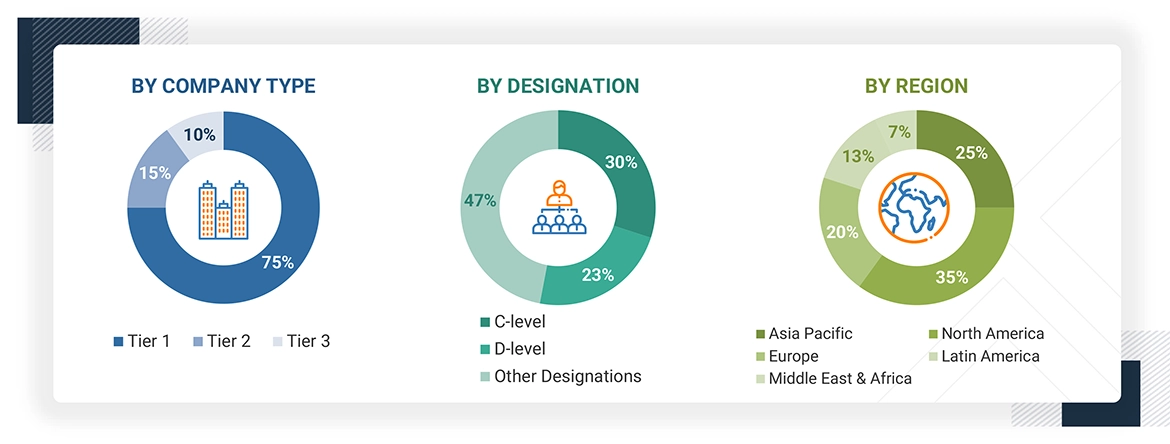
Note: Companies are classified into tiers based on their total revenue. As of 2024, Tier 1 = >USD 10.00 billion, Tier 2 = USD 1.00 billion to USD 10.00 billion, and Tier 3 = < USD 1.00 billion.
Other designations include sales managers, marketing managers, business development managers, product managers, distributors, and suppliers.
To know about the assumptions considered for the study, download the pdf brochure
Market Size Estimation
The total size of the veterinary monoclonal antibodies market was determined after data triangulation from two approaches, as mentioned below. After each approach, the weighted average of these approaches was taken based on the level of assumptions used in each approach.
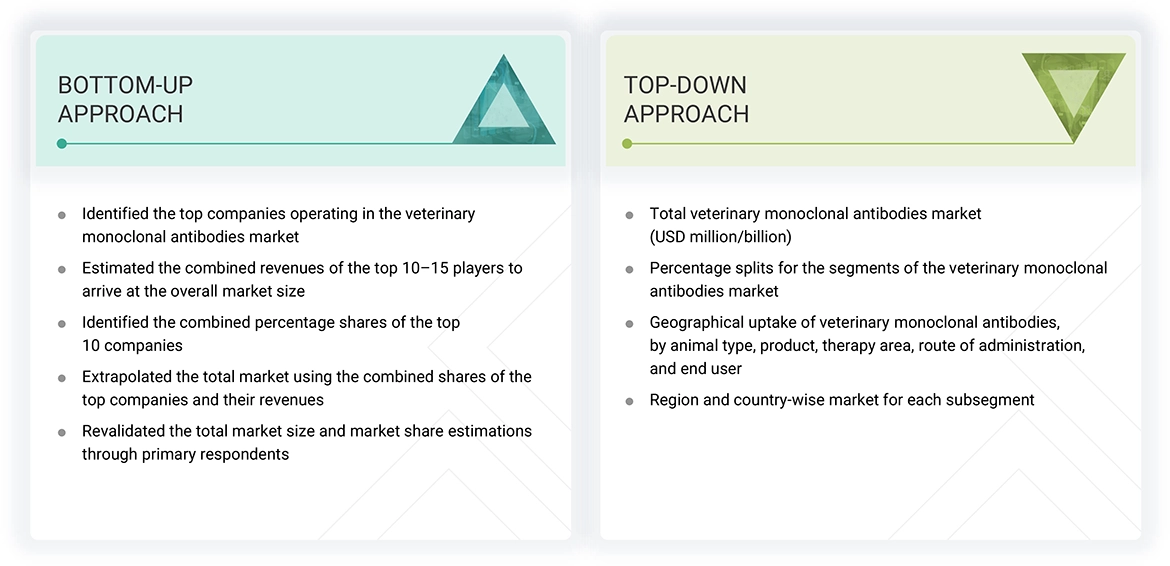
Data Triangulation
After arriving at the market size, the total market was divided into several segments and subsegments. Data triangulation and market breakdown procedures were employed wherever applicable to complete the overall market engineering process and arrive at the exact statistics for all segments and subsegments.
Market Definition
Veterinary monoclonal antibodies are laboratory-produced antibodies designed to target specific antigens in animals, offering precise treatment for conditions like atopic dermatitis, osteoarthritis, and infectious diseases. These species-specific biologics are engineered to work effectively in the immune systems of dogs, cats, or livestock. They represent a significant advancement over traditional drugs by providing targeted therapy with fewer side effects.
Stakeholders
- Veterinary monoclonal antibody manufacturers
- Animal healthcare product manufacturers
- Veterinary monoclonal antibody distributors and wholesalers
- Animal welfare associations
- Veterinary clinics and care centers
- Research and consulting firms
- Veterinary R&D organizations
- Contract research organizations
- Contract manufacturing organizations
- Venture capitalists
Report Objectives
- To define, describe, and forecast the veterinary monoclonal antibodies market by animal type, product, therapy area, route of administration, end user, and region
- To identify and analyze key drivers, restraints, opportunities, and challenges influencing market growth
- To strategically analyze the regulatory scenario, value chain analysis, supply chain analysis, Porter’s Five Forces analysis, ecosystem analysis, trade analysis, pricing analysis, patent analysis, impact of AI, case study analysis, adjacent market analysis, unmet needs/end user expectations, and trends and disruptions impacting customer business in the market
- To analyze micro markets with respect to individual growth trends, prospects, and contributions to the overall market
- To analyze opportunities for stakeholders and provide details of the competitive landscape for key players
- To strategically profile key players in this market and comprehensively analyze their market shares and core competencies
- To track and analyze competitive developments such as product launches and approvals, partnerships, and expansions in the market
Get the Full Veterinary Monoclonal Antibodies Market Report
Full forecast, segment splits, and company analysis for all Veterinary Monoclonal Antibodies Market.
- US Veterinary Monoclonal Antibodies Market
- Germany Veterinary Monoclonal Antibodies Market
- France Veterinary Monoclonal Antibodies Market
- UK Veterinary Monoclonal Antibodies Market
- Italy Veterinary Monoclonal Antibodies Market
- Spain Veterinary Monoclonal Antibodies Market
- Netherlands Veterinary Monoclonal Antibodies Market
- Japan Veterinary Monoclonal Antibodies Market
- China Veterinary Monoclonal Antibodies Market
- India Veterinary Monoclonal Antibodies Market
- Australia Veterinary Monoclonal Antibodies Market
- South Korea Veterinary Monoclonal Antibodies Market
- New Zealand Veterinary Monoclonal Antibodies Market
- Brazil Veterinary Monoclonal Antibodies Market
- Mexico Veterinary Monoclonal Antibodies Market
- Rest Of Europe Veterinary Monoclonal Antibodies Market
- Rest Of Asia Pacific Veterinary Monoclonal Antibodies Market
- Rest Of Latin America Veterinary Monoclonal Antibodies Market
Need a Tailored Report?
Customize this report to your needs
Get 10% FREE Customization
Customize This Report
