
Germany Vibration Monitoring Market (2024-2029)

The Germany Vibration Monitoring Market was valued at $131 Million in 2024 and projected to reach to $195.9 Million by 2029, representing a compound annual growth rate of 8.4%. Germany's vibration monitoring market is positioned for sustained growth through 2029, driven by the country's commitment to Industry 4.0 initiatives and digital transformation across manufacturing.


| Market Size in | USD 26.32 MN |
| Market Forecast in | |
| CAGR | |
| Forecast Period | |
| Units Considered | Value (USD MN) |
Germany Vibration Monitoring Market Trends and Insights
- Germany's advanced manufacturing sector and strong automotive and industrial base drive demand for predictive maintenance solutions, positioning the country as a key European hub for vibration monitoring technology adoption.
- The 8.4% compound annual growth rate reflects Germany's commitment to Industry 4.0 initiatives and digital transformation across semiconductor and electronics manufacturing. In Germany, vibration monitoring solutions are increasingly integrated into production lines to enhance equipment reliability and reduce unplanned downtime.
- Germany's emphasis on precision engineering and quality control standards accelerates the deployment of real-time monitoring systems across factories and facilities.
- Between 2024 and 2029, Germany is expected to see heightened investment in IoT-enabled vibration sensors and analytics platforms, driven by regulatory compliance requirements and competitive pressures in the global semiconductor supply chain..
Key Market Statistics
- CAGR (2024-2029) 8.4% CAGR
- Market Size, 2024 ~USD 131 Million
- Forecast, 2029 ~USD 195.9 Million
- Country Germany
Germany Vibration Monitoring Market Overview
Market Valuation Growth :
Germany's vibration monitoring market reached USD 131.0 million in 2024 and is projected to grow to USD 195.9 million by 2029, representing a robust 8.4% CAGR, outpacing the global average of 7.8%.
Manufacturing Excellence Driver :
Germany's world-class automotive and industrial manufacturing sectors are primary catalysts for vibration monitoring adoption, with predictive maintenance becoming essential for maintaining competitive advantage in precision engineering.
European Technology Hub :
As a leading European center for vibration monitoring technology, Germany benefits from strong R&D capabilities, established industrial automation infrastructure, and stringent quality standards that drive market expansion.
Predictive Maintenance Adoption :
German manufacturers increasingly prioritize predictive maintenance solutions to reduce downtime, extend equipment lifespan, and optimize operational efficiency across automotive, machinery, and industrial sectors.
Germany Vibration Monitoring Market Dynamics
- The strong automotive sector, coupled with Germany's reputation for engineering excellence, creates consistent demand for advanced condition monitoring technologies.
- Investment in smart factory solutions and IoT-enabled predictive maintenance systems will continue to accelerate market penetration across mid-sized and large industrial enterprises. The competitive landscape in Germany favors technology providers offering integrated solutions that combine vibration analysis with broader asset management platforms.
- Rising labor costs and skilled worker shortages further incentivize automation and predictive maintenance adoption.
- With regulatory emphasis on operational safety and environmental compliance, German manufacturers view vibration monitoring as a strategic investment rather than a discretionary expense, ensuring sustained market momentum through the forecast period..
Market Ecosystem
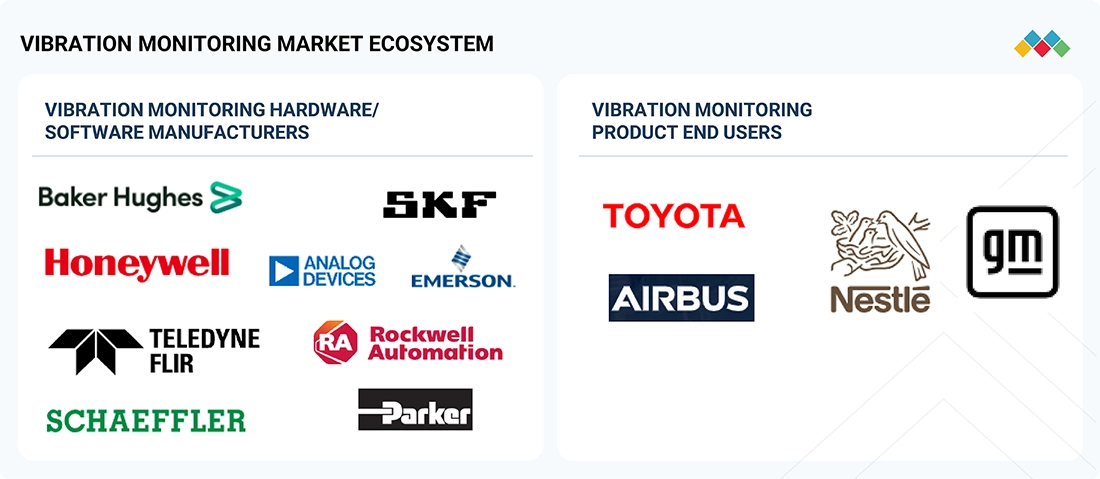
VIBRATION MONITORING MARKET SIZE SHARE AND TRENDS: COMMERCIAL USE CASES ACROSS INDUSTRIES
| COMPANY | USE CASE DESCRIPTION | BENEFITS |
|---|---|---|
 |
Provides vibration monitoring and machine protection through Bently Nevada, deployed across oil & gas, petrochemical plants, LNG terminals, and power assets for turbines, compressors, pumps, and motors. | Reduces unplanned downtime, improves equipment reliability, enhances safety in high-risk operations, and lowers maintenance costs via predictive insights. |
 |
Delivers wireless and integrated vibration monitoring through AMS Machine Works and Ovation, supporting refining, chemical plants, metals, and power facilities. | Strengthens continuous asset visibility, cuts manual inspection effort, accelerates fault diagnostics, and extends asset life with centralized monitoring. |
 |
Offers wireless sensors, handheld analysers, and cloud analytics (SKF Enlight) for manufacturing lines, food processing, mining, and heavy rotating machinery. | Detects early bearing and shaft issues, increases uptime, reduces failure risk in harsh environments, and cuts maintenance costs with automated data capture. |
 |
Provides OPTIME and SmartCheck for continuous vibration-based monitoring of motors, pumps, gearboxes, and conveyors across automotive, steel, cement, and renewables. | Enables early-stage fault prediction, reduces maintenance workload, improves operational stability, and supports scalable plant-wide diagnostics. |
 |
Integrates vibration sensing into hydraulic, pneumatic, and motion systems for industrial equipment, mobile machinery, and aerospace applications. | Prevents hydraulic and mechanical failures, increases system reliability, enhances operator safety, and supports predictive maintenance to reduce downtime. |
Logos and trademarks shown above are the property of their respective owners. Their use here is for informational and illustrative purposes only.
Related Ecosystem
Industrial Automation
- Sensors
- Image Sensors
- Manufacturing Execution System (MES)
- Actuators
- Flow Sensors
- Siemens ag
- ABB India Limited
- Emerson Electric Co.
- HONEYWELL INTERNATIONAL INC.
- SCHNEIDER ELECTRIC SE
Industrial Iot
- Sensors
- Pressure Sensors
- Flow Sensors
- Gas Sensors
- Image Sensors
- Siemens ag
- ABB India Limited
- HONEYWELL INTERNATIONAL INC.
- Emerson Electric Co.
- SCHNEIDER ELECTRIC SE
Key Takeaways
- Germany's vibration monitoring market is valued at USD 131.0 million in 2024 and will grow to USD 195.9 million by 2029, representing an 8.4% CAGR.
- Germany's Industry 4.0 framework and advanced manufacturing ecosystem are primary catalysts for vibration monitoring technology adoption across semiconductor and electronics sectors.
- Predictive maintenance and IoT integration are driving Germany's shift toward real-time equipment monitoring and condition-based maintenance strategies.
- Germany's stringent quality standards and automotive supply chain requirements create sustained demand for vibration monitoring solutions through 2029.
Vibration Monitoring Market Report Scope
| Report Metric | Details |
|---|---|
| Base Year | 2024 |
| Fastest Growing Segment | VIBRATION ANALYZERS (Type) |
| Forecast Period | 2024-2029 |
| Growth Rate | CAGR of 7.8% from 2024 to 2029 |
| Largest Segment | HARDWARE (Offering) |
| Market Size Base Year (Billions) | ~USD 1.85 (2024) |
| Revenue Forecast (Billions) | ~USD 2.69 (2029) |
| Segments Covered | Offering, Type, Industry, Deployment Type, System Type, Product Type & Service Type, Product Type |
Germany Vibration Monitoring Market Report Segmentation
7 segment dimensions are covered across the global market.
By Offering
- Hardware
- Services
- Software
By Type
- Accelerometers
- Other Hardware Types
- Proximity Probes
- Velocity Sensors
- Vibration Analyzers
- Vibration Meters
- Vibration Transmitters
By Industry
- Aerospace
- Automotive
- Chemicals
- Food & Beverages
- Metals & Mining
- Oil & Gas
- Other Industries
- Power Generation
By Deployment Type
- Cloud-Based
- On-Premises
By System Type
- Online
- Portable
By Product Type & Service Type
- Product Type
- Service Type
By Product Type
- General-Purpose Test Equipment
- Mechanical Test Equipment
Target Audience
- Vibration Monitoring Equipment Manufacturers : Manufacturers need Germany-specific market data to understand local demand patterns, competitive positioning, and growth opportunities within Europe's largest industrial economy.
- Predictive Maintenance Solution Providers : Software and service providers require insights into German manufacturing adoption rates, integration requirements with Industry 4.0 platforms, and customer buying behaviors to tailor offerings.
- Automotive & Industrial OEMs : Original equipment manufacturers need market intelligence on vibration monitoring technology trends, supplier capabilities, and customer expectations specific to the German market context.
- System Integrators & Consultants : Integration firms require Germany-focused data to advise clients on predictive maintenance implementation, technology selection, and ROI expectations aligned with local manufacturing standards.
- Investment & Private Equity Firms : Investors evaluating opportunities in German industrial technology need market sizing, growth projections, and competitive dynamics to assess acquisition targets and portfolio company potential.
Reasons to Buy this Report
- Market-Specific Growth Insights : Gain detailed understanding of Germany's 8.4% CAGR trajectory and USD 64.9 million market expansion opportunity, with country-specific drivers distinct from broader European trends.
- Automotive Sector Intelligence : Access targeted analysis of vibration monitoring adoption within Germany's dominant automotive industry, including OEM requirements, supplier ecosystems, and predictive maintenance integration strategies.
- Competitive Landscape Mapping : Identify key players, market consolidation patterns, and technology differentiation strategies specific to the German market, enabling informed competitive positioning and partnership decisions.
- Industry 4.0 Implementation Roadmap : Understand how German manufacturers are integrating vibration monitoring into smart factory initiatives, IoT ecosystems, and digital transformation programs with quantified adoption metrics.
- Investment & Expansion Strategy : Leverage Germany-specific market data to evaluate market entry opportunities, identify high-growth segments, and develop localized go-to-market strategies for manufacturing and industrial clients.
Frequently asked questions
What is the current size of Germany's vibration monitoring market?
Germany's vibration monitoring market was valued at USD 131.0 million in 2024 and is expected to reach USD 195.9 million by 2029.
What is the projected growth rate for vibration monitoring in Germany?
Germany's vibration monitoring market is projected to grow at a compound annual growth rate (CAGR) of 8.4% from 2024 to 2029.
Which industries in Germany are driving vibration monitoring adoption?
Germany's semiconductor, electronics, automotive, and precision manufacturing sectors are the primary drivers of vibration monitoring market growth.
How is Germany's Industry 4.0 initiative impacting vibration monitoring demand?
Germany's Industry 4.0 framework accelerates adoption of IoT-enabled vibration sensors and predictive maintenance solutions across manufacturing facilities.
What technologies are emerging in Germany's vibration monitoring market?
Real-time analytics, AI-powered condition monitoring, wireless sensor networks, and cloud-based data platforms are key emerging technologies in Germany's market.
RESEARCH METHODOLOGY
The study involved four major activities in estimating the current size of the vibration monitoring market. Exhaustive secondary research has been done to collect information on the market, peer, and parent markets. The next step has been to validate these findings, assumptions, and sizing with industry experts across the value chain through primary research. Both top-down and bottom-up approaches have been employed to estimate the total market size. After that, market breakdown and data triangulation methods were used to estimate the market size of segments and subsegments. Two sources of information—secondary and primary—have been used to identify and collect information for an extensive technical and commercial study of the vibration monitoring market.
Secondary Research
Secondary sources include company websites, magazines, industry news, associations, and databases (Factiva and Bloomberg). These secondary sources include annual reports, press releases, investor presentations of companies, white papers, certified publications, articles by recognized authors, regulatory bodies, trade directories, and databases.
Primary Research
Primary sources mainly consist of several experts from the core and related industries, along with preferred vibration monitoring system providers, distributors, alliances, standards, and certification organizations related to various segments of this industry’s value chain.
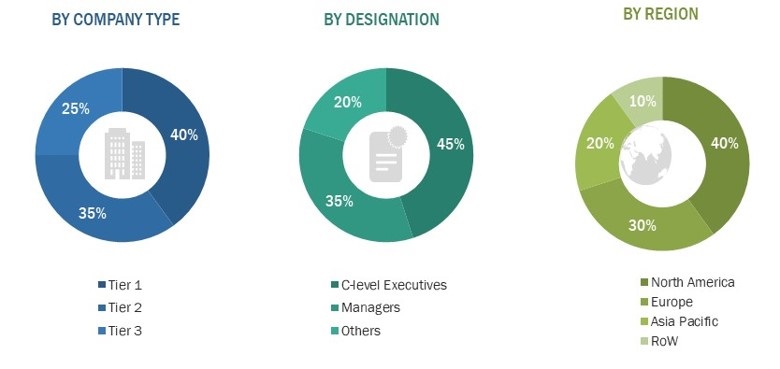
In the primary research process, various primary sources from both the supply and demand sides were interviewed to obtain qualitative and quantitative information on the market. The primary sources from the supply side included various industry experts such as Chief Experience Officers (CXOs), Vice Presidents (VPs), and Directors from business development, marketing, product development/innovation teams, and related key executives from vibration monitoring system providers, such as Baker Hughes Company (US), Emerson Electric Co. (US), SKF (Sweden), Schaeffler AG (Germany), and Parker Hannifin Corp (US); research organizations, distributors, industry associations, and key opinion leaders. Following is the breakdown of primary respondents.
To know about the assumptions considered for the study, download the pdf brochure
Market Size Estimation
Both top-down and bottom-up approaches have been used to estimate and validate the total size of the vibration monitoring market. These methods have also been used extensively to estimate the size of various subsegments in the market. The following research methodology has been used to estimate the market size:
- Major players in the industry and markets have been identified through extensive secondary research.
- The industry’s value chain and market size (in terms of value) have been determined through primary and secondary research processes.
- All percentage shares, splits, and breakdowns have been determined using secondary sources and verified through primary sources.
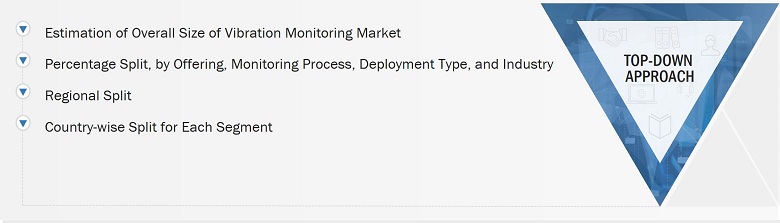
Vibration Monitoring Market: Top-Down Approach
In the top-down approach, the overall market size has been used to estimate the size of the individual market segments (mentioned in market segmentation) through percentage splits from secondary and primary research. For specific market segments, the size of the most appropriate immediate parent market has been used to implement the top-down approach. The bottom-up approach has also been implemented for data obtained from secondary research to validate the market size of various segments.
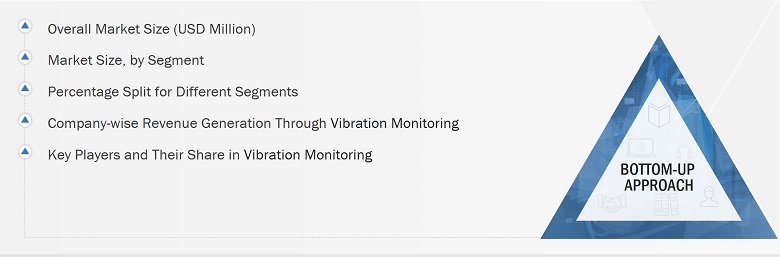
Vibration Monitoring Market: Bottom-up Approach
The bottom-up approach has been used to arrive at the overall size of the vibration monitoring market from the revenues of the key players and their market shares. Calculations based on revenues of key companies identified in the market led to the estimation of their overall market size.
Data Triangulation
After arriving at the overall market size from the estimation process explained above, the overall market has been split into several segments and subsegments. The market breakdown and data triangulation procedures have been employed, wherever applicable, to complete the overall market engineering process and arrive at the exact statistics for all segments and subsegments. The data has been triangulated by studying various factors and trends from both the demand and supply sides. The market has also been validated using both top-down and bottom-up approaches.
Market Definition
Vibration can be defined as a cyclic or periodic displacement of a machine from its static position due to its back and forth motion. This motion is mainly caused by the oscillation of various components of the machine, such as belts, gears, bearings, and drive motors. Vibration monitoring plays a critical role in plant operations because of its diverse applications on different types of critical machinery.
The vibration monitoring process includes periodical or continuous collection, analysis, interpretation, and diagnosis of data to determine the operational state and condition of machines for detecting potential failures before they turn into functional failures. This approach is different from traditional methods wherein the process of determining the condition of machines is manually controlled by the maintenance personnel. The technology is capable of detecting problems caused by misalignments and improper functioning of various sources such as bearings and gears. Vibration monitoring is widely implemented in most of the conventional rotating machinery such as pumps, motors, and turbines. It optimizes equipment readiness while reducing maintenance and staff requirements. This technique is widely used in chemical, oil & gas, aerospace & defense, power generation, automotive, heavy equipment, manufacturing, and other industries.
Key Stakeholders
- Asset management consultants specializing in physical asset management
- Associations and regulatory authorities related to plant maintenance
- Government bodies, venture capitalists, and private equity firms
- Manufacturers of components such as accelerometers, Eddy current sensors, IR detectors, ultrasonic detectors, and other instruments used for vibration monitoring
- Maintenance personnel, as well as manufacturers and suppliers of vibration monitoring systems
- Research institutes and organizations
Report Objectives
- To define and forecast the vibration monitoring market regarding offering, deployment type, monitoring process, and industry.
- To describe and forecast the vibration monitoring market and its value segments for four regions—North America, Europe, Asia Pacific, and the Rest of the World (RoW), along with their respective countries.
- To provide detailed information regarding the drivers, restraints, opportunities, and challenges influencing the growth of the market
- To strategically analyze micro-markets concerning individual growth trends, prospects, and contributions to the overall market
- To study the complete value chain of the vibration monitoring market
- To analyze opportunities in the market for stakeholders by identifying high-growth segments of the market
- To strategically profile key players and comprehensively analyze their market position regarding ranking and core competencies, along with a detailed market competitive landscape.
- To analyze strategic approaches such as agreements, collaborations, and partnerships in the vibration monitoring market
- To provide an analysis of the recession impact on the growth of the market and its segments
Available Customizations:
Based on the given market data, MarketsandMarkets offers customizations in the reports according to the client’s specific requirements. The available customization options are as follows:
Company Information
- Detailed analysis and profiling of additional market players (up to 5)
Get the Full Vibration Monitoring Market Report
Full forecast, segment splits, and company analysis for all Vibration Monitoring Market.
- US Vibration Monitoring Market
- Canada Vibration Monitoring Market
- Mexico Vibration Monitoring Market
- UK Vibration Monitoring Market
- France Vibration Monitoring Market
- Spain Vibration Monitoring Market
- Italy Vibration Monitoring Market
- Rest Of Europe Vibration Monitoring Market
- China Vibration Monitoring Market
- Japan Vibration Monitoring Market
- India Vibration Monitoring Market
- South Korea Vibration Monitoring Market
- Singapore Vibration Monitoring Market
- Malaysia Vibration Monitoring Market
- Rest Of Asia Pacific Vibration Monitoring Market
- GCC Countries Vibration Monitoring Market
- Rest Of Middle East Vibration Monitoring Market
Need a Tailored Report?
Customize this report to your needs
Get 10% FREE Customization
Customize This Report
