
China Video Streaming Software Market (2026-2031)

The China Video Streaming Software Market was valued at $1288 Million in 2026 and projected to reach to $2495.5 Million by 2031, representing a compound annual growth rate of CAGR 14.1%. China's video streaming software market is poised for sustained growth through 2031, driven by increasing smartphone penetration, expanding 5G network coverage, and rising disposable incomes among middle-class consumers.


| Market Size in | USD 26.32 MN |
| Market Forecast in | |
| CAGR | |
| Forecast Period | |
| Units Considered | Value (USD MN) |
China Video Streaming Software Market Trends and Insights
- This growth trajectory reflects China's dominant position in digital content consumption and the rapid adoption of streaming technologies across urban and emerging markets.
- China's market expansion is driven by increasing internet penetration, rising disposable incomes, and the proliferation of mobile devices that enable seamless video consumption. The video streaming software sector in China is characterized by intense competition among domestic and international players, with platforms leveraging advanced compression technologies and AI-driven content recommendations.
- China's regulatory environment and content localization requirements continue to shape market dynamics, creating both opportunities and challenges for software providers.
- By 2031, China is expected to solidify its position as a critical growth engine within the Asia Pacific region, with the market expanding at a 14.1% compound annual growth rate. China's investment in 5G infrastructure and cloud computing capabilities further accelerates the adoption of sophisticated video streaming solutions.
- China's market maturity and technological sophistication position it as a benchmark for video streaming software innovation across emerging markets globally..
Key Market Statistics
- CAGR (2026-2031) CAGR 14.1%
- Market Size, 2026 ~USD 1288 Million
- Forecast, 2031 ~USD 2495.5 Million
- Country China
China Video Streaming Software Market Overview
Market Valuation Growth :
China's video streaming software market is valued at USD 1,288.0 million in 2026 and is projected to reach USD 2,495.5 million by 2031, representing a robust 14.1% CAGR over the forecast period.
Digital Content Consumption Leadership :
China maintains a dominant position in global digital content consumption, with over 900 million internet users driving unprecedented demand for streaming platforms and video-on-demand services across multiple demographics.
Urban and Emerging Market Penetration :
Rapid adoption of streaming technologies is expanding beyond tier-1 cities into emerging markets and rural regions, supported by improved 5G infrastructure and affordable mobile devices across China.
Technology Innovation and Competition :
China's video streaming market is characterized by intense competition among domestic players like Tencent Video, iQIYI, and Youku, driving continuous innovation in content delivery, AI-powered recommendations, and interactive features.
China Video Streaming Software Market Dynamics
- The market will benefit from growing demand for original content, live streaming capabilities, and premium subscription services.
- Government support for digital infrastructure and content localization initiatives will further accelerate market expansion.
- Competition among major platforms will intensify, leading to differentiation through exclusive content partnerships and advanced streaming technologies.
- The integration of AI, cloud computing, and interactive features will reshape user engagement patterns and monetization strategies across the Chinese market..
Market Ecosystem
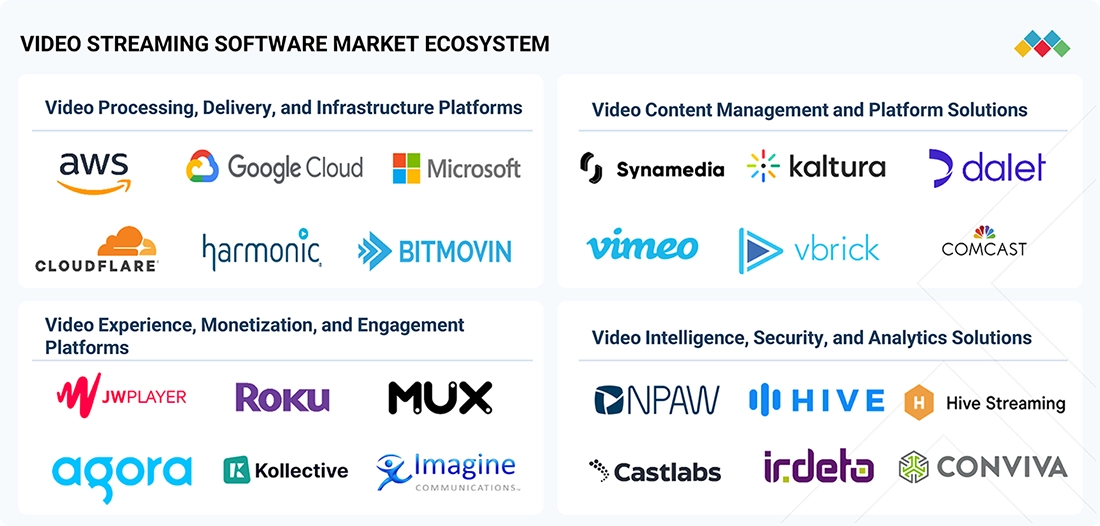
VIDEO STREAMING SOFTWARE MARKET: COMMERCIAL USE CASES ACROSS INDUSTRIES
| COMPANY | USE CASE DESCRIPTION | BENEFITS |
|---|---|---|
 |
StreamAMG And Amazon Web Services Enable Scalable And Resilient Live Sports Streaming Infrastructure | Delivered 2.9 million streams with near-zero downtime during peak demand | Successfully handled traffic spikes up to 500% without system failure | Achieved high scalability and elasticity aligned with live event demand patterns | Increased customer satisfaction and reinforced brand reputation in OTT streaming | Enabled rapid deployment of a fully transformed architecture within 12 weeks |
 |
E-Vision And Synamedia Deliver Multi-tenant Ott Platform For Scalable Video Services | Enabled multi-opco and multi-brand operations on a single unified platform | Delivered highly reliable, scalable, and high-quality video streaming with no buffering | Accelerated launch and management of multi-screen OTT services | Reduced overall operational and infrastructure costs | Improved customer experience through consistent and seamless video delivery |
 |
History Hit And Vimeo OTT Enable Scalable Subscription Video Platform For Audience Growth | Achieved high platform reliability, scalability, and consistent video quality | Enabled seamless transition with no disruption to existing subscribers | Expanded audience reach through smart TV and multi-device app availability | Improved operational efficiency, allowing teams to focus on content creation | Accelerated time-to-market for launching new applications and services |
 |
Brightcove And HISPlayer Enable End-to-end VR And XR Video Streaming Solutions | Delivered a fully integrated, end-to-end streaming solution for immersive XR experiences | Enabled low-latency, high-performance video playback across VR and AR environments | Enhanced content quality with advanced video formats and spatial audio support | Accelerated deployment of immersive OTT and XR streaming applications | Improved scalability and reliability for enterprise and media streaming use cases |
 |
Salesforce And Kaltura Enable Scalable Digital Engagement Platform For Global Virtual Events | Achieved a 536% increase in audience engagement during Dreamforce |Delivered millions of hours of streamed content with high reliability and performance | Increased event show rate by 30%, improving audience retention | Enhanced user experience through interactive and immersive digital features | Enabled rapid deployment of Salesforce+ within four to five months |
Logos and trademarks shown above are the property of their respective owners. Their use here is for informational and illustrative purposes only.
Related Ecosystem
Cloud Computing
- Software as A Service (SaaS)
- Natural Language Processing (NLP)
- Platform as A Service (PaaS)
- Machine Learning
- Supply Chain Management
- International Business Machines Corporation
- MICROSOFT CORPORATION
- Oracle Corporation
- Amazon.com, Inc.
Software And Services
- Natural Language Processing (NLP)
- Machine Learning
- Supply Chain Management
- Predictive Analytics
- Image Sensors
- International Business Machines Corporation
- MICROSOFT CORPORATION
- Oracle Corporation
- SAP SE
- Amazon.com, Inc.
Information System And Analytics
- Machine Learning
- Natural Language Processing (NLP)
- Sensors
- Software as A Service (SaaS)
- Data Loss Prevention (DLP)
- International Business Machines Corporation
- MICROSOFT CORPORATION
- Amazon.com, Inc.
- Oracle Corporation
Key Takeaways
- China's video streaming software market will nearly double from USD 1,288.0 million in 2026 to USD 2,495.5 million by 2031, representing a 14.1% CAGR.
- China's 5G infrastructure rollout and cloud computing investments are accelerating adoption of advanced video streaming technologies.
- China's competitive landscape features both domestic giants and international players competing through AI-driven personalization and content localization.
- China's regulatory framework and content requirements create unique market dynamics that differentiate it from other Asia Pacific markets.
Video Streaming Software Market Report Scope
| Report Metric | Details |
|---|---|
| Base Year | 2026 |
| Fastest Growing Segment | RETAIL & ECOMMERCE (Vertical) |
| Forecast Period | 2026–2031 |
| Growth Rate | CAGR of 13.6% from 2026 to 2031 |
| Largest Segment | SOLUTIONS (Offering) |
| Market Size Base Year (Billions) | ~USD 13.81 (2026) |
| Revenue Forecast (Billions) | ~USD 26.13 (2031) |
| Segments Covered | Offering, Solution, Service, Professional Service, Streaming Type, Consumption Mode/Device, Deployment Mode, Vertical |
China Video Streaming Software Market Report Segmentation
8 segment dimensions are covered across the global market.
By Offering
- Services
- Solutions
By Solution
- AI Video Workflow Tools
- Experience Management Platforms
- Other Solutions
- Video Analytics & Performance Monitoring
- Video Content Management
- Video Monetization Software
- Video Processing & Delivery
- Video Security & Digital Rights Management (Drm)
By Service
- Managed Services
- Professional Services
By Professional Service
- Consulting & Strategy
- Implementation & Integration
- Support And Maintenance
By Streaming Type
- Live Streaming
- Time-Shifted Streaming (Live To Vod)
- Video-On-Demand (Vod) Streaming
By Consumption Mode/Device
- Connected Tv (Ctv) & Streaming Platforms
- Mobile/Handheld Devices
- Other Streaming Endpoints
- Web/Desktop
By Deployment Mode
- Cloud-Based
- Hybrid/Edge
- On-Premises
By Vertical
- Bfsi
- Education
- Educations
- Government & Public Sector
- Healthcare
- Media & Entertainment
- Other Verticals
- Retail & Ecommerce
- Telecommunications
Target Audience
- Streaming Platform Operators : Streaming service providers and OTT platforms need China-specific market data to benchmark performance, identify growth opportunities, and optimize content and technology investments in this competitive landscape.
- Content Production Companies : Media and entertainment producers require insights into China's streaming preferences, regional demand patterns, and platform partnerships to guide content creation and distribution strategies.
- Technology and Infrastructure Providers : Software vendors, CDN providers, and cloud infrastructure companies need market intelligence to understand adoption rates, technical requirements, and infrastructure investments needed across China's regions.
- Investment and Private Equity Firms : Investors evaluating opportunities in China's digital media sector require validated market sizing, growth projections, and competitive analysis to assess portfolio companies and identify acquisition targets.
- Telecommunications and ISP Companies : Telecom operators and internet service providers need market data to understand streaming demand, bandwidth requirements, and bundling opportunities within China's evolving digital ecosystem.
Key Companies in the China Video Streaming Software Market
| Company | HQ | Ownership | Strongest segments |
|---|---|---|---|
| NETSCOUT SYSTEMS, INC | United States | Public Company | Service assurance and performance analytics (nGeniusONE, ISNG, vSTREAM, Infinistream, Omnis Insights),DDoS and cybersecurity (Arbor Sightline, TMS, Edge Defense, Omnis Cyber Intelligence),Packet flow and access infrastructure (packet flow systems, test access points), |
| PCCW | Hong Kong | Public Company | Local telephony, data & broadband,Mobile services,Enterprise solutions & IT services, |
| ADOBE SYSTEMS INCORPORATED | United States | Public Company | Digital Media (Creative Cloud, Document Cloud and related),Digital Experience (Experience Cloud, analytics, commerce),Publishing, Advertising and Other, |
| APPLE INC | United States | Public Company | iPhone,Mac,iPad, |
| CISCO SYSTEMS INC | United States | Public Company | Enterprise routing and switching (campus, data center, branch),Network security, identity, and SASE,Collaboration (Webex, devices, contact center, CPaaS), |
| HILL-ROM HOLDINGS, INC. | United States | Private Company | Patient Support Systems (beds, surfaces, mobility),Front Line Care (monitoring, diagnostics, respiratory),Surgical Solutions (tables, lights, pendants, positioning), |
| LIBERTY GLOBAL PLC | Bermuda | Public Company | Broadband Internet & Intelligent WiFi (ONE Connect, Connect Box),Video & Entertainment (Horizon 5, Replay TV, VOD, Channels),Mobile Services (Postpaid, Prepaid, FMC), |
| NETFLIX, INC | United States | Public Company | Core ad-free streaming subscriptions,Ad-supported streaming tier,Licensing, content partnerships, and other services, |
| NOKIA CORPORATION | Finland | Public Company | Network Infrastructure (fixed, IP, optical),Mobile Networks (RAN and microwave),Cloud and Network Services, |
| SHAW COMMUNICATIONS INC | Canada | Private Company | Residential Internet and WiFi,Video (cable and satellite),Wireless (Freedom Mobile and Shaw Mobile), |
| TENCENT | China | Public Company | Online games and interactive entertainment,Social networks and value-added services,Fintech services (payments, wealth, lending, securities), |
| TELENOR | Norway | Public Company | Mobile services (consumer and business),Fixed broadband and TV,B2B solutions (managed services, VPN/SDN, NaaS), |
| SES S.A. | Canada | Public Company | Waste Management,Energy Infrastructure, |
| TECHNICOLOR SA | France | Public Company | Broadband gateways, routers, extenders, Wi-Fi XL,Video CPE (set-top boxes, dongles, smart media devices),Software platforms (RDK-B, RDK-V, PRPL OS, Homeware, Navigate), |
| MICROSOFT | United States | Public Company | Intelligent Cloud (Azure, Server products, GitHub, Nuance, enterprise services),Productivity and Business Processes (Microsoft 365, LinkedIn, Dynamics),Personal Computing (Windows, Devices, Gaming, Search & News Advertising), |
| BRIGHTCOVE | United States | Private Company | Enterprise streaming (CorpTV, internal and external comms),Media and OTT streaming (PlayTV, channel creation and distribution),Ad monetization services, |
| KALTURA | United States | Public Company | Enterprise, Education & Technology (EE&T),Media & Telecom (M&T),Platform-as-a-Service / OEM, |
| United States | Public Company | Search & Other Ads,YouTube Ads & Subscriptions,Google Cloud (incl. Workspace), | |
| AMAGI | India | Public Company | Cloud playout & channel origination,Targeted advertising & ad-tech (CTV/FAST/OTT),Content distribution & SaaS infrastructure services, |
| IBM | United States | Public Company | Software (Hybrid Cloud & AI Platforms),Consulting (Strategy, Technology, Managed Services),Infrastructure (Servers, Storage, Lifecycle Services), |
| AKAMAI TECHNOLOGIES | United States | Public Company | Security (web, API, bot, account protection),Delivery (web performance, media, DNS, data & analytics),Cloud computing (compute, storage, app platform, networking), |
NETSCOUT SYSTEMS, INC
Netscout Systems, Inc. is a United States-based public company founded in 1984 that employs 2,063 people. The company operates in the technology and networking sector.
PCCW
PCCW is a Hong Kong-based public company founded in 1925 with 14,600 employees. The company operates as a major telecommunications and media conglomerate.
ADOBE SYSTEMS INCORPORATED
Adobe Systems Incorporated is a United States-based public company founded in 1982 with 31,360 employees. The company develops and markets creative and document management software solutions.
APPLE INC
Apple Inc. is a United States-based public company founded in 1976 with 166,000 employees. The company designs, manufactures, and markets consumer electronics, software, and digital services.
CISCO SYSTEMS INC
Cisco Systems Inc. is a United States-based public company founded in 1984 with 86,200 employees. The company develops and sells networking hardware, software, and telecommunications equipment.
HILL-ROM HOLDINGS, INC.
Hill-Rom Holdings, Inc. is a United States-based private company founded in 1915 with 10,000 employees. The company operates in the healthcare equipment and services industry.
LIBERTY GLOBAL PLC
Liberty Global PLC is a Bermuda-based public company founded in 2004 with 6,636 employees. The company operates as a media and telecommunications provider.
NETFLIX, INC
Netflix, Inc. is a United States-based public company founded in 1997 with 16,000 employees. The company provides streaming entertainment services including films, television series, and documentaries.
NOKIA CORPORATION
Nokia Corporation is a Finland-based public company founded in 1865 with 78,005 employees. The company operates in telecommunications, networking, and technology infrastructure sectors.
SHAW COMMUNICATIONS INC
Shaw Communications Inc. is a Canada-based private company founded in 1966 with 9,300 employees. The company provides telecommunications and media services.
TENCENT
Tencent is a China-based public company founded in 1998 with 114,848 employees. The company operates as a major technology and entertainment conglomerate providing social media, gaming, and digital services.
TELENOR
Telenor is a Norway-based public company founded in 1855 with 9,819 employees. The company operates as a telecommunications provider.
SES S.A.
SES S.A. is a Canada-based public company founded in 2007 with 1,937 employees. The company operates in the satellite communications industry.
TECHNICOLOR SA
Technicolor SA is a France-based public company founded in 1985 with 1,552 employees. The company operates in the media and entertainment technology sector.
MICROSOFT
Microsoft is a United States-based public company founded in 1975 with 228,000 employees. The company develops and markets software, cloud services, and computing devices.
BRIGHTCOVE
Brightcove is a United States-based private company founded in 2004 with 621 employees. The company provides video hosting and management solutions.
KALTURA
Kaltura is a United States-based public company founded in 2006 with 494 employees. The company provides video management and streaming technology solutions.
Google is a United States-based public company founded in 1998 with 194,668 employees. The company operates as a technology conglomerate providing search, advertising, cloud services, and digital products.
AMAGI
Amagi is an India-based public company founded in 2008 with 986 employees. The company provides cloud-based media and broadcast technology solutions.
IBM
IBM is a United States-based public company founded in 1911 with 264,300 employees. The company provides information technology services, software, and computing solutions.
AKAMAI TECHNOLOGIES
Akamai Technologies is a United States-based public company founded in 1998 with 11,000 employees. The company provides content delivery network and cloud security services.
Reasons to Buy this Report
- Market Size and Growth Validation : Obtain precise market valuation data for China's video streaming sector with verified forecasts through 2031, enabling accurate business planning and investment decisions in this high-growth market.
- Competitive Landscape Intelligence : Understand the competitive dynamics among China's leading streaming platforms, including market share distribution, strategic positioning, and differentiation strategies to identify partnership and investment opportunities.
- Regional Expansion Opportunities : Identify growth pockets across urban centers and emerging markets within China, with insights into regional adoption rates, consumer preferences, and infrastructure readiness for streaming services.
- Technology and Monetization Trends : Access detailed analysis of emerging technologies (5G, AI, cloud), subscription models, and revenue streams specific to China's market, informing product development and go-to-market strategies.
- Strategic Decision Support : Leverage comprehensive market data to support M&A decisions, content investment strategies, and platform localization efforts tailored to China's unique regulatory environment and consumer behavior.
Frequently asked questions
What is the projected market size of video streaming software in China by 2031?
China's video streaming software market is projected to reach USD 2,495.5 million by 2031, growing from USD 1,288.0 million in 2026.
What is the CAGR for China's video streaming software market?
China's video streaming software market is expected to grow at a compound annual growth rate of 14.1% between 2026 and 2031.
What factors are driving growth in China's video streaming software market?
Key growth drivers in China include increasing internet penetration, rising disposable incomes, 5G infrastructure expansion, mobile device proliferation, and AI-driven content personalization.
How does China's market compare to the global video streaming software market?
China's 14.1% CAGR slightly exceeds the global average of 13.6%, positioning China as a faster-growing market within the video streaming software industry.
What challenges does China's video streaming software market face?
China's market faces challenges including strict content regulations, localization requirements, intense domestic competition, and the need for compliance with government policies on data and content.
RESEARCH METHODOLOGY
This research study on the video streaming software market involved extensive secondary sources, including directories, IEEE Communication-Efficient: Algorithms and Systems, and the International Journal of Innovation and Technology Management, as well as paid databases. Primary sources were mainly industry experts from core and related industries, preferred video streaming software providers, third-party service providers, consulting service providers, end users, and other commercial enterprises. In-depth interviews with primary respondents, including key industry participants and subject matter experts, were conducted to gather and verify critical qualitative and quantitative information, as well as assess the market’s prospects.
Secondary Research
In the secondary research process, various sources were referred to identify and collect information for this study. Secondary sources included annual reports, press releases, and investor presentations of companies; white papers, journals, and certified publications; and articles from recognized authors, directories, and databases. The data was also collected from other secondary sources, such as journals, government websites, blogs, and vendors’ websites. Additionally, the video streaming software spending of various countries was extracted from the respective sources.
Primary Research
In the primary research process, various sources from the supply and demand sides were interviewed to obtain qualitative and quantitative information on the market. The primary sources from the supply side included various industry experts, such as chief experience officers (CXOs), vice presidents (VPs), and directors specializing in business development, marketing, and video streaming software services. It also included key executives from video streaming software vendors, system integrators (SIs), professional service providers, industry associations, and other key opinion leaders.
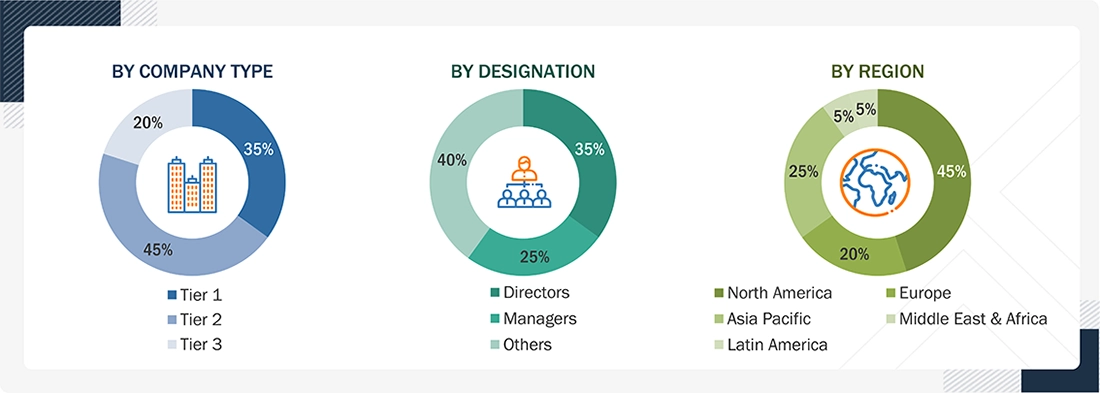
Note: Tier 1 companies’ revenues are more than USD 10 billion; tier 2 companies’ revenues range between USD 1 and 10 billion; and tier 3 companies’ revenues range between USD 500 million and USD 1 billion. Other designations include sales, marketing, and product managers
To know about the assumptions considered for the study, download the pdf brochure
Market Size Estimation
Multiple approaches were adopted to estimate and forecast the video streaming software market. The first approach involved estimating the market size based on companies’ revenue from the sale of video streaming software products.
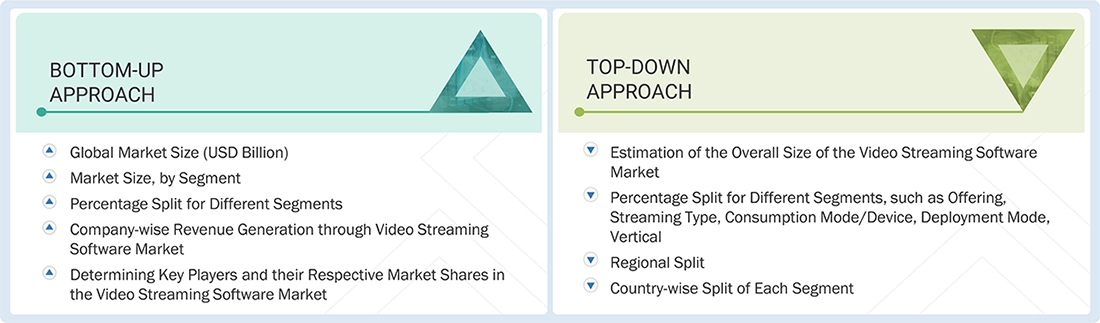
Market Size Estimation Methodology: Top-down Approach
The top-down approach prepared an exhaustive list of all the vendors offering products in the video streaming software market. The revenue contribution of the market vendors was estimated through annual reports, press releases, funding, investor presentations, paid databases, and primary interviews. Each vendor’s offerings were evaluated based on offering, solution type, deployment mode, streaming type, consumption mode/device, vertical, and region. The markets were triangulated through primary and secondary research. The primary procedure included extensive interviews for key insights from industry leaders, such as CIOs, CEOs, VPs, directors, and marketing executives. The market numbers were further triangulated with the existing MarketsandMarkets’ repository for validation.
Market Size Estimation Methodology: Bottom-up Approach
The bottom-up approach identified the adoption rate of video streaming software products across different verticals in key countries, considering the regions that contribute the most to the market share. For cross-validation, the adoption of video streaming software products among enterprises and other use cases for their regions was identified and extrapolated. Use cases identified in different areas were weighed for the market size calculation.
Based on the market numbers, the regional split was determined by primary and secondary sources. The procedure included an analysis of the video streaming software market’s regional penetration. Based on secondary research, the regional spending on Information and Communications Technology (ICT), socioeconomic analysis of each country, strategic vendor analysis of major video streaming software service providers, and organic and inorganic business development activities of regional and global players were estimated.
Data Triangulation
After determining the overall market size using the market size estimation processes as explained above, the market was split into several segments and subsegments. Data triangulation and market breakup procedures were employed, wherever applicable, to complete the overall market engineering process and arrive at the exact statistics of each market segment and subsegment. The overall market size was then used in the top-down approach to estimate the size of other individual markets by applying percentage splits to the market segmentation.
Market Definition
According to MarketsandMarkets, the Video Streaming Software market comprises software platforms and associated services that enable video ingestion, processing, management, delivery, monetization, security, and analytics across live streaming, video-on-demand (VOD), and time-shifted streaming environments. The market includes video processing and delivery solutions, content management platforms, experience management systems, DRM and video security solutions, monetization software, AI-powered video workflow tools, analytics and performance monitoring platforms, and live audience engagement technologies. These solutions are deployed across cloud-based, on-premises, and hybrid/edge environments to support scalable and low-latency streaming across web, mobile, connected TV, gaming, and enterprise ecosystems.
Key Stakeholders
- Video Streaming Software Platform Providers
- OTT Platform and Digital Media Technology Vendors
- Video Processing, Encoding, and Transcoding Solution Providers
- Content Delivery Network (CDN) and Edge Streaming Providers
- Video Security, DRM, and Anti-Piracy Solution Vendors
- Video Monetization and Advertising Technology Providers
- AI Video Workflow and Media Automation Solution Providers
- Video Analytics and QoE Monitoring Platform Vendors
- Cloud Video Infrastructure Providers and Hyperscalers
- Enterprise Video Communication and Collaboration Platform Providers
- System Integrators and Media Technology Implementation Partners
- Managed Streaming Service Providers
- Telecom Operators and Network Infrastructure Providers
- Broadcasters and Media & Entertainment Companies
- Live Event Streaming and Sports Broadcasting Organizations
- Government Agencies and Public Sector Communication Bodies
Report Objectives
- To define and describe the video streaming software market based on offering (solutions and services), solution type (Video Processing & Delivery, Video Content Management, Experience Management Platforms, Video Security & Digital Rights Management (DRM), Video Monetization Software, AI Video Workflow Tools, Video Analytics & Performance Monitoring, and Other Solutions), streaming type (live streaming, Video-On-Demand Streaming, Time-shifted Streaming), consumption mode/device (Web/Desktop, Mobile/handheld Devices, Connected TV (CTV) & Streaming Platforms, Other Streaming Endpoints), deployment mode (on-premises, cloud-based, hybrid/edge), and industry verticals.
- To provide detailed information on major factors influencing market growth (drivers, restraints, opportunities, and challenges) across video streaming software, video analytics, digital rights management, and aftermarket transformation.
- To strategically analyze micro markets with respect to individual growth trends, adoption patterns, and their contribution to the overall video streaming software market.
- To analyze market opportunities for stakeholders and present a comprehensive competitive landscape of leading video streaming software vendors, OEM aftermarket players, and service providers.
- To project the market size and its submarkets in terms of value (USD million) across five key regions (North America, Europe, Asia Pacific, Middle East & Africa, Latin America), along with an analysis of their respective major countries.
- To strategically profile leading companies and provide an in-depth evaluation of their core competencies, product portfolios, technology capabilities, and market positioning.
- To examine competitive developments, including product launches, software upgrades, partnerships, integrations, strategic expansions, and mergers & acquisitions across the video streaming software ecosystem.
Available customizations:
With the given market data, MarketsandMarkets offers customizations as per the company’s specific needs. The following customization options are available for the report:\
Product Analysis
- The product matrix provides a detailed comparison of the product portfolio of each company.
Geographic Analysis based on feasibility
- Further breakup of the North American video streaming software market
- Further breakup of the European video streaming software market
- Further breakup of the Asia Pacific video streaming software market
- Further breakup of the Middle East & Africa video streaming software market
- Further breakup of the Latin American video streaming software market
Company Information
- Detailed analysis and profiling of additional market players (up to five)
Get the Full Video Streaming Software Market Report
Full forecast, segment splits, and company analysis for all Video Streaming Software Market.
- US Video Streaming Software Market
- Canada Video Streaming Software Market
- UK Video Streaming Software Market
- Germany Video Streaming Software Market
- France Video Streaming Software Market
- Italy Video Streaming Software Market
- India Video Streaming Software Market
- Japan Video Streaming Software Market
- Australia Video Streaming Software Market
- South Korea Video Streaming Software Market
- Saudi Arabia Video Streaming Software Market
- UAE Video Streaming Software Market
- South Africa Video Streaming Software Market
- Brazil Video Streaming Software Market
- Mexico Video Streaming Software Market
- Rest Of Europe Video Streaming Software Market
- Rest Of Asia Pacific Video Streaming Software Market
Need a Tailored Report?
Customize this report to your needs
Get 10% FREE Customization
Customize This Report
