
China Water Bus Market (2024-2029)

The China Water Bus Market was valued at $80.8 Million in 2024 and projected to reach to $109.3 Million by 2029, representing a compound annual growth rate of 5.2%. China's water bus market is positioned for steady expansion as urbanization pressures and environmental concerns drive demand for alternative transportation solutions.


| Market Size in | USD 26.32 MN |
| Market Forecast in | |
| CAGR | |
| Forecast Period | |
| Units Considered | Value (USD MN) |
China Water Bus Market Trends and Insights
- This expansion reflects China's increasing investment in sustainable urban transportation infrastructure and waterway development across major metropolitan areas.
- China's strategic focus on reducing congestion and emissions in densely populated cities is driving adoption of water-based transit solutions. The water bus sector in China is benefiting from government initiatives promoting eco-friendly public transportation and modernization of inland waterway systems.
- China's rapid urbanization and rising disposable incomes are creating demand for efficient, environmentally conscious commuting options.
- Between 2024 and 2029, China is expected to see accelerated deployment of advanced water bus fleets in key regions, supported by both public and private sector investments. China's competitive advantage in manufacturing and technology integration positions the country as a significant player in the global water bus market.
- The 5.2% compound annual growth rate reflects China's commitment to sustainable mobility solutions and infrastructure development in the Aerospace & Defence sector..
Key Market Statistics
- CAGR (2024-2029) 5.2% CAGR
- Market Size, 2024 ~USD 80.8 Million
- Forecast, 2029 ~USD 109.3 Million
- Country China
China Water Bus Market Overview
Market Valuation Growth :
China's water bus market is valued at USD 80.8 million in 2024, with a projected CAGR of 5.2% through 2029, reaching USD 109.3 million by forecast end.
Urban Transportation Focus :
Major Chinese metropolitan areas are increasingly adopting water bus systems as part of sustainable urban mobility solutions to alleviate road congestion and reduce carbon emissions.
Government Infrastructure Investment :
China's strategic commitment to waterway development and sustainable transportation infrastructure is driving significant capital allocation toward water bus fleet expansion and modernization.
Emission Reduction Initiatives :
Water bus adoption aligns with China's environmental policies and urban planning objectives to transition away from traditional road-based public transportation in congested metropolitan regions.
China Water Bus Market Dynamics
- The 5.2% CAGR reflects growing government support for waterway-based mobility infrastructure across major cities including Shanghai, Hangzhou, and Chongqing.
- Investment in modern water bus fleets and terminal facilities is accelerating as municipalities recognize the efficiency and sustainability benefits of water-based transit systems. Looking ahead, China's water bus market will benefit from continued infrastructure development, technological advancements in vessel design, and integration with broader smart city initiatives.
- Rising disposable incomes and increasing environmental awareness among urban populations will further support adoption.
- Strategic partnerships between government agencies and private operators are expected to enhance service quality and expand network coverage across China's major waterway corridors..
Market Ecosystem
Related Ecosystem
Marine
- Tankers
- Fuel Cell
- HVAC System
- Navigation Systems
- Sensors
- Wartsila
- Kongsberg Gruppen ASA
- L3Harris Technologies, Inc.
- ABB India Limited
- Thales group
Key Takeaways
- China's water bus market is valued at USD 80.8 million in 2024 and will grow to USD 109.3 million by 2029, representing a 5.2% CAGR.
- China is leveraging government sustainability initiatives and urbanization trends to expand water-based public transportation infrastructure.
- China's manufacturing capabilities and technological innovation are driving competitive advantages in water bus development and deployment.
- Between 2024 and 2029, China expects significant investment in modernizing inland waterway systems and fleet expansion across major cities.
Water Bus Market Report Scope
| Report Metric | Details |
|---|---|
| Base Year | 2024 |
| Fastest Growing Segment | FULLY ELECTRIC (Propulsion) |
| Forecast Period | 2024-2029 |
| Growth Rate | CAGR of 5.1% from 2024 to 2029 |
| Largest Segment | INTERCITY (Operation) |
| Market Size Base Year (Billions) | ~USD 1.22 (2024) |
| Revenue Forecast (Billions) | ~USD 1.56 (2029) |
| Segments Covered | Capacity, Operation, Propulsion |
China Water Bus Market Report Segmentation
3 segment dimensions are covered across the global market.
By Capacity
- 25-50 Pax
- 26-50 Pax
- 50-75 Pax
- 50-75 Pax
- 51-75 Pax
- <25 Pax
By Operation
- Intercity
- Intra City
- Intracity
By Propulsion
- Fuel Powered
- Fully Electric
- Hybrid Electric
Target Audience
- Transportation & Infrastructure Operators : Water bus operators and public transit authorities in China need market data to plan fleet expansion, assess profitability, and identify optimal routes for service deployment.
- Government & Policy Makers : Chinese municipal and national government agencies require market intelligence to inform sustainable transportation policies, allocate infrastructure budgets, and evaluate water bus viability.
- Vessel Manufacturers & Suppliers : Shipbuilders and marine equipment suppliers targeting China need market forecasts to plan production capacity, develop competitive offerings, and secure contracts with operators.
- Investment & Financial Institutions : Private equity firms, venture capital, and financial institutions evaluating water bus investments in China require detailed market analysis to assess returns and portfolio fit.
- Urban Planning & Sustainability Consultants : Consulting firms advising Chinese cities on sustainable mobility solutions need market data to validate water bus feasibility, benchmark against global standards, and support client recommendations.
Reasons to Buy this Report
- Market Size & Growth Trajectory : Access precise valuation data showing China's water bus market growing from USD 80.8M to USD 109.3M, enabling accurate financial forecasting and investment planning for the 2024-2029 period.
- Regional Competitive Intelligence : Understand China-specific market dynamics, key players, and competitive positioning within the water bus sector to identify opportunities and threats in this high-growth Asian market.
- Government Policy & Infrastructure Insights : Gain detailed understanding of China's sustainable transportation policies, waterway development initiatives, and government funding mechanisms driving water bus market expansion.
- Urban Market Segmentation : Identify growth opportunities across China's major metropolitan areas including Shanghai, Hangzhou, and Chongqing with city-specific demand patterns and infrastructure readiness assessments.
- Strategic Investment Decisions : Make informed decisions on market entry, partnerships, and capital allocation in China's water bus sector with comprehensive data on growth drivers, regulatory environment, and emerging trends.
Frequently asked questions
What is the current size of China's water bus market?
China's water bus market was valued at USD 80.8 million in 2024 and is projected to reach USD 109.3 million by 2029.
What is the growth rate of China's water bus market?
China's water bus market is expected to grow at a compound annual growth rate (CAGR) of 5.2% from 2024 to 2029.
What factors are driving growth in China's water bus market?
Growth in China's water bus market is driven by urbanization, government sustainability initiatives, rising disposable incomes, and the need for eco-friendly public transportation solutions.
Which regions in China are leading water bus market expansion?
Major metropolitan areas and densely populated cities in China are leading water bus market expansion, supported by government infrastructure investments and waterway modernization projects.
How does China's water bus market compare to global trends?
China's water bus market growth rate of 5.2% is slightly higher than the global CAGR of 5.1%, reflecting China's strong commitment to sustainable urban mobility solutions.
RESEARCH METHODOLOGY
The research study conducted on the water bus market involved the extensive use of secondary sources, directories, and databases, such as D&B Hoovers, Bloomberg, and Factiva, to identify and collect relevant information. Primary sources included industry experts from the market as well as suppliers, manufacturers, solution providers, technology developers, alliances, and organizations related to all segments of the value chain of this industry. In-depth interviews of various primary respondents, including key industry participants, subject matter experts (SMEs), industry consultants, and C-level executives, were conducted to obtain and verify critical qualitative and quantitative information pertaining to the market as well as assess the growth prospects of the market. A deductive approach, also known as the bottom-up approach combined with the top-down approach, was used to forecast the market size of different market segments.
Secondary Research
In the secondary research process, various secondary sources were referred to identify and collect information for this study on the water bus market. Secondary sources included annual reports, press releases, and investor presentations of companies; white papers and certified publications; articles from recognized authors; manufacturers' associations; directories; and databases. Secondary research was mainly used to obtain key information about the supply chain of the marine industry, the monetary chain of the market, the total pool of key players, market classification and segmentation according to the industry trends to the bottom-most level, regional markets, and key developments from both market and technology-oriented perspectives.
Primary Research
Extensive Extensive primary research was conducted to obtain qualitative and quantitative information for this report on the water bus market. Several primary interviews were conducted with market experts from both the demand and supply sides across major regions, namely, North America, Europe, Asia Pacific, the Middle East, Latin America & Africa. Primary sources from the supply side included industry experts such as business development managers, sales heads, technology and innovation directors, and related key executives from various key companies and organizations operating in the autonomous boats market.
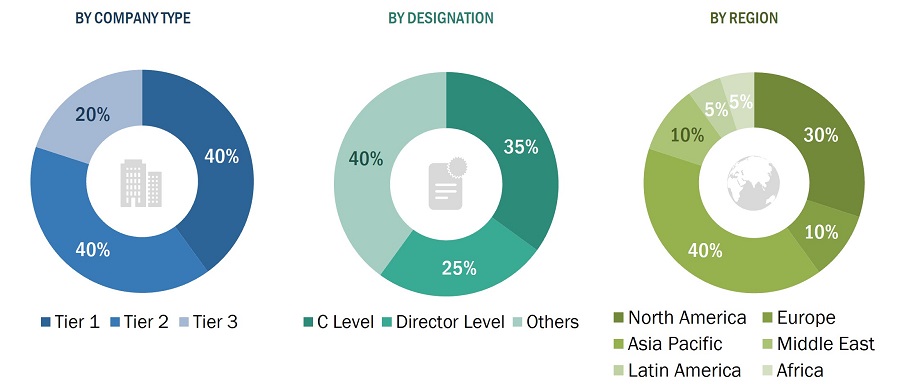
To know about the assumptions considered for the study, download the pdf brochure
Market Size Estimation
The top-down and bottom-up approaches were used to estimate and validate the size of the autonomous boats market. The research methodology used to estimate the market size includes the following details. Key players in the market were identified through secondary research, and their market share was determined through primary and secondary research. This included a study of the annual and financial reports of top market players and extensive interviews with industry stakeholders such as CEOs, technical advisors, military experts, marine vessel maintenance professionals, and SMEs of leading companies operating in the water bus market.
All percentage shares, splits, and breakdowns were determined using secondary sources and verified through primary sources. All possible parameters that affect the markets covered in this research study were accounted for, viewed in extensive detail, verified through primary research, and analyzed to obtain the final quantitative and qualitative data on the water bus market. This data was consolidated, enhanced with detailed inputs, analyzed by MarketsandMarkets, and presented in this report.
Bottom-Up Approach
The bottom-up approach was employed to determine the overall size of the water bus market. Calculations for the market relied on water bus market were based on regional demand for each country. The bottom-up approach was also implemented to extract secondary research data to validate different market segments' revenues. With the data triangulation procedure and data validation through primaries, the overall sizes of the water bus market from the revenues of key players and their shares in the market and each market segment were determined and confirmed in this study.
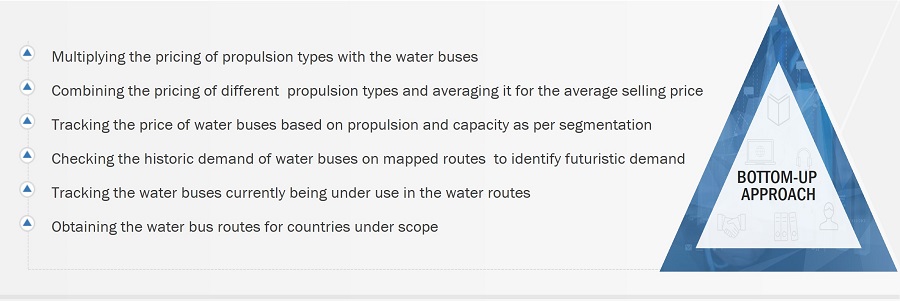
Top-Down Approach
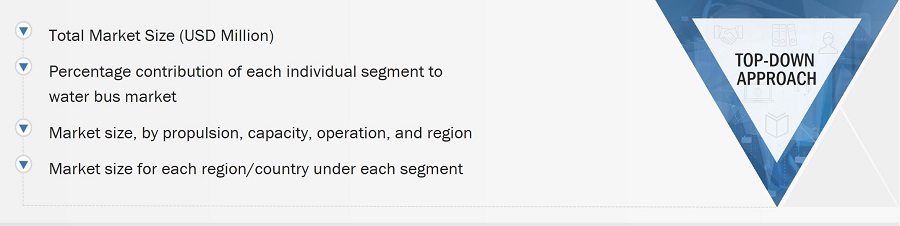
In the top-down approach, the overall market size was used to estimate the size of individual markets (mentioned in market segmentation) through percentage splits based on secondary and primary research.
For calculating the sizes of specific market segments, the most appropriate and immediate parent market size was used to implement the top-down approach. The bottom-up approach was also implemented to validate the market segment revenues obtained.
Market shares were then estimated for each company to verify the revenue shares used earlier in the bottom-up approach. With the data triangulation procedure and validation of data through primaries, the sizes of the parent market and each individual market were determined and confirmed in this study. The data triangulation procedure used for this study is explained in the market breakdown and triangulation section.
Data triangulation
After arriving at the overall market size through the market size estimation process explained above, the total market was split into several segments and subsegments. To complete the overall market engineering process and arrive at the exact statistics for market segments and subsegments, market breakdown & data triangulation procedures explained below were implemented, wherever applicable. Data was triangulated by studying various factors and trends from both the demand and supply sides. Along with this, the market size was validated using both top-down and bottom-up approaches.
Market Definition
Water bus refers to marine vessels that are used to navigate through rivers, canals, or harbors within cities and tourist areas and accommodating around 50 to 75 people. Water buses provide public transportation services by offering scheduled or on-demand services, connecting various points along waterways. Water buses follow fixed routes or schedules for commutes and focus on connecting specific points across a waterway, making them suitable for short and longe intercity and intra city travel.
Stakeholders
Various stakeholders of the market are listed below:
- Water Bus Manufacturers
- Subcomponent Manufacturers
- Water Bus Service Providers
- Raw Material Suppliers
- Technology Support Providers
- System Integrators
- Government Agencies
- Commercial Vessel Operators
- Research Organizations
Report Objectives
- To define, describe, segment, and forecast the size of the water bus market based on propulsion, capacity, operation, and region.
- To analyze the degree of competition in the market by mapping the recent developments, products, and services of key market players
- To understand the structure of the water bus market by identifying its various segments and subsegments.
- To identify and analyze key drivers, restraints, opportunities, and challenges that influence market growth.
- To forecast the size of market segments across North America, Europe, Asia Pacific, Middle East, Latin America & Africa along with major countries in each region
- To analyze micromarkets1 with respect to individual technological trends and their contribution to the total market
- To profile key market players and comprehensively analyze their market share and core competencies2.
- To provide a detailed competitive landscape of the market, along with an analysis of business and strategies, such as mergers and acquisitions, partnerships, and agreements, in the water bus market.
- To identify detailed financial positions, key products, and unique selling points of leading companies in the market.
1. Micromarkets are further segments and subsegments of the water bus market market.
2. Core competencies of companies were captured in terms of their key developments and strategies adopted to sustain their position in the market
Available customizations
Along with the market data, MarketsandMarkets offers customizations as per the specific needs of companies. The following customization options are available for the report:
Product Analysis
- Product matrix, which gives a detailed comparison of the product portfolio of each company.
Regional Analysis
- Further breakdown of the market segments at the country level
Company Information
- Detailed analysis and profiling of additional market players (up to 5)
Get the Full Water Bus Market Report
Full forecast, segment splits, and company analysis for all Water Bus Market.
- Canada Water Bus Market
- US Water Bus Market
- UK Water Bus Market
- France Water Bus Market
- Germany Water Bus Market
- Denmark Water Bus Market
- Norway Water Bus Market
- Italy Water Bus Market
- India Water Bus Market
- Japan Water Bus Market
- South Korea Water Bus Market
- UAE Water Bus Market
- Saudi Arabia Water Bus Market
- Brazil Water Bus Market
- Mexico Water Bus Market
- Rest Of Europe Water Bus Market
- Rest Of Asia Pacific Water Bus Market
- Rest Of Middle East Water Bus Market
- Africa Water Bus Market
Need a Tailored Report?
Customize this report to your needs
Get 10% FREE Customization
Customize This Report
