
Rest Of Asia Pacific Wearable AI Market (2024-2029)

The Rest Of Asia Pacific Wearable AI Market was valued at $1436.5 Million in 2024 and projected to reach to $3170.6 Million by 2029, representing a compound annual growth rate of 17.2%. Rest Of Asia Pacific is positioned as a high-growth segment within the global wearable AI market, with substantial expansion opportunities through 2029.


| Market Size in | USD 26.32 MN |
| Market Forecast in | |
| CAGR | |
| Forecast Period | |
| Units Considered | Value (USD MN) |
Rest Of Asia Pacific Wearable AI Market Trends and Insights
- The region is experiencing rapid expansion driven by increasing smartphone penetration, rising consumer demand for health-monitoring devices, and growing adoption of AI-enabled wearables across emerging economies.
- Rest Of Asia Pacific is projected to reach USD 3,170.6 million by 2029, reflecting a compound annual growth rate (CAGR) of 17.2%. The wearable AI ecosystem in Rest Of Asia Pacific is characterized by strong investment in semiconductor innovation and electronics manufacturing capabilities.
- Rest Of Asia Pacific's market growth is supported by favorable demographics, expanding middle-class populations, and accelerating digital transformation initiatives.
- Key applications include smartwatches, fitness trackers, AR glasses, and health-monitoring devices powered by on-device AI processing. Rest Of Asia Pacific is positioned as a critical growth engine for the global wearable AI market, with emerging markets driving adoption rates that exceed developed regions.
- The forecast period from 2024 to 2029 will see Rest Of Asia Pacific capture increasing market share as local manufacturers scale production and regional tech ecosystems mature..
Key Market Statistics
- CAGR (2024-2029) 17.2% CAGR
- Market Size, 2024 ~USD 1436.5 Million
- Forecast, 2029 ~USD 3170.6 Million
- Country Rest Of Asia Pacific
Rest Of Asia Pacific Wearable AI Market Overview
Rapid Market Expansion :
Rest Of Asia Pacific's wearable AI market is growing at 17.2% CAGR, expanding from USD 1,436.5 million in 2024 to USD 3,170.6 million by 2029, driven by emerging economies' digital transformation.
Smartphone Penetration Catalyst :
Increasing smartphone adoption across Rest Of Asia Pacific is fueling demand for AI-enabled wearables, as consumers seek seamless ecosystem integration and enhanced connectivity features.
Health-Monitoring Device Surge :
Rising consumer awareness of personal health and wellness in Rest Of Asia Pacific is accelerating adoption of AI-powered health-monitoring wearables, particularly in emerging middle-class segments.
Emerging Market Opportunities :
Rest Of Asia Pacific's diverse emerging economies present untapped growth potential for AI wearable manufacturers, with increasing purchasing power and digital literacy driving market penetration.
Rest Of Asia Pacific Wearable AI Market Dynamics
- The region's rapid digitalization, coupled with increasing smartphone penetration and rising health consciousness, creates a favorable environment for AI-enabled wearable adoption.
- Emerging economies within the region are experiencing accelerating consumer demand for smart health-monitoring devices, fitness trackers, and AI-powered personal assistants. The forecast trajectory to USD 3,170.6 million by 2029 reflects strong market fundamentals driven by improving disposable incomes, growing tech-savvy populations, and expanding e-commerce infrastructure.
- Strategic investments by global and regional manufacturers in localized products and affordable pricing strategies will further accelerate market penetration.
- Rest Of Asia Pacific's wearable AI market is expected to maintain its 17.2% CAGR momentum, establishing the region as a critical growth engine for the global wearable AI industry..
Market Ecosystem
Related Ecosystem
Internet Of Things And M2M
- Sensors
- Cellular Network
- Digital Signal Processor (DSP)
- Global Positioning System (GPS)
- Image Sensors
- MITSUI ELECTRONICS INC
- MICROSOFT CORPORATION
- INTEL CORPORATION
- Amazon.com, Inc.
- Cisco Systems, Inc.
Sensors And Control
- Sensors
- Temperature Sensors
- Image Sensors
- Pressure Sensors
- Flow Sensors
- BAUMER ELECTRIC AG
- HONEYWELL INTERNATIONAL INC.
- Stmicroelectronics
- Lenovo
- Texas Instruments Incorporated
Analytics
- Natural Language Processing (NLP)
- Machine Learning
- Supply Chain Management
- Predictive Analytics
- Image Sensors
- International Business Machines Corporation
- MICROSOFT CORPORATION
- Oracle Corporation
- SAP SE
Key Takeaways
- Rest Of Asia Pacific wearable AI market valued at USD 1,436.5M in 2024, expanding to USD 3,170.6M by 2029 at 17.2% CAGR
- Rest Of Asia Pacific's growth outpaced by emerging economies with rising disposable incomes and health-consciousness among consumers
- Rest Of Asia Pacific benefits from robust semiconductor manufacturing infrastructure and increasing local AI chip development
- Rest Of Asia Pacific is expected to capture significant global market share as regional brands scale wearable AI product portfolios
Wearable AI Market Report Scope
| Report Metric | Details |
|---|---|
| Base Year | 2024 |
| Fastest Growing Segment | AR/VR HEADSETS (Product) |
| Forecast Period | 2024-2029 |
| Growth Rate | CAGR of 17.2% from 2024 to 2029 |
| Largest Segment | ON-DEVICE AI (Operation) |
| Market Size Base Year (Billions) | ~USD 62.63 (2024) |
| Revenue Forecast (Billions) | ~USD 138.5 (2029) |
| Segments Covered | Product, Operation, Application |
Rest Of Asia Pacific Wearable AI Market Report Segmentation
3 segment dimensions are covered across the global market.
By Product
- Ar/Vr Headsets
- Fitness Trackers
- Other Products
- Smart Clothing & Footwear
- Smart Earwear
- Smartwatches
- Wearable Cameras
By Operation
- Cloud-Based AI
- On-Device AI
By Application
- Consumer Electronics
- Enterprise & Industrial
- Healthcare
- Other Applications
Target Audience
- Wearable Technology Manufacturers : Manufacturers need Rest Of Asia Pacific-specific market data to identify growth opportunities, understand regional consumer preferences, and develop competitive strategies for this high-CAGR emerging market segment.
- Semiconductor & Electronics Companies : Component suppliers require detailed Rest Of Asia Pacific market insights to forecast demand for AI chips, sensors, and processors used in wearable devices across the region's expanding manufacturing ecosystem.
- Investment & Private Equity Firms : Investors need Rest Of Asia Pacific market analysis to evaluate investment opportunities in wearable AI startups, assess regional growth potential, and identify acquisition targets in this 17.2% CAGR market.
- Healthcare & Wellness Companies : Healthcare providers and wellness platforms require Rest Of Asia Pacific wearable AI data to understand health-monitoring device adoption trends and develop integrated digital health solutions for emerging markets.
- Market Research & Strategy Consultants : Consultants need Rest Of Asia Pacific-specific wearable AI market intelligence to support client strategy development, competitive analysis, and market entry planning for this rapidly expanding regional segment.
Reasons to Buy this Report
- Regional Market Sizing & Forecasts : Obtain precise market valuation for Rest Of Asia Pacific (USD 1,436.5M in 2024) with detailed 5-year forecasts, enabling accurate budget allocation and revenue projections specific to this high-growth region.
- Emerging Economy Insights : Understand growth dynamics across Rest Of Asia Pacific's diverse emerging markets, including smartphone penetration trends, consumer health awareness, and purchasing power shifts driving wearable AI adoption.
- Competitive Positioning Strategy : Identify market opportunities and competitive gaps within Rest Of Asia Pacific's wearable AI segment to develop targeted go-to-market strategies and localized product offerings for maximum market penetration.
- Investment & Expansion Planning : Leverage comprehensive Rest Of Asia Pacific market data to evaluate expansion feasibility, assess regional growth potential, and make informed capital allocation decisions for manufacturing and distribution infrastructure.
- Consumer Demand Analysis : Access detailed insights into Rest Of Asia Pacific consumer preferences for AI wearables, health-monitoring features, and pricing sensitivity to optimize product development and marketing strategies.
Frequently asked questions
What is the current market size of wearable AI in Rest Of Asia Pacific?
Rest Of Asia Pacific's wearable AI market was valued at USD 1,436.5 million in 2024 and is projected to grow to USD 3,170.6 million by 2029.
What is the expected growth rate for Rest Of Asia Pacific wearable AI market?
Rest Of Asia Pacific wearable AI market is expected to grow at a compound annual growth rate (CAGR) of 17.2% from 2024 to 2029.
Which factors are driving wearable AI adoption in Rest Of Asia Pacific?
Rest Of Asia Pacific's wearable AI growth is driven by increasing smartphone penetration, rising health awareness, expanding middle-class populations, and growing AI chip manufacturing capabilities in the region.
What types of wearable AI devices are popular in Rest Of Asia Pacific?
Rest Of Asia Pacific consumers are adopting smartwatches, fitness trackers, health-monitoring devices, and AR glasses equipped with on-device AI processing capabilities.
How does Rest Of Asia Pacific compare to other Asia Pacific regions in wearable AI adoption?
Rest Of Asia Pacific represents a significant portion of the broader Asia Pacific wearable AI market, with emerging economies in the region showing adoption rates that often exceed developed markets.
RESEARCH METHODOLOGY
The study involved four major activities in estimating the size for wearable AI market. Exhaustive secondary research was done to collect information on the market, peer market, and parent market. The next step was to validate these findings, assumptions, and sizing with industry experts across value chains through primary research. The bottom-up approach was employed to estimate the overall market size. After that, market breakdown and data triangulation were used to estimate the market size of segments and subsegments.
Secondary Research
In the secondary research process, sources such as annual reports, press releases, investor presentations of companies, white papers, and articles by recognized authors were referred to. Secondary research was done to obtain key information about the market’s supply chain, the market's value chain, the pool of key market players, and market segmentation according to industry trends, region, and developments from both market and technology perspectives.
Primary Research
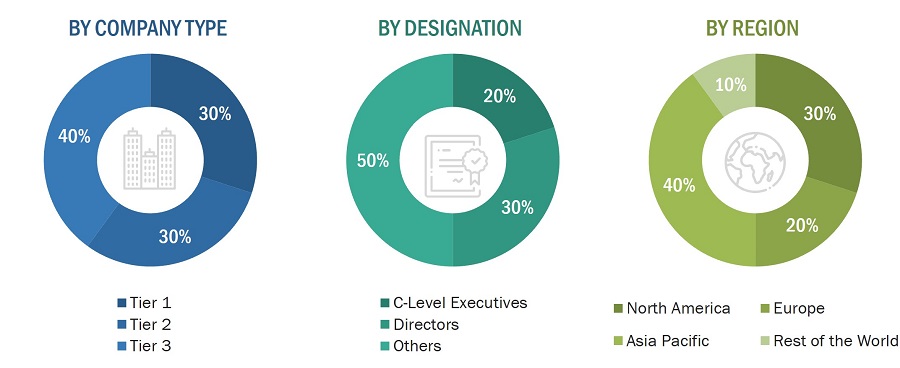
Extensive primary research has been conducted after understanding and analyzing the wearable AI market scenario through secondary research. Several primary interviews have been conducted with key opinion leaders from demand- and supply-side vendors across four major regions—North America, Europe, Asia Pacific, and RoW. Approximately 25% of primary interviews have been conducted with the demand side and 75% with the supply side. These primary data have been collected through telephonic interviews, questionnaires, and emails.
To know about the assumptions considered for the study, download the pdf brochure
Market Size Estimation
In the complete market engineering process, both top-down and bottom-up approaches, along with several data triangulation methods, have been used to perform the market size estimation and forecasting for the overall market segments and subsegments listed in this report. Extensive qualitative and quantitative analyses have been performed on the complete market engineering process to list the key information/insights throughout the report. The following table explains the process flow of the market size estimation.
The key players in the market have been identified through secondary research, and their market shares in the respective regions have been determined through primary and secondary research. This entire procedure includes the study of annual and financial reports of the top players as well as extensive interviews with industry experts (such as CEOs, VPs, directors, and marketing executives) for key insights (both quantitative and qualitative) on the wearable AI market. All percentage shares, splits, and breakdowns have been determined using secondary sources and verified through primary sources. All the possible parameters that affect the markets covered in this research study have been accounted for, viewed in extensive detail, verified through primary research, and analyzed to get the final quantitative and qualitative data. This data has been consolidated and supplemented with detailed inputs and analysis from MarketsandMarkets and presented in this report.
Wearable AI Market: Bottom-Up Approach
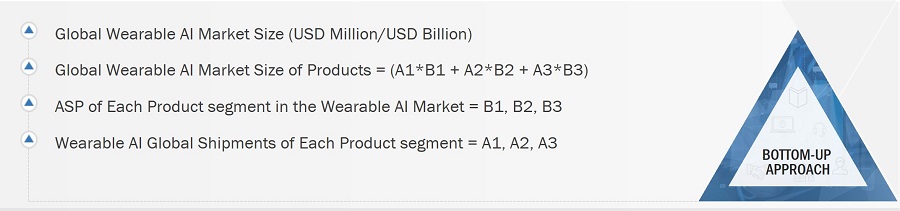
The bottom-up approach has been employed to arrive at the overall market size of the wearable AI market, in terms of products. The summation of all the products in all the regions is calculated to arrive at the overall market size.
Wearable AI Market: Top-Down Approach
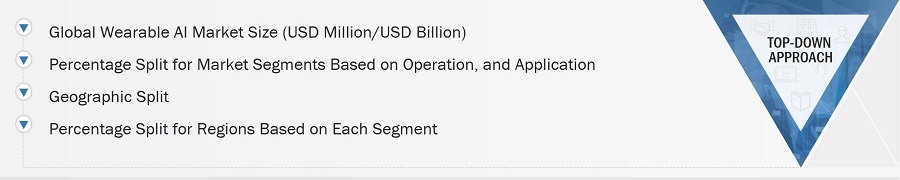
In the top-down approach, the overall market size has been used to estimate the size of individual markets (mentioned in the market segmentation) through the percentage splits from secondary and primary research.
For the calculation of specific market segments, the most appropriate parent market size has been considered to implement the top-down approach. The bottom-up approach has also been implemented for the data extracted from the secondary research to validate the obtained market size of segments.
The market share of each company has been estimated to verify the revenue shares used earlier in the bottom-up approach. With the data triangulation procedure and the validation of data through primaries, the overall parent market size and each individual market size has been determined and confirmed in this study. The data triangulation procedure used for this study is explained in the next section.
Data Triangulation
After arriving at the overall market size through the process explained above, the overall market has been split into several segments. To complete the overall market engineering process and arrive at the exact statistics for all the segments, market breakdown and data triangulation procedures have been employed, wherever applicable. The data has been triangulated by studying various factors and trends from both the demand and supply sides. The market has also been validated using both top-down and bottom-up approaches.
Definition
Wearable AI refers to artificial intelligence integrated into wearable devices, which are typically worn on the body, such as smartwatches, fitness trackers, wearable camera, smart earwear, augmented reality/virtual reality (AR/VR) headsets, and other similar accessories. These devices are designed to collect data from the user's movements, activities, and surroundings, and then utilize AI algorithms to analyze and interpret that data in real-time.
The primary goal of wearable AI is to enhance the functionality of the wearable device by providing personalized and context-aware information, insights, and services to the user. This can include features like health and fitness tracking, notifications, voice recognition, gesture control, and more. Wearable AI leverages machine learning and other AI technologies to understand user behavior, preferences, and patterns, adapting to the individual's needs and delivering a more tailored and intuitive user experience.
Key Stakeholders
- Wearable technology companies
- Artificial Intelligence companies
- Companies involved in the ecosystem of wearable technology and AI market
- Key service providers
- Software solution providers
- Network providers
- Retail distributor
- Government, financial, and research institutions as well as investment communities
- Analysts and strategic business planners
- Research and consulting firms
Report Objectives
- To define, describe, and forecast the wearable AI market, in terms of value, by product, operation, application, and region.
- To describe and forecast the wearable AI market, in terms of volume, by product.
- To forecast the size of the market segments for four major regions—North America, Europe, Asia Pacific, and the Rest of the World (RoW).
- To provide detailed information regarding the major factors influencing the growth of the market (drivers, restraints, opportunities, and challenges)
- To offer an ecosystem analysis, case study analysis, patent analysis, technology analysis, pricing analysis, Porter’s Five Forces analysis, and regulations pertaining to the market.
- To give a detailed overview of the value chain of the wearable AI market ecosystem
- To strategically analyze micromarkets1 with respect to individual growth trends, prospects, and contributions to the total market
- To strategically profile the key players and comprehensively analyze their market shares and core competencies
- To analyze the opportunities in the market for stakeholders and describe the competitive landscape of the market
- To study competitive developments such as collaborations, partnerships, product developments, and acquisitions in the market
- To understand the impact of the recession on the wearable AI market
Available Customizations
With the given market data, MarketsandMarkets offers customizations according to the company’s specific needs. The following customization options are available for the report:
Company Information
- Detailed analysis and profiling of additional market players (up to 7)
Get the Full Wearable AI Market Report
Full forecast, segment splits, and company analysis for all Wearable AI Market.
Need a Tailored Report?
Customize this report to your needs
Get 10% FREE Customization
Customize This Report
