
Middle East Wearable Technology Market (2026-2031)

The Middle East Wearable Technology Market was valued at $2585.8 Million in 2026 and projected to reach to $614.7 Million by 2031, representing a compound annual growth rate of -21.3%. The Middle East wearable technology market faces unprecedented headwinds as conventional devices lose market relevance.


| Market Size in | USD 26.32 MN |
| Market Forecast in | |
| CAGR | |
| Forecast Period | |
| Units Considered | Value (USD MN) |
Middle East Wearable Technology Market Trends and Insights
- This sharp decline reflects a fundamental shift in consumer preferences and technological advancement away from traditional Conventional wearable devices toward more advanced, feature-rich alternatives.
- Conventional wearables, which dominated earlier market cycles, are losing market share as innovation accelerates across the broader wearable ecosystem. The erosion of the Conventional segment underscores the industry's rapid evolution and the obsolescence of legacy wearable technologies.
- Between 2026 and 2031, Conventional devices are projected to represent a diminishing portion of total wearable adoption, as manufacturers and consumers pivot toward next-generation solutions with enhanced connectivity, AI integration, and health monitoring capabilities.
- This structural decline positions Conventional as a legacy category within the wearable technology landscape, with limited growth prospects and increasing competitive pressure from emerging operational paradigms..
Key Market Statistics
- CAGR (2026-2031) -21.3%
- Market Size, 2026 ~USD 2585.8 Million
- Forecast, 2031 ~USD 614.7 Million
- Geography Middle East
Middle East Wearable Technology Market Overview
Severe Market Contraction :
The Middle East wearable technology market is experiencing a dramatic decline, shrinking from $2,585.8 million in 2026 to $614.7 million by 2031, representing a -21.3% CAGR—a stark contrast to the global growth rate of 14.7%.
GCC vs. Rest of Middle East Dynamics :
The GCC countries ($16,788.7M) represent a significant portion of the region's market, while the Rest of Middle East ($50,798.6M) shows varied adoption patterns. Both segments face challenges in conventional wearable device retention as consumers shift toward advanced technologies.
Technology Transition Impact :
The conventional wearable segment's collapse in the Middle East reflects accelerated consumer migration toward next-generation devices, including AI-powered wearables and advanced health monitoring systems, outpacing traditional product lifecycles.
Regional Investment Opportunity :
Despite current contraction, the Middle East's substantial market base and high purchasing power in GCC nations present opportunities for vendors offering innovative, advanced wearable solutions aligned with regional digital transformation initiatives.
Middle East Wearable Technology Market Dynamics
- The projected decline from $2,585.8 million to $614.7 million by 2031 signals a fundamental market restructuring, driven by rapid technological obsolescence and shifting consumer expectations toward smarter, more integrated wearable ecosystems.
- This contraction is particularly pronounced compared to the global market's 14.7% CAGR expansion. However, this decline presents a critical inflection point for market participants.
- The Middle East's affluent consumer base, particularly in GCC nations, demonstrates strong appetite for premium, innovative wearables.
- Organizations that successfully transition from conventional to advanced wearable offerings—incorporating AI, IoT integration, and health analytics—will capture emerging opportunities within this evolving landscape.
- Regional digital transformation initiatives and healthcare modernization efforts further support long-term growth potential for next-generation solutions..
Market Ecosystem
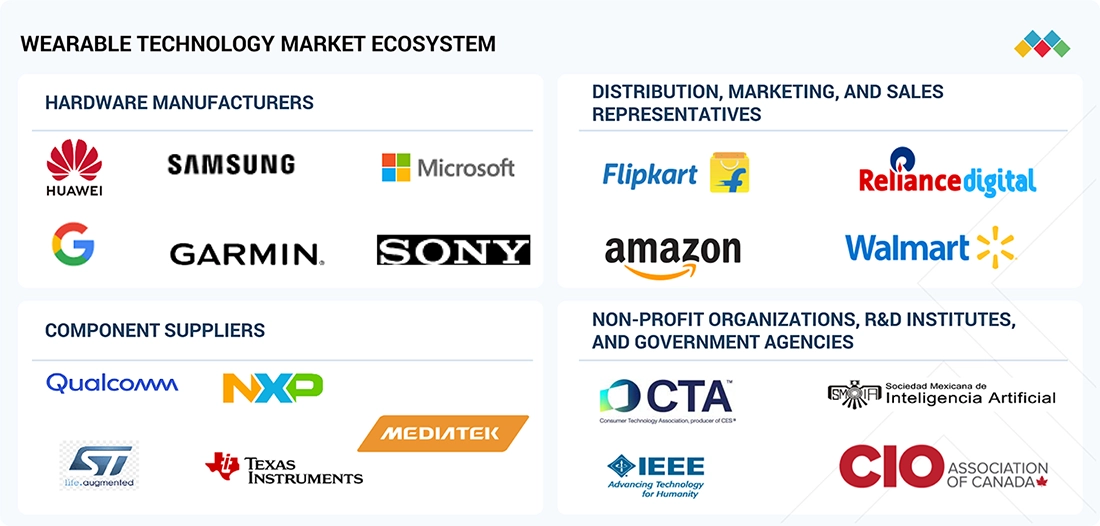
WEARABLE TECHNOLOGY MARKET SIZE, SHARE & TRENDS: COMMERCIAL USE CASES ACROSS INDUSTRIES
| COMPANY | USE CASE DESCRIPTION | BENEFITS |
|---|---|---|
 |
Provides AI-enabled smartwatches and earwear for consumer health monitoring, fitness tracking, communication, and wellness management; Devices support ECG monitoring, activity tracking, sleep analysis, and seamless integration with connected digital ecosystems | Enhances preventive healthcare | Improves user engagement | Enables real-time health insights | Supports continuous wellness monitoring through advanced sensors and AI-driven analytics |
 |
Delivers smartwatches, smart rings, and earwear solutions for consumer electronics, healthcare, and fitness applications; Devices integrate health monitoring capabilities, AI-powered features, and connectivity across smartphones and cloud platforms | Improves health tracking accuracy | Strengthens connected experiences | Increases user convenience | Enables personalized recommendations through integrated wearable ecosystems |
 |
Offers cost-effective smartwatches, fitness trackers, and earwear designed for large-scale consumer adoption; Solutions focus on activity tracking, health monitoring, and connected lifestyle management across emerging and developed markets | Expands accessibility to wearable technology | Supports fitness and wellness objectives | Enhances user connectivity | Delivers value-driven wearable experiences |
 |
Develops smartwatches, fitness trackers, earwear, and smart glasses with advanced health monitoring and AI-enabled capabilities; Devices are utilized across consumer wellness, fitness, and productivity applications | Enables comprehensive health monitoring | Improves device intelligence | Supports seamless connectivity | Enhances user experiences through integrated hardware and software platforms |
 |
Provides advanced smartwatches and wearable devices for sports, fitness, outdoor recreation, aviation, and marine applications; Solutions incorporate GPS technologies, biometric monitoring, and performance analytics for professional and recreational users | Delivers accurate performance tracking | Improves athletic training outcomes | Supports navigation and safety applications | Enables data-driven decision-making across specialized use cases |
Logos and trademarks shown above are the property of their respective owners. Their use here is for informational and illustrative purposes only.
Related Ecosystem
Aviation
- Narrow Body Aircraft
- Wide Body Aircraft
- Military Helicopters
- Special Mission Aircraft
- Fighter Aircraft
- HONEYWELL INTERNATIONAL INC.
- COLLINS AEROSPACE
- Thales group
- Safran group
- HEICO Corporation
Industrial Iot
- Sensors
- Pressure Sensors
- Flow Sensors
- Gas Sensors
- Image Sensors
- Siemens ag
- ABB India Limited
- HONEYWELL INTERNATIONAL INC.
- Emerson Electric Co.
- SCHNEIDER ELECTRIC SE
Sensors And Control
- Sensors
- Image Sensors
- Temperature Sensors
- Pressure Sensors
- Flow Sensors
- BAUMER ELECTRIC AG
- HONEYWELL INTERNATIONAL INC.
- Stmicroelectronics
- Lenovo
- Texas Instruments Incorporated
Key Takeaways
- Conventional wearables are declining at -21.3% CAGR, shrinking from $2,585.8M (2026) to $614.7M (2031).
- Conventional segment represents a legacy technology category being displaced by advanced wearable solutions.
- Market contraction in Conventional reflects accelerating consumer migration toward AI-enabled and connected devices.
- Conventional devices face structural headwinds as manufacturers redirect investment toward next-generation operational models.
Wearable Technology Market Report Scope
| Report Metric | Details |
|---|---|
| Base Year | 2026 |
| Fastest Growing Segment | EXOSKELETONS (Wristwear) |
| Forecast Period | 2026–2031 |
| Growth Rate | CAGR of 14.7% from 2026 to 2031 |
| Largest Segment | NORTH AMERICA (Application) |
| Market Size Base Year (Billions) | ~USD 105.59 (2026) |
| Revenue Forecast (Billions) | ~USD 209.62 (2031) |
| Segments Covered | Product, Product Type, Type, Operation, Ai-Based Operation, Operation Type, Wristwear, Application |
Middle East Wearable Technology Market Report Segmentation
8 segment dimensions are covered across the global market.
By Product
- Earwear
- Earwears
- Exoskeletons
- Head-Mounted Displays
- Other Products
- Smart Clothing & Footwear
- Smart Glasses
- Smart Rings
- Wearable Cameras
- Wristwear
By Product Type
- Ar
- Augmented Reality
- Fitness Trackers
- Other Head-Mounted Displays
- Smartwatches
- Virtual Reality
- Vr
By Type
- Cloud-Based AI
- Fitness Trackers
- Non-Textile Wearables
- On-Device AI
- Smartwatches
- Wearable Products (Non-Textiles)
- Wearable Smart Textiles
By Operation
- AI-Based
- Conventional
By Ai-Based Operation
- Cloud-Based AI
- On-Device AI
By Operation Type
- Cloud-Based AI
- On-Device AI
By Wristwear
- Fitness Trackers
- Smartwatches
By Application
- Consumer Electronics
- Enterprise & Industrial
- Healthcare
- Other Applications
Target Audience
- Wearable Technology Manufacturers : Manufacturers need this data to understand the Middle East's market contraction trajectory, assess portfolio viability, and strategically pivot from conventional to advanced wearable offerings to maintain regional competitiveness.
- Regional Distributors & Retailers : Distributors require detailed market insights to optimize inventory management, forecast demand accurately across GCC and non-GCC markets, and adjust product mix strategies in response to the -21.3% CAGR decline.
- Investment & Private Equity Firms : Investors need comprehensive market analysis to evaluate acquisition targets, assess portfolio company performance in the Middle East, and identify consolidation or transformation opportunities within the contracting wearable technology sector.
- Technology Consultants & Strategy Advisors : Consultants leverage this regional data to advise clients on market positioning, technology transition strategies, and competitive differentiation in the Middle East's rapidly evolving wearable technology landscape.
- Government & Economic Development Agencies : Regional policymakers and development agencies use this market intelligence to inform technology sector strategies, identify investment priorities, and support digital transformation initiatives aligned with wearable technology trends.
Key Companies in the Middle East Wearable Technology Market
| Company | HQ | Ownership | Strongest segments |
|---|---|---|---|
| OBERTHUR TECHNOLOGIES | France | Private Company | Smartwatch,Fitness Tracker,Head-Mounted Display, |
| WISECHIP SEMICONDUCTOR INC. | Taiwan | Public Company | Smartwatch,Fitness Tracker,Smart Glass, |
| ASUSTEK COMPUTER INC | Taiwan | Public Company | Smartwatch,Fitness Tracker,Head-Mounted Display, |
| HCL TECHNOLOGIES LIMITED | India | Public Company | Smartwatch,Fitness Tracker,Head-Mounted Display, |
| JABIL | United States | Public Company | Smartwatch,Fitness Tracker,Head-Mounted Display, |
| LATTICE SEMICONDUCTOR | United States | Public Company | Smartwatch,Fitness Tracker,Head-Mounted Display, |
| T-MOBILE US, INC | United States | Public Company | Smartwatch,Fitness Tracker,Head-Mounted Display, |
| AT&S | Austria | Public Company | Smartwatch,Fitness Tracker,Head-Mounted Display, |
| DSP GROUP, INC. | United States | Private Company | Smartwatch,Fitness Tracker,Head-Mounted Display, |
| MINDTREE | India | Public Company | Smartwatch,Fitness Tracker,Head-Mounted Display, |
| AMS AG | United States | Public Company | Smartwatch,Fitness Tracker,Head-Mounted Display, |
| XIAOMI | China | Public Company | Smartwatch,Fitness Tracker,Smart Glass, |
| APPLE INC. | United States | Public Company | Smartwatch,Fitness Tracker,Head-Mounted Display, |
| SAMSUNG | South Korea | Public Company | Smartwatch,Fitness Tracker,Head-Mounted Display, |
| GARMIN LTD. | Switzerland | Public Company | Smartwatch,Fitness Tracker,Head-Mounted Display, |
| SONY GROUP CORPORATION | Japan | Public Company | Smartwatch,Fitness Tracker,Head-Mounted Display, |
| ALPHABET INC. | United States | Public Company | Smartwatch,Fitness Tracker,Head-Mounted Display, |
| LENOVO | China | Public Company | Smartwatch,Fitness Tracker,Head-Mounted Display, |
| META | United States | Public Company | Head-Mounted Display,Smart Glass,Smartwatch, |
| IMAGINE MARKETING LIMITED | India | Private Company | Smartwatch,Fitness Tracker,Smart Ring, |
| VUZIX | United States | Public Company | Smart Glass,Head-Mounted Display,Waveguides & Display Engines (OEM/ODM components), |
| COMAU | Italy | Private Company | Exoskeleton,Smart Vest,Smart Glass, |
OBERTHUR TECHNOLOGIES
Oberthur Technologies is a French private company founded in 2011 with 6,127 employees.
WISECHIP SEMICONDUCTOR INC.
Wisechip Semiconductor Inc. is a Taiwanese public company founded in 2005 with 298 employees.
ASUSTEK COMPUTER INC
Asustek Computer Inc. is a Taiwanese public company founded in 1989 specializing in computer hardware and electronics.
HCL TECHNOLOGIES LIMITED
HCL Technologies Limited is an Indian public company founded in 1976 providing IT services and solutions.
JABIL
Jabil is a United States-based public company founded in 1966 with 135,000 employees.
LATTICE SEMICONDUCTOR
Lattice Semiconductor is a United States-based public company founded in 1983 with 1,174 employees.
T-MOBILE US, INC
T-Mobile US, Inc. is a United States-based public company founded in 1994 with 75,000 employees.
AT&S
AT&S is an Austrian public company founded in 1978 with 7,000 employees.
DSP GROUP, INC.
DSP Group, Inc. is a United States-based private company founded in 1987 with 352 employees.
MINDTREE
Mindtree is an Indian public company founded in 1999 with 87,950 employees providing IT services.
AMS AG
AMS AG is a United States-based public company founded in 1987 with 20,605 employees.
XIAOMI
Xiaomi is a Chinese public company founded in 2010 with 55,994 employees.
APPLE INC.
Apple Inc. is a United States-based public company founded in 1976 with 166,000 employees.
SAMSUNG
Samsung is a South Korean public company founded in 1969 with 128,735 employees.
GARMIN LTD.
Garmin Ltd. is a Switzerland-based public company founded in 1989 with 23,000 employees.
SONY GROUP CORPORATION
Sony Group Corporation is a Japanese public company founded in 1946 with 94,900 employees.
ALPHABET INC.
Alphabet Inc. is a United States-based public company founded in 1998 with 194,668 employees.
LENOVO
Lenovo is a Chinese public company founded in 1984.
META
Meta is a United States-based public company founded in 2004 with 77,986 employees.
IMAGINE MARKETING LIMITED
Imagine Marketing Limited is an Indian private company founded in 2013 with 486 employees.
VUZIX
Vuzix is a United States-based public company founded in 1997 with 88 employees.
COMAU
Comau is an Italian private company founded in 1970 with 7,103 employees.
Countries within Middle East - compare and drill down
| Country | 2025 size (native) |
|---|---|
| GCC Countries | USD 16788.7 Million |
| Rest Of Middle East | USD 50798.6 Million |
Country market size visualization
Reasons to Buy this Report
- Regional Market Segmentation Data : Gain detailed insights into GCC countries ($16,788.7M) and Rest of Middle East ($50,798.6M) market dynamics, enabling precise targeting and localized strategy development for your wearable technology offerings.
- Competitive Positioning Intelligence : Understand why the Middle East market is contracting at -21.3% CAGR while global markets grow at 14.7%, identifying competitive gaps and opportunities to differentiate your conventional wearable products or pivot to advanced solutions.
- Investment Decision Support : Make informed capital allocation decisions with comprehensive market size projections (2026-2031), helping you determine whether to maintain, divest, or transform your Middle East wearable technology portfolio.
- Technology Transition Roadmap : Leverage detailed analysis of the shift from conventional to advanced wearables in the Middle East, enabling strategic planning for product innovation, R&D investment, and go-to-market strategies aligned with regional preferences.
- Risk Mitigation & Opportunity Identification : Identify emerging opportunities within the declining conventional segment and high-growth potential in advanced wearables, supporting risk management and revenue diversification strategies specific to Middle Eastern markets.
Frequently asked questions
Why is the Conventional wearables segment declining?
Conventional wearables are declining due to rapid technological advancement and consumer preference shift toward AI-integrated, connected devices with superior functionality and health monitoring capabilities.
What is the projected market size for Conventional wearables in 2031?
The Conventional segment is projected to reach $614.7 million by 2031, down from $2,585.8 million in 2026.
How does the Conventional segment's CAGR compare to the overall wearable market?
Conventional wearables decline at -21.3% CAGR, while the global wearable market grows at 14.7% CAGR, highlighting the segment's structural obsolescence.
What alternatives are replacing Conventional wearables?
Conventional wearables are being replaced by advanced operational models featuring AI integration, enhanced connectivity, real-time health analytics, and IoT interoperability.
Will Conventional wearables become obsolete by 2031?
While Conventional wearables will not completely disappear, their market share will shrink dramatically, relegating them to niche legacy applications with minimal growth potential.
RESEARCH METHODOLOGY
The study involved four major activities in estimating the current size of the wearable technology market. Extensive secondary research was conducted to gather information on the market, adjacent markets, and the broader imaging system ecosystem. This was followed by primary research with industry stakeholders across the value chain, including manufacturers, distributors, technology providers, and end users, to validate assumptions and market sizing. Both top-down and bottom-up approaches were used to estimate the overall market size. Market breakdown and data triangulation techniques were then applied to derive the size of individual segments and sub-segments. Secondary and primary sources were jointly used to support a comprehensive technical and commercial analysis of the wearable technology market.
Secondary Research
Various secondary sources have been referred to in the secondary research process to identify and collect information crucial for this study. The secondary sources include annual reports, press releases, and investor presentations of companies; white papers; journals and certified publications; and articles from recognized authors, websites, directories, and databases. Secondary research has been conducted to obtain key information about the industry’s supply chain, the market’s value chain, the total pool of key players, market segmentation according to the industry trends (to the bottom-most level), regional markets, and key developments from market- and technology-oriented perspectives. The secondary data has been collected and analyzed to determine the overall market size, further validated by primary research.
Primary Research
Extensive primary research was conducted after gaining knowledge about the current scenario of the wearable technology market through secondary research. Several primary interviews were conducted with experts from the demand and supply sides across four major regions: North America, Europe, Asia Pacific, and RoW. This primary data was collected through questionnaires, emails, and telephonic interviews.
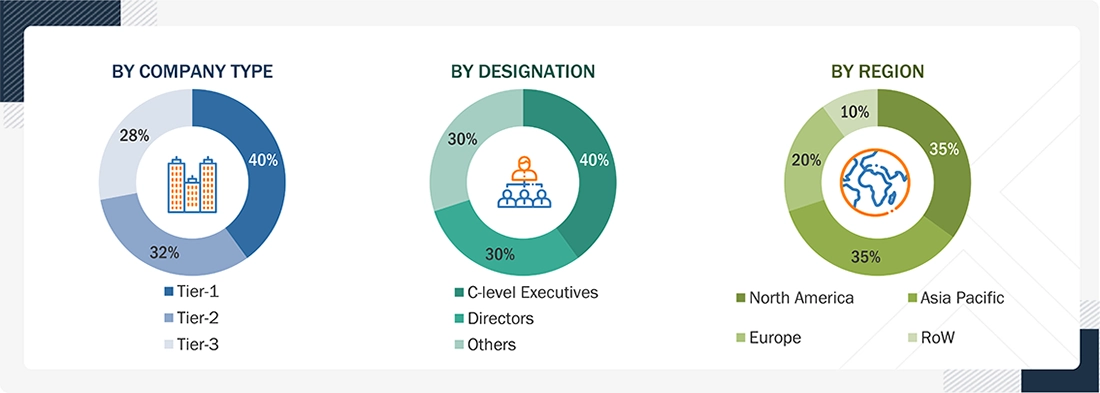
Note: The three tiers of the companies are defined based on their total revenue in 2023: Tier 1 - revenue greater than or equal to USD 1 billion; Tier 2 - revenue between USD 100 million and USD 1 billion; and Tier 3 revenue less than or equal to USD 100 million. Other designations include sales managers, marketing managers, and product managers.
To know about the assumptions considered for the study, download the pdf brochure
Market Size Estimation
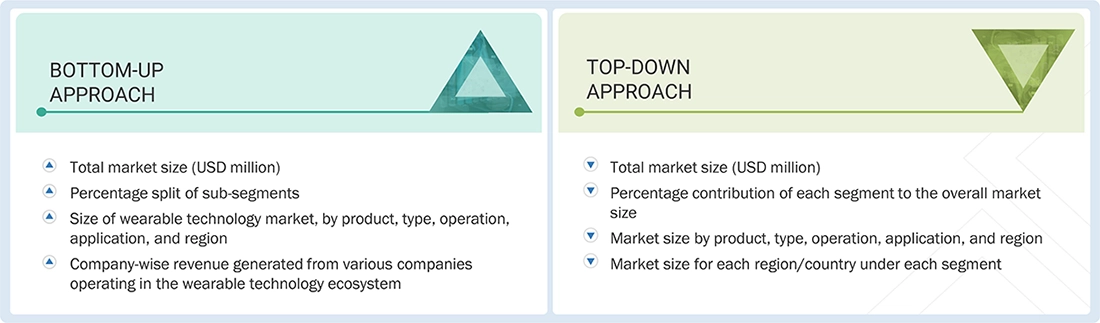
Both top-down and bottom-up approaches have been used to estimate and validate the total size of the wearable technology market. These methods have also been used extensively to estimate the size of various sub-segments in the market. The following research methodology has been used to estimate the market size:
- Major players in the industry and markets have been identified through extensive secondary research.
- The industry’s value chain and market size (in terms of value) have been determined through primary and secondary research processes.
- All percentage shares, splits, and breakdowns have been determined using secondary sources and verified through primary sources.
The market sizing includes the following:
Data Triangulation
After arriving at the overall size of the wearable technology market from the market size estimation process explained above, the total market has been split into several segments and sub-segments. Data triangulation and market breakdown procedures have been employed, wherever applicable, to complete the overall market engineering process and arrive at the exact statistics for all segments and sub-segments of the market. The data has been triangulated by studying various factors and trends from the demand and supply sides. Along with this, the market size has been validated using top-down and bottom-up approaches.
Market Definition
Wearable technology refers to electronic devices designed to be worn on the body, taking various forms, such as jewelry, accessories, medical devices, or clothing. While some wearables offer advanced features, such as AI-powered hearing aids, Google Glass, and Microsoft’s HoloLens, simpler versions include devices such as disposable skin patches with sensors that wirelessly transmit patient data in healthcare settings.
Key Stakeholders
- Wearable technology companies
- Artificial intelligence companies
- Wearable AI companies
- Key service providers
- Software solution providers
- Network providers
- Retail distributors
- Government, financial, and research institutions, and investment communities
- Analysts and strategic business planners
- Research and consulting firms
Report Objectives
- To describe and forecast the wearable technology market, by product, type, operation, and application, in terms of value
- To describe and forecast the wearable technology market, by product and operation, in terms of volume
- To describe and forecast the market for various segments with respect to four main regions, namely North America, Europe, Asia Pacific, and RoW, in terms of value
- To study different types of technology, connectivity, vertical, distribution channel, and component used in the wearable technology market, with the scope limited to qualitative research
- To provide detailed information regarding the major factors, such as drivers, restraints, opportunities, and challenges, influencing the growth of the wearable technology market
- To provide ecosystem analysis, trends/disruptions impacting customer business, technology analysis, pricing analysis, key stakeholders & buying criteria, case study analysis, trade analysis, patent analysis, key conferences & events, Gen AI/ AI impact, and regulations related to the wearable technology market
- To strategically analyze micromarkets with respect to individual growth trends, prospects, and contributions to the total market
- To analyze opportunities for stakeholders by identifying high-growth segments of the wearable technology market
- To benchmark players within the market using the proprietary company evaluation matrix framework, which analyzes market players on various parameters within the broad categories of market rank and product offering
- To strategically profile the key players and comprehensively analyze their market shares and core competencies, and provide a detailed competitive landscape for market leaders
- To analyze competitive developments, such as partnerships, collaborations, agreements, joint ventures, mergers & acquisitions, expansions, and product launches & developments, in the wearable technology market
Available customizations:
With the given market data, MarketsandMarkets offers customizations according to the company’s specific needs. The following customization options are available for the report:
Company Information:
- Detailed analysis and profiling of additional market players (up to 5)
Get the Full Wearable Technology Market Report
Full forecast, segment splits, and company analysis for all Wearable Technology Market.
- US Wearable Technology Market
- Canada Wearable Technology Market
- Mexico Wearable Technology Market
- Germany Wearable Technology Market
- UK Wearable Technology Market
- France Wearable Technology Market
- Italy Wearable Technology Market
- Rest Of Europe Wearable Technology Market
- China Wearable Technology Market
- Japan Wearable Technology Market
- India Wearable Technology Market
- South Korea Wearable Technology Market
- Rest Of Asia Pacific Wearable Technology Market
- GCC Countries Wearable Technology Market
- Rest Of Middle East Wearable Technology Market
- Africa Wearable Technology Market
Need a Tailored Report?
Customize this report to your needs
Get 10% FREE Customization
Customize This Report
