
Canada Wireless Audio Device Market (2026-2031)

The Canada Wireless Audio Device Market was valued at $2274 Million in 2026 and projected to reach to $3346 Million by 2031, representing a compound annual growth rate of 6.6%. Canada's wireless audio device market is positioned for sustained growth through 2031, driven by increasing consumer preference for wireless solutions and the proliferation of connected devices.


| Market Size in | USD 26.32 MN |
| Market Forecast in | |
| CAGR | |
| Forecast Period | |
| Units Considered | Value (USD MN) |
Canada Wireless Audio Device Market Trends and Insights
- This 6.6% compound annual growth rate reflects strong consumer demand for portable audio solutions across Canada, driven by increasing smartphone penetration and lifestyle preferences favoring wireless connectivity.
- Canada's market growth outpaces the global average of 5.6%, positioning the country as a key growth region in North America. The Canadian wireless audio market benefits from high disposable income levels, advanced digital infrastructure, and early technology adoption patterns.
- Throughout the 2026–2031 forecast period, Canada is expected to see sustained demand for true wireless earbuds, over-ear headphones, and smart speakers.
- Consumer preferences in Canada increasingly favor premium audio quality and seamless device integration, supporting market expansion across both urban and emerging regional markets..
Key Market Statistics
- CAGR (2026-2031) 6.6% CAGR
- Market Size, 2026 ~USD 2274 Million
- Forecast, 2031 ~USD 3346 Million
- Country Canada
Canada Wireless Audio Device Market Overview
Market Valuation Growth :
Canada's wireless audio device market is valued at $2,274 million in 2026 and is projected to reach $3,346 million by 2031, representing a 47% increase over the five-year forecast period.
Above-Global Growth Rate :
Canada's market CAGR of 6.6% significantly outpaces the global wireless audio device market growth rate of 5.6%, indicating stronger regional demand and market maturation.
Smartphone Penetration Driver :
High smartphone adoption rates across Canada continue to fuel demand for wireless audio solutions, as consumers increasingly prefer portable, connected audio devices for daily use.
Lifestyle & Connectivity Trends :
Canadian consumers' preference for wireless connectivity and mobile-first lifestyles is accelerating adoption of true wireless earbuds, Bluetooth speakers, and connected audio wearables.
Canada Wireless Audio Device Market Dynamics
- The market's 6.6% CAGR reflects strong fundamentals including high disposable income, tech-savvy demographics, and robust smartphone penetration across urban and suburban regions.
- Premium audio segments, particularly true wireless earbuds and smart speakers, are expected to capture significant market share as Canadian consumers prioritize convenience and audio quality. The competitive landscape in Canada will intensify as both established audio brands and emerging players expand their product portfolios.
- Integration with smart home ecosystems, improved battery technology, and enhanced noise-cancellation features will drive consumer upgrades and replacement cycles.
- Regional distribution through major retailers and e-commerce platforms will continue to support market accessibility, positioning Canada as a key growth market within North America's wireless audio sector..
Market Ecosystem
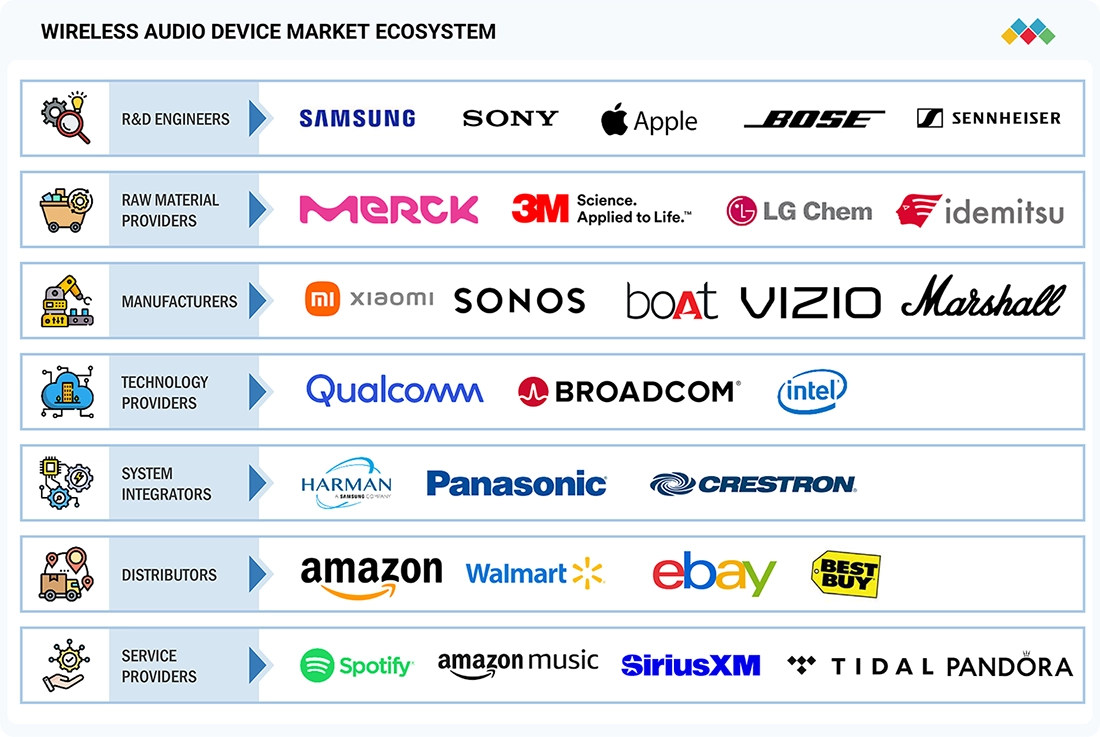
WIRELESS AUDIO DEVICE MARKET SIZE, SHARE & GROWTH: COMMERCIAL USE CASES ACROSS INDUSTRIES
| COMPANY | USE CASE DESCRIPTION | BENEFITS |
|---|---|---|
 |
Deployment of AirPods and AirPods Pro across consumer electronics and enterprise mobility ecosystems, integrated with iOS, macOS, and spatial audio technologies | Seamless device interoperability, enhanced user experience, strong ecosystem lock-in, and premium sound quality with active noise cancellation |
 |
Use of wireless noise-canceling headphones (WH-1000XM series) in consumer, travel, and professional audio segments | Industry-leading noise cancellation, superior audio processing, improved user comfort, and strong brand differentiation |
 |
Adoption of wireless earbuds and headphones in aviation, corporate offices, and premium consumer markets | Advanced acoustic engineering, reduced ambient noise, improved productivity, and high customer loyalty |
 |
Integration of Galaxy Buds within the Galaxy smartphone and wearable ecosystem, targeting mass-market consumers | Optimized device connectivity, scalable manufacturing, competitive pricing, and enhanced user convenience |
Logos and trademarks shown above are the property of their respective owners. Their use here is for informational and illustrative purposes only.
Related Ecosystem
Connected Car
- Light Commercial Vehicles (LCVs)
- Battery Electric Vehicle (BEV)
- Fuel Cell Electric Vehicle (FCEV)
- Cellular Network
- Sensors
- BOSCH LIMITED
- Visteon Corporation
- Jabil Inc.
- DENSO Corporation
- VALENS SEMICONDUCTOR LTD.
Communication And Connectivity Technology
- Sensors
- Smart Card & Readers
- Cellular Network
- Femtocell
- Image Sensors
- Cisco Systems, Inc.
- HUAWEI TECHNOLOGIES CO LTD
- Lenovo
- CommScope Holding Company, Inc.
- Nokia corporation
Electronics System And Components
- Sensors
- Temperature Sensors
- Pressure Sensors
- Actuators
- Image Sensors
- Lenovo
- Samsung
- Texas Instruments Incorporated
- HONEYWELL INTERNATIONAL INC.
- Teledyne Technologies Incorporated
Key Takeaways
- Canada's wireless audio device market will grow from $2,274M (2026) to $3,346M (2031) at a 6.6% CAGR, outpacing global growth.
- High consumer purchasing power and digital infrastructure adoption in Canada drive above-average market expansion through 2031.
- True wireless earbuds and smart speakers represent the fastest-growing product categories in Canada's wireless audio segment.
- Canada's market trajectory reflects strong regional demand for premium audio devices and seamless ecosystem integration.
Wireless Audio Device Market Report Scope
| Report Metric | Details |
|---|---|
| Base Year | 2026 |
| Fastest Growing Segment | AUTOMOTIVE (End User) |
| Forecast Period | 2026–2031 |
| Growth Rate | CAGR of 5.6% from 2026 to 2031 |
| Largest Segment | BLUETOOTH (Technology) |
| Market Size Base Year (Billions) | ~USD 65.74 (2026) |
| Revenue Forecast (Billions) | ~USD 86.33 (2031) |
| Segments Covered | Product Type, Functionality, Technology, Distribution Channel, End User |
Canada Wireless Audio Device Market Report Segmentation
5 segment dimensions are covered across the global market.
By Product Type
- Headphones
- Neckband Earphones
- Portable Speakers
- Soundbars
- Tws Earbuds
By Functionality
- Non-Smart Devices
- Smart Devices
By Technology
- Airplay
- Bluetooth
- Other Technologies
- Radio Frequency (Rf)
- Wi-Fi
By Distribution Channel
- Offline
- Online
By End User
- Automotive
- Commercial
- Consumer
- Other End Users
- Professional
Target Audience
- Audio Device Manufacturers : Manufacturers need Canada-specific market data to evaluate regional demand, set production targets, and develop localized product strategies for the growing wireless audio segment.
- Retail & Distribution Partners : Retailers and distributors require market sizing and growth forecasts for Canada to optimize inventory levels, negotiate supplier agreements, and plan store assortments effectively.
- Investment & Private Equity Firms : Investors need detailed Canada market analysis to assess acquisition targets, evaluate portfolio company growth potential, and identify emerging opportunities in the wireless audio sector.
- Market Entry & Expansion Teams : Companies planning Canadian market entry or expansion require validated market data, growth projections, and consumer insights to minimize risk and maximize market penetration.
- Strategic Business Planners : Corporate strategists need Canada-specific forecasts and market intelligence to inform business plans, competitive positioning, and resource allocation decisions for regional operations.
Key Companies in the Canada Wireless Audio Device Market
| Company | HQ | Ownership | Strongest segments |
|---|---|---|---|
| JABIL | United States | Public Company | Regulated Industries (healthcare, packaging, industrial, semi-cap),Intelligent Infrastructure (5G, wireless, cloud, networking, storage, digital print and retail),Connected Living and Digital Commerce (automotive, transportation, connected devices, mobility, digital commerce ecosystem), |
| HP | United States | Public Company | Server,Hybrid Cloud & Storage (GreenLake, Alletra, InfoSight, CloudPhysics),Networking & Security (Aruba, switches, routers, software), |
| DSP GROUP, INC. | United States | Private Company | Ultra-low-power voice and audio SoCs for wearables,Connectivity solutions for home and IoT devices,Standalone DSP processors and smart codecs, |
| GODREJ GROUP | India | Private Company | Home appliances (refrigerators, washers, ACs, microwaves, coolers, disinfecting),Commercial appliances (medical refrigerators, deep freezers, institutional cooling),Construction, civil engineering, green building, and MEP services, |
| TEXAS INSTRUMENTS INC | United States | Public Company | Analog – Power Management,Analog – Signal Chain,Embedded Processing (MCUs, processors, connectivity, radar), |
| APPLE INC. | United States | Public Company | iPhone,Mac,iPad, |
| SAMSUNG | South Korea | Public Company | Smartphones, tablets, wearables, and mobile accessories,Memory, storage, and system LSI,TVs, displays, and digital signage, |
| SONOS, INC. | United States | Public Company | Home theater and soundbars,Wireless and plug-in speakers (multi-room),Portable speakers and headphones, |
| SONY CORPORATION | Japan | Public Company | Game & Network Services,Music,Pictures, |
| XIAOMI | China | Public Company | Smartphones,IoT and Lifestyle Products,Internet Services (ads, games, fintech), |
| LG ELECTRONICS | South Korea | Public Company | Home Appliance & Air Solution,Home Entertainment (TVs & Digital Media),Vehicle Component Solutions, |
| ANKER INNOVATIONS | China | Public Company | Power banks, chargers, cables, hubs, car chargers,Balcony and residential energy storage systems,Security cameras, video doorbells, alarm systems, |
| EDIFIER | China | Public Company | Headphones and Earphones (incl. gaming, open-ear, on/over-ear),Bookshelf and Monitor Speakers / Studio Monitors,Home Audio / TV and Home Theater Speakers / Subwoofers, |
| SKULLCANDY | United States | Private Company | Wireless earbuds,Over/on-ear headphones,Gaming headsets, |
JABIL
Jabil is a United States-based public company founded in 1966 that employs 135,000 people. The company operates as a global manufacturing services provider.
HP
HP is a United States-based public company founded in 1939 with 67,000 employees. The company is a leading provider of personal computers, printers, and related technology solutions.
DSP GROUP, INC.
DSP Group, Inc. is a United States-based private company founded in 1987 with 352 employees. The company specializes in digital signal processing technology and solutions.
GODREJ GROUP
Godrej Group is an India-based private company founded in 1897 with 13,316 employees. The company operates across multiple sectors including consumer goods, real estate, and industrial products.
TEXAS INSTRUMENTS INC
Texas Instruments Inc. is a United States-based public company founded in 1930 with 33,000 employees. The company is a leading manufacturer of semiconductors and analog integrated circuits.
APPLE INC.
Apple Inc. is a United States-based public company founded in 1976 with 166,000 employees. The company designs and manufactures consumer electronics, software, and digital services.
SAMSUNG
Samsung is a South Korea-based public company founded in 1969 with 128,735 employees. The company operates across multiple sectors including electronics, semiconductors, and consumer appliances.
SONOS, INC.
Sonos, Inc. is a United States-based public company founded in 2002 with 1,404 employees. The company designs and manufactures wireless speakers and audio systems.
SONY CORPORATION
Sony Corporation is a Japan-based public company founded in 1946 with 94,900 employees. The company operates across entertainment, electronics, gaming, and financial services sectors.
XIAOMI
Xiaomi is a China-based public company founded in 2010 with 55,994 employees. The company manufactures and sells smartphones, consumer electronics, and smart home devices.
LG ELECTRONICS
LG Electronics is a South Korea-based public company founded in 1958 with 34,884 employees. The company manufactures consumer electronics, home appliances, and display technologies.
ANKER INNOVATIONS
Anker Innovations is a China-based public company founded in 2011 with 6,304 employees. The company designs and manufactures consumer electronics and mobile device accessories.
EDIFIER
Edifier is a China-based public company founded in 1996 with 2,665 employees. The company manufactures audio equipment and speaker systems.
SKULLCANDY
Skullcandy is a United States-based private company founded in 2003 with 300 employees. The company designs and manufactures audio products and headphones.
Reasons to Buy this Report
- Precise Market Sizing for Canada : Access validated market valuations specific to Canada ($2,274M in 2026, $3,346M in 2031) to accurately assess market opportunity and competitive positioning within the region.
- Above-Global Growth Intelligence : Understand why Canada's 6.6% CAGR outperforms the global 5.6% rate, enabling strategic decisions on regional investment prioritization and resource allocation.
- Consumer Behavior & Demand Drivers : Gain insights into Canadian consumer preferences for wireless connectivity, smartphone integration, and lifestyle factors driving adoption of wireless audio solutions in the market.
- Competitive Landscape Analysis : Identify market dynamics, key players, and growth opportunities specific to Canada's wireless audio sector to inform product development and go-to-market strategies.
- 5-Year Forecast Planning : Leverage detailed projections through 2031 to support long-term business planning, inventory management, and revenue forecasting for Canadian market operations.
Frequently asked questions
What is the current size of Canada's wireless audio device market?
Canada's wireless audio device market is valued at $2,274 million in 2026 and is projected to reach $3,346 million by 2031.
What is the expected growth rate for Canada's wireless audio market?
Canada's wireless audio device market is expected to grow at a compound annual growth rate (CAGR) of 6.6% from 2026 to 2031.
How does Canada's wireless audio market growth compare to global trends?
Canada's 6.6% CAGR exceeds the global average of 5.6%, indicating stronger regional demand and market momentum in the country.
Which product categories are driving growth in Canada's wireless audio market?
True wireless earbuds, over-ear headphones, and smart speakers are the primary growth drivers in Canada's wireless audio device market.
What factors support wireless audio device adoption in Canada?
High disposable income, advanced digital infrastructure, early technology adoption, and consumer preference for premium audio quality support market growth in Canada.
RESEARCH METHODOLOGY
The study involved major activities in estimating the current market size for the wireless audio device market. Exhaustive secondary research was done to collect information on the wireless audio device industry. The next step was to validate these findings and assumptions and validate them with industry experts across the supply chain through primary research. Different approaches, including top-down and bottom-up methods, were employed to estimate the total market size. Following this, the market breakup and data triangulation procedures were employed to determine the market size of the segments and subsegments within the wireless audio device market.
Secondary Research
Secondary research for this study involved gathering information from various credible sources, such as company reports, white papers, journals, and industry publications. This process helps in understanding the supply and value chains, identifying key players, analyzing market segmentation and regional trends, and tracking major market and technology developments. The data collected was used to estimate the overall market size, which was later validated through primary research.
Primary Research
Extensive primary research was conducted after gaining knowledge about the current scenario of the wireless audio device market through secondary research. Several primary interviews were conducted with experts from the demand and supply sides across four major regions—North America, Asia Pacific, Europe, and RoW. This primary data was collected through questionnaires, emails, and telephonic interviews.
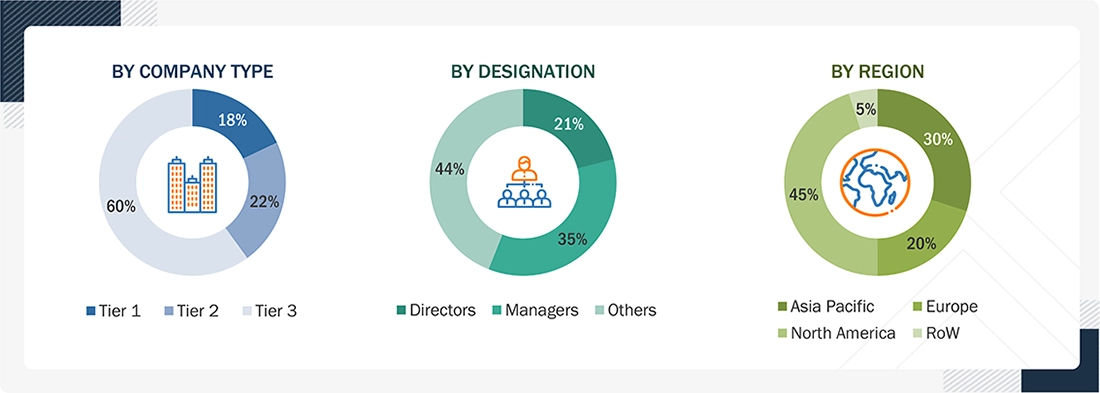
Notes: Other designations include product managers, sales managers, and marketing managers.
Tier 1 companies include market players with revenues above USD 500 million; tier 2 companies earn revenues between USD 100 million and USD 500 million; and tier 3 companies earn up to USD 100 million.
To know about the assumptions considered for the study, download the pdf brochure
Market Size Estimation
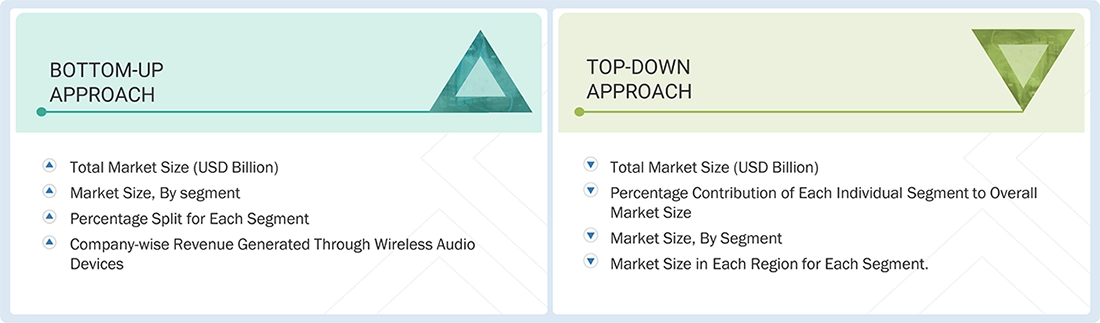
The bottom-up procedure has been employed to arrive at the overall size of the wireless audio device market.
- Identifying end users who are either using or are expected to use wireless audio devices
- Analyzing major providers of wireless audio devices and original equipment manufacturers (OEMs), as well as studying their portfolios and understanding the different technologies used
- Analyzing historical and current data pertaining to the market, in terms of volume, for each product segment of the wireless audio devices market
- Analyzing the average selling price of wireless audio devices based on the different technologies used in different products
- Arriving at the market size by analyzing the revenue of companies and then combining these figures to arrive at the market size
- Studying various paid and unpaid sources, such as annual reports, press releases, white papers, and databases, to gather the required information
- Tracking the ongoing developments and identifying the upcoming ones in the market that include investments, research and development activities, product launches, collaborations, and partnerships undertaken, as well as forecasting the market based on these developments and other critical parameters
- Carrying out multiple discussions with the key opinion leaders to understand the wireless audio device technologies and related raw materials, as well as products designed and developed to analyze the break-up of the scope of work carried out by the key companies manufacturing panels
- Verifying and cross-checking the estimate at every level through discussions with key opinion leaders such as chief executives (CXOs), directors, and operations managers, and finally with the domain experts in MarketsandMarkets
The top-down approach has been used to estimate and validate the total size of the wireless audio device market.
- Focusing on top-line investments and expenditures being made in the ecosystems of various end users
- Calculating the market size considering the revenues generated by major players through the cost of wireless audio device systems
- Segmenting each application of wireless audio devices in each region and deriving the global market size based on region
- Acquiring and analyzing information related to revenues generated by players through their key product offerings
- Conducting multiple on-field discussions with key opinion leaders involved in the development of various wireless audio device offerings
- Estimating the geographic split using secondary sources based on various factors, such as the number of players in a specific country and region and the types of wireless audio device technology used in commercial, consumer, professional, and automotive applications
Wireless Audio Device Market : Top-Down and Bottom-Up Approach
Data Triangulation
After arriving at the overall market size using the market size estimation processes as explained above, the market has been split into several segments and subsegments. Data triangulation and market breakdown procedures have been employed to complete the entire market engineering process and arrive at the exact statistics of each market segment and subsegment. The data has been triangulated by studying various factors and trends from the demand and supply sides in the wireless audio device market.
Market Definition
A wireless audio device is an instrument or device that uses wireless technology to transmit or receive audio signals through wireless technologies, such as Bluetooth, radio frequency, or Wi-Fi. Wireless audio devices, such as wireless speakers, soundbars, headphones, earphones, and headsets, are used across consumer, commercial, automotive, and professional sectors.
Key Stakeholders
- Brand Product Manufacturers/Original Equipment Manufacturers (OEMs)/Original Device Manufacturers (ODMs)
- Wireless Audio Device System Manufacturers
- Semiconductor Component Suppliers/Foundries
- Wireless Audio Device Material and Component Suppliers
- Manufacturing Equipment Suppliers
- System Integrators
- Technology/IP Developers
- Consulting and Market Research Service Providers
- Wireless Audio Device- and Material-related Associations, Organizations, Forums, and Alliances
- Venture Capitalists and Startups
- Research and Educational Institutes
- Distributors and Resellers
- End Users
Report Objectives
- To define, describe, and forecast the wireless audio device market, by technology, functionality, distribution channel, end user, and region, in terms of value
- To describe and forecast the wireless audio device market, by product, in terms of value and volume
-
To forecast the market size, in terms of value, for various segments with regard to
four main regions—North America, Europe, Asia Pacific, South America, and the Middle East & Africa - To provide detailed information regarding major factors such as drivers, restraints, opportunities, and challenges influencing the growth of the market
- To analyze the supply chain, market ecosystem, trends/disruptions impacting customer business, technology analysis, pricing analysis, Porter’s five forces model, key stakeholders and their buying criteria, case study analysis, trade analysis, patent analysis, key conferences and events for the upcoming quarters; regulations related to the market; and investment and funding scenario
- To analyze the micromarkets with respect to industry trends, prospects, and contribution to the total market
- To analyze the AI/Gen AI impact and the US tariff impact on the wireless audio device market
- To analyze opportunities in the market for stakeholders by identifying high-growth segments of the market and provide a detailed competitive landscape for market leaders
- To profile key players and comprehensively analyze their market position in terms of ranking and core competencies2
- To analyze strategic developments such as product launches, collaborations, contracts, expansions, and partnerships undertaken by the leading players in the wireless audio device market
Customization Options:
With the given market data, MarketsandMarkets offers customizations according to the company‘s specific needs. The following customization options are available for the report.
Company Information:
- Detailed analysis and profiling of additional market players (up to five)
Get the Full Wireless Audio Device Market Report
Full forecast, segment splits, and company analysis for all Wireless Audio Device Market.
- Rest Of South America Wireless Audio Device Market
- US Wireless Audio Device Market
- Mexico Wireless Audio Device Market
- UK Wireless Audio Device Market
- Germany Wireless Audio Device Market
- France Wireless Audio Device Market
- Italy Wireless Audio Device Market
- Spain Wireless Audio Device Market
- China Wireless Audio Device Market
- Japan Wireless Audio Device Market
- South Korea Wireless Audio Device Market
- India Wireless Audio Device Market
- Australia Wireless Audio Device Market
- Brazil Wireless Audio Device Market
- Argentina Wireless Audio Device Market
- Rest Of Europe Wireless Audio Device Market
- Rest Of Asia Pacific Wireless Audio Device Market
Need a Tailored Report?
Customize this report to your needs
Get 10% FREE Customization
Customize This Report
