
Rest Of Asia Pacific Wireless Gigabit Market (2024-2029)

The Rest Of Asia Pacific Wireless Gigabit Market was valued at $1.7 Million in 2024 and projected to reach to $1.9 Million by 2029, representing a compound annual growth rate of 3.1%. Rest Of Asia Pacific represents an emerging frontier for wireless gigabit technology adoption, with modest but consistent growth expected through 2029.


| Market Size in | USD 26.32 MN |
| Market Forecast in | |
| CAGR | |
| Forecast Period | |
| Units Considered | Value (USD MN) |
Rest Of Asia Pacific Wireless Gigabit Market Trends and Insights
- In 2024, Rest Of Asia Pacific's market was valued at $1.7 million, reflecting limited but emerging adoption of wireless gigabit technologies across the region's developing economies.
- Rest Of Asia Pacific is projected to expand to $1.9 million by 2029, growing at a compound annual growth rate of 3.1%, which reflects steady but constrained market development compared to more mature Asia Pacific markets. The growth trajectory for Rest Of Asia Pacific is characterized by gradual infrastructure development and increasing digital connectivity initiatives.
- Rest Of Asia Pacific's slower expansion rate relative to global trends indicates that wireless gigabit adoption remains in early stages, with limited enterprise and consumer penetration.
- Rest Of Asia Pacific's market dynamics are shaped by varying levels of technological readiness, regulatory frameworks, and investment capacity across constituent countries, creating a heterogeneous growth environment throughout the forecast period to 2029..
Key Market Statistics
- CAGR (2024-2029) 3.1% CAGR
- Market Size, 2024 ~USD 1.7 Million
- Forecast, 2029 ~USD 1.9 Million
- Country Rest Of Asia Pacific
Rest Of Asia Pacific Wireless Gigabit Market Overview
Modest Market Valuation :
Rest Of Asia Pacific's wireless gigabit market was valued at $1.7 million in 2024, representing a nascent but gradually expanding segment within the region's semiconductor and electronics landscape.
Steady Growth Trajectory :
The region is projected to grow at a CAGR of 3.1% through 2029, reaching $1.9 million, indicating emerging adoption despite lagging behind the global CAGR of 15.7%.
Developing Economy Adoption :
Limited but increasing wireless gigabit technology penetration across Rest Of Asia Pacific's developing economies reflects gradual infrastructure improvements and rising digital connectivity demands.
Growth Gap vs. Global Market :
The significant differential between regional CAGR (3.1%) and global CAGR (15.7%) highlights untapped potential and opportunities for market expansion in Rest Of Asia Pacific.
Rest Of Asia Pacific Wireless Gigabit Market Dynamics
- The region's $1.7 million market in 2024 reflects early-stage implementation across developing economies, where infrastructure investments and digital transformation initiatives are gradually accelerating.
- While the 3.1% CAGR trails significantly behind global growth rates, this gap presents substantial upside potential as economies mature and connectivity demands increase. The forecast expansion to $1.9 million by 2029 underscores growing recognition of wireless gigabit benefits in enterprise and consumer applications.
- Key drivers include improving broadband infrastructure, rising smartphone penetration, and increasing IoT deployments across the region.
- As developing nations prioritize digital economy initiatives and 5G rollouts expand, Rest Of Asia Pacific is positioned for accelerated wireless gigabit adoption in the coming years..
Market Ecosystem
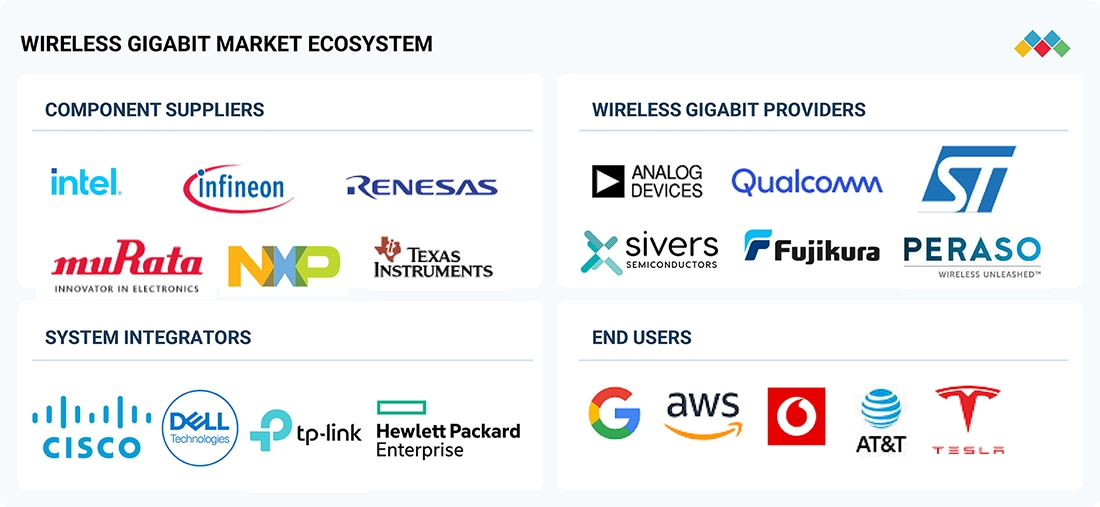
WIRELESS GIGABIT MARKET SIZE SHARE AND TRENDS: COMMERCIAL USE CASES ACROSS INDUSTRIES
| COMPANY | USE CASE DESCRIPTION | BENEFITS |
|---|---|---|
 |
Dell utilized Qualcomm's WiGig chipsets to create wireless docking solutions. These allowed users to wirelessly connect peripherals such as monitors, keyboards, mice, and external storage devices. | Dell's wireless docking solutions allowed employees to move around their workspaces more freely without losing connectivity to their peripherals. This increased workplace flexibility and enabled hot-desking and collaborative work environments. |
 |
Harman incorporated Peraso's WiGig chipsets into its infotainment systems, allowing the system to connect wirelessly with multiple devices inside the car at gigabit speeds. This enabled passengers to stream 4K videos, play online games, and transfer large media files quickly and seamlessly. | The implementation of WiGig enabled data transfer speeds up to several gigabits per second, far surpassing traditional wireless technologies. By integrating cutting-edge WiGig technology, Harman positioned itself as a leader in the connected car market, offering a unique value proposition that differentiates its products from those of competitors. |
 |
Cisco partnered with Peraso Technologies, a company specializing in 60 GHz WiGig chipsets. Peraso's chipsets, based on IEEE 802.11ad, provided the high bandwidth needed for enterprise applications while operating in the millimeter-wave spectrum, which reduced interference compared to traditional 2.4 GHz and 5 GHz Wi-Fi frequencies. | The integration of Peraso's WiGig technology into Cisco's networking solutions led to enhanced wireless performance in enterprise settings, enabling seamless connectivity for a large number of devices with minimal interference. |
 |
The wireless docking solution enabled EliteBook users to connect to multiple peripherals such as monitors, external storage devices, printers, and network connections, without needing physical cables. | The wireless docking solution helped create cleaner, more organized workspaces by eliminating the need for multiple cables. This not only improved the aesthetic appeal of the workspace but also reduced the risk of cable-related issues. |
Logos and trademarks shown above are the property of their respective owners. Their use here is for informational and illustrative purposes only.
Related Ecosystem
Communication And Connectivity Technology
- Sensors
- Smart Card & Readers
- Cellular Network
- Femtocell
- Image Sensors
- Cisco Systems, Inc.
- HUAWEI TECHNOLOGIES CO LTD
- Lenovo
- CommScope Holding Company, Inc.
- Nokia corporation
Key Takeaways
- Rest Of Asia Pacific's wireless gigabit market was valued at $1.7 million in 2024 and is forecast to reach $1.9 million by 2029.
- Rest Of Asia Pacific exhibits a 3.1% CAGR, indicating slower growth compared to global market expansion of 15.7%.
- Rest Of Asia Pacific's market remains in early adoption phases with significant untapped potential across developing economies.
- Rest Of Asia Pacific's growth is constrained by infrastructure gaps, varying regulatory environments, and limited enterprise investment readiness.
Wireless Gigabit Market Report Scope
| Report Metric | Details |
|---|---|
| Base Year | 2024 |
| Fastest Growing Segment | 63–65 GHZ (Channel) |
| Forecast Period | 2024–2029 |
| Growth Rate | CAGR of 15.7% from 2024 to 2029 |
| Largest Segment | IEEE 802.11 AD (Protocol) |
| Market Size Base Year (Billions) | ~USD 0.07 (2024) |
| Revenue Forecast (Billions) | ~USD 0.138 (2029) |
| Segments Covered | Channel, Protocol, Offering, Product, Device Type, End User |
Rest Of Asia Pacific Wireless Gigabit Market Report Segmentation
6 segment dimensions are covered across the global market.
By Channel
- 57–59 Ghz
- 59–61 Ghz
- 61–63 Ghz
- 63–65 Ghz
- Other Channels
By Protocol
- Ieee 802.11 Ad
- Ieee 802.11 Ay
By Offering
- Module
- Soc
By Product
- Display Devices
- Network Infrastructure Devices
By Device Type
- Backhaul Stations
- Docking Stations
- Network Adapters
- Network Router & Access Point
- Network Routers & Access Points
By End User
- Automotive
- Commercial
- Consumer Electronics
- Other End Users
- Railway
- Telecom
Target Audience
- Semiconductor Manufacturers : Need regional market data to assess Rest Of Asia Pacific's wireless gigabit chip demand, production capacity planning, and distribution strategy optimization for developing economies.
- Electronics OEMs : Require market insights to evaluate Rest Of Asia Pacific's device integration opportunities, supply chain positioning, and product roadmap alignment with regional adoption timelines.
- Technology Investors : Seek detailed market forecasts for Rest Of Asia Pacific to identify investment opportunities, assess growth potential, and evaluate portfolio companies' regional expansion prospects.
- Telecom & Infrastructure Providers : Need regional market analysis to understand wireless gigabit deployment opportunities, infrastructure investment requirements, and service monetization potential across Rest Of Asia Pacific.
- Market Strategy Consultants : Require comprehensive Rest Of Asia Pacific data to advise clients on market entry strategies, competitive positioning, and growth acceleration tactics in emerging wireless technology segments.
Key Companies in the Rest Of Asia Pacific Wireless Gigabit Market
| Company | HQ | Ownership | Strongest segments |
|---|---|---|---|
| WINWAY TECH. CO., LTD. | United States | Public Company | High-frequency test sockets (including HyperSocket, coaxial, burn-in, PoP, CRS) for 57–71 GHz RF SoCs and modules,Vertical and WLCSP probe cards for mmWave RFIC and antenna-in-package,Thermal control systems (ATC, E-Flux 4.0, HEATCon Titan, chillers) for high-power wireless gigabit devices, |
| DELTA ELECTRONICS INC | Taiwan | Public Company | Backhaul Station & Telecom Power-Linked Solutions,Video Wall, Multimedia Streaming & Signage Solutions,Smart City, Surveillance & Building Solutions, |
| QORVO | United States | Public Company | |
| LENOVO | China | Public Company | |
| NUTANIX INC | United States | Public Company | |
| COMMSCOPE HOLDING COMPANY, INC | United States | Public Company | |
| PERASO TECHNOLOGIES INC. | United States | Public Company | |
| SIVERS SEMICONDUCTORS AB | Sweden | Public Company | |
| STMICROELECTRONICS | Switzerland | Public Company | |
| FUJIKURA LTD. | Japan | Public Company | |
| INDIE SEMICONDUCTOR | United States | Public Company | |
| ANALOG DEVICES, INC. | United States | Public Company | |
| CAMBIUM NETWORKS, LTD. | United States | Public Company | |
| RENESAS ELECTRONICS CORPORATION | Japan | Public Company | |
| MURATA MANUFACTURING CO., LTD. | Japan | Public Company |
WINWAY TECH. CO., LTD.
WINWAY TECH. CO., LTD. is a publicly traded company founded in 2001 and based in the United States.
DELTA ELECTRONICS INC
Delta Electronics Inc. is a Taiwan-based public company founded in 1971 with 85,684 employees, operating as a major electronics manufacturer.
QORVO
Qorvo is a United States public company founded in 1957 with 5,200 employees, specializing in semiconductor and RF solutions.
LENOVO
Lenovo is a publicly traded technology company founded in 1984 and headquartered in China.
NUTANIX INC
Nutanix Inc. is a United States-based public company founded in 2009 with 7,800 employees, providing cloud computing and infrastructure solutions.
COMMSCOPE HOLDING COMPANY, INC
CommScope Holding Company, Inc. is a publicly traded United States company founded in 1976 with 4,500 employees, operating in the communications infrastructure sector.
PERASO TECHNOLOGIES INC.
Peraso Technologies Inc. is a small United States public company founded in 1991 with 42 employees.
SIVERS SEMICONDUCTORS AB
Sivers Semiconductors AB is a Swedish public company founded in 1951 with 132 employees, specializing in semiconductor technology.
STMICROELECTRONICS
STMicroelectronics is a Switzerland-based public company founded in 1987 with 48,000 employees, serving as a major semiconductor manufacturer.
FUJIKURA LTD.
Fujikura Ltd. is a Japan-based public company founded in 1885 with 50,586 employees, operating in the electronics and materials sectors.
INDIE SEMICONDUCTOR
Indie Semiconductor is a United States public company founded in 2007 with 800 employees, providing semiconductor solutions.
ANALOG DEVICES, INC.
Analog Devices, Inc. is a United States public company founded in 1965 with 24,500 employees, specializing in analog and mixed-signal semiconductors.
CAMBIUM NETWORKS, LTD.
Cambium Networks, Ltd. is a United States public company founded in 2011 with 486 employees, providing wireless networking solutions.
RENESAS ELECTRONICS CORPORATION
Renesas Electronics Corporation is a Japan-based public company founded in 2002 with 21,907 employees, operating as a major semiconductor manufacturer.
MURATA MANUFACTURING CO., LTD.
Murata Manufacturing Co., Ltd. is a Japan-based public company founded in 1944 with 74,302 employees, specializing in electronic components and modules.
Reasons to Buy this Report
- Identify Emerging Opportunities : Gain strategic insights into Rest Of Asia Pacific's untapped wireless gigabit market potential, where the 12.6% growth gap versus global rates signals significant expansion opportunities for early movers.
- Competitive Market Positioning : Understand regional adoption patterns and infrastructure readiness to position products and services effectively within developing economies experiencing gradual digital transformation.
- Investment Decision Support : Access detailed market valuation data and growth forecasts for Rest Of Asia Pacific to inform capital allocation, market entry strategies, and resource planning decisions.
- Regional Growth Trajectory Analysis : Track the region's projected expansion from $1.7M to $1.9M through 2029, enabling accurate revenue forecasting and long-term business planning specific to Rest Of Asia Pacific markets.
- Comparative Market Intelligence : Benchmark Rest Of Asia Pacific performance against global wireless gigabit trends to identify regional dynamics, barriers to adoption, and localized growth drivers.
Frequently asked questions
What is the current market size of wireless gigabit in Rest Of Asia Pacific?
Rest Of Asia Pacific's wireless gigabit market was valued at $1.7 million in 2024, representing a small but emerging segment within the broader Asia Pacific region.
What is the projected market size for Rest Of Asia Pacific by 2029?
Rest Of Asia Pacific's wireless gigabit market is forecast to reach $1.9 million by 2029, reflecting a 3.1% compound annual growth rate over the five-year period.
How does Rest Of Asia Pacific's growth rate compare to global trends?
Rest Of Asia Pacific's 3.1% CAGR is significantly lower than the global wireless gigabit market CAGR of 15.7%, indicating slower adoption and market maturation in the region.
What factors are limiting wireless gigabit adoption in Rest Of Asia Pacific?
Rest Of Asia Pacific faces constraints including inadequate digital infrastructure, varying regulatory frameworks across countries, limited enterprise readiness, and lower investment capacity compared to developed markets.
What growth opportunities exist for wireless gigabit in Rest Of Asia Pacific?
Rest Of Asia Pacific presents opportunities through infrastructure modernization initiatives, increasing smartphone penetration, growing enterprise digitalization, and government-backed connectivity programs in developing economies.
RESEARCH METHODOLOGY
The study involved four major activities in estimating the current size of the Wireless gigabit market. Exhaustive secondary research collected information on the market, peer, and parent markets. The next step was to validate these findings, assumptions, and sizing with industry experts across the value chain through primary research. Both top-down and bottom-up approaches were employed to estimate the complete market size. After that, market breakdown and data triangulation were used to estimate the market size of segments and subsegments.
Secondary Research
Secondary sources for this research study included corporate filings (such as annual reports, investor presentations, and financial statements), trade, business, professional associations, white papers, certified publications, articles by recognized authors, directories, and databases. The secondary data was collected and analyzed to determine the overall market size, further validated through primary research.
List of major secondary sources
|
SOURCE |
WEB LINK |
|
Federal Communications Commission (FCC) |
|
|
Canadian Radio-television and Telecommunications Commission (CRTC) |
|
|
European Telecommunications Standards Institute (ETSI) |
|
|
Office of Communications (Ofcom) |
|
|
Ministry of Industry and Information Technology (MIIT) |
|
|
Ministry of Internal Affairs and Communications (MIC) |
|
|
Ministry of Electronics and Information Technology (MeitY) |
|
|
Ericsson |
https://www.ericsson.com/en/reports-and-papers/mobility-report/reports/june-2024 |
|
Nokia |
https://www.nokia.com/about-us/company/worldwide-presence/india/mbit-index-2024/ |
Primary Research
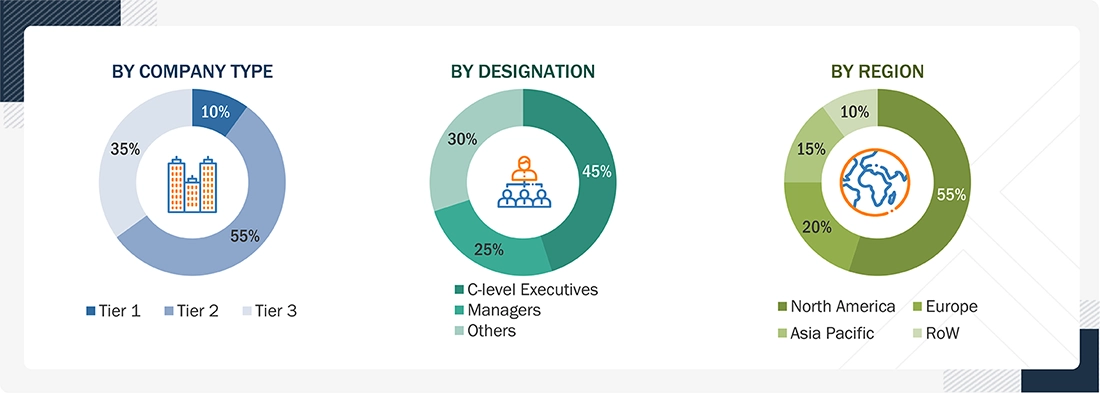
Extensive primary research was conducted after gaining knowledge about the current scenario of the Wireless gigabit market through secondary research. Several primary interviews were conducted with experts from the demand and supply sides across four major regions: North America, Europe, Asia Pacific, and RoW. This primary data was collected through questionnaires, emails, and telephone interviews.
To know about the assumptions considered for the study, download the pdf brochure
Market Size Estimation
Both top-down and bottom-up approaches were used to estimate and validate the Wireless gigabit market size and its various dependent submarkets. The key players in the market were identified through secondary research, and their market share in the respective regions was determined through primary and secondary research. This entire procedure involved the study of annual and financial reports of top players and extensive interviews with industry leaders such as chief executive officers (CEOs), vice presidents (VPs), directors, and marketing executives. All percentage shares and breakdowns were determined using secondary sources and verified through primary sources. All the possible parameters that affect the markets covered in this research study were accounted for, viewed in extensive detail, verified through primary research, and analyzed to obtain the final quantitative and qualitative data. This data was consolidated and supplemented with detailed inputs and analysis from MarketsandMarkets and presented in this report.
Bottom-Up Approach and Top-Down Approach
The bottom-up approach was used to determine the overall size of the wireless gigabit market based on the revenues of the key players and their shares in the market. The overall market size was calculated based on the revenues of the key players identified in the market.
- Identifying various end-use industries using or expected to implement Wireless Gigabit
- Identifying various end users using or expected to implement Wireless Gigabit
- Analyzing each end user, along with the significant related companies and Wireless gigabit providers
- Estimating the Wireless gigabit market for end user
- Understanding the demand generated by companies operating across different end-user
- Tracking the ongoing and upcoming implementation of projects based on Wireless gigabit technology by end users and forecasting the market based on these developments and other critical parameters
- Carrying out multiple discussions with key opinion leaders to understand the type of Wireless gigabit products designed and developed vertically, helping analyze the breakdown of the scope of work carried out by each significant company in the Wireless gigabit market
- Arriving at the market estimates by analyzing Wireless gigabit companies as per their countries and subsequently combining this information to arrive at the market estimates by region
- Verifying and cross-checking the forecasts at every level through discussions with the key opinion leaders, including CXOs, directors, and operations managers, and finally with domain experts at MarketsandMarkets
- Studying various paid and unpaid sources of information, such as annual reports, press releases, white papers, and databases
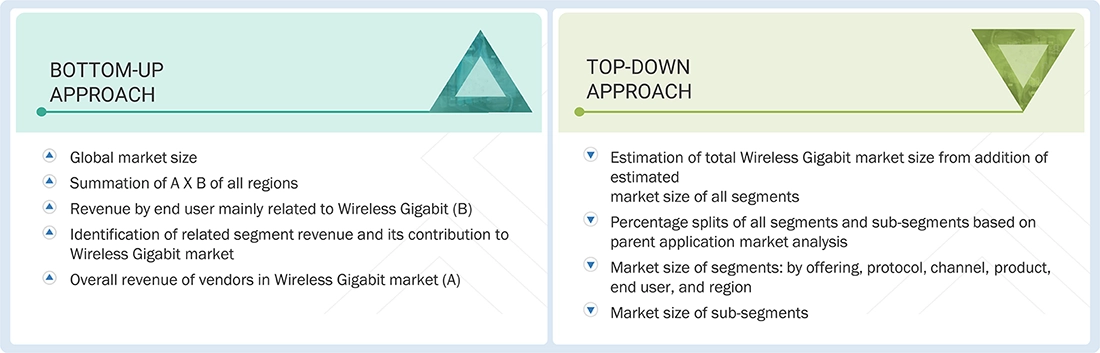
In the top-down approach, the overall market size has been used to estimate the size of the individual markets (mentioned in the market segmentation) through percentage splits from secondary and primary research.
The most appropriate immediate parent market size has been used to implement the top-down approach to calculate the market size of specific segments. The top-down approach was implemented for the data extracted from the secondary research to validate the market size obtained.
Each company's market share was estimated to verify the revenue shares used earlier in the top-down approach. This study determined and confirmed the overall parent and individual market sizes using the data triangulation method and validating data through primaries. The data triangulation method is explained in the next section.
- Focusing on top-line investments and expenditures being made in the ecosystems of various end-user
- Building and developing the information related to the market revenue generated by critical Wireless gigabit solution providers
- Conducting multiple on-field discussions with the key opinion leaders involved in the development of Wireless gigabit products in various end-user
- Estimating geographic splits using secondary sources based on numerous factors, such as the number of players in a specific country and region, the offering of Wireless gigabit, and the level of solutions offered by end-user
Data Triangulation
After arriving at the overall market size from the above estimation process, the market has been split into several segments and subsegments. The data triangulation procedure has been employed wherever applicable to complete the overall market engineering process and arrive at the exact statistics for all segments and subsegments. The data has been triangulated by studying various factors and trends from both the demand and supply sides. Additionally, the market size has been validated using top-down and bottom-up approaches.
Market Definition
Wireless Gigabit (WiGig) is a high-speed wireless communication technology operating in the 60 GHz frequency band. It is designed to provide very fast data rates over short distances, making it ideal for high-bandwidth and low-latency applications such as AR/VR devices, HD video streaming, online gaming, and more. WiGig technology follows the IEEE 802.11ad and IEEE 802.11ay standard protocols, enabling multi-gigabit speeds up to 7 Gbps.
Key Stakeholders
- Technology Developers and Standardization Bodies
- Semiconductor Manufacturers
- Device Manufacturers
- Network Equipment Manufacturers
- Telecommunications Providers
- Software and Application Developers
- Enterprise Users and End Consumers
- Regulatory Bodies and Governments
- Research and Academic Institutions
- Investors and Venture Capitalists
Report Objectives
- To define, describe, and forecast the Wireless gigabit (WiGig) market by offering, protocol, channel, product, use case, end user, and region
- To forecast the size of the market segments for four major regions—North America, Europe, Asia Pacific, and the Rest of the World (RoW)
- To provide detailed information regarding the major factors influencing the growth of the market (drivers, restraints, opportunities, and challenges)
- To strategically analyze micromarkets concerning individual growth trends, prospects, and contributions to the total market
- To provide a detailed overview of the Wireless gigabit (WiGig) market’s value chain, the ecosystem, technology trends, use cases, regulatory environment, and Porter’s five forces analysis.
- To strategically profile the key players and comprehensively analyze their market shares and core competencies
- To analyze the opportunities in the market for stakeholders and describe the competitive landscape of the market
- To analyze competitive developments, such as partnerships, product developments, and research & development (R&D), in the market
Available Customizations
With the given market data, MarketsandMarkets offers customizations according to the specific requirements of companies. The following customization options are available for the report:
- Detailed analysis and profiling of additional market players (up to 5)
- Additional country-level analysis of the Wireless gigabit market
Product Analysis
- The product matrix provides a detailed comparison of each company's product portfolio in the wireless gigabit market.
Get the Full Wireless Gigabit Market Report
Full forecast, segment splits, and company analysis for all Wireless Gigabit Market.
- US Wireless Gigabit Market
- Canada Wireless Gigabit Market
- Mexico Wireless Gigabit Market
- Germany Wireless Gigabit Market
- UK Wireless Gigabit Market
- France Wireless Gigabit Market
- Italy Wireless Gigabit Market
- Rest Of Europe Wireless Gigabit Market
- China Wireless Gigabit Market
- Japan Wireless Gigabit Market
- South Korea Wireless Gigabit Market
- GCC Countries Wireless Gigabit Market
- Rest Of Middle East Wireless Gigabit Market
Need a Tailored Report?
Customize this report to your needs
Get 10% FREE Customization
Customize This Report
