Network Automation Market

Network Automation Market by Network Automation Type (Orchestration Automation, Provisioning Automation, Script-driven Network Automation, AI-driven Network Automation, IBN Automation, Network Security Automation) - Global Forecast to 2032




OVERVIEW
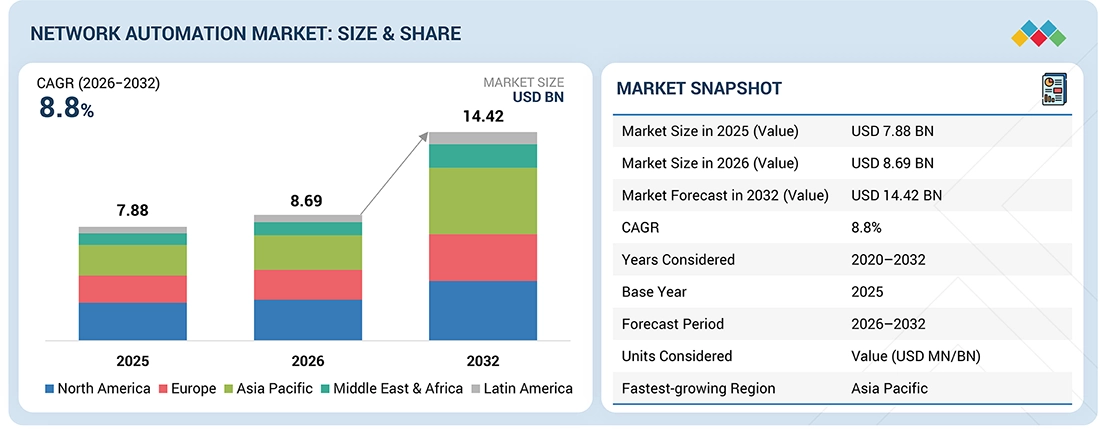
Source: Secondary Research, Interviews with Experts, MarketsandMarkets Analysis
The network automation market is expected to grow from USD 8.69 billion in 2026 to USD 14.42 billion by 2032, at a compound annual growth rate (CAGR) of 8.8% during the forecast period. The increasing diversity of enterprise and service provider infrastructure is creating a greater need for software-driven network management. Organizations are increasingly operating across data centers, cloud environments, branch locations, and distributed edge infrastructure, making manual configuration and operational processes difficult to scale. Network automation enables organizations to standardize repetitive tasks, accelerate provisioning, improve configuration consistency, and reduce operational dependencies. The adoption of programmable networks, API-based management, orchestration platforms, and infrastructure-as-code is further expanding automation across network operations. At the same time, AI-enabled observability and predictive network management are enabling organizations to identify anomalies, optimize performance, and automate remediation. As enterprises prioritize network agility, operational resilience, and faster service delivery, automation is becoming increasingly integrated into broader IT and infrastructure management strategies.
KEY TAKEAWAYS
-
By RegionThe Asia Pacific region is projected to grow the fastest from 2026 to 2032.
-
By OfferingThe services segment is expected to register the highest CAGR of 9.5%.
-
By Network Automation TypeOrchestration automation isset to be the largest segment.
-
By Network TypeThe data center networks segment is expected to hold the largest market share during the forecast period.
-
By End UserThe enterprise segment is expected to hold the largest market share during the forecast period.
-
Competitive Landscape - Key PlayersCompanies such as Cisco, Ericsson, HPE, IBM, Broadcom, and Nokia were identified as some of the star players in the network automation market, given their strong market share and product footprint.
-
Competitive Landscape - Startup/SMECompanies such as Backbox, Bluecat, Stardust, and Flock9 were identified as some of the emerging players in the network automation market.
The increasing diversity of enterprise and service provider infrastructure is expanding the range of networks, devices, and services that organizations must provision, monitor, and maintain across multiple environments. Automation enables network teams to coordinate these activities through centralized workflows and programmable interfaces, improving operational consistency across heterogeneous infrastructure. The expansion of cloud-native applications, edge deployments, and high-performance computing is further increasing demand for networks capable of dynamically responding to changing workloads and traffic patterns. The emergence of AI-driven operations, intent-based networking, and closed-loop automation is expected to further expand the role of automation from task execution toward predictive and autonomous network management.
TRENDS & DISRUPTIONS IMPACTING CUSTOMERS' CUSTOMERS
The network automation market is evolving from task-based scripting and device-level configuration toward integrated, policy-driven, and increasingly autonomous network operations. Earlier automation deployments primarily focused on repetitive activities such as provisioning, configuration, and software updates, while current solutions increasingly incorporate orchestration, observability, AI-driven analytics, and closed-loop remediation. This transition is shifting the value of automation from reducing manual effort to improving network agility, resilience, and operational decision-making. Automation capabilities are also being integrated with cloud management, DevOps, infrastructure-as-code, and IT service management platforms, enabling network changes to be coordinated with application and infrastructure lifecycles. As enterprises operate increasingly distributed and heterogeneous environments, network automation is becoming a foundational capability for scalable and programmable network infrastructure.
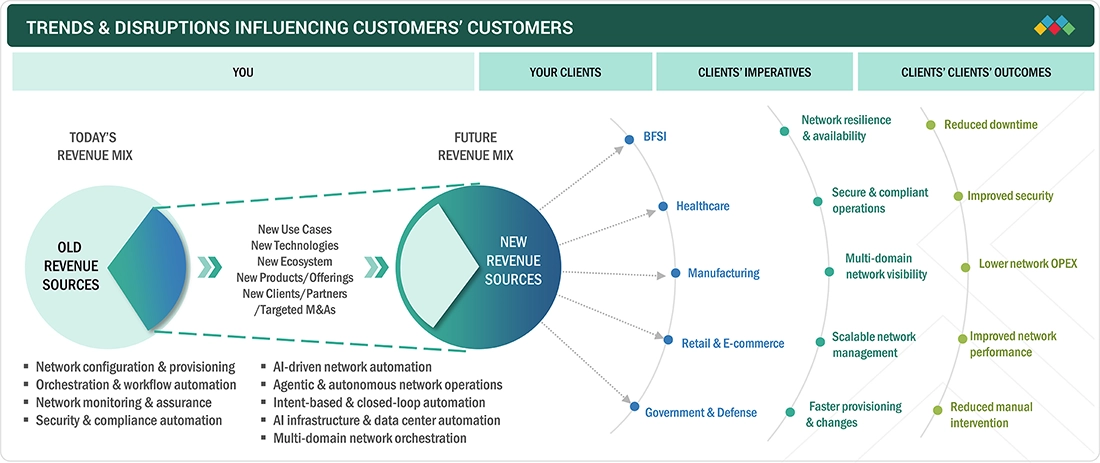
Source: Secondary Research, Interviews with Experts, MarketsandMarkets Analysis
MARKET DYNAMICS

Level
-
Expansion of AI Infrastructure & High-Performance Data Center Networks

-
Security & compliance requirements


Level
-
Data Quality & Automation Readiness Constraints

-
High initial investment & integration challenges


Level
-
Expansion of Closed-Loop & Intent-Based Network Operations

-
Cloud-Native & API-Driven Network Automation


Level
-
Security risks of automated networks

-
Vendor lock-in & interoperability issues

Source: Secondary Research, Interviews with Experts, MarketsandMarkets Analysis
Driver: Expansion of AI Infrastructure & High-Performance Data Center Networks
The rapid expansion of generative AI, machine learning, and other high-performance workloads is increasing demand for scalable and highly automated network infrastructure. AI workloads require high-bandwidth, low-latency, and highly available connections across compute, storage, and networking resources, creating greater operational complexity within data centers and distributed AI infrastructure. Manual provisioning and configuration processes can limit the speed at which organizations deploy and scale these environments. Network automation enables organizations to automate infrastructure provisioning, configuration, traffic management, performance monitoring, and resource optimization across high-performance data center environments. The growing deployment of GPU clusters, AI factories, and distributed AI workloads is therefore creating additional demand for automated network operations capable of supporting rapidly changing infrastructure requirements.
Restraint: Data Quality & Automation Readiness Constraints
Effective network automation depends on accurate network inventories, consistent configurations, reliable telemetry, standardized data models, and well-defined operational policies. In many organizations, fragmented monitoring systems, incomplete asset information, inconsistent configurations, and limited network visibility can reduce the effectiveness of automation initiatives. These limitations become more significant as organizations adopt AI-driven automation, which requires high-quality and contextual network data to generate reliable recommendations and execute automated actions. Organizations may therefore need to establish standardized data sources, improve network visibility, and modernize operational processes before deploying advanced automation capabilities. The effort required to improve data quality and establish the necessary automation foundations can delay adoption and increase the overall complexity of network transformation programs.
Opportunity: Expansion of Closed-Loop & Intent-Based Network Operations
The increasing adoption of intent-based networking and closed-loop automation is creating opportunities for network automation providers to move beyond task-level automation toward continuous network optimization. Intent-based systems allow organizations to define desired business or operational outcomes, while automation platforms translate these objectives into network policies and configurations. Closed-loop automation then continuously monitors network conditions, evaluates performance against defined policies, and initiates corrective actions when deviations occur. The convergence of intent management, network observability, policy-based orchestration, and automated validation can enable organizations to create more adaptive and resilient networks. Service providers are increasingly applying these capabilities across RAN, core, and service assurance environments, while enterprises are adopting policy-driven automation for configuration management, security, and performance optimization. This evolution creates opportunities for vendors capable of delivering end-to-end, multi-domain, and governed automation.
Challenge: Security risks of automated networks
Network automation can improve security and operational consistency, but increased automation also expands the potential impact of configuration errors, compromised credentials, unauthorized workflows, and malicious changes. Automated systems can execute network-wide changes rapidly, meaning that an incorrectly defined policy or compromised automation process can propagate across multiple devices and environments before an issue is identified. The growing use of AI and agentic automation introduces additional concerns related to decision transparency, access control, accountability, and unintended actions. Organizations must ensure that automated and AI-driven changes are appropriately validated, authorized, logged, and reversible. As network operations become increasingly autonomous, vendors and enterprises will need stronger governance frameworks, role-based controls, testing environments, audit trails, and human oversight to ensure that automation improves efficiency without increasing operational or security exposure.
NETWORK AUTOMATION MARKET: COMMERCIAL USE CASES ACROSS INDUSTRIES
| COMPANY | USE CASE DESCRIPTION | BENEFITS |
|---|---|---|
 |
Telstra partnered with Cisco to automate network operations using Cisco Network Services Orchestrator (NSO). The implementation enabled Telstra to upgrade its large network in hours and onboard 43,000 devices in four days, while automating network changes and reducing errors associated with manual operations. | Faster network upgrades | Rapid device onboarding | Reduced human error | Greater network agility |
 |
eMAG uses Juniper Apstra to automate and validate the design, deployment, and operation of its multivendor data center network. Apstra manages a SONiC overlay and 40 physical switches, enabling eMAG to provision new network services and add switches in minutes while maintaining consistent network policies. | Faster network deployment | Multivendor automation | Improved operational reliability | Reduced configuration effort |
 |
Mobily partnered with Ericsson to use its Cognitive Network Solution and AI-driven software to achieve Level 4 network management automation during Hajj 2025. The solution automated complex network optimization processes and improved network performance and end-user experience during a large-scale connectivity event. | Higher network automation | Automated optimization | Improved network performance | Enhanced end-user experience |
Logos and trademarks shown above are the property of their respective owners. Their use here is for informational and illustrative purposes only.
MARKET ECOSYSTEM
The network automation ecosystem comprises software and services providers and regulatory bodies that support the development and adoption of automated network infrastructure. Leading providers offer solutions for orchestration, provisioning, network management, observability, and AI-driven automation, while organizations such as NIST, ETSI, IEEE, ITU-T, and ISO/IEC establish standards, security frameworks, and interoperability guidelines that shape the market.
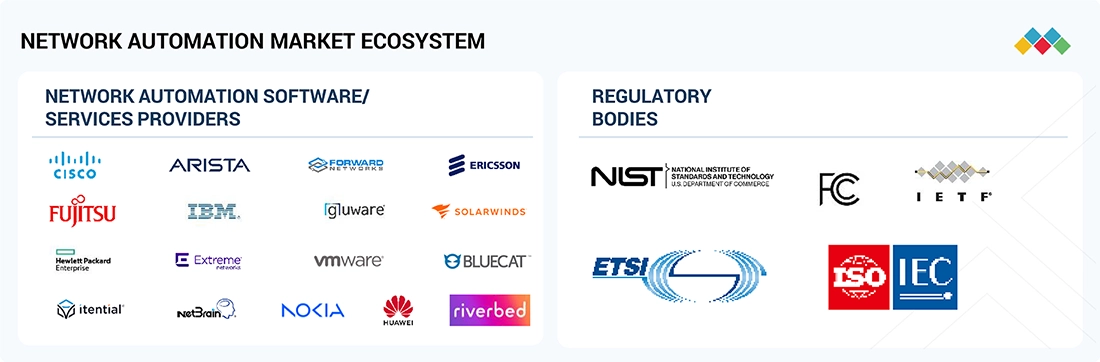
Logos and trademarks shown above are the property of their respective owners. Their use here is for informational and illustrative purposes only.
MARKET SEGMENTS
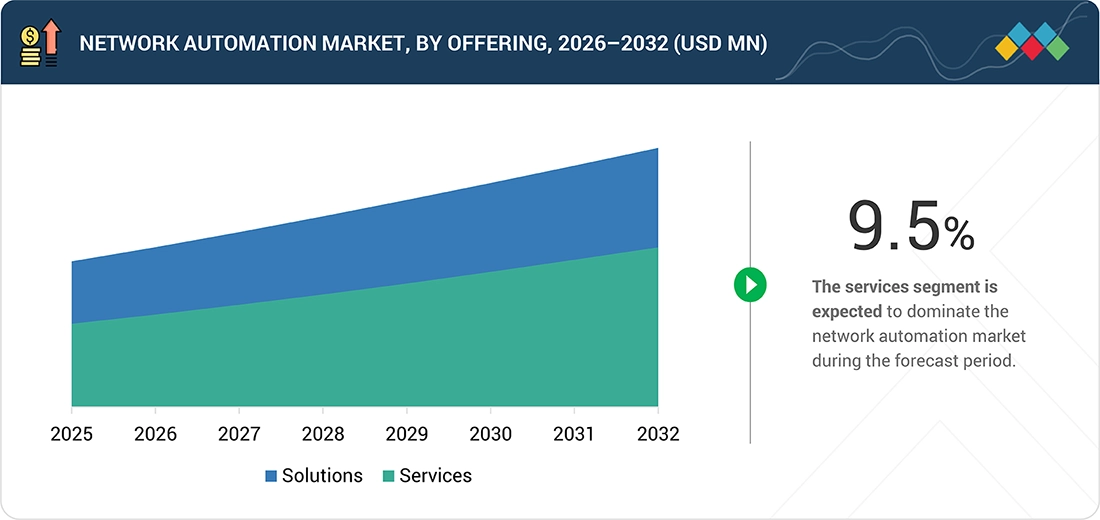
Source: Secondary Research, Interviews with Experts, MarketsandMarkets Analysis
Network Automation Market, By Offering
Network automation software forms the technological foundation for automating network configuration, provisioning, orchestration, monitoring, and policy management. These platforms allow organizations to manage increasingly heterogeneous infrastructure through centralized workflows and programmable interfaces, reducing reliance on manual device-level operations. Software solutions are also increasingly integrating with cloud platforms, IT service management, DevOps tools, and infrastructure-as-code environments, enabling network changes to be coordinated with broader infrastructure and application lifecycles. The integration of AI-driven analytics and observability is further expanding software capabilities toward predictive issue detection and automated remediation. As enterprises prioritize scalable and consistent network operations, demand for network automation software is expected to remain strong, supporting its leading position within the offering segment.
Network Automation Market, By Network Type
Data center networks represent a major application area for network automation as organizations seek to manage increasingly dynamic and high-performance infrastructure. Modern data centers support virtualized workloads, containerized applications, cloud services, and increasingly AI-intensive computing environments, resulting in complex traffic patterns and frequent infrastructure changes. Automation enables organizations to streamline network provisioning, apply configurations consistently, and validate network states across large-scale environments. The integration of automation with data center orchestration and intent-based networking further allows network resources to respond more closely to workload requirements. As enterprises and service providers expand data center capacity and adopt software-defined architectures, demand for automated data center networks is expected to remain significant.
Network Automation Market, By End User
Enterprises are increasingly adopting network automation to manage distributed infrastructure spanning corporate locations, data centers, cloud environments, and edge sites. Automation enables enterprise IT teams to standardize network configurations, accelerate service provisioning, and reduce repetitive operational activities. It also provides greater control over policy enforcement and network changes across large infrastructure environments. The integration of automation with cloud operations, DevOps, security, and IT service management is creating additional use cases across industries. Financial services, healthcare, manufacturing, retail, and other sectors are increasingly using programmable network infrastructure to support digital applications and evolving connectivity requirements. As enterprise networks become more distributed and software-driven, network automation is expected to remain an important component of modern IT infrastructure.
Network Automation Market, By Network Automation Type
Network automation is increasingly shifting from basic task execution toward more intelligent and policy-driven network management. Orchestration and provisioning automation help organizations coordinate network resources and accelerate configuration and service deployment, while script-driven automation supports repeatable operational tasks across network environments. AI-driven network automation is gaining traction by enabling predictive monitoring, anomaly detection, and automated remediation, whereas intent-based network automation translates business and operational requirements into network policies. Network security automation further supports automated policy enforcement, threat response, and compliance management. As organizations adopt increasingly complex and distributed network infrastructures, these automation approaches are becoming integral to improving network agility, scalability, and operational efficiency.
REGION
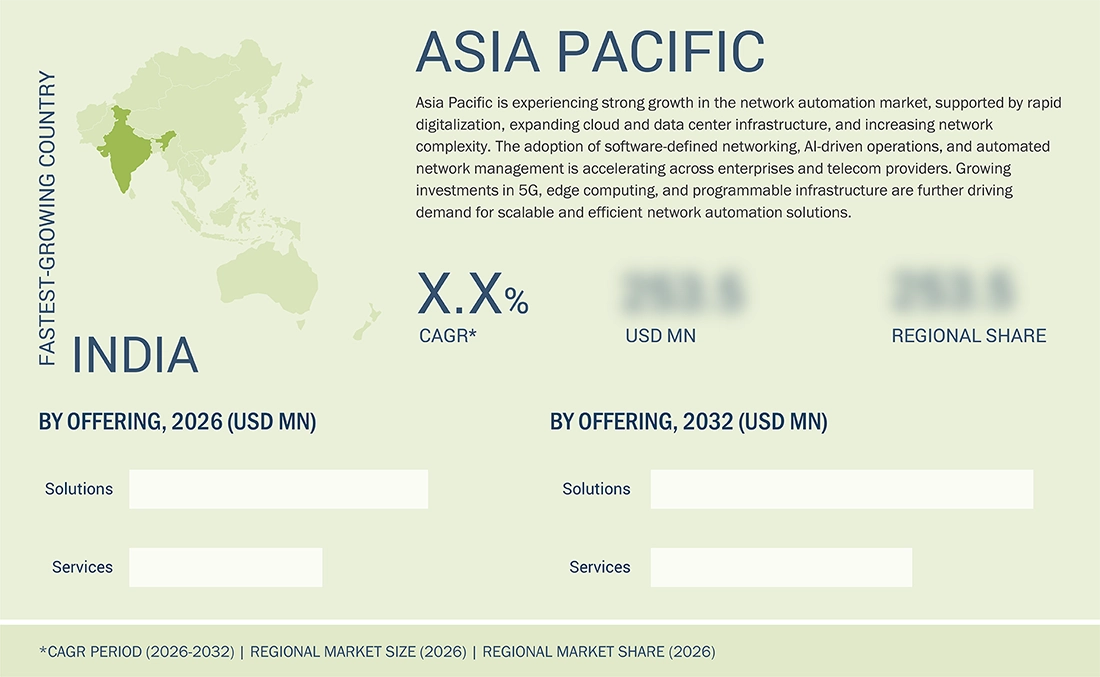
Asia Pacific to be fastest-growing region in global network automation market during forecast period
Asia Pacific is expected to register the highest growth in the network automation market during the forecast period, supported by increasing investments in cloud infrastructure, data centers, telecommunications, and enterprise digitalization. The rapid expansion of digital services is creating larger and more distributed network environments that require efficient provisioning, centralized management, and automated operations. Telecommunications providers across the region are also advancing toward software-defined and increasingly autonomous network architectures to manage growing traffic volumes and improve service delivery. In addition, the expansion of data center capacity and edge infrastructure is creating new opportunities for automated network deployment and optimization. Countries including China, India, Japan, South Korea, and Singapore are contributing to regional demand through investments in digital infrastructure and next-generation connectivity. The adoption of AI-driven network operations is expected to further support the transition toward predictive and autonomous network management across the region.
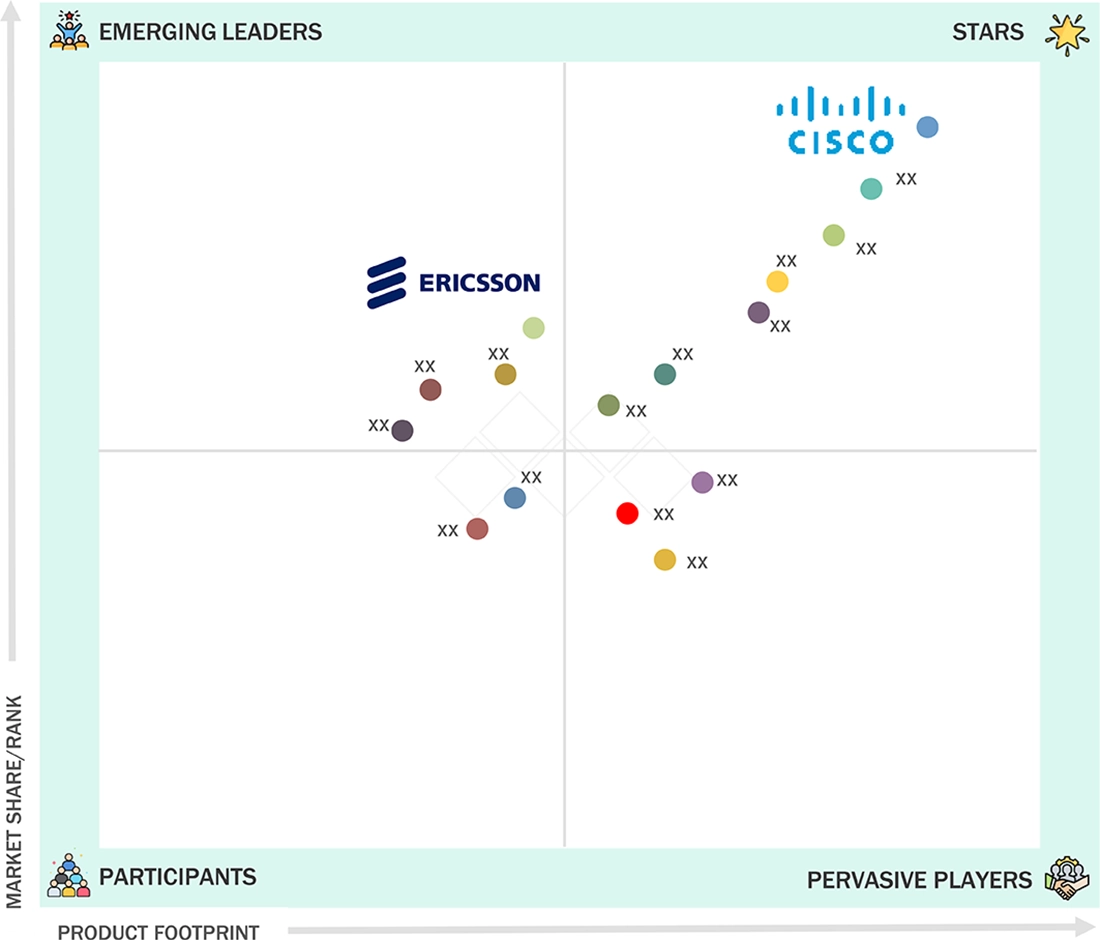
NETWORK AUTOMATION MARKET: COMPANY EVALUATION MATRIX
In the network automation market matrix, Cisco (Star) stands out due to its broad network automation portfolio, strong presence across enterprise and service provider environments, and integration of automation with network management, security, and observability capabilities. Ericsson (Emerging Leader) is strengthening its position through AI-driven automation and autonomous network capabilities focused particularly on telecommunications and 5G infrastructure. Ericsson's recent developments include expanded automation capabilities spanning RAN and core networks, as well as AI-driven closed-loop operations.
Source: Secondary Research, Interviews with Experts, MarketsandMarkets Analysis
KEY MARKET PLAYERS
- Cisco (US)
- IBM (US)
- HPE (US)
- Huawei (China)
- Broadcom (US)
- Arista Networks (US)
- Nokia (Finland)
- Ericsson (Sweden)
- Extreme Networks (US)
- Fujitsu (Japan)
- NetBrain Technologies (US)
- Gluware (US)
- SolarWinds (US)
- Riverbed (US)
- Forward Networks (US)
- Palo Alto Networks (US)
MARKET SCOPE
| REPORT METRIC | DETAILS |
|---|---|
| Market Size in 2025 (Value) | USD 7.88 Billion |
| Market Size in 2026 (Value) | USD 8.69 Billion |
| Market Forecast in 2032 (Value) | USD 14.42 Billion |
| Growth Rate | CAGR of 8.8% from 2026–2032 |
| Years Considered | 2020-2032 |
| Base Year | 2025 |
| Forecast Period | 2026–2032 |
| Units Considered | Value (USD Million/Billion) |
| Report Coverage | Revenue forecast, company ranking, competitive landscape, growth factors, and trends |
| Segments Covered |
|
| Regions Covered | North America, Europe, Asia Pacific, Middle East & Africa, Latin America |
WHAT IS IN IT FOR YOU: NETWORK AUTOMATION MARKET REPORT CONTENT GUIDE
DELIVERED CUSTOMIZATIONS
We have successfully delivered the following deep-dive customizations:
| CLIENT REQUEST | CUSTOMIZATION DELIVERED | VALUE ADDS |
|---|---|---|
| Leading Service Provider (US) |
|
|
| Company Information | Detailed analysis and profiling of additional market players (up to five) |
|
RECENT DEVELOPMENTS
- November 2025 : Broadcom and Cisco expanded collaboration around VCF's open networking architecture. The initiative supports standards-based EVPN/VXLAN interoperability between VCF Networking (NSX) and Cisco Nexus, enabling more flexible multivendor network fabrics and unified operations.
- July 2025 : HPE announced the successful completion of its acquisition of Juniper Networks, a leader in AI-native networks. The combination positions HPE to capture the growing AI and hybrid cloud market opportunity by creating an industry-leading cloud-native and AI-driven IT portfolio, including a full, modern networking stack.
- July 2025 : Ericsson collaborated with AT&T and announced that a third-party RAN automation application, an rApp, has successfully performed optimization activity on a Communication Service Provider’s (CSP) live production network. The shift empowers the industry to use standardized interfaces such as R1, through which rApps interact with a Service Management and Orchestration (SMO) platform to effect change through the network.
- June 2025 : Cisco expanded its relationship with NVIDIA to support AI-ready data center infrastructure, including integration of Cisco networking with NVIDIA Spectrum-X Ethernet networking. The collaboration supports high-performance AI networking and the automated management of increasingly complex AI infrastructure.
- March 2025 : Huawei launched AI Core Network, marking a transformative leap from AI-powered to AI-native infrastructure. The AI Core Network will be an autonomous generative network capable of self-optimization and self-O&M, enabling the whole industry to evolve from connecting everything intelligently to seamlessly interlinking AI-driven agents, terminals, and scenarios.
- February 2025 : IBM and Juniper Networks announced plans to expand their collaboration around joint sales, marketing and product integration efforts. The focus is on bringing Mist AI, a key part of Juniper’s AI-Native Networking Platform that uses AI to optimize the E2E client-to-cloud experience across wireless, wired, SD-WAN, data center and security experiences, with IBM watsonx, IBM’s portfolio of AI products designed to accelerate the impact of generative AI and drive productivity in core enterprise workflows.
Table of Contents
 Exclusive indicates content/data unique to MarketsandMarkets and not available with any competitors.
Methodology
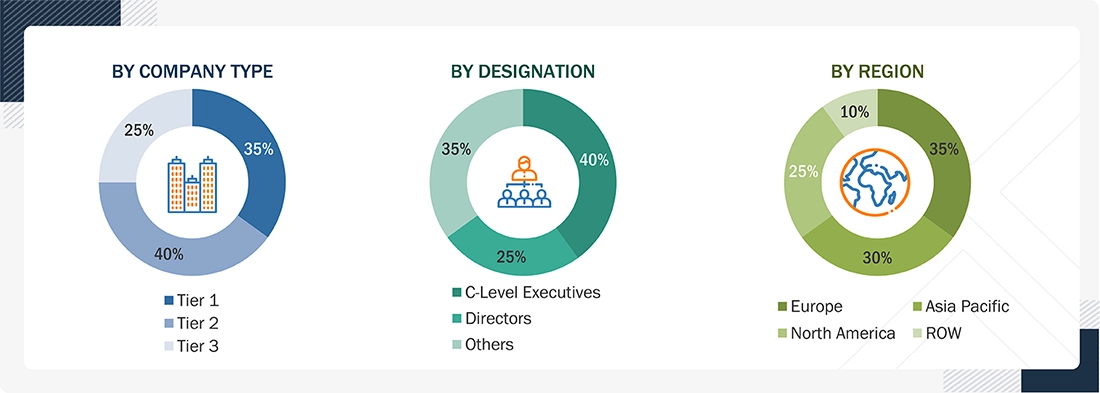
This research study on the network automation market involved extensive secondary sources, directories, and several journals and databases, such as D&B Hoovers, Bloomberg Businessweek, and Factiva, to identify and collect information useful for this technical, market-oriented, and commercial study of the network automation market. Primary sources were industry experts from core and related industries, preferred system developers, service providers, resellers, partners, and organizations related to the various segments of the industry’s value chain. In-depth interviews were conducted with different primary respondents, including key industry participants and subject-matter experts, to obtain and verify critical qualitative and quantitative information, as well as to assess the market’s prospects. These included key industry participants, subject-matter experts, C-level executives of key companies, and industry consultants. In-depth interviews were conducted with various primary respondents, including key industry participants and subject-matter experts, to obtain and verify critical qualitative and quantitative information and assess growth prospects. The following figure highlights the market research methodology applied to make the network automation market report.
Secondary Research
The market size of companies offering network automation was determined based on secondary data available through paid and unpaid sources. It was also arrived at by analyzing the product portfolios of major companies and rating the companies based on their performance and quality. In the secondary research process, various sources were referred to for identifying and collecting information for this study. Secondary sources included annual reports, press releases, and investor presentations of companies; white papers, journals, and certified publications; and articles from recognized authors, directories, and databases. The data was also collected from other secondary sources, such as journals and related magazines. Network automation spending of various countries was extracted from the respective sources. Secondary research was mainly used to obtain the key information related to the industry’s value chain and supply chain to identify key players, market classification, and segmentation according to offerings of major players; industry trends related to offerings, network automation type, network type, end user, and regions; and key developments from both market- and technology-oriented perspectives.
Primary Research
In the primary research process, various primary sources from both the supply and demand sides were interviewed to obtain qualitative and quantitative information for the report. The primary sources from the supply side included industry experts, such as Chief Executive Officers (CEOs), Vice Presidents (VPs), marketing directors, technology and innovation directors, and related key executives from various key companies and organizations providing network automation solutions and services. The primary sources from the demand side included end users, such as Chief Information Officers (CIOs), consultants, service professionals, technicians and technologists, and managers at public and investor-owned utilities.
In the market engineering process, top-down and bottom-up approaches were extensively used, along with several data triangulation methods, to perform market estimation and market forecasting for the overall market segments and subsegments listed in the report. Extensive qualitative and quantitative analyses were performed on the complete market engineering process to list key information/insights throughout the report.
After the complete market engineering (including calculations for market statistics, market breakup, market size estimations, market forecasting, and data triangulation), extensive primary research was conducted to gather information. Primary research was conducted to identify the segmentation, industry trends, key players, competitive landscape, and key market dynamics, such as drivers, restraints, opportunities, challenges, and key strategies.
To know about the assumptions considered for the study, download the pdf brochure
Note 1: Tier 1 companies have revenues greater than USD 10 billion; tier 2 companies' revenues range between USD 1 and 10 billion; and tier 3 companies' revenues range between USD 500 million and 1 billion Note 2: Others include sales, marketing, and product managers.
Source: Secondary Literature, Interviews with Experts, and MarketsandMarkets Analysis
Market Size Estimation
Multiple approaches were adopted to estimate and forecast the size of the network automation market. The first approach involves estimating market size by summing up the revenue generated by companies through the sale of network automation solutions and services.
Both top-down and bottom-up approaches were used to estimate and validate the total size of the network automation market. These methods were extensively used to estimate the size of various segments in the market. The research methodology used to estimate the market size includes the following:
- Key players in the market have been identified through extensive secondary research.
- In terms of value, the industry’s supply chain and market size have been determined through primary and secondary research processes.
- All percentage shares, splits, and breakups have been determined using secondary sources and verified through primary sources.
- After arriving at the overall market size, the network automation market was divided into several segments and subsegments.
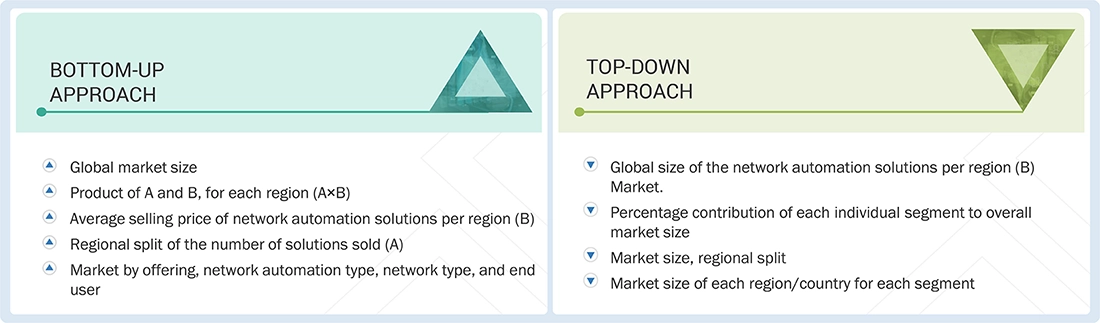
Source: Annual Reports, SEC Filings, Secondary Research, Primary Interview, and MarketsandMarkets Analysis
Data Triangulation
Once the overall market size was determined, we divided the market into segments and subsegments using the previously described market size estimation procedures. When required, market breakdown and data triangulation procedures were employed to complete the market engineering process and specify the exact figures for every market segment and subsegment. The data was triangulated by examining several variables and patterns from the supply and demand sides.
Market Definition
Network automation is the process of using software-based solutions, scripts, and intelligent systems to automatically configure, manage, test, deploy, and operate both physical and virtual network devices and services, without relying heavily on manual intervention.
Key Stakeholders
- Network automation solution providers
- Telecommunication providers
- Mobile network operators
- Cloud service providers
- Third-party network testing service providers
- Enterprise data center professionals
- Information technology (IT) suppliers
- Consultancy firms and advisory firms
- Regulatory agencies
- Technology consultants
Report Objectives
- To define, describe, and forecast the network automation market in terms of value
- To provide detailed information regarding drivers, restraints, opportunities, and challenges influencing the growth of the market
- To forecast the market by offering network automation type, network type, end user, and region
- To forecast the market size of segments for five main regions: North America, Europe, Asia Pacific, the Middle East & Africa, and Latin America
- To analyze opportunities in the market and provide details of the competitive landscape for stakeholders and market leaders
- To profile the key market players, including top vendors and startups; provide a comparative analysis based on business overviews, regional presence, product offerings, business strategies, and key financials; and provide a detailed competitive landscape of the market
- To analyze competitive developments, such as mergers & acquisitions (M&A), product launches/enhancements, agreements, partnerships, collaborations, expansions, and R&D activities, in the market
Available customizations:
MarketsandMarkets provides customizations based on the company's unique requirements using market data. The following customization options are available for the report:
Product analysis
- The product matrix provides a detailed comparison of each company's portfolio
Geographic analysis
- Further breakdown of the network automation market
Company information
- Detailed analysis and profiling of five additional market players
Key Questions Addressed by the Report
What is the projected growth of the Network Automation Market?
The Network Automation Market is projected to grow from USD 7.88 billion in 2025 to USD 12.38 billion by 2030, at a CAGR of 9.4% during the forecast period.
What factors are driving the Network Automation Market?
The market is driven by increasing network complexity, rapid cloud adoption, expanding 5G deployments, growing demand for operational efficiency, and the need for AI-driven network management.
Which component segment holds the largest share of the Network Automation Market?
The solutions segment is expected to hold the largest market share due to rising demand for automated network provisioning, configuration, orchestration, and performance management.
Which region leads the Network Automation Market?
North America is expected to account for the largest market share, supported by early adoption of AI-enabled networking, advanced telecom infrastructure, and significant investments in digital transformation.
What trends are shaping the future of the Network Automation Market?
Key trends include AI and machine learning-driven network operations, intent-based networking, automation for multi-cloud and hybrid environments, and increased adoption of software-defined networking (SDN).


Personalize This Research
- Triangulate with your Own Data
- Get Data as per your Format and Definition
- Gain a Deeper Dive on a Specific Application, Geography, Customer or Competitor
- Any level of Personalization
Let Us Help You
- What are the Known and Unknown Adjacencies Impacting the Network Automation Market
- What will your New Revenue Sources be?
- Who will be your Top Customer; what will make them switch?
- Defend your Market Share or Win Competitors
- Get a Scorecard for Target Partners

Custom Market Research Services
We Will Customise The Research For You, In Case The Report Listed Above Does Not Meet With Your Requirements
Get 10% Free CustomisationTESTIMONIALS
- Canada Network Automation Market
- US Network Automation Market
- UK Network Automation Market
- Germany Network Automation Market
- France Network Automation Market
- Italy Network Automation Market
- China Network Automation Market
- Japan Network Automation Market
- India Network Automation Market
- UAE Network Automation Market
- South Africa Network Automation Market
- Rest Of Europe Network Automation Market
Growth opportunities and latent adjacency in Network Automation Market






Alonso
May, 2022
Need to determine total addressable market size for network automation.
Ronald
Mar, 2022
Understand market trends and needs to inform network planning, engineering, and operations professionals about the current automation environment..