OCP Rack Market

OCP Rack Market by Application (AI, High-performance computing, Data Management, Enterprise Apps & Others), End User (Retail Colocation, Enterprise, Neocloud Providers, Others – Hyperscalers/Wholesale Colocation) - Global Forecast to 2030




OVERVIEW
Source: Secondary Research, Interviews with Experts, MarketsandMarkets Analysis
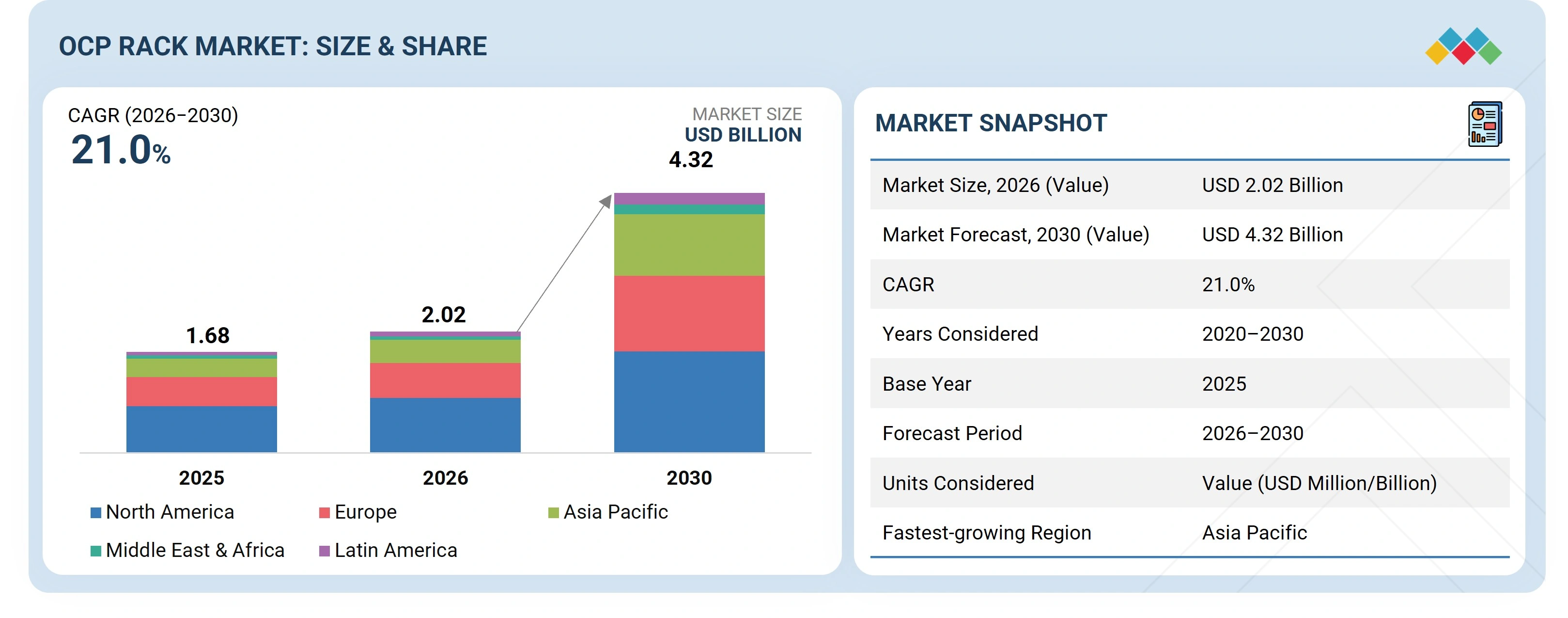
The OCP rack market is projected to grow from USD 2.02 billion in 2026 to USD 4.32 billion by 2030, at a CAGR of 21.0%. The OCP rack market is experiencing strong growth, driven by the rapid expansion of hyperscale data centers and AI workloads. The shift towards 21-inch OCP racks from 19-inch racks is gaining momentum because 21-inch racks are capable of handling power density better while having enhanced cooling solutions and airflow design. With the increasing demand for artificial intelligence, high-performance computing, and liquid cooling solutions, there is an increased adoption of OCP racks with a power-handling capacity of up to 100 kW. Efficiency, saving on costs, and standardization are critical factors that fuel the growth in the market since OCP racks enable the design of standardized IT infrastructures.
Market Size and Forecast:
- 2025 Market Size: USD 1.68 Billion
- 2026 Projected Market Size: USD 2.02 Billion
- 2030 Forecasted Market Size: USD 4.32 Billion
- Growth Rate (2030-2036): CAGR of 21.0%
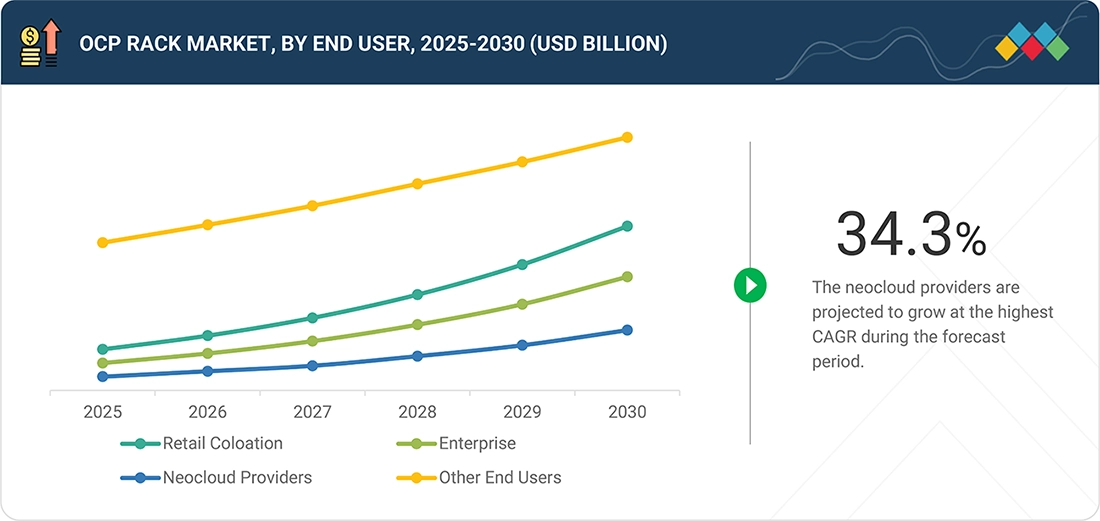
- The neocloud providers are expected highest CAGR of 34.3%.
- Forecast period: 2026–2030
- Asia Pacific is expected highest CAGR of 27.3%.
Key Market Trends and Insights
- Major Applications: Include AI training, high-performance computing, and data management.
-
Emerging Opportunities: Include pre-configured AI-ready racks and integrated liquid cooling.
- Latest Trends: Driven by hyperscale AI workloads, liquid cooling adoption, and the shift to 21-inch racks.
- Growth Factors: The expansion of hyperscale data centers, high-density AI workloads, and liquid cooling.
KEY TAKEAWAYS
-
BY REGIONNorth America is estimated to account for the largest market value of USD 905.6 million in 2026.
-
BY END USERThe neocloud providers are projected to grow at the highest CAGR of 34.3% during the forecast period.
-
BY APPLICATIONThe AI (training and inference) segment is estimated to hold the largest market value during the forecast period.
-
COMPETITIVE LANDSCAPE - KEY PLAYERThe OCP rack market is highly competitive, with leading players such as Dell Technologies and Vertiv delivering integrated rack-scale systems, power, and cooling solutions aligned with Open Compute Project standards. These companies leverage strong engineering capabilities, global delivery networks, and partnerships across hyperscale and colocation ecosystems to support high-density AI and cloud deployments, strengthening their position across large-scale data center environments.
-
COMPETITIVE LANDSCAPE - STARTUPS/SMESEmerging and SME players such as Sanmina Corporation and Cheval Group are gaining traction through manufacturing, customization, and modular deployment capabilities within the OCP ecosystem. Their focus on cost-efficient production, flexible design support, and alignment with hyperscale and OEM requirements enables broader adoption of OCP-compliant racks, particularly across expanding enterprise and colocation segments.
The OCP rack market is growing as data center operators accelerate the adoption of open and standardized infrastructure to support AI, cloud, and high-performance workloads. Demand is driven by the need for higher rack power density, efficient thermal management, and faster deployment through rack-scale integration. OCP-aligned designs, developed under the Open Compute Project, enable modular architectures, improved energy efficiency, and multi-vendor interoperability.
TRENDS & DISRUPTIONS IMPACTING CUSTOMERS' CUSTOMERS
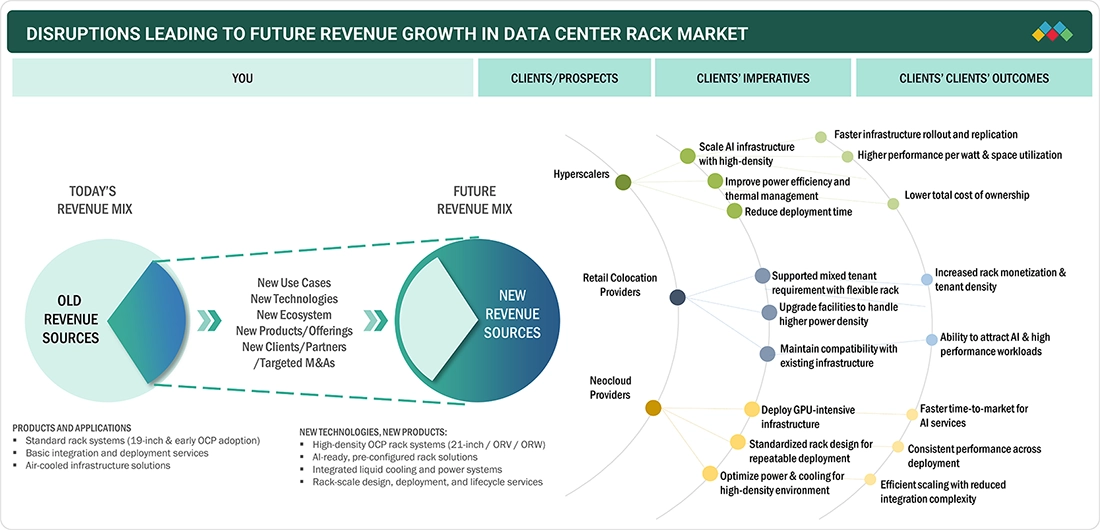
AI-driven workloads are demanding >100kW density per rack, leading to the transformation of the OCP rack market and favoring high-power rack-scale architectures. The shift from air cooling to liquid cooling or direct to chip cooling are major disruptor driving thermal design into the core OCP rack strategy. High voltage (> 48V) power architectures are moving from the traditional design with an aim to achieve greater efficiency. The market is experiencing the transition from traditional 19-inch racks to 21-inch OCP racks owing to their higher density and air flow capabilities. Rack-level integration of compute, network and storage infrastructure for ease of deployment. Use of open standards is disrupting the market by reducing reliance on proprietary solutions and driving adoption across hyperscalers and cloud providers.
Source: Secondary Research, Interviews with Experts, MarketsandMarkets Analysis
MARKET DYNAMICS

Level
-
Rising AI-driven rack power density accelerating OCP adoption

-
Hyperscaler-led standardization accelerating global OCP adoption


Level
-
Limited compatibility with legacy 19-inch rack infrastructure


Level
-
Pre-configured AI-ready rack solutions for hyperscale and neocloud players

-
Integration of liquid cooling (D2C and immersion) within rack designs


Level
-
Interoperability issues in multi-vendor OCP environments

-
Thermal management limitations at ultra-high rack densities

Source: Secondary Research, Interviews with Experts, MarketsandMarkets Analysis
Driver: Rising AI-driven rack power density accelerating OCP adoption
The increasing use of AI has led to a gradual increase in power density at the rack level, surpassing the capacity of conventional 19-inch rack solutions in terms of effective power delivery, cooling needs, and design considerations. This trend is pushing hyperscale players to adopt open compute project rack solutions, as they offer greater flexibility in dealing with higher loads in a more energy-efficient way. The demand for liquid and direct chip cooling solutions at the rack level is increasing, and OCP racks have proven to be more suitable for these needs compared to other alternatives. Considering that hyperscalers prioritize performance efficiency and effective use of space, OCP racks present a more viable solution for meeting rising power density requirements.
Restraint: Limited compatibility with legacy 19-inch rack infrastructure
OCP racks' inherent 21-inch form factor causes major compatibility limitations with legacy 19-inch rack environments, leading to integration challenges for data centers. Retrofit designs are restricted by the non-native support, impacting rack layout plans, power delivery mechanisms (busbar vs. PSU), mechanical dimensions and airflow management systems, which are all fundamentally different from 19-inch designs, thus hindering quick upgrades instead requiring a complete overhaul. This limitation results in higher switching costs for enterprises and colocation providers as they face issues with stranded assets, redundant facility layouts, and the need for significant reconfiguration of the existing power distribution and cooling infrastructures. Gaps in interoperability with legacy server and networking hardware further pose constraints, slowing down hybrid deployment scenarios. Consequently, the clear performance advantages of OCP racks are moderated in data centers heavily reliant on existing 19-inch equipment.
Opportunities: Pre-configured AI-ready rack solutions for hyperscale and neocloud players
The OCP rack market represents a great opportunity with the development of ready-made and pre-validated OCP rack offerings. These racks contain computing resources, fast network interconnection, power distribution systems, and liquid cooling systems designed for easy integration in AI facilities. It makes deployment simpler and more predictable while saving time and money compared to traditional rack offerings, where system integrations take much effort. In terms of hyperscalers' needs, speed, consistency, and reliability are essential, which the new rack offerings can provide. Moreover, more efficient integration allows for higher performance from the equipment used due to better heat management and energy efficiency, especially needed in AI data centers.
Challenge: Interoperability issues in multi-vendor OCP environments
A significant practical challenge faced by the OCP rack market in multi-vendor environments involves a perceived lack of full system-level interoperability despite adhering to open standards. Companies building components may implement the standard with slightly different approaches which affect the integration, performance and stability when combining compute, networking and power subsystems from various vendors. This results in the need for intensive validation processes, extending the integration timelines significantly. It also increases the operational complexities, impacting the refresh strategy and control layer orchestration between different vendors. As a result, while OCP principles aim at open standards for all, true interoperability requires additional engineering efforts, slowing down adoption and adoption for large-scale implementations.
OCP RACK MARKET: COMMERCIAL USE CASES ACROSS INDUSTRIES
| COMPANY | USE CASE DESCRIPTION | BENEFITS |
|---|---|---|
 |
Fidelity Investments adopted OCP-based infrastructure to redesign its data center architecture, focusing on reducing dependency on proprietary systems and improving operational efficiency. By developing and deploying the Open Bridge Rack aligned with Open Compute Project standards, the company enabled flexible support for multiple server form factors while transitioning toward a private cloud environment. | Fidelity achieved improved infrastructure efficiency with ~20% reduction in energy consumption and lower hardware costs through optimized power design. The approach also enhanced flexibility, reduced vendor lock-in, and simplified maintenance, enabling scalable and standardized deployments across its data center footprint. |
 |
RackRenew leverages decommissioned OCP-based infrastructure from hyperscale environments and reconditions it for redeployment across enterprise and service provider data centers. By aligning with Open Compute Project standards, the company enables scalable reuse of rack systems such as ORv2 configurations, supporting cost-effective and standardized deployments. | The approach delivers 40–60% CapEx savings and up to ~80% reduction in carbon emissions compared to new infrastructure deployments. It also improves supply availability, reduces lead times, and enables organizations to deploy high-performance, OCP-compliant systems at lower cost while supporting ESG objectives. |
 |
Parler Cloud Technologies partnered with MiTAC to deploy an OCP-based private cloud solution using Tioga Pass Ultra servers integrated within 21" Open Rack v2 architecture. The solution combines Triton SmartOS and Kubernetes to enable scalable, containerized cloud environments aligned with Open Compute Project standards. | The deployment delivers high-density compute with up to 936 cores per rack, improving scalability and resource utilization for cloud workloads. It also reduces deployment time through pre-integrated rack solutions and lowers operational costs via improved power efficiency and simplified maintenance. |
Logos and trademarks shown above are the property of their respective owners. Their use here is for informational and illustrative purposes only.
MARKET ECOSYSTEM
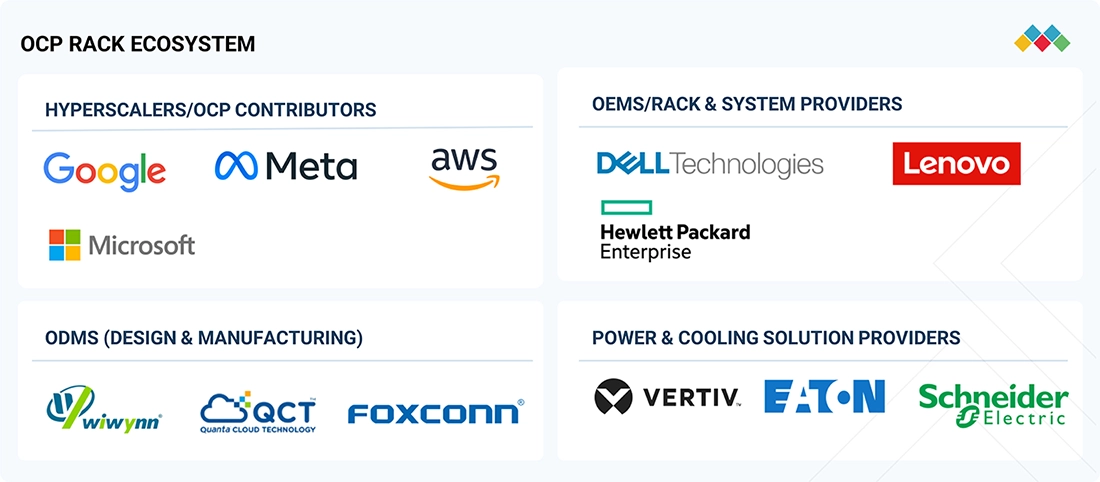
The open compute rack ecosystem includes various parties such as hyperscalers, original equipment manufacturers (OEMs), original design manufacturers (ODMs), component vendors, system integrators, and colocation services providers. Hyperscalers play an integral part in shaping the ecosystem by creating open standards through the Open Compute Project initiative, while OEMs and ODMs produce racks based on open standards set by the hyperscalers. Other vendors provide necessary components like power shelves, a cooling system, and a network to deploy the OCP system. System integrators and colocation services providers implement the OCP system across different data centers through customization. Software management vendors provide solutions for monitoring and management of multi-vendor solutions. This open standard-driven network creates value in terms of scalability and performance across hyperscale and cloud environments.
Logos and trademarks shown above are the property of their respective owners. Their use here is for informational and illustrative purposes only.
MARKET SEGMENTS
Source: Secondary Research, Interviews with Experts, MarketsandMarkets Analysis
OCP Rack Market, By Application
Neocloud providers appear to be the fastest growing end-user segment for the OCP racks based on their infrastructure approaches focused on the AI hosting and scalability capabilities. Neocloud providers employ compute-dense infrastructures, which require optimizations at the rack level in terms of power consumption, cooling, and mechanical aspects. By using OCP racks, providers ensure the ability to have standardized configurations that allow reaching higher power levels and incorporating liquid cooling. Thus, it is possible to avoid customization processes and accelerate rollouts of such solutions within different data centers. Unlike enterprises, neoclouds do not focus on customization and prefer to work together with original equipment manufacturers to buy OCP racks faster. At the same time, the increase in the demand for GPU as a service and AI training solutions drives constant capacity growth and, thus, necessitates scalable and optimized rack-level solutions.
OCP Rack Market, By End User
Data management is expected to hold the second largest portion of the OCP rack market, attributed to the ongoing expansion of data (structured and unstructured) across all business and AI environments (enterprise, cloud). Large-scale storage clusters, distributed file systems and data lakes demand scalable infrastructure that maintains both consistent performance and reliability. OCP rack design, following the Open Compute Project standards, fulfills the requirements of these storage solutions by providing higher storage density and simplified cabling solutions. Through standardization of racks and high power distribution, operators will be able to predictably scale across their facilities and avoid custom build requirements. Additionally, with the convergence of data pipelines with AI workloads, a growing number of businesses are increasingly requiring infrastructure capable of both high-capacity storage and high-throughput processing, making data management one of the biggest drivers in the market.
REGION
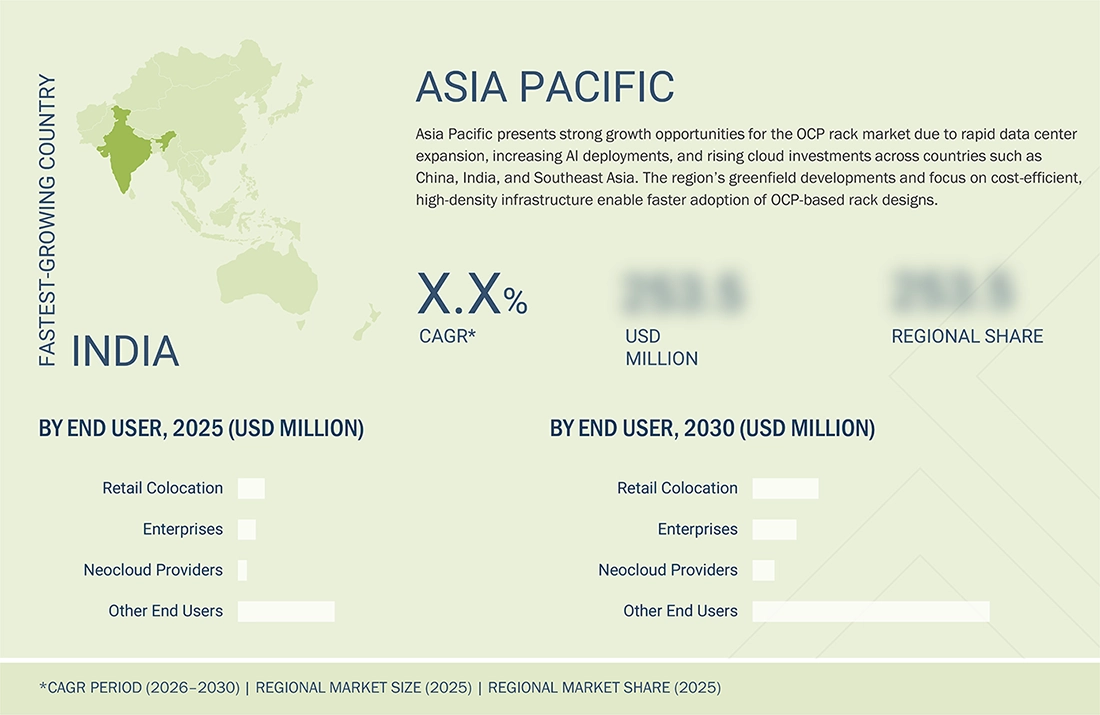
Asia Pacific to register a CAGR of 27.3 % in the OCP rack market during the forecast period
The Asia Pacific region will grow at the fastest CAGR in the OCP rack market due to the rapid increase in the deployment of data centers in both mature economies, such as China and India, and emerging economies like those in Southeast Asia and Australia. Cloud services, artificial intelligence (AI), and investments in digital infrastructure have been on the rise in this region, leading to increased demand for denser and more scalable racks. There is a rapid development of local and international cloud service providers, as well as the expansion of global hyper-scalers in this region through the development of data centers that are designed based on open standards that are consistent with the Open Compute Project. Some of the countries in the Asia-Pacific region are still greenfield, meaning that there is no restriction from existing legacy infrastructure when deploying OCP-based architecture.
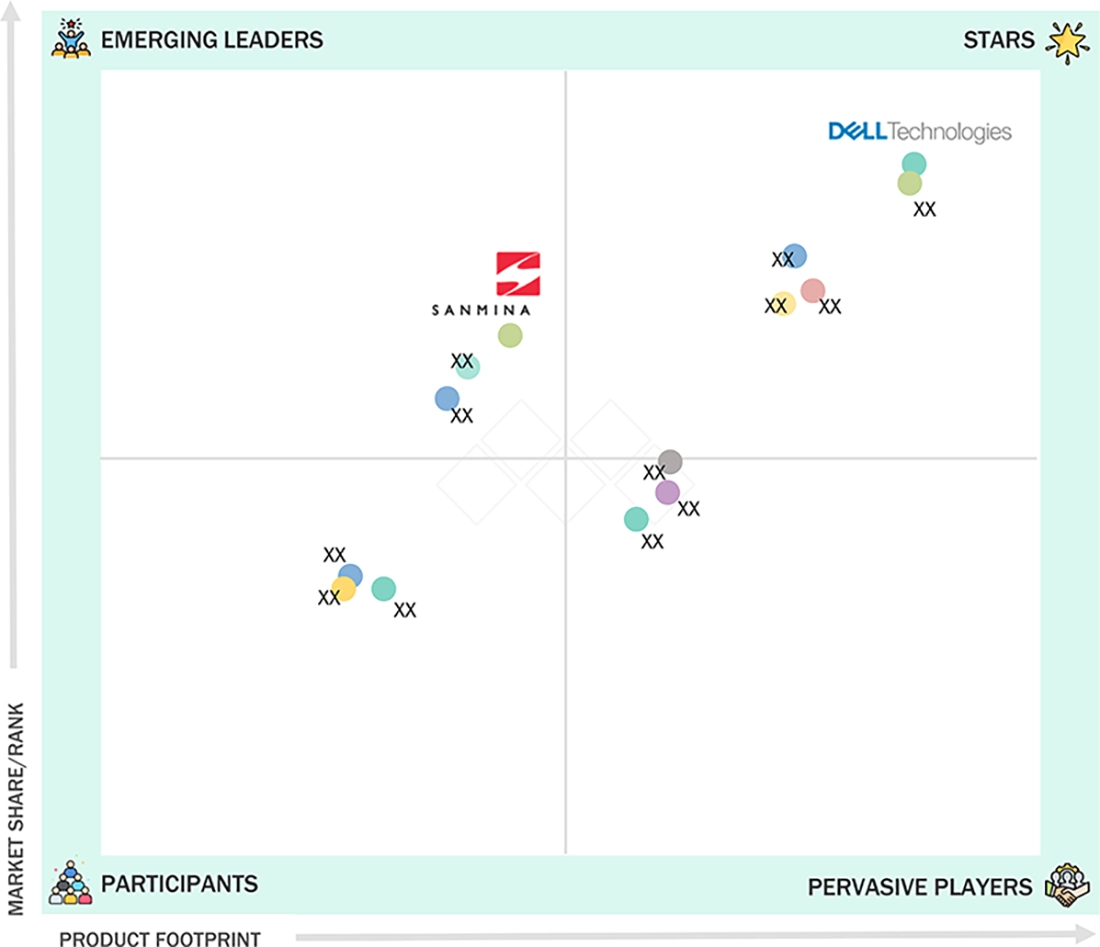
OCP RACK MARKET: COMPANY EVALUATION MATRIX
Dell Technologies is considered a star player in the OCP rack market due to its integrated portfolio of OCP-aligned rack-scale systems, enterprise reach, and ability to deliver pre-configured, validated infrastructure for AI and high-density workloads. Its focus on standardized, modular designs aligned with Open Compute Project specifications, along with strong deployment and support capabilities, strengthens its position across hyperscale and enterprise segments. Sanmina Corporation, meanwhile, is recognized as an emerging player, gaining traction through its design, engineering, and large-scale manufacturing capabilities for OCP-compliant hardware. Its role in enabling scalable production, customization, and supply chain efficiency for OEMs and hyperscalers supports its growing presence in the OCP rack ecosystem.
Source: Secondary Research, Interviews with Experts, MarketsandMarkets Analysis
KEY MARKET PLAYERS
- Rittal (Germany)
- Dell Technologies (US)
- Sanmina Corporation (US)
- Legrand (France)
- Vertiv (US)
- Eaton (Ireland)
- Belden (US)
- Wiwynn Corporation (Taiwan)
- Lite-On Cloud Infrastructure (Taiwan)
- Cheval Group (Thailand)
- Gigabyte (Taiwan)
- Chatsworth Products (US)
MARKET SCOPE
| REPORT METRIC | DETAILS |
|---|---|
| Market Size, 2025 (Value) | USD 1.68 Billion |
| Market Forecast, 2030 (Value) | USD 4.32 Billion |
| CAGR | 21.0% |
| Years Considered | 2020–2030 |
| Base Year | 2025 |
| Forecast Period | 2026–2030 |
| Units Considered | Value (USD Million/Billion) |
| Report Coverage | Revenue forecast, company ranking, competitive landscape, growth factors, and trends |
| Segments Covered |
|
| Regions Covered | North America, Asia Pacific, Europe, the Middle East & Africa, Latin America |
WHAT IS IN IT FOR YOU: OCP RACK MARKET REPORT CONTENT GUIDE
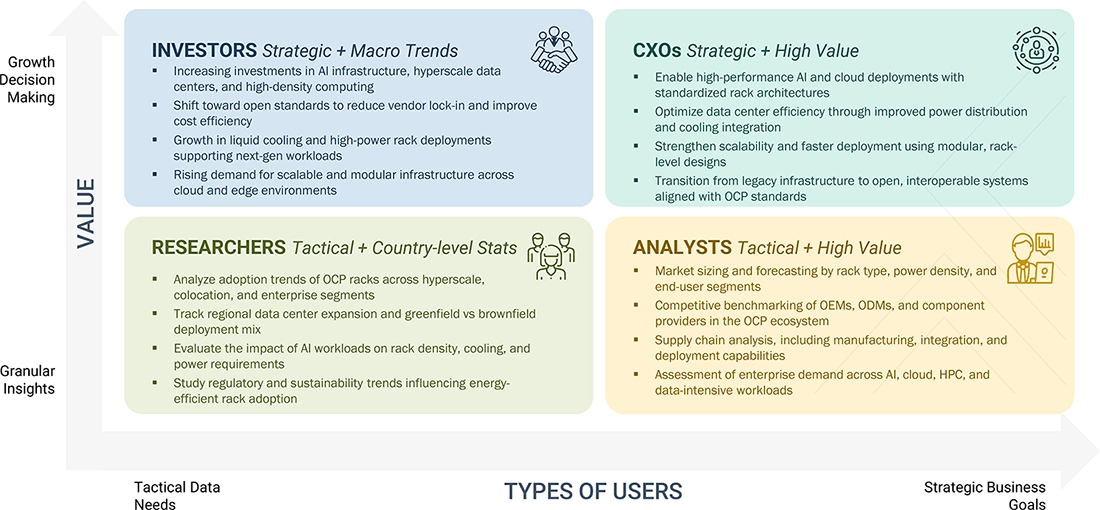
DELIVERED CUSTOMIZATIONS
We have successfully delivered the following deep-dive customizations:
| CLIENT REQUEST | CUSTOMIZATION DELIVERED | VALUE ADDS |
|---|---|---|
| OCP Rack Vendor (US) | In-depth segmentation of the North American OCP rack market by rack type, end user (hyperscale, colocation, enterprise), and application (AI, HPC, data management), with regional insights across the US and Canada | Identifies growth opportunities driven by AI infrastructure expansion and hyperscale deployments. Enables optimized infrastructure strategies aligned with power density, cooling requirements, and OCP adoption trends |
| OCP Rack Vendor (EU) | Profiling of up to 5 additional OCP rack ecosystem players, covering product offerings, OCP alignment, partnerships, and regional presence across enterprise, hyperscale, and colocation markets | Provides competitive benchmarking and identifies trends such as liquid cooling adoption and rack-scale integration. Supports strategy development through alignment of product portfolios, partnerships, and regional expansion initiatives |
RECENT DEVELOPMENTS
- January 2026 : PwC and Google Cloud announced a USD 400 million investment over three years to expand their AI-driven cybersecurity collaboration. The partnership focuses on integrating Google’s threat intelligence with PwC’s consulting and managed services to enhance security across hybrid and multi-cloud environments. This initiative enables organizations to shift from reactive to proactive security through AI-powered threat detection, compliance, and end-to-end protection.
- November 2025 : Amazon Web Services introduced AI-powered agents under its Professional Services Delivery Agent to automate cloud migration of legacy systems. The solution can generate project plans, rewrite code, and manage dependencies, reducing migration timelines from months to just days. Supported by AWS ProServe consultants, it improves efficiency and accuracy in complex migrations. This launch highlights the growing role of AI in accelerating cloud modernization and lowering barriers for enterprises moving from legacy infrastructure.
- November 2025 : Deloitte India launched INTEGRATE, a suite of industry-specific solutions built on SAP S/4HANA Public Cloud to accelerate digital transformation for Indian enterprises. These pre-configured solutions enable faster cloud adoption, improved ROI, and lower TCO across sectors such as automotive, retail, and energy. Supported by Deloitte’s Operate services and factory-based delivery model, the offering ensures scalability, continuous innovation, and long-term business value.
- October 2025 : Accenture expanded its partnership with Amazon Web Services to deliver AI-driven cloud modernization solutions for public sector and defense organizations. The collaboration focuses on improving operational efficiency, workforce transformation, and citizen services through secure cloud and AI capabilities. By leveraging AWS infrastructure and Accenture’s consulting expertise, the initiative enables faster adoption of compliant cloud solutions while reducing costs and enhancing service delivery. This expansion reflects a growing trend of integrating AI with cloud to drive large-scale public sector transformation.
- August 2025 : Tata Consultancy Services partnered with RailTel to launch a sovereign cloud platform aimed at strengthening India’s digital sovereignty. Built on TCS SovereignSecure Cloud, the initiative provides AI-enabled, secure, and scalable cloud services for government and public sector organizations. This collaboration supports India’s Digital India vision by enabling data residency, enhanced security, and greater self-reliance in cloud infrastructure.
Table of Contents
 Exclusive indicates content/data unique to MarketsandMarkets and not available with any competitors.
Methodology
This research study on the OCP rack market involved extensive secondary sources, directories, IEEE Communication-Efficient: Algorithms and Systems, International Journal of Innovation and Technology Management, and paid databases. Primary sources included industry experts from core and related industries, third-party service providers, consulting service providers, end users, and other commercial enterprises. In-depth interviews with primary respondents, including key industry participants and subject matter experts, were conducted to obtain and verify critical qualitative and quantitative information and assess the market’s prospects.
Secondary Research
In the secondary research process, various sources were referred to identify and collect information for this study. Secondary sources included annual reports, press releases, and investor presentations of companies; white papers, journals, and certified publications; and articles from recognized authors, directories, and databases. The data was also collected from other secondary sources, such as journals, government websites, blogs, and vendors’ websites.
Primary Research
During the primary research process, interviews were conducted with various stakeholders from both the supply and demand sides to gather qualitative and quantitative insights on the cloud professional services market. Primary respondents on the supply side included industry experts such as chief experience officers (CXOs), vice presidents (VPs), cloud practice leaders, and directors specializing in business development, marketing, and service delivery operations. The research also included key executives from cloud service providers, consulting firms, system integrators, industry associations, and other domain experts.
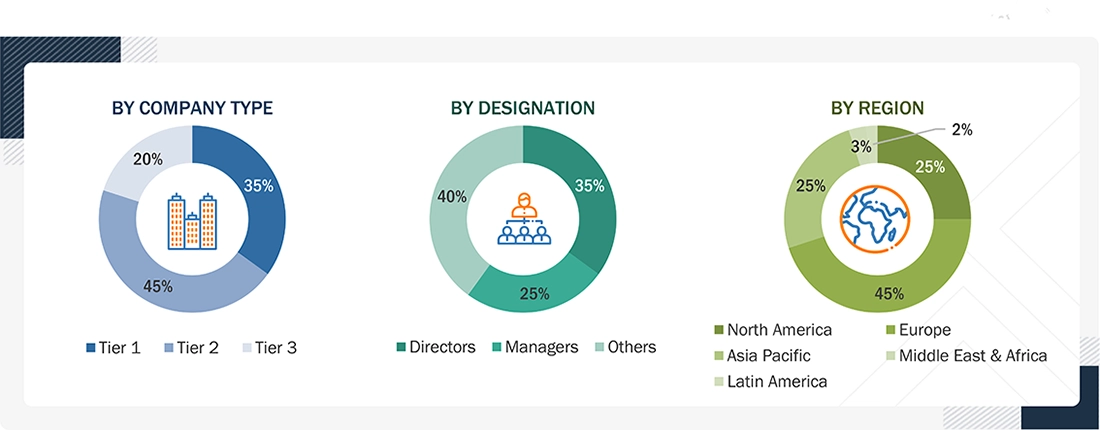
Note: Tier 1 companies’ revenues are more than USD 1 billion; tier 2 companies’ revenues range between USD 500 million and 1 billion; and tier 3 companies’ revenues range between USD 50 million and USD 500 million. Other designations include cloud architects, IT managers, digital transformation leaders, procurement managers, and product managers.
Source: Industry Experts
To know about the assumptions considered for the study, download the pdf brochure
Market Size Estimation
Multiple approaches were adopted to estimate and forecast the OCP rack market. The first approach involved estimating the market size based on companies’ revenue from cloud professional services sales.
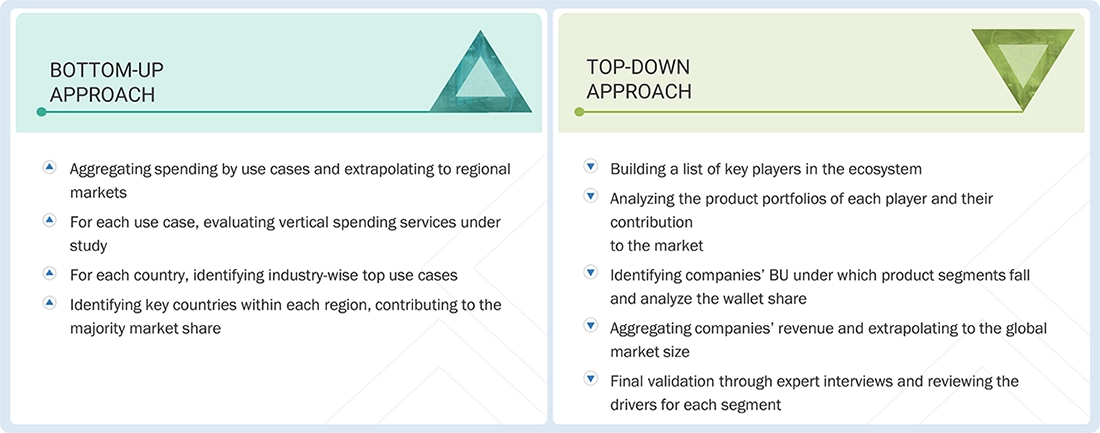
Market Size Estimation Methodology: Top-down Approach
The top-down approach estimates the overall OCP rack market size by starting with a macro-level view, such as total IT spending or digital transformation expenditures. High-level market values are then divided and allocated into segments based on identified proportions by service type, service model, organization size, industry vertical, and geography using researched splits. This approach leverages broad market trends, industry reports, and expert insights to proportionally distribute the total market value across subsegments, regions, and countries. It ensures that the overall estimation remains aligned with recognized industry benchmarks, enabling accurate segmentation and a comprehensive market perspective.
Market Size Estimation Methodology: Bottom-up Approach
The bottom-up approach for estimating the OCP rack market size involves aggregating data at a granular level, such as company-level revenues, to build the overall market size. This process begins by collecting revenue data directly associated with cloud professional services, including consulting, migration, integration, and managed services. By analyzing the market share and service revenues of key players and applying percentage splits across segments such as service type, service model, organization size and verticals, the total market size is derived. Further segmentation is conducted across regions and industries to ensure comprehensive coverage. The methodology then validates the estimates by comparing and consolidating segment-level data, resulting in a detailed and accurate market assessment based on actual business activity.
OCP Rack Market : Top-Down and Bottom-Up Approach
Data Triangulation
After determining the overall market size using the market estimation processes described above, the market was split into segments and subsegments. Data triangulation and market segmentation procedures were employed, where applicable, to complete the overall market engineering process and determine the exact statistics for each market segment and subsegment. The overall market size was then used in the top-down approach to estimate the size of other individual markets by applying percentage splits to the market segmentation.
Market Definition
According to MarketsandMarkets, an OCP rack is a data center rack designed based on specifications from the Open Compute Project, focusing on open, standardized, and efficient hardware design. It typically uses a 21-inch form factor (wider than traditional 19-inch racks) to support higher density and improved airflow. OCP racks are built with shared power infrastructure, simplified cabling, and support for advanced cooling methods such as liquid cooling. These features enable scalable, energy-efficient deployments, particularly for hyperscale and AI-driven data centers.
Key Stakeholders
- Open Compute Project
- Hyperscalers/Cloud Providers
- OEMs (Original Equipment Manufacturers)
- ODMs (Original Design Manufacturers)
- Infrastructure & Component Providers
- Electronics Manufacturing Services (EMS)
- Colocation & Data Center Operators
Report Objectives
- To define and describe the OCP rack market based on applications (AI training & inference, high performance computing [HPC], data management, enterprise apps, and others), end user (retail colocation providers, enterprise, neolcoud providers and other [hyperscalers/wholesale colocation providers])
- To provide detailed information on key factors influencing market growth (drivers, restraints, opportunities, and challenges), with a specific focus on OCP rack adoption, regulatory and data sovereignty requirements
- To analyze market opportunities for stakeholders across OCP rack and present a comprehensive competitive landscape of leading OCP rack providers, system integrators, and hyperscaler-led service ecosystems
- To project the market size and its subsegments in terms of value (USD million) across key regions (North America, Europe, Asia Pacific, Middle East & Africa, and Latin America), along with an analysis of major countries in each region
- To strategically profile leading companies and provide an in-depth evaluation of their rack offering and their positioning in the OCP rack environment
Available customizations:
With the given market data, MarketsandMarkets offers customizations as per the company’s specific needs. The following customization options are available for the report:
Product Analysis
- The product matrix provides a detailed comparison of the product portfolio of each company
Regional Analysis
- Further breakup of the North American OCP rack market
- Further breakup of the European OCP rack market
- Further breakup of the Asia Pacific OCP rack market
- Further breakup of the Middle East & Africa OCP rack market
- Further breakup of the Latin American OCP rack market
Company Information
- Detailed analysis and profiling of additional market players (up to five)
Key Questions Addressed by the Report
What is the projected size of the OCP rack market by 2030?
The OCP rack market is projected to grow from USD 2.02 billion in 2026 to USD 4.32 billion by 2030, at a CAGR of 21.0%.
What factors are driving growth in the OCP rack market?
The OCP rack market growth is driven by hyperscale data center expansion, AI workloads, high-performance computing, liquid cooling adoption, and demand for standardized infrastructure.
Which application segment leads the OCP rack market?
AI training and inference is expected to hold the largest market share in the OCP rack market.
Which end-user segment is expected to grow the fastest in the OCP rack market?
Neocloud providers are projected to register the highest CAGR of 34.3% in the OCP rack market.
Which region is expected to witness the fastest growth?
Asia Pacific is forecast to register the highest CAGR, driven by rapid data center development.


Personalize This Research
- Triangulate with your Own Data
- Get Data as per your Format and Definition
- Gain a Deeper Dive on a Specific Application, Geography, Customer or Competitor
- Any level of Personalization
Let Us Help You
- What are the Known and Unknown Adjacencies Impacting the OCP Rack Market
- What will your New Revenue Sources be?
- Who will be your Top Customer; what will make them switch?
- Defend your Market Share or Win Competitors
- Get a Scorecard for Target Partners

Custom Market Research Services
We Will Customise The Research For You, In Case The Report Listed Above Does Not Meet With Your Requirements
Get 10% Free CustomisationTESTIMONIALS
- US OCP Rack Market
- Canada OCP Rack Market
- UK OCP Rack Market
- Germany OCP Rack Market
- France OCP Rack Market
- Italy OCP Rack Market
- Spain OCP Rack Market
- China OCP Rack Market
- Japan OCP Rack Market
- India OCP Rack Market
- Brazil OCP Rack Market
- Mexico OCP Rack Market
- Saudi Arabia OCP Rack Market
- UAE OCP Rack Market
- South Africa OCP Rack Market
- Rest Of Europe OCP Rack Market
- Rest Of Asia Pacific OCP Rack Market
- Rest Of Latin America OCP Rack Market
- GCC OCP Rack Market
- Rest Of GCC Countries OCP Rack Market






Growth opportunities and latent adjacency in OCP Rack Market