Surgical Devices Market

Surgical Devices Market by Product [Capital Equipment (Robotic Systems, Energy Generators), Endoscopy (Rigid, Flexible), Single-use Consumables, Implants], Procedure [General, Cardiovascular], End User [Hospital, ASCs], Region - Global Forecast to 2031



SURGICAL DEVICES MARKET SIZE, SHARE & GROWTH SNAPSHOT
Source: Secondary Research, Interviews with Experts, MarketsandMarkets Analysis
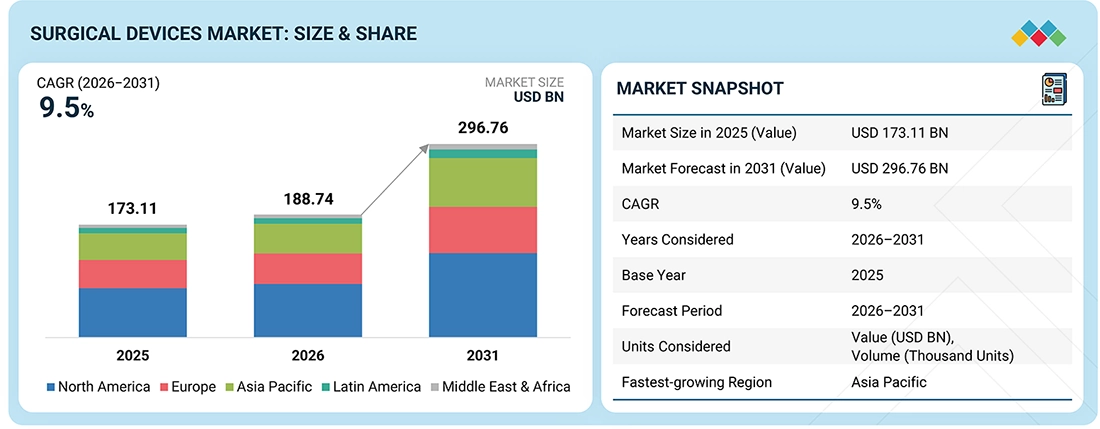
The global surgical devices market is projected to grow from USD 188.74 billion in 2026 to USD 296.76 billion by 2031, at a CAGR of 9.5% during the forecast period. The market was valued at USD 173.11 billion in 2025. Revenue growth in the market is increasingly shifting toward advanced surgical technologies and minimally invasive treatment solutions, supported by the growing aging population, rising surgical volumes, and increasing adoption of robotic-assisted procedures. Continuous technological advancements and expanding healthcare infrastructure worldwide are accelerating the adoption of next-generation solutions, creating new revenue opportunities across hospitals and surgical care settings.
KEY TAKEAWAYS
-
MARKET SNAPSHOT:
Base Year Market Size (2025): USD 173.11 Billion
Current Market Size (2026): USD 188.74 Billion
Forecast Market Size (2031): USD 296.76 Billion
CAGR (2026–2031): 9.5% -
SEGMENT LEADERSHIP:
Regional Leader: North America accounted for the largest share of 40–45% of the surgical devices market in 2025.
Type Leader: The soft-tissue segment accounted for the largest share of 42–46% of the surgical devices market in 2025.
Product Leader: The implants segment accounted for the largest share of 30–35% of the surgical devices market in 2025.
Procedure Leader: The orthopedic segment accounted for the largest share of 20–25% of the surgical devices market.
End User Leader: The hospitals segment held the largest share of 65–70% in the surgical devices market in 2025. -
MARKET OUTLOOK & COMPETITIVE LANDSCAPE:
Medtronic (Ireland) and Johnson & Johnson (US) were recognized as star players due to their established strong product portfolios.
Convergence Medical Robotics (Australia) and Articulus Surgical Private Limited (India) have established themselves among startups and SMEs due to their strong product portfolio and business strategies.
The surgical devices market is experiencing growth due to several factors, including the rising prevalence of chronic diseases, an aging population, an increase in the volume of surgical procedures, and a growing preference for minimally invasive and robotic-assisted surgeries. Additionally, continuous advancements in technology, increased healthcare spending, and investments in advanced surgical infrastructure are contributing to the demand for surgical devices in hospitals and ambulatory surgery centers worldwide.
TRENDS & DISRUPTIONS IMPACTING CUSTOMERS' CUSTOMERS
Healthcare practitioners, ambulatory surgery centers (ASCs), and specialty clinics, which are key customers of surgical devices, have become increasingly aware of emerging trends related to cost-effectiveness and value-based care. There is a growing focus on outpatient procedures and the demand for minimally invasive surgery. Hospitals are now prioritizing technologies that deliver better surgical outcomes, reduce the length of hospital stays, lower the risk of complications, and enhance operating room productivity. Patients are showing a significant preference for faster recovery times and minimally invasive surgery, leading to a heightened interest in robotic surgery, advanced visualization technology, and single-use surgical devices. Additionally, rising financial pressures and staff shortages have compelled healthcare institutions to invest in automation, digital operating rooms, and productivity-enhancing technologies.

Source: Secondary Research, Interviews with Experts, MarketsandMarkets Analysis
MARKET DYNAMICS

Level
-
Rising burden of chronic diseases is accelerating long-term demand for surgical devices

-
Increasing surgical intensity and procedure frequency among ageing population


Level
-
High capital intensity and long replacement cycles are restraining the adoption of the advanced surgical platforms

-
Shortage of skilled professionals to restraint the market growth


Level
-
Growing transition toward minimally invasive and outpatient surgery is expanding demand for disposable surgical devices


Level
-
Product recalls and device-related safety events pose a significant challenge to the growth of the surgical devices market.

Source: Secondary Research, Interviews with Experts, MarketsandMarkets Analysis
Driver: Rising burden of chronic diseases is accelerating long-term demand for surgical devices
The increasing prevalence of chronic diseases such as cardiovascular issues, cancers, diabetes, orthopedic problems, and neurological disorders is a primary reason for the heightened demand for surgical devices worldwide. Patients suffering from these chronic conditions often require various surgical interventions, including tumor removal, heart surgeries, joint replacements, spinal surgeries, and minimally invasive procedures. Additionally, the growing elderly population and the rise in lifestyle-related diseases are contributing to an increase in the number of surgical procedures performed. These factors are driving overall growth in the global surgical devices market.
Restraint: High capital intensity and long replacement cycles are restraining the adoption of the advanced surgical platforms
High capital intensity and long replacement times are significant issues that have limited the adoption of advanced surgical devices in the healthcare industry. Technologies such as robotic surgical systems, imaging systems, navigational tools, and energy-based devices require substantial initial investments, along with ongoing expenses for maintenance, software upgrades, training, and disposable components. Hospitals, particularly small and medium-sized ones, often face challenges in allocating financial resources to acquire these expensive technologies. As a result, purchasing decisions tend to be cautious, especially in cost-sensitive healthcare markets worldwide.
Opportunity: Growing transition toward minimally invasive and outpatient surgery is expanding demand for disposable surgical devices
The growing shift toward minimally invasive and outpatient surgeries is creating significant opportunities in the surgical devices market. Healthcare providers are increasingly adopting procedures that shorten hospital stays, minimize complications, and promote faster patient recovery. This trend is driving demand for advanced surgical devices, including endoscopes, robotic-assisted systems, energy-based devices, surgical staplers, trocars, and visualization platforms. Additionally, the rise of ambulatory surgery centers and same-day surgical procedures is boosting the need for efficient, precision-driven surgical technologies, supporting long-term market growth throughout the forecast period.
Challenge: Product recalls and device-related safety events pose a significant challenge to the growth of the surgical devices market
Product recalls and safety events related to surgical devices present significant challenges to the growth of the surgical devices market. These devices must adhere to strict safety, performance, and regulatory standards. Any issues such as product malfunctions, design flaws, software failures, or adverse patient outcomes can lead to recalls, increased regulatory scrutiny, and damage to a company's reputation. Such incidents can raise compliance costs, delay product approvals, and diminish healthcare providers' confidence in new technologies. As a result, manufacturers are under increased pressure to ensure product reliability, maintain quality control, and conduct thorough post-market surveillance, which can hinder market expansion.
SURGICAL DEVICES MARKET: COMMERCIAL USE CASES ACROSS INDUSTRIES
| COMPANY | USE CASE DESCRIPTION | BENEFITS |
|---|---|---|
 |
Offers a broad portfolio of surgical technologies, including robotic-assisted surgery platforms, advanced energy devices, stapling systems, electrosurgical generators, vessel sealing technologies, navigation systems, and minimally invasive surgical instruments | Improves surgical precision and procedural efficiency | Reduces blood loss and tissue trauma | Enables minimally invasive procedures and faster patient recovery | Supports integrated digital surgery workflows and improved OR utilization |
 |
Provides comprehensive surgical solutions through Ethicon and other surgical platforms, including sutures, wound closure products, staplers, energy devices, biosurgery products, robotic-assisted surgery systems, and advanced laparoscopic instruments | Enhances wound healing and surgical outcomes | Improves procedural standardization and surgeon confidence | Reduces complication rates and hospital stay duration | Supports transition toward robotic and minimally invasive surgery |
 |
Delivers surgical instrumentation, laparoscopic systems, sutures, container systems, electrosurgical devices, spine technologies, and infection prevention solutions with strong integration into hospital workflow management | Improves sterility assurance and infection prevention | Enhances surgical workflow efficiency and instrument reprocessing | Supports patient safety and regulatory compliance | Reduces operational inefficiencies in surgical departments |
 |
Specializes in robotic-assisted surgical platforms, including the da Vinci surgical system, advanced visualization technologies, robotic instruments, and integrated imaging | Enables highly precise minimally invasive surgery | Improves surgeon dexterity, visualization, and control | Reduces recovery time, pain, and length of hospital stay | Enhances patient outcomes and supports complex procedure capabilities |
 |
Provides surgical visualization systems, powered instruments, robotic-assisted orthopedic surgery platforms, endoscopy systems, operating room integration technologies, and advanced surgical equipment across multiple specialties | Improves surgical navigation and intraoperative visualization | Enhances OR connectivity and procedural workflow optimization | Supports precision-driven orthopedic and minimally invasive procedures | Increases operational efficiency and clinical productivity |
Logos and trademarks shown above are the property of their respective owners. Their use here is for informational and illustrative purposes only.
MARKET ECOSYSTEM
The surgical devices ecosystem includes various players such as raw material suppliers, component manufacturers, device manufacturers, software and technology vendors, distributors, healthcare providers, regulatory agencies, and end users of these products. Raw material and component suppliers provide essential items like metal parts, polymers, electronic components, imaging tools, sensors, and software technologies that are integrated into surgical devices. Surgical device manufacturers then use these materials to create a range of products, including robotic surgical devices, endoscopes, energy devices, implants, staplers, sutures, and visualization tools. Regulatory agencies, such as the US FDA, EU regulatory bodies, and CDSCO, ensure that these products meet safety, quality, and compliance standards before they are launched into the market. Distributors play a crucial role in making these devices available in hospitals, ambulatory surgical centers (ASCs), and specialized clinics. In addition, collaboration among device manufacturers, digital health companies, and healthcare organizations is driving innovation and the development of integrated surgical devices.

Logos and trademarks shown above are the property of their respective owners. Their use here is for informational and illustrative purposes only.
MARKET SEGMENTS

Source: Secondary Research, Interviews with Experts, MarketsandMarkets Analysis
Surgical Devices Market, By Product
The implants segment holds the largest share of the surgical devices market due to the growing volume of orthopedic, cardiovascular, spinal, dental, ophthalmic, and neurosurgical procedures worldwide. The rising prevalence of chronic diseases, aging populations, trauma cases, and degenerative disorders is increasing demand for long-term implantable solutions. Implants such as joint replacements, spinal implants, cardiac implants, soft tissue implants, and intraocular lenses are high-value products that contribute significantly to market revenue. Continuous advancements in biomaterials, implant design, and minimally invasive implantation techniques are further supporting widespread adoption and sustained market leadership.
Surgical Devices Market, By Type
Soft-tissue surgical devices hold the major share of the surgical devices market due to their extensive use across a broad range of high-volume surgical specialties, including general surgery, gastrointestinal surgery, gynecology, urology, cardiovascular surgery, and oncology. These procedures require numerous devices such as surgical staplers, sutures, energy devices, trocars, endoscopes, and hemostatic products. The increasing adoption of minimally invasive and robotic-assisted surgeries, which primarily involve soft-tissue interventions, is further accelerating demand. Additionally, rising incidence of cancer, obesity, and gastrointestinal disorders continues to increase soft-tissue surgical procedure volumes globally.
Surgical Devices Market, By Procedure
The orthopedic segment holds a major share of the surgical devices market due to the high prevalence of musculoskeletal disorders, osteoarthritis, osteoporosis, fractures, and sports-related injuries. The rapidly aging population is increasing demand for orthopedic procedures such as hip replacements, knee replacements, spinal surgeries, and trauma fixation procedures. These surgeries require a wide range of high-value products, including implants, powered instruments, navigation systems, and robotic-assisted surgical technologies. Furthermore, increasing obesity rates, active lifestyles, and technological advancements in implant materials and surgical techniques are driving sustained growth in orthopedic procedure volumes worldwide.
Surgical Devices Market, By End User
Hospitals hold the largest share of the surgical devices market because they perform the majority of complex, high-acuity, and specialized surgical procedures across multiple clinical disciplines. Hospitals possess advanced operating room infrastructure, highly skilled surgical teams, intensive care facilities, and access to sophisticated technologies such as surgical robots, navigation systems, and imaging platforms. They also serve as primary centers for trauma care, cardiovascular surgery, oncology procedures, organ transplantation, and other complex interventions requiring extensive surgical resources. Additionally, growing patient admissions, increasing surgical procedure volumes, and continuous investments in advanced surgical technologies further strengthen hospitals' dominant position in the market.
REGION
North America accounted for the largest share of the surgical devices market in 2025
North America held a significant share of the surgical devices market in 2025. This can be attributed to several factors, including advanced healthcare facilities, a high number of surgical procedures performed, and the widespread use of minimally invasive and robotic-assisted surgeries. Additionally, significant expenditure on healthcare services plays a crucial role. The region experiences a high incidence of various chronic conditions such as heart disease, cancer, obesity, and orthopedic issues. Additionally, the ongoing prevalence of these ailments increases the demand for surgeries and implants, further driving market growth in North America. Furthermore, the presence of leading manufacturers in the surgical device industry, favorable reimbursement policies, stringent regulatory practices, and the adoption of advanced surgical platforms all contribute to the region's market expansion.

SURGICAL DEVICES MARKET: COMPANY EVALUATION MATRIX
In the surgical devices market, Medtronic is a leading company known for its strong global presence, brand recognition, and extensive portfolio of products, including a range of surgical devices such as endoscopy tools and robotic systems. This has positioned the company as a star in the industry. In contrast, Intuitive Surgical Operations, Inc. is an emerging leader making significant strides in this market. The company is quickly gaining traction with its surgical robotic systems, which are utilized across a wide variety of surgical applications.

Source: Secondary Research, Interviews with Experts, MarketsandMarkets Analysis
KEY MARKET PLAYERS
- Medtronic (Ireland)
- Johnson & Johnson (US)
- Intuitive Surgical Operations, Inc (US)
- Stryker (US)
- B. Braun SE (Germany)
- Olympus Corporation (Japan)
- Boston Scientific Corporation (US)
- CONMED Corporation (US)
- Integra LifeSciences Corporation (US)
- Smith+Nephew (UK)
MARKET SCOPE
| REPORT METRIC | DETAILS |
|---|---|
| Base Year | 2025 |
| Base Year Market Size (2025) | USD 173.11 Billion |
| Current Market Size (2026) | USD 188.74 Billion |
| Projected Market Size (2031) | USD 296.76 Billion |
| Growth Rate | CAGR of 9.5% from 2026–2031 |
| Forecast Period | 2026–2031 |
| Years Considered | 2025–2031 |
| Units Considered | Value (USD Billion), Volume (Thousand Units) |
| Report Coverage | Revenue Forecast, Company Ranking, Competitive Landscape, Growth Factors, and Trends |
| Segments Covered | By Product, Type, Procedure, End User, and Region |
| Regional Scope | North America, Europe, Asia Pacific, Latin America, Middle East & Africa |
| Report Code | MD 10532 |
| Published | 2026-06-19 |
| Prepared By | MarketsandMarkets™ Healthcare Research Team |
| Last Reviewed | 2026-07-24 |
WHAT IS IN IT FOR YOU: SURGICAL DEVICES MARKET REPORT CONTENT GUIDE

DELIVERED CUSTOMIZATIONS
We have successfully delivered the following deep-dive customizations:
| CLIENT REQUEST | CUSTOMIZATION DELIVERED | VALUE ADDS |
|---|---|---|
| Product Analysis | Further breakdown of other products in the market | Insights on other products involved in the market |
| Company Information | Market share analysis, by region (North America and Europe) and competitive leadership mapping for established players in the US | Insights on market share analysis by region |
| Geographic Analysis |
|
Country-level demand mapping for product launches and localization strategy planning |
RECENT DEVELOPMENTS
- December 2025 : Medtronic announced that the US Food and Drug Administration (FDA) has cleared the Hugo™ robotic-assisted surgery (RAS) system for use in urologic surgical procedures.
- September 2024 : Stryker launched 1788, its next generation of advanced surgical camera in India, elevating surgical visualization across specialties.
- March 2024 : Intuitive announced that the US Food and Drug Administration (FDA) provided 510 (k) clearance for da Vinci 5, the company’s next-generation multiport robotic system.
Table of Contents
 Exclusive indicates content/data unique to MarketsandMarkets and not available with any competitors.
Methodology
The research study aimed to estimate the current market size of the surgical devices market through several key activities. Comprehensive secondary research was conducted to gather information on the surgical devices industry. The next step involved validating these findings, assumptions, and size estimates with industry experts across the value chain through primary research. To estimate the total market size, both top-down and bottom-up approaches were utilized. Following this, market segmentation and data triangulation procedures were employed to determine the sizes of different segments and subsegments within the surgical devices market.
Secondary Research
The secondary research process involved the widespread use of secondary sources, directories, databases (such as Bloomberg Businessweek, Factiva, and D&B Hoovers), white papers, annual reports, investor presentations, SEC filings of companies and publications from government sources, such as National Institutes of Health (NIH), US FDA, US Census Bureau, World Health Organization (WHO), International Trade Administration (ITA), Global Burden of Disease Study, and Centers for Medicare and Medicaid Services (CMS) were referred to identify and collect information for the global surgical devices market study. It was also used to obtain important information on key players, market classification & segmentation aligned with industry trends, and key developments from market and technology perspectives, down to the bottom-most level. A database of the key industry leaders was also prepared using secondary research.
Primary Research
In the primary research process, various sources from the supply and demand sides were interviewed to obtain qualitative and quantitative information for this report. The primary sources on the supply side include industry experts, such as CEOs, vice presidents, marketing and sales directors, technology & innovation directors and other key executives from leading companies and organizations in the surgical devices market. The primary demand-side sources include ambulatory surgical centers, hospitals, clinics, long-term & nursing facilities, and other end users. Primary research was conducted to validate the market segmentation, identify key players and gather insights into key industry trends & key market dynamics.
A breakdown of the primary respondents is provided below:

Notes:
- C-level executives include CEOs, CFOs, COOs, and VPs.
- Others include sales managers, marketing managers, business development managers, product managers, distributors, and suppliers.
- Companies are classified into tiers based on their total revenue. The tiers are as follows:
Tier 1 = > USD 10 billion, Tier 2 = USD 1 billion to USD 10 billion, and Tier 3 = <USD 1 billion
Source: MarketsandMarkets Analysis
To know about the assumptions considered for the study, download the pdf brochure
Market Size Estimation
Also, the global surgical devices market was split into various segments and sub-segments:
- List of major players operating in the products market at the regional and/or country level
- Product mapping of various surgical device manufacturers at the regional and/or country level
- Mapping of annual revenue generated by listed major players from surgical devices (or the nearest reported business unit/product category)
- Extrapolation of the revenue mapping of the listed major players to derive the global market value of the respective segments/subsegments
- Summation of the market value of all segments/subsegments to arrive at the global surgical devices market
Surgical Devices Market : Top-Down and Bottom-Up Approach

Key Stakeholders
- Surgical device manufacturers
- Suppliers and distributors of various surgical devices
- Hospitals and multi-specialty healthcare systems
- Ambulatory surgery centers (ASCs) and outpatient surgical centers
- Specialty clinics
- Surgeons, physicians, and operating room professionals
- Raw material and component suppliers
- Business research, consulting, and healthcare technology service providers
- Government bodies and regulatory authorities
- Reimbursement agencies and insurance providers
- Research institutes, universities, and surgical training centers
Report Objectives
- To define, describe, segment, and forecast the surgical devices market by product, type, procedure, end user, and region
- To provide detailed information about the factors (such as drivers, restraints, opportunities, and challenges) influencing market growth
- To analyze micromarkets with respect to individual growth trends, prospects, and contributions to the overall surgical devices market
- To analyze market opportunities for stakeholders and provide details of the competitive landscape for key players
- To forecast the size of the surgical devices market in five main regions (along with their respective key countries): North America, Europe, the Asia Pacific, Latin America, and the Middle East & Africa
- To profile the key players in the surgical devices market and comprehensively analyze their core competencies and market shares
- To track and analyze competitive developments such as acquisitions, product launches, expansions, collaborations, agreements, partnerships, and R&D activities of the leading players in the surgical devices market
- To benchmark players within the surgical devices market using the company evaluation matrix framework, which analyzes market players on various parameters within the broad categories of business strategy, market share, and product offerings
Geographic Analysis
- Further breakdown of the Rest of Europe surgical devices market into Russia, Switzerland, Denmark, Austria, and others
- Further breakdown of the Rest of Asia Pacific surgical devices market into South Korea, Taiwan, and others
- Further breakdown of the Rest of Latin America surgical devices market into Argentina, Colombia, Chile, Ecuador, and others
- Further breakdown of the Southeast Asia surgical devices market into Malaysia, Singapore, Australia, New Zealand, and others
Key Questions Addressed by the Report
What is the projected growth outlook for the global surgical devices market through 2031?
The global surgical devices market is projected to grow from USD 188.74 billion in 2026 to USD 296.76 billion by 2031, at a CAGR of 9.5% during the forecast period. The market was valued at USD 173.11 billion in 2025, driven by increasing demand for advanced surgical technologies and procedures.
Which product segment accounted for the largest share of the surgical devices market in 2025?
The implants segment accounted for the largest share of the surgical devices market by product, capturing 30–35% of the market in 2025. The product category includes implants used across various surgical procedures and applications.
Which surgical device type dominated the market in 2025?
The soft-tissue segment accounted for the largest share of the surgical devices market by type, representing 42–46% of the market in 2025. The segment includes devices used in soft-tissue surgical procedures.
Which region held the leading position in the global surgical devices market in 2025?
North America accounted for the largest share of the surgical devices market, holding 40–45% of the market in 2025. The region maintained its leading position due to strong adoption of surgical technologies and advanced healthcare systems.
Which procedure segment captured the largest share of the surgical devices market?
The orthopedic segment accounted for the largest share of the surgical devices market by procedure, representing 20–25% of the market. Orthopedic surgical devices are widely used across procedures requiring implants and specialized surgical solutions.
Which end user segment dominated the surgical devices market in 2025?
Hospitals held the largest share of the surgical devices market by end user, accounting for 65–70% of the market in 2025. Hospitals represent a major end-user segment due to their extensive utilization of surgical equipment and devices.
Who are the key players operating in the global surgical devices market?
Key players profiled in the surgical devices market include Medtronic, Johnson & Johnson, Intuitive Surgical Operations, Inc., Stryker, B. Braun SE, Olympus Corporation, Boston Scientific Corporation, CONMED Corporation, Integra LifeSciences Corporation, and Smith+Nephew.
Which companies are recognized as star players and emerging companies in the surgical devices market?
Medtronic (Ireland) and Johnson & Johnson (US) were recognized as star players due to their established strong product portfolios. Convergence Medical Robotics (Australia) and Articulus Surgical Private Limited (India) have established themselves among startups and SMEs due to their strong product portfolio and business strategies.


Personalize This Research
- Triangulate with your Own Data
- Get Data as per your Format and Definition
- Gain a Deeper Dive on a Specific Application, Geography, Customer or Competitor
- Any level of Personalization
Let Us Help You
- What are the Known and Unknown Adjacencies Impacting the Surgical Devices Market
- What will your New Revenue Sources be?
- Who will be your Top Customer; what will make them switch?
- Defend your Market Share or Win Competitors
- Get a Scorecard for Target Partners

Custom Market Research Services
We Will Customise The Research For You, In Case The Report Listed Above Does Not Meet With Your Requirements
Get 10% Free CustomisationTESTIMONIALS

JAYANT RAJPUROHIT
Director of Market Insights, Data and Analytics
SFI Health,
Leading Pharmaceutical Companywww.sfihealth.com/

We at SFI Health approached MarketsandMarkets for an Opportunity Assessment on "Incidence and Prevalence of Focus Indications" as we wanted to know the most attractive HCPs like Physician, Functional MD, Naturopath and Pharmacist. The project was critical for us to ensure our focus on the right target which would enable sustainable growth and profitability for SFI Health. The business insights provided exceeded our expectations and we were extremely impressed. The team at MarketsandMarkets is highly professional and detail oriented and very well understood our business needs. MarketsandMarkets offers a unique combination of expertise and dedicated engagement model. We identified 2 new products to be launched in coming months, based on the research findings provided by MarketsandMarkets. We are happy with the services and would strongly recommend MarketsandMarkets to my peers in the industry.

BEATRIZ DE LA CALLE
Head of Commercial Analytics
Qualicaps,
Leading Pharmaceutical Companywww.qualicaps.com/

We partnered with MarketsandMarkets for an assessment study on hard empty capsules. The team was extremely professional in understanding our business requirements and we received timely responses to all our queries. The market intelligence and the recommendations has met our business requirements. We were extremely impressed to see the final study results; it really exceeded our expectations. The market intelligence offered by MarketsandMarkets, and clarity on next steps will help us achieve our business objective for the Year 2021. We are happy with the services and would strongly recommend MarketsandMarkets to my peers in the industry.

Bob Williams,
Senior Director Business Development & Innovation
Bracco Diagnostics Inc.,
Italian Multinational in life sciences sector and a World Leader in imaging diagnosticsimaging.bracco.com/us-en
We were pleased with targeted insights that MarketsandMarkets identified from a custom study on the 'Radiation Dose Management Solutions Market'. Your team identified and characterized the market participants as well as underlying trends accurately. This study was useful to Bracco in formulating business strategies for our dose monitoring product lines and we thank MarketsandMarkets for the job well done.
Cody Coonradt,
Market Development and Strategy Manager
3M Health Information Systems,
Leader in Health care Coding, Payment & Analytics Solutions.www.3m.com/3M/en_US/health-information-systems-us
The value for our organization comes from three things: depth of research, specificity of segments and being easy to work with. As important as the first two are, the third can't be underestimated. MarketsandMarkets, maybe more than any other research vendor, wants to know what is top of mind for our team and what big questions we are grappling to answer.
Their customer first approach and high value engagement model, have given us great analysis and excellent value for money






Growth opportunities and latent adjacency in Surgical Devices Market