



Textured Vegetable Protein Market
Report Code
FB 7725
Published in
Jul, 2026, By MarketsandMarkets™
Textured Vegetable Protein Market by Source (Soy, Pea, Wheat, Other Sources), Product Form (Granules, Chunks/Cubes, Flakes, Crumbles, Others), Nature, Application, Protein Content, Processing Method, Functionality, and Region - Global Forecast to 2031

USD 2.79 BN
MARKET SIZE, 2031

CAGR 6.9%
(2026-2031)

300
REPORT PAGES

250
MARKET TABLES
OVERVIEW
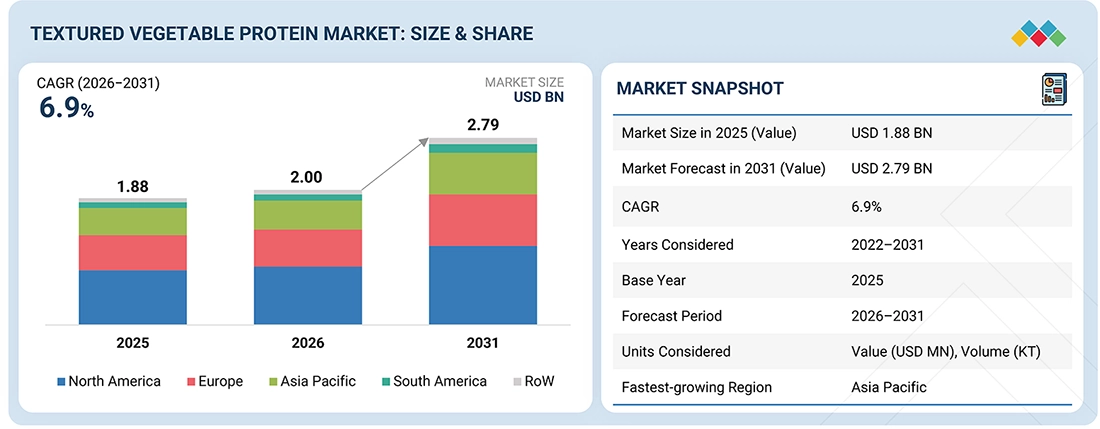
Source: Secondary Research, Interviews with Experts, MarketsandMarkets Analysis
The textured vegetable protein market size is projected to reach USD 2.79 billion by 2031 from USD 2.00 billion in 2026, growing at a CAGR of 6.9%. Rising consumer demand for plant-based, high-protein, and sustainable food ingredients, coupled with increasing adoption of meat alternatives, clean-label products, and protein-fortified foods across food processing and foodservice applications, is driving the growth of the textured vegetable protein market.
Market Size and Forecast:
- Market Size Value in 2025: USD 1.88 Billion
- Market Size Value in 2026: USD 2.00 Billion
- Revenue Forecast in 2031: USD 2.79 Billion
- Growth Rate: CAGR of 6.9% from 2026 to 2031
- Data available from 2022 to 2031
- Base year: 2025
- Forecast period: 2026–2031
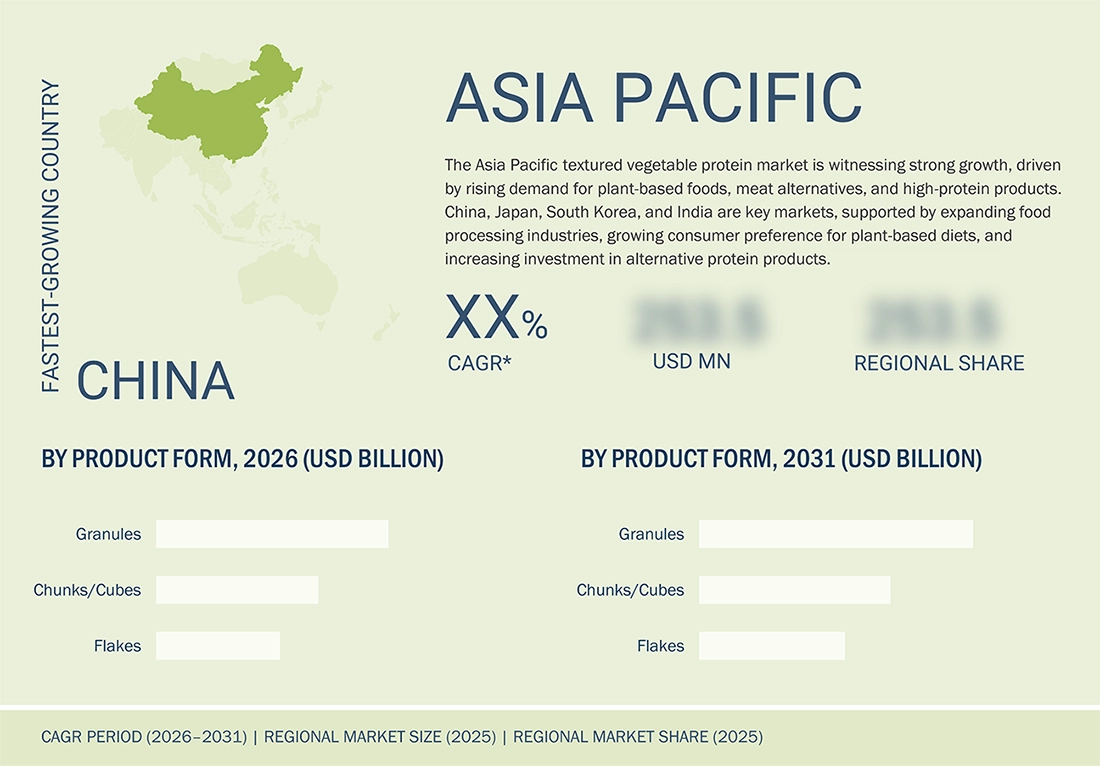
- Asia Pacific is expected to record the highest CAGR in the textured vegetable protein market during the forecast period.
- The soy protein segment is expected to record a CAGR of 7.4% during the forecast period.
Key Market Trends and Insights
- By Source: Soy, pea, wheat, and other plant-based protein sources are witnessing strong demand, with soy-based textured vegetable protein leading the market due to its affordability, high protein content, and wide application in meat alternatives.
-
Growth Drivers: Rising consumer preference for plant-based, high-protein, and sustainable food products, along with increasing demand for meat alternatives, clean-label ingredients, and protein-fortified foods, is accelerating market growth.
- Growing Trends: Expanding adoption of vegan and flexitarian diets, increasing innovation in extrusion processing technologies, and growing use of textured vegetable protein in ready-to-eat meals, meat analogs, snacks, and processed foods are shaping the market.
- Growth Opportunities: Rising investments in plant-based food innovation, increasing demand for sustainable protein ingredients, expansion of foodservice and food processing applications, and the development of new formulations using pea and other alternative protein sources are creating significant growth opportunities for the textured vegetable protein market.
KEY TAKEAWAYS
-
By RegionAsia Pacific is expected to record the highest CAGR in the textured vegetable protein market during the forecast period.
-
By ApplicationBy application, the food segment is expected to dominate the market throughout the forecast period.
-
By Product FormBy product form, the granules segment accounted for a 38.6% share of the market and is expected to register the highest CAGR during the forecast period.
-
By SourceBy source, the soy protein segment is expected to record a CAGR of 7.4% during the forecast period.
-
By Processing MethodBy processing method, the extrusion method segment is estimated to hold the largest market share in 2031.
-
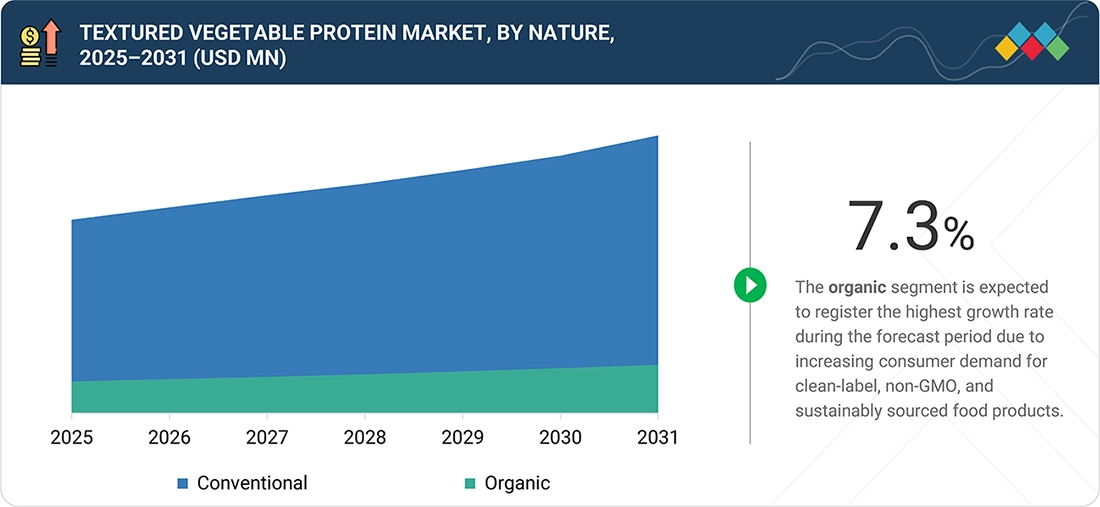
By NatureBy nature, the organic segment is expected to exhibit the fastest growth rate of 7.3% from 2026 to 2031.
-
By Protein ContentBy protein content, the 50%–70% segment is expected to dominate the market during the forecast period.
-
By Functionality (Qualitative)Textured vegetable protein offers a range of functional properties that enhance product quality, processing performance, and nutritional value across diverse food applications.
-
Competitive Landscape (Key Players)ADM, Cargill, Roquette Frères, International Flavors & Fragrances Inc., and Ingredion were identified as some of the key players due to their broad plant protein portfolios, global manufacturing footprint, and established presence in the textured vegetable protein market.
-
Competitive Landscape (Startups/SMEs)PURIS, Sotexpro, Stentorian Industries Co., Ltd., and Living Foods India Pvt. Ltd. have established a strong presence among startups and SMEs by focusing on plant-based protein ingredients.
The textured vegetable protein market is witnessing sustained growth, supported by the increasing shift toward plant-based diets and rising consumer preference for sustainable, protein-rich food ingredients. Growing demand for meat alternatives, convenience foods, and high-protein formulations is expanding the use of textured vegetable protein across retail and foodservice applications. Its ability to replicate the texture of meat, high-protein content, long shelf life, and compatibility with a wide range of formulations make it a preferred ingredient in plant-based meat products, ready meals, snacks, and processed foods.
TRENDS & DISRUPTIONS IMPACTING CUSTOMERS' CUSTOMERS
The impact on the textured vegetable protein market stakeholders is driven by increasing demand for plant-based, high-protein, and sustainable food products. Textured vegetable protein manufacturers primarily serve the food & beverages industry, particularly producers of meat alternatives, processed foods, and ready meals. Evolving consumer preferences for clean-label and protein-rich diets influence product demand, while fluctuations in raw material availability and prices, particularly soy, pea, and wheat proteins, along with processing costs, affect the value chain, pricing, and profitability of manufacturers and suppliers. The value-chain evolution of the plant-based protein industry highlights how changing customer requirements are reshaping revenue opportunities for ingredient suppliers. Companies that currently rely on traditional textured soy proteins and basic meat extenders are expected to shift toward higher-value offerings, including diversified protein sources, application-specific texturized ingredients, and clean-label, non-GMO formulations enabled by advanced processing technologies. This transformation is driven by the growing demand from plant-based food manufacturers, processed food companies, food & beverage companies, and foodservice manufacturers, which increasingly prioritize protein diversification, improved texture and sensory performance, cost-effective formulation, and lower environmental impact. These evolving priorities ultimately translate into consumer demand for nutritious, meat-like, clean-label, and sustainable plant-based foods. Consequently, suppliers that expand their portfolios through innovation, strategic partnerships, new applications, and ecosystem development will be better positioned to capture future revenue growth by aligning their solutions with the evolving priorities of both direct customers and end consumers.
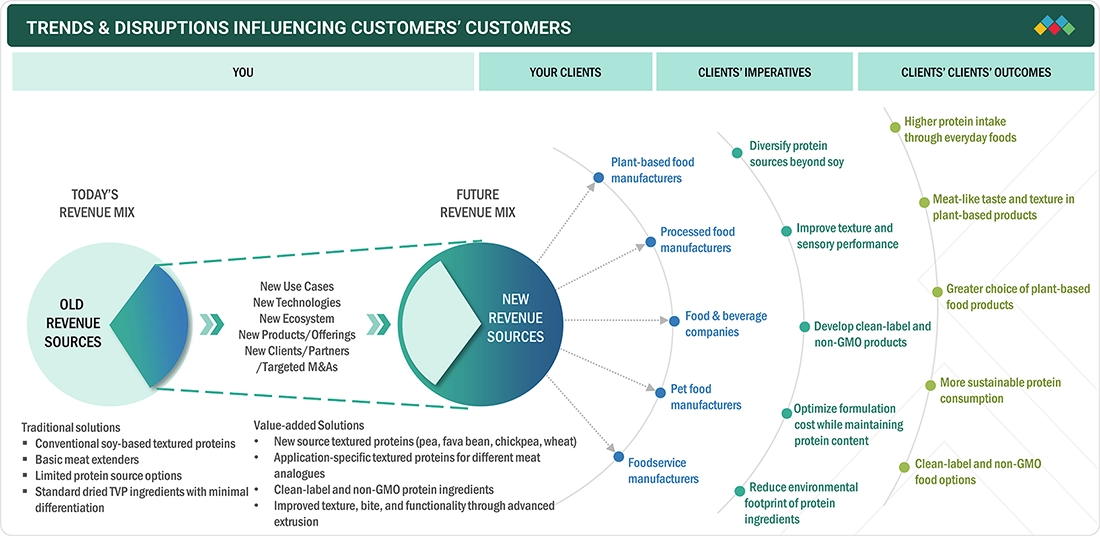
Source: Secondary Research, Interviews with Experts, MarketsandMarkets Analysis
MARKET DYNAMICS

Drivers
Impact
Level
Level
-
Growing demand for meat alternatives

-
Surge in investments and collaborations in plant-sourced food businesses


RESTRAINTS
Impact
Level
Level
-
Allergies associated with vegetable protein sources

-
Complexities in processing textured vegetable proteins


OPPORTUNITIES
Impact
Level
Level
-
Shift from traditional textured vegetable protein sources to diversified protein sources

-
Emergence of cost-efficient plant-based formulations


CHALLENGES
Impact
Level
Level
-
High production cost

-
Stringent government regulations

Source: Secondary Research, Interviews with Experts, MarketsandMarkets Analysis
Driver: Growing demand for meat alternatives
The increasing adoption of plant-based diets and flexitarian lifestyles is driving demand for meat alternatives, boosting the consumption of textured vegetable protein. TVP is widely used in burgers, sausages, nuggets, and other meat analogs due to its meat-like texture, high-protein content, and cost-effectiveness. Growing consumer preference for sustainable and protein-rich foods is further supporting market growth.
Restraint: Allergies associated with vegetable protein sources
Allergies related to soy and wheat proteins, two of the primary raw materials used in textured vegetable protein, may limit product adoption among sensitive consumers. In addition, the need for allergen labeling and the availability of alternative protein sources can influence purchasing decisions and product formulation strategies.
Opportunity: Shift from traditional textured vegetable protein sources to diversified protein sources
Increasing interest in alternative plant protein sources such as fava bean, chickpea, lentil, mung bean, canola, and sunflower is creating new growth opportunities for TVP manufacturers. Diversifying raw material sources helps address evolving consumer preferences, supports clean-label product development, and reduces dependence on conventional soy- and wheat-based proteins.
Challenge: High production cost
Producing high-quality textured vegetable protein requires specialized extrusion equipment, consistent raw material quality, and significant energy consumption, contributing to production costs. Price volatility of plant protein ingredients and investments in advanced processing technologies can further affect manufacturing costs, particularly for premium and high-moisture TVP products.
TEXTURED VEGETABLE PROTEIN MARKET: COMMERCIAL USE CASES ACROSS INDUSTRIES
| COMPANY | USE CASE DESCRIPTION | BENEFITS |
|---|---|---|
 |
Uses textured vegetable protein and textured soy protein in burgers, crumbles, chicken alternatives, and other meat-free products | Supports the development of high-protein meat alternatives with a meat-like texture across multiple food categories |
 |
Uses textured soy protein in products such as Original Veggie Ground Round as a meat alternative ingredient | Provides a high-protein ground meat alternative suitable for a variety of prepared food applications |
 |
Offers textured vegetable protein as a retail product for use as a meat substitute or meat extender in home cooking | Improves skin | Enables consumers to prepare high-protein, plant-based meals across a wide range of recipes |
Logos and trademarks shown above are the property of their respective owners. Their use here is for informational and illustrative purposes only.
MARKET ECOSYSTEM
The textured vegetable protein market ecosystem comprises textured vegetable protein manufacturers (Cargill, ADM, Roquette Frères, Ingredion, and DSM-Firmenich), technology providers (Coperion, Bühler, Wenger Manufacturing, and Clextral), associations and regulatory bodies (FDA, EFSA, FSSAI, ISO, and the Food Standards Agency), and end users (Beyond Meat, MorningStar Farms, Red Mill, and Yves Veggie Cuisine). Plant proteins are processed into textured ingredients using advanced extrusion technologies and supplied to food manufacturers for applications in meat alternatives, ready meals, snacks, and other protein-enriched foods. Technology providers support efficient manufacturing and product innovation, while regulatory bodies ensure compliance with food safety and quality standards. Growing demand from end users continues to drive innovation and expansion across the value chain.
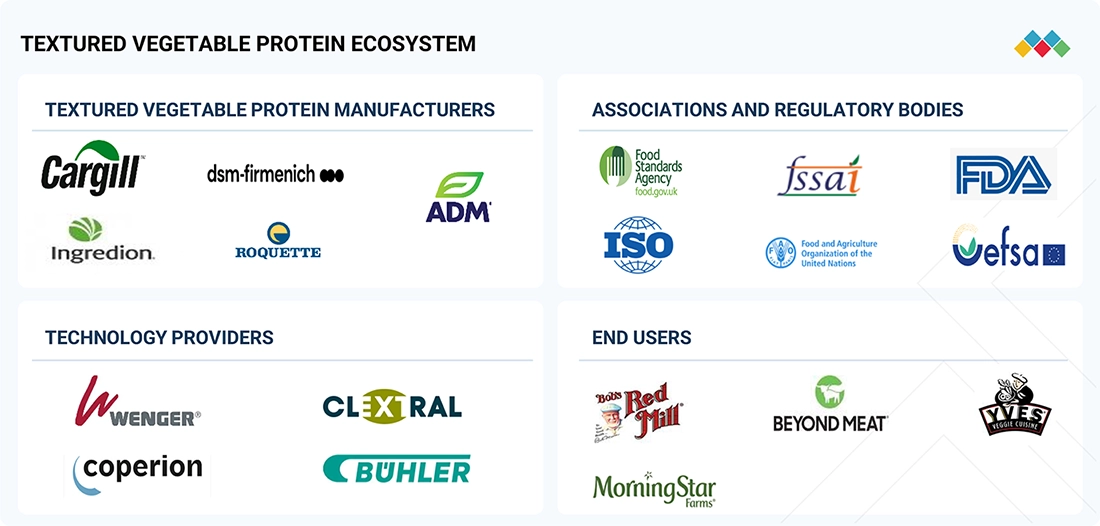
Logos and trademarks shown above are the property of their respective owners. Their use here is for informational and illustrative purposes only.
MARKET SEGMENTS
Source: Secondary Research, Interviews with Experts, MarketsandMarkets Analysis
Textured Vegetable Protein Market, By Source
By source, the soy protein segment holds the largest share of the textured vegetable protein market due to its high availability, low cost, high protein content, and its relatively matured application in the food industry. The segment includes soy protein concentrate (SPC), soy protein isolate (SPI) and defatted soy flour. These products are popular ingredients used in meat substitutes, ready-to-eat meals, snacks, and many other processed foods, due to their functional characteristics and high protein level. Soy protein performs well during extrusion, and it can be used to produce textured proteins that have a fibrous structure and a meat-like texture and taste. This makes it suitable for a wide range of plant-based food applications. In addition, its well-established supply chain and large commercial scale of production further support its continued dominance in the textured vegetable protein market.
Textured Vegetable Protein Market, By Product Form
By product form, the granules segment represents the largest share of texturized vegetable protein market as they are suitable for a variety of food products and products formats. Granules are finer than chunks and range from 1 mm to 8 mm. They quickly absorb water and any seasonings applied when rehydrated, allowing food manufactures to achieve the desired texture in meat extenders, meat substitutes, ready meal components, soups, snacks and other processed food products. Granules, used in their dehydrated form, also have increased shelf life and are relatively easy to store and transport, which makes them more suitable for commercial food production. While other product forms such as chunks, cubes, flakes, crumbles, strips, shreds, extruded protein crispies/inclusions, mince, pellets, nuggets, and powder blends are developed for specific product formats and texture requirements, granules continue to hold the largest market share due to their versatility across a broad range of food applications.
Textured Vegetable Protein Market, By Application
By application, the food applications segment accounts for the largest share of the textured vegetable protein market. The dominance of this segment is driven by the increasing commercialization of plant-based foods and the growing use of textured vegetable proteins as functional ingredients in processed food formulations. Beyond serving as the primary protein base in meat alternatives, textured vegetable proteins are increasingly incorporated into hybrid meat products, convenience foods, snacks, and other prepared foods to improve texture, enhance protein content, optimize formulation costs, and extend product yield. Their compatibility with existing food processing systems and ability to deliver consistent product performance have supported their adoption across both retail and foodservice channels. As food manufacturers continue to expand plant-based and protein-enriched product portfolios, food applications are expected to remain the primary segment for textured vegetable proteins.
Textured Vegetable Protein Market, By Nature
The organic segment is projected to be the fastest-growing market for textured vegetable protein during the forecast period. The growth of this segment is driven by increasing consumer preference for organic, clean-label, and non-GMO food products, particularly across North America and Europe. Organic textured vegetable proteins are produced from organically cultivated plant sources, including soy, pea, and wheat, without the use of synthetic pesticides, fertilizers, or genetically modified organisms (GMOs). They are increasingly used in premium plant-based meat alternatives, ready meals, snacks, and other processed food products that target health-conscious and environmentally conscious consumers. In addition, compliance with organic certification standards and growing demand for traceable and sustainably sourced ingredients are expected to support the growth of the organic segment during the forecast period.
REGION
Asia Pacific is expected to exhibit highest CAGR in textured vegetable protein market during forecast period
Asia Pacific is expected to exhibit the highest CAGR in the textured vegetable protein market during the forecast period. Growing consumption of plant-based diets and increased health consciousness among countries such as China, India, Japan, South Korea, and Australia are witnessing high demand for plant-based foods. Additionally, increasing urbanization and rising disposable incomes, along with a growing retail footprint of plant-based product ranges, are also encouraging consumers to incorporate alternative protein products into their diets. The region is witnessing growing investment in the production of plant-based foods with the expansion of established domestic and international food manufacturers. This region benefits from abundant raw materials, mainly soy and pea proteins, and a matured food processing industry that supports large-scale production of textured vegetable proteins. In addition, the rising foodservice sector, product launches and consumer demand for meat alternatives are further driving textured vegetable protein demand in various food applications. Government strategies aimed at sustainable food systems and investments toward alternative protein innovation in multiple Asia Pacific nations are also contributing to the expansion of the textured vegetable protein market. Together, these factors are expected to support the region's strong growth in the textured vegetable protein market.
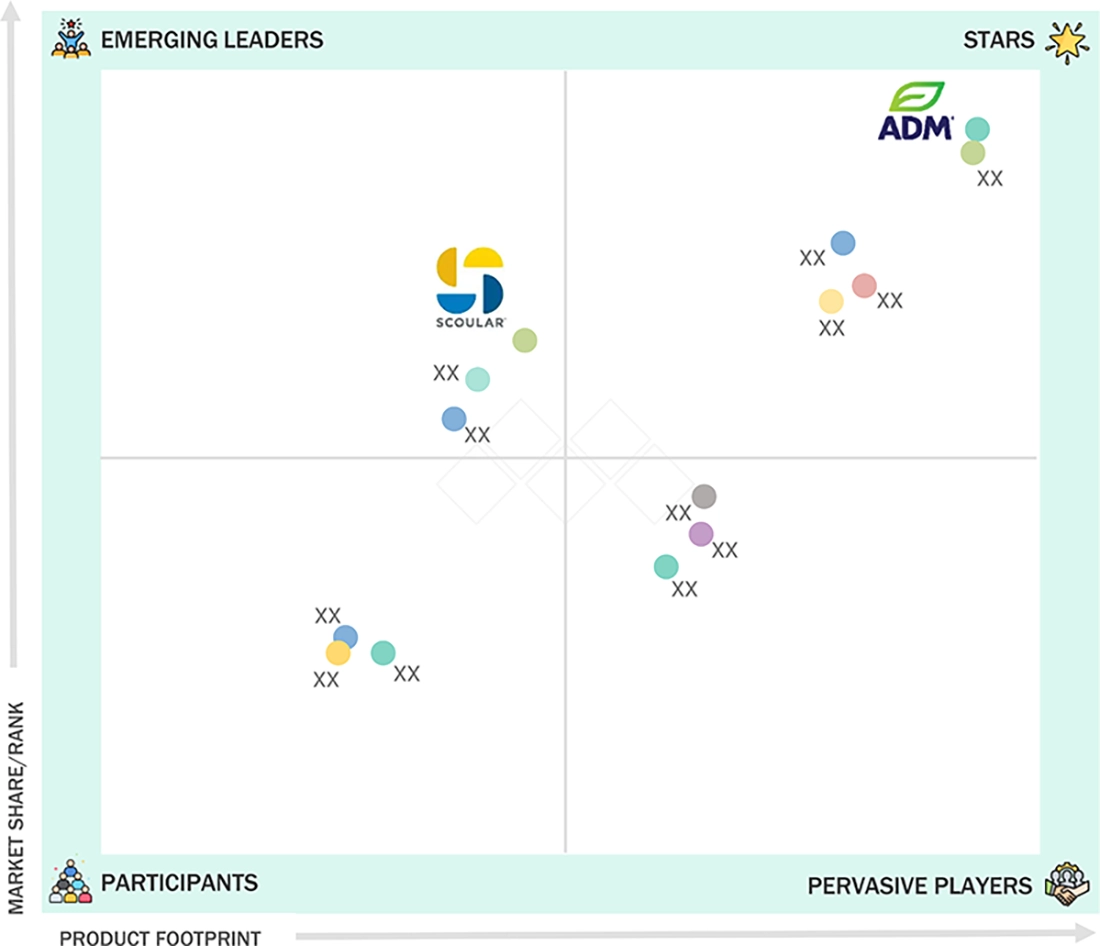
TEXTURED VEGETABLE PROTEIN MARKET: COMPANY EVALUATION MATRIX
In the textured vegetable protein market matrix, ADM (Star) leads with its broad portfolio of soy- and pea-based textured proteins, global manufacturing footprint, and well-established position in the plant protein industry. The Scoular Company (Emerging Leader) is strengthening its presence through its expanding portfolio of plant protein ingredients, including textured proteins, and its focus on serving food manufacturers with application-specific solutions. While ADM benefits from its global scale, integrated supply chain, and diversified product portfolio, The Scoular Company is enhancing its market position through investments in plant protein capabilities and growing demand for alternative protein ingredients, positioning it for continued growth in the textured vegetable protein market.
Source: Secondary Research, Interviews with Experts, MarketsandMarkets Analysis
KEY MARKET PLAYERS
- ADM (US)
- Cargill, Incorporated (US)
- Roquette Frères (France)
- International Flavors & Fragrances Inc. (US)
- Ingredion Incorporated (US)
- dsm-firmenich (Switzerland)
- MGP Ingredients, Inc. (US)
- PURIS (US)
- BENEO (Germany)
- Axiom Foods, Inc. (US)
- The Scoular Company (US)
- Shandong Yuxin Bio-Tech Co., Ltd. (China)
- Gushen Biological Technology Group Co., Ltd. (China)
- Foodchem International Corporation (China)
- DACSA Group (Spain)
MARKET SCOPE
| REPORT METRIC | DETAILS |
|---|---|
| Market Size in 2025 (Value) | USD 1.88 billion |
| Market Forecast in 2026 (Value) | USD 2.00 billion |
| Market Forecast in 2031 (Value) | USD 2.79 billion |
| Growth Rate | CAGR of 6.9% from 2026–2031 |
| Years Considered | 2022–2031 |
| Base Year | 2025 |
| Forecast Period | 2026–2031 |
| Units Considered | Value (USD billion), Volume (KT) |
| Report Coverage | Revenue forecast, company ranking, competitive landscape, growth factors, and trends |
| Segments Covered |
|
| Regions Covered | North America, Asia Pacific, Europe, South America, RoW |
WHAT IS IN IT FOR YOU: TEXTURED VEGETABLE PROTEIN MARKET REPORT CONTENT GUIDE
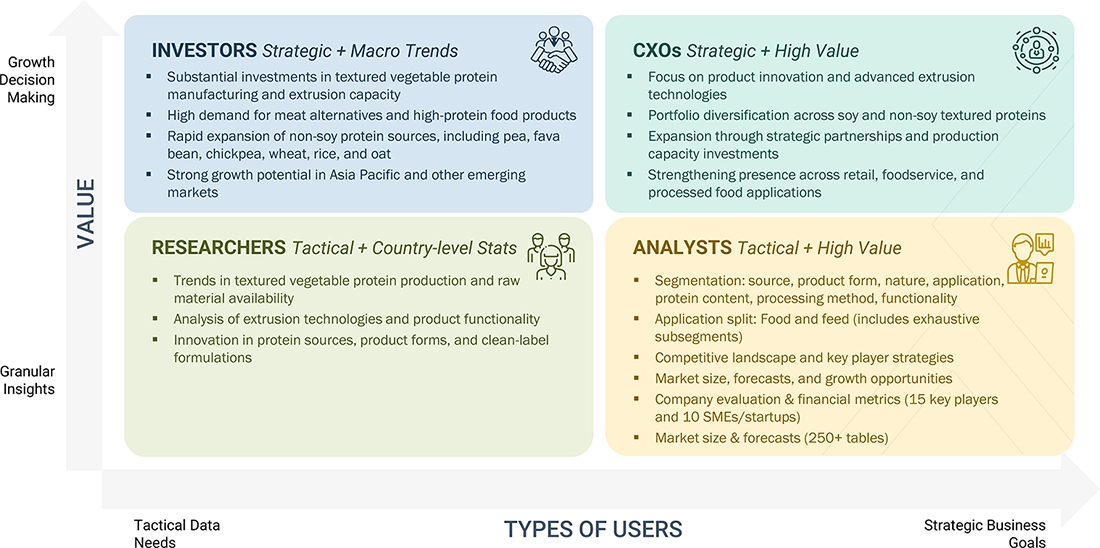
DELIVERED CUSTOMIZATIONS
We have successfully delivered the following deep-dive customizations:
| CLIENT REQUEST | CUSTOMIZATION DELIVERED | VALUE ADDS |
|---|---|---|
| Plant-Based Protein Ingredients Market |
|
|
| Pea Protein Market |
|
|
| Protein Alternatives Market |
|
|
RECENT DEVELOPMENTS
- September 2022 : MGP launched Proterra Crumbles, chef-seasoned plant-based protein crumbles made from pea protein for foodservice applications.
- May 2022 : BENEO acquired Meatless B.V., a Dutch supplier of textured plant-based ingredients for meat and fish alternatives. The acquisition expanded BENEO's portfolio of plant-based texturizing solutions and strengthened its position in the alternative protein ingredients market.
- April 2022 : ADM announced an investment of approximately USD 300 million to expand its alternative protein production operations in Decatur, Illinois. The expansion increased soy protein concentrate production and extrusion capacity to support the growing demand for textured vegetable proteins and other plant-based protein ingredients.
Table of Contents
 Exclusive indicates content/data unique to MarketsandMarkets and not available with any competitors.
TITLE
PAGE NO
1
INTRODUCTION
41
2
EXECUTIVE SUMMARY
48
3
PREMIUM INSIGHTS
54
4
MARKET OVERVIEW
Explore booming plant-based protein market driven by innovation, investment, and emerging hybrid products.
58
4.1
INTRODUCTION
4.2
MARKET DYNAMICS
4.2.1
DRIVERS
4.2.1.1
GROWING DEMAND FOR MEAT ALTERNATIVES
4.2.1.2
ADVANCEMENTS IN EXTRUSION AND PROTEIN PROCESSING TECHNOLOGIES
4.2.1.3
SURGE IN INVESTMENTS AND COLLABORATIONS IN PLANT-SOURCED FOOD BUSINESS
4.2.2
RESTRAINTS
4.2.2.1
ALLERGIES ASSOCIATED WITH VEGETABLE PROTEIN SOURCES
4.2.2.2
COMPLEXITIES IN PROCESSING TEXTURED VEGETABLE PROTEINS
4.2.3
OPPORTUNITIES
4.2.3.1
GROWING ADOPTION OF HYBRID MEAT PRODUCTS
4.2.3.2
SHIFT FROM TRADITIONAL EXTRACTION SOURCES OF TEXTURED VEGETABLE PROTEIN TO NEW SOURCES
4.2.4
CHALLENGES
4.2.4.1
STRINGENT GOVERNMENT REGULATIONS
4.2.4.2
HIGH COST OF PRODUCTION
4.3
UNMET NEEDS AND WHITE SPACES
4.3.1
UNMET NEEDS IN TEXTURED VEGETABLE PROTEIN MARKET
4.3.2
WHITE SPACE OPPORTUNITIES
4.4
INTERCONNECTED MARKETS AND CROSS-SECTOR OPPORTUNITIES
4.4.1
INTERCONNECTED MARKETS
4.4.2
CROSS-SECTOR OPPORTUNITIES
4.5
STRATEGIC MOVES BY TIER-1/2/3 PLAYERS
4.5.1
KEY MOVES AND STRATEGIC FOCUS
5
INDUSTRY TRENDS
Navigate the textured vegetable protein market's competitive landscape with strategic insights from Porter’s Five Forces.
73
5.1
INTRODUCTION
5.2
PORTER’S FIVE FORCES ANALYSIS
5.2.1
IMPACT OF PORTER’S FIVE FORCES ON TEXTURED VEGETABLE PROTEIN MARKET
5.2.2
THREAT OF NEW ENTRANTS
5.2.3
THREAT OF SUBSTITUTES
5.2.4
BARGAINING POWER OF SUPPLIERS
5.2.5
BARGAINING POWER OF BUYERS
5.2.6
INTENSITY OF COMPETITIVE RIVALRY
5.3
MACROECONOMIC INDICATORS
5.3.1
GLOBAL PRODUCTION OF PLANT PROTEIN FEEDSTOCKS
5.3.2
GROWING HEALTH TRENDS
5.3.3
CONSUMER SHIFT TOWARD PLANT-BASED NUTRITION
5.4
VALUE CHAIN ANALYSIS
5.4.1
RESEARCH AND PRODUCT DEVELOPMENT
5.4.2
CROP CULTIVATION AND RAW MATERIAL SOURCING
5.4.3
PROTEIN EXTRACTION AND INGREDIENT PROCESSING
5.4.4
TEXTURIZATION AND PRODUCT MANUFACTURING
5.4.5
COMMERCIALIZATION AND DISTRIBUTION
5.4.6
END-USE APPLICATIONS
5.5
ECOSYSTEM ANALYSIS
5.5.1
DEMAND SIDE
5.5.2
SUPPLY SIDE
5.6
PRICING ANALYSIS
5.6.1
AVERAGE SELLING PRICE OF KEY PLAYERS, BY SOURCE, 2025
5.6.2
AVERAGE SELLING PRICE TREND, BY SOURCE
5.6.3
AVERAGE SELLING PRICE TREND, BY REGION
5.7
TRADE ANALYSIS
5.7.1
TRADE ANALYSIS OF HS CODE 210610: PROTEIN CONCENTRATES AND TEXTURED PROTEIN SUBSTANCES
5.7.1.1
EXPORT TRENDS UNDER HS CODE 210610 (2021–2025)
5.7.1.2
IMPORT TRENDS UNDER HS CODE 210610 (2021–2025)
5.8
KEY CONFERENCES AND EVENTS, 2026–2027
5.9
TRENDS/DISRUPTIONS IMPACTING CUSTOMER BUSINESS
5.10
INVESTMENT AND FUNDING SCENARIO
5.11
CASE STUDY ANALYSIS
5.11.1
PLANT-BASED MEAT BRAND ENHANCED PLANT-BASED MEAT WITH RESPONSE 4380 IP SOY PROTEIN
5.11.2
GOODDOT EXPANDED PLANT-BASED MEAT ADOPTION THROUGH AFFORDABLE PLANT PROTEINS
5.12
IMPACT OF US TARIFF – TEXTURED VEGETABLE PROTEIN MARKET
5.12.1
INTRODUCTION
5.12.2
PRICE IMPACT ANALYSIS
5.12.3
IMPACT ON COUNTRIES/REGIONS
5.12.3.1
US
5.12.3.2
EUROPE
5.12.3.3
ASIA PACIFIC
5.12.4
IMPACT ON END-USE INDUSTRIES
6
REGULATORY LANDSCAPE AND SUSTAINABILITY INITIATIVES
Navigate evolving regulations and sustainability strategies to future-proof plant-based protein ventures.
100
6.1
INTRODUCTION
6.2
REGIONAL REGULATIONS AND COMPLIANCE
6.2.1
REGULATORY BODIES, GOVERNMENT AGENCIES, AND OTHER ORGANIZATIONS
6.2.2
INDUSTRY STANDARDS
6.2.3
LABELING REQUIREMENTS AND CLAIMS
6.2.4
ANTICIPATED REGULATORY CHANGES IN NEXT 5–10 YEARS
6.2.4.1
ENHANCED SUPPLY CHAIN TRACEABILITY AND DIGITAL RECORDKEEPING REQUIREMENTS
6.2.4.2
STRICTER REGULATION OF PLANT-BASED LABELING AND PRODUCT CLAIMS
6.2.4.3
INCREASED FOCUS ON SUSTAINABILITY REPORTING AND RESPONSIBLE SOURCING
6.2.4.4
EXPANSION OF REGULATORY FRAMEWORKS FOR ALTERNATIVE PROTEINS AND NOVEL INGREDIENTS
6.2.4.5
GREATER HARMONIZATION OF INTERNATIONAL FOOD SAFETY AND PLANT PROTEIN STANDARDS
6.3
SUSTAINABILITY INITIATIVES
6.3.1
SUSTAINABLE SOURCING OF PLANT PROTEIN RAW MATERIALS
6.3.2
CARBON FOOTPRINT REDUCTION INITIATIVES
6.3.3
RESOURCE EFFICIENCY AND CIRCULAR ECONOMY APPROACHES
6.3.4
SUSTAINABLE MANUFACTURING AND CLEAN ENERGY ADOPTION
6.4
IMPACT OF REGULATORY POLICIES ON SUSTAINABILITY INITIATIVES
6.5
CERTIFICATIONS, LABELING, ECO-STANDARDS
7
CUSTOMER LANDSCAPE AND BUYER BEHAVIOR
Unlock hidden revenue by understanding buyer dynamics and unmet needs in textured vegetable protein.
116
7.1
INTRODUCTION
7.2
DECISION-MAKING PROCESS
7.3
KEY STAKEHOLDERS INVOLVED IN BUYING PROCESS AND THEIR EVALUATION CRITERIA
7.3.1
KEY STAKEHOLDERS IN BUYING PROCESS
7.3.2
BUYING CRITERIA
7.4
ADOPTION BARRIERS AND INTERNAL CHALLENGES
7.5
UNMET NEEDS OF VARIOUS END USERS
7.6
MARKET PROFITABILITY
7.7
REVENUE POTENTIAL
7.7.1
COST DYNAMICS
8
TECHNOLOGICAL ADVANCEMENTS, AI-DRIVEN IMPACT, PATENTS, INNOVATIONS, AND FUTURE APPLICATIONS
AI-driven advancements revolutionize textured vegetable protein with precision technologies and future-ready applications.
126
8.1
INTRODUCTION
8.2
KEY TECHNOLOGIES
8.2.1
EXTRUSION TECHNOLOGY
8.2.2
PROTEIN FRACTIONATION AND CONCENTRATION TECHNOLOGIES
8.2.3
TEXTURE ENGINEERING AND STRUCTURING TECHNOLOGIES
8.3
COMPLEMENTARY TECHNOLOGIES
8.3.1
ENZYMATIC MODIFICATION AND FUNCTIONALIZATION TECHNOLOGIES
8.3.2
HYDROCOLLOID AND INGREDIENT SYSTEM TECHNOLOGIES
8.3.3
FLAVOR GENERATION AND SENSORY ENHANCEMENT TECHNOLOGIES
8.3.4
DIGITAL MANUFACTURING AND PROCESS OPTIMIZATION TECHNOLOGIES
8.4
ADJACENT TECHNOLOGIES
8.4.1
3D PRINTING
8.4.2
CONTROLLED EXTRUSION PROCESSES AND PRECISION FERMENTATION
8.4.3
NUTRIENT FORTIFICATION AND BIOFORTIFICATION
8.5
TECHNOLOGY/PRODUCT ROADMAP
8.5.1
SHORT-TERM | EXTRUSION OPTIMIZATION & ALTERNATIVE PROTEIN EXPANSION
8.5.2
MID-TERM | TEXTURE INNOVATION, DIGITALIZATION, & FUNCTIONAL DIFFERENTIATION
8.5.3
LONG-TERM | HYBRID PROTEINS, FERMENTATION-ENABLED INGREDIENTS, & NEXT-GENERATION APPLICATIONS
8.6
PATENT ANALYSIS
8.6.1
LIST OF MAJOR PATENTS
8.7
FUTURE APPLICATIONS
8.7.1
TEXTURED VEGETABLE PROTEIN IN CULTIVATED MEAT SCAFFOLD SYSTEMS
8.7.2
TEXTURED VEGETABLE PROTEIN IN 3D-PRINTED PLANT-BASED MEAT PRODUCTS
8.7.3
TEXTURED VEGETABLE PROTEIN IN STRUCTURED WHOLE-CUT CULTIVATED MEAT PRODUCTS
8.8
IMPACT OF GENERATIVE AI ON TEXTURED VEGETABLE PROTEIN MARKET
8.8.1
INTRODUCTION
8.8.2
BEST PRACTICES IN TEXTURED VEGETABLE PROTEIN INDUSTRY
8.8.3
CASE STUDIES OF AI IMPLEMENTATION IN TEXTURED VEGETABLE PROTEIN MARKET
8.8.4
INTERCONNECTED ADJACENT ECOSYSTEM AND IMPACT ON MARKET PLAYERS
8.8.5
CLIENTS’ READINESS TO ADOPT GENERATIVE AI IN TEXTURED VEGETABLE PROTEIN MARKET
8.9
SUCCESS STORIES AND REAL-WORLD APPLICATIONS
9
TEXTURED VEGETABLE PROTEIN MARKET, BY PROCESSING METHOD
Market Size & Growth Rate Forecast Analysis
141
9.1
INTRODUCTION
9.2
EXTRUSION
9.2.1
HIGH-MOISTURE EXTRUSION
9.2.1.1
GROWING DEMAND FOR WHOLE-CUT AND PREMIUM MEAT ALTERNATIVES TO ACCELERATE ADOPTION OF HIGH-MOISTURE EXTRUSION TECHNOLOGIES
9.2.2
LOW-MOISTURE EXTRUSION
9.2.2.1
WIDESPREAD USE OF LOW-MOISTURE EXTRUSION IN MEAT ANALOG AND PROTEIN-ENRICHED FOOD APPLICATIONS TO SUPPORT MARKET GROWTH
9.3
OTHER PROCESSING METHODS
10
TEXTURED VEGETABLE PROTEIN MARKET, BY FUNCTIONALITY
Market Size & Growth Rate Forecast Analysis
145
10.1
INTRODUCTION
10.2
WATER BINDING
10.3
FAT BINDING
10.4
TEXTURE ENHANCEMENT
10.5
PROTEIN ENRICHMENT
10.6
EMULSIFICATION
10.7
OTHER FUNCTIONAL PROPERTIES
11
TEXTURED VEGETABLE PROTEIN MARKET, BY SOURCE
Market Size & Growth Rate Forecast Analysis to 2031 in USD Million | 48 Data Tables
149
11.1
INTRODUCTION
11.2
SOY
11.2.1
HIGH SHELF-LIFE AND LOW CALORIES IN SOYMEAL PRODUCTS TO BOOST DEMAND
11.2.2
SOY PROTEIN CONCENTRATE
11.2.3
SOY PROTEIN ISOLATE
11.2.4
DEFATTED SOY FLOUR
11.3
PEA
11.3.1
USE OF TEXTURED PEA PROTEIN IN DIFFERENT PRODUCTS TO DRIVE MARKET
11.4
WHEAT
11.4.1
EXCELLENT BINDING CHARACTERISTICS TO INCREASE WHEAT USAGE IN ALTERNATIVE MEAT PRODUCTS
11.5
FAVA BEAN
11.5.1
GROWING CONSUMPTION OF SOY-FREE AND ALLERGEN-FRIENDLY PROTEIN INGREDIENTS TO DRIVE DEMAND FOR FAVA BEAN-BASED TEXTURED VEGETABLE PROTEIN
11.6
CHICKPEA
11.6.1
STRONG EMULSIFICATION AND WATER-BINDING PROPERTIES TO SUPPORT ADOPTION OF CHICKPEA PROTEIN IN TEXTURED VEGETABLE PROTEIN
11.7
LENTIL
11.7.1
ABILITY OF LENTIL PROTEIN TO DEVELOP MEAT-LIKE FIBROUS STRUCTURES TO SUPPORT MARKET GROWTH
11.8
RICE
11.8.1
COMPLEMENTARY NUTRITIONAL PROFILE OF RICE PROTEIN TO DRIVE ADOPTION IN TEXTURED VEGETABLE PROTEIN FORMULATIONS
11.9
OAT
11.9.1
HIGH PROTEIN AND Β-GLUCAN FIBER CONTENT TO SUPPORT ADOPTION OF OATS IN TEXTURED VEGETABLE PROTEIN APPLICATIONS
11.10
OTHER SOURCES
12
TEXTURED VEGETABLE PROTEIN MARKET, BY PRODUCT FORM
Market Size & Growth Rate Forecast Analysis to 2031 in USD Million | 16 Data Tables
176
12.1
INTRODUCTION
12.2
GRANULES
12.2.1
ABILITY OF GRANULES TO REPLICATE MINCED MEAT TEXTURE TO BOOST ADOPTION IN PLANT-BASED FOODS
12.3
CHUNKS/CUBES
12.3.1
GROWING DEMAND FOR WHOLE-CUT MEAT ALTERNATIVES TO SUPPORT ADOPTION OF CHUNKS AND CUBES
12.4
FLAKES
12.4.1
RAPID HYDRATION AND FORMULATION VERSATILITY OF FLAKES TO SUPPORT TEXTURED VEGETABLE PROTEIN UTILIZATION IN CONVENIENCE FOOD APPLICATIONS
12.5
CRUMBLES
12.5.1
SUITABILITY OF CRUMBLE-FORMAT TEXTURED VEGETABLE PROTEIN FOR READY-TO-EAT AND READY-TO-COOK FOOD APPLICATIONS TO SUPPORT MARKET GROWTH
12.6
STRIPS/SHREDS
12.6.1
USE OF STRIPS AND SHREDS IN WHOLE-MUSCLE MEAT ALTERNATIVE APPLICATIONS TO SUPPORT MARKET GROWTH
12.7
EXTRUDED PROTEIN CRISPIES/INCLUSIONS
12.7.1
USE OF EXTRUDED PROTEIN CRISPIES AND INCLUSIONS IN HIGH-PROTEIN FOOD APPLICATIONS TO DRIVE MARKET
12.7.2
OTHER PRODUCT FORMS
13
TEXTURED VEGETABLE PROTEIN MARKET, BY NATURE
Market Size & Growth Rate Forecast Analysis to 2031 in USD Million | 6 Data Tables
188
13.1
INTRODUCTION
13.2
CONVENTIONAL
13.2.1
WIDESPREAD AVAILABILITY AND COST COMPETITIVENESS TO DRIVE CONSUMPTION OF CONVENTIONAL TEXTURED VEGETABLE PROTEINS
13.3
ORGANIC
13.3.1
GROWING DEMAND FOR CERTIFIED ORGANIC PLANT-BASED FOODS TO SUPPORT ADOPTION OF ORGANIC TEXTURED VEGETABLE PROTEINS
14
TEXTURED VEGETABLE PROTEIN MARKET, BY PROTEIN CONTENT
Market Size & Growth Rate Forecast Analysis to 2031 in USD Million | 8 Data Tables
193
14.1
INTRODUCTION
14.2
BELOW 50%
14.2.1
USE OF FLOUR-BASED TEXTURED VEGETABLE PROTEINS IN COST-SENSITIVE FOOD APPLICATIONS TO DRIVE MARKET
14.3
50–70%
14.3.1
GROWING DEMAND FOR HIGH-PROTEIN PLANT-BASED FOODS TO SUPPORT ADOPTION OF 50–70% TEXTURED VEGETABLE PROTEINS
14.4
ABOVE 70%
14.4.1
INCREASING FOCUS ON PROTEIN ENRICHMENT TO SUPPORT DEMAND FOR ABOVE-70% TEXTURED VEGETABLE PROTEINS
15
TEXTURED VEGETABLE PROTEIN MARKET, BY APPLICATION
Market Size & Growth Rate Forecast Analysis to 2031 in USD Million | 64 Data Tables
200
15.1
INTRODUCTION
15.2
FOOD APPLICATIONS
15.2.1
MEAT ALTERNATIVES
15.2.1.1
GROWING FLEXITARIAN ADOPTION, HEALTH-CONSCIOUS CONSUMPTION, AND SUSTAINABILITY CONSIDERATIONS TO SUPPORT DEMAND FOR TEXTURED VEGETABLE PROTEIN IN MEAT ALTERNATIVES
15.2.1.2
BURGERS
15.2.1.3
SAUSAGES
15.2.1.4
NUGGETS
15.2.1.5
MEATBALLS
15.2.1.6
GROUND MEAT ANALOGS
15.2.1.7
WHOLE-CUT ANALOGS
15.2.1.8
SEAFOOD ALTERNATIVES
15.2.2
READY-TO-EAT/READY-TO-COOK FOODS
15.2.2.1
CONSUMER PREFERENCE FOR CONVENIENCE, NUTRITION, AND SUSTAINABILITY IN FOOD CHOICES TO DRIVE MARKET
15.2.2.2
FROZEN MEALS
15.2.2.3
INSTANT MEALS
15.2.2.4
CANNED FOOD
15.2.3
SNACKS
15.2.3.1
GROWING CONSUMER PREFERENCE FOR PROTEIN-RICH SNACKING TO DRIVE DEMAND FOR TEXTURED VEGETABLE PROTEIN
15.2.3.2
PROTEIN SNACKS
15.2.3.3
EXTRUDED SNACKS
15.2.3.4
CRISPS
15.2.4
BAKERY & SAVORY PRODUCTS
15.2.4.1
GROWING DEMAND FOR PROTEIN-ENRICHED BAKERY AND SAVORY PRODUCTS TO SUPPORT TEXTURED VEGETABLE PROTEIN ADOPTION
15.2.5
SOUPS, SAUCES, & SEASONINGS
15.2.5.1
INCREASING DEMAND FOR CONVENIENT SHELF-STABLE MEAL SOLUTIONS TO DRIVE CONSUMPTION OF TEXTURED VEGETABLE PROTEIN IN SOUPS, SAUCES, & SEASONINGS
15.2.6
FOOD SERVICE & INSTITUTIONAL
15.2.6.1
GROWING ADOPTION OF PLANT-BASED MENU OFFERINGS ACROSS FOODSERVICE AND INSTITUTIONAL CHANNELS TO SUPPORT DEMAND FOR TEXTURED VEGETABLE PROTEINS
15.2.7
OTHER FOOD APPLICATIONS
15.3
FEED APPLICATIONS
15.3.1
PET FOOD
15.3.1.1
RISING DEMAND FOR HIGH-PROTEIN NUTRITION AND SUSTAINABLE SOURCING TO DRIVE TEXTURED VEGETABLE PROTEIN ADOPTION IN PET FOOD
15.3.2
LIVESTOCK FEED ADDITIVES
15.3.2.1
INCREASING ADOPTION OF ALTERNATIVE PLANT PROTEINS IN LIVESTOCK NUTRITION TO SUPPORT DEMAND FOR TEXTURED VEGETABLE PROTEINS
15.3.3
AQUAFEED
15.3.3.1
GROWING ADOPTION OF ALTERNATIVE PLANT PROTEINS IN AQUAFEED TO SUPPORT DEMAND FOR TEXTURED VEGETABLE PROTEINS
15.3.4
OTHER FEED APPLICATIONS
16
TEXTURED VEGETABLE PROTEIN MARKET, BY REGION
Comprehensive coverage of 7 Regions with country-level deep-dive of 14 Countries | 258 Data Tables.
239
16.1
INTRODUCTION
16.2
NORTH AMERICA
16.2.1
US
16.2.1.1
STRONG SOYBEAN PRODUCTION AND ADVANCED MANUFACTURING ECOSYSTEM TO SUPPORT MARKET GROWTH
16.2.2
CANADA
16.2.2.1
ABUNDANT PULSE FEEDSTOCKS AND STRATEGIC PROTEIN INVESTMENTS TO DRIVE MARKET
16.2.3
MEXICO
16.2.3.1
GROWING FLEXITARIAN CONSUMER BASE AND EXPANDING PLANT-BASED INNOVATION TO DRIVE MARKET
16.3
EUROPE
16.3.1
GERMANY
16.3.1.1
STRONG FLEXITARIAN ADOPTION AND STRATEGIC PLANT PROTEIN INVESTMENTS TO DRIVE MARKET
16.3.2
FRANCE
16.3.2.1
RISING CONSUMER ADOPTION OF PLANT-BASED FOODS AND STRATEGIC INDUSTRY PARTNERSHIPS TO DRIVE MARKET
16.3.3
UK
16.3.3.1
ADVANCEMENTS IN ALTERNATIVE PROTEIN INNOVATION AND MARKET DEVELOPMENT TO DRIVE MARKET
16.3.4
SPAIN
16.3.4.1
INCREASING CONSUMER DEMAND AND PRODUCT INNOVATION IN ALTERNATIVE PROTEINS TO DRIVE MARKET
16.3.5
ITALY
16.3.5.1
EXPANDING PLANT-BASED FOOD BUSINESS AND STRENGTHENING INDUSTRY COLLABORATION TO DRIVE MARKET
16.3.6
REST OF EUROPE
16.4
ASIA PACIFIC
16.4.1
CHINA
16.4.1.1
ADVANCING PROTEIN DIVERSIFICATION AND ALTERNATIVE PROTEIN DEVELOPMENT TO DRIVE MARKET
16.4.2
INDIA
16.4.2.1
ESTABLISHED CONSUMPTION OF SOY-BASED PROTEIN FOODS AND GROWING ALTERNATIVE PROTEIN INITIATIVES TO DRIVE MARKET
16.4.3
JAPAN
16.4.3.1
STRATEGIC FOCUS ON FOOD SECURITY AND PROTEIN INNOVATION TO DRIVE MARKET
16.4.4
AUSTRALIA & NEW ZEALAND
16.4.4.1
EXPANDING ALTERNATIVE PROTEIN ADOPTION AND DOMESTIC PLANT PROTEIN PROCESSING CAPACITY TO SUPPORT MARKET GROWTH
16.4.5
REST OF ASIA PACIFIC
16.5
SOUTH AMERICA
16.5.1
BRAZIL
16.5.1.1
ABUNDANT SOYBEAN SUPPLY AND STRONG PROTEIN PROCESSING CAPABILITIES TO DRIVE MARKET
16.5.2
ARGENTINA
16.5.2.1
EXPANDING PROTEIN INGREDIENT EXPORTS AND GROWING INTEREST IN PLANT-BASED FOODS TO DRIVE MARKET
16.5.3
REST OF SOUTH AMERICA
16.6
REST OF THE WORLD
16.6.1
MIDDLE EAST
16.6.1.1
GROWING INVESTMENTS IN ALTERNATIVE PROTEIN MANUFACTURING AND FOOD SECURITY INITIATIVES TO DRIVE MARKET
16.6.2
AFRICA
16.6.2.1
RISING ADOPTION OF SOY-BASED PROTEIN FOODS AND GOVERNMENT SUPPORT FOR SOYBEAN PRODUCTION TO DRIVE MARKET
17
COMPETITIVE LANDSCAPE
Gain insights into leading market strategies and emerging competitors shaping industry dynamics.
346
17.1
OVERVIEW
17.2
KEY PLAYER COMPETITIVE STRATEGIES/RIGHT TO WIN, 2021–2026
17.3
REVENUE ANALYSIS, 2023–2025
17.4
MARKET SHARE ANALYSIS, 2025
17.5
BRAND/PRODUCT COMPARISON
17.5.1
ADM (US)
17.5.2
ROQUETTE FRÈRES (FRANCE)
17.5.3
DSM-FIRMENICH (SWITZERLAND)
17.5.4
INGREDION (US
17.5.5
INTERNATIONAL FLAVORS & FRAGRANCES INC. (US)
17.6
COMPANY EVALUATION MATRIX: KEY PLAYERS, 2025
17.6.1
STARS
17.6.2
EMERGING LEADERS
17.6.3
PERVASIVE PLAYERS
17.6.4
PARTICIPANTS
17.6.5
COMPANY FOOTPRINT: KEY PLAYERS, 2025
17.6.5.1
COMPANY FOOTPRINT
17.6.5.2
REGION FOOTPRINT
17.6.5.3
SOURCE FOOTPRINT
17.6.5.4
NATURE FOOTPRINT
17.6.5.5
PRODUCT FORM FOOTPRINT
17.7
COMPANY EVALUATION MATRIX: STARTUPS/SMES, 2025
17.7.1
PROGRESSIVE COMPANIES
17.7.2
RESPONSIVE COMPANIES
17.7.3
DYNAMIC COMPANIES
17.7.4
STARTING BLOCKS
17.7.5
COMPETITIVE BENCHMARKING: STARTUPS/SMES, 2025
17.7.5.1
DETAILED LIST OF KEY STARTUPS/SMES
17.7.5.2
COMPETITIVE BENCHMARKING OF KEY STARTUPS/SMES
17.8
COMPANY VALUATION AND FINANCIAL METRICS
17.8.1
COMPANY VALUATION
17.8.2
EV/EBITDA
17.9
COMPETITIVE SCENARIO
17.9.1
PRODUCT LAUNCHES
17.9.2
DEALS
17.9.3
EXPANSIONS
18
COMPANY PROFILES
In-depth Company Profiles of Leading Market Players with detailed Business Overview, Product and Service Portfolio, Recent Developments, and Unique Analyst Perspective (MnM View)
372
18.1
KEY PLAYERS
18.1.1
ADM
18.1.1.1
BUSINESS OVERVIEW
18.1.1.2
PRODUCTS OFFERED
18.1.1.3
RECENT DEVELOPMENTS
18.1.1.3.1
PRODUCT LAUNCHES
18.1.1.3.2
DEALS
18.1.1.3.3
EXPANSIONS
18.1.1.4
MNM VIEW
18.1.1.4.1
RIGHT TO WIN
18.1.1.4.2
STRATEGIC CHOICES
18.1.1.4.3
WEAKNESSES AND COMPETITIVE THREATS
18.1.2
CARGILL, INCORPORATED
18.1.3
ROQUETTE FRÈRES
18.1.4
INTERNATIONAL FLAVORS & FRAGRANCES INC.
18.1.5
INGREDION
18.1.6
DSM-FIRMENICH
18.1.7
MGP INGREDIENTS, INC.
18.1.8
PURIS
18.1.9
BENEO
18.1.10
AXIOM FOODS, INC.
18.1.11
THE SCOULAR COMPANY
18.1.12
SHANDONG YUXIN BIO-TECH CO., LTD.
18.1.13
GUSHEN BIOLOGICAL TECHNOLOGY GROUP CO., LTD.
18.1.14
FOODCHEM INTERNATIONAL CORPORATION
18.1.15
DACSA GROUP
18.2
OTHER PLAYERS
18.2.1
SHANDONG WONDERFUL BIOTECH CO., LTD.
18.2.2
SUN NUTRAFOODS
18.2.3
CROWN SOYA PROTEIN GROUP COMPANY
18.2.4
HOYA FOODS
18.2.5
SOTEXPRO
18.2.6
LIVING FOODS INDIA PVT. LTD.
18.2.7
PRANA ORGANIC
18.2.8
STENTORIAN INDUSTRIES CO., LTD.
18.2.9
BLATTMANN SCHWEIZ AG
18.2.10
SONIC BIOCHEM
19
RESEARCH METHODOLOGY
440
19.1
RESEARCH DATA
19.1.1
SECONDARY DATA
19.1.1.1
LIST OF MAJOR SECONDARY SOURCES
19.1.1.2
KEY DATA FROM SECONDARY SOURCES
19.1.2
PRIMARY DATA
19.1.2.1
KEY DATA FROM PRIMARY SOURCES
19.1.2.2
KEY INDUSTRY INSIGHTS
19.1.2.3
BREAKDOWN OF PRIMARIES
19.2
MARKET SIZE ESTIMATION
19.2.1
BOTTOM-UP APPROACH
19.2.2
TOP-DOWN APPROACH
19.2.2.1
APPROACH TO ESTIMATE MARKET SIZE USING TOP-DOWN ANALYSIS
19.3
DATA TRIANGULATION
19.4
RESEARCH ASSUMPTIONS
19.5
RESEARCH LIMITATIONS AND RISK ASSESSMENT
20
ADJACENT & RELATED MARKETS
450
20.1
INTRODUCTION
20.2
LIMITATIONS
20.3
PLANT-BASED PROTEIN MARKET
20.3.1
MARKET DEFINITION
20.3.2
MARKET OVERVIEW
20.4
PEA PROTEIN MARKET
20.4.1
MARKET DEFINITION
20.4.2
MARKET OVERVIEW
21
APPENDIX
456
21.1
DISCUSSION GUIDE
21.2
KNOWLEDGESTORE: MARKETSANDMARKETS’ SUBSCRIPTION PORTAL
21.3
CUSTOMIZATION OPTIONS
21.4
RELATED REPORTS
21.5
AUTHOR DETAILS
LIST OF TABLES
TABLE 1
USD EXCHANGE RATES, 2021–2025
TABLE 2
TEXTURED VEGETABLE PROTEIN MARKET: SUPPLY CHAIN (ECOSYSTEM)
TABLE 3
AVERAGE SELLING PRICE OF KEY PLAYERS, BY SOURCE, 2025 (USD/KG)
TABLE 4
AVERAGE SELLING PRICE (ASP) TREND, BY SOURCE, 2022–2026 (USD/KG)
TABLE 5
AVERAGE SELLING PRICE (ASP) TREND, BY REGION, 2022–2026 (USD/KG)
TABLE 6
TOP 10 EXPORTERS OF HS CODE 210610, 2021–2025 (USD THOUSAND)
TABLE 7
TOP 10 EXPORTERS OF HS CODE 210610, 2021–2025 (TONS)
TABLE 8
TOP 10 IMPORTERS OF HS CODE 210610, 2021–2025 (USD THOUSAND)
TABLE 9
TOP 10 IMPORTERS OF HS CODE 210610, 2021–2025 (TONS)
TABLE 10
TEXTURED VEGETABLE PROTEIN MARKET: LIST OF KEY CONFERENCES AND EVENTS, 2026–2027
TABLE 11
EXPECTED IMPACT LEVEL ON TARGET INGREDIENTS WITH RELEVANT HS CODES DUE TO US TARIFFS
TABLE 12
TEXTURED VEGETABLE PROTEIN MARKET: TARIFF IMPACT ON END-USE INDUSTRIES
TABLE 13
NORTH AMERICA: LIST OF REGULATORY BODIES, GOVERNMENT AGENCIES, AND OTHER ORGANIZATIONS
TABLE 14
EUROPE: LIST OF REGULATORY BODIES, GOVERNMENT AGENCIES, AND OTHER ORGANIZATIONS
TABLE 15
ASIA PACIFIC: LIST OF REGULATORY BODIES, GOVERNMENT AGENCIES, AND OTHER ORGANIZATIONS
TABLE 16
SOUTH AMERICA: LIST OF REGULATORY BODIES, GOVERNMENT AGENCIES, AND OTHER ORGANIZATIONS
TABLE 17
INTERNATIONAL: LIST OF REGULATORY BODIES, GOVERNMENT AGENCIES, AND OTHER ORGANIZATIONS
TABLE 18
GLOBAL INDUSTRY STANDARDS IN TEXTURED VEGETABLE PROTEIN MARKET
TABLE 19
LABELING REQUIREMENTS AND CLAIMS IN TEXTURED VEGETABLE PROTEIN MARKET
TABLE 20
SUSTAINABILITY INITIATIVES IN TEXTURED VEGETABLE PROTEIN MARKET
TABLE 21
CERTIFICATIONS, LABELING, AND ECO-STANDARDS IN TEXTURED VEGETABLE PROTEIN MARKET
TABLE 22
INFLUENCE OF STAKEHOLDERS ON BUYING PROCESS, BY APPLICATION
TABLE 23
KEY BUYING CRITERIA, BY APPLICATION
TABLE 24
UNMET NEEDS IN TEXTURED VEGETABLE PROTEIN MARKET, BY END USER
TABLE 25
COST DYNAMICS IN TEXTURED VEGETABLE PROTEIN MARKET
TABLE 26
LIST OF MAJOR PATENTS IN TEXTURED VEGETABLE PROTEIN MARKET, 2021–2026
TABLE 27
TOP USE CASES AND MARKET POTENTIAL
TABLE 28
BEST PRACTICES: COMPANIES IMPLEMENTING USE CASES
TABLE 29
TEXTURED VEGETABLE PROTEIN MARKET: CASE STUDIES RELATED TO GEN AI IMPLEMENTATION
TABLE 30
INTERCONNECTED ADJACENT ECOSYSTEM AND IMPACT ON MARKET PLAYERS
TABLE 31
TEXTURED VEGETABLE PROTEIN MARKET, BY SOURCE, 2022–2025 (USD MILLION)
TABLE 32
TEXTURED VEGETABLE PROTEIN MARKET, BY SOURCE, 2026–2031 (USD MILLION)
TABLE 33
TEXTURED VEGETABLE PROTEIN MARKET, BY SOURCE, 2022–2025 (KILOTONS)
TABLE 34
TEXTURED VEGETABLE PROTEIN MARKET, BY SOURCE, 2026–2031 (KILOTONS)
TABLE 35
TEXTURED VEGETABLE PROTEIN MARKET, BY SOY, 2022–2025 (USD MILLION)
TABLE 36
TEXTURED VEGETABLE PROTEIN MARKET, BY SOY, 2026–2031 (USD MILLION)
TABLE 37
SOY: TEXTURED VEGETABLE PROTEIN MARKET, BY REGION, 2022–2025 (USD MILLION)
TABLE 38
SOY: TEXTURED VEGETABLE PROTEIN MARKET, BY REGION, 2026–2031 (USD MILLION)
TABLE 39
SOY: TEXTURED VEGETABLE PROTEIN MARKET, BY REGION, 2022–2025 (KILOTONS)
TABLE 40
SOY: TEXTURED VEGETABLE PROTEIN MARKET, BY REGION, 2026–2031 (KILOTONS)
TABLE 41
SOY PROTEIN CONCENTRATE: TEXTURED VEGETABLE PROTEIN MARKET, BY REGION, 2022–2025 (USD MILLION)
TABLE 42
SOY PROTEIN CONCENTRATE: TEXTURED VEGETABLE PROTEIN MARKET, BY REGION, 2026–2031 (USD MILLION)
TABLE 43
SOY PROTEIN ISOLATE: TEXTURED VEGETABLE PROTEIN MARKET, BY REGION, 2022–2025 (USD MILLION)
TABLE 44
SOY PROTEIN ISOLATE: TEXTURED VEGETABLE PROTEIN MARKET, BY REGION, 2026–2031 (USD MILLION)
TABLE 45
DEFATTED SOY FLOUR: TEXTURED VEGETABLE PROTEIN MARKET, BY REGION, 2022–2025 (USD MILLION)
TABLE 46
DEFATTED SOY FLOUR: TEXTURED VEGETABLE PROTEIN MARKET, BY REGION, 2026–2031 (USD MILLION)
TABLE 47
PEA: TEXTURED VEGETABLE PROTEIN MARKET, BY REGION, 2022–2025 (USD MILLION)
TABLE 48
PEA: TEXTURED VEGETABLE PROTEIN MARKET, BY REGION, 2026–2031 (USD MILLION)
TABLE 49
PEA: TEXTURED VEGETABLE PROTEIN MARKET, BY REGION, 2022–2025 (KILOTONS)
TABLE 50
PEA: TEXTURED VEGETABLE PROTEIN MARKET, BY REGION, 2026–2031 (KILOTONS)
TABLE 51
WHEAT: TEXTURED VEGETABLE PROTEIN MARKET, BY REGION, 2022–2025 (USD MILLION)
TABLE 52
WHEAT: TEXTURED VEGETABLE PROTEIN MARKET, BY REGION, 2026–2031 (USD MILLION)
TABLE 53
WHEAT: TEXTURED VEGETABLE PROTEIN MARKET, BY REGION, 2022–2025 (KILOTONS)
TABLE 54
WHEAT: TEXTURED VEGETABLE PROTEIN MARKET, BY REGION, 2026–2031 (KILOTONS)
TABLE 55
FAVA BEAN: TEXTURED VEGETABLE PROTEIN MARKET, BY REGION, 2022–2025 (USD MILLION)
TABLE 56
FAVA BEAN: TEXTURED VEGETABLE PROTEIN MARKET, BY REGION, 2026–2031 (USD MILLION)
TABLE 57
FAVA BEAN: TEXTURED VEGETABLE PROTEIN MARKET, BY REGION, 2022–2025 (KILOTONS)
TABLE 58
FAVA BEAN: TEXTURED VEGETABLE PROTEIN MARKET, BY REGION, 2026–2031 (KILOTONS)
TABLE 59
CHICKPEA: TEXTURED VEGETABLE PROTEIN MARKET, BY REGION, 2022–2025 (USD MILLION)
TABLE 60
CHICKPEA: TEXTURED VEGETABLE PROTEIN MARKET, BY REGION, 2026–2031 (USD MILLION)
TABLE 61
CHICKPEA: TEXTURED VEGETABLE PROTEIN MARKET, BY REGION, 2022–2025 (KILOTONS)
TABLE 62
CHICKPEA: TEXTURED VEGETABLE PROTEIN MARKET, BY REGION, 2026–2031 (KILOTONS)
TABLE 63
LENTIL: TEXTURED VEGETABLE PROTEIN MARKET, BY REGION, 2022–2025 (USD MILLION)
TABLE 64
LENTIL: TEXTURED VEGETABLE PROTEIN MARKET, BY REGION, 2026–2031 (USD MILLION)
TABLE 65
LENTIL: TEXTURED VEGETABLE PROTEIN MARKET, BY REGION, 2022–2025 (KILOTONS)
TABLE 66
LENTIL: TEXTURED VEGETABLE PROTEIN MARKET, BY REGION, 2026–2031 (KILOTONS)
TABLE 67
RICE: TEXTURED VEGETABLE PROTEIN MARKET, BY REGION, 2022–2025 (USD MILLION)
TABLE 68
RICE: TEXTURED VEGETABLE PROTEIN MARKET, BY REGION, 2026–2031 (USD MILLION)
TABLE 69
RICE: TEXTURED VEGETABLE PROTEIN MARKET, BY REGION, 2022–2025 (KILOTONS)
TABLE 70
RICE: TEXTURED VEGETABLE PROTEIN MARKET, BY REGION, 2026–2031 (KILOTONS)
TABLE 71
OAT: TEXTURED VEGETABLE PROTEIN MARKET, BY REGION, 2022–2025 (USD MILLION)
TABLE 72
OAT: TEXTURED VEGETABLE PROTEIN MARKET, BY REGION, 2026–2031 (USD MILLION)
TABLE 73
OAT: TEXTURED VEGETABLE PROTEIN MARKET, BY REGION, 2022–2025 (KILOTONS)
TABLE 74
OAT: TEXTURED VEGETABLE PROTEIN MARKET, BY REGION, 2026–2031 (KILOTONS)
TABLE 75
OTHER SOURCES: TEXTURED VEGETABLE PROTEIN MARKET, BY REGION, 2022–2025 (USD MILLION)
TABLE 76
OTHER SOURCES: TEXTURED VEGETABLE PROTEIN MARKET, BY REGION, 2026–2031 (USD MILLION)
TABLE 77
OTHER SOURCES: TEXTURED VEGETABLE PROTEIN MARKET, BY REGION, 2022–2025 (KILOTONS)
TABLE 78
OTHER SOURCES: TEXTURED VEGETABLE PROTEIN MARKET, BY REGION, 2026–2031 (KILOTONS)
TABLE 79
TEXTURED VEGETABLE PROTEIN MARKET, BY PRODUCT FORM, 2022–2025 (USD MILLION)
TABLE 80
TEXTURED VEGETABLE PROTEIN MARKET, BY PRODUCT FORM, 2026–2031 (USD MILLION)
TABLE 81
GRANULES: TEXTURED VEGETABLE PROTEIN MARKET, BY REGION, 2022–2025 (USD MILLION)
TABLE 82
GRANULES: TEXTURED VEGETABLE PROTEIN MARKET, BY REGION, 2026–2031 (USD MILLION)
TABLE 83
CHUNKS/CUBES: TEXTURED VEGETABLE PROTEIN MARKET, BY REGION, 2022–2025 (USD MILLION)
TABLE 84
CHUNKS/CUBES: TEXTURED VEGETABLE PROTEIN MARKET, BY REGION, 2026–2031 (USD MILLION)
TABLE 85
FLAKES: TEXTURED VEGETABLE PROTEIN MARKET, BY REGION, 2022–2025 (USD MILLION)
TABLE 86
FLAKES: TEXTURED VEGETABLE PROTEIN MARKET, BY REGION, 2026–2031 (USD MILLION)
TABLE 87
CRUMBLES: TEXTURED VEGETABLE PROTEIN MARKET, BY REGION, 2022–2025 (USD MILLION)
TABLE 88
CRUMBLES: TEXTURED VEGETABLE PROTEIN MARKET, BY REGION, 2026–2031 (USD MILLION)
TABLE 89
STRIPS/SHREDS: TEXTURED VEGETABLE PROTEIN MARKET, BY REGION, 2022–2025 (USD MILLION)
TABLE 90
STRIPS/SHREDS: TEXTURED VEGETABLE PROTEIN MARKET, BY REGION, 2026–2031 (USD MILLION)
TABLE 91
EXTRUDED PROTEIN CRISPIES/INCLUSIONS: TEXTURED VEGETABLE PROTEIN MARKET, BY REGION, 2022–2025 (USD MILLION)
TABLE 92
EXTRUDED PROTEIN CRISPIES/INCLUSIONS: TEXTURED VEGETABLE PROTEIN MARKET, BY REGION, 2026–2031 (USD MILLION)
TABLE 93
OTHER PRODUCT FORMS: TEXTURED VEGETABLE PROTEIN MARKET, BY REGION, 2022–2025 (USD MILLION)
TABLE 94
OTHER PRODUCT FORMS: TEXTURED VEGETABLE PROTEIN MARKET, BY REGION, 2026–2031 (USD MILLION)
TABLE 95
TEXTURED VEGETABLE PROTEIN MARKET, BY NATURE, 2022–2025 (USD MILLION)
TABLE 96
TEXTURED VEGETABLE PROTEIN MARKET, BY NATURE, 2026–2031 (USD MILLION)
TABLE 97
CONVENTIONAL: TEXTURED VEGETABLE PROTEIN MARKET, BY REGION, 2022–2025 (USD MILLION)
TABLE 98
CONVENTIONAL: TEXTURED VEGETABLE PROTEIN MARKET, BY REGION, 2026–2031 (USD MILLION)
TABLE 99
ORGANIC: TEXTURED VEGETABLE PROTEIN MARKET, BY REGION, 2022–2025 (USD MILLION)
TABLE 100
ORGANIC: TEXTURED VEGETABLE PROTEIN MARKET, BY REGION, 2026–2031 (USD MILLION)
TABLE 101
TEXTURED VEGETABLE PROTEIN MARKET, BY PROTEIN CONTENT, 2022–2025 (USD MILLION)
TABLE 102
TEXTURED VEGETABLE PROTEIN MARKET, BY PROTEIN CONTENT, 2026–2031 (USD MILLION)
TABLE 103
BELOW 50%: TEXTURED VEGETABLE PROTEIN MARKET, BY REGION, 2022–2025 (USD MILLION)
TABLE 104
BELOW 50%: TEXTURED VEGETABLE PROTEIN MARKET, BY REGION, 2026–2031 (USD MILLION)
TABLE 105
50–70%: TEXTURED VEGETABLE PROTEIN MARKET, BY REGION, 2022–2025 (USD MILLION)
TABLE 106
50–70%: TEXTURED VEGETABLE PROTEIN MARKET, BY REGION, 2026–2031 (USD MILLION)
TABLE 107
ABOVE 70%: TEXTURED VEGETABLE PROTEIN MARKET, BY REGION, 2022–2025 (USD MILLION)
TABLE 108
ABOVE 70%: TEXTURED VEGETABLE PROTEIN MARKET, BY REGION, 2026–2031 (USD MILLION)
TABLE 109
TEXTURED VEGETABLE PROTEIN MARKET, BY APPLICATION, 2022–2025 (USD MILLION)
TABLE 110
TEXTURED VEGETABLE PROTEIN MARKET, BY APPLICATION, 2026–2031 (USD MILLION)
TABLE 111
TEXTURED VEGETABLE PROTEIN MARKET, BY FOOD APPLICATION, 2022–2025 (USD MILLION)
TABLE 112
TEXTURED VEGETABLE PROTEIN MARKET SIZE, BY FOOD APPLICATION, 2026–2031 (USD MILLION)
TABLE 113
FOOD APPLICATIONS: TEXTURED VEGETABLE PROTEIN MARKET, BY REGION, 2022–2025 (USD MILLION)
TABLE 114
FOOD APPLICATIONS: TEXTURED VEGETABLE PROTEIN MARKET, BY REGION, 2026–2031 (USD MILLION)
TABLE 115
TEXTURED VEGETABLE PROTEIN MARKET, BY MEAT ALTERNATIVE, 2022–2025 (USD MILLION)
TABLE 116
TEXTURED VEGETABLE PROTEIN MARKET SIZE, BY MEAT ALTERNATIVE, 2026–2031 (USD MILLION)
TABLE 117
MEAT ALTERNATIVES: TEXTURED VEGETABLE PROTEIN MARKET, BY REGION, 2022–2025 (USD MILLION)
TABLE 118
MEAT ALTERNATIVES: TEXTURED VEGETABLE PROTEIN MARKET, BY REGION, 2026–2031 (USD MILLION)
TABLE 119
BURGERS: TEXTURED VEGETABLE PROTEIN MARKET, BY REGION, 2022–2025 (USD MILLION)
TABLE 120
BURGERS: TEXTURED VEGETABLE PROTEIN MARKET, BY REGION, 2026–2031 (USD MILLION)
TABLE 121
SAUSAGES: TEXTURED VEGETABLE PROTEIN MARKET, BY REGION, 2022–2025 (USD MILLION)
TABLE 122
SAUSAGES: TEXTURED VEGETABLE PROTEIN MARKET, BY REGION, 2026–2031 (USD MILLION)
TABLE 123
NUGGETS: TEXTURED VEGETABLE PROTEIN MARKET, BY REGION, 2022–2025 (USD MILLION)
TABLE 124
NUGGETS: TEXTURED VEGETABLE PROTEIN MARKET, BY REGION, 2026–2031 (USD MILLION)
TABLE 125
MEATBALLS: TEXTURED VEGETABLE PROTEIN MARKET, BY REGION, 2022–2025 (USD MILLION)
TABLE 126
MEATBALLS: TEXTURED VEGETABLE PROTEIN MARKET, BY REGION, 2026–2031 (USD MILLION)
TABLE 127
GROUND MEAT ANALOGS: TEXTURED VEGETABLE PROTEIN MARKET, BY REGION, 2022–2025 (USD MILLION)
TABLE 128
GROUND MEAT ANALOGS: TEXTURED VEGETABLE PROTEIN MARKET, BY REGION, 2026–2031 (USD MILLION)
TABLE 129
WHOLE-CUT ANALOGS: TEXTURED VEGETABLE PROTEIN MARKET, BY REGION, 2022–2025 (USD MILLION)
TABLE 130
WHOLE-CUT ANALOGS: TEXTURED VEGETABLE PROTEIN MARKET, BY REGION, 2026–2031 (USD MILLION)
TABLE 131
SEAFOOD ALTERNATIVES: TEXTURED VEGETABLE PROTEIN MARKET, BY REGION, 2022–2025 (USD MILLION)
TABLE 132
SEAFOOD ALTERNATIVES: TEXTURED VEGETABLE PROTEIN MARKET, BY REGION, 2026–2031 (USD MILLION)
TABLE 133
TEXTURED VEGETABLE PROTEIN MARKET, BY READY-TO-EAT/READY-TO-COOK FOOD, 2022–2025 (USD MILLION)
TABLE 134
TEXTURED VEGETABLE PROTEIN MARKET SIZE, BY READY-TO-EAT/READY-TO-COOK FOOD, 2026–2031 (USD MILLION)
TABLE 135
READY-TO-EAT/READY-TO-COOK FOODS: TEXTURED VEGETABLE PROTEIN MARKET, BY REGION, 2022–2025 (USD MILLION)
TABLE 136
READY-TO-EAT/READY-TO-COOK FOODS: TEXTURED VEGETABLE PROTEIN MARKET, BY REGION, 2026–2031 (USD MILLION)
TABLE 137
FROZEN MEALS: TEXTURED VEGETABLE PROTEIN MARKET, BY REGION, 2022–2025 (USD MILLION)
TABLE 138
FROZEN MEALS: TEXTURED VEGETABLE PROTEIN MARKET, BY REGION, 2026–2031 (USD MILLION)
TABLE 139
INSTANT MEALS: TEXTURED VEGETABLE PROTEIN MARKET, BY REGION, 2022–2025 (USD MILLION)
TABLE 140
INSTANT MEALS: TEXTURED VEGETABLE PROTEIN MARKET, BY REGION, 2026–2031 (USD MILLION)
TABLE 141
CANNED FOOD: TEXTURED VEGETABLE PROTEIN MARKET, BY REGION, 2022–2025 (USD MILLION)
TABLE 142
CANNED FOOD: TEXTURED VEGETABLE PROTEIN MARKET, BY REGION, 2026–2031 (USD MILLION)
TABLE 143
TEXTURED VEGETABLE PROTEIN MARKET, BY SNACKS, 2022–2025 (USD MILLION)
TABLE 144
TEXTURED VEGETABLE PROTEIN MARKET SIZE, BY SNACKS, 2026–2031 (USD MILLION)
TABLE 145
SNACKS: TEXTURED VEGETABLE PROTEIN MARKET, BY REGION, 2022–2025 (USD MILLION)
TABLE 146
SNACKS: TEXTURED VEGETABLE PROTEIN MARKET, BY REGION, 2026–2031 (USD MILLION)
TABLE 147
PROTEIN SNACKS: TEXTURED VEGETABLE PROTEIN MARKET, BY REGION, 2022–2025 (USD MILLION)
TABLE 148
PROTEIN SNACKS: TEXTURED VEGETABLE PROTEIN MARKET, BY REGION, 2026–2031 (USD MILLION)
TABLE 149
EXTRUDED SNACKS: TEXTURED VEGETABLE PROTEIN MARKET, BY REGION, 2022–2025 (USD MILLION)
TABLE 150
EXTRUDED SNACKS: TEXTURED VEGETABLE PROTEIN MARKET, BY REGION, 2026–2031 (USD MILLION)
TABLE 151
CRISPS: TEXTURED VEGETABLE PROTEIN MARKET, BY REGION, 2022–2025 (USD MILLION)
TABLE 152
CRISPS: TEXTURED VEGETABLE PROTEIN MARKET, BY REGION, 2026–2031 (USD MILLION)
TABLE 153
BAKERY & SAVORY PRODUCTS: TEXTURED VEGETABLE PROTEIN MARKET, BY REGION, 2022–2025 (USD MILLION)
TABLE 154
BAKERY & SAVORY PRODUCTS: TEXTURED VEGETABLE PROTEIN MARKET, BY REGION, 2026–2031 (USD MILLION)
TABLE 155
SOUPS, SAUCES, & SEASONINGS: TEXTURED VEGETABLE PROTEIN MARKET, BY REGION, 2022–2025 (USD MILLION)
TABLE 156
SOUPS, SAUCES, & SEASONINGS: TEXTURED VEGETABLE PROTEIN MARKET, BY REGION, 2026–2031 (USD MILLION)
TABLE 157
FOOD SERVICE & INSTITUTIONAL: TEXTURED VEGETABLE PROTEIN MARKET, BY REGION, 2022–2025 (USD MILLION)
TABLE 158
FOOD SERVICE & INSTITUTIONAL: TEXTURED VEGETABLE PROTEIN MARKET, BY REGION, 2026–2031 (USD MILLION)
TABLE 159
OTHER FOOD APPLICATIONS: TEXTURED VEGETABLE PROTEIN MARKET, BY REGION, 2022–2025 (USD MILLION)
TABLE 160
OTHER FOOD APPLICATIONS: TEXTURED VEGETABLE PROTEIN MARKET, BY REGION, 2026–2031 (USD MILLION)
TABLE 161
TEXTURED VEGETABLE PROTEIN MARKET, BY FEED APPLICATION, 2022–2025 (USD MILLION)
TABLE 162
TEXTURED VEGETABLE PROTEIN MARKET SIZE, BY FEED APPLICATION, 2026–2031 (USD MILLION)
TABLE 163
FEED APPLICATIONS: TEXTURED VEGETABLE PROTEIN MARKET, BY REGION, 2022–2025 (USD MILLION)
TABLE 164
FEED APPLICATIONS: TEXTURED VEGETABLE PROTEIN MARKET, BY REGION, 2026–2031 (USD MILLION)
TABLE 165
PET FOOD: TEXTURED VEGETABLE PROTEIN MARKET, BY REGION, 2022–2025 (USD MILLION)
TABLE 166
PET FOOD: TEXTURED VEGETABLE PROTEIN MARKET, BY REGION, 2026–2031 (USD MILLION)
TABLE 167
LIVESTOCK FEED ADDITIVES: TEXTURED VEGETABLE PROTEIN MARKET, BY REGION, 2022–2025 (USD MILLION)
TABLE 168
LIVESTOCK FEED ADDITIVES: TEXTURED VEGETABLE PROTEIN MARKET, BY REGION, 2026–2031 (USD MILLION)
TABLE 169
AQUAFEED: TEXTURED VEGETABLE PROTEIN MARKET, BY REGION, 2022–2025 (USD MILLION)
TABLE 170
AQUAFEED: TEXTURED VEGETABLE PROTEIN MARKET, BY REGION, 2026–2031 (USD MILLION)
TABLE 171
OTHER FEED APPLICATIONS: TEXTURED VEGETABLE PROTEIN MARKET, BY REGION, 2022–2025 (USD MILLION)
TABLE 172
OTHER FEED APPLICATIONS: TEXTURED VEGETABLE PROTEIN MARKET, BY REGION, 2026–2031 (USD MILLION)
TABLE 173
TEXTURED VEGETABLE PROTEIN MARKET, BY REGION, 2022–2025 (USD MILLION)
TABLE 174
TEXTURED VEGETABLE PROTEIN MARKET, BY REGION, 2026–2031 (USD MILLION)
TABLE 175
TEXTURED VEGETABLE PROTEIN MARKET, BY REGION, 2022–2025 (KILOTONS)
TABLE 176
TEXTURED VEGETABLE PROTEIN MARKET, BY REGION, 2026–2031 (KILOTONS)
TABLE 177
NORTH AMERICA: TEXTURED VEGETABLE PROTEIN MARKET, BY COUNTRY, 2022–2025 (USD MILLION)
TABLE 178
NORTH AMERICA: TEXTURED VEGETABLE PROTEIN MARKET, BY COUNTRY, 2026–2031 (USD MILLION)
TABLE 179
NORTH AMERICA: TEXTURED VEGETABLE PROTEIN MARKET, BY COUNTRY, 2022–2025 (KILOTONS)
TABLE 180
NORTH AMERICA: TEXTURED VEGETABLE PROTEIN MARKET, BY COUNTRY, 2026–2031 (KILOTONS)
TABLE 181
NORTH AMERICA: TEXTURED VEGETABLE PROTEIN MARKET, BY SOURCE, 2022–2025 (USD MILLION)
TABLE 182
NORTH AMERICA: TEXTURED VEGETABLE PROTEIN MARKET, BY SOURCE, 2026–2031 (USD MILLION)
TABLE 183
NORTH AMERICA: TEXTURED VEGETABLE PROTEIN MARKET, BY SOURCE, 2022–2025 (KILOTONS)
TABLE 184
NORTH AMERICA: TEXTURED VEGETABLE PROTEIN MARKET, BY SOURCE, 2026–2031 (KILOTONS)
TABLE 185
NORTH AMERICA: TEXTURED VEGETABLE PROTEIN MARKET, BY SOY, 2022–2025 (USD MILLION)
TABLE 186
NORTH AMERICA: TEXTURED VEGETABLE PROTEIN MARKET, BY SOY, 2026–2031 (USD MILLION)
TABLE 187
NORTH AMERICA: TEXTURED VEGETABLE PROTEIN MARKET, BY PRODUCT FORM, 2022–2025 (USD MILLION)
TABLE 188
NORTH AMERICA: TEXTURED VEGETABLE PROTEIN MARKET, BY PRODUCT FORM, 2026–2031 (USD MILLION)
TABLE 189
NORTH AMERICA: TEXTURED VEGETABLE PROTEIN MARKET, BY NATURE, 2022–2025 (USD MILLION)
TABLE 190
NORTH AMERICA: TEXTURED VEGETABLE PROTEIN MARKET, BY NATURE, 2026–2031 (USD MILLION)
TABLE 191
NORTH AMERICA: TEXTURED VEGETABLE PROTEIN MARKET, BY PROTEIN CONTENT, 2022–2025 (USD MILLION)
TABLE 192
NORTH AMERICA: TEXTURED VEGETABLE PROTEIN MARKET, BY PROTEIN CONTENT, 2026–2031 (USD MILLION)
TABLE 193
NORTH AMERICA: TEXTURED VEGETABLE PROTEIN MARKET, BY APPLICATION, 2022–2025 (USD MILLION)
TABLE 194
NORTH AMERICA: TEXTURED VEGETABLE PROTEIN MARKET, BY APPLICATION, 2026–2031 (USD MILLION)
TABLE 195
NORTH AMERICA: TEXTURED VEGETABLE PROTEIN MARKET, BY FOOD APPLICATION, 2022–2025 (USD MILLION)
TABLE 196
NORTH AMERICA: TEXTURED VEGETABLE PROTEIN MARKET, BY FOOD APPLICATION, 2026–2031 (USD MILLION)
TABLE 197
NORTH AMERICA: TEXTURED VEGETABLE PROTEIN MARKET, BY MEAT ALTERNATIVE, 2022–2025 (USD MILLION)
TABLE 198
NORTH AMERICA: TEXTURED VEGETABLE PROTEIN MARKET, BY MEAT ALTERNATIVE, 2026–2031 (USD MILLION)
TABLE 199
NORTH AMERICA: TEXTURED VEGETABLE PROTEIN MARKET, BY READY-TO-EAT/READY-TO-COOK FOOD, 2022–2025 (USD MILLION)
TABLE 200
NORTH AMERICA: TEXTURED VEGETABLE PROTEIN MARKET, BY READY-TO-EAT/READY-TO-COOK FOOD, 2026–2031 (USD MILLION)
TABLE 201
NORTH AMERICA: TEXTURED VEGETABLE PROTEIN MARKET, BY SNACKS, 2022–2025 (USD MILLION)
TABLE 202
NORTH AMERICA: TEXTURED VEGETABLE PROTEIN MARKET, BY SNACKS, 2026–2031 (USD MILLION)
TABLE 203
NORTH AMERICA: TEXTURED VEGETABLE PROTEIN MARKET, BY FEED APPLICATION, 2022–2025 (USD MILLION)
TABLE 204
NORTH AMERICA: TEXTURED VEGETABLE PROTEIN MARKET, BY FEED APPLICATION, 2026–2031 (USD MILLION)
TABLE 205
US: TEXTURED VEGETABLE PROTEIN MARKET, BY APPLICATION, 2022–2025 (USD MILLION)
TABLE 206
US: TEXTURED VEGETABLE PROTEIN MARKET, BY APPLICATION, 2026–2031 (USD MILLION)
TABLE 207
US: TEXTURED VEGETABLE PROTEIN MARKET, BY FOOD APPLICATION, 2022–2025 (USD MILLION)
TABLE 208
US: TEXTURED VEGETABLE PROTEIN MARKET, BY FOOD APPLICATION, 2026–2031 (USD MILLION)
TABLE 209
US: TEXTURED VEGETABLE PROTEIN MARKET, BY FEED APPLICATION, 2022–2025 (USD MILLION)
TABLE 210
US: TEXTURED VEGETABLE PROTEIN MARKET, BY FEED APPLICATION, 2026–2031 (USD MILLION)
TABLE 211
CANADA: TEXTURED VEGETABLE PROTEIN MARKET, BY APPLICATION, 2022–2025 (USD MILLION)
TABLE 212
CANADA: TEXTURED VEGETABLE PROTEIN MARKET, BY APPLICATION, 2026–2031 (USD MILLION)
TABLE 213
CANADA: TEXTURED VEGETABLE PROTEIN MARKET, BY FOOD APPLICATION, 2022–2025 (USD MILLION)
TABLE 214
CANADA: TEXTURED VEGETABLE PROTEIN MARKET, BY FOOD APPLICATION, 2026–2031 (USD MILLION)
TABLE 215
CANADA: TEXTURED VEGETABLE PROTEIN MARKET, BY FEED APPLICATION, 2022–2025 (USD MILLION)
TABLE 216
CANADA: TEXTURED VEGETABLE PROTEIN MARKET, BY FEED APPLICATION, 2026–2031 (USD MILLION)
TABLE 217
MEXICO: TEXTURED VEGETABLE PROTEIN MARKET, BY APPLICATION, 2022–2025 (USD MILLION)
TABLE 218
MEXICO: TEXTURED VEGETABLE PROTEIN MARKET, BY APPLICATION, 2026–2031 (USD MILLION)
TABLE 219
MEXICO: TEXTURED VEGETABLE PROTEIN MARKET, BY FOOD APPLICATION, 2022–2025 (USD MILLION)
TABLE 220
MEXICO: TEXTURED VEGETABLE PROTEIN MARKET, BY FOOD APPLICATION, 2026–2031 (USD MILLION)
TABLE 221
MEXICO: TEXTURED VEGETABLE PROTEIN MARKET, BY FEED APPLICATION, 2022–2025 (USD MILLION)
TABLE 222
MEXICO: TEXTURED VEGETABLE PROTEIN MARKET, BY FEED APPLICATION, 2026–2031 (USD MILLION)
TABLE 223
EUROPE: TEXTURED VEGETABLE PROTEIN MARKET, BY COUNTRY, 2022–2025 (USD MILLION)
TABLE 224
EUROPE: TEXTURED VEGETABLE PROTEIN MARKET, BY COUNTRY, 2026–2031 (USD MILLION)
TABLE 225
EUROPE: TEXTURED VEGETABLE PROTEIN MARKET, BY COUNTRY, 2022–2025 (KILOTONS)
TABLE 226
EUROPE: TEXTURED VEGETABLE PROTEIN MARKET, BY COUNTRY, 2026–2031 (KILOTONS)
TABLE 227
EUROPE: TEXTURED VEGETABLE PROTEIN MARKET, BY SOURCE, 2022–2025 (USD MILLION)
TABLE 228
EUROPE: TEXTURED VEGETABLE PROTEIN MARKET, BY SOURCE, 2026–2031 (USD MILLION)
TABLE 229
EUROPE: TEXTURED VEGETABLE PROTEIN MARKET, BY SOURCE, 2022–2025 (KILOTONS)
TABLE 230
EUROPE: TEXTURED VEGETABLE PROTEIN MARKET, BY SOURCE, 2026–2031 (KILOTONS)
TABLE 231
EUROPE: TEXTURED VEGETABLE PROTEIN MARKET, BY SOY, 2022–2025 (USD MILLION)
TABLE 232
EUROPE: TEXTURED VEGETABLE PROTEIN MARKET, BY SOY, 2026–2031 (USD MILLION)
TABLE 233
EUROPE: TEXTURED VEGETABLE PROTEIN MARKET, BY PRODUCT FORM, 2022–2025 (USD MILLION)
TABLE 234
EUROPE: TEXTURED VEGETABLE PROTEIN MARKET, BY PRODUCT FORM, 2026–2031 (USD MILLION)
TABLE 235
EUROPE: TEXTURED VEGETABLE PROTEIN MARKET, BY NATURE, 2022–2025 (USD MILLION)
TABLE 236
EUROPE: TEXTURED VEGETABLE PROTEIN MARKET, BY NATURE, 2026–2031 (USD MILLION)
TABLE 237
EUROPE: TEXTURED VEGETABLE PROTEIN MARKET, BY PROTEIN CONTENT, 2022–2025 (USD MILLION)
TABLE 238
EUROPE: TEXTURED VEGETABLE PROTEIN MARKET, BY PROTEIN CONTENT, 2026–2031 (USD MILLION)
TABLE 239
EUROPE: TEXTURED VEGETABLE PROTEIN MARKET, BY APPLICATION, 2022–2025 (USD MILLION)
TABLE 240
EUROPE: TEXTURED VEGETABLE PROTEIN MARKET, BY APPLICATION, 2026–2031 (USD MILLION)
TABLE 241
EUROPE: TEXTURED VEGETABLE PROTEIN MARKET, BY FOOD APPLICATION, 2022–2025 (USD MILLION)
TABLE 242
EUROPE: TEXTURED VEGETABLE PROTEIN MARKET, BY FOOD APPLICATION, 2026–2031 (USD MILLION)
TABLE 243
EUROPE: TEXTURED VEGETABLE PROTEIN MARKET, BY MEAT ALTERNATIVE, 2022–2025 (USD MILLION)
TABLE 244
EUROPE: TEXTURED VEGETABLE PROTEIN MARKET, BY MEAT ALTERNATIVE, 2026–2031 (USD MILLION)
TABLE 245
EUROPE: TEXTURED VEGETABLE PROTEIN MARKET, BY READY-TO-EAT/READY-TO-COOK FOOD, 2022–2025 (USD MILLION)
TABLE 246
EUROPE: TEXTURED VEGETABLE PROTEIN MARKET, BY READY-TO-EAT/READY-TO-COOK FOOD, 2026–2031 (USD MILLION)
TABLE 247
EUROPE: TEXTURED VEGETABLE PROTEIN MARKET, BY SNACKS, 2022–2025 (USD MILLION)
TABLE 248
EUROPE: TEXTURED VEGETABLE PROTEIN MARKET, BY SNACKS, 2026–2031 (USD MILLION)
TABLE 249
EUROPE: TEXTURED VEGETABLE PROTEIN MARKET, BY FEED APPLICATION, 2022–2025 (USD MILLION)
TABLE 250
EUROPE: TEXTURED VEGETABLE PROTEIN MARKET, BY FEED APPLICATION, 2026–2031 (USD MILLION)
TABLE 251
GERMANY: TEXTURED VEGETABLE PROTEIN MARKET, BY APPLICATION, 2022–2025 (USD MILLION)
TABLE 252
GERMANY: TEXTURED VEGETABLE PROTEIN MARKET, BY APPLICATION, 2026–2031 (USD MILLION)
TABLE 253
GERMANY: TEXTURED VEGETABLE PROTEIN MARKET, BY FOOD APPLICATION, 2022–2025 (USD MILLION)
TABLE 254
GERMANY: TEXTURED VEGETABLE PROTEIN MARKET, BY FOOD APPLICATION, 2026–2031 (USD MILLION)
TABLE 255
GERMANY: TEXTURED VEGETABLE PROTEIN MARKET, BY FEED APPLICATION, 2022–2025 (USD MILLION)
TABLE 256
GERMANY: TEXTURED VEGETABLE PROTEIN MARKET, BY FEED APPLICATION, 2026–2031 (USD MILLION)
TABLE 257
FRANCE: TEXTURED VEGETABLE PROTEIN MARKET, BY APPLICATION, 2022–2025 (USD MILLION)
TABLE 258
FRANCE: TEXTURED VEGETABLE PROTEIN MARKET, BY APPLICATION, 2026–2031 (USD MILLION)
TABLE 259
FRANCE: TEXTURED VEGETABLE PROTEIN MARKET, BY FOOD APPLICATION, 2022–2025 (USD MILLION)
TABLE 260
FRANCE: TEXTURED VEGETABLE PROTEIN MARKET, BY FOOD APPLICATION, 2026–2031 (USD MILLION)
TABLE 261
FRANCE: TEXTURED VEGETABLE PROTEIN MARKET, BY FEED APPLICATION, 2022–2025 (USD MILLION)
TABLE 262
FRANCE: TEXTURED VEGETABLE PROTEIN MARKET, BY FEED APPLICATION, 2026–2031 (USD MILLION)
TABLE 263
UK: TEXTURED VEGETABLE PROTEIN MARKET, BY APPLICATION, 2022–2025 (USD MILLION)
TABLE 264
UK: TEXTURED VEGETABLE PROTEIN MARKET, BY APPLICATION, 2026–2031 (USD MILLION)
TABLE 265
UK: TEXTURED VEGETABLE PROTEIN MARKET, BY FOOD APPLICATION, 2022–2025 (USD MILLION)
TABLE 266
UK: TEXTURED VEGETABLE PROTEIN MARKET, BY FOOD APPLICATION, 2026–2031 (USD MILLION)
TABLE 267
UK: TEXTURED VEGETABLE PROTEIN MARKET, BY FEED APPLICATION, 2022–2025 (USD MILLION)
TABLE 268
UK: TEXTURED VEGETABLE PROTEIN MARKET, BY FEED APPLICATION, 2026–2031 (USD MILLION)
TABLE 269
SPAIN: TEXTURED VEGETABLE PROTEIN MARKET, BY APPLICATION, 2022–2025 (USD MILLION)
TABLE 270
SPAIN: TEXTURED VEGETABLE PROTEIN MARKET, BY APPLICATION, 2026–2031 (USD MILLION)
TABLE 271
SPAIN: TEXTURED VEGETABLE PROTEIN MARKET, BY FOOD APPLICATION, 2022–2025 (USD MILLION)
TABLE 272
SPAIN: TEXTURED VEGETABLE PROTEIN MARKET, BY FOOD APPLICATION, 2026–2031 (USD MILLION)
TABLE 273
SPAIN: TEXTURED VEGETABLE PROTEIN MARKET, BY FEED APPLICATION, 2022–2025 (USD MILLION)
TABLE 274
SPAIN: TEXTURED VEGETABLE PROTEIN MARKET, BY FEED APPLICATION, 2026–2031 (USD MILLION)
TABLE 275
ITALY: TEXTURED VEGETABLE PROTEIN MARKET, BY APPLICATION, 2022–2025 (USD MILLION)
TABLE 276
ITALY: TEXTURED VEGETABLE PROTEIN MARKET, BY APPLICATION, 2026–2031 (USD MILLION)
TABLE 277
ITALY: TEXTURED VEGETABLE PROTEIN MARKET, BY FOOD APPLICATION, 2022–2025 (USD MILLION)
TABLE 278
ITALY: TEXTURED VEGETABLE PROTEIN MARKET, BY FOOD APPLICATION, 2026–2031 (USD MILLION)
TABLE 279
ITALY: TEXTURED VEGETABLE PROTEIN MARKET, BY FEED APPLICATION, 2022–2025 (USD MILLION)
TABLE 280
ITALY: TEXTURED VEGETABLE PROTEIN MARKET, BY FEED APPLICATION, 2026–2031 (USD MILLION)
TABLE 281
REST OF EUROPE: TEXTURED VEGETABLE PROTEIN MARKET, BY APPLICATION, 2022–2025 (USD MILLION)
TABLE 282
REST OF EUROPE: TEXTURED VEGETABLE PROTEIN MARKET, BY APPLICATION, 2026–2031 (USD MILLION)
TABLE 283
REST OF EUROPE: TEXTURED VEGETABLE PROTEIN MARKET, BY FOOD APPLICATION, 2022–2025 (USD MILLION)
TABLE 284
REST OF EUROPE: TEXTURED VEGETABLE PROTEIN MARKET, BY FOOD APPLICATION, 2026–2031 (USD MILLION)
TABLE 285
REST OF EUROPE: TEXTURED VEGETABLE PROTEIN MARKET, BY FEED APPLICATION, 2022–2025 (USD MILLION)
TABLE 286
REST OF EUROPE: TEXTURED VEGETABLE PROTEIN MARKET, BY FEED APPLICATION, 2026–2031 (USD MILLION)
TABLE 287
ASIA PACIFIC: TEXTURED VEGETABLE PROTEIN MARKET, BY COUNTRY, 2022–2025 (USD MILLION)
TABLE 288
ASIA PACIFIC: TEXTURED VEGETABLE PROTEIN MARKET, BY COUNTRY, 2026–2031 (USD MILLION)
TABLE 289
ASIA PACIFIC: TEXTURED VEGETABLE PROTEIN MARKET, BY COUNTRY, 2022–2025 (KILOTON)
TABLE 290
ASIA PACIFIC: TEXTURED VEGETABLE PROTEIN MARKET, BY COUNTRY, 2026–2031 (KILOTON)
TABLE 291
ASIA PACIFIC: TEXTURED VEGETABLE PROTEIN MARKET, BY SOURCE, 2022–2025 (USD MILLION)
TABLE 292
ASIA PACIFIC: TEXTURED VEGETABLE PROTEIN MARKET, BY SOURCE, 2026–2031 (USD MILLION)
TABLE 293
ASIA PACIFIC: TEXTURED VEGETABLE PROTEIN MARKET, BY SOURCE, 2022–2025 (KILOTON)
TABLE 294
ASIA PACIFIC: TEXTURED VEGETABLE PROTEIN MARKET, BY SOURCE, 2026–2031 (KILOTON)
TABLE 295
ASIA PACIFIC: TEXTURED VEGETABLE PROTEIN MARKET, BY SOY, 2022–2025 (USD MILLION)
TABLE 296
ASIA PACIFIC: TEXTURED VEGETABLE PROTEIN MARKET, BY SOY, 2026–2031 (USD MILLION)
TABLE 297
ASIA PACIFIC: TEXTURED VEGETABLE PROTEIN MARKET, BY PRODUCT FORM, 2022–2025 (USD MILLION)
TABLE 298
ASIA PACIFIC: TEXTURED VEGETABLE PROTEIN MARKET, BY PRODUCT FORM, 2026–2031 (USD MILLION)
TABLE 299
ASIA PACIFIC: TEXTURED VEGETABLE PROTEIN MARKET, BY NATURE, 2022–2025 (USD MILLION)
TABLE 300
ASIA PACIFIC: TEXTURED VEGETABLE PROTEIN MARKET, BY NATURE, 2026–2031 (USD MILLION)
TABLE 301
ASIA PACIFIC: TEXTURED VEGETABLE PROTEIN MARKET, BY PROTEIN CONTENT, 2022–2025 (USD MILLION)
TABLE 302
ASIA PACIFIC: TEXTURED VEGETABLE PROTEIN MARKET, BY PROTEIN CONTENT, 2026–2031 (USD MILLION)
TABLE 303
ASIA PACIFIC: TEXTURED VEGETABLE PROTEIN MARKET, BY APPLICATION, 2022–2025 (USD MILLION)
TABLE 304
ASIA PACIFIC: TEXTURED VEGETABLE PROTEIN MARKET, BY APPLICATION, 2026–2031 (USD MILLION)
TABLE 305
ASIA PACIFIC: TEXTURED VEGETABLE PROTEIN MARKET, BY FOOD APPLICATION, 2022–2025 (USD MILLION)
TABLE 306
ASIA PACIFIC: TEXTURED VEGETABLE PROTEIN MARKET, BY FOOD APPLICATION, 2026–2031 (USD MILLION)
TABLE 307
ASIA PACIFIC: TEXTURED VEGETABLE PROTEIN MARKET, BY MEAT ALTERNATIVE, 2022–2025 (USD MILLION)
TABLE 308
ASIA PACIFIC: TEXTURED VEGETABLE PROTEIN MARKET, BY MEAT ALTERNATIVE, 2026–2031 (USD MILLION)
TABLE 309
ASIA PACIFIC: TEXTURED VEGETABLE PROTEIN MARKET, BY READY-TO-EAT/READY-TO-COOK FOOD, 2022–2025 (USD MILLION)
TABLE 310
ASIA PACIFIC: TEXTURED VEGETABLE PROTEIN MARKET, BY READY-TO-EAT/READY-TO-COOK FOOD, 2026–2031 (USD MILLION)
TABLE 311
ASIA PACIFIC: TEXTURED VEGETABLE PROTEIN MARKET, BY SNACKS, 2022–2025 (USD MILLION)
TABLE 312
ASIA PACIFIC: TEXTURED VEGETABLE PROTEIN MARKET, BY SNACKS, 2026–2031 (USD MILLION)
TABLE 313
ASIA PACIFIC: TEXTURED VEGETABLE PROTEIN MARKET, BY FEED APPLICATION, 2022–2025 (USD MILLION)
TABLE 314
ASIA PACIFIC: TEXTURED VEGETABLE PROTEIN MARKET, BY FEED APPLICATION, 2026–2031 (USD MILLION)
TABLE 315
CHINA: TEXTURED VEGETABLE PROTEIN MARKET, BY APPLICATION, 2022–2025 (USD MILLION)
TABLE 316
CHINA: TEXTURED VEGETABLE PROTEIN MARKET, BY APPLICATION, 2026–2031 (USD MILLION)
TABLE 317
CHINA: TEXTURED VEGETABLE PROTEIN MARKET, BY FOOD APPLICATION, 2022–2025 (USD MILLION)
TABLE 318
CHINA: TEXTURED VEGETABLE PROTEIN MARKET, BY FOOD APPLICATION, 2026–2031 (USD MILLION)
TABLE 319
CHINA: TEXTURED VEGETABLE PROTEIN MARKET, BY FEED APPLICATION, 2022–2025 (USD MILLION)
TABLE 320
CHINA: TEXTURED VEGETABLE PROTEIN MARKET, BY FEED APPLICATION, 2026–2031 (USD MILLION)
TABLE 321
INDIA: TEXTURED VEGETABLE PROTEIN MARKET, BY APPLICATION, 2022–2025 (USD MILLION)
TABLE 322
INDIA: TEXTURED VEGETABLE PROTEIN MARKET, BY APPLICATION, 2026–2031 (USD MILLION)
TABLE 323
INDIA: TEXTURED VEGETABLE PROTEIN MARKET, BY FOOD APPLICATION, 2022–2025 (USD MILLION)
TABLE 324
INDIA: TEXTURED VEGETABLE PROTEIN MARKET, BY FOOD APPLICATION, 2026–2031 (USD MILLION)
TABLE 325
INDIA: TEXTURED VEGETABLE PROTEIN MARKET, BY FEED APPLICATION, 2022–2025 (USD MILLION)
TABLE 326
INDIA: TEXTURED VEGETABLE PROTEIN MARKET, BY FEED APPLICATION, 2026–2031 (USD MILLION)
TABLE 327
JAPAN: TEXTURED VEGETABLE PROTEIN MARKET, BY APPLICATION, 2022–2025 (USD MILLION)
TABLE 328
JAPAN: TEXTURED VEGETABLE PROTEIN MARKET, BY APPLICATION, 2026–2031 (USD MILLION)
TABLE 329
JAPAN: TEXTURED VEGETABLE PROTEIN MARKET, BY FOOD APPLICATION, 2022–2025 (USD MILLION)
TABLE 330
JAPAN: TEXTURED VEGETABLE PROTEIN MARKET, BY FOOD APPLICATION, 2026–2031 (USD MILLION)
TABLE 331
JAPAN: TEXTURED VEGETABLE PROTEIN MARKET, BY FEED APPLICATION, 2022–2025 (USD MILLION)
TABLE 332
JAPAN: TEXTURED VEGETABLE PROTEIN MARKET, BY FEED APPLICATION, 2026–2031 (USD MILLION)
TABLE 333
AUSTRALIA & NEW ZEALAND: TEXTURED VEGETABLE PROTEIN MARKET, BY APPLICATION, 2022–2025 (USD MILLION)
TABLE 334
AUSTRALIA & NEW ZEALAND: TEXTURED VEGETABLE PROTEIN MARKET, BY APPLICATION, 2026–2031 (USD MILLION)
TABLE 335
AUSTRALIA & NEW ZEALAND: TEXTURED VEGETABLE PROTEIN MARKET, BY FOOD APPLICATION, 2022–2025 (USD MILLION)
TABLE 336
AUSTRALIA & NEW ZEALAND: TEXTURED VEGETABLE PROTEIN MARKET, BY FOOD APPLICATION, 2026–2031 (USD MILLION)
TABLE 337
AUSTRALIA & NEW ZEALAND: TEXTURED VEGETABLE PROTEIN MARKET, BY FEED APPLICATION, 2022–2025 (USD MILLION)
TABLE 338
AUSTRALIA & NEW ZEALAND: TEXTURED VEGETABLE PROTEIN MARKET, BY FEED APPLICATION, 2026–2031 (USD MILLION)
TABLE 339
REST OF ASIA PACIFIC: TEXTURED VEGETABLE PROTEIN MARKET, BY APPLICATION, 2022–2025 (USD MILLION)
TABLE 340
REST OF ASIA PACIFIC: TEXTURED VEGETABLE PROTEIN MARKET, BY APPLICATION, 2026–2031 (USD MILLION)
TABLE 341
REST OF ASIA PACIFIC: TEXTURED VEGETABLE PROTEIN MARKET, BY FOOD APPLICATION, 2022–2025 (USD MILLION)
TABLE 342
REST OF ASIA PACIFIC: TEXTURED VEGETABLE PROTEIN MARKET, BY FOOD APPLICATION, 2026–2031 (USD MILLION)
TABLE 343
REST OF ASIA PACIFIC: TEXTURED VEGETABLE PROTEIN MARKET, BY FEED APPLICATION, 2022–2025 (USD MILLION)
TABLE 344
REST OF ASIA PACIFIC: TEXTURED VEGETABLE PROTEIN MARKET, BY FEED APPLICATION, 2026–2031 (USD MILLION)
TABLE 345
SOUTH AMERICA: TEXTURED VEGETABLE PROTEIN MARKET, BY COUNTRY, 2022–2025 (USD MILLION)
TABLE 346
SOUTH AMERICA: TEXTURED VEGETABLE PROTEIN MARKET, BY COUNTRY, 2026–2031 (USD MILLION)
TABLE 347
SOUTH AMERICA: TEXTURED VEGETABLE PROTEIN MARKET, BY COUNTRY, 2022–2025 (KILOTONS)
TABLE 348
SOUTH AMERICA: TEXTURED VEGETABLE PROTEIN MARKET, BY COUNTRY, 2026–2031 (KILOTONS)
TABLE 349
SOUTH AMERICA: TEXTURED VEGETABLE PROTEIN MARKET, BY SOURCE, 2022–2025 (USD MILLION)
TABLE 350
SOUTH AMERICA: TEXTURED VEGETABLE PROTEIN MARKET, BY SOURCE, 2026–2031 (USD MILLION)
TABLE 351
SOUTH AMERICA: TEXTURED VEGETABLE PROTEIN MARKET, BY SOURCE, 2022–2025 (KILOTONS)
TABLE 352
SOUTH AMERICA: TEXTURED VEGETABLE PROTEIN MARKET, BY SOURCE, 2026–2031 (KILOTONS)
TABLE 353
SOUTH AMERICA: TEXTURED VEGETABLE PROTEIN MARKET, BY SOY, 2022–2025 (USD MILLION)
TABLE 354
SOUTH AMERICA: TEXTURED VEGETABLE PROTEIN MARKET, BY SOY, 2026–2031 (USD MILLION)
TABLE 355
SOUTH AMERICA: TEXTURED VEGETABLE PROTEIN MARKET, BY PRODUCT FORM, 2022–2025 (USD MILLION)
TABLE 356
SOUTH AMERICA: TEXTURED VEGETABLE PROTEIN MARKET, BY PRODUCT FORM, 2026–2031 (USD MILLION)
TABLE 357
SOUTH AMERICA: TEXTURED VEGETABLE PROTEIN MARKET, BY NATURE, 2022–2025 (USD MILLION)
TABLE 358
SOUTH AMERICA: TEXTURED VEGETABLE PROTEIN MARKET, BY NATURE, 2026–2031 (USD MILLION)
TABLE 359
SOUTH AMERICA: TEXTURED VEGETABLE PROTEIN MARKET, BY PROTEIN CONTENT, 2022–2025 (USD MILLION)
TABLE 360
SOUTH AMERICA: TEXTURED VEGETABLE PROTEIN MARKET, BY PROTEIN CONTENT, 2026–2031 (USD MILLION)
TABLE 361
SOUTH AMERICA: TEXTURED VEGETABLE PROTEIN MARKET, BY APPLICATION, 2022–2025 (USD MILLION)
TABLE 362
SOUTH AMERICA: TEXTURED VEGETABLE PROTEIN MARKET, BY APPLICATION, 2026–2031 (USD MILLION)
TABLE 363
SOUTH AMERICA: TEXTURED VEGETABLE PROTEIN MARKET, BY FOOD APPLICATION, 2022–2025 (USD MILLION)
TABLE 364
SOUTH AMERICA: TEXTURED VEGETABLE PROTEIN MARKET, BY FOOD APPLICATION, 2026–2031 (USD MILLION)
TABLE 365
SOUTH AMERICA: TEXTURED VEGETABLE PROTEIN MARKET, BY MEAT ALTERNATIVE, 2022–2025 (USD MILLION)
TABLE 366
SOUTH AMERICA: TEXTURED VEGETABLE PROTEIN MARKET SIZE, BY MEAT ALTERNATIVE, 2026–2031 (USD MILLION)
TABLE 367
SOUTH AMERICA: TEXTURED VEGETABLE PROTEIN MARKET, BY READY-TO-EAT/READY-TO-COOK FOOD, 2022–2025 (USD MILLION)
TABLE 368
SOUTH AMERICA: TEXTURED VEGETABLE PROTEIN MARKET, BY READY-TO-EAT/READY-TO-COOK FOOD, 2026–2031 (USD MILLION)
TABLE 369
SOUTH AMERICA: TEXTURED VEGETABLE PROTEIN MARKET, BY SNACKS, 2022–2025 (USD MILLION)
TABLE 370
SOUTH AMERICA: TEXTURED VEGETABLE PROTEIN MARKET, BY SNACKS, 2026–2031 (USD MILLION)
TABLE 371
SOUTH AMERICA: TEXTURED VEGETABLE PROTEIN MARKET, BY FEED APPLICATION, 2022–2025 (USD MILLION)
TABLE 372
SOUTH AMERICA: TEXTURED VEGETABLE PROTEIN MARKET, BY FEED APPLICATION, 2026–2031 (USD MILLION)
TABLE 373
BRAZIL: TEXTURED VEGETABLE PROTEIN MARKET, BY APPLICATION, 2022–2025 (USD MILLION)
TABLE 374
BRAZIL: TEXTURED VEGETABLE PROTEIN MARKET, BY APPLICATION, 2026–2031 (USD MILLION)
TABLE 375
BRAZIL: TEXTURED VEGETABLE PROTEIN MARKET, BY FOOD APPLICATION, 2022–2025 (USD MILLION)
TABLE 376
BRAZIL: TEXTURED VEGETABLE PROTEIN MARKET, BY FOOD APPLICATION, 2026–2031 (USD MILLION)
TABLE 377
BRAZIL: TEXTURED VEGETABLE PROTEIN MARKET, BY FEED APPLICATION, 2022–2025 (USD MILLION)
TABLE 378
BRAZIL: TEXTURED VEGETABLE PROTEIN MARKET, BY FEED APPLICATION, 2026–2031 (USD MILLION)
TABLE 379
ARGENTINA: TEXTURED VEGETABLE PROTEIN MARKET, BY APPLICATION, 2022–2025 (USD MILLION)
TABLE 380
ARGENTINA: TEXTURED VEGETABLE PROTEIN MARKET, BY APPLICATION, 2026–2031 (USD MILLION)
TABLE 381
ARGENTINA: TEXTURED VEGETABLE PROTEIN MARKET, BY FOOD APPLICATION, 2022–2025 (USD MILLION)
TABLE 382
ARGENTINA: TEXTURED VEGETABLE PROTEIN MARKET, BY FOOD APPLICATION, 2026–2031 (USD MILLION)
TABLE 383
ARGENTINA: TEXTURED VEGETABLE PROTEIN MARKET, BY FEED APPLICATION, 2022–2025 (USD MILLION)
TABLE 384
ARGENTINA: TEXTURED VEGETABLE PROTEIN MARKET, BY FEED APPLICATION, 2026–2031 (USD MILLION)
TABLE 385
REST OF SOUTH AMERICA: TEXTURED VEGETABLE PROTEIN MARKET, BY APPLICATION, 2022–2025 (USD MILLION)
TABLE 386
REST OF SOUTH AMERICA: TEXTURED VEGETABLE PROTEIN MARKET, BY APPLICATION, 2026–2031 (USD MILLION)
TABLE 387
REST OF SOUTH AMERICA: TEXTURED VEGETABLE PROTEIN MARKET, BY FOOD APPLICATION, 2022–2025 (USD MILLION)
TABLE 388
REST OF SOUTH AMERICA: TEXTURED VEGETABLE PROTEIN MARKET, BY FOOD APPLICATION, 2026–2031 (USD MILLION)
TABLE 389
REST OF SOUTH AMERICA: TEXTURED VEGETABLE PROTEIN MARKET, BY FEED APPLICATION, 2022–2025 (USD MILLION)
TABLE 390
REST OF SOUTH AMERICA: TEXTURED VEGETABLE PROTEIN MARKET, BY FEED APPLICATION, 2026–2031 (USD MILLION)
TABLE 391
REST OF THE WORLD: TEXTURED VEGETABLE PROTEIN MARKET, BY REGION, 2022–2025 (USD MILLION)
TABLE 392
REST OF THE WORLD: TEXTURED VEGETABLE PROTEIN MARKET, BY REGION, 2026–2031 (USD MILLION)
TABLE 393
REST OF THE WORLD: TEXTURED VEGETABLE PROTEIN MARKET, BY REGION, 2022–2025 (KILOTONS)
TABLE 394
REST OF THE WORLD: TEXTURED VEGETABLE PROTEIN MARKET, BY REGION, 2026–2031 (KILOTONS)
TABLE 395
REST OF THE WORLD: TEXTURED VEGETABLE PROTEIN MARKET, BY SOURCE, 2022–2025 (USD MILLION)
TABLE 396
REST OF THE WORLD: TEXTURED VEGETABLE PROTEIN MARKET, BY SOURCE, 2026–2031 (USD MILLION)
TABLE 397
REST OF THE WORLD: TEXTURED VEGETABLE PROTEIN MARKET, BY SOURCE, 2022–2025 (KILOTONS)
TABLE 398
REST OF THE WORLD: TEXTURED VEGETABLE PROTEIN MARKET, BY SOURCE, 2026–2031 (KILOTONS)
TABLE 399
REST OF THE WORLD: TEXTURED VEGETABLE PROTEIN MARKET, BY SOY, 2022–2025 (USD MILLION)
TABLE 400
REST OF THE WORLD: TEXTURED VEGETABLE PROTEIN MARKET, BY SOY, 2026–2031 (USD MILLION)
TABLE 401
REST OF THE WORLD: TEXTURED VEGETABLE PROTEIN MARKET, BY PRODUCT FORM, 2022–2025 (USD MILLION)
TABLE 402
REST OF THE WORLD: TEXTURED VEGETABLE PROTEIN MARKET, BY PRODUCT FORM, 2026–2031 (USD MILLION)
TABLE 403
REST OF THE WORLD: TEXTURED VEGETABLE PROTEIN MARKET, BY NATURE, 2022–2025 (USD MILLION)
TABLE 404
REST OF THE WORLD: TEXTURED VEGETABLE PROTEIN MARKET, BY NATURE, 2026–2031 (USD MILLION)
TABLE 405
REST OF THE WORLD: TEXTURED VEGETABLE PROTEIN MARKET, BY PROTEIN CONTENT, 2022–2025 (USD MILLION)
TABLE 406
REST OF THE WORLD: TEXTURED VEGETABLE PROTEIN MARKET, BY PROTEIN CONTENT, 2026–2031 (USD MILLION)
TABLE 407
REST OF THE WORLD: TEXTURED VEGETABLE PROTEIN MARKET, BY APPLICATION, 2022–2025 (USD MILLION)
TABLE 408
REST OF THE WORLD: TEXTURED VEGETABLE PROTEIN MARKET, BY APPLICATION, 2026–2031 (USD MILLION)
TABLE 409
REST OF THE WORLD: TEXTURED VEGETABLE PROTEIN MARKET, BY FOOD APPLICATION, 2022–2025 (USD MILLION)
TABLE 410
REST OF THE WORLD: TEXTURED VEGETABLE PROTEIN MARKET, BY FOOD APPLICATION, 2026–2031 (USD MILLION)
TABLE 411
REST OF THE WORLD: TEXTURED VEGETABLE PROTEIN MARKET, BY MEAT ALTERNATIVE, 2022–2025 (USD MILLION)
TABLE 412
REST OF THE WORLD: TEXTURED VEGETABLE PROTEIN MARKET, BY MEAT ALTERNATIVE, 2026–2031 (USD MILLION)
TABLE 413
REST OF THE WORLD: TEXTURED VEGETABLE PROTEIN MARKET, BY READY-TO-EAT/READY-TO-COOK FOOD, 2022–2025 (USD MILLION)
TABLE 414
REST OF THE WORLD: TEXTURED VEGETABLE PROTEIN MARKET, BY READY-TO-EAT/READY-TO-COOK FOOD, 2026–2031 (USD MILLION)
TABLE 415
REST OF THE WORLD: TEXTURED VEGETABLE PROTEIN MARKET, BY SNACKS, 2022–2025 (USD MILLION)
TABLE 416
REST OF THE WORLD: TEXTURED VEGETABLE PROTEIN MARKET, BY SNACKS, 2026–2031 (USD MILLION)
TABLE 417
REST OF THE WORLD: TEXTURED VEGETABLE PROTEIN MARKET, BY FEED APPLICATION, 2022–2025 (USD MILLION)
TABLE 418
REST OF THE WORLD: TEXTURED VEGETABLE PROTEIN MARKET, BY FEED APPLICATION, 2026–2031 (USD MILLION)
TABLE 419
MIDDLE EAST: TEXTURED VEGETABLE PROTEIN MARKET, BY APPLICATION, 2022–2025 (USD MILLION)
TABLE 420
MIDDLE EAST: TEXTURED VEGETABLE PROTEIN MARKET, BY APPLICATION, 2026–2031 (USD MILLION)
TABLE 421
MIDDLE EAST: TEXTURED VEGETABLE PROTEIN MARKET, BY FOOD APPLICATION, 2022–2025 (USD MILLION)
TABLE 422
MIDDLE EAST: TEXTURED VEGETABLE PROTEIN MARKET, BY FOOD APPLICATION, 2026–2031 (USD MILLION)
TABLE 423
MIDDLE EAST: TEXTURED VEGETABLE PROTEIN MARKET, BY FEED APPLICATION, 2022–2025 (USD MILLION)
TABLE 424
MIDDLE EAST: TEXTURED VEGETABLE PROTEIN MARKET, BY FEED APPLICATION, 2026–2031 (USD MILLION)
TABLE 425
AFRICA: TEXTURED VEGETABLE PROTEIN MARKET, BY APPLICATION, 2022–2025 (USD MILLION)
TABLE 426
AFRICA: TEXTURED VEGETABLE PROTEIN MARKET, BY APPLICATION, 2026–2031 (USD MILLION)
TABLE 427
AFRICA: TEXTURED VEGETABLE PROTEIN MARKET, BY FOOD APPLICATION, 2022–2025 (USD MILLION)
TABLE 428
AFRICA: TEXTURED VEGETABLE PROTEIN MARKET, BY FOOD APPLICATION, 2026–2031 (USD MILLION)
TABLE 429
AFRICA: TEXTURED VEGETABLE PROTEIN MARKET, BY FEED APPLICATION, 2022–2025 (USD MILLION)
TABLE 430
AFRICA: TEXTURED VEGETABLE PROTEIN MARKET, BY FEED APPLICATION, 2026–2031 (USD MILLION)
TABLE 431
COMPETITIVE STRATEGIES OF KEY PLAYERS IN TEXTURED VEGETABLE PROTEIN MARKET, 2021–2026
TABLE 432
TEXTURED VEGETABLE PROTEIN MARKET: DEGREE OF COMPETITION
TABLE 433
TEXTURED VEGETABLE PROTEIN MARKET: REGION FOOTPRINT
TABLE 434
TEXTURED VEGETABLE PROTEIN MARKET: SOURCE FOOTPRINT
TABLE 435
TEXTURED VEGETABLE PROTEIN MARKET: NATURE FOOTPRINT
TABLE 436
TEXTURED VEGETABLE PROTEIN MARKET: PRODUCT FORM FOOTPRINT
TABLE 437
TEXTURED VEGETABLE PROTEIN MARKET: KEY STARTUPS/SMES
TABLE 438
TEXTURED VEGETABLE PROTEIN MARKET: COMPETITIVE BENCHMARKING OF KEY STARTUPS/SMES
TABLE 439
TEXTURED VEGETABLE PROTEIN MARKET: PRODUCT LAUNCHES, 2021– JUNE 2026
TABLE 440
TEXTURED VEGETABLE PROTEIN MARKET: DEALS, 2021–JUNE 2026
TABLE 441
TEXTURED VEGETABLE PROTEIN MARKET: EXPANSIONS, 2021–JUNE 2026
TABLE 442
ADM: COMPANY OVERVIEW
TABLE 443
ADM: PRODUCTS OFFERED
TABLE 444
ADM: PRODUCT LAUNCHES
TABLE 445
ADM: DEALS
TABLE 446
ADM: EXPANSIONS
TABLE 447
CARGILL, INCORPORATED: COMPANY OVERVIEW
TABLE 448
CARGILL, INCORPORATED: PRODUCTS OFFERED
TABLE 449
CARGILL, INCORPORATED: PRODUCT LAUNCHES
TABLE 450
CARGILL, INCORPORATED: EXPANSIONS
TABLE 451
ROQUETTE FRÈRES: COMPANY OVERVIEW
TABLE 452
ROQUETTE FRÈRES: PRODUCTS OFFERED
TABLE 453
ROQUETTE FRÈRES: PRODUCT LAUNCHES
TABLE 454
ROQUETTE FRÈRES: DEALS
TABLE 455
ROQUETTE FRÈRES: EXPANSIONS
TABLE 456
INTERNATIONAL FLAVORS & FRAGRANCES INC.: COMPANY OVERVIEW
TABLE 457
INTERNATIONAL FLAVORS & FRAGRANCES INC.: PRODUCTS OFFERED
TABLE 458
INTERNATIONAL FLAVORS & FRAGRANCES INC.: PRODUCT LAUNCHES
TABLE 459
INTERNATIONAL FLAVORS & FRAGRANCES INC.: DEALS
TABLE 460
INTERNATIONAL FLAVORS & FRAGRANCES INC.: OTHER DEVELOPMENTS
TABLE 461
INGREDION: COMPANY OVERVIEW
TABLE 462
INGREDION: PRODUCTS OFFERED
TABLE 463
INGREDION: PRODUCT LAUNCHES
TABLE 464
INGREDION: DEALS
TABLE 465
INGREDION: EXPANSIONS
TABLE 466
DSM-FIRMENICH: COMPANY OVERVIEW
TABLE 467
DSM-FIRMENICH: PRODUCTS OFFERED
TABLE 468
DSM-FIRMENICH: PRODUCT LAUNCHES
TABLE 469
DSM-FIRMENICH: DEALS
TABLE 470
MGP INGREDIENTS, INC.: COMPANY OVERVIEW
TABLE 471
MGP INGREDIENTS, INC.: PRODUCTS OFFERED
TABLE 472
MGP INGREDIENTS, INC.: PRODUCT LAUNCHES
TABLE 473
MGP INGREDIENTS, INC.: EXPANSIONS
TABLE 474
PURIS: COMPANY OVERVIEW
TABLE 475
PURIS: PRODUCTS OFFERED
TABLE 476
PURIS: PRODUCT LAUNCHES
TABLE 477
PURIS: EXPANSIONS
TABLE 478
BENEO: COMPANY OVERVIEW
TABLE 479
BENEO: PRODUCTS OFFERED
TABLE 480
BENEO: DEALS
TABLE 481
BENEO: EXPANSIONS
TABLE 482
AXIOM FOODS, INC.: COMPANY OVERVIEW
TABLE 483
AXIOM FOODS, INC.: PRODUCTS OFFERED
TABLE 484
THE SCOULAR COMPANY: COMPANY OVERVIEW
TABLE 485
THE SCOULAR COMPANY: PRODUCTS OFFERED
TABLE 486
SHANDONG YUXIN BIO-TECH CO., LTD.: COMPANY OVERVIEW
TABLE 487
SHANDONG YUXIN BIO-TECH CO., LTD.: PRODUCTS OFFERED
TABLE 488
GUSHEN BIOLOGICAL TECHNOLOGY GROUP CO., LTD.: COMPANY OVERVIEW
TABLE 489
GUSHEN BIOLOGICAL TECHNOLOGY GROUP CO., LTD.: PRODUCTS OFFERED
TABLE 490
FOODCHEM INTERNATIONAL CORPORATION: COMPANY OVERVIEW
TABLE 491
FOODCHEM INTERNATIONAL CORPORATION: PRODUCTS OFFERED
TABLE 492
DACSA GROUP: COMPANY OVERVIEW
TABLE 493
DACSA GROUP: PRODUCTS OFFERED
TABLE 494
SHANDONG WONDERFUL BIOTECH CO., LTD.: COMPANY OVERVIEW
TABLE 495
SHANDONG WONDERFUL BIOTECH CO., LTD.: PRODUCTS OFFERED
TABLE 496
SUN NUTRAFOODS: COMPANY OVERVIEW
TABLE 497
SUN NUTRAFOODS: PRODUCTS OFFERED
TABLE 498
CROWN SOYA PROTEIN GROUP COMPANY: COMPANY OVERVIEW
TABLE 499
CROWN SOYA PROTEIN GROUP COMPANY: PRODUCTS OFFERED
TABLE 500
HOYA FOODS: COMPANY OVERVIEW
TABLE 501
HOYA FOODS: PRODUCTS OFFERED
TABLE 502
SOTEXPRO: COMPANY OVERVIEW
TABLE 503
SOTEXPRO: PRODUCTS OFFERED
TABLE 504
LIVING FOODS INDIA PVT. LTD.: COMPANY OVERVIEW
TABLE 505
PRANA ORGANIC: COMPANY OVERVIEW
TABLE 506
STENTORIAN INDUSTRIES CO., LTD.: COMPANY OVERVIEW
TABLE 507
BLATTMANN SCHWEIZ AG: COMPANY OVERVIEW
TABLE 508
SONIC BIOCHEM: COMPANY OVERVIEW
TABLE 509
ADJACENT MARKETS TO TEXTURED VEGETABLE PROTEIN MARKET
TABLE 510
PLANT-BASED PROTEIN MARKET, BY SOURCE, 2021–2024 (USD MILLION)
TABLE 511
PLANT-BASED PROTEIN MARKET, BY SOURCE, 2025–2030 (USD MILLION)
TABLE 512
PLANT-BASED PROTEIN MARKET, BY SOURCE, 2021–2024 (KT)
TABLE 513
PLANT-BASED PROTEIN MARKET, BY SOURCE, 2025–2030 (KT)
TABLE 514
PEA PROTEIN MARKET, BY TYPE, 2020–2023 (USD MILLION)
TABLE 515
PEA PROTEIN MARKET, BY TYPE, 2024–2029 (USD MILLION)
TABLE 516
PEA PROTEIN MARKET, BY TYPE, 2020–2023 (KILOTONS)
TABLE 517
PEA PROTEIN MARKET, BY TYPE, 2024–2029 (KILOTONS)
LIST OF FIGURES
FIGURE 1
MARKET SEGMENTATION
FIGURE 2
MARKET SCENARIO
FIGURE 3
TEXTURED VEGETABLE PROTEIN MARKET, 2022–2031
FIGURE 4
MAJOR STRATEGIES ADOPTED BY KEY PLAYERS IN TEXTURED VEGETABLE PROTEIN MARKET, 2021–JUNE 2026
FIGURE 5
DISRUPTIONS INFLUENCING GROWTH OF TEXTURED VEGETABLE PROTEIN MARKET
FIGURE 6
TEXTURED VEGETABLE PROTEIN MARKET: HIGH-GROWTH SEGMENTS, 2026–2031
FIGURE 7
ASIA PACIFIC TO REGISTER HIGHEST CAGR DURING FORECAST PERIOD
FIGURE 8
GROWING ADOPTION OF PLANT-BASED FOODS AND ALTERNATIVE PROTEINS TO DRIVE MARKET GROWTH
FIGURE 9
SOY SEGMENT AND NORTH AMERICA TO ACCOUNT FOR LARGEST MARKET SHARES IN 2026
FIGURE 10
50–70% SEGMENT TO DOMINATE MARKET IN 2026
FIGURE 11
SOY SEGMENT TO ACCOUNT FOR LARGEST MARKET SHARE IN 2026
FIGURE 12
GRANULES SEGMENT TO LEAD MARKET IN 2026
FIGURE 13
FOOD APPLICATIONS SEGMENT TO DOMINATE MARKET IN 2026
FIGURE 14
CONVENTIONAL SEGMENT TO DOMINATE MARKET IN 2026
FIGURE 15
US TO ACCOUNT FOR LARGEST MARKET SHARE IN 2026
FIGURE 16
TEXTURED VEGETABLE PROTEIN MARKET: DRIVERS, RESTRAINTS, OPPORTUNITIES, AND CHALLENGES
FIGURE 17
PLANT-BASED MEAT AND SEAFOOD PRODUCT CATEGORY, 2023
FIGURE 18
TEXTURED VEGETABLE PROTEIN MARKET: PORTER’S FIVE FORCES ANALYSIS
FIGURE 19
GLOBAL PRODUCTION OF SOYBEANS, DRY PEAS, AND WHEAT, 2020–2024 (MILLION TONNES)
FIGURE 20
US PLANT-BASED MARKET, 2019–2022 (BILLION)
FIGURE 21
VALUE CHAIN ANALYSIS: TEXTURED VEGETABLE PROTEIN MARKET
FIGURE 22
TEXTURED VEGETABLE PROTEIN MARKET: ECOSYSTEM ANALYSIS
FIGURE 23
AVERAGE SELLING PRICE TREND, BY SOURCE, 2022–2026 (USD/KG)
FIGURE 24
AVERAGE SELLING PRICE TREND, BY REGION, 2022–2026 (USD/KG)
FIGURE 25
EXPORT VALUE OF HS CODE 210610, BY KEY COUNTRIES, 2021–2025 (USD THOUSAND)
FIGURE 26
IMPORT VALUE OF HS CODE 210610, BY KEY COUNTRIES, 2021–2025 (USD THOUSAND)
FIGURE 27
TRENDS/DISRUPTIONS IMPACTING CUSTOMER BUSINESS
FIGURE 28
INVESTMENT AND FUNDING SCENARIO, 2021–2026 (USD MILLION)
FIGURE 29
INFLUENCE OF STAKEHOLDERS ON BUYING PROCESS, BY APPLICATION
FIGURE 30
KEY BUYING CRITERIA, BY APPLICATION
FIGURE 31
ADOPTION BARRIERS AND INTERNAL CHALLENGES
FIGURE 32
NUMBER OF PATENTS APPLIED AND GRANTED, 2016–2026
FIGURE 33
REGIONAL ANALYSIS OF PATENTS GRANTED FOR TEXTURED VEGETABLE PROTEIN MARKET, 2016–2026
FIGURE 34
FUTURE APPLICATIONS
TEXTURED VEGETABLE PROTEIN MARKET, BY SOURCE,
2026
VS. 2031 (USD MILLION)
150
TEXTURED VEGETABLE PROTEIN MARKET, BY PRODUCT FORM,
2026
VS. 2031 (USD MILLION)
177
TEXTURED VEGETABLE PROTEIN MARKET, BY NATURE,
2026
VS. 2031 (USD MILLION)
189
TEXTURED VEGETABLE PROTEIN MARKET, BY PROTEIN CONTENT,
2026
VS. 2031 (USD MILLION)
194
TEXTURED VEGETABLE PROTEIN MARKET, BY APPLICATION,
2026
VS. 2031 (USD MILLION)
201
FIGURE 40
INDIA TO EXHIBIT HIGHEST CAGR DURING FORECAST PERIOD
FIGURE 41
NORTH AMERICA: MARKET SNAPSHOT
FIGURE 42
ASIA PACIFIC: MARKET SNAPSHOT
FIGURE 43
TEXTURED VEGETABLE PROTEIN MARKET: REVENUE ANALYSIS OF FIVE KEY PLAYERS, 2023–2025 (USD BILLION)
FIGURE 44
SHARE OF LEADING COMPANIES IN TEXTURED VEGETABLE PROTEIN MARKET, 2025
FIGURE 45
BRAND/PRODUCT COMPARISON
FIGURE 46
TEXTURED VEGETABLE PROTEIN MARKET: COMPANY EVALUATION MATRIX (KEY PLAYERS), 2025
FIGURE 47
TEXTURED VEGETABLE PROTEIN MARKET: COMPANY FOOTPRINT
FIGURE 48
TEXTURED VEGETABLE PROTEIN MARKET: COMPANY EVALUATION MATRIX (STARTUPS/SMES), 2025
FIGURE 49
COMPANY VALUATION OF TEXTURED VEGETABLE PROTEIN PLAYERS
FIGURE 50
EV/EBITDA OF KEY COMPANIES
FIGURE 51
ADM: COMPANY SNAPSHOT
FIGURE 52
CARGILL, INCORPORATED: COMPANY SNAPSHOT
FIGURE 53
ROQUETTE FRÈRES: COMPANY SNAPSHOT
FIGURE 54
INTERNATIONAL FLAVORS & FRAGRANCES INC.: COMPANY SNAPSHOT
FIGURE 55
INGREDION: COMPANY SNAPSHOT
FIGURE 56
DSM-FIRMENICH: COMPANY SNAPSHOT
FIGURE 57
MGP INGREDIENTS, INC.: COMPANY SNAPSHOT
FIGURE 58
TEXTURED VEGETABLE PROTEIN MARKET: RESEARCH DESIGN
FIGURE 59
KEY DATA FROM SECONDARY SOURCES
FIGURE 60
KEY DATA FROM PRIMARY SOURCES
FIGURE 61
INSIGHTS FROM INDUSTRY EXPERTS
FIGURE 62
BREAKDOWN OF PRIMARIES, BY COMPANY TYPE, DESIGNATION, AND REGION
FIGURE 63
TEXTURED VEGETABLE PROTEIN MARKET: DEMAND-SIDE CALCULATION
FIGURE 64
TEXTURED VEGETABLE PROTEIN MARKET: TOP-DOWN APPROACH
FIGURE 65
TEXTURED VEGETABLE PROTEIN MARKET SIZE ESTIMATION STEPS AND RESPECTIVE SOURCES: SUPPLY SIDE
FIGURE 66
DATA TRIANGULATION METHODOLOGY
Methodology
This study employed two primary approaches to estimate the current size of the textured vegetable protein market. Exhaustive secondary research was carried out to collect information on source, product form, protein content, nature, application, processing method, functionality, and regions for the market. The next step involved validating these findings, assumptions, and sizing with industry experts across the value chain through primary research. The top-down and bottom-up approaches were employed to estimate the complete market size. Thereafter, data triangulation was used to estimate the market size of segments and subsegments.
Secondary Research
This research study used extensive secondary sources—directories and databases such as Bloomberg Businessweek and Factiva—to identify and collect information for a technical, market-oriented, and commercial market study. In the secondary research process, sources such as annual reports, press releases and investor presentations of companies, white papers, agriculture and textured vegetable protein-related journals, certified publications, articles from recognized authors, directories, and databases were referred to identify and collect information. Secondary research was mainly used to obtain key information about the industry’s supply chain, the pool of key players, and market classification and segmentation based on the industry trends to the bottom-most level, regional markets, and key developments from market- and technology-oriented perspectives.
Primary Research
Extensive primary research was conducted after obtaining information regarding the textured vegetable protein market scenario through secondary research. Several primary interviews were conducted with market experts from the demand and supply sides. Primary data was collected through questionnaires, emails, and telephonic interviews. The primary sources from the supply side included various industry experts, such as chief experience officers (CXOs); vice presidents (VPs); directors from business development, marketing, research, and development teams; and related key executives from distributors and key opinion leaders.
Primary interviews were conducted to gather insights, including market statistics, revenue data from products and services, market breakdowns, market size estimations, market forecasting, and data triangulation. Primary research helped understand various trends related to source, product form, protein content, nature, application, processing method, functionality, and regions. Stakeholders from the demand side, including food manufacturers, plant-based meat producers, ingredient distributors, importers, exporters, foodservice providers, and retailers, were interviewed to understand buyers' perspectives on suppliers, textured vegetable protein ingredients, purchasing trends, and the outlook for the market, which will influence the overall industry.
Breakdown of Primary Interviews
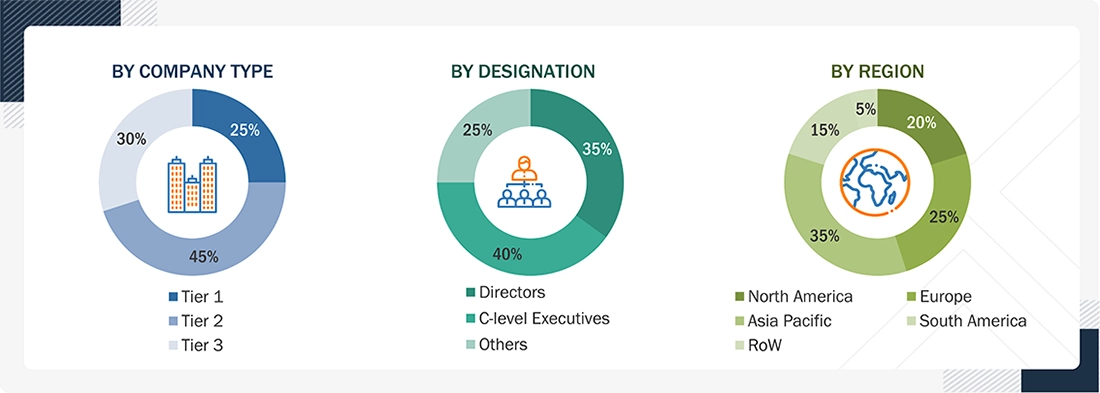
Notes: The three tiers of the companies are defined based on their total revenues in 2025, based on the availability of financial data. Tier 1: Revenue > USD 1 billion; Tier 2: USD 100 million ≤ Revenue ≤ USD 1 billion; Tier 3: Revenue < USD 100 million. Others include product managers, R&D managers, technical managers, production managers, procurement managers, sales and marketing managers, business development managers, application specialists, and quality assurance managers.
|
COMPANY |
DESIGNATION |
|
ADM (US) |
Regional Sales Manager |
|
PURIS (US) |
Marketing Manager |
|
Cargill, Incorporated (US) |
General Manager |
|
MGP (US) |
Product Manager |
|
International Flavors & Fragrances Inc. (US) |
Sales Executive |
To know about the assumptions considered for the study, download the pdf brochure
Market Size Estimation
The top-down and bottom-up approaches were used to estimate and validate the total size of the textured vegetable protein market. These approaches were also used extensively to determine the size of various subsegments in the market.
The research methodology used to estimate the market size includes the following details:
- The key players in the industry and the overall markets were identified through extensive secondary research.
- All shares, splits, and breakdowns were determined using secondary sources and verified through primary sources.
- All possible parameters that affect the market covered in this research study were accounted for, viewed in extensive detail, verified through primary research, and analyzed to obtain final quantitative and qualitative data.
- The research included the study of reports, reviews, and newsletters of top market players, along with extensive interviews for opinions from leaders, such as CEOs, directors, and marketing executives.
Textured Vegetable Protein Market : Top-Down and Bottom-Up Approach
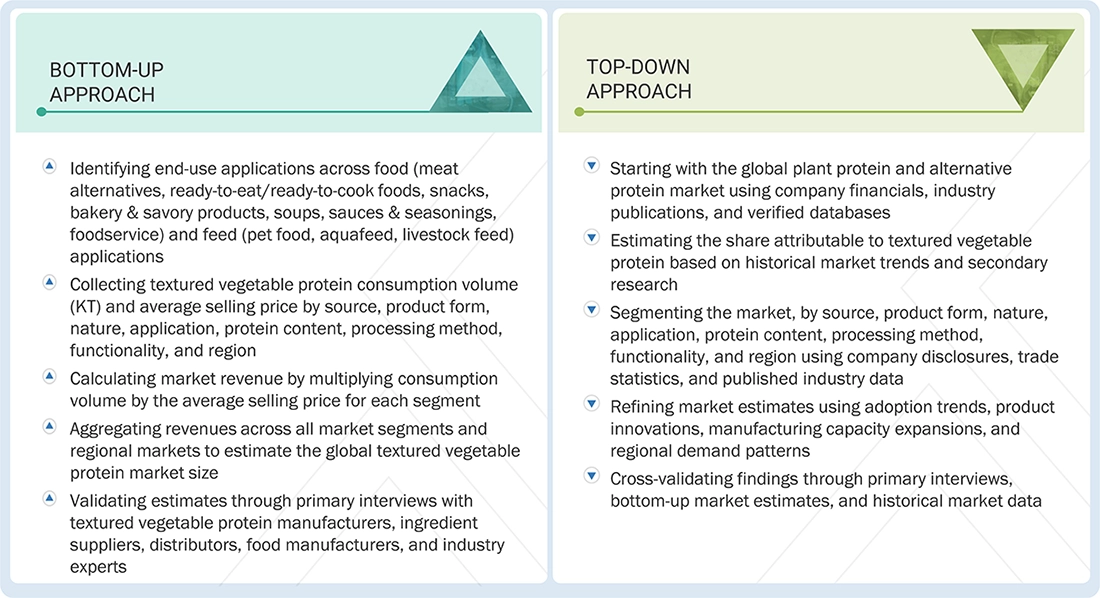
Data Triangulation
After determining the overall market size from the estimation process explained above, the total market was split into several segments and subsegments. The data triangulation procedure was employed, wherever applicable, to estimate the overall textured vegetable protein market and obtain precise statistics for all segments and subsegments. The data was triangulated by studying various factors and trends from the demand and supply sides. The market size was also validated using the top-down and bottom-up approaches.
Market Definition
According to the United States Department of Agriculture (USDA), textured vegetable protein (TVP) is a meat or poultry replacer. TVP, used as a fat-replacing ingredient in a standardized substitute product, complies with the general standard. According to the United States Agency for International Development (USAID), a government agency, textured soy protein (TSP) is a processed food product manufactured from either soybean flakes, soy flour, or soy protein concentrate. It can be uncolored or in caramel color and contains at least 52% protein on a dry basis.
Key Stakeholders
- Textured vegetable protein manufacturers
- Plant protein ingredient manufacturers
- Soy, pea, wheat, and pulse processors
- Raw material suppliers
- Plant-based meat manufacturers
- Processed food manufacturers
- Ready-to-eat and ready-to-cook food manufacturers
- Snack and bakery product manufacturers
- Pet food and animal feed manufacturers
- Ingredient distributors, importers, and exporters
- Foodservice operators and contract food manufacturers
- Retailers, supermarkets, and hypermarkets
- Equipment and extrusion technology providers
- Government and food safety authorities
- Food regulatory agencies and standards organizations
- Research institutes and universities
-
Associations, regulatory bodies, and other industry-related organizations
- Food and Agriculture Organization (FAO)
- Codex Alimentarius Commission (CAC)
- US Food and Drug Administration (FDA)
- United States Department of Agriculture (USDA)
- European Food Safety Authority (EFSA)
- Food Safety and Standards Authority of India (FSSAI)
-
Industry and trade associations
- Plant-based Foods Association (PBFA)
- Good Food Institute (GFI)
- Institute of Food Technologists (IFT)
- European Plant-based Foods Association (ENSA)
Report Objectives
- To determine and project the size of the textured vegetable protein market based on source, product form, protein content, nature, application, processing method, and region over the forecast period
- To identify key growth opportunities by analyzing the largest and fastest-growing segments across regions
- To provide detailed insights on factors influencing market growth, including drivers, restraints, opportunities, and challenges
- To evaluate market opportunities for stakeholders and present the competitive landscape of leading players
- To analyze micro-markets with respect to individual growth trends, future potential, and their contribution to the overall market
- To identify and profile key companies operating in the textured vegetable protein market
- To assess the competitive environment and highlight key strategies adopted by major players across regions
Available customizations:
With the given market data, MarketsandMarkets offers customizations according to company-specific scientific needs. The following customization options are available for the report:
Product Analysis
-
Product matrix, which gives a detailed comparison of the product portfolio of each company.
Segmental Analysis
-
With the given market data, MarketsandMarkets offers customizations according to company-specific scientific needs.
- Further breakdown of Rest of Europe by key countries
- Further breakdown of Rest of Asia Pacific by key countries
Company Information
-
Detailed analyses and profiling of additional market players (up to five)
Key Questions Addressed by the Report
What is the current size of the textured vegetable protein market?
The textured vegetable protein market is valued at USD 1.88 billion in 2025 and is projected to reach USD 2.79 billion by 2031. Growing consumer demand for plant-based foods, meat alternatives, and sustainable protein ingredients is driving market expansion across global food industries.
What is the CAGR of the textured vegetable protein market?
The textured vegetable protein market is expected to register a CAGR of 6.9% between 2026 and 2031. Rising investments in plant-based protein innovation, increasing vegan and flexitarian populations, and expanding food processing applications continue to support steady market growth.
What factors are driving the growth of the textured vegetable protein market?
The textured vegetable protein market growth is fueled by increasing health awareness, demand for meat substitutes, sustainability concerns, advancements in food processing technologies, and the growing popularity of high-protein, plant-based diets. Food manufacturers are also expanding their product portfolios with innovative TVP-based offerings.
What are the latest trends in the textured vegetable protein market?
Major trends include growing demand for pea-based textured proteins, expansion of organic product offerings, technological improvements in extrusion processing, and increasing use of TVP in ready-to-eat meals, snacks, and meat analogues.
What opportunities exist in the textured vegetable protein market?
Opportunities are emerging through product innovation, expansion into developing economies, rising demand for clean-label foods, partnerships with food manufacturers, and increasing applications in plant-based meat alternatives and convenience foods.
Fact checked
Personalize This Research
- Triangulate with your Own Data
- Get Data as per your Format and Definition
- Gain a Deeper Dive on a Specific Application, Geography, Customer or Competitor
- Any level of Personalization
Let Us Help You
- What are the Known and Unknown Adjacencies Impacting the Textured Vegetable Protein Market
- What will your New Revenue Sources be?
- Who will be your Top Customer; what will make them switch?
- Defend your Market Share or Win Competitors
- Get a Scorecard for Target Partners

Custom Market Research Services
We Will Customise The Research For You, In Case The Report Listed Above Does Not Meet With Your Requirements
Get 10% Free CustomisationTESTIMONIALS

Business Innovation Director
US Based Leading Agribusiness,
Food and Ingredients ManufacturerI highly appreciate the team's efficiency for a well conducted study that helped us clarify some blind spots in food and agricultural niche markets. Although compiling information for B2B markets is very difficult, the MnM team pulled out the task successfully. The quality of research, level of insights, and responsiveness of team were commendable.
- China Textured Vegetable Protein Market
- India Textured Vegetable Protein Market
- Japan Textured Vegetable Protein Market
- Brazil Textured Vegetable Protein Market
- Argentina Textured Vegetable Protein Market
- South America Textured Vegetable Protein Market
- Rest Of Europe Textured Vegetable Protein Market
- Rest Of Asia Pacific Textured Vegetable Protein Market
- US Textured Vegetable Protein Market
- Canada Textured Vegetable Protein Market
- Mexico Textured Vegetable Protein Market
- Germany Textured Vegetable Protein Market
- France Textured Vegetable Protein Market
- UK Textured Vegetable Protein Market
- Spain Textured Vegetable Protein Market
- Italy Textured Vegetable Protein Market
Growth opportunities and latent adjacency in Textured Vegetable Protein Market






Olivia
Jul, 2026
What are the major factors driving the growth of the TVP market?.
Samuel
Jul, 2026
What technological trends are shaping the future of the TVP market?.
Larry
Jul, 2026
What future trends are expected in the textured vegetable protein industry?.
George
Jul, 2026
Which source segment is expected to grow the fastest?.