



Wearable Technology Market Size, Share & Trends
Report Code
SE 2763
Published in
Jan, 2026, By MarketsandMarkets™
Wearable Technology Market Size, Share, Growth & Trends by Product (Smartwatch, Fitness Tracker, Head-Mounted Display, Smart Shoe, Smart Glass, Smart Vest, Smart Ring, Body-worn Camera, Exoskeleton, Skin Patch, Smart Helmet), Operation (AI, Conventional) - Global Forecast to 2032

USD 238.71 BN
MARKET SIZE, 2032

CAGR 14.7%
(2026-2032)

270
REPORT PAGES

150
MARKET TABLES
WEARABLE TECHNOLOGY MARKET OVERVIEW
According to Marketsandmarkets, the global wearable technology market size is projected to grow from USD 104.95 Billion in 2026 to USD 238.71 billion by 2032, growing at a CAGR of 14.7% from 2026 to 2032. The market is growing due to the increasing adoption of AI-enabled wearable devices, the rising demand for continuous health monitoring, and the expanding use of connected technologies across consumer and enterprise applications. Products such as smartwatches, fitness trackers, smart rings, earwear, smart glasses, head-mounted displays, and smart clothing are witnessing strong demand as users seek enhanced health insights, productivity, communication, and immersive experiences.
REPORT SCOPE
| REPORT METRIC | DETAILS |
|---|---|
| Market Size in 2025 (Value) | USD 87.19 Billion |
| Market Size in 2026 (Value) | USD 104.95 Billion |
| Market Forecast in 2032 (Value) | USD 238.71 Billion |
| Growth Rate | CAGR of 14.7% from 2026–2032 |
| Years Considered | 2022–2032 |
| Base Year | 2025 |
| Forecast Period | 2026–2032 |
| Units Considered | Value (USD Million/Billion), Volume (Million Units) |
| Report Coverage | Revenue Forecast, Company Ranking, Competitive Landscape, Growth Factors, and Trends |
| Top Companies |
|
| Growth Drivers |
|
| Segments Covered |
|
| Regions Covered | North America, Europe, Asia Pacific, and RoW |
The wearable technology industry is growing due to the increasing health and fitness consciousness, the reliance on remote patient monitoring, and the evolution of sensor technologies. Some of the key trends include AI-powered health analytics, integration with IoT ecosystems, growth in AR/VR wearables, and rising demand for smartwatches and smart clothing. The market is also growing as connectivity improves and user experience becomes more tailored.
WEARABLE ELECTRONICS MARKET
Wearable electronics market are smart electronic devices designed to be worn on the body, seamlessly integrating advanced sensors, connectivity, and computing capabilities into everyday accessories such as smartwatches, fitness trackers, smart glasses, medical patches, and smart clothing. These devices continuously monitor health metrics, physical activity, environmental conditions, and user behavior while enabling real-time data transmission through wireless technologies such as Bluetooth, Wi-Fi, and 5G. The rapid adoption of wearable electronics is driven by increasing consumer demand for health and fitness monitoring, advancements in miniaturized sensors and low-power semiconductor technologies, the growing popularity of the Internet of Things (IoT), and the integration of artificial intelligence (AI) for personalized insights. Beyond consumer applications, wearable electronics are gaining traction in healthcare, industrial safety, defense, and enterprise environments, supporting remote patient monitoring, workforce productivity, predictive maintenance, and enhanced situational awareness. As battery technology, flexible electronics, and edge AI continue to evolve, wearable electronics are expected to become more intelligent, energy-efficient, and integral to connected digital ecosystems.
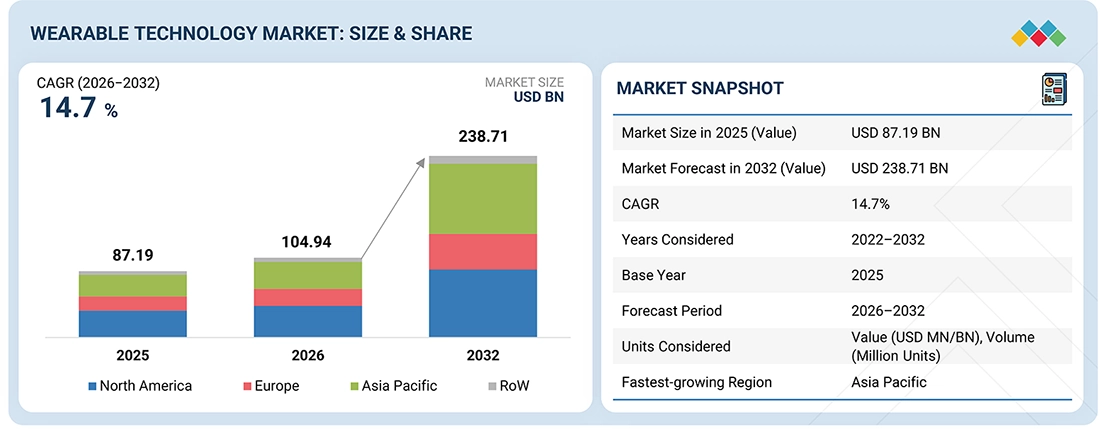
Source: Secondary Research, Interviews with Experts, MarketsandMarkets Analysis
KEY TAKEAWAYS
-
BY REGIONBy region, North America is expected to dominate the wearable technology market with a 35–40% share, in terms of value, in 2026.
-
BY PRODUCTBy product, the head-mounted displays segment is expected to register a CAGR of 22–24% between 2026 and 2032.
-
BY TYPEBy type, the wearable products (non-textiles) segment is anticipated to exhibit a growth rate of ~15% during the forecast period.
-
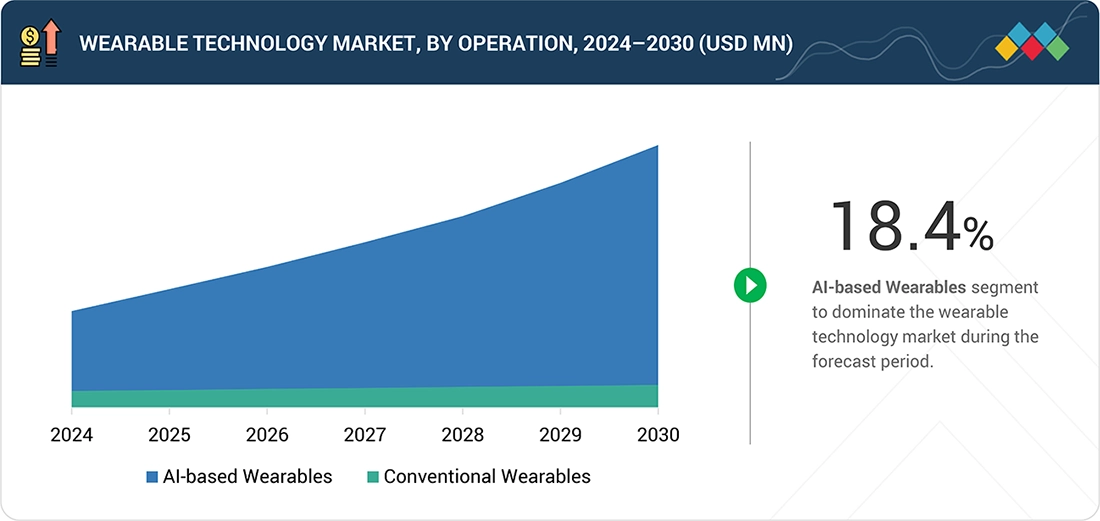
BY OPERATIONBy operation, the AI-based segment is expected to dominate the wearable technology market during the forecast period.
-
BY APPLICATIONBy application, the enterprise & industrial segment is expected to register a CAGR of 17–19% during the forecast period.
-
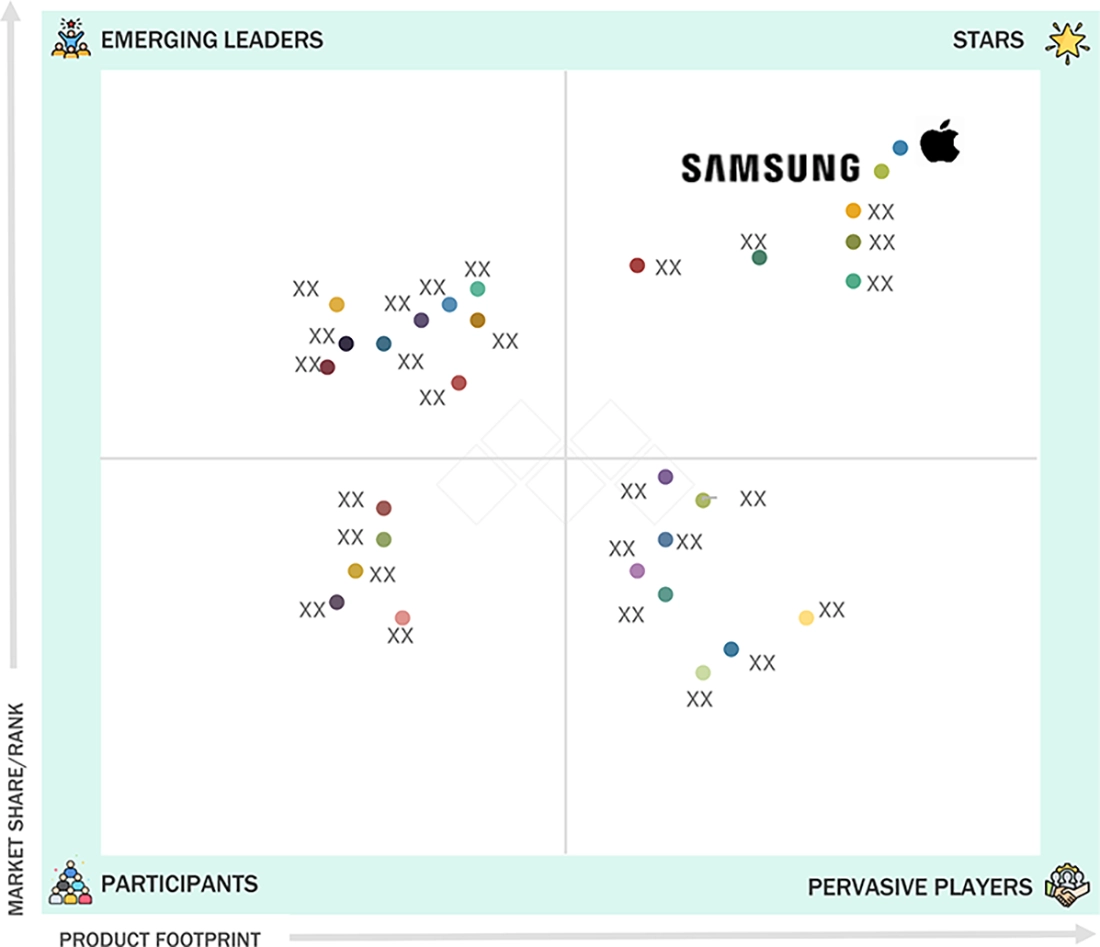
COMPETITIVE LANDSCAPE (KEY PLAYERS)Apple Inc. (US), SAMSUNG (South Korea), Xiaomi (China), Huawei Technologies Co., Ltd. (China), and Garmin Ltd. (US) were identified as star players in the wearable technology market due to their strong market share and extensive product footprint.
-
COMPETITIVE LANDSCAPE (STARTUPS/SMES)Vuzix (US), WHOOP (US), Comau (Italy), and Token (US), among others, have distinguished themselves among startups and SMEs by securing strong footholds in specialized niche areas, underscoring their potential as emerging market leaders in the wearable technology market.
The wearable technology industry is growing due to the increasing health and fitness consciousness, the reliance on remote patient monitoring, and the evolution of sensor technologies. Some of the key trends include AI-powered health analytics, integration with IoT ecosystems, growth in AR/VR wearables, and rising demand for smartwatches and smart clothing. The market is also growing as connectivity improves and user experience becomes more tailored.
TRENDS & DISRUPTIONS IMPACTING CUSTOMERS' CUSTOMERS
The wearable technology market trends is witnessing a shift in revenue generation from traditional connected devices toward AI-enabled and health-focused wearable ecosystems. While smartphones and mobile applications continue to support existing revenues, emerging technologies, such as smartwatches, fitness trackers, smart rings, and advanced health-monitoring wearables, are creating new growth opportunities. These devices are increasingly adopted across consumer electronics, healthcare, enterprise, and industrial sectors, driven by trends such as health tracking, contactless payments, artificial intelligence, digitalization, and the Internet of Things (IoT) adoption. As wearable technologies become more intelligent and interconnected, manufacturers are expanding their revenue mix through advanced sensing, personalized analytics, and integrated digital health solutions.
Investment and funding, the market has experienced strong growth, driven by rising consumer demand for health and fitness monitoring, AI-enabled smart devices, and connected ecosystems. Continuous innovations in sensors, batteries, smart displays, and IoT integration, along with increasing adoption of remote patient monitoring and digital healthcare solutions, are further accelerating market expansion.
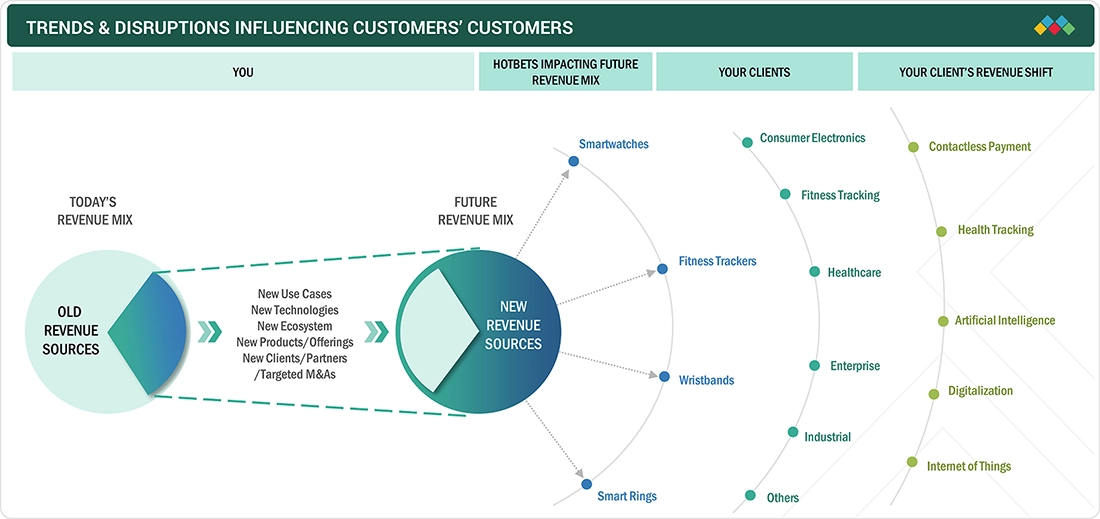
Source: Secondary Research, Interviews with Experts, MarketsandMarkets Analysis
MARKET DYNAMICS

Drivers
Impact
Level
Level
-
Rapid advances in flexible display technology

-
Growing consumer preference for sleek and compact devices


RESTRAINTS
Impact
Level
Level
-
Limited battery life

-
Security vulnerabilities


OPPORTUNITIES
Impact
Level
Level
-
Rising demand for compact devices to address computing and monitoring needs

-
Increasing preference for remote patient monitoring


CHALLENGES
Impact
Level
Level
-
Changing customer expectations

-
Regulatory issues and vulnerability of healthcare information

Source: Secondary Research, Interviews with Experts, MarketsandMarkets Analysis
Driver: Rapid advances in flexible display technology
Rapid advances in flexible display technology are significantly driving the wearable technology market growth by enabling lighter, thinner, and more durable devices with enhanced user experiences. Flexible OLED and micro LED displays support innovative form factors, such as smart rings, smart clothing, foldable wearables, and advanced smart glasses, increasing consumer adoption globally.
Restraint: Limited battery life
Limited battery life remains a major restraint for the wearable technology market share, as consumers increasingly demand continuous monitoring, connectivity, and AI-powered functionalities. Advanced features, such as health tracking, augmented reality, and real-time analytics, consume substantial power, creating challenges for manufacturers to balance performance, device size, convenience, and longevity.
Opportunity: Rising demand for compact devices to address computing and monitoring needs
The mounting demand for compact devices capable of delivering advanced computing and monitoring functions presents a significant opportunity for wearable technology manufacturers. Consumers and enterprises seek portable solutions for health tracking, communication, navigation, productivity, and safety applications, encouraging innovation in miniaturization, sensor integration, and intelligent wearable ecosystems.
Challenge: Changing customer expectations
Changing customer expectations pose a significant challenge for wearable technology companies as users increasingly demand greater accuracy, personalization, seamless connectivity, longer battery life, enhanced aesthetics, and stronger data privacy. Manufacturers must continuously innovate and rapidly adapt product offerings to meet evolving preferences while maintaining affordability and competitive differentiation.
WEARABLE TECHNOLOGY MARKET SIZE, SHARE & TRENDS: COMMERCIAL USE CASES ACROSS INDUSTRIES
| COMPANY | USE CASE DESCRIPTION | BENEFITS |
|---|---|---|
 |
Provides AI-enabled smartwatches and earwear for consumer health monitoring, fitness tracking, communication, and wellness management; Devices support ECG monitoring, activity tracking, sleep analysis, and seamless integration with connected digital ecosystems | Enhances preventive healthcare | Improves user engagement | Enables real-time health insights | Supports continuous wellness monitoring through advanced sensors and AI-driven analytics |
 |
Delivers smartwatches, smart rings, and earwear solutions for consumer electronics, healthcare, and fitness applications; Devices integrate health monitoring capabilities, AI-powered features, and connectivity across smartphones and cloud platforms | Improves health tracking accuracy | Strengthens connected experiences | Increases user convenience | Enables personalized recommendations through integrated wearable ecosystems |
 |
Offers cost-effective smartwatches, fitness trackers, and earwear designed for large-scale consumer adoption; Solutions focus on activity tracking, health monitoring, and connected lifestyle management across emerging and developed markets | Expands accessibility to wearable technology | Supports fitness and wellness objectives | Enhances user connectivity | Delivers value-driven wearable experiences |
 |
Develops smartwatches, fitness trackers, earwear, and smart glasses with advanced health monitoring and AI-enabled capabilities; Devices are utilized across consumer wellness, fitness, and productivity applications | Enables comprehensive health monitoring | Improves device intelligence | Supports seamless connectivity | Enhances user experiences through integrated hardware and software platforms |
 |
Provides advanced smartwatches and wearable devices for sports, fitness, outdoor recreation, aviation, and marine applications; Solutions incorporate GPS technologies, biometric monitoring, and performance analytics for professional and recreational users | Delivers accurate performance tracking | Improves athletic training outcomes | Supports navigation and safety applications | Enables data-driven decision-making across specialized use cases |
Logos and trademarks shown above are the property of their respective owners. Their use here is for informational and illustrative purposes only.
MARKET ECOSYSTEM
The wearable technology ecosystem comprises multiple stakeholders that collectively drive innovation, production, commercialization, and adoption. Hardware manufacturers, such as Apple, Samsung, Garmin, Huawei, Sony, Google, and Microsoft, develop wearable devices and integrated solutions. Component suppliers, including Qualcomm, Panasonic, STMicroelectronics, NXP, Texas Instruments, and OSRAM, provide processors, sensors, displays, and connectivity technologies. Distribution, marketing, and sales representatives, such as Amazon, Flipkart, Walmart, Best Buy, Reliance Digital, and Croma, facilitate market reach. At the same time, non-profit organizations, R&D institutes, and government agencies support innovation, regulation, research, and technology advancement across the global wearable technology market analysis.
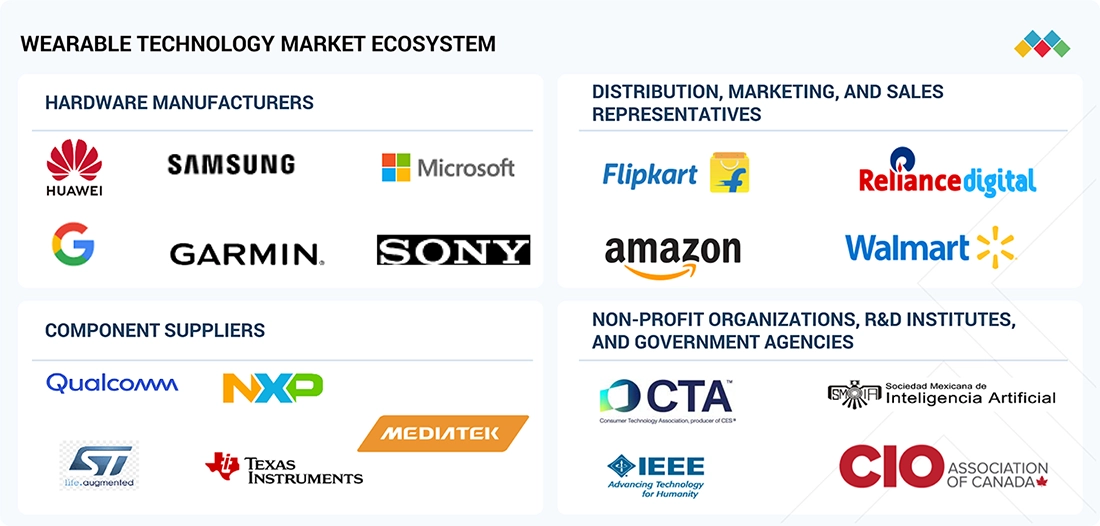
Logos and trademarks shown above are the property of their respective owners. Their use here is for informational and illustrative purposes only.
MARKET SEGMENTS
Source: Secondary Research, Interviews with Experts, MarketsandMarkets Analysis
Wearable Market, by Product
The head-mounted displays segment is expected to register the highest CAGR during the forecast period due to the increasing adoption of augmented reality (AR), virtual reality (VR), and mixed reality (MR) devices across consumer, enterprise, healthcare, and industrial applications. Increasing investments in immersive technologies, advancements in display systems, AI integration, and expanding metaverse-related use cases are accelerating the demand for next-generation wearable visualization solutions worldwide.
Market, by Type
The wearable products (non-textiles) segment is projected to register the highest growth rate during the forecast period, owing to strong demand for smartwatches, fitness trackers, smart rings, earwear, smart glasses, and head-mounted displays. Continuous innovation in sensors, connectivity, artificial intelligence, and health-monitoring capabilities, combined with broader consumer acceptance and increasing disposable incomes, is supporting sustained market growth globally.
Market, by Operation
The AI-based segment is expected to dominate the wearable market during the forecast period due to the growing demand for intelligent health monitoring, predictive analytics, voice assistance, activity recognition, and personalized user experiences. Advancements in edge AI, machine learning algorithms, and cloud-based processing capabilities are enabling wearables to deliver real-time insights, enhanced functionality, and greater operational efficiency across applications.
Market, by Application
The enterprise & industrial segment is anticipated to register the highest CAGR during the forecast period due to the increasing deployment of smart glasses, wearable cameras, smart helmets, and exoskeletons for worker safety, remote assistance, workforce productivity, and operational efficiency. Growing digital transformation initiatives, Industry 4.0 adoption, and rising investments in connected workforce solutions are further accelerating market expansion.
REGION
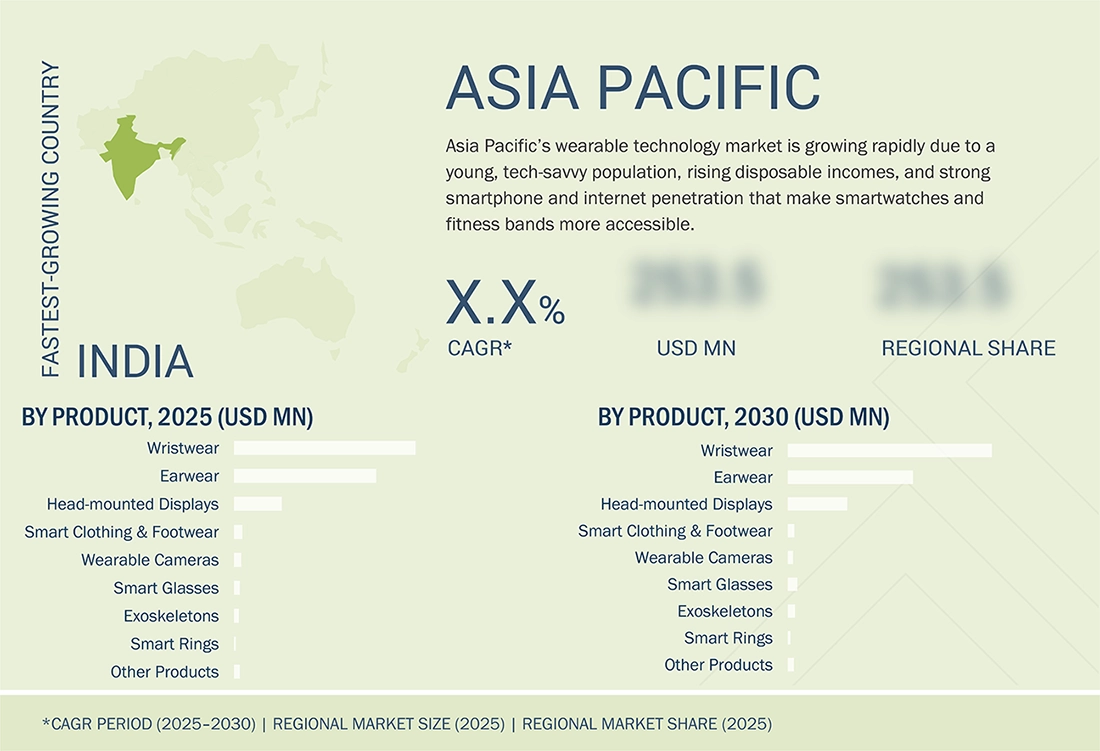
Asia Pacific to be fastest-growing region in wearable technology market during forecast period
Asia Pacific is expected to be the fastest-growing region during the forecast period, driven by rapid urbanization, rising disposable incomes, expanding consumer electronics adoption, and a strong manufacturing ecosystem. Growing demand for smartwatches, fitness trackers, earwear, smart rings, and AR/VR devices across China, India, Japan, and South Korea, coupled with increasing investments in digital health, AI-enabled wearables, and connected technologies, is accelerating regional market growth.
WEARABLE TECHNOLOGY MARKET SIZE, SHARE & TRENDS: COMPANY EVALUATION MATRIX
In the wearable technology market statistic matrix, Apple (Star) maintains a leading position through its strong ecosystem integration, premium product portfolio, and dominance in smartwatches, earwear, and emerging spatial computing devices. The company's continuous innovation, advanced health-monitoring capabilities, and loyal customer base drive sustained market leadership. Huawei (Emerging Leader) is rapidly expanding its presence with competitively priced wearables, strong technological capabilities, and growing adoption across Asia Pacific and international markets, positioning it to challenge established leaders during the forecast period.
Source: Secondary Research, Interviews with Experts, MarketsandMarkets Analysis
KEY MARKET PLAYERS - TOP WEARABLE TECHNOLOGY COMAPNIES
- Apple Inc. (US)
- SAMSUNG (South Korea)
- Xiaomi (China)
- Huawei Technologies Co., Ltd. (China)
- Garmin Ltd. (US)
- Imagine Marketing Limited (India)
- Sony Corporation (Japan)
- LG Electronics (South Korea)
- Alphabet Inc. (US)
- Lenovo (China)
WHAT IS IN IT FOR YOU: WEARABLE TECHNOLOGY MARKET SIZE, SHARE & TRENDS REPORT CONTENT GUIDE
DELIVERED CUSTOMIZATIONS
We have successfully delivered the following deep-dive customizations:
| CLIENT REQUEST | CUSTOMIZATION DELIVERED | VALUE ADDS |
|---|---|---|
| Wearable Device Manufacturer (Smartwatches, Earwear, Smart Rings, Smart Glasses, and AR/VR Devices) | Mapping of wearable device ecosystems across smartwatches, fitness trackers, earwear, smart rings, smart glasses, HMDs, and emerging wearable categories; benchmarking product portfolios, pricing strategies, AI capabilities, sensor integration, and regional market presence |
|
| Component Supplier (Sensors, Chipsets, Displays, Batteries, and Connectivity Modules) | Assessment of wearable device BOM structures, supplier relationships, sourcing strategies, technology adoption trends, and demand outlook across OEMs and product categories |
|
| Software/AI Platform Provider | Evaluation of on-device AI and cloud-based AI adoption across wearable devices; mapping of partnerships, operating systems, health platforms, and AI-enabled use cases |
|
| Healthcare/Digital Health Enterprise | Analysis of wearable adoption across clinical and non-clinical healthcare applications; assessment of remote patient monitoring, wellness tracking, regulatory landscape, and reimbursement trends |
|
| Retailer/Distributor/E-commerce Platform | Benchmarking of wearable product demand, ASP trends, consumer preferences, sales channels, and regional purchasing patterns across key markets |
|
RECENT DEVELOPMENTS
- August 2026 : Empatica received FDA 510(k) clearance for its Empatica Health Monitoring Platform to continuously monitor Parkinson disease symptoms. The wearable platform tracks bradykinesia, dyskinesia, tremor, sleep, and medication adherence using clinical-grade sensors and digital monitoring. Its algorithms have been validated across more than 70 peer-reviewed publications and 150+ hospitals and clinical sites. The technology brings objective, real-world data into Parkinson care, supporting more personalized treatment decisions and remote monitoring. The clearance expands Empatica’s clinical wearable portfolio into Parkinson disease while strengthening its position in digital health and precision care.
- August 2026 : Covestro, FILK Freiberg Institute, and OUT e.V. developed conductive textile compounds that integrate flexible electronics directly into fabrics. The Impranil-based smart textile technology combines carbon nanotubes with flexible polyurethane materials to enable embedded LEDs and sensors without conventional wiring. The technology supports real-time monitoring, active control, and bidirectional communication across textile surfaces. Applications include healthcare wearables, sportswear, protective equipment, and automotive interiors, including a sensor-controlled phototherapy bodysuit for newborns. The innovation advances smart textiles toward more flexible, scalable, comfortable, and multifunctional wearable solutions.
- July 2026 : Oura Health, Plaud, Samsung, TAG Heuer, Whoop, and EssilorLuxottica/Meta are advancing stylish wearable technology with discreet smart rings, AI note-taking devices, smartwatches, health trackers, and connected eyewear. Oura Ring 4 and Samsung Galaxy Ring deliver continuous health and sleep tracking in compact titanium designs. Plaud NotePin S brings AI-powered recording and transcription to a lightweight wearable form factor, while Whoop MG provides screen-free health and fitness monitoring. TAG Heuer Connected Calibre E5 and Ray-Ban Meta Wayfarer Gen 2 combine premium design with smart functionality, including health tracking, cameras, audio, and AI features. The latest generation of wearable technology is increasingly blending into everyday fashion, making connected devices more discreet, functional, and style-focused.
- July 2026 : ANF Care, a Spain-based wellness brand under Amino Frequency Corporation, introduced its frequency-coded wearable discs to the U.S. market. The skin-applied ANF Care wearable technology uses proprietary frequency coding and the company’s BioCoherence concept to support rest, calm, and energy. The non-invasive, battery-free format offers an alternative to supplements, pills, and topical wellness products. ANF Care has developed the technology through 15 years of R&D and has practitioner adoption across more than 50 countries. The launch expands frequency-based wearable wellness into the U.S. consumer market with a discreet, low-maintenance format.
- July 2026 : Wearable technology is emerging as a powerful tool for digital content creation, enabling creators to capture first-person experiences through smart glasses, wearable cameras, audio devices, and AI-powered tools. Hands-free cameras can make content creation faster, more mobile, and less intrusive while opening new formats for travel, fitness, events, product demonstrations, and lifestyle content. Wearables also help solo creators capture spontaneous moments without dedicated production equipment. For brands, the technology offers new opportunities for authentic social content, event coverage, product demos, and influencer campaigns. The convergence of wearables and content creation is creating a faster, more immersive, and increasingly platform-ready media workflow.
Table of Contents
 Exclusive indicates content/data unique to MarketsandMarkets and not available with any competitors.
TITLE
PAGE NO
1
INTRODUCTION
29
2
EXECUTIVE SUMMARY
35
3
PREMIUM INSIGHTS
42
4
MARKET OVERVIEW
Next-gen displays and IoT drive wearable growth, but battery and security issues persist.
46
4.1
INTRODUCTION
4.2
MARKET DYNAMICS
4.2.1
DRIVERS
4.2.1.1
INCREASING GROWTH PROSPECTS OF NEXT-GENERATION DISPLAYS IN WEARABLE DEVICES
4.2.1.2
GROWING CONSUMER PREFERENCE FOR SLEEK AND COMPACT DEVICES IN FITNESS AND HEALTHCARE APPLICATIONS
4.2.1.3
RISING POPULARITY OF IOT AND CONNECTED DEVICES
4.2.1.4
AUGMENTED REALITY INTEGRATION IN WEARABLES ENHANCES IMMERSIVE, CONTEXT-AWARE EXPERIENCES
4.2.1.5
HANDS-FREE BANKING AND PAYMENTS ENHANCE CONVENIENCE AND SECURITY FOR CUSTOMERS
4.2.2
RESTRAINTS
4.2.2.1
LIMITED BATTERY LIFE
4.2.2.2
SECURITY VULNERABILITIES IN WEARABLE-TO-NETWORK CONNECTIONS POSE DATA PROTECTION CHALLENGES
4.2.3
OPPORTUNITIES
4.2.3.1
DEMAND FOR WEARABLES THAT INTEGRATE ALL COMPUTING REQUIREMENTS IN ONE COMPACT DEVICE
4.2.3.2
ADOPTION OF WEARABLES IN MULTIPLE APPLICATIONS
4.2.3.3
DATA-DRIVEN PERFORMANCE OPTIMIZATION IN SPORTS THROUGH REAL-TIME MONITORING OF ATHLETE METRICS
4.2.3.4
GROWING INTEGRATION OF AR/VR AND AFFORDABLE DESIGNS
4.2.4
CHALLENGES
4.2.4.1
DEMAND FOR CONTINUOUS DEVELOPMENTS IN DEVICES
4.2.4.2
UNADDRESSED REGULATORY ISSUES AND VULNERABILITY OF HEALTHCARE INFORMATION
4.2.4.3
ACHIEVING LONG-TERM, SUSTAINABLE CUSTOMER ENGAGEMENT
4.3
INTERCONNECTED MARKETS AND CROSS-SECTOR OPPORTUNITIES
4.4
STRATEGIC MOVES BY TIER-1/2/3 PLAYERS
5
INDUSTRY TRENDS
Uncover how evolving industry dynamics and tech innovations shape the future of global markets.
60
5.1
PORTER’S FIVE FORCES ANALYSIS
5.1.1
BARGAINING POWER OF SUPPLIERS
5.1.2
BARGAINING POWER OF BUYERS
5.1.3
THREAT OF NEW ENTRANTS
5.1.4
THREAT OF SUBSTITUTES
5.1.5
INTENSITY OF COMPETITIVE RIVALRY
5.2
MACROECONOMIC OUTLOOK
5.2.1
INTRODUCTION
5.2.2
GDP TRENDS AND FORECAST
5.2.3
TRENDS IN GLOBAL CONSUMER ELECTRONICS INDUSTRY
5.2.4
TRENDS IN GLOBAL HEALTHCARE INDUSTRY
5.3
VALUE CHAIN ANALYSIS
5.4
ECOSYSTEM ANALYSIS
5.5
PRICING ANALYSIS
5.5.1
PRICING RANGE OF WEARABLE TECHNOLOGY PRODUCTS OFFERED BY KEY PLAYERS, 2025
5.5.2
AVERAGE SELLING PRICE TREND OF SMARTWATCHES, BY REGION
5.5.3
AVERAGE SELLING PRICE TREND OF FITNESS TRACKERS, BY REGION
5.5.4
AVERAGE SELLING PRICE TREND OF SMART EARWEAR, BY REGION
5.6
TRADE ANALYSIS
5.6.1
IMPORT SCENARIO (HS CODE 910212)
5.6.2
EXPORT SCENARIO (HS CODE 910212)
5.7
KEY CONFERENCES AND EVENTS, 2026–2027
5.8
TRENDS/DISRUPTIONS IMPACTING CUSTOMER BUSINESS
5.9
INVESTMENT AND FUNDING SCENARIO
5.10
CASE STUDY ANALYSIS
5.10.1
SAMSUNG ALLOWS USERS TO EXPERIENCE S9’S ARCORE CAPABILITIES THROUGH VRAI’S INTERACTIVE AR CAMERA AND SAMPLE MARKERS
5.10.2
BMW REVOLUTIONIZES OPERATIONS WITH XR TECHNOLOGY INTEGRATION
5.10.3
VEE WEAR SOFTWARE PLATFORM ENHANCES SMARTWATCHES BY ENSURING ULTRA-FAST CUSTOMIZATION
5.10.4
HEALTHCARE AND TELEMATICS SECTORS ADOPT WEARABLE TECHNOLOGY TO IMPROVE PERSONAL WELL-BEING AND SAFETY
5.10.5
REMOTE HEALTH MONITORING AND ACTIVITY ANALYTICS IMPROVE PERSONALIZED WELLNESS THROUGH BIOSTRAP WEARABLE TECHNOLOGY
5.11
IMPACT OF US TARIFF – WEARABLE TECHNOLOGY MARKET
5.11.1
INTRODUCTION
5.11.2
KEY TARIFF RATES
5.11.3
PRICE IMPACT ANALYSIS
5.11.4
IMPACT ON COUNTRIES/REGIONS
5.11.4.1
US
5.11.4.2
EUROPE
5.11.4.3
ASIA PACIFIC
5.11.5
IMPACT ON INDUSTRIES
6
TECHNOLOGICAL ADVANCEMENTS, AI-DRIVEN IMPACT, PATENTS, AND INNOVATIONS
AI-driven innovations redefine wearable tech with cutting-edge patents and IoT integration strategies.
87
6.1
KEY TECHNOLOGIES
6.1.1
OPTICAL SENSORS
6.1.2
ACCELEROMETERS
6.2
COMPLEMENTARY TECHNOLOGIES
6.2.1
IOT INTEGRATION
6.3
ADJACENT TECHNOLOGIES
6.3.1
FLEXIBLE ELECTRONICS
6.4
TECHNOLOGY ROADMAP
6.5
PATENT ANALYSIS, 2017–2026
6.6
IMPACT OF AI ON WEARABLE TECHNOLOGY MARKET
6.6.1
TOP USE CASES AND MARKET POTENTIAL
6.6.2
BEST PRACTICES FOLLOWED BY MANUFACTURERS IN MARKET
6.6.3
CASE STUDIES RELATED TO AI IMPLEMENTATION IN MARKET
6.6.4
INTERCONNECTED ECOSYSTEM AND IMPACT ON MARKET PLAYERS
6.6.5
CLIENTS' READINESS TO ADOPT AI-INTEGRATED WEARABLE TECHNOLOGY
6.7
SUCCESS STORIES AND REAL-WORLD APPLICATIONS
7
REGULATORY LANDSCAPE
Navigate global compliance with insights into key regulations and standards across major regions.
96
7.1
REGIONAL REGULATIONS AND COMPLIANCE
7.1.1
REGULATORY BODIES, GOVERNMENT AGENCIES, AND OTHER ORGANIZATIONS
7.1.2
STANDARDS
7.1.2.1
GENERAL DATA PROTECTION REGULATION (GDPR)
7.1.2.2
FEDERAL COMMUNICATIONS COMMISSION (FCC)
7.1.2.3
IEC 62368
7.1.2.4
IEEE STANDARDS FOR AI ETHICS AND TRANSPARENCY
7.1.2.5
HEALTH INSURANCE PORTABILITY AND ACCOUNTABILITY ACT (HIPAA)
7.1.2.6
ISO 13485
7.1.2.7
BLUETOOTH SPECIAL INTEREST GROUP (SIG) STANDARDS
7.1.3
GOVERNMENT REGULATIONS
7.1.3.1
US
7.1.3.2
EUROPE
7.1.3.3
CHINA
7.1.3.4
JAPAN
8
CUSTOMER LANDSCAPE AND BUYER BEHAVIOR
Identify key decision-makers and criteria to overcome adoption barriers and boost market profitability.
100
8.1
DECISION-MAKING PROCESS
8.2
KEY STAKEHOLDERS AND BUYING CRITERIA
8.2.1
KEY STAKEHOLDERS IN BUYING PROCESS
8.2.2
BUYING CRITERIA
8.3
ADOPTION BARRIERS AND INTERNAL CHALLENGES
8.4
UNMET NEEDS OF VARIOUS INDUSTRIES
8.5
MARKET PROFITABILITY
9
WEARABLE TECHNOLOGY MARKET, BY TECHNOLOGY
Market Size & Growth Rate Forecast Analysis
109
9.1
INTRODUCTION
9.2
COMPUTING
9.3
DISPLAY
9.4
NETWORKING
9.5
POSITIONING
10
WEARABLE TECHNOLOGY MARKET, BY CONNECTIVITY
Market Size & Growth Rate Forecast Analysis
112
10.1
INTRODUCTION
10.2
WI-FI
10.3
BLUETOOTH
10.4
CELLULAR
10.5
NEAR FIELD COMMUNICATION
11
WEARABLE TECHNOLOGY MARKET, BY VERTICAL
Market Size & Growth Rate Forecast Analysis
115
11.1
INTRODUCTION
11.2
GAMING
11.2.1
USE CASE: ADVANCING COMMUNICATION IN VIRTUAL REALITY THROUGH GESTURES
11.3
FASHION
11.3.1
USE CASE: ENHANCING INNOVATION AND EFFICIENCY IN FASHION MARKET
11.4
EDUCATION
11.4.1
USE CASE: IMPROVING PHARMACY EDUCATION BY INTEGRATING AUGMENTED REALITY INTO WEARABLE TECHNOLOGY
11.5
INDUSTRIAL
11.5.1
USE CASE: TRANSFORMING EMPLOYEE ONBOARDING EXPERIENCES BY LEVERAGING VIRTUAL REALITY TECHNOLOGY
12
WEARABLE TECHNOLOGY MARKET, BY DISTRIBUTION CHANNEL
Market Size & Growth Rate Forecast Analysis
119
12.1
INTRODUCTION
12.2
OFFLINE
12.3
ONLINE
13
WEARABLE TECHNOLOGY MARKET, BY OPERATING SYSTEM
Market Size & Growth Rate Forecast Analysis
120
13.1
INTRODUCTION
13.2
ANDROID
13.3
WEAR OS
13.4
RTOS
13.5
WINDOWS
13.6
WATCHOS
13.7
OTHER OPERATING SYSTEMS
14
WEARABLE TECHNOLOGY MARKET, BY COMPONENT
Market Size & Growth Rate Forecast Analysis
122
14.1
INTRODUCTION
14.2
POWER SUPPLY COMPONENTS
14.3
POSITIONING AND NETWORKING COMPONENTS
14.4
CONTROL COMPONENTS
14.5
DISPLAY AND OPTOELECTRONIC COMPONENTS
14.6
MEMORY COMPONENTS
14.7
INTERFACE COMPONENTS
14.7.1
MICROPHONES & MICROSPEAKERS
14.7.2
TOUCH SENSORS
14.8
SENSORS
14.8.1
ACCELEROMETERS
14.8.2
MAGNETOMETERS
14.8.3
GYROSCOPES
14.8.4
INERTIAL SENSORS
14.8.5
MOTION SENSORS
14.8.6
PRESSURE & FORCE SENSORS
14.8.7
TEMPERATURE & HUMIDITY SENSORS
14.8.8
MEDICAL-BASED SENSORS
14.8.9
IMAGE SENSORS
15
WEARABLE TECHNOLOGY MARKET, BY PRODUCT
Market Size & Growth Rate Forecast Analysis to 2032 in USD Million and Units | 100 Data Tables
129
15.1
INTRODUCTION
15.2
WRISTWEAR
15.2.1
SMARTWATCHES
15.2.1.1
INCREASING USE OF SMARTWATCHES IN HEALTHCARE AND FITNESS TO BOOST MARKET
15.2.2
FITNESS TRACKERS
15.2.2.1
INNOVATIONS IN FITNESS TRACKERS TO PROPEL GROWTH
15.3
HEAD-MOUNTED DISPLAYS
15.3.1
AUGMENTED REALITY (AR)
15.3.1.1
AR SMART GLASSES TO DRIVE GROWTH ACROSS ENTERPRISE, HEALTHCARE, RETAIL, AUTOMOTIVE, AND CONSUMER SECTORS
15.3.2
VIRTUAL REALITY (VR)
15.3.2.1
VR APPLICATIONS IN MOTION PICTURES AND VIDEO GAMES TO BOOST MARKET GROWTH
15.3.3
OTHER HEAD-MOUNTED DISPLAYS
15.4
SMART CLOTHING & FOOTWEAR
15.4.1
SMART SHOES
15.4.1.1
INNOVATIONS IN SMART SHOE TECHNOLOGY TO ACCELERATE MARKET GROWTH
15.4.2
SMART VESTS
15.4.2.1
REAL-TIME HEALTH MONITORING AND PERSONALIZED FITNESS TO PROPEL GROWTH
15.4.3
OTHER SMART CLOTHING & FOOTWEAR PRODUCTS
15.5
SMART GLASSES
15.5.1
BASIC
15.5.1.1
BASIC SMART GLASSES ENABLE CONTINUOUS EVERYDAY HEALTH MONITORING THROUGH INTEGRATED WEARABLE SENSORS
15.5.2
ADVANCED
15.5.2.1
ADVANCED SMART GLASSES INTEGRATE AI, AUGMENTED REALITY, AND ADVANCED HEALTH MONITORING TO TRANSFORM CONNECTED WEARABLE EXPERIENCES
15.6
SMART RINGS
15.6.1
SURGING POPULARITY OF SMART RINGS TO PROPEL MARKET GROWTH
15.7
WEARABLE CAMERAS
15.7.1
NEED FOR ENHANCED SAFETY AND SECURITY TO DRIVE MARKET
15.8
EARWEAR
15.8.1
INCREASING ADOPTION OF WIRELESS AUDIO DEVICES TO PROPEL MARKET
15.9
EXOSKELETONS
15.9.1
ADVANCEMENTS IN EXOSKELETONS TO ACCELERATE MARKET GROWTH
15.10
OTHER PRODUCTS
16
WEARABLE TECHNOLOGY MARKET, BY OPERATION
Market Size & Growth Rate Forecast Analysis to 2032 in USD Million | 20 Data Tables
171
16.1
INTRODUCTION
16.2
AI-BASED
16.2.1
ON-DEVICE AI
16.2.1.1
REAL-TIME DATA PROCESSING AND PRIVACY PROTECTION TO DRIVE DEMAND
16.2.2
CLOUD-BASED AI
16.2.2.1
EASE OF IMPLEMENTATION AND COST-EFFECTIVENESS OF CLOUD-BASED AI TO DRIVE MARKET
16.3
CONVENTIONAL
16.3.1
SENSOR-BASED CONVENTIONAL WEARABLES OFFER RELIABLE PERFORMANCE FOR BASIC HEALTH AND ACTIVITY TRACKING
17
WEARABLE TECHNOLOGY MARKET, BY TYPE
Market Size & Growth Rate Forecast Analysis to 2032 in USD Million | 2 Data Tables
181
17.1
INTRODUCTION
17.2
WEARABLE SMART TEXTILES
17.2.1
ACTIVE
17.2.1.1
FLEXIBLE APPLICATIONS IN WEARABLES, AUTOMOTIVE, AND OTHER SECTORS TO BOOST MARKET
17.2.2
PASSIVE
17.2.2.1
WIDE ADOPTION IN OUTDOOR APPAREL, MEDICAL WEARABLES, AND VARIOUS CONSUMER GOODS TO PROPEL ADOPTION
17.2.3
ULTRA-SMART
17.2.3.1
PIVOTAL IN INDUSTRIES REQUIRING BOTH ADVANCED FUNCTIONALITY AND SEAMLESS INTEGRATION
17.3
WEARABLE PRODUCTS (NON-TEXTILES)
17.3.1
ENHANCE USER EXPERIENCE THROUGH DATA COLLECTION AND INTERACTION
18
WEARABLE TECHNOLOGY MARKET, BY APPLICATION
Market Size & Growth Rate Forecast Analysis to 2032 in USD Million | 2 Data Tables
185
18.1
INTRODUCTION
18.2
CONSUMER ELECTRONICS
18.2.1
FITNESS & SPORTS
18.2.1.1
INCREASING HEALTH CONSCIOUSNESS TO BOOST ADOPTION
18.2.2
INFOTAINMENT & MULTIMEDIA
18.2.2.1
GROWING GAMING INDUSTRY TO ACCELERATE MARKET GROWTH
18.2.3
GARMENTS & FASHION
18.2.3.1
COMMERCIALIZATION OF E-TEXTILES AND AI WEARABLES ACCELERATES MARKET EXPANSION
18.2.4
MULTIFUNCTION
18.2.4.1
AR MODELING AND 3D VISUALIZATION ARE EXPECTED TO BOOST HEALTHCARE SECTOR
18.3
HEALTHCARE
18.3.1
CLINICAL APPLICATIONS
18.3.1.1
AI-ENABLED CLINICAL WEARABLES ADVANCE REAL-TIME PATIENT MONITORING AND INTELLIGENT HEALTHCARE DELIVERY
18.3.2
NON-CLINICAL APPLICATIONS
18.3.2.1
NON-CLINICAL WEARABLES EXPAND PREVENTIVE HEALTHCARE THROUGH CONTINUOUS REMOTE MONITORING AND WELLNESS ANALYTICS
18.4
ENTERPRISE & INDUSTRIAL
18.4.1
LOGISTICS, PACKAGING, & WAREHOUSE
18.4.1.1
SMART WEARABLES TO ENHANCE WAREHOUSE EFFICIENCY AND WORKFORCE PRODUCTIVITY IN LOGISTICS
18.4.2
OTHER ENTERPRISE & INDUSTRIAL APPLICATIONS
18.5
OTHER APPLICATIONS
19
WEARABLE TECHNOLOGY MARKET, BY REGION
Comprehensive coverage of 9 Regions with country-level deep-dive of 11 Countries | 36 Data Tables.
194
19.1
INTRODUCTION
19.2
NORTH AMERICA
19.2.1
MACROECONOMIC OUTLOOK FOR NORTH AMERICA
19.2.2
US
19.2.2.1
RISING DIABETES PREVALENCE TO DRIVE DEMAND FOR WEARABLE HEALTH TECHNOLOGY
19.2.3
CANADA
19.2.3.1
STRATEGIC R&D INVESTMENTS TO PROPEL MARKET
19.2.4
MEXICO
19.2.4.1
PARTNERSHIPS AND PRODUCT LAUNCHES TO BOOST MARKET GROWTH
19.3
EUROPE
19.3.1
MACROECONOMIC OUTLOOK FOR EUROPE
19.3.2
UK
19.3.2.1
AGING POPULATION AND HEALTHCARE INNOVATION TO DRIVE WEARABLE TECHNOLOGY ADOPTION
19.3.3
GERMANY
19.3.3.1
EXPANSION OF DIGITAL HEALTHCARE AND REMOTE PATIENT MONITORING ECOSYSTEM TO PROPEL MARKET GROWTH
19.3.4
FRANCE
19.3.4.1
INCREASING ADOPTION OF WEARABLE TECHNOLOGY IN HEALTHCARE AND FITNESS TO DRIVE GROWTH
19.3.5
ITALY
19.3.5.1
AI-POWERED WEARABLES STRENGTHEN LOGISTICS EFFICIENCY AND SMART WAREHOUSE OPERATIONS
19.3.6
REST OF EUROPE
19.4
ASIA PACIFIC
19.4.1
MACROECONOMIC OUTLOOK FOR ASIA PACIFIC
19.4.2
CHINA
19.4.2.1
LARGE PRESENCE OF KEY MARKET PLAYERS TO BOOST MARKET GROWTH
19.4.3
JAPAN
19.4.3.1
GROWING AGING POPULATION TO PROPEL MARKET GROWTH
19.4.4
SOUTH KOREA
19.4.4.1
INNOVATIONS AND PRODUCT DEVELOPMENTS TO DRIVE MARKET
19.4.5
INDIA
19.4.5.1
MAKE IN INDIA INITIATIVE TO DRIVE GROWTH
19.4.6
REST OF ASIA PACIFIC
19.5
ROW
19.5.1
MACROECONOMIC OUTLOOK FOR ROW
19.5.2
SOUTH AMERICA
19.5.2.1
RISING PREVALENCE OF LIFESTYLE-RELATED DISEASES TO ACCELERATE MARKET DEMAND
19.5.3
MIDDLE EAST
19.5.3.1
INDUSTRIALIZATION AND GOVERNMENT INITIATIVES TO FUEL MARKET GROWTH
19.5.3.2
GCC COUNTRIES
19.5.3.3
REST OF MIDDLE EAST
19.5.4
AFRICA
19.5.4.1
RISING INTERNET AND MOBILE TECHNOLOGY PENETRATION TO DRIVE GROWTH
20
COMPETITIVE LANDSCAPE
Discover strategic moves and market dominance shaping the competitive landscape through 2026.
222
20.1
OVERVIEW
20.2
KEY PLAYER STRATEGIES/RIGHT TO WIN, 2022–2026
20.3
REVENUE ANALYSIS, 2021–2025
20.4
MARKET SHARE ANALYSIS, 2025
20.5
COMPANY VALUATION AND FINANCIAL METRICS, 2025
20.6
BRAND COMPARATIVE ANALYSIS
20.7
COMPANY EVALUATION MATRIX: KEY PLAYERS, 2025
20.7.1
STARS
20.7.2
EMERGING LEADERS
20.7.3
PERVASIVE PLAYERS
20.7.4
PARTICIPANTS
20.7.5
COMPANY FOOTPRINT: KEY PLAYERS, 2025
20.7.5.1
COMPANY FOOTPRINT
20.7.5.2
REGION FOOTPRINT
20.7.5.3
PRODUCT FOOTPRINT
20.7.5.4
OPERATION FOOTPRINT
20.7.5.5
TYPE FOOTPRINT
20.7.5.6
APPLICATION FOOTPRINT
20.8
COMPANY EVALUATION MATRIX: STARTUPS/SMES, 2025
20.8.1
PROGRESSIVE COMPANIES
20.8.2
RESPONSIVE COMPANIES
20.8.3
DYNAMIC COMPANIES
20.8.4
STARTING BLOCKS
20.8.5
COMPETITIVE BENCHMARKING: STARTUPS/SMES, 2025
20.8.5.1
DETAILED LIST OF KEY STARTUPS/SMES
20.8.5.2
COMPETITIVE BENCHMARKING OF KEY STARTUPS/SMES
20.9
COMPETITIVE SCENARIO
20.9.1
PRODUCT LAUNCHES AND DEVELOPMENTS
20.9.2
DEALS
21
COMPANY PROFILES
In-depth Company Profiles of Leading Market Players with detailed Business Overview, Product and Service Portfolio, Recent Developments, and Unique Analyst Perspective (MnM View)
243
21.1
KEY PLAYERS
21.1.1
XIAOMI
21.1.1.1
BUSINESS OVERVIEW
21.1.1.2
PRODUCTS/SOLUTIONS/SERVICES OFFERED
21.1.1.3
RECENT DEVELOPMENTS
21.1.1.3.1
PRODUCT LAUNCHES
21.1.1.3.2
DEALS
21.1.1.4
MNM VIEW
21.1.1.4.1
KEY STRENGTHS
21.1.1.4.2
STRATEGIC CHOICES
21.1.1.4.3
WEAKNESSES AND COMPETITIVE THREATS
21.1.2
APPLE INC.
21.1.3
HUAWEI TECHNOLOGIES CO., LTD.
21.1.4
SAMSUNG
21.1.5
GARMIN LTD.
21.1.6
SONY GROUP CORPORATION
21.1.7
ALPHABET INC.
21.1.8
LENOVO
21.1.9
META
21.1.10
OPPO
21.1.11
IMAGINE MARKETING LIMITED
21.2
OTHER PLAYERS
21.2.1
VUZIX
21.2.2
MOTOROLA MOBILITY LLC
21.2.3
INTELLITIX
21.2.4
COMAU
21.2.5
HYUNDAI MOTOR COMPANY
21.2.6
CYBERDYNE INC.
21.2.7
EKSO BIONICS
21.2.8
MCLEAR LTD.
21.2.9
JAKCOM TECHNOLOGY CO., LTD.
21.2.10
TOKEN
21.2.11
ADIDAS AG
21.2.12
LIFESENSE GROUP B.V.
21.2.13
DYNABOOK AMERICAS, INC.
21.2.14
OPTINVENT
21.2.15
SEIKO EPSON CORPORATION
21.2.16
WHOOP
21.2.17
MOTIV INC.
21.2.18
BRAGI
21.2.19
CLIM8
21.2.20
PROGLOVE
21.2.21
BIOBEAT
21.2.22
MOOV INC.
22
RESEARCH METHODOLOGY
311
22.1
RESEARCH DATA
22.1.1
SECONDARY AND PRIMARY RESEARCH
22.1.2
SECONDARY DATA
22.1.2.1
MAJOR SECONDARY SOURCES
22.1.2.2
KEY DATA FROM SECONDARY SOURCES
22.1.3
PRIMARY DATA
22.1.3.1
INTENDED PARTICIPANTS IN PRIMARY INTERVIEWS
22.1.3.2
KEY PRIMARY INTERVIEW PARTICIPANTS
22.1.3.3
BREAKDOWN OF PRIMARIES
22.1.3.4
KEY DATA FROM PRIMARY SOURCES
22.1.3.5
KEY INDUSTRY INSIGHTS
22.2
MARKET SIZE ESTIMATION METHODOLOGY
22.2.1
BOTTOM-UP APPROACH
22.2.1.1
APPROACH TO ARRIVE AT MARKET SIZE USING BOTTOM-UP ANALYSIS (DEMAND SIDE)
22.2.2
TOP-DOWN APPROACH
22.2.2.1
APPROACH TO ARRIVE AT MARKET SIZE USING TOP-DOWN ANALYSIS (SUPPLY SIDE)
22.3
DATA TRIANGULATION
22.4
RESEARCH ASSUMPTIONS
22.5
RESEARCH LIMITATIONS
22.6
RISK ANALYSIS
23
APPENDIX
323
23.1
DISCUSSION GUIDE
23.2
KNOWLEDGESTORE: MARKETSANDMARKETS’ SUBSCRIPTION PORTAL
23.3
CUSTOMIZATION OPTIONS
23.4
RELATED REPORTS
23.5
AUTHOR DETAILS
LIST OF TABLES
TABLE 1
WEARABLE TECHNOLOGY MARKET: SUMMARY OF CHANGES
TABLE 2
INTERCONNECTED MARKETS AND CROSS-SECTOR OPPORTUNITIES
TABLE 3
STRATEGIC MOVES OF TIER-1/2/3 PLAYERS
TABLE 4
IMPACT OF PORTER’S FIVE FORCES ON MARKET
TABLE 5
GDP PERCENTAGE CHANGE, BY KEY COUNTRY, 2021–2030
TABLE 6
ROLE OF COMPANIES IN WEARABLE TECHNOLOGY ECOSYSTEM
TABLE 7
PRICING RANGE OF WEARABLE TECHNOLOGY PRODUCTS PROVIDED BY KEY PLAYERS, 2025
TABLE 8
AVERAGE SELLING PRICE OF WEARABLE TECHNOLOGY PRODUCTS OFFERED BY KEY PLAYERS, 2025
TABLE 9
AVERAGE SELLING PRICE TREND OF SMARTWATCHES, BY REGION, 2021–2025 (USD)
TABLE 10
AVERAGE SELLING PRICE TREND OF FITNESS TRACKERS, BY REGION, 2021–2025 (USD)
TABLE 11
AVERAGE SELLING PRICE TREND OF SMART EARWEAR, BY REGION, 2021–2025 (USD)
TABLE 12
IMPORT DATA FOR HS CODE 910212-COMPLIANT PRODUCTS, BY COUNTRY, 2021–2025 (USD MILLION)
TABLE 13
EXPORT DATA FOR HS CODE 910212-COMPLIANT PRODUCTS, BY COUNTRY, 2021–2025 (USD MILLION)
TABLE 14
MARKET: DETAILED LIST OF CONFERENCES AND EVENTS
TABLE 15
US-ADJUSTED RECIPROCAL TARIFF RATES
TABLE 16
PATENT REGISTRATIONS RELATED TO WEARABLE TECHNOLOGY MARKET
TABLE 17
BEST PRACTICES FOLLOWED BY OEMS IN MARKET
TABLE 18
CASE STUDIES RELATED TO ADOPTION OF AI-INTEGRATED WEARABLE TECHNOLOGY
TABLE 19
IMPACT OF AI IMPLEMENTATION IN WEARABLE TECHNOLOGY ECOSYSTEM
TABLE 20
NORTH AMERICA: LIST OF REGULATORY BODIES, GOVERNMENT AGENCIES, AND OTHER ORGANIZATIONS
TABLE 21
EUROPE: LIST OF REGULATORY BODIES, GOVERNMENT AGENCIES, AND OTHER ORGANIZATIONS
TABLE 22
ASIA PACIFIC: LIST OF REGULATORY BODIES, GOVERNMENT AGENCIES, AND OTHER ORGANIZATIONS
TABLE 23
ROW: LIST OF REGULATORY BODIES, GOVERNMENT AGENCIES, AND OTHER ORGANIZATIONS
TABLE 24
INFLUENCE OF STAKEHOLDERS ON BUYING PROCESS FOR TOP APPLICATIONS (%)
TABLE 25
KEY BUYING CRITERIA FOR TOP THREE APPLICATIONS
TABLE 26
WEARABLE TECHNOLOGY ADOPTION BARRIERS AND INTERNAL CHALLENGES
TABLE 27
UNMET NEEDS, BY APPLICATION
TABLE 28
WEARABLE TECHNOLOGY MARKET, BY PRODUCT, 2022–2025 (USD MILLION)
TABLE 29
MARKET, BY PRODUCT, 2026–2032 (USD MILLION)
TABLE 30
MARKET, BY PRODUCT, 2022–2025 (MILLION UNITS)
TABLE 31
MARKET, BY PRODUCT, 2026–2032 (MILLION UNITS)
TABLE 32
MARKET FOR WRISTWEAR, BY TYPE, 2022–2025 (USD MILLION)
TABLE 33
MARKET FOR WRISTWEAR, BY TYPE, 2026–2032 (USD MILLION)
TABLE 34
WEARABLE TECHNOLOGY MARKET FOR WRISTWEAR, BY TYPE, 2022–2025 (MILLION UNITS)
TABLE 35
MARKET FOR WRISTWEAR, BY TYPE, 2026–2032 (MILLION UNITS)
TABLE 36
MARKET FOR WRISTWEAR, BY OPERATION, 2022–2025 (USD MILLION)
TABLE 37
MARKET FOR WRISTWEAR, BY OPERATION, 2026–2032 (USD MILLION)
TABLE 38
MARKET FOR WRISTWEAR, BY AI-BASED OPERATION, 2022–2025 (USD MILLION)
TABLE 39
MARKET FOR WRISTWEAR, BY AI-BASED OPERATION, 2026–2032 (USD MILLION)
TABLE 40
WEARABLE TECHNOLOGY MARKET FOR WRISTWEAR, BY REGION, 2022–2025 (USD MILLION)
TABLE 41
MARKET FOR WRISTWEAR, BY REGION, 2026–2032 (USD MILLION)
TABLE 42
WRISTWEAR: WEARABLE TECHNOLOGY MARKET, 2022–2025
TABLE 43
WRISTWEAR: MARKET, 2026–2032
TABLE 44
MARKET FOR SMARTWATCHES, BY OPERATION, 2022–2025 (USD MILLION)
TABLE 45
MARKET FOR SMARTWATCHES, BY OPERATION, 2026–2032 (USD MILLION)
TABLE 46
MARKET FOR SMARTWATCHES, BY AI-BASED OPERATION, 2022–2025 (USD MILLION)
TABLE 47
MARKET FOR SMARTWATCHES, BY AI-BASED OPERATION, 2026–2032 (USD MILLION)
TABLE 48
MARKET FOR SMARTWATCHES, BY REGION, 2022–2025 (USD MILLION)
TABLE 49
MARKET FOR SMARTWATCHES, BY REGION, 2026–2032 (USD MILLION)
TABLE 50
SMARTWATCHES: WEARABLE TECHNOLOGY MARKET, 2022–2025
TABLE 51
SMARTWATCHES: MARKET, 2026–2032
TABLE 52
WEARABLE TECHNOLOGY MARKET FOR FITNESS TRACKERS, BY OPERATION, 2022–2025 (USD MILLION)
TABLE 53
MARKET FOR FITNESS TRACKERS, BY OPERATION, 2026–2032 (USD MILLION)
TABLE 54
MARKET FOR FITNESS TRACKERS, BY AI-BASED OPERATION, 2022–2025 (USD MILLION)
TABLE 55
MARKET FOR FITNESS TRACKERS, BY AI-BASED OPERATION, 2026–2032 (USD MILLION)
TABLE 56
MARKET FOR FITNESS TRACKERS, BY REGION, 2022–2025 (USD MILLION)
TABLE 57
MARKET FOR FITNESS TRACKER, BY REGION, 2026–2032 (USD MILLION)
TABLE 58
FITNESS TRACKERS: WEARABLE TECHNOLOGY MARKET, 2022–2025
TABLE 59
FITNESS TRACKERS: MARKET, 2026–2032
TABLE 60
WEARABLE TECHNOLOGY MARKET FOR HEAD-MOUNTED DISPLAYS, BY PRODUCT TYPE, 2022–2025 (USD MILLION)
TABLE 61
MARKET FOR HEAD-MOUNTED DISPLAYS, BY PRODUCT TYPE, 2026–2032 (USD MILLION)
TABLE 62
MARKET FOR HEAD-MOUNTED DISPLAYS, BY AI-BASED OPERATION, 2022–2025 (USD MILLION)
TABLE 63
MARKET FOR HEAD-MOUNTED DISPLAYS, BY AI-BASED OPERATION, 2026–2032 (USD MILLION)
TABLE 64
MARKET FOR HEAD-MOUNTED DISPLAYS, BY REGION, 2022–2025 (USD MILLION)
TABLE 65
MARKET FOR HEAD-MOUNTED DISPLAYS, BY REGION, 2026–2032 (USD MILLION)
TABLE 66
HEAD-MOUNTED DISPLAYS: WEARABLE TECHNOLOGY MARKET, 2022–2025
TABLE 67
HEAD-MOUNTED DISPLAYS: MARKET, 2026–2032
TABLE 68
WEARABLE TECHNOLOGY MARKET FOR AR, BY REGION, 2022–2025 (USD MILLION)
TABLE 69
MARKET FOR AR, BY REGION, 2026–2032 (USD MILLION)
TABLE 70
MARKET FOR VR, BY REGION, 2022–2025 (USD MILLION)
TABLE 71
MARKET FOR VR, BY REGION, 2026–2032 (USD MILLION)
TABLE 72
WEARABLE TECHNOLOGY MARKET FOR OTHER HEAD-MOUNTED DISPLAYS, BY REGION, 2022–2025 (USD MILLION)
TABLE 73
MARKET FOR OTHER HEAD-MOUNTED DISPLAYS, BY REGION, 2026–2032 (USD MILLION)
TABLE 74
MARKET FOR SMART CLOTHING & FOOTWEAR, BY OPERATION, 2022–2025 (USD MILLION)
TABLE 75
MARKET FOR SMART CLOTHING & FOOTWEAR, BY OPERATION, 2026–2032 (USD MILLION)
TABLE 76
WEARABLE TECHNOLOGY MARKET FOR SMART CLOTHING & FOOTWEAR, BY AI-BASED OPERATION, 2022–2025 (USD MILLION)
TABLE 77
MARKET FOR SMART CLOTHING & FOOTWEAR, BY AI-BASED OPERATION, 2026–2032 (USD MILLION)
TABLE 78
MARKET FOR SMART CLOTHING & FOOTWEAR, BY REGION, 2022–2025 (USD MILLION)
TABLE 79
MARKET FOR SMART CLOTHING & FOOTWEAR, BY REGION, 2026–2032 (USD MILLION)
TABLE 80
SMART CLOTHING & FOOTWEAR: WEARABLE TECHNOLOGY MARKET, 2022–2025
TABLE 81
SMART CLOTHING & FOOTWEAR: MARKET, 2026–2032
TABLE 82
WEARABLE TECHNOLOGY MARKET FOR SMART GLASSES, BY OPERATION, 2022–2025 (USD MILLION)
TABLE 83
MARKET FOR SMART GLASSES, BY OPERATION, 2026–2032 (USD MILLION)
TABLE 84
MARKET FOR SMART GLASSES, BY AI-BASED OPERATION, 2022–2025 (USD MILLION)
TABLE 85
MARKET FOR SMART GLASSES, BY AI-BASED OPERATION, 2026–2032 (USD MILLION)
TABLE 86
MARKET FOR SMART GLASSES, BY REGION, 2022–2025 (USD MILLION)
TABLE 87
MARKET FOR SMART GLASSES, BY REGION, 2026–2032 (USD MILLION)
TABLE 88
SMART GLASSES: WEARABLE TECHNOLOGY MARKET, 2022–2025
TABLE 89
SMART GLASSES: MARKET, 2026–2032
TABLE 90
WEARABLE TECHNOLOGY MARKET FOR SMART RINGS, BY OPERATION, 2022–2025 (USD MILLION)
TABLE 91
MARKET FOR SMART RINGS, BY OPERATION, 2026–2032 (USD MILLION)
TABLE 92
MARKET FOR SMART RINGS, BY AI-BASED OPERATION, 2022–2025 (USD MILLION)
TABLE 93
MARKET FOR SMART RINGS, BY AI-BASED OPERATION, 2026–2032 (USD MILLION)
TABLE 94
MARKET FOR SMART RINGS, BY REGION, 2022–2025 (USD MILLION)
TABLE 95
MARKET FOR SMART RINGS, BY REGION, 2026–2032 (USD MILLION)
TABLE 96
SMART RINGS: WEARABLE TECHNOLOGY MARKET, 2022–2025
TABLE 97
SMART RINGS: MARKET, 2026–2032
TABLE 98
WEARABLE TECHNOLOGY MARKET FOR WEARABLE CAMERAS, BY AI-BASED OPERATION, 2022–2025 (USD MILLION)
TABLE 99
MARKET FOR WEARABLE CAMERAS, BY AI-BASED OPERATION, 2026–2032 (USD MILLION)
TABLE 100
MARKET FOR WEARABLE CAMERAS, BY REGION, 2022–2025 (USD MILLION)
TABLE 101
MARKET FOR WEARABLE CAMERAS, BY REGION, 2026–2032 (USD MILLION)
TABLE 102
WEARABLE CAMERAS: WEARABLE TECHNOLOGY MARKET, 2022–2025
TABLE 103
WEARABLE CAMERAS: MARKET, 2026–2032
TABLE 104
WEARABLE TECHNOLOGY MARKET FOR EARWEAR, BY OPERATION, 2022–2025 (USD MILLION)
TABLE 105
MARKET FOR EARWEAR, BY OPERATION, 2026–2032 (USD MILLION)
TABLE 106
MARKET FOR EARWEAR, BY AI-BASED OPERATION, 2022–2025 (USD MILLION)
TABLE 107
MARKET FOR EARWEAR, BY AI-BASED OPERATION, 2026–2032 (USD MILLION)
TABLE 108
MARKET FOR EARWEAR, BY REGION, 2022–2025 (USD MILLION)
TABLE 109
MARKET FOR EARWEAR, BY REGION, 2026–2032 (USD MILLION)
TABLE 110
EARWEAR: WEARABLE TECHNOLOGY MARKET, 2022–2025
TABLE 111
EARWEAR: MARKET, 2026–2032
TABLE 112
WEARABLE TECHNOLOGY MARKET FOR EXOSKELETONS, BY OPERATION, 2022–2025 (USD MILLION)
TABLE 113
MARKET FOR EXOSKELETONS, BY OPERATION, 2026–2032 (USD MILLION)
TABLE 114
MARKET FOR EXOSKELETONS, BY AI-BASED OPERATION, 2022–2025 (USD MILLION)
TABLE 115
MARKET FOR EXOSKELETONS, BY AI-BASED OPERATION, 2026–2032 (USD MILLION)
TABLE 116
MARKET FOR EXOSKELETONS, BY REGION, 2022–2025 (USD MILLION)
TABLE 117
MARKET FOR EXOSKELETONS, BY REGION, 2026–2032 (USD MILLION)
TABLE 118
EXOSKELETONS: WEARABLE TECHNOLOGY MARKET, 2022–2025
TABLE 119
EXOSKELETONS: MARKET, 2026–2032
TABLE 120
WEARABLE TECHNOLOGY MARKET FOR OTHER PRODUCTS, BY OPERATION, 2022–2025 (USD MILLION)
TABLE 121
MARKET FOR OTHER PRODUCTS, BY OPERATION, 2026–2032 (USD MILLION)
TABLE 122
MARKET FOR OTHER PRODUCTS, BY AI-BASED OPERATION, 2022–2025 (USD MILLION)
TABLE 123
MARKET FOR OTHER PRODUCTS, BY AI-BASED OPERATION, 2026–2032 (USD MILLION)
TABLE 124
MARKET FOR OTHER PRODUCTS, BY REGION, 2022–2025 (USD MILLION)
TABLE 125
MARKET FOR OTHER PRODUCTS, BY REGION, 2026–2032 (USD MILLION)
TABLE 126
OTHER PRODUCTS: WEARABLE TECHNOLOGY MARKET, 2022–2025
TABLE 127
OTHER PRODUCTS: MARKET, 2026–2032
TABLE 128
WEARABLE TECHNOLOGY MARKET, BY OPERATION, 2022–2025 (USD MILLION)
TABLE 129
MARKET, BY OPERATION, 2026–2032 (USD MILLION)
TABLE 130
MARKET FOR AI-BASED WEARABLES, BY TYPE, 2022–2025 (USD MILLION)
TABLE 131
MARKET FOR AI-BASED WEARABLES, BY TYPE, 2026–2032 (USD MILLION)
TABLE 132
MARKET FOR AI-BASED WEARABLES, BY PRODUCT, 2022–2025 (USD MILLION)
TABLE 133
MARKET FOR AI-BASED WEARABLES, BY PRODUCT, 2026–2032 (USD MILLION)
TABLE 134
MARKET FOR AI-BASED WEARABLES, BY WRISTWEAR, 2022–2025 (USD MILLION)
TABLE 135
MARKET FOR AI-BASED WEARABLES, BY WRISTWEAR, 2026–2032 (USD MILLION)
TABLE 136
WEARABLE TECHNOLOGY MARKET FOR ON-DEVICE AI, BY PRODUCT, 2022–2025 (USD MILLION)
TABLE 137
MARKET FOR ON-DEVICE AI, BY PRODUCT, 2026–2032 (USD MILLION)
TABLE 138
MARKET FOR ON-DEVICE AI, BY WRISTWEAR, 2022–2025 (USD MILLION)
TABLE 139
MARKET FOR ON-DEVICE AI, BY WRISTWEAR, 2026–2032 (USD MILLION)
TABLE 140
MARKET FOR CLOUD-BASED AI, BY PRODUCT, 2022–2025 (USD MILLION)
TABLE 141
MARKET FOR CLOUD-BASED AI, BY PRODUCT, 2026–2032 (USD MILLION)
TABLE 142
MARKET FOR CLOUD-BASED AI, BY WRISTWEAR, 2022–2025 (USD MILLION)
TABLE 143
MARKET FOR CLOUD-BASED AI, BY WRISTWEAR, 2026–2032 (USD MILLION)
TABLE 144
WEARABLE TECHNOLOGY MARKET FOR CONVENTIONAL WEARABLES, BY PRODUCT, 2022–2025 (USD MILLION)
TABLE 145
MARKET FOR CONVENTIONAL WEARABLES, BY PRODUCT, 2026–2032 (USD MILLION)
TABLE 146
MARKET FOR CONVENTIONAL WEARABLES, BY WRISTWEAR, 2022–2025 (USD MILLION)
TABLE 147
MARKET FOR CONVENTIONAL WEARABLES, BY WRISTWEAR, 2026–2032 (USD MILLION)
TABLE 148
WEARABLE TECHNOLOGY MARKET, BY TYPE, 2022–2025 (USD MILLION)
TABLE 149
MARKET, BY TYPE, 2026–2032 (USD MILLION)
TABLE 150
MARKET, BY APPLICATION, 2022–2025 (USD MILLION)
TABLE 151
MARKET, BY APPLICATION, 2026–2032 (USD MILLION)
TABLE 152
MARKET, BY REGION, 2022–2025 (USD MILLION)
TABLE 153
WEARABLE TECHNOLOGY MARKET, BY REGION, 2026–2032 (USD MILLION)
TABLE 154
NORTH AMERICA: MARKET, BY COUNTRY, 2022–2025 (USD MILLION)
TABLE 155
NORTH AMERICA: MARKET, BY COUNTRY, 2026–2032 (USD MILLION)
TABLE 156
NORTH AMERICA: MARKET, BY PRODUCT, 2022–2025 (USD MILLION)
TABLE 157
NORTH AMERICA: MARKET, BY PRODUCT, 2026–2032 (USD MILLION)
TABLE 158
NORTH AMERICA: MARKET FOR WRISTWEAR, BY TYPE, 2022–2025 (USD MILLION)
TABLE 159
NORTH AMERICA: MARKET FOR WRISTWEAR, BY TYPE, 2026–2032 (USD MILLION)
TABLE 160
NORTH AMERICA: MARKET FOR HEAD-MOUNTED DISPLAYS, BY PRODUCT TYPE, 2022–2025 (USD MILLION)
TABLE 161
NORTH AMERICA: MARKET FOR HEAD-MOUNTED DISPLAYS, BY PRODUCT TYPE, 2026–2032 (USD MILLION)
TABLE 162
EUROPE: WEARABLE TECHNOLOGY MARKET, BY COUNTRY, 2022–2025 (USD MILLION)
TABLE 163
EUROPE: MARKET, BY COUNTRY, 2026–2032 (USD MILLION)
TABLE 164
EUROPE: MARKET, BY PRODUCT, 2022–2025 (USD MILLION)
TABLE 165
EUROPE: MARKET, BY PRODUCT, 2026–2032 (USD MILLION)
TABLE 166
EUROPE: MARKET FOR WRISTWEAR, BY TYPE, 2022–2025 (USD MILLION)
TABLE 167
EUROPE: MARKET FOR WRISTWEAR, BY TYPE, 2026–2032 (USD MILLION)
TABLE 168
EUROPE: MARKET FOR HEAD-MOUNTED DISPLAYS, BY PRODUCT TYPE, 2022–2025 (USD MILLION)
TABLE 169
EUROPE: MARKET FOR HEAD-MOUNTED DISPLAYS, BY PRODUCT TYPE, 2026–2032 (USD MILLION)
TABLE 170
ASIA PACIFIC: WEARABLE TECHNOLOGY MARKET, BY COUNTRY, 2022–2025 (USD MILLION)
TABLE 171
ASIA PACIFIC: MARKET, BY COUNTRY, 2026–2032 (USD MILLION)
TABLE 172
ASIA PACIFIC: MARKET, BY PRODUCT, 2022–2025 (USD MILLION)
TABLE 173
ASIA PACIFIC: MARKET, BY PRODUCT, 2026–2032 (USD MILLION)
TABLE 174
ASIA PACIFIC: MARKET FOR WRISTWEAR, BY TYPE, 2022–2025 (USD MILLION)
TABLE 175
ASIA PACIFIC: MARKET FOR WRISTWEAR, BY TYPE, 2026–2032 (USD MILLION)
TABLE 176
ASIA PACIFIC: MARKET FOR HEAD-MOUNTED DISPLAYS, BY PRODUCT TYPE, 2022–2025 (USD MILLION)
TABLE 177
ASIA PACIFIC: MARKET FOR HEAD-MOUNTED DISPLAYS, BY PRODUCT TYPE, 2026–2032 (USD MILLION)
TABLE 178
ROW: WEARABLE TECHNOLOGY MARKET, BY REGION, 2022–2025 (USD MILLION)
TABLE 179
ROW: MARKET, BY REGION, 2026–2032 (USD MILLION)
TABLE 180
ROW: MARKET, BY PRODUCT, 2022–2025 (USD MILLION)
TABLE 181
ROW: MARKET, BY PRODUCT, 2026–2032 (USD MILLION)
TABLE 182
ROW: MARKET FOR WRISTWEAR, BY TYPE, 2022–2025 (USD MILLION)
TABLE 183
ROW: MARKET FOR WRISTWEAR, BY TYPE, 2026–2032 (USD MILLION)
TABLE 184
ROW: MARKET FOR HEAD-MOUNTED DISPLAYS, BY PRODUCT TYPE, 2022–2025 (USD MILLION)
TABLE 185
ROW: MARKET FOR HEAD-MOUNTED DISPLAYS, BY PRODUCT TYPE, 2026–2032 (USD MILLION)
TABLE 186
MIDDLE EAST: MARKET, BY COUNTRY, 2022–2025 (USD MILLION)
TABLE 187
MIDDLE EAST: MARKET, BY COUNTRY, 2026–2032 (USD MILLION)
TABLE 188
WEARABLE TECHNOLOGY MARKET: OVERVIEW OF STRATEGIES ADOPTED BY KEY PLAYERS, JANUARY 2022–JUNE 2026
TABLE 189
MARKET: DEGREE OF COMPETITION, 2025
TABLE 190
MARKET: REGION FOOTPRINT
TABLE 191
MARKET: PRODUCT FOOTPRINT
TABLE 192
WEARABLE TECHNOLOGY MARKET: OPERATION FOOTPRINT
TABLE 193
MARKET: TYPE FOOTPRINT
TABLE 194
MARKET: APPLICATION FOOTPRINT
TABLE 195
MARKET: DETAILED LIST OF KEY STARTUPS/SMES
TABLE 196
WEARABLE TECHNOLOGY MARKET: COMPETITIVE BENCHMARKING OF KEY STARTUPS/SMES (1/2)
TABLE 197
MARKET: COMPETITIVE BENCHMARKING OF KEY STARTUPS/SMES (2/2)
TABLE 198
MARKET: PRODUCT LAUNCHES & DEVELOPMENTS, JANUARY 2022–JUNE 2026
TABLE 199
MARKET: DEALS, JANUARY 2022–JUNE 2026
TABLE 200
XIAOMI: COMPANY OVERVIEW
TABLE 201
XIAOMI: PRODUCTS/SOLUTIONS/SERVICES OFFERED
TABLE 202
XIAOMI: PRODUCT LAUNCHES
TABLE 203
XIAOMI: DEALS
TABLE 204
APPLE INC.: COMPANY OVERVIEW
TABLE 205
APPLE INC.: PRODUCTS/SOLUTIONS/SERVICES OFFERED
TABLE 206
APPLE INC.: PRODUCT LAUNCHES
TABLE 207
APPLE INC.: DEALS
TABLE 208
HUAWEI TECHNOLOGIES CO., LTD.: COMPANY OVERVIEW
TABLE 209
HUAWEI TECHNOLOGIES CO., LTD.: PRODUCTS/SOLUTIONS/SERVICES OFFERED
TABLE 210
HUAWEI TECHNOLOGIES CO., LTD.: PRODUCT LAUNCHES
TABLE 211
HUAWEI TECHNOLOGIES CO., LTD.: DEALS
TABLE 212
SAMSUNG: COMPANY OVERVIEW
TABLE 213
SAMSUNG: PRODUCTS/SOLUTIONS/SERVICES OFFERED
TABLE 214
SAMSUNG: PRODUCT LAUNCHES
TABLE 215
SAMSUNG: DEALS
TABLE 216
SAMSUNG: EXPANSIONS
TABLE 217
GARMIN LTD.: COMPANY OVERVIEW
TABLE 218
GARMIN LTD.: PRODUCTS/SOLUTIONS/SERVICES OFFERED
TABLE 219
GARMIN LTD.: PRODUCT LAUNCHES
TABLE 220
GARMIN LTD: DEALS
TABLE 221
GARMIN LTD.: EXPANSIONS
TABLE 222
SONY GROUP CORPORATION: COMPANY OVERVIEW
TABLE 223
SONY GROUP CORPORATION: PRODUCTS/SOLUTIONS/SERVICES OFFERED
TABLE 224
SONY CORPORATION: PRODUCT LAUNCHES
TABLE 225
SONY GROUP CORPORATION: DEALS
TABLE 226
SONY GROUP CORPORATION: EXPANSIONS
TABLE 227
ALPHABET INC.: COMPANY OVERVIEW
TABLE 228
ALPHABET INC.: PRODUCTS/SOLUTIONS/SERVICES OFFERED
TABLE 229
ALPHABET INC.: PRODUCT LAUNCHES
TABLE 230
ALPHABET INC.: DEALS
TABLE 231
LENOVO: COMPANY OVERVIEW
TABLE 232
LENOVO: PRODUCTS/SOLUTIONS/SERVICES OFFERED
TABLE 233
LENOVO: PRODUCT LAUNCHES
TABLE 234
LENOVO: DEALS
TABLE 235
META: COMPANY OVERVIEW
TABLE 236
META: PRODUCTS/SOLUTIONS/SERVICES OFFERED
TABLE 237
META: PRODUCT LAUNCHES
TABLE 238
META: DEALS
TABLE 239
OPPO: COMPANY OVERVIEW
TABLE 240
OPPO: PRODUCTS/SOLUTIONS/SERVICES OFFERED
TABLE 241
OPPO: PRODUCT LAUNCHES
TABLE 242
IMAGINE MARKETING LIMITED: COMPANY OVERVIEW
TABLE 243
IMAGINE MARKETING LIMITED: PRODUCTS/SOLUTIONS/SERVICES OFFERED
TABLE 244
IMAGINE MARKETING LIMITED: DEALS
TABLE 245
VUZIX: COMPANY OVERVIEW
TABLE 246
MOTOROLA MOBILITY LLC: COMPANY OVERVIEW
TABLE 247
INTELLITIX: COMPANY OVERVIEW
TABLE 248
COMAU: COMPANY OVERVIEW
TABLE 249
HYUNDAI MOTOR COMPANY: COMPANY OVERVIEW
TABLE 250
CYBERDYNE INC.: COMPANY OVERVIEW
TABLE 251
EKSO BIONICS: COMPANY OVERVIEW
TABLE 252
MCLEAR LTD.: COMPANY OVERVIEW
TABLE 253
JAKCOM TECHNOLOGY CO., LTD.: COMPANY OVERVIEW
TABLE 254
TOKEN: COMPANY OVERVIEW
TABLE 255
ADDIDAS AG: COMPANY OVERVIEW
TABLE 256
LIFESENSE GROUP B.V.: COMPANY OVERVIEW
TABLE 257
DYNABOOK AMERICAS, INC.: COMPANY OVERVIEW
TABLE 258
OPTINVENT: COMPANY OVERVIEW
TABLE 259
SEIKO EPSON CORPORATION: COMPANY OVERVIEW
TABLE 260
WHOOP: COMPANY OVERVIEW
TABLE 261
MOTIV INC.: COMPANY OVERVIEW
TABLE 262
BRAGI: COMPANY OVERVIEW
TABLE 263
CLIM8: COMPANY OVERVIEW
TABLE 264
PROGLOVE: COMPANY OVERVIEW
TABLE 265
BIOBEAT: COMPANY OVERVIEW
TABLE 266
MOOV INC.: COMPANY OVERVIEW
TABLE 267
WEARABLE TECHNOLOGY MARKET: RESEARCH ASSUMPTIONS
TABLE 268
WEARABLE TECHNOLOGY MARKET: RISK ANALYSIS
LIST OF FIGURES
FIGURE 1
MARKET SEGMENTATION AND REGIONAL SCOPE
FIGURE 2
MARKET SCENARIO
FIGURE 3
GLOBAL WEARABLE TECHNOLOGY MARKET, 2022–2032
FIGURE 4
MAJOR STRATEGIES ADOPTED BY KEY PLAYERS IN MARKET, JANUARY 2022–JUNE 2026
FIGURE 5
DISRUPTIONS INFLUENCING GROWTH OF MARKET
FIGURE 6
HIGH-GROWTH SEGMENTS IN WEARABLE TECHNOLOGY MARKET, 2026–2032
FIGURE 7
ASIA PACIFIC TO REGISTER HIGHEST CAGR IN MARKET DURING FORECAST PERIOD
FIGURE 8
EXPANSION OF 5G NETWORKS, IOT CONNECTIVITY, AND INTEGRATED WEARABLE ECOSYSTEMS TO DRIVE MARKET
FIGURE 9
HEAD-MOUNTED DISPLAYS SEGMENT TO ACCOUNT FOR LARGEST SHARE OF MARKET IN 2032
FIGURE 10
WEARABLE PRODUCTS (NON-TEXTILES) SEGMENT TO ACCOUNT FOR LARGER MARKET SHARE IN 2026
FIGURE 11
AI-BASED SEGMENT TO DOMINATE MARKET DURING FORECAST PERIOD
FIGURE 12
CONSUMER ELECTRONICS SEGMENT TO ACCOUNT FOR LARGEST MARKET SHARE IN 2026
FIGURE 13
SMARTWATCHES SEGMENT ACCOUNTED FOR LARGEST SHARE OF NORTH AMERICAN MARKET IN 2025
FIGURE 14
CANADA TO EXHIBIT HIGHEST CAGR IN GLOBAL WEARABLE TECHNOLOGY MARKET DURING FORECAST PERIOD
FIGURE 15
MARKET: DRIVERS, RESTRAINTS, OPPORTUNITIES, AND CHALLENGES
FIGURE 16
GLOBAL IOT MARKET FORECAST
FIGURE 17
IMPACT OF DRIVERS ON WEARABLE TECHNOLOGY MARKET
FIGURE 18
IMPACT OF RESTRAINTS ON MARKET
FIGURE 19
IMPACT OF OPPORTUNITIES ON MARKET
FIGURE 20
IMPACT OF CHALLENGES ON WEARABLE TECHNOLOGY MARKET
FIGURE 21
WEARABLE TECHNOLOGY MARKET: PORTER’S FIVE FORCES ANALYSIS
FIGURE 22
WEARABLE TECHNOLOGY MARKET: VALUE CHAIN ANALYSIS
FIGURE 23
ECOSYSTEM OF WEARABLE TECHNOLOGY
FIGURE 24
AVERAGE SELLING PRICE OF WEARABLE TECHNOLOGY PRODUCTS OFFERED BY KEY PLAYERS, 2025
FIGURE 25
AVERAGE SELLING PRICE TREND OF SMARTWATCHES, BY REGION, 2021–2025
FIGURE 26
AVERAGE SELLING PRICE TREND OF FITNESS TRACKERS, BY REGION, 2021–2025
FIGURE 27
AVERAGE SELLING PRICE TREND OF SMART EARWEAR, BY REGION, 2021–2025
FIGURE 28
IMPORT DATA FOR HS CODE 910212-COMPLIANT PRODUCTS, BY COUNTRY, 2021–2025 (USD MILLION)
FIGURE 29
EXPORT DATA FOR HS CODE 910212-COMPLIANT PRODUCTS, BY COUNTRY, 2021–2025 (USD MILLION)
FIGURE 30
WEARABLE TECHNOLOGY MARKET: TRENDS/DISRUPTIONS IMPACTING CUSTOMER BUSINESS
FIGURE 31
INVESTMENT AND FUNDING SCENARIO
FIGURE 32
NUMBER OF PATENTS GRANTED FOR WEARABLE TECHNOLOGY PRODUCTS, 2017–2026
FIGURE 33
WEARABLE TECHNOLOGY MARKET: DECISION-MAKING FACTORS
FIGURE 34
INFLUENCE OF STAKEHOLDERS IN BUYING PROCESS FOR TOP APPLICATIONS
FIGURE 35
KEY BUYING CRITERIA FOR TOP THREE APPLICATIONS
FIGURE 36
HEAD-MOUNTED DISPLAYS SEGMENT TO ACCOUNT FOR LARGEST MARKET SHARE IN 2026
FIGURE 37
AI-BASED WEARABLES SEGMENT TO REGISTER HIGHER CAGR DURING FORECAST PERIOD
FIGURE 38
WEARABLE PRODUCTS (NON-TEXTILES) SEGMENT TO WITNESS HIGHEST GROWTH RATE DURING FORECAST PERIOD
FIGURE 39
ENTERPRISE & INDUSTRIAL APPLICATIONS TO REGISTER HIGHEST GROWTH BETWEEN 2026 AND 2032
FIGURE 40
NORTH AMERICA TO ACCOUNT FOR LARGEST MARKET SHARE IN 2026
FIGURE 41
NORTH AMERICA: WEARABLE TECHNOLOGY MARKET SNAPSHOT
FIGURE 42
EUROPE: WEARABLE TECHNOLOGY MARKET SNAPSHOT
FIGURE 43
ASIA PACIFIC: WEARABLE TECHNOLOGY MARKET SNAPSHOT
FIGURE 44
WEARABLE TECHNOLOGY MARKET: REVENUE ANALYSIS OF KEY PLAYERS, 2021–2025
FIGURE 45
WEARABLE TECHNOLOGY MARKET: MARKET SHARE ANALYSIS, 2025
FIGURE 46
COMPANY VALUATION, 2025
FIGURE 47
FINANCIAL METRICS (EV/EBITDA), 2025
FIGURE 48
WEARABLE TECHNOLOGY MARKET: TOP TRENDING BRANDS
FIGURE 49
WEARABLE TECHNOLOGY MARKET: COMPANY EVALUATION MATRIX (KEY PLAYERS), 2025
FIGURE 50
WEARABLE TECHNOLOGY MARKET: COMPANY FOOTPRINT
FIGURE 51
WEARABLE TECHNOLOGY MARKET: COMPANY EVALUATION MATRIX (STARTUPS/SMES), 2025
FIGURE 52
XIAOMI: COMPANY SNAPSHOT
FIGURE 53
APPLE INC.: COMPANY SNAPSHOT
FIGURE 54
HUAWEI TECHNOLOGIES CO., LTD.: COMPANY SNAPSHOT
FIGURE 55
SAMSUNG: COMPANY SNAPSHOT
FIGURE 56
GARMIN LTD.: COMPANY SNAPSHOT
FIGURE 57
SONY GROUP CORPORATION: COMPANY SNAPSHOT
FIGURE 58
ALPHABET INC.: COMPANY SNAPSHOT
FIGURE 59
LENOVO: COMPANY SNAPSHOT
FIGURE 60
META: COMPANY SNAPSHOT
FIGURE 61
WEARABLE TECHNOLOGY MARKET: RESEARCH DESIGN
FIGURE 62
WEARABLE TECHNOLOGY MARKET: RESEARCH APPROACH
FIGURE 63
WEARABLE TECHNOLOGY MARKET SIZE ESTIMATION METHODOLOGY
FIGURE 64
WEARABLE TECHNOLOGY MARKET: BOTTOM-UP APPROACH
FIGURE 65
WEARABLE TECHNOLOGY MARKET: TOP-DOWN APPROACH
FIGURE 66
WEARABLE TECHNOLOGY MARKET: SUPPLY-SIDE ANALYSIS
FIGURE 67
WEARABLE TECHNOLOGY MARKET: DATA TRIANGULATION
FIGURE 68
WEARABLE TECHNOLOGY MARKET: RESEARCH LIMITATIONS
Methodology
The study involved four major activities in estimating the current size of the wearable technology market. Extensive secondary research was conducted to gather information on the market, adjacent markets, and the broader imaging system ecosystem. This was followed by primary research with industry stakeholders across the value chain, including manufacturers, distributors, technology providers, and end users, to validate assumptions and market sizing. Both top-down and bottom-up approaches were used to estimate the overall market size. Market breakdown and data triangulation techniques were then applied to derive the size of individual segments and sub-segments. Secondary and primary sources were jointly used to support a comprehensive technical and commercial analysis of the wearable technology market.
Secondary Research
Various secondary sources have been referred to in the secondary research process to identify and collect information crucial for this study. The secondary sources include annual reports, press releases, and investor presentations of companies; white papers; journals and certified publications; and articles from recognized authors, websites, directories, and databases. Secondary research has been conducted to obtain key information about the industry’s supply chain, the market’s value chain, the total pool of key players, market segmentation according to the industry trends (to the bottom-most level), regional markets, and key developments from market- and technology-oriented perspectives. The secondary data has been collected and analyzed to determine the overall market size, further validated by primary research.
Primary Research
Extensive primary research was conducted after gaining knowledge about the current scenario of the wearable technology market through secondary research. Several primary interviews were conducted with experts from the demand and supply sides across four major regions: North America, Europe, Asia Pacific, and RoW. This primary data was collected through questionnaires, emails, and telephonic interviews.
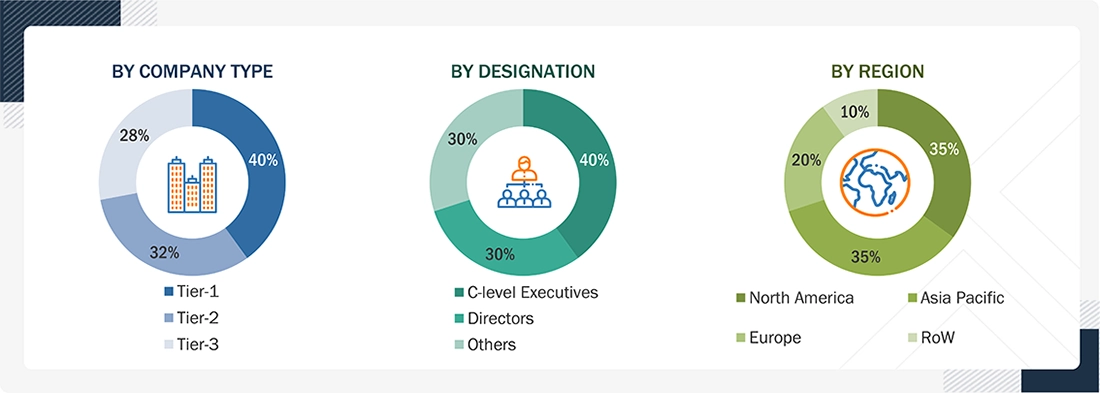
Note: The three tiers of the companies are defined based on their total revenue in 2023: Tier 1 - revenue greater than or equal to USD 1 billion; Tier 2 - revenue between USD 100 million and USD 1 billion; and Tier 3 revenue less than or equal to USD 100 million. Other designations include sales managers, marketing managers, and product managers.
To know about the assumptions considered for the study, download the pdf brochure
Market Size Estimation
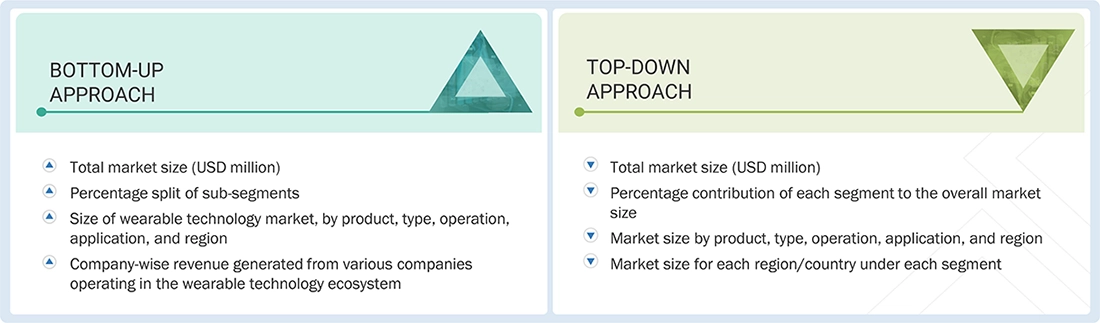
Both top-down and bottom-up approaches have been used to estimate and validate the total size of the wearable technology market. These methods have also been used extensively to estimate the size of various sub-segments in the market. The following research methodology has been used to estimate the market size:
- Major players in the industry and markets have been identified through extensive secondary research.
- The industry’s value chain and market size (in terms of value) have been determined through primary and secondary research processes.
- All percentage shares, splits, and breakdowns have been determined using secondary sources and verified through primary sources.
The market sizing includes the following:
Data Triangulation
After arriving at the overall size of the wearable technology market from the market size estimation process explained above, the total market has been split into several segments and sub-segments. Data triangulation and market breakdown procedures have been employed, wherever applicable, to complete the overall market engineering process and arrive at the exact statistics for all segments and sub-segments of the market. The data has been triangulated by studying various factors and trends from the demand and supply sides. Along with this, the market size has been validated using top-down and bottom-up approaches.
Market Definition
Wearable technology refers to electronic devices designed to be worn on the body, taking various forms, such as jewelry, accessories, medical devices, or clothing. While some wearables offer advanced features, such as AI-powered hearing aids, Google Glass, and Microsoft’s HoloLens, simpler versions include devices such as disposable skin patches with sensors that wirelessly transmit patient data in healthcare settings.
Key Stakeholders
- Wearable technology companies
- Artificial intelligence companies
- Wearable AI companies
- Key service providers
- Software solution providers
- Network providers
- Retail distributors
- Government, financial, and research institutions, and investment communities
- Analysts and strategic business planners
- Research and consulting firms
Report Objectives
- To describe and forecast the wearable technology market, by product, type, operation, and application, in terms of value
- To describe and forecast the wearable technology market, by product and operation, in terms of volume
- To describe and forecast the market for various segments with respect to four main regions, namely North America, Europe, Asia Pacific, and RoW, in terms of value
- To study different types of technology, connectivity, vertical, distribution channel, and component used in the wearable technology market, with the scope limited to qualitative research
- To provide detailed information regarding the major factors, such as drivers, restraints, opportunities, and challenges, influencing the growth of the wearable technology market
- To provide ecosystem analysis, trends/disruptions impacting customer business, technology analysis, pricing analysis, key stakeholders & buying criteria, case study analysis, trade analysis, patent analysis, key conferences & events, Gen AI/ AI impact, and regulations related to the wearable technology market
- To strategically analyze micromarkets with respect to individual growth trends, prospects, and contributions to the total market
- To analyze opportunities for stakeholders by identifying high-growth segments of the wearable technology market
- To benchmark players within the market using the proprietary company evaluation matrix framework, which analyzes market players on various parameters within the broad categories of market rank and product offering
- To strategically profile the key players and comprehensively analyze their market shares and core competencies, and provide a detailed competitive landscape for market leaders
- To analyze competitive developments, such as partnerships, collaborations, agreements, joint ventures, mergers & acquisitions, expansions, and product launches & developments, in the wearable technology market
Available customizations:
With the given market data, MarketsandMarkets offers customizations according to the company’s specific needs. The following customization options are available for the report:
Company Information:
- Detailed analysis and profiling of additional market players (up to 5)
Key Questions Addressed by the Report
How big is the wearable technology market?
the global wearable technology market size is projected to grow from 104.95 Billion in 2026 to USD 238.71 billion by 2032, growing at a CAGR of 14.7% from 2026 to 2032.
What is driving market growth?
Growing demand for smartwatches, fitness trackers, health monitoring, AI, IoT, and connected devices.
Which product segment leads?
Smartwatches and fitness bands account for a significant share due to health and wellness adoption.
Which industries use wearable electronics?
Consumer electronics, healthcare, industrial, defense, sports, and enterprise sectors.
Who are the major companies?
Apple, Samsung, Xiaomi, Huawei, Garmin, Google (Fitbit), Sony, and Meta are key participants.
Which region dominates?
Asia Pacific is a major manufacturing hub, while North America leads in premium device adoption.
What are the latest trends?
AI-powered wearables, smart rings, AR glasses, medical wearables, and edge AI integration.
What challenges affect the market?
Battery life, data privacy, cybersecurity, and high component costs remain challenges.
What does the report analyze?
Market size, share, growth, trends, drivers, restraints, opportunities, competitive landscape, and regional forecasts.
Fact checked
Personalize This Research
- Triangulate with your Own Data
- Get Data as per your Format and Definition
- Gain a Deeper Dive on a Specific Application, Geography, Customer or Competitor
- Any level of Personalization
Let Us Help You
- What are the Known and Unknown Adjacencies Impacting the Wearable Technology Market
- What will your New Revenue Sources be?
- Who will be your Top Customer; what will make them switch?
- Defend your Market Share or Win Competitors
- Get a Scorecard for Target Partners

Custom Market Research Services
We Will Customise The Research For You, In Case The Report Listed Above Does Not Meet With Your Requirements
Get 10% Free CustomisationTESTIMONIALS

Tetsuya Ohhira
Business Development Manager-Technology Business
Nikon Corporation,
Leading Japanese MNC specializing in optics and imaging productswww.nikon.com
MarketsandMarkets™ response
is quick. Their attitude is flexible and positive. Analyst Insights are globally considered and
significant. Client Services quickly respond to our inquiry and demand. Their wide range of global
surveys help us make our strategic plan.
We hope Knowledge Store will be easier to search
for a report.
VP - Marketing & Business Development
Leading Provider of Process Control Solutions
We engaged with MarketsandMarkets on a study to perform an analysis and recommend a Go-To-Market strategy for metrology and process control in the semiconductor market. The study was tailored to our targets and needs with well-defined milestones. Our overall experience with the MarketsandMarkets team was very good throughout the project in all aspects including the analysis methodologies used, the quality and depth of primary and secondary data sets, the professionalism and flexibility of the team and the ability to meet the target schedule and milestones. We want to thank MarketsandMarkets team for a job well done.
- US Wearable Technology Market
- Canada Wearable Technology Market
- Mexico Wearable Technology Market
- Germany Wearable Technology Market
- UK Wearable Technology Market
- France Wearable Technology Market
- Italy Wearable Technology Market
- Rest Of Europe Wearable Technology Market
- China Wearable Technology Market
- Japan Wearable Technology Market
- India Wearable Technology Market
- South Korea Wearable Technology Market
- Rest Of Asia Pacific Wearable Technology Market
- GCC Countries Wearable Technology Market
- Rest Of Middle East Wearable Technology Market
- Africa Wearable Technology Market
Growth opportunities and latent adjacency in Wearable Technology Market






Albert
Apr, 2026
What are the major trends influencing consumer behavior and purchasing decisions in the wearable technology market across online and offline channels?.
Richard
Apr, 2026
What are the differences between AI-based wearables and conventional wearables in terms of performance, adoption, and future market potential?.
Demetrius
Apr, 2026
What are the regional dynamics of the wearable technology market across North America, Europe, Asia Pacific, and other regions, and which countries are leading growth?.
sarah
Apr, 2022
Wanted to know the Potential for growth in wearable tech (Apple watch, Fitbit) in US or UK market. .
User
Jan, 2024
What is the potential growth for wearables in Apple Inc.?.
Maria
Sep, 2022
Interested in South Africa specific Wearable Technology Market information.
Shawal
Sep, 2022
To find out about wearables linked to occupational safety and health..
Joseph
Jun, 2025
Thank you very much, I look forward to getting in touch with you..