



Digital Twin Market Size, Share & Trends
Report Code
SE 5540
Published in
Jul, 2025, By MarketsandMarkets™
Digital Twin Market Size, Share & Trends by Deployment (PaaS, SaaS), Application (Product Design & Development, Predictive Maintenance, Performance Monitoring, Business Optimization), Industry (Automotive & Transportation, Oil & Gas) and Region - Global Forecast to 2030

USD 149.81 BN
MARKET SIZE, 2030

CAGR 47.9%
(2025-2030)

325
REPORT PAGES

296
MARKET TABLES
DIGITAL TWIN MARKET OVERVIEW
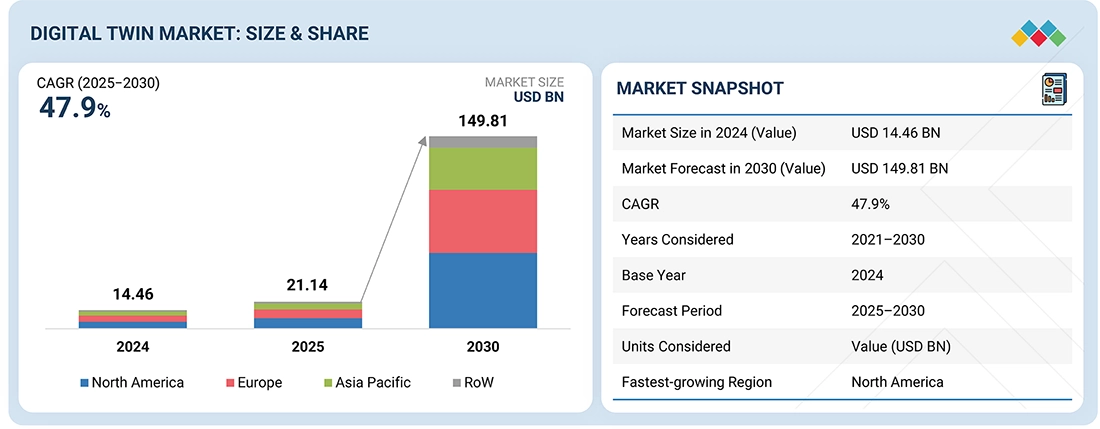
According to Marketsandmarkets, the global digital twin market size is projected to reach USD 149.81 billion in 2030 from an estimated USD 21.14 billion in 2025, growing at a CAGR of 47.9% from 2025 to 2030. The adoption of digital twin technology is revolutionizing operations across sectors by enabling real-time monitoring, simulation, and predictive maintenance. Integration with IoT, AI, and machine learning allows businesses to create precise virtual replicas of physical assets, processes, and systems to optimize performance and reduce downtime.
The digital twin market share is witnessing strong growth as organizations increasingly adopt virtual replicas of physical assets, systems, and processes to improve decision-making and operational efficiency. Digital twins enable real-time monitoring, simulation, and optimization by combining data from sensors, connected devices, and advanced analytics. Their ability to reduce downtime, improve asset performance, and enhance product design is driving adoption across industries such as manufacturing, healthcare, energy, automotive, construction, and smart cities.
As digital transformation accelerates globally, the digital twin market growth continues to expand due to advancements in artificial intelligence, machine learning, cloud computing, and the Industrial Internet of Things. Enterprises are leveraging digital twins to support predictive maintenance, lifecycle management, and scenario planning, making them a critical component of Industry 4.0 strategies. With growing emphasis on automation, sustainability, and data-driven operations, digital twins are evolving from experimental tools into essential platforms for long-term business and infrastructure planning.
This digital twin market report provides insights into market size, growth trends, applications, industries, regional developments, competitive landscape, and emerging opportunities through 2030.
REPORT SCOPE
| REPORT METRIC | DETAILS |
|---|---|
| Market Size in 2025 (Value) | USD 21.14 Billion |
| Market Forecast in 2030 (Value) | USD 149.81 Billion |
| Growth Rate | CAGR of 47.9% from 2025-2030 |
| Years Considered | 2021-2030 |
| Base Year | 2024 |
| Forecast Period | 2025-2030 |
| Units Considered | Value (USD Billion/Million) |
| Report Coverage | Revenue forecast, company ranking, competitive landscape, growth factors, and trends |
| Top Companies |
|
| Growth Driver |
|
| Segments Covered |
|
| Regions Covered | North America, Asia Pacific, Europe, RoW |
Market Size & Forecast
• 2025 Market Size: USD 21.14 Billion
• 2030 Projected Market Size: USD 149.81 Billion
• CAGR (2025-2030): 47.9%
• Healthcare Segment: Highest CAGR
• North America: Highest Revenue Share
DIGITAL TWIN MARKET KEY TAKEAWAYS
-
By RegionNorth America digital twin market accounted for a 38% revenue share in 2024.
-
By IndustryBy industry, the healthcare segment is expected to register the highest CAGR of 52.7%.
-
By ApplicationBy application, the busines & optimization segment is projected to grow at the fastest rate from 2025 to 2030.
-
Competitive LandscapeNavVis, Sight Machine, and COSMO TECH among others, have distinguished themselves among startups and SMEs by securing strong footholds in specialized niche areas, underscoring their potential as emerging market leaders
Digital twins are playing a critical role in accelerating digital transformation, particularly in industries such as manufacturing, healthcare, energy, and aerospace. In particular, the ability to simulate scenarios and forecast outcomes is enhancing decision-making and operational efficiency. Advanced analytics and real-time data feedback loops are driving continuous improvements across lifecycle stages, from design and development to operation and maintenance. Furthermore, the convergence of digital twins with augmented reality and edge computing is enhancing visualization and responsiveness. Their deployment is increasingly seen as essential for smart infrastructure, predictive diagnostics, and remote asset management.
Source: Secondary Research, Interviews with Experts, MarketsandMarkets Analysis
TRENDS & DISRUPTIONS IMPACTING CUSTOMERS' CUSTOMERS
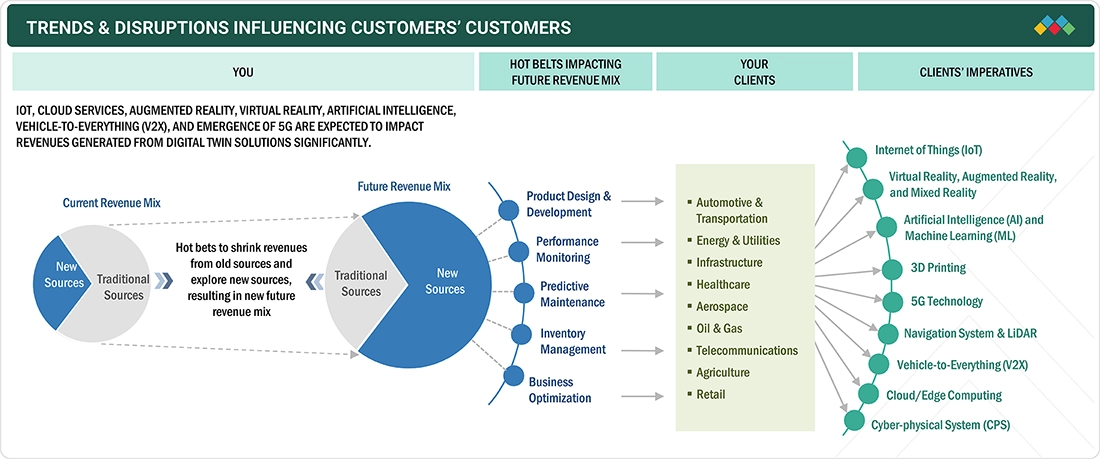
Organizations are shifting toward digital infrastructure, and the rising emphasis on digital twins in manufacturing industries is reducing the cost and improving the supply chain, which is accelerating the growth of the digital twin market. The digital twin in manufacturing market is gaining momentum as manufacturers use virtual replicas to monitor production processes, optimize equipment performance, improve product development, and support predictive maintenance. The increasing penetration of AI, ML, IoT, and AR/VR/XR technologies in the process and discrete industries is boosting the growth of the digital twin market trends and will continue to do so in the next 4 to 5 years and beyond. Introducing these technologies in an otherwise traditional factory setting has revolutionized the industries (aerospace, automotive & transportation, retail, infrastructure, and others) and opened new avenues for sustainable and optimized production.
The digital twin technology in manufacturing market is expanding as manufacturers integrate digital twins with AI, IoT, machine learning, and advanced analytics. These technologies enable real-time monitoring, process simulation, predictive maintenance, and production optimization, helping manufacturers improve operational efficiency and make data-driven decisions.
Source: Secondary Research, Interviews with Experts, MarketsandMarkets Analysis
DIGITAL TWIN MARKET DYNAMICS

Drivers
Impact
Level
Level
-
Innovation in rapid design and tailored manufacturing.

-
Surging adoption of predictive maintenance model across industries to reduce downtime.


RESTRAINTS
Impact
Level
Level
-
High capital requirement to implement digital twin technology.

-
Cybersecurity threats are limiting the growth and adoption of digital twin technology


OPPORTUNITIES
Impact
Level
Level
-
Development of human-centered digital twins.

-
Emergence of urban-scale digital twins unlock new opportunities in smart city planning.


CHALLENGES
Impact
Level
Level
-
Complexities associated with data collection and mathematical models.

-
Undermined real-time analytics due to unreliable networks.

Source: Secondary Research, Interviews with Experts, MarketsandMarkets Analysis
Driver: Surging adoption of predictive maintenance model across industries to reduce downtime.
One of the key drivers propelling the growth of the digital twin market size is the rising demand for predictive maintenance and asset optimization across industries. As organizations seek to minimize unplanned downtime, reduce maintenance costs, and extend asset life, digital twin technology has emerged as a critical enabler. By creating a virtual replica of physical assets, digital twins enable real-time monitoring, diagnostics, and forecasting of equipment performance based on data collected through sensors and IoT devices. Predictive maintenance powered by digital twins uses advanced analytics and machine learning models to detect early signs of wear, performance anomalies, or potential failures. This proactive approach significantly reduces operational disruptions and enhances decision-making for maintenance scheduling.
Restraint:Cybersecurity threats are limiting the growth and adoption of digital twin technology.
Data security and privacy concerns represent a significant restraint in the growth of the digital twin market. Digital twin solutions rely heavily on real-time data collection, transmission, and integration from physical assets, sensors, and connected devices. This data often includes sensitive information related to operational processes, proprietary system designs, and in some cases, personal or confidential data. The risk of cyberattacks, data breaches, and unauthorized access increases as more endpoints and networks become part of a digital twin ecosystem. Industries such as aerospace, defense, healthcare, and manufacturing are particularly cautious, given their operations' critical and confidential nature. Moreover, compliance with data protection regulations such as the General Data Protection Regulation (GDPR) in Europe, the California Consumer Privacy Act (CCPA) in the US, and other regional cybersecurity standards further complicates implementation.
Opportunity: Development of human-centered digital twins.
Digital twins that incorporate human-in-the-loop (HIL) technology empower artificial intelligence to leverage both human and machine intelligence, enabling the creation of advanced machine-learning models. This approach links human, product, and system data to computational toolkits, facilitating the integration of ergonomic decision-making into digital twin-driven design. When developing a model, it becomes essential to consider human factors such as work-session breaks, fatigue management, and working hours. The human-centric design of digital twins allows for realistic output optimization, focusing on boosting production and efficiency and accounting for human variables.
Challenge: Complexities associated with data collection and mathematical models.
Despite the benefits, many organizations have yet to implement a digital twin model for asset management and business and operational optimization. A digital twin should be capable of modeling simple as well as complex objects and their relationships by accurately capturing their physical properties and simulating behaviors. Obtaining asset data from the supplier may pose a challenge, as it requires close collaboration with multiple supply chain tiers. Moreover, establishing the required level of communication in a supply chain to retrieve asset data may be challenging to maintain.
Digital Twin Market: COMMERCIAL USE CASES ACROSS INDUSTRIES
| COMPANY | USE CASE DESCRIPTION | BENEFITS |
|---|---|---|
 |
Design, simulate, and verify physical products and manufacturing processes using digital twins with historical and live data integration. | Accurate predictions, reduced development time, continuous lifecycle traceability. |
 |
Monitor production lines, evaluate equipment performance, and optimize energy assets like wind turbines through digital twin simulations. | Enhanced decision-making, reduced downtime via failure anticipation, improved energy generation. |
 |
Create virtual twin experiences for real-time manufacturing simulations to test products and processes before physical builds. | Faster product development, predictive maintenance, increased operational agility. |
 |
Develop virtual prototypes for real-time system analysis, predictive maintenance, and full product lifecycle management. | Prevent unanticipated failures, optimize asset management, enable hybrid physics-AI insights. |
 |
Implement digital twins for real-time product data collection across engineering, manufacturing, and service for predictive maintenance. | Improved customer satisfaction, enhanced product quality, reduced time to market, sustainability gains. |
Logos and trademarks shown above are the property of their respective owners. Their use here is for informational and illustrative purposes only.
DIGITAL TWIN MARKET ECOSYSTEM
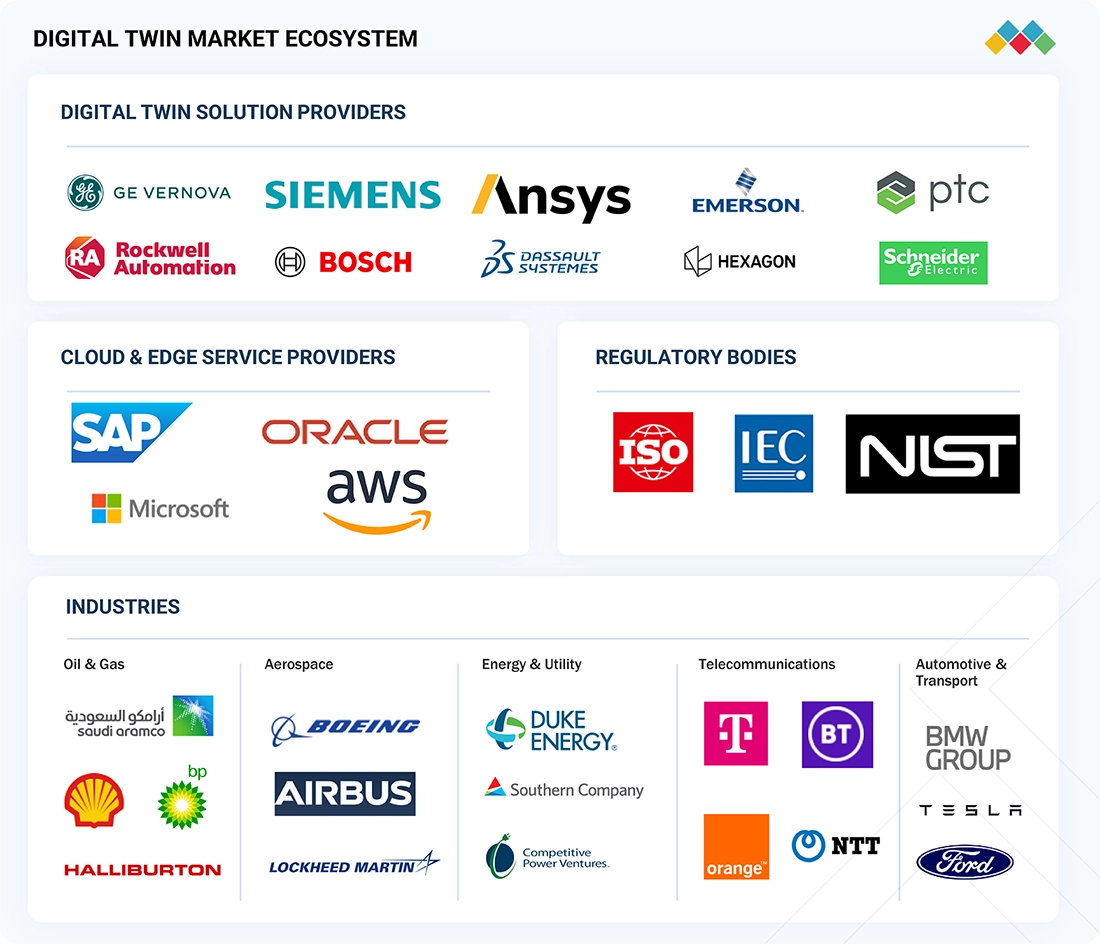
Digital twins represent a revolutionary convergence of physical and virtual worlds, creating real-time digital replicas of assets, processes, and systems that enable unprecedented insights and optimization capabilities. This comprehensive ecosystem brings together leading technology providers like Dassault Systèmes, Bosch, ANSYS, Inc., PTC, Ansys, and Siemens, who deliver the foundational platforms, simulation tools, and IoT connectivity that make digital twin implementations possible. These solutions span diverse end-user industries—from automotive and aerospace to healthcare and retail, transforming how organizations design, monitor, and optimize their operations.
Logos and trademarks shown above are the property of their respective owners. Their use here is for informational and illustrative purposes only.
DIGITAL TWIN MARKET SEGMENTS
Source: Secondary Research, Interviews with Experts, MarketsandMarkets Analysis
Digital Twin Market, By Grade
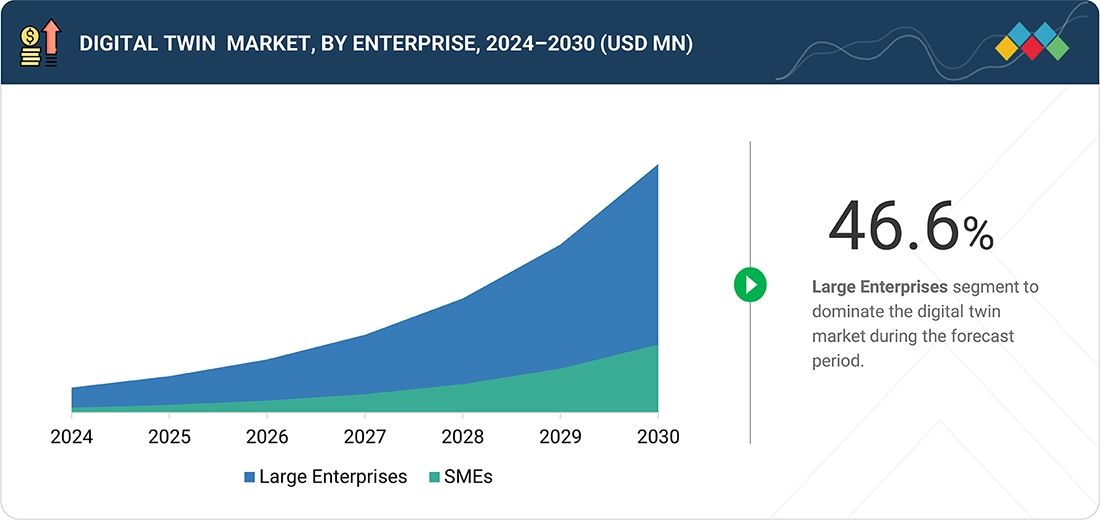
Large enterprises held a larger share of the digital twin market in 2024, and a similar trend is expected to be observed throughout the forecast period. Digital twin solutions are still in the nascent stage of development and implementation, and large enterprises have abundant resources to incorporate the latest digital twin technologies and solutions. Hence, large enterprises are expected to dominate the market
Digital Twin Market, By Application
By applicaion, predictive maintenance hold the largest market in digital twin makret. Predictive maintenance offered by digital twins increases content productivity, enabling improved ongoing operations, maintenance, and other services. This virtual copy of a product allows for better communication and collaboration among organizations or manufacturers for product management, manufacturing, supply chain management, and service offering. For example, a digital twin of a wind turbine with intelligent data processing capability enables predictive maintenance of its behavior and condition. Also, the virtual models combine mathematical models to describe the physics of the turbine operation, with sensor data collected and processed from tangible assets during real-world operations
Digital Twin Market size, By Industry
The automotive & transportation segment is expected to hold the largest share of the digital twin market. The adoption of digital twin technology in the automotive & transportation sector is expanding rapidly, driven by the ongoing digitization of vehicles and mobility systems. Digital twins are transforming the industry by enabling virtual representations of physical assets, systems, and processes. These virtual models facilitate improvements in product design, manufacturing efficiency, and vehicle maintenance, leading to higher-quality products, streamlined operations, and enhanced reliability.
DIGITAL TWIN MARKET BY REGION
North America to be fastest-growing region in global digital twin market during forecast period
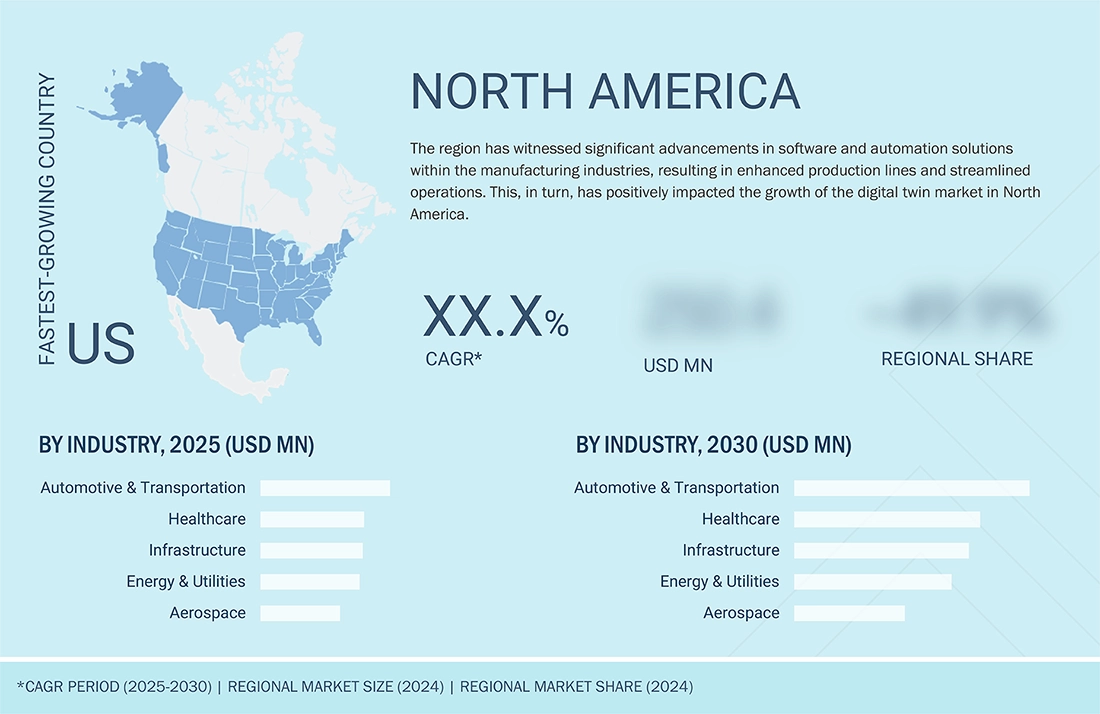
North America dominates the global digital twin market, with projections indicating it will maintain this leadership position throughout the forecast period. The region's dominance stems from several key factors that create a perfect ecosystem for digital twin adoption. North America's technological infrastructure provides the foundation for widespread digital twin implementation, supported by robust internet connectivity, cloud computing capabilities, and advanced IoT networks essential for real-time data synchronization. The region's industrial maturity is crucial, particularly in manufacturing, automotive, and aerospace sectors that heavily utilize digital twin technology for product development, predictive maintenance, and operational optimization.
The North America digital twin market is projected to grow from USD 8.08 billion in 2025 to USD 58.92 billion in 2030 at a CAGR of 48.8% during the forecast period. North America’s digital twin industry benefits from a mature cloud, edge, and AI ecosystem that allows for quick implementation and scaling. Significant investments in infrastructure upgrades, grid modernization, and the energy transition are fueling demand for real-time modeling and operational insights.
The digital twin market in Europe is projected to reach USD 49.32 billion by 2030, up from USD 7.08 billion in 2025, at a CAGR of 47.4% from 2025 to 2030. The growth of the europe digital twin market is driven by the region’s aggressive sustainability and decarbonization agenda, which pushes industries to adopt advanced modeling and real-time monitoring to meet strict EU regulations. This push for energy efficiency, emissions tracking, and lifecycle optimization is accelerating digital twin deployments across manufacturing, energy grids, transport networks, and buildings, making sustainability compliance a major catalyst for market growth.
The Asia Pacific digital twin market is projected to reach USD 4.57 billion in 2025 and USD 32.57 billion in 2030, growing at a CAGR of 48.1% from 2025 to 2030. The regional market growth is fueled by large-scale infrastructure development and strong government initiatives promoting digital transformation across emerging and developed economies. China, Japan, South Korea, and India are increasingly adopting advanced simulation and real-time monitoring technologies to enhance manufacturing productivity, improve asset performance, and support smart city programs. Rising investments in sectors such as automotive, electronics, energy, and transportation further accelerate digital twin deployment.
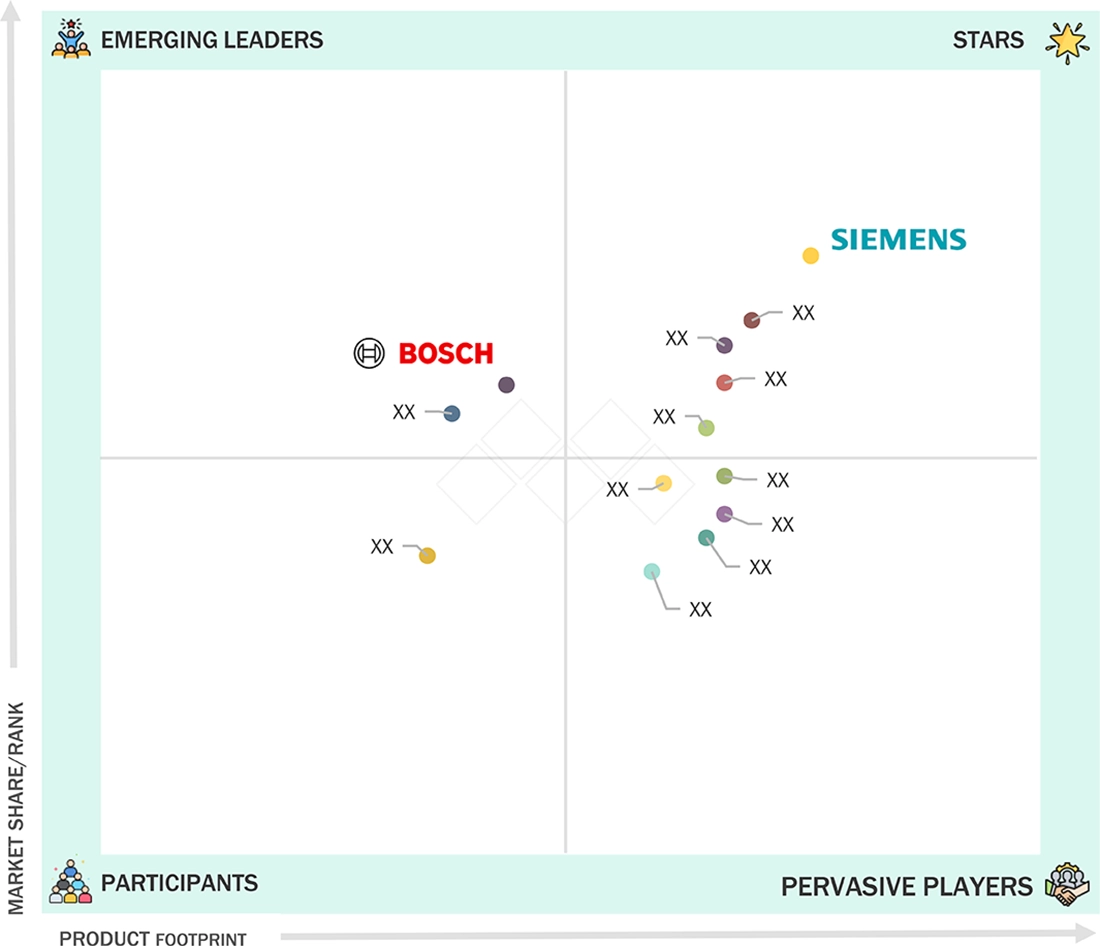
Digital Twin Market: COMPANY EVALUATION MATRIX
In the digital twin companies matrix, Siemens (Star) leads with a strong market shareleveraging its comprehensive ecosystem of software and automation solutions to drive innovation across industries. With platforms like Siemens Xcelerator, the company seamlessly integrates the physical and digital worlds, enabling real-time simulation, optimization, and predictive insights. Robert Bosch GmbH (Emerging Leader) is emerging as a strong contender in the digital twin space, rapidly expanding its capabilities through IoT integration, AI-driven analytics, and connected manufacturing solutions.
Source: Secondary Research, Interviews with Experts, MarketsandMarkets Analysis
DIGITAL TWIN MARKET KEY PLAYERS
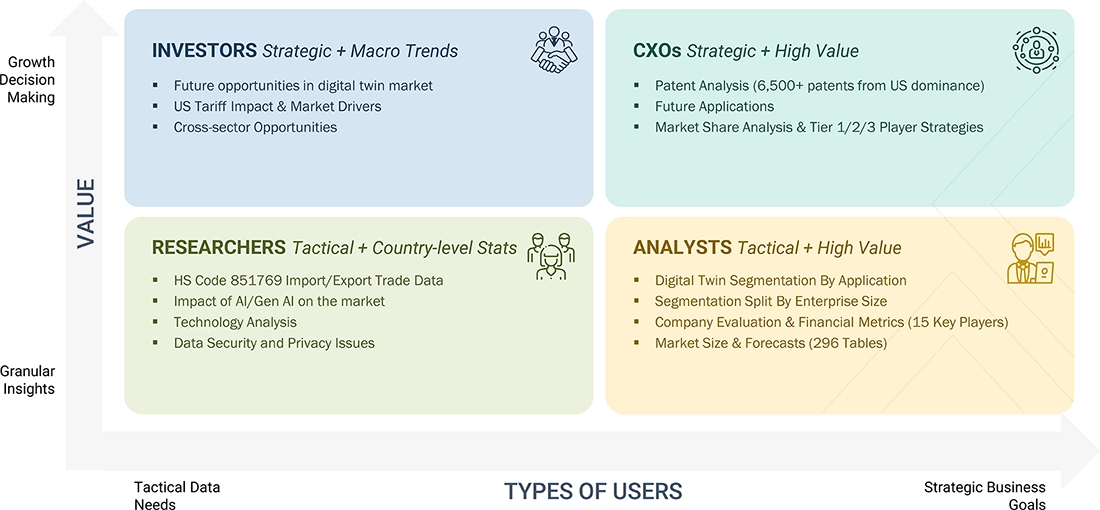
WHAT IS IN IT FOR YOU: Digital Twin Market REPORT CONTENT GUIDE
DELIVERED CUSTOMIZATIONS
We have successfully delivered the following deep-dive customizations:
| CLIENT REQUEST | CUSTOMIZATION DELIVERED | VALUE ADDS |
|---|---|---|
| Manufacturing & Industrial Operator | Vendor landscape & platform benchmarking (PTC, Siemens, Ansys, etc.) | TCO/ROI modeling for specific asset classes (e.g., turbines, production lines) |
| Digital Twin Platform Vendor | Competitive profiling (features, pricing, GTM) across key verticals | Market adoption benchmarking (e.g., automotive vs. energy vs. smart cities) |
| IoT & IIoT Sensor Supplier | Analysis of data requirements for high-fidelity digital twins | Partnership ecosystem mapping (integration with leading software platforms) |
RECENT DEVELOPMENTS
- January 2026: Siemens (Germany) announced the launch of Digital Twin Composer at CES on January 6, 2026. The software combines Siemens’ digital twin technology, NVIDIA Omniverse libraries and real-world engineering data to create virtual 3D models of products, processes and plants. It enables users to visualize and simulate engineering and operational changes in industrial environments. Siemens also announced that PepsiCo was using the software to simulate manufacturing and warehouse upgrades in the United States.
- April 2025: Dassault Systèmes (France) extended its strategic partnership with Airbus on April 24, 2025, placing the 3DEXPERIENCE platform at the centre of lifecycle management for all future Airbus civil and military aircraft and helicopter programmes. The agreement provides for more than 20,000 users across Airbus and its value chain to collaborate using virtual twins, supporting product development, efficiency improvements and shorter development cycles.
- April 2025 : Hexagon AB (Sweden) launched Digital Factory, a cloud-based digital twin service designed to create accurate 3D replicas of manufacturing facilities using laser scanning. This solution helps manufacturers plan factory upgrades, test new layouts, and optimize space without making physical changes. It also enables faster decision-making, reduces the need for on-site visits, and lowers operational costs through virtual simulations and remote collaboration.
- March 2025 : Siemens (Germany) acquired Altair Engineering Inc. (US) for USD 10 billion to strengthen its digital twin and industrial AI capabilities. Altair's advanced simulation, HPC, and AI tools will be integrated into the Siemens Xcelerator platform. This acquisition aims to deliver one of the most comprehensive AI-powered industrial software suites, making simulation-driven digital twins more accessible and scalable for businesses of all sizes.
- March 2025 : Emerson Electric Co. (US) completed the acquisition of Aspen Technology (US). This acquisition strengthened Emerson's position in industrial automation by adding advanced software capabilities to its portfolio. This move helps Emerson Electric Co. offer more complete digital solutions by combining its control systems with Aspen Technology's powerful tools for simulation, optimization, and asset performance, supporting Emerson's strategy to lead in industrial software and deliver greater value to customers.
Table of Contents
 Exclusive indicates content/data unique to MarketsandMarkets and not available with any competitors.
TITLE
PAGE NO
1
INTRODUCTION
29
2
RESEARCH METHODOLOGY
34
3
EXECUTIVE SUMMARY
47
4
PREMIUM INSIGHTS
51
5
MARKET OVERVIEW
Unlock new growth by leveraging real-time intelligence and predictive maintenance in smart manufacturing.
54
5.1
INTRODUCTION
5.2
MARKET DYNAMICS
5.2.1
DRIVERS
5.2.1.1
INNOVATION IN RAPID DESIGN AND TAILORED MANUFACTURING
5.2.1.2
INCREASING FOCUS ON EMPOWERING OPERATIONS WITH REAL-TIME INTELLIGENCE
5.2.1.3
SURGING ADOPTION OF PREDICTIVE MAINTENANCE MODEL ACROSS INDUSTRIES TO REDUCE DOWNTIME
5.2.2
RESTRAINTS
5.2.2.1
HIGH UPFRONT INVESTMENT AND EXTENDED PAYBACK PERIODS
5.2.2.2
DATA SECURITY AND PRIVACY CONCERNS
5.2.3
OPPORTUNITIES
5.2.3.1
RISE OF SMART FACTORIES THROUGH REAL-TIME SIMULATION AND AUTONOMOUS OPERATIONS
5.2.3.2
EMERGENCE OF URBAN-SCALE DIGITAL TWINS UNLOCKING NEW OPPORTUNITIES IN SMART CITY PLANNING
5.2.3.3
DEVELOPMENT OF HUMAN-CENTERED DIGITAL TWINS
5.2.4
CHALLENGES
5.2.4.1
COMPLEXITIES ASSOCIATED WITH DATA COLLECTION AND MATHEMATICAL MODELS
5.2.4.2
UNDERMINED REAL-TIME ANALYTICS DUE TO UNRELIABLE NETWORKS
5.3
VALUE CHAIN ANALYSIS
5.4
ECOSYSTEM ANALYSIS
5.5
INVESTMENT AND FUNDING SCENARIO
5.6
PRICING ANALYSIS
5.6.1
INDICATIVE PRICING OF DIGITAL TWIN PLATFORMS, BY KEY PLAYER, 2024
5.6.2
AVERAGE SELLING PRICE TREND, BY REGION, 2021–2024
5.7
TRENDS/DISRUPTIONS IMPACTING CUSTOMER BUSINESS
5.8
TECHNOLOGY ANALYSIS
5.8.1
KEY TECHNOLOGIES
5.8.1.1
IOT AND IIOT
5.8.1.2
ARTIFICIAL INTELLIGENCE AND MACHINE LEARNING
5.8.1.3
AUGMENTED REALITY, VIRTUAL REALITY, AND MIXED REALITY
5.8.1.4
CLOUD COMPUTING AND EDGE COMPUTING
5.8.2
COMPLEMENTARY TECHNOLOGIES
5.8.2.1
BLOCKCHAIN
5.8.2.2
5G
5.8.3
ADJACENT TECHNOLOGIES
5.8.3.1
PRODUCT LIFECYCLE MANAGEMENT
5.8.3.2
ENTERPRISE RESOURCE PLANNING
5.9
PORTER’S FIVE FORCES ANALYSIS
5.9.1
THREAT OF NEW ENTRANTS
5.9.2
THREAT OF SUBSTITUTES
5.9.3
BARGAINING POWER OF BUYERS
5.9.4
BARGAINING POWER OF SUPPLIERS
5.9.5
INTENSITY OF COMPETITIVE RIVALRY
5.10
KEY STAKEHOLDERS AND BUYING CRITERIA
5.10.1
KEY STAKEHOLDERS IN BUYING PROCESS
5.10.2
BUYING CRITERIA
5.11
CASE STUDY ANALYSIS
5.11.1
LUNDIN GROUP UTILIZES HONEYWELL'S DIGITAL TWIN TECH TO ENHANCE EFFICIENCY AND CUT EMISSIONS ON OFFSHORE PLATFORM
5.11.2
NRF PARTNERS WITH DASSAULT SYSTÈMES TO DEPLOY 3D DIGITAL TWIN PLATFORM FOR SMARTER URBAN PLANNING
5.11.3
FAURECIA ADOPTS 3DEXPERIENCE DIGITAL TWIN PLATFORM TO OPTIMIZE AGV INBOUND LOGISTICS
5.11.4
DOOSAN CORPORATION OPTIMIZES ENERGY OUTPUT IN WIND FARMS BY IMPLEMENTING AZURE DIGITAL TWINS
5.11.5
IBM INCORPORATES DIGITAL TWINS TO IMPROVE SPARE PART INVENTORY
5.12
TRADE ANALYSIS
5.12.1
IMPORT SCENARIO (HS CODE 851769)
5.12.2
EXPORT SCENARIO (HS CODE 851769)
5.13
PATENT ANALYSIS
5.14
KEY CONFERENCES AND EVENTS, 2025–2026
5.15
REGULATORY LANDSCAPE
5.15.1
REGULATORY BODIES, GOVERNMENT AGENCIES, AND OTHER ORGANIZATIONS
5.15.2
STANDARDS AND REGULATIONS RELATED TO DIGITAL TWIN TECHNOLOGY
5.16
IMPACT OF AI/GEN AI ON DIGITAL TWIN MARKET
5.16.1
INTRODUCTION
5.16.2
IMPACT OF AI/GEN AI ON KEY INDUSTRIES
5.16.2.1
AEROSPACE
5.16.2.2
AUTOMOTIVE & TRANSPORTATION
5.16.2.3
ENERGY & UTILITIES
5.16.3
USE CASES
5.16.4
FUTURE OF AI/GEN AI IN DIGITAL TWIN ECOSYSTEM
5.17
IMPACT OF 2025 US TARIFF – OVERVIEW
5.17.1
INTRODUCTION
5.17.2
KEY TARIFF RATES
5.17.3
PRICE IMPACT ANALYSIS
5.17.4
IMPACT ON COUNTRIES/REGIONS
5.17.4.1
US
5.17.4.2
EUROPE
5.17.4.3
ASIA PACIFIC
5.17.5
IMPACT ON INDUSTRIES
5.17.5.1
AEROSPACE
5.17.5.2
OIL & GAS
6
DIGITAL TWIN INTEGRATION ACROSS DIFFERENT COMPONENTS, PRODUCTS, PROCESSES, AND SYSTEMS
Optimize efficiency by integrating digital twins across components, products, processes, and systems.
98
6.1
INTRODUCTION
6.2
COMPONENT DIGITAL TWIN
6.3
PRODUCT DIGITAL TWIN
6.4
PROCESS DIGITAL TWIN
6.5
SYSTEM DIGITAL TWIN
7
DIGITAL TWIN DEPLOYMENT MODELS
Explore strategic advantages of PaaS and SaaS in digital twin deployments.
101
7.1
INTRODUCTION
7.2
PLATFORM AS A SERVICE (PAAS)
7.3
SOFTWARE AS A SERVICE (SAAS)
8
MATURITY EVOLUTION OF DIGITAL TWIN TECHNOLOGY
Witness the transformative journey from prototype twins to interconnected enterprise ecosystems.
103
8.1
INTRODUCTION
8.2
CONCEPTUAL OR PROTOTYPE TWINS
8.3
OPERATIONAL DEPLOYMENT
8.4
SCALED ENTERPRISE IMPLEMENTATION
8.5
CROSS-PLATFORM ECOSYSTEMS (INTERCONNECTED TWINS)
9
DIGITAL TWIN MARKET, BY ENTERPRISE SIZE
Market Size & Growth Rate Forecast Analysis to 2030 in USD Million | 6 Data Tables
105
9.1
INTRODUCTION
9.2
LARGE ENTERPRISES
9.2.1
RAPID DEPLOYMENT OF BLOCKCHAIN TECHNOLOGY IN HEALTHCARE, AUTOMOTIVE, OIL & GAS SECTORS TO DRIVE MARKET
9.3
SMALL & MEDIUM-SIZED ENTERPRISES
9.3.1
AVAILABILITY OF BUDGET-FRIENDLY AND SUBSCRIPTION-BASED DIGITAL TWIN SERVICES TO SUPPORT SEGMENTAL GROWTH
10
DIGITAL TWIN MARKET, BY APPLICATION
Market Size & Growth Rate Forecast Analysis to 2030 in USD Million | 14 Data Tables
111
10.1
INTRODUCTION
10.2
PRODUCT DESIGN & DEVELOPMENT
10.2.1
GROWING RELIANCE ON VIRTUAL SIMULATIONS TO REDUCE COSTLY PHYSICAL PROTOTYPES TO BOOST DEMAND
10.3
PERFORMANCE MONITORING
10.3.1
PRESSING NEED FOR REAL-TIME PERFORMANCE MONITORING TO OPTIMIZE PRODUCTION OUTCOME TO DRIVE MARKET
10.4
PREDICTIVE MAINTENANCE
10.4.1
GROWING FOCUS OF MANUFACTURING FIRMS ON COST SAVING TO CONTRIBUTE TO SEGMENTAL GROWTH
10.5
INVENTORY MANAGEMENT
10.5.1
STRONG EMPHASIS OF PROCESS INDUSTRIES ON INVENTORY OPTIMIZATION TO SPUR DEMAND
10.6
BUSINESS OPTIMIZATION
10.6.1
SIGNIFICANT FOCUS ON COST-EFFECTIVE AND FASTER PRODUCTIVE DEVELOPMENT TO INCREASE ADOPTION
10.7
OTHER APPLICATIONS
11
DIGITAL TWIN MARKET, BY INDUSTRY
Market Size & Growth Rate Forecast Analysis to 2030 in USD Million | 122 Data Tables
124
11.1
INTRODUCTION
11.2
AUTOMOTIVE & TRANSPORTATION
11.2.1
GROWING FOCUS OF AUTOMAKERS ON SCALABLE INTELLIGENT PRODUCTION TO BOOST DEMAND
11.3
ENERGY & UTILITIES
11.3.1
RISING USE OF DIGITAL TWIN TECHNOLOGY IN WIND FARMS TO STIMULATE MARKET GROWTH
11.4
INFRASTRUCTURE
11.4.1
SMART CITY PROJECTS AND SMART TRANSPORTATION INITIATIVES TO DRIVE MARKET
11.5
HEALTHCARE
11.5.1
DIGITAL TRANSFORMATION IN HEALTHCARE INDUSTRY TO ACCELERATE MARKET GROWTH
11.6
AEROSPACE
11.6.1
PRESSING NEED FOR REAL-TIME TELEMETRY DATA TO INCREASE ADOPTION
11.7
OIL & GAS
11.7.1
CRITICAL NECESSITY TO OPTIMIZE OIL AND GAS PLANT OPERATIONS TO DRIVE MARKET
11.8
TELECOMMUNICATIONS
11.8.1
URGENT NEED TO MONITOR IMPACT OF 5G COMMERCIALIZATION TO CREATE GROWTH OPPORTUNITIES
11.9
AGRICULTURE
11.9.1
ELEVATING DEMAND FOR PRECISION AGRICULTURE INSIGHTS TO FOSTER MARKET GROWTH
11.10
RETAIL
11.10.1
SURGING ADOPTION TO IMPROVE CUSTOMER ENGAGEMENT AND SATISFACTION TO PROPEL MARKET
11.11
OTHER INDUSTRIES
12
DIGITAL TWIN MARKET, BY REGION
Comprehensive coverage of 8 Regions with country-level deep-dive of 16 Countries | 68 Data Tables.
174
12.1
INTRODUCTION
12.2
NORTH AMERICA
12.2.1
MACROECONOMIC OUTLOOK FOR NORTH AMERICA
12.2.2
US
12.2.2.1
ENERGY, AUTOMOTIVE, AND MANUFACTURING SECTORS TO CONTRIBUTE TO MARKET GROWTH
12.2.3
CANADA
12.2.3.1
ESCALATING DEMAND FOR CLOUD-ENABLED AND AI-POWERED DIGITAL TWIN FROM INDUSTRIAL PLAYERS TO FUEL MARKET GROWTH
12.2.4
MEXICO
12.2.4.1
SIGNIFICANT FOCUS ON DECARBONIZATION AND RENEWABLE ENERGY PROJECTS TO CREATE GROWTH OPPORTUNITIES
12.3
EUROPE
12.3.1
MACROECONOMIC OUTLOOK FOR EUROPE
12.3.2
GERMANY
12.3.2.1
INCREASING ADOPTION OF AUTOMATION AND DIGITAL TECHNOLOGIES TO STIMULATE MARKET GROWTH
12.3.3
FRANCE
12.3.3.1
RISING ADOPTION OF IOT AND CLOUD COMPUTING TO PROPEL MARKET
12.3.4
UK
12.3.4.1
INCREASING INVESTMENTS IN RENEWABLE ENERGY PROJECTS TO FACILITATE MARKET GROWTH
12.3.5
SPAIN
12.3.5.1
INFRASTRUCTURE MODERNIZATION AND URBAN PLANNING INITIATIVES TO DRIVE MARKET
12.3.6
ITALY
12.3.6.1
RISING USE IN ENVIRONMENTAL AND INDUSTRIAL INNOVATION TO CONTRIBUTE TO MARKET GROWTH
12.3.7
POLAND
12.3.7.1
LAUNCH OF INNOVATIVE DIGITAL TWIN SOLUTIONS FOR WATER MANAGEMENT AND RENEWABLE ENERGY SECTORS TO DRIVE MARKET
12.3.8
REST OF EUROPE
12.4
ASIA PACIFIC
12.4.1
MACROECONOMIC OUTLOOK FOR ASIA PACIFIC
12.4.2
CHINA
12.4.2.1
GREATER EMPHASIS ON SMART CITY PLANNING AND DISASTER PREPAREDNESS TO BOOST DEMAND
12.4.3
JAPAN
12.4.3.1
GOVERNMENT PLAN TO EXPAND MANUFACTURING BASE OF HIGH-VALUE-ADDED PRODUCTS TO FOSTER MARKET GROWTH
12.4.4
INDIA
12.4.4.1
SMART CITY, DIGITAL PUBLIC INFRASTRUCTURE, AND INDUSTRIAL MODERNIZATION INITIATIVES TO CREATE FERTILE ENVIRONMENT
12.4.5
SOUTH KOREA
12.4.5.1
RISING FOCUS ON ADDRESSING COMPLEX URBAN CHALLENGES TO SPIKE DEMAND
12.4.6
AUSTRALIA
12.4.6.1
NEXT-GENERATION URBAN PLANNING PROGRAMS TO SPUR DEMAND
12.4.7
INDONESIA
12.4.7.1
SMART CITY EVOLUTION TO CONTRIBUTE TO INDUSTRIAL-SCALE DIGITAL TWIN ADOPTION
12.4.8
REST OF ASIA PACIFIC
12.5
ROW
12.5.1
MACROECONOMIC OUTLOOK FOR ROW
12.5.2
SOUTH AMERICA
12.5.2.1
ACCELERATED ADOPTION OF IOT TO SUPPORT MARKET GROWTH
12.5.3
MIDDLE EAST
12.5.3.1
SAUDI ARABIA
12.5.3.2
UAE
12.5.3.3
REST OF MIDDLE EAST
12.5.4
AFRICA
12.5.4.1
PROGRESSIVE SHIFT TOWARD DATA-DRIVEN, COLLABORATIVE WATER MANAGEMENT PRACTICES TO SUPPORT MARKET GROWTH
13
COMPETITIVE LANDSCAPE
Discover market dominance tactics and key player strategies shaping the competitive landscape.
225
13.1
OVERVIEW
13.2
KEY PLAYER STRATEGIES/RIGHT TO WIN, 2023–2025
13.3
REVENUE ANALYSIS, 2020–2024
13.4
MARKET SHARE ANALYSIS, 2024
13.5
COMPANY VALUATION AND FINANCIAL METRICS
13.6
BRAND COMPARISON
13.7
COMPANY EVALUATION MATRIX: KEY PLAYERS, 2024
13.7.1
STARS
13.7.2
EMERGING LEADERS
13.7.3
PERVASIVE PLAYERS
13.7.4
PARTICIPANTS
13.7.5
COMPANY FOOTPRINT: KEY PLAYERS, 2024
13.7.5.1
COMPANY FOOTPRINT
13.7.5.2
REGION FOOTPRINT
13.7.5.3
ENTERPRISE SIZE FOOTPRINT
13.7.5.4
APPLICATION FOOTPRINT
13.7.5.5
INDUSTRY FOOTPRINT
13.8
COMPANY EVALUATION MATRIX: STARTUPS/SMES, 2024
13.8.1
PROGRESSIVE COMPANIES
13.8.2
RESPONSIVE COMPANIES
13.8.3
DYNAMIC COMPANIES
13.8.4
STARTING BLOCKS
13.8.5
COMPETITIVE BENCHMARKING: STARTUPS/SMES, 2024
13.8.5.1
DETAILED LIST OF KEY STARTUPS/SMES
13.8.5.2
COMPETITIVE BENCHMARKING OF KEY STARTUPS/SMES
13.9
COMPETITIVE SCENARIO
13.9.1
PRODUCT LAUNCHES/ENHANCEMENTS
13.9.2
DEALS
14
COMPANY PROFILES
In-depth Company Profiles of Leading Market Players with detailed Business Overview, Product and Service Portfolio, Recent Developments, and Unique Analyst Perspective (MnM View)
251
14.1
KEY PLAYERS
14.1.1
SIEMENS
14.1.1.1
BUSINESS OVERVIEW
14.1.1.2
PRODUCTS/SOLUTIONS/SERVICES OFFERED
14.1.1.3
RECENT DEVELOPMENTS
14.1.1.4
MNM VIEW
14.1.2
GE VERNOVA
14.1.3
ANSYS, INC.
14.1.4
DASSAULT SYSTÈMES
14.1.5
PTC
14.1.6
HONEYWELL INTERNATIONAL INC.
14.1.7
ROCKWELL AUTOMATION
14.1.8
HEXAGON AB
14.1.9
EMERSON ELECTRIC CO.
14.1.10
ABB
14.1.11
ROBERT BOSCH GMBH
14.1.12
SCHNEIDER ELECTRIC
14.1.13
BENTLEY SYSTEMS, INCORPORATED
14.2
OTHER KEY PLAYERS
14.2.1
NAVVIS
14.2.2
AUTODESK INC.
14.2.3
ANDRITZ
14.2.4
RIVER LOGIC, INC.
14.2.5
JOHNSON CONTROLS
14.2.6
SENSAT
14.2.7
PETRA
14.2.8
PRATITI TECHNOLOGIES
14.2.9
SYNAVISION GMBH
14.2.10
DUALITY ROBOTICS, INC.
14.2.11
TOMORROW THINGS GMBH
14.2.12
AKSELOS S.A.
14.3
PLATFORM-AS-A-SERVICE (PAAS) PROVIDERS
14.3.1
SAP SE
14.3.2
ORACLE
14.3.3
AMAZON WEB SERVICES, INC. (AWS)
14.3.4
MICROSOFT
15
APPENDIX
318
15.1
DISCUSSION GUIDE
15.2
KNOWLEDGESTORE: MARKETSANDMARKETS’ SUBSCRIPTION PORTAL
15.3
CUSTOMIZATION OPTIONS
15.4
RELATED REPORTS
15.5
AUTHOR DETAILS
LIST OF TABLES
TABLE 1
INCLUSIONS AND EXCLUSIONS IN DIGITAL TWIN MARKET REPORT
TABLE 2
MAJOR SECONDARY SOURCES
TABLE 3
INDUSTRY EXPERT DETAILS, BY COMPANY
TABLE 4
ROLE OF KEY PLAYERS IN DIGITAL TWIN ECOSYSTEM
TABLE 5
INDICATIVE PRICING OF DIGITAL TWIN PLATFORMS OFFERED BY KEY PLAYERS, 2024 (USD)
TABLE 6
AVERAGE SELLING PRICE TREND OF DIGITAL TWIN PLATFORM, BY REGION, 2021–2024 (USD)
TABLE 7
DIGITAL TWIN MARKET: PORTER’S FIVE FORCES ANALYSIS
TABLE 8
INFLUENCE OF STAKEHOLDERS ON BUYING PROCESS, BY INDUSTRY
TABLE 9
KEY BUYING CRITERIA, BY INDUSTRY
TABLE 10
IMPORT DATA FOR HS CODE 851769-COMPLIANT PRODUCTS, BY COUNTRY, 2020–2024 (USD MILLION)
TABLE 11
EXPORT DATA FOR HS CODE 851769-COMPLIANT PRODUCTS, BY COUNTRY, 2020–2024 (USD MILLION)
TABLE 12
DIGITAL TWIN MARKET: INNOVATIONS AND PATENT REGISTRATIONS, 2023–2024
TABLE 13
DIGITAL TWIN MARKET: LIST OF CONFERENCES AND EVENTS
TABLE 14
NORTH AMERICA: LIST OF REGULATORY BODIES, GOVERNMENT AGENCIES, AND OTHER ORGANIZATIONS
TABLE 15
EUROPE: LIST OF REGULATORY BODIES, GOVERNMENT AGENCIES, AND OTHER ORGANIZATIONS
TABLE 16
ASIA PACIFIC: LIST OF REGULATORY BODIES, GOVERNMENT AGENCIES, AND OTHER ORGANIZATIONS
TABLE 17
ROW: LIST OF REGULATORY BODIES, GOVERNMENT AGENCIES, AND OTHER ORGANIZATIONS
TABLE 18
DIGITAL TWIN: STANDARDS AND REGULATIONS
TABLE 19
US-ADJUSTED RECIPROCAL TARIFF RATES
TABLE 20
KEY PRODUCT-RELATED TARIFF EFFECTIVE FOR DIGITAL TWIN
TABLE 21
DIGITAL TWIN MARKET, BY ENTERPRISE SIZE, 2021–2024 (USD MILLION)
TABLE 22
DIGITAL TWIN MARKET, BY ENTERPRISE SIZE, 2025–2030 (USD MILLION)
TABLE 23
LARGE ENTERPRISES: DIGITAL TWIN MARKET, BY REGION, 2021–2024 (USD MILLION)
TABLE 24
LARGE ENTERPRISES: MARKET, BY REGION, 2025–2030 (USD MILLION)
TABLE 25
SMALL & MEDIUM-SIZED ENTERPRISES: MARKET, BY REGION, 2021–2024 (USD MILLION)
TABLE 26
SMALL & MEDIUM-SIZED ENTERPRISES: MARKET, BY REGION, 2025–2030 (USD MILLION)
TABLE 27
DIGITAL TWIN MARKET, BY APPLICATION, 2021–2024 (USD MILLION)
TABLE 28
MARKET, BY APPLICATION, 2025–2030 (USD MILLION)
TABLE 29
PRODUCT DESIGN & DEVELOPMENT: MARKET, BY INDUSTRY, 2021–2024 (USD MILLION)
TABLE 30
PRODUCT DESIGN & DEVELOPMENT: MARKET, BY INDUSTRY, 2025–2030 (USD MILLION)
TABLE 31
PERFORMANCE MONITORING: MARKET, BY INDUSTRY, 2021–2024 (USD MILLION)
TABLE 32
PERFORMANCE MONITORING: MARKET, BY INDUSTRY, 2025–2030 (USD MILLION)
TABLE 33
PREDICTIVE MAINTENANCE: DIGITAL TWINS MARKET, BY INDUSTRY, 2021–2024 (USD MILLION)
TABLE 34
PREDICTIVE MAINTENANCE: MARKET, BY INDUSTRY, 2025–2030 (USD MILLION)
TABLE 35
INVENTORY MANAGEMENT: MARKET, BY INDUSTRY, 2021–2024 (USD MILLION)
TABLE 36
INVENTORY MANAGEMENT: MARKET, BY INDUSTRY, 2025–2030 (USD MILLION)
TABLE 37
BUSINESS OPTIMIZATION: MARKET, BY INDUSTRY, 2021–2024 (USD MILLION)
TABLE 38
BUSINESS OPTIMIZATION: MARKET, BY INDUSTRY, 2025–2030 (USD MILLION)
TABLE 39
OTHER APPLICATIONS: DIGITAL TWIN MARKET, BY INDUSTRY, 2021–2024 (USD MILLION)
TABLE 40
OTHER APPLICATIONS: MARKET, BY INDUSTRY, 2025–2030 (USD MILLION)
TABLE 41
DIGITAL TWIN MARKET, BY INDUSTRY, 2021–2024 (USD MILLION)
TABLE 42
MARKET, BY INDUSTRY, 2025–2030 (USD MILLION)
TABLE 43
AUTOMOTIVE & TRANSPORTATION: MARKET, BY APPLICATION, 2021–2024 (USD MILLION)
TABLE 44
AUTOMOTIVE & TRANSPORTATION: MARKET, BY APPLICATION, 2025–2030 (USD MILLION)
TABLE 45
AUTOMOTIVE & TRANSPORTATION: MARKET, BY REGION, 2021–2024 (USD MILLION)
TABLE 46
AUTOMOTIVE & TRANSPORTATION: MARKET, BY REGION, 2025–2030 (USD MILLION)
TABLE 47
AUTOMOTIVE & TRANSPORTATION: MARKET IN NORTH AMERICA, BY COUNTRY, 2021–2024 (USD MILLION)
TABLE 48
AUTOMOTIVE & TRANSPORTATION: MARKET IN NORTH AMERICA, BY COUNTRY, 2025–2030 (USD MILLION)
TABLE 49
AUTOMOTIVE & TRANSPORTATION: MARKET IN EUROPE, BY COUNTRY, 2021–2024 (USD MILLION)
TABLE 50
AUTOMOTIVE & TRANSPORTATION: MARKET IN EUROPE, BY COUNTRY, 2025–2030 (USD MILLION)
TABLE 51
AUTOMOTIVE & TRANSPORTATION: MARKET IN ASIA PACIFIC, BY COUNTRY, 2021–2024 (USD MILLION)
TABLE 52
AUTOMOTIVE & TRANSPORTATION: MARKET IN ASIA PACIFIC, BY COUNTRY, 2025–2030 (USD MILLION)
TABLE 53
AUTOMOTIVE & TRANSPORTATION: DIGITAL TWIN MARKET IN ROW, BY REGION, 2021–2024 (USD MILLION)
TABLE 54
AUTOMOTIVE & TRANSPORTATION: MARKET IN ROW, BY REGION, 2025–2030 (USD MILLION)
TABLE 55
ENERGY & UTILITIES: MARKET, BY APPLICATION, 2021–2024 (USD MILLION)
TABLE 56
ENERGY & UTILITIES: MARKET, BY APPLICATION, 2025–2030 (USD MILLION)
TABLE 57
ENERGY & UTILITIES: MARKET, BY REGION, 2021–2024 (USD MILLION)
TABLE 58
ENERGY & UTILITIES: DIGITAL TWIN MARKET, BY REGION, 2025–2030 (USD MILLION)
TABLE 59
ENERGY & UTILITIES: MARKET IN NORTH AMERICA, BY COUNTRY, 2021–2024 (USD MILLION)
TABLE 60
ENERGY & UTILITIES: MARKET IN NORTH AMERICA, BY COUNTRY, 2025–2030 (USD MILLION)
TABLE 61
ENERGY & UTILITIES: MARKET IN EUROPE, BY COUNTRY, 2021–2024 (USD MILLION)
TABLE 62
ENERGY & UTILITIES: MARKET IN EUROPE, BY COUNTRY, 2025–2030 (USD MILLION)
TABLE 63
ENERGY & UTILITIES: DIGITAL TWIN MARKET IN ASIA PACIFIC, BY COUNTRY, 2021–2024 (USD MILLION)
TABLE 64
ENERGY & UTILITIES: MARKET IN ASIA PACIFIC, BY COUNTRY, 2025–2030 (USD MILLION)
TABLE 65
ENERGY & UTILITIES: MARKET IN ROW, BY REGION, 2021–2024 (USD MILLION)
TABLE 66
ENERGY & UTILITIES: MARKET IN ROW, BY REGION, 2025–2030 (USD MILLION)
TABLE 67
INFRASTRUCTURE: MARKET, BY APPLICATION, 2021–2024 (USD MILLION)
TABLE 68
INFRASTRUCTURE: MARKET, BY APPLICATION, 2025–2030 (USD MILLION)
TABLE 69
INFRASTRUCTURE: MARKET, BY REGION, 2021–2024 (USD MILLION)
TABLE 70
INFRASTRUCTURE: DIGITAL TWIN MARKET, BY REGION, 2025–2030 (USD MILLION)
TABLE 71
INFRASTRUCTURE: DIGITAL TWIN MARKET IN NORTH AMERICA, BY COUNTRY, 2021–2024 (USD MILLION)
TABLE 72
INFRASTRUCTURE: MARKET IN NORTH AMERICA, BY COUNTRY, 2025–2030 (USD MILLION)
TABLE 73
INFRASTRUCTURE: DIGITAL TWIN MARKET IN EUROPE, BY COUNTRY, 2021–2024 (USD MILLION)
TABLE 74
INFRASTRUCTURE: MARKET IN EUROPE, BY COUNTRY, 2025–2030 (USD MILLION)
TABLE 75
INFRASTRUCTURE: MARKET IN ASIA PACIFIC, BY COUNTRY, 2021–2024 (USD MILLION)
TABLE 76
INFRASTRUCTURE: MARKET IN ASIA PACIFIC, BY COUNTRY, 2025–2030 (USD MILLION)
TABLE 77
INFRASTRUCTURE: MARKET IN ROW, BY REGION, 2021–2024 (USD MILLION)
TABLE 78
INFRASTRUCTURE: MARKET IN ROW, BY REGION, 2025–2030 (USD MILLION)
TABLE 79
HEALTHCARE: DIGITAL TWIN MARKET, BY APPLICATION, 2021–2024 (USD MILLION)
TABLE 80
HEALTHCARE: MARKET, BY APPLICATION, 2025–2030 (USD MILLION)
TABLE 81
HEALTHCARE: MARKET, BY REGION, 2021–2024 (USD MILLION)
TABLE 82
HEALTHCARE: MARKET, BY REGION, 2025–2030 (USD MILLION)
TABLE 83
HEALTHCARE: MARKET IN NORTH AMERICA, BY COUNTRY, 2021–2024 (USD MILLION)
TABLE 84
HEALTHCARE: MARKET IN NORTH AMERICA, BY COUNTRY, 2025–2030 (USD MILLION)
TABLE 85
HEALTHCARE: MARKET IN EUROPE, BY COUNTRY, 2021–2024 (USD MILLION)
TABLE 86
HEALTHCARE: DIGITAL TWIN MARKET IN EUROPE, BY COUNTRY, 2025–2030 (USD MILLION)
TABLE 87
HEALTHCARE: MARKET IN ASIA PACIFIC, BY COUNTRY, 2021–2024 (USD MILLION)
TABLE 88
HEALTHCARE: MARKET IN ASIA PACIFIC, BY COUNTRY, 2025–2030 (USD MILLION)
TABLE 89
HEALTHCARE: MARKET IN ROW, BY REGION, 2021–2024 (USD MILLION)
TABLE 90
HEALTHCARE: MARKET IN ROW, BY REGION, 2025–2030 (USD MILLION)
TABLE 91
AEROSPACE: MARKET, BY APPLICATION, 2021–2024 (USD MILLION)
TABLE 92
AEROSPACE: MARKET, BY APPLICATION, 2025–2030 (USD MILLION)
TABLE 93
AEROSPACE: DIGITAL TWIN MARKET, BY REGION, 2021–2024 (USD MILLION)
TABLE 94
AEROSPACE: MARKET, BY REGION, 2025–2030 (USD MILLION)
TABLE 95
AEROSPACE: MARKET IN NORTH AMERICA, BY COUNTRY, 2021–2024 (USD MILLION)
TABLE 96
AEROSPACE: MARKET IN NORTH AMERICA, BY COUNTRY, 2025–2030 (USD MILLION)
TABLE 97
AEROSPACE: MARKET IN EUROPE, BY COUNTRY, 2021–2024 (USD MILLION)
TABLE 98
AEROSPACE: MARKET IN EUROPE, BY COUNTRY, 2025–2030 (USD MILLION)
TABLE 99
AEROSPACE: DIGITAL TWIN MARKET IN ASIA PACIFIC, BY COUNTRY, 2021–2024 (USD MILLION)
TABLE 100
AEROSPACE: MARKET IN ASIA PACIFIC, BY COUNTRY, 2025–2030 (USD MILLION)
TABLE 101
AEROSPACE: MARKET IN ROW, BY REGION, 2021–2024 (USD MILLION)
TABLE 102
AEROSPACE: MARKET IN ROW, BY REGION, 2025–2030 (USD MILLION)
TABLE 103
OIL & GAS: DIGITAL TWIN MARKET, BY APPLICATION, 2021–2024 (USD MILLION)
TABLE 104
OIL & GAS: MARKET, BY APPLICATION, 2025–2030 (USD MILLION)
TABLE 105
OIL & GAS: MARKET, BY REGION, 2021–2024 (USD MILLION)
TABLE 106
OIL & GAS: MARKET, BY REGION, 2025–2030 (USD MILLION)
TABLE 107
OIL & GAS: MARKET IN NORTH AMERICA, BY COUNTRY, 2021–2024 (USD MILLION)
TABLE 108
OIL & GAS: MARKET IN NORTH AMERICA, BY COUNTRY, 2025–2030 (USD MILLION)
TABLE 109
OIL & GAS: DIGITAL TWIN MARKET IN EUROPE, BY COUNTRY, 2021–2024 (USD MILLION)
TABLE 110
OIL & GAS: DIGITAL TWIN MARKET IN EUROPE, BY COUNTRY, 2025–2030 (USD MILLION)
TABLE 111
OIL & GAS: MARKET IN ASIA PACIFIC, BY COUNTRY, 2021–2024 (USD MILLION)
TABLE 112
OIL & GAS: MARKET IN ASIA PACIFIC, BY COUNTRY, 2025–2030 (USD MILLION)
TABLE 113
OIL & GAS: MARKET IN ROW, BY REGION, 2021–2024 (USD MILLION)
TABLE 114
OIL & GAS: DIGITAL TWIN MARKET IN ROW, BY REGION, 2025–2030 (USD MILLION)
TABLE 115
TELECOMMUNICATIONS: MARKET, BY APPLICATION, 2021–2024 (USD MILLION)
TABLE 116
TELECOMMUNICATIONS: MARKET, BY APPLICATION, 2025–2030 (USD MILLION)
TABLE 117
TELECOMMUNICATIONS: DIGITAL TWIN MARKET, BY REGION, 2021–2024 (USD MILLION)
TABLE 118
TELECOMMUNICATIONS: MARKET, BY REGION, 2025–2030 (USD MILLION)
TABLE 119
TELECOMMUNICATIONS: MARKET IN NORTH AMERICA, BY COUNTRY, 2021–2024 (USD MILLION)
TABLE 120
TELECOMMUNICATIONS: MARKET IN NORTH AMERICA, BY COUNTRY, 2025–2030 (USD MILLION)
TABLE 121
TELECOMMUNICATIONS: MARKET IN EUROPE, BY COUNTRY, 2021–2024 (USD MILLION)
TABLE 122
TELECOMMUNICATIONS: MARKET IN EUROPE, BY COUNTRY, 2025–2030 (USD MILLION)
TABLE 123
TELECOMMUNICATIONS: MARKET IN ASIA PACIFIC, BY COUNTRY, 2021–2024 (USD MILLION)
TABLE 124
TELECOMMUNICATIONS: MARKET IN ASIA PACIFIC, BY COUNTRY, 2025–2030 (USD MILLION)
TABLE 125
TELECOMMUNICATIONS: MARKET IN ROW, BY REGION, 2021–2024 (USD MILLION)
TABLE 126
TELECOMMUNICATIONS: DIGITAL TWIN MARKET IN ROW, BY REGION, 2025–2030 (USD MILLION)
TABLE 127
AGRICULTURE: MARKET, BY APPLICATION, 2021–2024 (USD MILLION)
TABLE 128
AGRICULTURE: MARKET, BY APPLICATION, 2025–2030 (USD MILLION)
TABLE 129
AGRICULTURE: MARKET, BY REGION, 2021–2024 (USD MILLION)
TABLE 130
AGRICULTURE: MARKET, BY REGION, 2025–2030 (USD MILLION)
TABLE 131
AGRICULTURE: MARKET IN NORTH AMERICA, BY COUNTRY, 2021–2024 (USD MILLION)
TABLE 132
AGRICULTURE: MARKET IN NORTH AMERICA, BY COUNTRY, 2025–2030 (USD MILLION)
TABLE 133
AGRICULTURE: DIGITAL TWIN MARKET IN EUROPE, BY COUNTRY, 2021–2024 (USD MILLION)
TABLE 134
AGRICULTURE: MARKET IN EUROPE, BY COUNTRY, 2025–2030 (USD MILLION)
TABLE 135
AGRICULTURE: MARKET IN ASIA PACIFIC, BY COUNTRY, 2021–2024 (USD MILLION)
TABLE 136
AGRICULTURE: MARKET IN ASIA PACIFIC, BY COUNTRY, 2025–2030 (USD MILLION)
TABLE 137
AGRICULTURE: DIGITAL TWIN MARKET IN ROW, BY REGION, 2021–2024 (USD MILLION)
TABLE 138
AGRICULTURE: MARKET IN ROW, BY REGION, 2025–2030 (USD MILLION)
TABLE 139
RETAIL: DIGITAL TWIN MARKET, BY APPLICATION, 2021–2024 (USD MILLION)
TABLE 140
RETAIL: MARKET, BY APPLICATION, 2025–2030 (USD MILLION)
TABLE 141
RETAIL: MARKET, BY REGION, 2021–2024 (USD MILLION)
TABLE 142
RETAIL: MARKET, BY REGION, 2025–2030 (USD MILLION)
TABLE 143
RETAIL: MARKET IN NORTH AMERICA, BY COUNTRY, 2021–2024 (USD MILLION)
TABLE 144
RETAIL: DIGITAL TWIN MARKET IN NORTH AMERICA, BY COUNTRY, 2025–2030 (USD MILLION)
TABLE 145
RETAIL: MARKET IN EUROPE, BY COUNTRY, 2021–2024 (USD MILLION)
TABLE 146
RETAIL: MARKET IN EUROPE, BY COUNTRY, 2025–2030 (USD MILLION)
TABLE 147
RETAIL: MARKET IN ASIA PACIFIC, BY COUNTRY, 2021–2024 (USD MILLION)
TABLE 148
RETAIL: DIGITAL TWIN MARKET IN ASIA PACIFIC, BY COUNTRY, 2025–2030 (USD MILLION)
TABLE 149
RETAIL: MARKET IN ROW, BY REGION, 2021–2024 (USD MILLION)
TABLE 150
RETAIL: MARKET IN ROW, BY REGION, 2025–2030 (USD MILLION)
TABLE 151
OTHER INDUSTRIES: MARKET, BY APPLICATION, 2021–2024 (USD MILLION)
TABLE 152
OTHER INDUSTRIES: MARKET, BY APPLICATION, 2025–2030 (USD MILLION)
TABLE 153
OTHER INDUSTRIES: MARKET, BY REGION, 2021–2024 (USD MILLION)
TABLE 154
OTHER INDUSTRIES: MARKET, BY REGION, 2025–2030 (USD MILLION)
TABLE 155
OTHER INDUSTRIES: MARKET IN NORTH AMERICA, BY COUNTRY, 2021–2024 (USD MILLION)
TABLE 156
OTHER INDUSTRIES: MARKET IN NORTH AMERICA, BY COUNTRY, 2025–2030 (USD MILLION)
TABLE 157
OTHER INDUSTRIES: MARKET IN EUROPE, BY COUNTRY, 2021–2024 (USD MILLION)
TABLE 158
OTHER INDUSTRIES: MARKET IN EUROPE, BY COUNTRY, 2025–2030 (USD MILLION)
TABLE 159
OTHER INDUSTRIES: MARKET IN ASIA PACIFIC, BY COUNTRY, 2021–2024 (USD MILLION)
TABLE 160
OTHER INDUSTRIES: DIGITAL TWIN MARKET IN ASIA PACIFIC, BY COUNTRY, 2025–2030 (USD MILLION)
TABLE 161
OTHER INDUSTRIES: MARKET IN ROW, BY REGION, 2021–2024 (USD MILLION)
TABLE 162
OTHER INDUSTRIES: MARKET IN ROW, BY REGION, 2025–2030 (USD MILLION)
TABLE 163
DIGITAL TWIN MARKET, BY REGION, 2021–2024 (USD MILLION)
TABLE 164
MARKET, BY REGION, 2025–2030 (USD MILLION)
TABLE 165
NORTH AMERICA: MARKET, BY COUNTRY, 2021–2024 (USD MILLION)
TABLE 166
NORTH AMERICA: MARKET, BY COUNTRY, 2025–2030 (USD MILLION)
TABLE 167
NORTH AMERICA: MARKET, BY INDUSTRY, 2021–2024 (USD MILLION)
TABLE 168
NORTH AMERICA: MARKET, BY INDUSTRY, 2025–2030 (USD MILLION)
TABLE 169
NORTH AMERICA: DIGITAL TWIN MARKET, BY ENTERPRISE SIZE, 2021–2024 (USD MILLION)
TABLE 170
NORTH AMERICA: MARKET, BY ENTERPRISE SIZE, 2025–2030 (USD MILLION)
TABLE 171
US: MARKET, BY INDUSTRY, 2021–2024 (USD MILLION)
TABLE 172
US: MARKET, BY INDUSTRY, 2025–2030 (USD MILLION)
TABLE 173
CANADA: DIGITAL TWIN MARKET, BY INDUSTRY, 2021–2024 (USD MILLION)
TABLE 174
CANADA: MARKET, BY INDUSTRY, 2025–2030 (USD MILLION)
TABLE 175
MEXICO: MARKET, BY INDUSTRY, 2021–2024 (USD MILLION)
TABLE 176
MEXICO: DIGITAL TWIN MARKET, BY INDUSTRY, 2025–2030 (USD MILLION)
TABLE 177
EUROPE: MARKET, BY COUNTRY, 2021–2024 (USD MILLION)
TABLE 178
EUROPE: MARKET, BY COUNTRY, 2025–2030 (USD MILLION)
TABLE 179
EUROPE: MARKET, BY INDUSTRY, 2021–2024 (USD MILLION)
TABLE 180
EUROPE: DIGITAL TWIN MARKET, BY INDUSTRY, 2025–2030 (USD MILLION)
TABLE 181
EUROPE: MARKET, BY ENTERPRISE SIZE, 2021–2024 (USD MILLION)
TABLE 182
EUROPE: MARKET, BY ENTERPRISE SIZE, 2025–2030 (USD MILLION)
TABLE 183
GERMANY: MARKET, BY INDUSTRY, 2021–2024 (USD MILLION)
TABLE 184
GERMANY: MARKET, BY INDUSTRY, 2025–2030 (USD MILLION)
TABLE 185
FRANCE: MARKET, BY INDUSTRY, 2021–2024 (USD MILLION)
TABLE 186
FRANCE: DIGITAL TWIN MARKET, BY INDUSTRY, 2025–2030 (USD MILLION)
TABLE 187
UK: MARKET, BY INDUSTRY, 2021–2024 (USD MILLION)
TABLE 188
UK: MARKET, BY INDUSTRY, 2025–2030 (USD MILLION)
TABLE 189
SPAIN: MARKET, BY INDUSTRY, 2021–2024 (USD MILLION)
TABLE 190
SPAIN: MARKET, BY INDUSTRY, 2025–2030 (USD MILLION)
TABLE 191
ITALY: DIGITAL TWIN MARKET, BY INDUSTRY, 2021–2024 (USD MILLION)
TABLE 192
ITALY: MARKET, BY INDUSTRY, 2025–2030 (USD MILLION)
TABLE 193
POLAND: MARKET, BY INDUSTRY, 2021–2024 (USD MILLION)
TABLE 194
POLAND: MARKET, BY INDUSTRY, 2025–2030 (USD MILLION)
TABLE 195
REST OF EUROPE: MARKET, BY INDUSTRY, 2021–2024 (USD MILLION)
TABLE 196
REST OF EUROPE: MARKET, BY INDUSTRY, 2025–2030 (USD MILLION)
TABLE 197
ASIA PACIFIC: MARKET, BY COUNTRY, 2021–2024 (USD MILLION)
TABLE 198
ASIA PACIFIC: MARKET, BY COUNTRY, 2025–2030 (USD MILLION)
TABLE 199
ASIA PACIFIC: MARKET, BY INDUSTRY, 2021–2024 (USD MILLION)
TABLE 200
ASIA PACIFIC: MARKET, BY INDUSTRY, 2025–2030 (USD MILLION)
TABLE 201
ASIA PACIFIC: MARKET, BY ENTERPRISE SIZE, 2021–2024 (USD MILLION)
TABLE 202
ASIA PACIFIC: MARKET, BY ENTERPRISE SIZE, 2025–2030 (USD MILLION)
TABLE 203
CHINA: MARKET, BY INDUSTRY, 2021–2024 (USD MILLION)
TABLE 204
CHINA: MARKET, BY INDUSTRY, 2025–2030 (USD MILLION)
TABLE 205
JAPAN: MARKET, BY INDUSTRY, 2021–2024 (USD MILLION)
TABLE 206
JAPAN: MARKET, BY INDUSTRY, 2025–2030 (USD MILLION)
TABLE 207
INDIA: MARKET, BY INDUSTRY, 2021–2024 (USD MILLION)
TABLE 208
INDIA: DIGITAL TWIN MARKET, BY INDUSTRY, 2025–2030 (USD MILLION)
TABLE 209
SOUTH KOREA: MARKET, BY INDUSTRY, 2021–2024 (USD MILLION)
TABLE 210
SOUTH KOREA: MARKET, BY INDUSTRY, 2025–2030 (USD MILLION)
TABLE 211
AUSTRALIA: MARKET, BY INDUSTRY, 2021–2024 (USD MILLION)
TABLE 212
AUSTRALIA: MARKET, BY INDUSTRY, 2025–2030 (USD MILLION)
TABLE 213
INDONESIA: MARKET, BY INDUSTRY, 2021–2024 (USD MILLION)
TABLE 214
INDONESIA: MARKET, BY INDUSTRY, 2025–2030 (USD MILLION)
TABLE 215
REST OF ASIA PACIFIC: MARKET, BY INDUSTRY, 2021–2024 (USD MILLION)
TABLE 216
REST OF ASIA PACIFIC: MARKET, BY INDUSTRY, 2025–2030 (USD MILLION)
TABLE 217
ROW: MARKET, BY REGION, 2021–2024 (USD MILLION)
TABLE 218
ROW: MARKET, BY REGION, 2025–2030 (USD MILLION)
TABLE 219
ROW: MARKET, BY INDUSTRY, 2021–2024 (USD MILLION)
TABLE 220
ROW: MARKET, BY INDUSTRY, 2025–2030 (USD MILLION)
TABLE 221
ROW: MARKET, BY ENTERPRISE SIZE, 2021–2024 (USD MILLION)
TABLE 222
ROW: MARKET, BY ENTERPRISE SIZE, 2025–2030 (USD MILLION)
TABLE 223
SOUTH AMERICA: MARKET, BY INDUSTRY, 2021–2024 (USD MILLION)
TABLE 224
SOUTH AMERICA: MARKET, BY INDUSTRY, 2025–2030 (USD MILLION)
TABLE 225
MIDDLE EAST: DIGITAL TWIN MARKET, BY COUNTRY, 2021–2024 (USD MILLION)
TABLE 226
MIDDLE EAST: MARKET, BY COUNTRY, 2025–2030 (USD MILLION)
TABLE 227
MIDDLE EAST: MARKET, BY INDUSTRY, 2021–2024 (USD MILLION)
TABLE 228
MIDDLE EAST: MARKET, BY INDUSTRY, 2025–2030 (USD MILLION)
TABLE 229
AFRICA: MARKET, BY INDUSTRY, 2021–2024 (USD MILLION)
TABLE 230
AFRICA: MARKET, BY INDUSTRY, 2025–2030 (USD MILLION)
TABLE 231
OVERVIEW OF STRATEGIES ADOPTED BY DIGITAL TWIN PROVIDERS, JANUARY 2023–MAY 2025
TABLE 232
MARKET: DEGREE OF COMPETITION
TABLE 233
MARKET: REGION FOOTPRINT
TABLE 234
MARKET: ENTERPRISE SIZE FOOTPRINT
TABLE 235
MARKET: APPLICATION FOOTPRINT
TABLE 236
MARKET: INDUSTRY FOOTPRINT
TABLE 237
DIGITAL TWIN MARKET: LIST OF KEY STARTUPS
TABLE 238
MARKET: COMPETITIVE BENCHMARKING OF KEY STARTUPS/SMES
TABLE 239
MARKET: PRODUCT LAUNCHES/ENHANCEMENTS, JANUARY 2023–MAY 2025
TABLE 240
MARKET: DEALS, JANUARY 2023–MAY 2025
TABLE 241
SIEMENS: BUSINESS OVERVIEW
TABLE 242
SIEMENS: PRODUCTS/SOLUTIONS/SERVICES OFFERED
TABLE 243
SIEMENS: DEALS
TABLE 244
GE VERNOVA: BUSINESS OVERVIEW
TABLE 245
GE VERNOVA: PRODUCTS/SOLUTIONS/SERVICES OFFERED
TABLE 246
GE VERNOVA: PRODUCT LAUNCHES/ENHANCEMENTS
TABLE 247
ANSYS, INC.: BUSINESS OVERVIEW
TABLE 248
ANSYS, INC.: PRODUCTS/SOLUTIONS/SERVICES OFFERED
TABLE 249
ANSYS, INC.: PRODUCTS LAUNCHES/ ENHANCEMENTS
TABLE 250
ANSYS, INC.: DEALS
TABLE 251
DASSAULT SYSTÈMES: BUSINESS OVERVIEW
TABLE 252
DASSAULT SYSTÈMES: PRODUCTS/SOLUTIONS/SERVICES OFFERED
TABLE 253
DASSAULT SYSTÈMES: DEALS
TABLE 254
PTC: BUSINESS OVERVIEW
TABLE 255
PTC: PRODUCTS/SOLUTIONS/SERVICES OFFERED
TABLE 256
PTC: DEALS
TABLE 257
HONEYWELL INTERNATIONAL INC.: BUSINESS OVERVIEW
TABLE 258
HONEYWELL INTERNATIONAL INC.: PRODUCTS/SOLUTIONS/SERVICES OFFERED
TABLE 259
HONEYWELL INTERNATIONAL INC.: PRODUCT LAUNCHES/ENHANCEMENTS
TABLE 260
ROCKWELL AUTOMATION: BUSINESS OVERVIEW
TABLE 261
ROCKWELL AUTOMATION: PRODUCTS/SOLUTIONS/SERVICES OFFERED
TABLE 262
ROCKWELL AUTOMATION: DEALS
TABLE 263
HEXAGON AB: BUSINESS OVERVIEW
TABLE 264
HEXAGON AB: PRODUCTS/SOLUTIONS/SERVICES OFFERED
TABLE 265
HEXAGON AB: PRODUCT LAUNCHES/ENHANCEMENTS
TABLE 266
HEXAGON AB: DEALS
TABLE 267
EMERSON ELECTRIC CO.: BUSINESS OVERVIEW
TABLE 268
EMERSON ELECTRIC CO.: PRODUCTS/SOLUTIONS/SERVICES OFFERED
TABLE 269
EMERSON ELECTRIC CO.: PRODUCT LAUNCHES/ENHANCEMENTS
TABLE 270
EMERSON ELECTRIC CO.: DEALS
TABLE 271
ABB: BUSINESS OVERVIEW
TABLE 272
ABB: PRODUCTS/SOLUTIONS/SERVICES OFFERED
TABLE 273
ABB: DEALS
TABLE 274
ROBERT BOSCH GMBH: BUSINESS OVERVIEW
TABLE 275
ROBERT BOSCH GMBH: PRODUCTS/SOLUTIONS/SERVICES OFFERED
TABLE 276
ROBERT BOSCH GMBH: PRODUCT LAUNCHES/ENHANCEMENTS
TABLE 277
ROBERT BOSCH GMBH: DEALS
TABLE 278
SCHNEIDER ELECTRIC: BUSINESS OVERVIEW
TABLE 279
SCHNEIDER ELECTRIC: PRODUCTS/SOLUTIONS/SERVICES OFFERED
TABLE 280
SCHNEIDER ELECTRIC: DEALS
TABLE 281
BENTLEY SYSTEMS, INCORPORATED: BUSINESS OVERVIEW
TABLE 282
BENTLEY SYSTEMS, INCORPORATED: PRODUCTS/SOLUTIONS/SERVICES OFFERED
TABLE 283
BENTLEY SYSTEMS, INCORPORATED: DEALS
TABLE 284
SAP SE: BUSINESS OVERVIEW
TABLE 285
SAP SE: PRODUCTS/SOLUTIONS/SERVICES OFFERED
TABLE 286
SAP SE: DEALS
TABLE 287
ORACLE: BUSINESS OVERVIEW
TABLE 288
ORACLE: PRODUCTS/SOLUTIONS/SERVICES OFFERED
TABLE 289
ORACLE: DEAL
TABLE 290
AMAZON WEB SERVICES, INC.: BUSINESS OVERVIEW
TABLE 291
AMAZON WEB SERVICES, INC.: PRODUCTS/SOLUTIONS/SERVICES OFFERED
TABLE 292
AMAZON WEB SERVICES, INC.: DEAL
TABLE 293
MICROSOFT: BUSINESS OVERVIEW
TABLE 294
MICROSOFT: PRODUCTS/SOLUTIONS/SERVICES OFFERED
TABLE 295
MICROSOFT: PRODUCT LAUNCHES/ENHANCEMENTS
TABLE 296
MICROSOFT: DEALS
LIST OF FIGURES
FIGURE 1
DIGITAL TWIN MARKET SEGMENTATION AND REGIONAL SCOPE
FIGURE 2
DURATION COVERED
FIGURE 3
DIGITAL TWIN MARKET: RESEARCH DESIGN
FIGURE 4
MARKET: RESEARCH APPROACH
FIGURE 5
DATA CAPTURED USING SECONDARY SOURCES
FIGURE 6
DATA CAPTURED FROM PRIMARY SOURCES
FIGURE 7
CORE FINDINGS FROM INDUSTRY EXPERTS
FIGURE 8
BREAKDOWN OF PRIMARY INTERVIEWS, BY COMPANY TYPE, DESIGNATION, AND REGION
FIGURE 9
BOTTOM-UP APPROACH
FIGURE 10
TOP-DOWN APPROACH
FIGURE 11
MARKET SIZE ESTIMATION METHODOLOGY: (DEMAND SIDE) REVENUE GENERATED BY COMPANIES IN DIGITAL TWIN MARKET
FIGURE 12
DATA TRIANGULATION METHODOLOGY
FIGURE 13
ASSUMPTIONS CONSIDERED DURING RESEARCH
FIGURE 14
PREDICTIVE MAINTENANCE SEGMENT TO HOLD LARGEST SHARE OF MARKET, BY APPLICATION, IN 2030
FIGURE 15
SMALL & MEDIUM-SIZED ENTERPRISES TO REGISTER HIGHER CAGR DURING FORECAST PERIOD
FIGURE 16
HEALTHCARE INDUSTRY TO WITNESS HIGHEST CAGR FROM 2025 TO 2030
FIGURE 17
NORTH AMERICA ACCOUNTED FOR LARGEST MARKET SHARE IN 2024
FIGURE 18
RISING ADOPTION OF DIGITAL TWIN SOLUTIONS BY MANUFACTURING FIRMS TO FUEL MARKET GROWTH
FIGURE 19
PREDICTIVE MAINTENANCE SEGMENT TO DOMINATE MARKET IN 2025
FIGURE 20
LARGE ENTERPRISES SEGMENT TO SECURE LARGER MARKET SHARE IN 2025
FIGURE 21
AUTOMOTIVE & TRANSPORTATION SEGMENT TO CAPTURE LARGEST MARKET SHARE IN 2025
FIGURE 22
CHINA TO REGISTER HIGHEST CAGR IN GLOBAL DIGITAL TWIN MARKET DURING FORECAST PERIOD
FIGURE 23
MARKET: DRIVERS, RESTRAINTS, OPPORTUNITIES, AND CHALLENGES
FIGURE 24
MARKET: IMPACT OF DRIVERS
FIGURE 25
MARKET: IMPACT OF RESTRAINTS
FIGURE 26
MARKET: IMPACT OF OPPORTUNITIES
FIGURE 27
MARKET: IMPACT OF CHALLENGES
FIGURE 28
DIGITAL TWIN MARKET: VALUE CHAIN ANALYSIS
FIGURE 29
ECOSYSTEM ANALYSIS
FIGURE 30
INVESTMENT AND FUNDING SCENARIO, 2020–2025
FIGURE 31
AVERAGE SELLING PRICE TREND OF DIGITAL TWIN PLATFORM, BY REGION, 2021–2024
FIGURE 32
TRENDS/DISRUPTIONS INFLUENCING CUSTOMER BUSINESS
FIGURE 33
DIGITAL TWIN MARKET: PORTER’S FIVE FORCES ANALYSIS
FIGURE 34
INFLUENCE OF STAKEHOLDERS ON BUYING PROCESS FOR TOP 3 INDUSTRIES
FIGURE 35
KEY BUYING CRITERIA OF TOP 3 INDUSTRIES
FIGURE 36
IMPORT SCENARIO FOR PRODUCTS COVERED UNDER HS CODE 851769, BY COUNTRY, 2020–2024
FIGURE 37
EXPORT SCENARIO FOR PRODUCTS COVERED UNDER HS CODE 851769, BY COUNTRY, 2020–2024
FIGURE 38
ANALYSIS OF PATENTS GRANTED AND APPLIED IN DIGITAL TWIN MARKET
FIGURE 39
AI USE CASES IN DIGITAL TWIN
FIGURE 40
DIGITAL TWIN DEPLOYMENT MODELS
FIGURE 41
MARKET, BY ENTERPRISE SIZE
FIGURE 42
MARKET FOR SMALL & MEDIUM-SIZED ENTERPRISES TO GROW AT HIGHER CAGR DURING FORECAST PERIOD
FIGURE 43
MARKET, BY APPLICATION
FIGURE 44
PREDICTIVE MAINTENANCE APPLICATIONS TO HOLD PROMINENT MARKET SHARE IN 2030
FIGURE 45
DIGITAL TWIN MARKET, BY INDUSTRY
FIGURE 46
HEALTHCARE SEGMENT TO DISPLAY HIGHEST CAGR DURING FORECAST PERIOD
FIGURE 47
MARKET IN CHINA TO GROW AT HIGHEST CAGR FROM 2025 TO 2030
FIGURE 48
NORTH AMERICA TO DOMINATE MARKET DURING FORECAST PERIOD
FIGURE 49
NORTH AMERICA: MARKET SNAPSHOT
FIGURE 50
EUROPE: MARKET SNAPSHOT
FIGURE 51
ASIA PACIFIC: MARKET SNAPSHOT
FIGURE 52
DIGITAL TWIN MARKET: REVENUE ANALYSIS, 2020–2024
FIGURE 53
MARKET SHARE ANALYSIS, 2024
FIGURE 54
COMPANY VALUATION
FIGURE 55
FINANCIAL METRICS (EV/EBITDA)
FIGURE 56
BRAND COMPARISON
FIGURE 57
MARKET: COMPANY EVALUATION MATRIX (KEY PLAYERS), 2024
FIGURE 58
DIGITAL TWIN MARKET: COMPANY FOOTPRINT
FIGURE 59
MARKET: COMPANY EVALUATION MATRIX (STARTUPS/SMES), 2024
FIGURE 60
SIEMENS: COMPANY SNAPSHOT
FIGURE 61
GE VERNOVA: COMPANY SNAPSHOT
FIGURE 62
ANSYS, INC.: COMPANY SNAPSHOT
FIGURE 63
DASSAULT SYSTÈMES: COMPANY SNAPSHOT
FIGURE 64
PTC: COMPANY SNAPSHOT
FIGURE 65
HONEYWELL INTERNATIONAL INC.: COMPANY SNAPSHOT
FIGURE 66
ROCKWELL AUTOMATION: COMPANY SNAPSHOT
FIGURE 67
HEXAGON AB: COMPANY SNAPSHOT
FIGURE 68
EMERSON ELECTRIC CO.: COMPANY SNAPSHOT
FIGURE 69
ABB: COMPANY SNAPSHOT
FIGURE 70
ROBERT BOSCH GMBH: COMPANY SNAPSHOT
FIGURE 71
SCHNEIDER ELECTRIC: COMPANY SNAPSHOT
FIGURE 72
BENTLEY SYSTEMS, INCORPORATED: COMPANY SNAPSHOT
FIGURE 73
SAP SE: COMPANY SNAPSHOT
FIGURE 74
ORACLE: COMPANY SNAPSHOT
FIGURE 75
AMAZON WEB SERVICES, INC.: COMPANY SNAPSHOT
FIGURE 76
MICROSOFT: COMPANY SNAPSHOT
Methodology
The study involved major activities in estimating the current market size for the global Digital Twin market. Exhaustive secondary research was done to collect information on the industry. The next step was to validate these findings, assumptions, and sizing with industry experts across the value chain using primary research. Different approaches, such as top-down and bottom-up, were employed to estimate the total market size. After that, the market breakup and data triangulation procedures were used to estimate the market size of the segments and subsegments of the digital twin market.
Secondary Research
The market for companies offering digital twin is arrived at by secondary data available through paid and unpaid sources, analyzing the product portfolios of the major companies in the ecosystem, and rating the companies by their performance and quality. Various sources were referred to in the secondary research process to identify and collect information for this study. The secondary sources include annual reports, press releases, investor presentations of companies, white papers, journals, certified publications, and articles from recognized authors, directories, and databases. In the secondary research process, various secondary sources were referred to identify and collect information related to the study. Secondary sources included annual reports, press releases, and investor presentations of vendors, forums, certified publications, and whitepapers. The secondary research was used to obtain critical information on the industry's value chain, the total pool of key players, market classification, and segmentation from the market and technology-oriented perspectives.
Primary Research
Extensive primary research has been conducted after understanding and analyzing the current scenario of the global Digital Twin market through secondary research. Several primary interviews have been conducted with the key opinion leaders from the demand and supply sides across four main regions—North America, Europe, Asia Pacific, and the Rest of the World. Approximately 30% of the primary interviews were conducted with the demand-side respondents, while approximately 70% were conducted with the supply-side respondents. The primary data has been collected through questionnaires, emails, and telephone interviews.
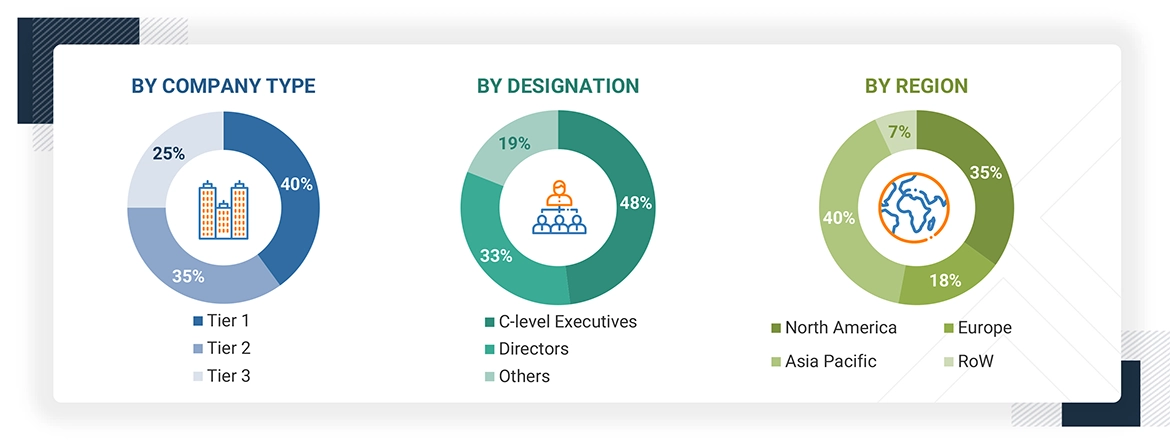
After interacting with industry experts, brief sessions were conducted with highly experienced independent consultants to reinforce the findings from our primary research. This, along with the in-house subject matter experts' opinions, has led us to the findings as described in the remainder of this report. The breakdown of primary respondents is as follows:
To know about the assumptions considered for the study, download the pdf brochure
Market Size Estimation
Both top-down and bottom-up approaches were used to estimate and validate the total size of the global Digital Twin market. These methods were also used extensively to estimate the size of various subsegments in the market. The research methodology used to estimate the market size includes the following:
Digital Twin Market : Top-Down and Bottom-Up Approach

Data Triangulation
The market was split into several segments and subsegments after arriving at the overall market size using the market size estimation processes as explained above. The data triangulation and market breakdown procedures were employed, wherever applicable, to complete the overall market engineering process and arrive at the exact statistics of each market segment and subsegment. The data was triangulated by studying various factors and trends from the demand and supply sides.
Market Definition
A digital twin is a virtual replica or digital copy of a physical object, process, or system. It serves as a digital counterpart that accurately captures the essential characteristics and behaviors of the real-world entity. Digital twins utilize advanced technologies such as sensors, data analysis, and simulations to collect real-time data from their physical counterparts. This data is then used to create and maintain an up-to-date digital representation that closely resembles the behavior of the actual object or system. The primary purpose of digital twins is to provide valuable insights and drive operational improvements in the business. By analyzing the digital twin, organizations can gain a deeper understanding of how the physical entity will perform, identify opportunities for enhancement, and test different strategies or scenarios before implementing them in the real world. Digital twins find applications in various industries, such as manufacturing, healthcare, transportation, energy, and construction.
Key Stakeholders
- Government bodies and policymakers
- Industry organizations, forums, alliances, and associations
- Market research and consulting firms
- Raw material suppliers and distributors
- Research institutes and organizations
- Analysts and strategic business planners
- End users of digital twins across various industries such as the aerospace, automotive & transportation, energy & utilities, oil & gas, infrastructure, healthcare, agriculture, retail, telecommunications, and other industries (semiconductors, chemicals, paper & pulp, and food & beverages)
Report Objectives
- To define, describe, and forecast the global Digital Twin market size, by industry, application, and enterprise, in terms of value
- To assess the size of the global Digital Twin market across four regions, namely, North America, Europe, Asia Pacific, and the RoW, along with their respective country-level market sizes, in terms of value
- To provide detailed information regarding the drivers, restraints, opportunities, and challenges influencing the global Digital Twin market growth
- To give ecosystem analysis, case study analysis, patent analysis, technology analysis, pricing analysis, Porter's five forces analysis, key stakeholders and buying criteria, key conferences and events, regulatory bodies, government agencies, and regulations pertaining to the global Digital Twin market
- To analyse the impact of AI and the US Tariff on the global Digital Twin market
- To offer a detailed overview of the process flow of the global Digital Twin market
- To strategically analyze micromarkets with respect to individual growth trends, prospects, and contributions to the overall global Digital Twin market size
- To study the complete value chain of the global Digital Twin market
- To understand opportunities for stakeholders by identifying high-growth segments of the global Digital Twin market
- To strategically profile the key players and comprehensively analyze their market positions in terms of their ranking and core competencies in the global Digital Twin market
- To analyze competitive developments, such as product launches, deals (mergers, acquisitions, partnerships, cooperation, alliances, collaborations, agreements, contracts, and investments), and others (expansions) in the global Digital Twin market
Available customizations:
With the given market data, MarketsandMarkets offers customizations according to the specific requirements of companies. The following customization options are available for the report:
- Detailed analysis and profiling of additional market players based on various blocks of the supply chain
Key Questions Addressed by the Report
What Is a Digital Twin?
A digital twin is a virtual representation of a physical asset, system, or process that replicates its behavior and characteristics in real time. It integrates data from sensors, control systems, and operational sources to simulate, monitor, and optimize performance throughout the asset's lifecycle. By leveraging technologies such as the Internet of Things (IoT), artificial intelligence (AI), and advanced analytics, digital twins enable predictive maintenance, enhance decision-making, and support process optimization.
What Is the Total Cagr Expected for the Digital Twin Market During the Forecast Period?
The global digital twin market is expected to record a CAGR of 47.9% during the forecast period.
What Are the Driving Factors for the Digital Twin Market Size?
The growing demand for predictive maintenance and asset management, and increased focus on smart manufacturing & urban planning are some factors driving the digital twin market.
Which Are the Significant Players Operating in the Digital Twin Market Size?
Siemens (Germany), GE Vernova (US), Dassault Systèmes (France), and PTC (US)are some of the major companies operating in the digital twin market.
Which Region Will Lead the Digital Market in the Future?
North America is expected to lead the hydraulics market during the forecast period.
What is the digital twin market size for 2025 and 2030, and what is the CAGR according to MarketsandMarkets?
According to MarketsandMarkets, the global digital twin market size is estimated at USD 21.14 billion in 2025 and is projected to reach USD 149.81 billion by 2030, registering a CAGR of 47.9% from 2025 to 2030.
What do the digital twin market size growth statistics for 2024 and 2025 indicate?
The digital twin market size growth statistics for 2024 and 2025 indicate increasing adoption of digital twin technologies across industries. MarketsandMarkets estimates the market at USD 21.14 billion in 2025, with growth supported by demand for real-time monitoring, predictive maintenance, process optimization, simulation, and data-driven decision-making.
What does the MarketsandMarkets digital twin market size analysis for 2025–2030 cover?
The MarketsandMarkets digital twin market size 2025–2030 CAGR analysis covers market size, growth trends, deployment, applications, industries, regional developments, competitive landscape, and factors influencing digital twin adoption. The report provides market estimates and forecasts for the 2025–2030 period.
Fact checked
Personalize This Research
- Triangulate with your Own Data
- Get Data as per your Format and Definition
- Gain a Deeper Dive on a Specific Application, Geography, Customer or Competitor
- Any level of Personalization
Let Us Help You
- What are the Known and Unknown Adjacencies Impacting the Digital Twin Market
- What will your New Revenue Sources be?
- Who will be your Top Customer; what will make them switch?
- Defend your Market Share or Win Competitors
- Get a Scorecard for Target Partners

Custom Market Research Services
We Will Customise The Research For You, In Case The Report Listed Above Does Not Meet With Your Requirements
Get 10% Free CustomisationTESTIMONIALS

Tetsuya Ohhira
Business Development Manager-Technology Business
Nikon Corporation,
Leading Japanese MNC specializing in optics and imaging productswww.nikon.com
MarketsandMarkets™ response
is quick. Their attitude is flexible and positive. Analyst Insights are globally considered and
significant. Client Services quickly respond to our inquiry and demand. Their wide range of global
surveys help us make our strategic plan.
We hope Knowledge Store will be easier to search
for a report.
VP - Marketing & Business Development
Leading Provider of Process Control Solutions
We engaged with MarketsandMarkets on a study to perform an analysis and recommend a Go-To-Market strategy for metrology and process control in the semiconductor market. The study was tailored to our targets and needs with well-defined milestones. Our overall experience with the MarketsandMarkets team was very good throughout the project in all aspects including the analysis methodologies used, the quality and depth of primary and secondary data sets, the professionalism and flexibility of the team and the ability to meet the target schedule and milestones. We want to thank MarketsandMarkets team for a job well done.
- US Digital Twin Market
- Canada Digital Twin Market
- Mexico Digital Twin Market
- Germany Digital Twin Market
- France Digital Twin Market
- UK Digital Twin Market
- Spain Digital Twin Market
- Italy Digital Twin Market
- Poland Digital Twin Market
- China Digital Twin Market
- Japan Digital Twin Market
- India Digital Twin Market
- South Korea Digital Twin Market
- Australia Digital Twin Market
- Indonesia Digital Twin Market
- Rest Of Europe Digital Twin Market
Growth opportunities and latent adjacency in Digital Twin Market






Brian
Apr, 2026
Which digital twin market segments offer the highest potential for capital appreciation over the next decade?.
Kevin
Apr, 2026
Which regions offer the strongest investment outlook in the digital twin market based on growth rates and infrastructure spending?.
Federico
Dec, 2022
Understanding the potential of digital twins for creative industries and the environmental movement. .