
South Korea 3D Printing Market (2025-2030)

The South Korea 3D Printing Market was valued at $379 Million in 2025 and projected to reach to $905.9 Million by 2030, representing a compound annual growth rate of 19.0%. South Korea's 3D printing market is poised for exceptional growth, driven by the country's advanced manufacturing capabilities and strong electronics sector.


| Market Size in | USD 26.32 MN |
| Market Forecast in | |
| CAGR | |
| Forecast Period | |
| Units Considered | Value (USD MN) |
South Korea 3D Printing Market Trends and Insights
- This represents a robust compound annual growth rate of 19.0%, significantly outpacing global expansion trends.
- South Korea's advanced semiconductor and electronics manufacturing ecosystem, combined with strong government support for Industry 4.0 initiatives, is driving rapid adoption of 3D printing technologies across prototyping, tooling, and production applications. The South Korea market benefits from the country's world-leading position in electronics manufacturing and a highly skilled workforce capable of integrating additive manufacturing into complex supply chains.
- South Korea's investment in R&D and digital transformation is accelerating the deployment of metal and polymer 3D printing systems in high-value sectors.
- Between 2025 and 2030, South Korea is expected to consolidate its role as a regional innovation hub, with increasing demand from semiconductor fabrication support, consumer electronics, and automotive component manufacturing driving sustained market expansion..
Key Market Statistics
- CAGR (2025-2030) 19.0% CAGR
- Market Size, 2025 ~USD 379 Million
- Forecast, 2030 ~USD 905.9 Million
- Country South Korea
South Korea 3D Printing Market Overview
Market Valuation & Growth :
South Korea's 3D printing market is valued at USD 379.0 million in 2025, with a projected CAGR of 19.0% through 2030, reaching USD 905.9 million. This growth rate significantly exceeds the global average of 17.2%, positioning South Korea as a high-growth market within Asia Pacific.
Advanced Manufacturing Ecosystem :
South Korea's world-class semiconductor and electronics manufacturing infrastructure provides a strong foundation for 3D printing adoption. The country's expertise in precision manufacturing and component production creates substantial demand for additive manufacturing technologies across multiple industrial verticals.
Technology Innovation Hub :
South Korea's commitment to R&D and digital transformation initiatives drives rapid adoption of 3D printing in prototyping, tooling, and production applications. Major electronics manufacturers and semiconductor firms are increasingly integrating additive manufacturing into their production workflows.
Strategic Industry Integration :
The convergence of 3D printing with South Korea's electronics and semiconductor sectors creates unique opportunities for customized solutions, rapid prototyping, and supply chain optimization. This integration accelerates market expansion beyond traditional manufacturing applications.
South Korea 3D Printing Market Dynamics
- The 19.0% CAGR reflects increasing adoption across semiconductor fabrication, consumer electronics, and precision component manufacturing.
- Government support for Industry 4.0 initiatives and digital manufacturing technologies further accelerates market penetration. Looking ahead to 2030, South Korea's market will benefit from technological advancements in materials science, expanded applications in high-value manufacturing, and growing integration with IoT and AI-driven production systems.
- The market's trajectory suggests South Korea will emerge as a regional leader in additive manufacturing innovation, attracting significant investment from global technology providers and driving localized supply chain development..
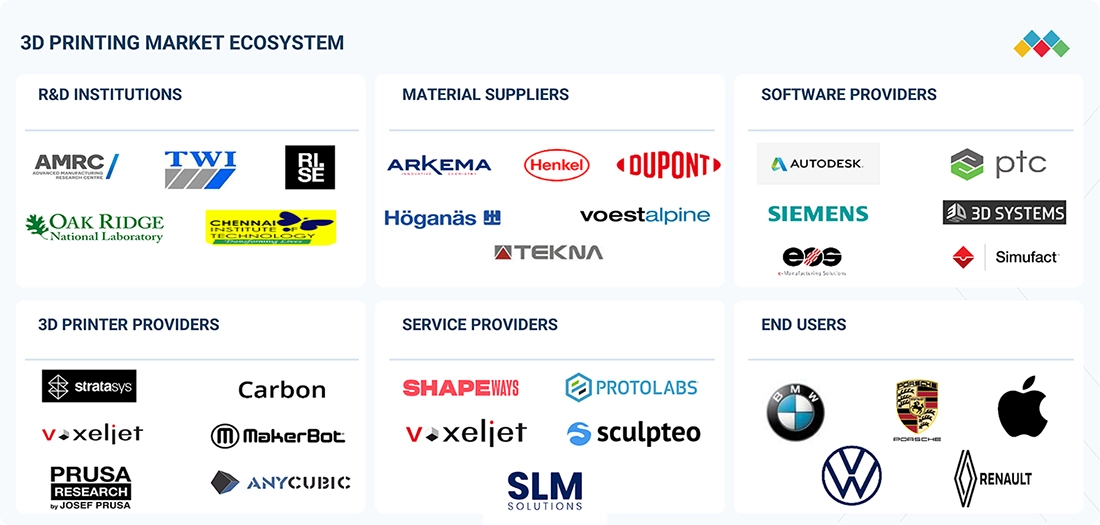
Market Ecosystem
3D PRINTING MARKET SIZE, SHARE & TRENDS: COMMERCIAL USE CASES ACROSS INDUSTRIES
| COMPANY | USE CASE DESCRIPTION | BENEFITS |
|---|---|---|
 |
Swinburne University of Technology collaborated with Renishaw to improve the performance of its Formula SAE electric race car. Renishaw utilized metal additive manufacturing to redesign wheel centers using titanium instead of aluminum and optimized the components through finite element analysis (FEA). The solution reduced component weight while maintaining structural integrity and improving rotational efficiency. | The solution achieved a 20% reduction in wheel weight and a 75% reduction in rotational inertia, resulting in improved acceleration, braking performance, and vehicle handling | It also demonstrated the advantages of additive manufacturing in lightweight electric vehicle development |
|
|
Linex Manufacturing, a division of Linamar Corporation, required a precise inspection solution for automotive components located outside the measuring range of its Equator gauge. Renishaw designed and manufactured a customized titanium stylus using metal powder bed fusion with an internal lattice structure to improve stiffness while reducing weight. | The custom stylus significantly improved inspection accuracy, rigidity, and repeatability for complex automotive components | Its durable single-piece design enhanced long-term inspection performance and enabled Linex to expand its quality inspection capabilities |
 |
Alex Degnes partnered with Protolabs to manufacture a high-performance aluminum engine cylinder using Direct Metal Laser Sintering (DMLS) technology. Additive manufacturing enabled the production of intricate internal cooling channels and lightweight honeycomb structures that were not achievable using conventional casting methods. | The DMLS-produced engine component provided excellent mechanical strength, thermal performance, and dimensional accuracy while enabling complex geometries | The solution supported the development of a high-performance engine designed for competitive speed record applications |
 |
PepsiCo adopted Nexa3D's NXE 400 3D printer and Henkel Loctite xPEEK147 material to manufacture tooling inserts for bottle blow molding. The hybrid tooling approach combined additively manufactured inserts with conventional molds to accelerate product development and reduce manufacturing costs. | The solution reduced tooling development time from 4 weeks to 48 hours and lowered mold costs from USD 10,000 to USD 350 per set | PepsiCo achieved approximately 96% cost savings, faster design validation, and improved production efficiency |
|
|
Lalaland Production and Design implemented Nexa3D's Selective Laser Sintering (SLS) technology with thermoplastic copolyester (TPC) material to accelerate footwear midsole development. The solution enabled rapid prototyping, eliminated tooling requirements, and supported customized lattice-based designs for improved product performance. | The solution reduced midsole production time from 26 hours to 3 hours and shortened the product development cycle from 18–24 weeks to 4 weeks | It also enabled mass customization, reduced manufacturing costs, and improved overall production flexibility |
Logos and trademarks shown above are the property of their respective owners. Their use here is for informational and illustrative purposes only.
Related Ecosystem
Aviation
- Narrow Body Aircraft
- Wide Body Aircraft
- Military Helicopters
- Special Mission Aircraft
- Fighter Aircraft
- HONEYWELL INTERNATIONAL INC.
- COLLINS AEROSPACE
- Thales group
- Safran group
- HEICO Corporation
Automotive Electronics And Electrical Equipment
- Battery Electric Vehicle (BEV)
- Light Commercial Vehicles (LCVs)
- Fuel Cell Electric Vehicle (FCEV)
- Sensors
- Hybrid Electric Vehicle (HEV)
- BOSCH LIMITED
- Continental ag
- DENSO Corporation
- Texas Instruments Incorporated
- Panasonic Holdings Corporation
Electronics System And Components
- Sensors
- Temperature Sensors
- Pressure Sensors
- Actuators
- Image Sensors
- Lenovo
- Samsung
- Texas Instruments Incorporated
- HONEYWELL INTERNATIONAL INC.
- Teledyne Technologies Incorporated
Key Takeaways
- South Korea's 3D printing market will grow from USD 379.0M (2025) to USD 905.9M (2030) at a 19.0% CAGR, outpacing global growth.
- South Korea's semiconductor and electronics leadership creates strong demand for advanced additive manufacturing in high-precision applications.
- South Korea's government-backed Industry 4.0 initiatives and R&D investments are accelerating 3D printing adoption across manufacturing sectors.
- South Korea is emerging as a regional innovation and manufacturing hub for 3D printing technology integration in Asia Pacific.
3D Printing Market Report Scope
| Report Metric | Details |
|---|---|
| Base Year | 2025 |
| Fastest Growing Segment | AUTOMOTIVE (Vertical) |
| Forecast Period | 2025–2030 |
| Growth Rate | CAGR of 17.2% from 2025 to 2030 |
| Largest Segment | PROTOTYPING (Application) |
| Market Size Base Year (Billions) | ~USD 16.19 (2025) |
| Revenue Forecast (Billions) | ~USD 35.79 (2030) |
| Segments Covered | Offering, Type, Application, Vertical, Technology, Process |
South Korea 3D Printing Market Report Segmentation
6 segment dimensions are covered across the global market.
By Offering
- Material
- Printer
- Service
- Software
By Type
- After-Sales
- Aluminum
- Ceramics
- Custom Design & Manufacturing
- Desktop
- Desktop Printers
- Industrial
- Industrial Printers
- Metal
- Nickel
- Other Materials
- Other Metals
- Photopolymers
- Plastic
- Steel
- Thermoplastics
- Titanium
By Application
- Functional Part Manufacturing
- Functional Parts
- Prototyping
- Tooling
By Vertical
- Aerospace & Defense
- Architecture & Construction
- Automotive
- Consumer Products
- Education
- Energy
- Food & Culinary
- Healthcare
- Industrial
- Jewelry
- Other Verticals
- Printed Electronics
By Technology
- Direct Light Projection (Dlp)
- Direct Metal Laser Sintering (Dmls)
- Electron Beam Melting (Ebm)
- Fuse Deposition Modeling (Fdm)
- Other Technologies
- Polyjet Printing (Mjp)
- Selective Laser Sintering (Sls)
- Stereolithography (Sla)
By Process
- Binder Jetting
- Material Extrusion
- Material Jetting
- Other Processes
- Powder Bed Fusion
- Vat Photopolymerization
Target Audience
- 3D Printing Equipment Manufacturers : Manufacturers need South Korea-specific market data to identify growth opportunities, assess competitive positioning, and develop localized product strategies for the high-growth semiconductor and electronics sectors.
- Materials & Software Providers : Suppliers of 3D printing materials and software solutions require detailed insights into South Korean adoption patterns, industry-specific requirements, and technology preferences to optimize their product offerings and market penetration.
- Electronics & Semiconductor Companies : Major manufacturers in South Korea's electronics and semiconductor industries need market intelligence to evaluate 3D printing integration opportunities, benchmark against competitors, and plan digital manufacturing investments.
- Investment & Private Equity Firms : Investors targeting South Korea's advanced manufacturing sector require comprehensive market data to identify acquisition targets, assess growth potential, and make informed capital allocation decisions in the 3D printing ecosystem.
- Consulting & Systems Integration Firms : Consultants advising Korean manufacturers on digital transformation need market-specific insights to develop implementation strategies, identify technology partners, and guide clients through 3D printing adoption and integration processes.
Key Companies in the South Korea 3D Printing Market
| Company | HQ | Ownership | Strongest segments |
|---|---|---|---|
| JABIL | United States | ||
| NOVANTA, INC | United States | ||
| TEXAS INSTRUMENTS INC | United States | ||
| KORNIT DIGITAL LTD | Israel | ||
| LENOVO | China | ||
| ESSENTRA PLC | United Kingdom | ||
| STRATASYS | United States | ||
| HP DEVELOPMENT COMPANY, L.P. | United States | ||
| 3D SYSTEMS, INC. | United States | ||
| PROTO LABS, INC. | United States | Public Company | 3D Printing Services,CNC Machining Services,Injection Molding Services, |
| PRODWAYS GROUP | France | Public Company | Printers,Materials,Software, |
JABIL
Jabil is a global manufacturing services company that provides electronics design, production, and logistics solutions to major technology and industrial clients.
NOVANTA, INC
Novanta Inc. is a technology company specializing in photonics, software, and precision motion control solutions for medical, industrial, and advanced imaging applications.
TEXAS INSTRUMENTS INC
Texas Instruments Inc. is a semiconductor company that designs and manufactures analog and embedded processing chips for industrial, automotive, personal electronics, and communications markets.
KORNIT DIGITAL LTD
Kornit Digital Ltd. is an Israeli digital printing technology company that develops and manufactures industrial inkjet printing solutions for textile and apparel production.
LENOVO
Lenovo is a Chinese multinational technology company that manufactures and sells personal computers, smartphones, tablets, and enterprise IT solutions globally.
ESSENTRA PLC
Essentra PLC is a United Kingdom-based specialty materials and components company serving customers in healthcare, industrial, and consumer markets.
STRATASYS
Stratasys is a 3D printing company that develops and manufactures additive manufacturing systems and materials for prototyping and production applications.
HP DEVELOPMENT COMPANY, L.P.
HP Development Company, L.P. is a technology company that designs and manufactures personal computers, printers, imaging devices, and related supplies.
3D SYSTEMS, INC.
3D Systems, Inc. is an additive manufacturing company that develops and produces 3D printers, materials, and software solutions for various industrial and commercial applications.
PROTO LABS, INC.
Proto Labs, Inc. is a digital manufacturing company providing on-demand injection molding, CNC machining, 3D printing, and sheet metal fabrication services to product designers and manufacturers.
PRODWAYS GROUP
Prodways Group is a French public company founded in 2013 that designs and manufactures 3D printers and provides additive manufacturing solutions and services.
Reasons to Buy this Report
- Market-Specific Growth Intelligence : Gain detailed insights into South Korea's 19.0% CAGR trajectory and understand the unique drivers propelling the market to USD 905.9 million by 2030, enabling precise investment and expansion decisions tailored to this high-growth economy.
- Competitive Landscape Analysis : Identify key players, market consolidation trends, and competitive positioning specific to South Korea's 3D printing ecosystem. Understand how local manufacturers and international vendors are competing in this advanced manufacturing market.
- Sector-Specific Application Insights : Discover how South Korea's semiconductor and electronics industries are leveraging 3D printing for prototyping, tooling, and production. Access data on adoption rates across different manufacturing verticals and technology segments.
- Strategic Market Entry Guidance : Develop informed go-to-market strategies for South Korea with comprehensive analysis of regulatory environment, supply chain dynamics, and customer preferences. Identify partnership opportunities and distribution channels specific to the Korean market.
- Technology & Innovation Trends : Stay ahead of emerging technologies and innovation patterns in South Korea's 3D printing sector. Understand material advancements, process improvements, and integration with Industry 4.0 initiatives driving market evolution.
Frequently asked questions
What is the projected market size of 3D printing in South Korea by 2030?
South Korea's 3D printing market is forecast to reach USD 905.9 million by 2030, growing from USD 379.0 million in 2025.
What is the CAGR for South Korea's 3D printing market?
South Korea's 3D printing market is expected to grow at a compound annual growth rate of 19.0% between 2025 and 2030.
Which industries are driving 3D printing adoption in South Korea?
South Korea's semiconductor fabrication, consumer electronics, automotive component manufacturing, and precision tooling sectors are primary growth drivers for 3D printing technology adoption.
How does South Korea's 3D printing market compare to global growth?
South Korea's 19.0% CAGR exceeds the global 3D printing market CAGR of 17.2%, reflecting the country's advanced manufacturing capabilities and technology adoption rates.
What factors support 3D printing market expansion in South Korea?
South Korea's strong electronics manufacturing base, government Industry 4.0 support, skilled workforce, and significant R&D investments are key factors accelerating 3D printing market growth.
RESEARCH METHODOLOGY
The research process for this technical, market-oriented, and commercial study of the 3D printing market included systematic gathering, recording, and analysis of data about companies operating in the market. It involved the extensive use of secondary sources, directories, and databases (Factiva, Oanda) to identify and collect relevant information. In-depth interviews were conducted with various primary respondents, including experts from core and related industries and preferred manufacturers, to obtain and verify critical qualitative and quantitative information, as well as to assess the growth prospects of the market. Key players in the 3D printing market were identified through secondary research, and their market rankings were determined through primary and secondary research. This included studying annual reports of top players and interviewing key industry experts, such as CEOs, directors, and marketing executives.
Secondary Research
In the secondary research process, various secondary sources were referred to for identifying and collecting information relevant to this study. Secondary sources include annual reports, press releases, and investor presentations of companies; white papers, certified publications, and articles from recognized authors; directories; and databases. Secondary research was mainly conducted to obtain key information about the supply of the industry; a total pool of key players; segmentation of the market according to industry trends, geographic markets, and key developments from market- and technology-oriented perspectives.
Primary Research
In the primary research process, primary sources from the supply and demand sides were interviewed to obtain qualitative and quantitative information for this report. Primary sources from the supply side included experts, such as CEOs, vice presidents, marketing directors, technology and innovation directors, subject-matter experts, consultants, and related key executives from major companies and organizations operating in the 3D printing market.
After the complete market engineering process (market statistics calculations, market breakdown, market size estimations, market forecasting, and data triangulation), extensive primary research was conducted to gather information and verify and validate the critical market numbers.
Several primary interviews were conducted with experts from the demand and supply sides across four major regions—North America, Europe, Asia Pacific, and RoW. Approximately 25% of the primary interviews were conducted with the demand side and 75% with the supply side. This primary data was collected through questionnaires, emails, and telephonic interviews.
BREAKDOWN OF PRIMARY INTERVIEW PARTICIPANTS
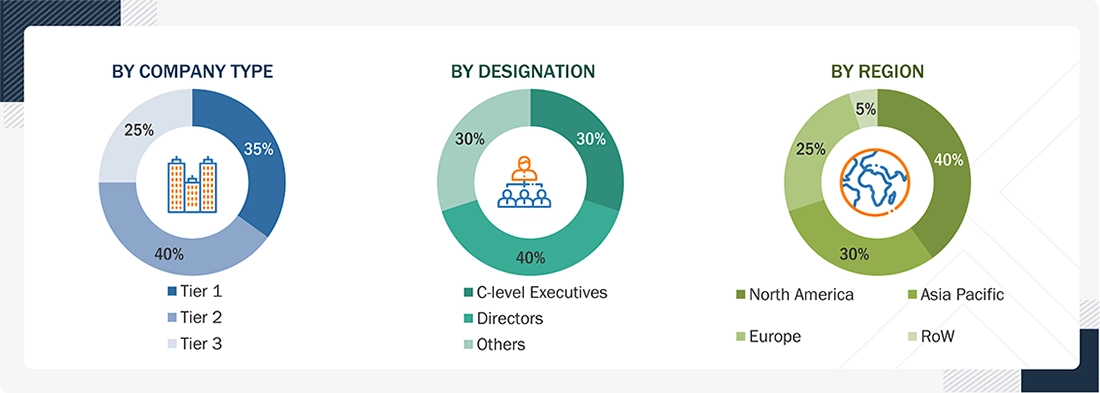
Notes: Tier 1 companies include market players with revenues above USD 500 million; tier 2 companies earn revenues between USD 100 million and USD 500 million; and tier 3 companies earn revenues up to USD 100 million.
Other designations include sales, marketing, and product managers.
To know about the assumptions considered for the study, download the pdf brochure
Market Size Estimation
In the complete market estimation process, the top-down and bottom-up approaches were used, along with several data triangulation methods, to estimate and forecast the size of the market and its segments and subsegments listed in the report. Extensive qualitative and quantitative analyses were carried out on the complete market engineering process to list the key information/insights pertaining to the 3D printing market.
Key players in the 3D printing market were identified through secondary research, and their rankings in the respective regions were determined through primary and secondary research. This entire procedure involved the study of the annual and financial reports of top players and interviews with industry experts, such as chief executive officers, vice presidents, directors, and marketing executives, for quantitative and qualitative insights. All percentage shares, splits, and breakdowns were determined using secondary sources and verified through primary sources. All parameters that affect the markets covered in this research study were accounted for, viewed in extensive detail, verified through primary research, and analyzed to obtain the final quantitative and qualitative data. This data was consolidated and enhanced with detailed inputs and analysis from MarketsandMarkets and presented in this report.
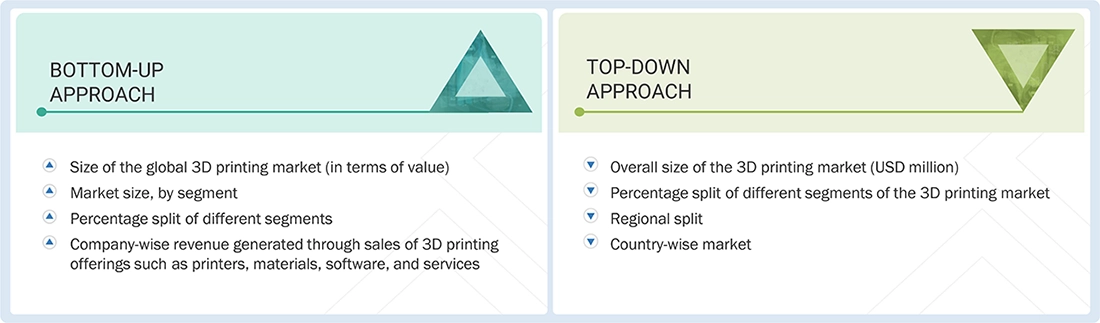
BOTTOM-UP APPROACH
- Identifying the entities in the 3D printing market influencing the entire market, along with the related players, including material, printer, software, and service providers
- Analyzing major manufacturers of 3D printing offerings, studying their portfolios, and understanding different types of printers, including desktop and industrial ones
- Analyzing the trends pertaining to the use of different types of 3D printers for different kinds of applications, technologies, and processes
- Tracking the ongoing and upcoming market developments, such as investments made, R&D activities, government support, product launches, collaborations, and partnerships, and forecasting the market based on these developments and other critical parameters
- Carrying out multiple discussions with key opinion leaders to understand the different types of printers and materials, services, verticals, technologies, and recent trends in the market, thereby analyzing the breakup of the scope of work carried out by major companies
- Arriving at the market estimates by analyzing revenues of the companies generated from each type of printer, material, software, and service, and then combining the same to get the market estimate
- Segmenting the overall market into various other market segments
- Verifying and cross-checking the estimate at every level from the discussion with key opinion leaders, such as CXOs, directors, and operations managers, and finally with the domain experts in MarketsandMarkets
- Studying various paid and unpaid sources of information, such as annual reports, press releases, white papers, and databases
TOP-DOWN APPROACH
- Focusing initially on top-line investments and expenditures being made in the ecosystems of the 3D printing market
- Calculating the market size considering the revenues generated by players through the sales of 3D printers, materials, software, and services
- Further segmenting on the basis of the mapping usage of 3D printing for different applications and verticals
- Building and developing the information related to the revenues generated by players through offerings
- Conducting multiple on-field discussions with key opinion leaders across major companies involved in the development of 3D printing technology
- Estimating the geographic split using secondary sources based on various factors, such as the number of players in a specific country and region, the role of major players in the market for the development of innovative products, adoption and penetration rates in a particular country for various verticals, government support, investments, and others
3D Printing Market : Top-Down and Bottom-Up Approach
Data Triangulation
After arriving at the overall size of the 3D printing market from the estimation process explained above, the market was split into several segments and subsegments. The data triangulation and market breakdown procedures were employed (wherever applicable) to complete the overall market engineering process and arrive at the exact statistics for all segments and subsegments. The data was triangulated by studying various factors and trends from both the demand and supply sides. The size of the 3D printing market was validated using both top-down and bottom-up approaches.
Market Definition
Three-dimensional (3D) printing is the process of building a real 3D object from a digital model by joining thin layers of materials (which might be in solid, powder, or liquid forms), usually layer-upon-layer in horizontal cross-section, unlike subtractive manufacturing methods. It is also known as additive manufacturing (AM) or freeform fabrication. 3D printing is the most common term in the consumer markets, while AM is mostly used in the industrial markets. 3D printing is used for prototyping, tooling, and functional part manufacturing. The manufactured functional parts are used in various verticals, such as automotive, aerospace, healthcare, jewelry, education, tooling, consumer goods, and art & architecture.
Key Stakeholders
- 3D printing product and solution providers
- 3D printing-related service providers
- 3D printing material and accessory providers
- 3D printing consulting companies
- 3D printing assembly companies
- 3D printing software providers
- 3D printing-related associations, organizations, forums, and alliances
- Government and corporate offices
- Venture capitalists, private equity firms, and startup companies
- Distributors and traders
- End users willing to know more about 3D printing technologies and the latest technological developments in the 3D printing market
Report Objectives
- To define, describe, and forecast the 3D printing market based on offering, process, technology, application, vertical, and region
- To forecast the market size, in terms of value, for various segments, with respect to four main regions—North America, Europe, Asia Pacific, and Rest of the World (RoW)
- To forecast the market size for printer types, in terms of volume
- To provide detailed information regarding the major factors influencing the growth of the 3D printing market (drivers, restraints, opportunities, and challenges)
- To provide trends/disruptions impacting customers’ businesses, value chain analysis, ecosystem analysis, investment and funding scenario, case study analysis, key conferences and events, patent analysis, technology analysis, average selling price (ASP) analysis, Porter’s five forces analysis, key stakeholders and buying criteria, and regulations pertaining to the market
- To strategically analyze micromarkets with respect to individual growth trends, prospects, and contributions to the total market
- To analyze opportunities for the stakeholders by identifying high-growth segments of the 3D printing market
- To benchmark players within the market using the proprietary Company Evaluation Matrix framework, which analyzes market players on various parameters within the broad categories of market rank and product offerings
- To strategically profile the key players and comprehensively analyze their market shares and core competencies and provide a detailed competitive landscape for market leaders
- To analyze competitive developments such as partnerships, collaborations, agreements, joint ventures, mergers and acquisitions, expansions, and product launches in the 3D printing market
Available customizations:
With the market data given, MarketsandMarkets offers customizations according to the company’s specific needs. The following customization options are available for the report:
Company Information
- Detailed analysis and profiling of additional market players (up to 7)
Get the Full 3D Printing Market Report
Full forecast, segment splits, and company analysis for all 3D Printing Market.
- US 3D Printing Market
- Canada 3D Printing Market
- Mexico 3D Printing Market
- Germany 3D Printing Market
- UK 3D Printing Market
- France 3D Printing Market
- Spain 3D Printing Market
- Italy 3D Printing Market
- Rest Of Europe 3D Printing Market
- China 3D Printing Market
- Japan 3D Printing Market
- India 3D Printing Market
- Rest Of Asia Pacific 3D Printing Market
- GCC 3D Printing Market
- Rest Of Middle East 3D Printing Market
Need a Tailored Report?
Customize this report to your needs
Get 10% FREE Customization
Customize This Report
