
Europe 3D Sensor Market (2026-2031)

The Europe 3D Sensor Market was valued at $1548.7 Million in 2026 and projected to reach to $3792.6 Million by 2031, representing a compound annual growth rate of CAGR 16.1%. Europe's 3D sensor market is poised for accelerated growth, expanding from $1,548.7 million in 2026 to $3,792.6 million by 2031 at a 16.1% CAGR.


| Market Size in | USD 26.32 MN |
| Market Forecast in | |
| CAGR | |
| Forecast Period | |
| Units Considered | Value (USD MN) |
Europe 3D Sensor Market Trends and Insights
- This growth trajectory reflects Europe's strong position in automotive, industrial automation, and consumer electronics sectors, where 3D sensing technology is becoming increasingly critical.
- Europe's advanced manufacturing ecosystem and stringent quality standards drive adoption of 3D sensors across multiple verticals. The European market benefits from significant investments in Industry 4.0 initiatives and autonomous vehicle development, particularly in Germany, France, and the Nordic region.
- Europe's regulatory environment and focus on precision engineering create favorable conditions for 3D sensor deployment in robotics, quality control, and gesture recognition applications.
- The 16.1% CAGR through 2031 underscores Europe's commitment to technological innovation and digital transformation across industrial and consumer segments..
Key Market Statistics
- CAGR (2026-2031) CAGR 16.1%
- Market Size, 2026 ~USD 1548.7 Million
- Forecast, 2031 ~USD 3792.6 Million
- Geography Europe
Europe 3D Sensor Market Overview
Strong Automotive Integration :
Europe's automotive sector is driving 3D sensor adoption for advanced driver assistance systems (ADAS), autonomous vehicles, and in-cabin monitoring. Major OEMs across Germany, UK, and France are integrating 3D sensing for enhanced safety and user experience.
Industrial Automation Leadership :
European manufacturers leverage 3D sensors for robotics, quality control, and smart factory applications. The region's commitment to Industry 4.0 standards accelerates deployment across manufacturing hubs in Germany, Italy, and Scandinavia.
Consumer Electronics Expansion :
Growing demand for 3D-enabled smartphones, tablets, and smart home devices in Western Europe fuels market growth. Premium consumer segments in UK and Germany show strong adoption of depth-sensing and facial recognition technologies.
Regulatory & Quality Standards :
Europe's stringent quality certifications and data privacy regulations (GDPR) create competitive advantages for premium 3D sensor manufacturers, supporting higher-value market positioning and sustainable growth.
Europe 3D Sensor Market Dynamics
- This expansion is underpinned by Europe's leadership in automotive electrification, industrial digitalization, and consumer technology innovation.
- Key growth drivers include increasing ADAS adoption, Industry 4.0 investments, and rising demand for contactless interfaces across commercial and residential applications. The region's advanced manufacturing ecosystem, coupled with strong R&D capabilities and regulatory frameworks, positions European companies as innovation leaders in 3D sensing solutions.
- Strategic investments by automotive OEMs and industrial automation providers, particularly in Germany, UK, and France, will sustain market momentum.
- Emerging applications in augmented reality, healthcare diagnostics, and smart retail further diversify revenue streams, ensuring robust long-term growth prospects..
Market Ecosystem
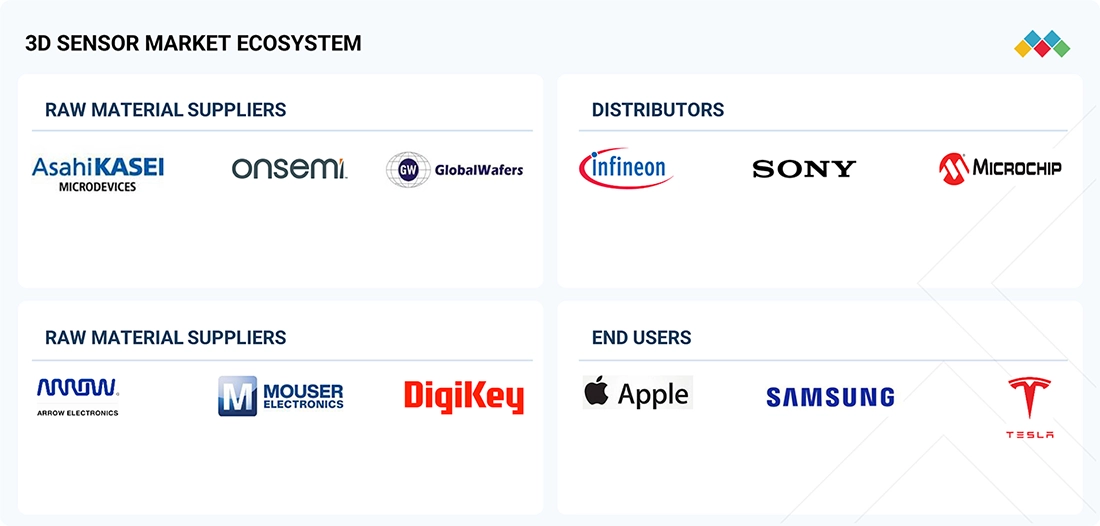
3D SENSOR MARKET SIZE, SHARE & INDUSTRY TRENDS: COMMERCIAL USE CASES ACROSS INDUSTRIES
| COMPANY | USE CASE DESCRIPTION | BENEFITS |
|---|---|---|
 |
Infineon provides REAL3 and XENSIV Time of Flight (ToF) 3D image sensors. These sensors function within automotive in-cabin monitoring systems, industrial automation, and consumer electronics to capture accurate spatial depth data. | Enables continuous 3D environmental mapping | Operates reliably across variable lighting conditions | Supports automated vehicle safety systems | Integrates into compact electronic hardware |
 |
Microchip develops GestIC technology. This hardware utilizes electrical near field (E-field) 3D tracking to enable touchless gesture recognition in automotive interfaces, smart home appliances, and consumer electronics. | Provides touchless device control | Operates with low electrical power consumption | Integrates behind non conductive device housings | Functions continuously in space-constrained environments |
 |
Sony manufactures DepthSense ToF sensors. These components utilize Current Assisted Photonic Demodulator (CAPD) and back-illuminated complementary metal oxide semiconductor (CMOS) architectures for machine vision, robotics, and mobile augmented reality. | Delivers precise spatial depth measurements | Supports high speed object detection | Captures high resolution 3D data in low light environments | Maintains stable operational performance |
 |
STMicroelectronics supplies FlightSense Time of Flight (ToF) sensors. These integrated depth-sensing components process visual data for smartphone facial authentication, consumer robotics navigation, and computer presence detection. | Calculates exact physical distance metrics | Supports secure biometric hardware architectures | Enables rapid optical autofocus functions | Integrates into low-power electronic assemblies |
 |
Keyence develops industrial 3D measurement systems. These products include 3D optical profilometers and high speed laser snapshot sensors for inline production inspection, surface roughness analysis, and automated quality control. | Captures sub-micron surface topography data | Inspects fast-moving production lines continuously | Identifies physical manufacturing defects | Integrates directly into automated manufacturing equipment |
Logos and trademarks shown above are the property of their respective owners. Their use here is for informational and illustrative purposes only.
Related Ecosystem
Aviation
- Narrow Body Aircraft
- Wide Body Aircraft
- Military Helicopters
- Special Mission Aircraft
- Fighter Aircraft
- HONEYWELL INTERNATIONAL INC.
- COLLINS AEROSPACE
- Thales group
- Safran group
- HEICO Corporation
Digitalization And Iot
- Sensors
- Remote Monitoring
- Supply Chain Management
- Passenger Information System (PIS)
- Platform as A Service (PaaS)
- International Business Machines Corporation
- Cisco Systems, Inc.
- MICROSOFT CORPORATION
- Oracle Corporation
- HUAWEI TECHNOLOGIES CO LTD
Sensors And Control
- Sensors
- Image Sensors
- Temperature Sensors
- Pressure Sensors
- Flow Sensors
- BAUMER ELECTRIC AG
- HONEYWELL INTERNATIONAL INC.
- Lenovo
- Stmicroelectronics
- Texas Instruments Incorporated
Key Takeaways
- Europe's 3D sensor market will more than double from $1,548.7M (2026) to $3,792.6M (2031), driven by automotive and industrial automation demand.
- The 16.1% CAGR positions Europe as a high-growth region, supported by Industry 4.0 adoption and autonomous vehicle development initiatives.
- Germany, France, and Nordic countries lead European adoption, leveraging advanced manufacturing and precision engineering capabilities.
- Industrial robotics, quality control, and gesture recognition applications are primary growth drivers across Europe's diverse market segments.
3D Sensor Market Report Scope
| Report Metric | Details |
|---|---|
| Base Year | 2026 |
| Fastest Growing Segment | AUTONOMOUS DRIVING (Application) |
| Forecast Period | 2026–2031 |
| Growth Rate | CAGR of 17.2% from 2026 to 2031 |
| Largest Segment | TIME-OF-FLIGHT (Technology) |
| Market Size Base Year (Billions) | ~USD 8.28 (2026) |
| Revenue Forecast (Billions) | ~USD 18.3 (2031) |
| Segments Covered | Type, End-Use Industry, Technology, Application |
Europe 3D Sensor Market Report Segmentation
4 segment dimensions are covered across the global market.
By Type
- Acoustic Sensor
- Image Sensor
- Magnetometer
- Other Sensors
- Position Sensor
By End-Use Industry
- Aerospace & Defense
- Automotive
- Consumer Electronics
- Entertainment
- Healthcare
- Other End-Use Industries
- Robotics
By Technology
- Other Technologies
- Stereo Vision
- Structured Light
- Time-Of-Flight
- Ultrasound
By Application
- Autonomous Driving
- Facial Recognition
- Inspection & Measurement
- Mapping & Navigation
- Object Detection & Tracking
- Other Applications
- Robotics & Automation
REST OF EUROPE: 3D SENSOR MARKET, BY END-USE INDUSTRY, 2026–2032
| Segment | 2026 | 2027 | 2028 | 2029 | 2030 | 2031 | 2032 | CAGR (%) |
|---|---|---|---|---|---|---|---|---|
| AEROSPACE & DEFENSE | 27.8 | 30.9 | 34.4 | 38.4 | 42.8 | 47.8 | 53.2 | 11.4 |
| AUTOMOTIVE | 16.4 | 18.6 | 21.1 | 23.9 | 27.1 | 30.6 | 35 | 13.5 |
| CONSUMER ELECTRONICS | 67.8 | 76.4 | 86.5 | 98 | 111.3 | 126.4 | 143.6 | 13.3 |
| ENTERTAINMENT | 7.3 | 8.2 | 9.2 | 10.4 | 11.8 | 13.3 | 15 | 12.8 |
| HEALTHCARE | 32.3 | 37 | 42.6 | 49.1 | 56.7 | 65.5 | 75.8 | 15.3 |
| OTHER END-USE INDUSTRIES | 13 | 14.9 | 16.9 | 19.2 | 21.5 | 24 | 22.3 | 9.4 |
| ROBOTICS | 38.3 | 43.1 | 48.7 | 55.1 | 62.3 | 70.5 | 80.1 | 13.1 |
| TOTAL | 202.8 | 229.1 | 259.4 | 294.1 | 333.6 | 378.1 | 424.9 | 13.1 |
EUROPE: 3D SENSOR MARKET, BY END-USE INDUSTRY, 2026–2032
| Segment | 2026 | 2027 | 2028 | 2029 | 2030 | 2031 | 2032 | CAGR (%) |
|---|---|---|---|---|---|---|---|---|
| AEROSPACE & DEFENSE | 180.3 | 205.8 | 235.7 | 270.6 | 311.1 | 358.1 | 412.3 | 14.8 |
| AUTOMOTIVE | 232.2 | 274.1 | 324.8 | 385.8 | 459.1 | 546.8 | 659.9 | 19 |
| CONSUMER ELECTRONICS | 405.8 | 463.9 | 532.2 | 612.1 | 705.3 | 813.5 | 938.5 | 15 |
| ENTERTAINMENT | 92.2 | 105.9 | 122.2 | 141.3 | 163.7 | 189.9 | 220.2 | 15.6 |
| HEALTHCARE | 201.7 | 234.7 | 274 | 320.7 | 376 | 441.3 | 518.9 | 17.1 |
| OTHER END-USE INDUSTRIES | 81.3 | 94.3 | 108.9 | 125.2 | 142.9 | 161.8 | 152.9 | 11.1 |
| ROBOTICS | 355.3 | 411.2 | 477.7 | 556.2 | 648.7 | 757.3 | 889.9 | 16.5 |
| TOTAL | 1548.7 | 1790 | 2075.4 | 2411.9 | 2807 | 3268.7 | 3792.6 | 16.1 |
Target Audience
- Automotive OEMs & Suppliers : European automotive manufacturers and Tier-1 suppliers need market intelligence to guide ADAS and autonomous vehicle sensor procurement, supply chain optimization, and technology roadmap planning.
- Industrial Automation Companies : Robotics and factory automation providers require insights into 3D sensor adoption trends, competitive offerings, and ROI metrics to support Industry 4.0 initiatives across European manufacturing facilities.
- Consumer Electronics Manufacturers : Smartphone, tablet, and smart home device makers need data on 3D sensor market dynamics, consumer preferences, and technology trends to inform product development and market positioning in Europe.
- Semiconductor & Sensor Vendors : 3D sensor chip designers and manufacturers require competitive analysis, market sizing, and application-specific demand forecasts to optimize product portfolios and sales strategies for European markets.
- Investment & Strategy Consultants : Private equity, venture capital, and management consulting firms need comprehensive market data to evaluate investment opportunities, support M&A due diligence, and guide client growth strategies in Europe.
Key Companies in the Europe 3D Sensor Market
| Company | HQ | Ownership | Strongest segments |
|---|---|---|---|
| EPCOS AG | Germany | Private Company | EMC filters and suppression components,Capacitors for EMC and power integrity,Ferrites and inductors, |
| LENOVO | China | Public Company | Commercial PCs & Small Form Factor Signage Controllers,Embedded Media Players & Thin Clients,Tablets & Smart Devices for Kiosks/POS, |
| AMS AG | United States | Public Company | Air Distribution (Amadeus GDS),Airline IT Solutions (Altéa, New Skies, departure control),Hospitality & Other Solutions, |
| FIRST SENSOR AG | Germany | Public Company | Sensor chips, components, and systems,Connectivity (cable assemblies, connectors, terminals, wire and cable),Fiber optics, EMI/EMC, and protection (heat shrink, wire management, shielding), |
| INFINEON TECHNOLOGIES AG | Germany | Public Company | Automotive,Green Industrial Power,Power & Sensor Systems, |
| MICROCHIP TECHNOLOGY INC. | United States | Public Company | Microcontrollers and Microprocessors,Analog, Interface, and Connectivity,FPGA and ASIC, Aerospace and Timing Systems, |
| SONY GROUP CORPORATION | Japan | Public Company | Game & Network Services,Music,Pictures, |
| STMICROELECTRONICS | Switzerland | Public Company | Power and Discrete products (P&D),Analog products, MEMS and Sensors Group (AM&S),Embedded Processing (EMP), |
| KEYENCE CORPORATION | Japan | Public Company | Photoelectric, laser, and proximity sensors,Displacement, profiling, and precision measurement,Machine vision systems and barcode readers, |
| OMNIVISION | United States | Private Company | Mobile and consumer (smartphones, tablets, entertainment, webcams, DSC),Automotive imaging,Security and surveillance, |
| AMS-OSRAM AG | Austria | Public Company | Opto Semiconductors (OS),CMOS Sensors & ASICs (CSA),Lamps & Systems (L&S), |
| SICK AG | Germany | Private Company | Detection and distance sensors,Safety sensors and systems,LiDAR and radar sensors, |
| OUSTER INC. | United States | Public Company | OS series (OS0/OS1/OS2/OSDome),Velodyne surround-view portfolio (VLP/VLS series),DF solid-state digital lidar for ADAS/autonomous driving, |
| MELEXIS | Belgium | Public Company | Magnetic, current, and position sensor ICs,Other sensor ICs (speed, pressure, temperature, optical, tire, time-of-flight),Embedded motor, fan, pump, and pre-driver ICs, |
EPCOS AG
EPCOS AG is a German private company founded in 1989 that employs 23,619 people. The company operates in the electronics and components sector.
LENOVO
LENOVO is a Chinese public company founded in 1984 that operates as a major technology and computing hardware manufacturer.
AMS AG
AMS AG is a publicly traded American company founded in 1987 with 20,605 employees, operating in the semiconductor and sensor technology industry.
FIRST SENSOR AG
FIRST SENSOR AG is a German public company founded in 1991 with 538 employees, specializing in sensor technology and solutions.
INFINEON TECHNOLOGIES AG
INFINEON TECHNOLOGIES AG is a German public semiconductor company founded in 1952 with 56,500 employees, serving automotive, industrial, and consumer markets.
MICROCHIP TECHNOLOGY INC.
MICROCHIP TECHNOLOGY INC. is an American public company founded in 1989 with 17,900 employees, specializing in microcontroller and semiconductor solutions.
SONY GROUP CORPORATION
SONY GROUP CORPORATION is a Japanese public company founded in 1946 with 94,900 employees, operating across electronics, entertainment, gaming, and financial services.
STMICROELECTRONICS
STMICROELECTRONICS is a Swiss public company founded in 1987 with 48,000 employees, manufacturing semiconductors and microelectronics for diverse industrial applications.
KEYENCE CORPORATION
KEYENCE CORPORATION is a Japanese public company founded in 1972 with 12,784 employees, specializing in automation sensors and inspection systems.
OMNIVISION
OMNIVISION is an American private company founded in 1995 with 2,176 employees, focusing on imaging sensor technology and solutions.
AMS-OSRAM AG
AMS-OSRAM AG is an Austrian public company founded in 1981 with 18,500 employees, manufacturing semiconductors, sensors, and lighting solutions.
SICK AG
SICK AG is a German private company founded in 1946 with 11,804 employees, specializing in sensor technology and industrial automation solutions.
OUSTER INC.
OUSTER INC. is an American public company founded in 2015 with 320 employees, developing lidar sensors and perception technology.
MELEXIS
MELEXIS is a Belgian public company founded in 1988 with 2,000 employees, manufacturing semiconductor solutions for automotive and industrial applications.
Countries within Europe - compare and drill down
| Country | 2025 size (native) |
|---|---|
| UK | USD 1165.8 Million |
| Germany | USD 53.4 Million |
| France | USD 32.7 Million |
| Rest Of Europe | USD 22.3 Million |
Country market size visualization
Reasons to Buy this Report
- Market Size & Forecast Precision : Access detailed 2026-2031 projections for Europe's 3D sensor market with country-level breakdowns. Make informed investment and expansion decisions backed by quantified growth trajectories and CAGR analysis.
- Competitive Landscape Intelligence : Understand market positioning across European regions, identify leading OEMs and technology providers, and benchmark your offerings against regional competitors in automotive, industrial, and consumer segments.
- Sector-Specific Insights : Gain deep insights into 3D sensor adoption across automotive ADAS, industrial robotics, consumer electronics, and emerging applications. Tailor go-to-market strategies for high-growth European verticals.
- Regulatory & Standards Guidance : Navigate Europe's complex regulatory environment including GDPR, automotive safety standards, and quality certifications. Understand compliance requirements that shape market dynamics and competitive advantages.
- Strategic Growth Opportunities : Identify white-space opportunities in emerging applications, underserved geographies within Europe, and technology gaps. Develop targeted expansion strategies for market penetration and revenue acceleration.
Frequently asked questions
What is the projected size of Europe's 3D sensor market in 2031?
Europe's 3D sensor market is projected to reach $3,792.6 million by 2031, growing from $1,548.7 million in 2026.
What is the CAGR for Europe's 3D sensor market?
Europe's 3D sensor market is expected to grow at a compound annual growth rate (CAGR) of 16.1% between 2026 and 2031.
Which European countries are leading 3D sensor adoption?
Germany, France, and Nordic countries are leading 3D sensor adoption in Europe, driven by advanced manufacturing and Industry 4.0 initiatives.
What are the primary applications driving Europe's 3D sensor market growth?
Industrial robotics, quality control systems, gesture recognition, and autonomous vehicle development are the primary applications driving growth in Europe.
How does Europe's 3D sensor market growth compare to global trends?
Europe's 16.1% CAGR is slightly below the global 17.2% CAGR, reflecting Europe's mature but steadily expanding market with strong industrial foundations.
RESEARCH METHODOLOGY
The research process for this study involved the systematic gathering, recording, and analysis of data on customers and companies operating in the 3D sensor market. This process involved the extensive use of secondary sources, directories, and databases (Factiva and OANDA) to identify and collect valuable information for the comprehensive, technical, market-oriented, and commercial study of the 3D sensor market. In-depth interviews were conducted with primary respondents, including experts from core and related industries, as well as preferred manufacturers, to obtain and verify critical qualitative and quantitative information and assess growth prospects. Key players in the 3D sensor market were identified through secondary research, and their market rankings were determined through a combination of primary and secondary research. This research involved studying the annual reports of top players and conducting interviews with key industry experts, including CEOs, directors, and marketing executives.
Secondary Research
Various sources were utilized in the secondary research process to identify and collect information relevant to this study. These include company annual reports, press releases, investor presentations, white papers, technology journals, certified publications, articles by recognized authors, directories, and databases.
Secondary research was primarily used to gather key information on the industry’s value chain, the total pool of market players, market classification by industry trends at the most detailed level, regional markets, and key developments from both market and technology-oriented perspectives.
Primary Research
Primary research was also conducted to identify the segmentation types, key players, competitive landscape, and key market dynamics, including drivers, restraints, opportunities, challenges, and industry trends, as well as the key strategies adopted by players operating in the 3D sensor market. Extensive qualitative and quantitative analyses were conducted across the complete market engineering process to present key information and insights throughout the report.
Extensive primary research has been conducted following the acquisition of knowledge about the 3D sensor market scenarios through secondary research. Several primary interviews were conducted with experts from the demand side (application, and region) and the supply side (type, technology, application) across four major geographic regions: North America, Europe, Asia Pacific, and RoW. Approximately 60% and 40% of the primary interviews were conducted from the supply and demand sides, respectively. These primary data have been collected through questionnaires, emails, and telephonic interviews.
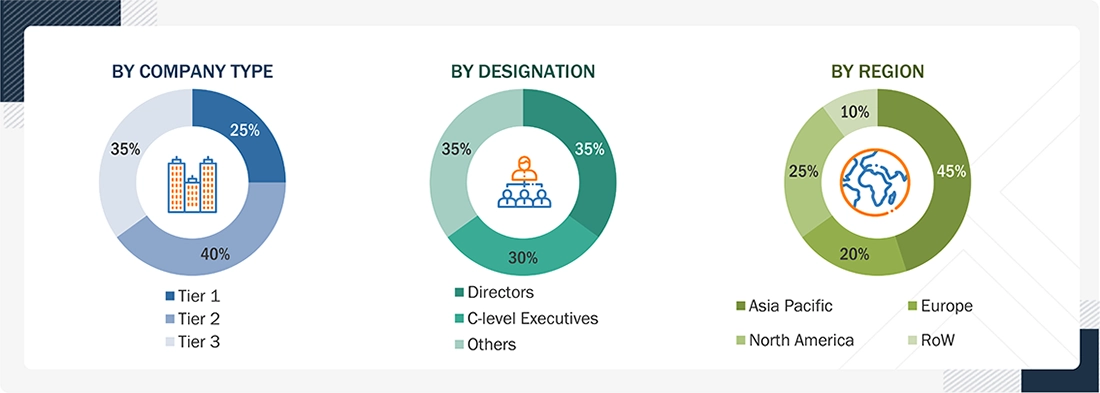
Notes: The three tiers of companies have been defined based on their total/segmental revenue as of 2025: Tier 1 = > USD 1 billion, Tier 2 = USD 1 billion–USD 500 million, and Tier 3 = < USD 500 million.
To know about the assumptions considered for the study, download the pdf brochure
Market Size Estimation
In the complete market engineering process, top-down and bottom-up approaches, along with several data triangulation methods, were used to estimate and validate the size of the 3D sensor market and various other dependent submarkets. Key players in the market were identified through secondary research, and their market share in each region was determined through a combination of primary and secondary research. This research methodology involved analyzing the annual and financial reports of the top players and conducting interviews with experts (including CEOs, VPs, directors, and marketing executives) to gather key insights (both quantitative and qualitative).
All percentage shares, splits, and breakdowns were determined using secondary sources and verified through primary sources. All possible parameters affecting the markets covered in this study were accounted for, examined in detail, verified through primary research, and analyzed to obtain final quantitative and qualitative data. This data was consolidated and supplemented with detailed inputs and analysis from MarketsandMarkets and presented in this report.
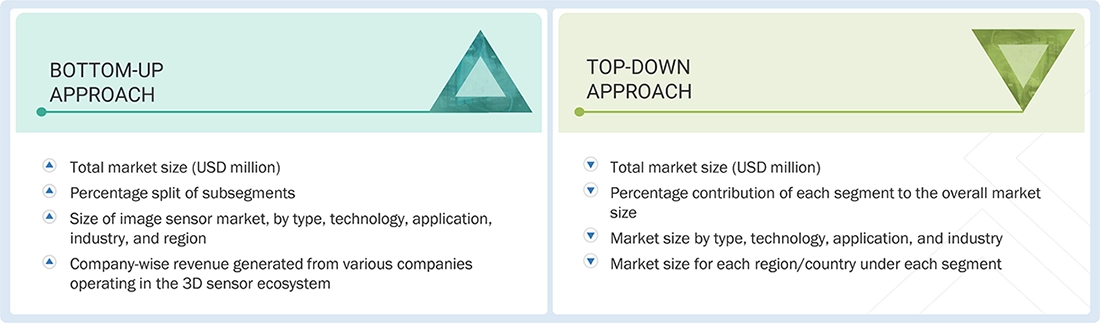
Data Triangulation
After determining the overall market size through the estimation process, as explained above, the total market was divided into several segments and subsegments. To complete the overall market engineering process and obtain precise statistics for all segments and subsegments, the data triangulation procedure was employed, as applicable. The data was triangulated by studying various factors and trends from the demand and supply sides. Additionally, the market has been validated using both top-down and bottom-up approaches.
Market Definition
A 3D sensor is a device that measures distance to objects by emitting some form of energy (such as light or sound) and detecting the reflected signal. Unlike traditional 2D cameras, which capture flat images, 3D sensors provide in-depth information, enabling them to perceive the three-dimensional structure of the scene. This technology is widely used in various applications, including augmented reality, virtual reality, gesture recognition, robotics, automotive safety systems, and more, where accurate spatial understanding is crucial for interaction and decision-making processes.
Key Stakeholders
- 3D Sensor Manufacturers
- Component Suppliers
- Original Equipment Manufacturers (OEMs)
- End Users
- System Integrators
- Resellers and Distributors
- Regulatory Bodies and Compliance Agencies
- Research Institutions
- Industry Associations and Organizations
- Investors and Financial Institutions
Report Objectives
- To describe and forecast the 3D sensor market, in terms of value, based on type, technology application, and industry
- To define and forecast the market size, in terms of value, with regard to four main regions: North America, Europe, Asia Pacific, and RoW (Rest of the World)
- To describe and forecast the market size for 3D sensors, by type and region, in terms of volume
- To provide detailed information regarding drivers, restraints, opportunities, and challenges influencing the growth of the market
- To understand the impact of artificial intelligence (AI) on the market
- To strategically analyze micromarkets with respect to individual growth trends, prospects, and contributions to the total market
- To provide a qualitative overview of the digital and analog outputs of 3D sensors
- To provide a qualitative overview of different technologies of 3D sensors
- To analyze opportunities for various stakeholders by identifying high-growth segments of the market
- To strategically profile key players and comprehensively analyze their market position in terms of ranking and core competencies, along with detailing the competitive landscape of the market
- To analyze competitive developments, such as acquisitions, product launches, developments, and partnerships in the market
- To provide a detailed overview of the ecosystem analysis, case study analysis, patent analysis, trade analysis, technology analysis, average selling price (ASP) analysis, AI/Gen AI impact analysis, Porter’s five forces analysis, macroeconomic outlook, and regulatory landscape pertaining to the 3D sensor market
Available customizations:
With the given market data, MarketsandMarkets offers customizations according to the company’s specific needs. The following customization options are available for the report:
Get the Full 3D Sensor Market Report
Full forecast, segment splits, and company analysis for all 3D Sensor Market.
- Rest Of Middle East 3D Sensor Market
- Saudi Arabia 3D Sensor Market
- UAE 3D Sensor Market
- Argentina 3D Sensor Market
- Brazil 3D Sensor Market
- Rest Of South America 3D Sensor Market
- US 3D Sensor Market
- Canada 3D Sensor Market
- Mexico 3D Sensor Market
- UK 3D Sensor Market
- Germany 3D Sensor Market
- France 3D Sensor Market
- China 3D Sensor Market
- Japan 3D Sensor Market
- South Korea 3D Sensor Market
- India 3D Sensor Market
- Rest Of Europe 3D Sensor Market
- Rest Of Asia Pacific 3D Sensor Market
Need a Tailored Report?
Customize this report to your needs
Get 10% FREE Customization
Customize This Report
