
North America Agricultural Lubricants Market (2026-2031)

The North America Agricultural Lubricants Market was valued at $2530.9 Million in 2026 and projected to reach to $3032.1 Million by 2031, representing a compound annual growth rate of 3.7%. North America's agricultural lubricants market is positioned for steady expansion through 2031, supported by the region's advanced farming infrastructure and high equipment utilization rates.


| Market Size in | USD 26.32 MN |
| Market Forecast in | |
| CAGR | |
| Forecast Period | |
| Units Considered | Value (USD MN) |
North America Agricultural Lubricants Market Trends and Insights
- This steady growth in North America reflects increasing mechanization of farming operations and rising demand for high-performance lubricants that enhance equipment efficiency and longevity.
- North America's agricultural sector continues to invest in advanced machinery and maintenance solutions, driving consistent demand for specialized lubricant formulations. The North America market benefits from a mature agricultural infrastructure and strong regulatory frameworks that emphasize equipment performance and environmental compliance.
- Between 2026 and 2031, North America is expected to see sustained growth driven by technological advancements in lubricant chemistry and the expansion of precision agriculture practices.
- North America's competitive landscape features both established multinational lubricant manufacturers and regional suppliers catering to diverse farming operations across the United States, Canada, and Mexico..
Key Market Statistics
- CAGR (2026-2031) 3.7% CAGR
- Market Size, 2026 ~USD 2530.9 Million
- Forecast, 2031 ~USD 3032.1 Million
- Geography North America
North America Agricultural Lubricants Market Overview
Market Valuation & Growth :
North America's agricultural lubricants market is valued at $2,530.9 million in 2026 and is projected to reach $3,032.1 million by 2031, representing a robust 3.7% CAGR—outpacing the global average of 3.5%.
US Market Dominance :
The United States accounts for the majority of North America's market at $2,361.7 million, driven by extensive mechanized farming operations and advanced agricultural infrastructure across the region.
Mechanization & Equipment Efficiency :
Increasing mechanization of farming operations in North America is driving demand for high-performance lubricants that enhance equipment efficiency, reduce downtime, and extend machinery longevity in demanding agricultural environments.
Regional Growth Drivers :
Rising adoption of precision agriculture, larger farm sizes, and stringent equipment maintenance standards across North America are fueling consistent demand for specialized agricultural lubricant formulations.
North America Agricultural Lubricants Market Dynamics
- The market benefits from strong mechanization trends, with farmers increasingly investing in premium lubricants to optimize operational efficiency and reduce maintenance costs.
- Growing awareness of equipment longevity and performance optimization continues to drive adoption of specialized formulations tailored to North American farming conditions. The forecast period will see sustained demand driven by technological advancements in lubricant chemistry, expansion of large-scale farming operations, and increasing focus on sustainability.
- North America's mature agricultural sector, combined with rising input costs, encourages farmers to invest in quality lubricants that deliver superior protection and extended drain intervals, supporting market growth at a 3.7% CAGR through 2031..
Market Ecosystem
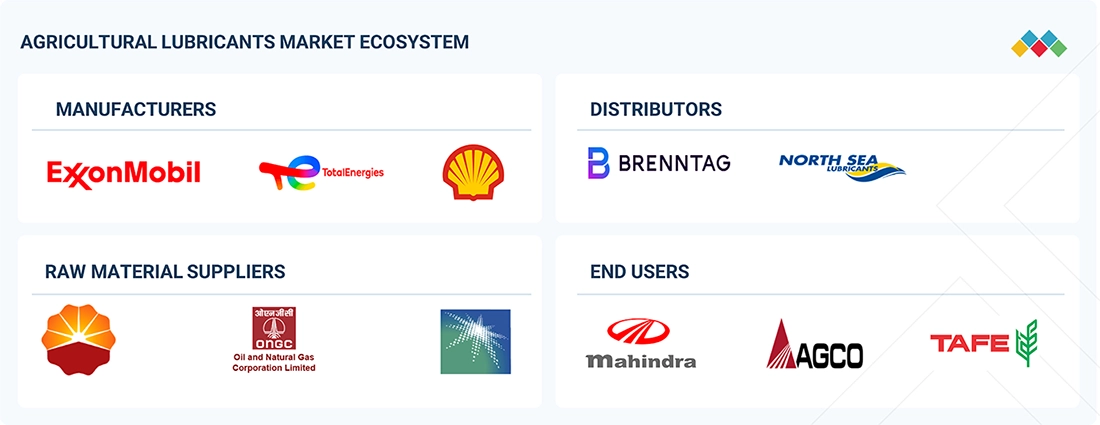
AGRICULTURAL LUBRICANT MARKET: COMMERCIAL USE CASES ACROSS INDUSTRIES
| COMPANY | USE CASE DESCRIPTION | BENEFITS |
|---|---|---|
 |
Provides high-performance agricultural lubricants for tractors, harvesters, irrigation systems, and heavy-duty farm machinery to improve equipment reliability and operational efficiency in large-scale farming operations. | Extends machinery life, reduces downtime and maintenance costs, improves fuel efficiency, and supports continuous farm productivity during peak agricultural seasons. |
 |
Supplies multifunctional engine oils, hydraulic fluids, and transmission lubricants designed for modern agricultural equipment operating under harsh environmental and field conditions. | Enhances equipment performance, protects components against wear and corrosion, increases oil drain intervals, and lowers total operating costs for farmers. |
 |
Develops advanced lubricants and greases for agricultural machinery, including combines, balers, and planting equipment, to optimize heavy-load and high-temperature operations. | Improves machinery durability, reduces friction and energy losses, ensures reliable performance under extreme conditions, and increases operational efficiency in farming activities. |
 |
Delivers agricultural lubricant solutions for farm fleets, off-highway vehicles, and diesel-powered equipment with a focus on equipment protection and sustainability | Minimizes engine wear, improves equipment uptime, supports sustainable farming practices, and reduces lubricant consumption and environmental impact. |
 |
Provides industrial and agricultural lubricants for tractors, harvesters, and hydraulic systems used in precision farming and mechanized agriculture. | Reduces maintenance frequency, enhances hydraulic system efficiency, improves reliability of farm operations, and supports long-term equipment performance. |
Logos and trademarks shown above are the property of their respective owners. Their use here is for informational and illustrative purposes only.
Related Ecosystem
Agricultural Biologicals
- Bionematicides
- Auxins
- Cytokinins
- Ethylene
- Humic Substances
- NICHINO INDIA PVT LTD.
- Corteva, Inc.
- Basf se
- AZELIS HOLDINGS SA
- BAYER AG
Farm Equipment And Irrigation
- Sensors
- Hydroponics
- Aeroponics
- Camera Systems
- Global Positioning System (GPS)
- MSK FARM MACHINERY CORPORATION
- MITSUBISHI CHEMICAL AGRI DREAM
- MITSUBISHI AGRICULTURAL MACHINERY
- RIVULIS IRRIGATION
- AGCO Corporation
Lubricants
- Polyalkylene Glycol (PAG)
- Tankers
- Exxon Mobil Corporation
- AZELIS HOLDINGS SA
- Chevron Corporation
- PETROLIAM NASIONAL BERHAD (NATIONAL PETROLEUM LIMITED)
- Idemitsu Kosan Co.,Ltd.
Key Takeaways
- North America's agricultural lubricants market is valued at $2,530.9 million in 2026 and will reach $3,032.1 million by 2031 at a 3.7% CAGR.
- North America's market growth is driven by increased farm mechanization and demand for equipment maintenance solutions.
- North America benefits from mature agricultural infrastructure and stringent environmental and performance regulations.
- North America's market features competition between multinational corporations and regional suppliers serving diverse farming segments.
Agricultural Lubricants Market Report Scope
| Report Metric | Details |
|---|---|
| Base Year | 2026 |
| Fastest Growing Segment | UTTO (TRANSMISSION & HYDRAULIC OIL) (Product Type) |
| Forecast Period | 2026-2031 |
| Growth Rate | CAGR of 3.5% from 2026 to 2031 |
| Largest Segment | AFTERMARKETS (Sales Channel) |
| Market Size Base Year (Billions) | ~USD 7.54 (2026) |
| Revenue Forecast (Billions) | ~USD 8.95 (2031) |
| Segments Covered | Category, Product Type, Sales Channel |
North America Agricultural Lubricants Market Report Segmentation
3 segment dimensions are covered across the global market.
By Category
- Bio-Based Lubricants
- Mineral Oil-Based Lubricants
- Synthetic Oil-Based Lubricants
By Product Type
- Coolant
- Engine Oil
- Grease
- Utto (Transmission & Hydraulic Oil)
By Sales Channel
- Aftermarkets
- Oems
Target Audience
- Lubricant Manufacturers & Suppliers : Develop targeted product formulations and marketing strategies for North America's mechanized farming sector; identify growth opportunities across the US, Canada, and Mexico markets.
- Agricultural Equipment OEMs : Understand lubricant performance requirements and regional specifications to optimize equipment recommendations and establish preferred lubricant partnerships in North America.
- Distributors & Retailers : Identify market demand patterns, regional preferences, and growth hotspots to optimize inventory management and expand distribution networks across North American agricultural regions.
- Investment & Private Equity Firms : Evaluate market growth potential, competitive dynamics, and regional expansion opportunities in North America's $2.5B+ agricultural lubricants sector for M&A and investment decisions.
- Agricultural Consultants & Industry Advisors : Provide clients with data-driven insights on lubricant market trends, regional adoption rates, and equipment efficiency impacts to support farm management and procurement recommendations.
Countries within North America - compare and drill down
| Country | 2025 size (native) |
|---|---|
| US | USD 2361.7 Million |
| Canada | USD 447.3 Million |
| Mexico | USD 223.1 Million |
Country market size visualization
Reasons to Buy this Report
- Regional Market Sizing & Forecasts : Obtain precise market valuations for North America ($2,530.9M in 2026) and country-level breakdowns for the US, Canada, and Mexico with detailed 5-year projections through 2031.
- Competitive Landscape Analysis : Understand key players, market share distribution, and competitive strategies specific to North America's agricultural lubricants sector to identify partnership and investment opportunities.
- Growth Driver Identification : Gain insights into mechanization trends, equipment efficiency demands, and regional farming practices driving the 3.7% CAGR in North America versus global 3.5% growth.
- Country-Level Intelligence : Access detailed market data for the US ($2,361.7M), Canada ($447.3M), and Mexico ($223.1M) to tailor market entry strategies and regional expansion plans.
- Strategic Decision Support : Leverage comprehensive North America-specific insights to guide product development, pricing strategies, and distribution channel optimization for agricultural lubricant portfolios.
Frequently asked questions
What is the current size of North America's agricultural lubricants market?
North America's agricultural lubricants market is estimated at $2,530.9 million in 2026.
What is the projected market size for North America by 2031?
North America's agricultural lubricants market is forecast to reach $3,032.1 million by 2031.
What is the growth rate for North America's agricultural lubricants market?
North America's agricultural lubricants market is expected to grow at a CAGR of 3.7% from 2026 to 2031.
What factors are driving growth in North America's agricultural lubricants market?
Growth in North America is driven by increased farm mechanization, precision agriculture adoption, equipment maintenance investments, and regulatory compliance requirements.
Who are the key players in North America's agricultural lubricants market?
North America's market includes multinational lubricant manufacturers and regional suppliers serving agricultural operations across the United States, Canada, and Mexico.
RESEARCH METHODOLOGY
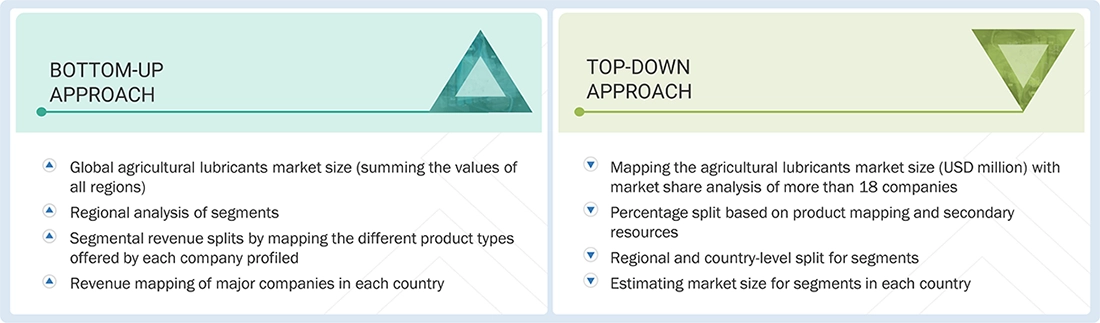
The study involved four major activities in estimating the current size of the agricultural lubricants market. Exhaustive secondary research was done to collect information on the market, peer markets, and parent market. The next step was to validate these findings, assumptions, and sizing with the industry experts across the agricultural lubricants value chain through primary research. Both top-down and bottom-up approaches were employed to estimate the complete market size. Thereafter, market breakdown and data triangulation were used to estimate the market size of segments and subsegments.
Secondary Research
Secondary sources for this research study include annual reports, press releases, and investor presentations of companies; white papers; certified publications; articles by recognized authors; gold- and silver-standard websites; agricultural lubricants manufacturing companies, regulatory bodies, trade directories, and databases. The secondary research was mainly used to obtain key information about the industry’s supply chain, the total pool of key players, market classification, and segmentation according to industry trends, down to the bottom-most level and regional markets. It has also been used to obtain information about key developments from a market-oriented perspective.
Primary Research
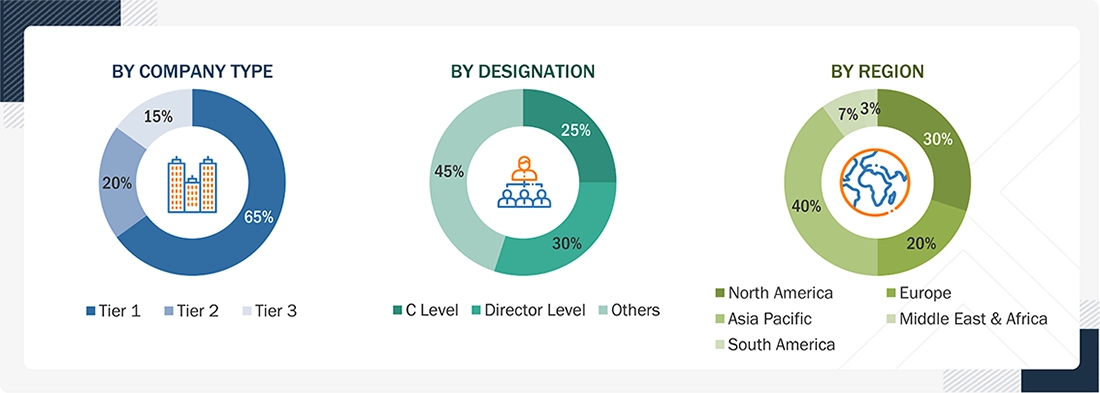
The agricultural lubricants market comprises several stakeholders, such as raw material suppliers, technology support providers, lithium-ion battery recyclers, and regulatory organizations in the supply chain. Various primary sources from both the supply and demand sides of the market were interviewed to obtain qualitative and quantitative information. Primary sources from the supply side included industry experts such as Chief Executive Officers (CEOs), vice presidents, marketing directors, technology and innovation directors, and related key executives from various key companies and organizations operating in the agricultural lubricants market. Primary sources from the demand side included directors, marketing heads, and purchase managers from various sourcing industries. The following is the breakdown of the primary respondents:
To know about the assumptions considered for the study, download the pdf brochure
Market Size Estimation
The top-down and bottom-up approaches have been employed to estimate and validate the total size of the agricultural lubricants market. These approaches have also been used extensively to estimate the size of various dependent market subsegments. The research methodology used to estimate the market size included the following:
The following segments provide details about the overall market size estimation process employed in this study:
- Extensive primary and secondary research was done to identify the key players.
- The value chain and market size of the agricultural lubricants market, in terms of value, were determined through primary and secondary research.
- All percentage shares, splits, and breakdowns were collected through secondary sources and verified through primary sources.
- All possible parameters that affect the market were covered in this research study and are viewed in extensive detail, verified through primary research, and analyzed to obtain the final quantitative and qualitative data.
- The study of reports, reviews, and newsletters of top market players, along with extensive interviews for opinions from key leaders, such as CEOs, directors, and marketing executives, is included in this research.
Agricultural Lubricant Market : Top-Down and Bottom-Up Approach
Data Triangulation
After arriving at the overall market size using the market size estimation processes as explained above, the market was split into several segments and sub-segments. To complete the overall market engineering process and arrive at the exact statistics of each market segment and subsegment, the data triangulation and market breakdown procedures were employed, wherever applicable. The data was triangulated by studying various factors and trends from both the demand and supply sides.
Market Definition
Agricultural lubricants are high-performance fluids specifically formulated to protect and enhance the efficiency of farm machinery operating under heavy loads, dust, moisture, and extreme field conditions. They include mineral oil-based, synthetic, and bio-based formulations used in tractors, combines, and agricultural implements to ensure smooth engine operation, hydraulic performance, and component protection. Key products such as engine oils, coolants, UTTO, and greases are distributed through OEM and aftermarket channels to support both new equipment and maintenance needs. The market is driven by increasing mechanization in farming, rising dependence on advanced agricultural equipment, and the need to minimize breakdowns and downtime. Growing focus on equipment efficiency and longer service life is further strengthening demand for specialized agricultural lubricants.
Key Stakeholders
- Agricultural Lubricants Manufacturers, Processors, and Recycling Technology Providers
- Research Institutions, Standards Organizations, and Regulatory Agencies such as ASTM, EDQM, and Others
- NGOs, Governments, Investment Banks, Venture Capitalists, and Private Equity Firms
Report Objectives
- To define, describe, and forecast the market size of agricultural lubricants, in terms of value and volume
- To provide detailed information regarding the key factors, such as drivers, restraints, opportunities, and industry-specific challenges, influencing the growth of the agricultural lubricants market
- To analyze and forecast the global agricultural lubricants market on the basis of category, product type, sales channel, and region
- To analyze the opportunities in the market for stakeholders and provide details of a competitive landscape for market leaders
- To forecast the size of various market segments based on four major regions: North America, Europe, and Asia Pacific, along with their respective key countries
- To track and analyze the competitive developments, such as acquisitions, partnerships, collaborations, agreements, and expansions in the market
- To strategically profile the key players and comprehensively analyze their market shares and core competencies
Available customizations:
With the given market data, MarketsandMarkets offers customizations according to the client-specific needs. The following customization options are available for the report:
? Additional country-level analysis of the agricultural lubricants market
? Profiling of additional market players (up to 5)
Product Analysis
-
Product matrix, which provides a detailed comparison of each company's product portfolio.
Get the Full Agricultural Lubricants Market Report
Full forecast, segment splits, and company analysis for all Agricultural Lubricants Market.
- China Agricultural Lubricants Market
- India Agricultural Lubricants Market
- Japan Agricultural Lubricants Market
- Indonesia Agricultural Lubricants Market
- US Agricultural Lubricants Market
- Canada Agricultural Lubricants Market
- Mexico Agricultural Lubricants Market
- Germany Agricultural Lubricants Market
- France Agricultural Lubricants Market
- UK Agricultural Lubricants Market
- Italy Agricultural Lubricants Market
- Brazil Agricultural Lubricants Market
- Argentina Agricultural Lubricants Market
- South Africa Agricultural Lubricants Market
- Turkey Agricultural Lubricants Market
- Rest Of Europe Agricultural Lubricants Market
- Rest Of Asia Pacific Agricultural Lubricants Market
- - Rest Of GCC Countries Agricultural Lubricants Market
- - Saudi Arabia Agricultural Lubricants Market
- GCC Countries Agricultural Lubricants Market
- Rest Of South America Agricultural Lubricants Market
Need a Tailored Report?
Customize this report to your needs
Get 10% FREE Customization
Customize This Report
