
Middle East Aircraft Electrical Systems Market (2025-2030)

The Middle East Aircraft Electrical Systems Market was valued at $5160.2 Million in 2025 and projected to reach to $6124.3 Million by 2030, representing a compound annual growth rate of 3.5%. The Middle East aircraft electrical systems market is poised for robust growth, driven by the region's strategic importance in global aviation and continuous fleet expansion by major carriers.


| Market Size in | USD 26.32 MN |
| Market Forecast in | |
| CAGR | |
| Forecast Period | |
| Units Considered | Value (USD MN) |
Middle East Aircraft Electrical Systems Market Trends and Insights
- The Middle East's strategic position as a global aviation hub, coupled with rising air traffic and fleet modernization initiatives, drives demand for advanced electrical systems across commercial and military aircraft.
- The Middle East continues to invest heavily in aerospace infrastructure and next-generation aircraft procurement, supporting sustained market expansion. Key drivers of growth in the Middle East include increased regional airline expansion, government defense spending, and the adoption of more-electric aircraft (MEA) technologies.
- The Middle East's major airlines and defense establishments are upgrading their fleets with modern electrical architectures to enhance fuel efficiency and reduce maintenance costs.
- Between 2025 and 2030, the Middle East market will benefit from both new aircraft deliveries and aftermarket services, as operators prioritize system reliability and performance in a competitive regional aviation landscape..
Key Market Statistics
- CAGR (2025-2030) 3.5% CAGR
- Market Size, 2025 ~USD 5160.2 Million
- Forecast, 2030 ~USD 6124.3 Million
- Geography Middle East
Middle East Aircraft Electrical Systems Market Overview
Aviation Hub Growth :
The Middle East's position as a global aviation crossroads drives sustained demand for aircraft electrical systems, with major hubs in UAE and Saudi Arabia expanding fleet capacity and modernization programs.
Fleet Modernization Initiatives :
Airlines across the Middle East are investing heavily in next-generation aircraft with advanced electrical architectures, replacing aging systems and upgrading to more efficient power distribution technologies.
Regional Market Expansion :
UAE leads the region with USD 1,274.9 million in market value, followed by Saudi Arabia at USD 2,029.5 million, reflecting significant aerospace infrastructure development and airline expansion strategies.
Steady Growth Trajectory :
The Middle East market is projected to grow from USD 5,160.2 million in 2025 to USD 6,124.3 million by 2030 at a 3.5% CAGR, outpacing the global growth rate of 3.3%.
Middle East Aircraft Electrical Systems Market Dynamics
- Investment in airport infrastructure, particularly in UAE and Saudi Arabia, coupled with the rise of low-cost carriers and regional airlines, creates sustained demand for advanced electrical systems.
- The region's focus on modernizing aging fleets and adopting next-generation aircraft with sophisticated power management systems will accelerate market expansion through 2030. Government initiatives supporting aerospace manufacturing and maintenance capabilities further strengthen the market outlook.
- The integration of more-electric aircraft (MEA) technologies and digital systems in new aircraft deliveries presents significant opportunities for electrical systems suppliers.
- Additionally, the region's emphasis on reducing operational costs and improving fuel efficiency drives adoption of advanced electrical architectures, positioning the Middle East as a high-growth market within the global aerospace sector..
Market Ecosystem
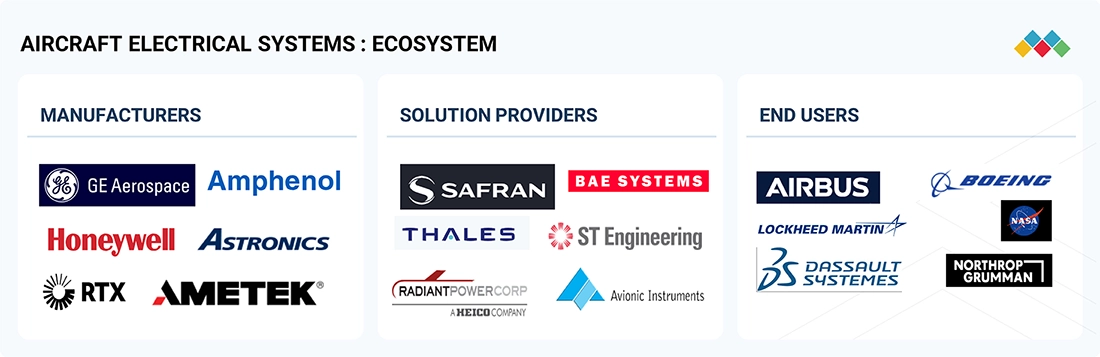
Aircraft Electrical Systems Market: COMMERCIAL USE CASES ACROSS INDUSTRIES
| COMPANY | USE CASE DESCRIPTION | BENEFITS |
|---|---|---|
 |
Predictive Health Monitoring for Power Electronics to detect degradation in generators, converters, and wiring systems | Reduces unplanned failures | Extends component lifespan, optimizes maintenance schedules | Lowers operational costs |
 |
AI-Assisted Electrical Load Management to optimize real-time power allocation during peak demand phases | Enhances energy efficiency | Improves system reliability | Reduces fuel burn | Ensures stable electrical performance during critical flight conditions |
 |
Digital Twin for Electrical Architecture to simulate and validate electrical system behavior under thousands of operating scenarios | Accelerates certification | Reduces testing time and development costs | Enables early fault detection | Enhances design accuracy |
 |
Automated Fault Detection & Isolation (AFDI) to rapidly detect voltage anomalies and component failures in high-voltage systems | Improves flight safety | Minimizes cascading failures | Reduces troubleshooting time | Enables precise diagnostic insights |
 |
Gen AI–Enhanced Component Design for converters, inverters, and solid-state power controllers (SSPCs) | Optimizes thermal and weight performance | Enhances component efficiency | Shortens development cycles | Improves system reliability |
Logos and trademarks shown above are the property of their respective owners. Their use here is for informational and illustrative purposes only.
Related Ecosystem
Key Takeaways
- The Middle East aircraft electrical systems market is valued at USD 5,160.2 million in 2025 and will reach USD 6,124.3 million by 2030.
- The Middle East market is growing at a 3.5% CAGR, driven by fleet modernization and increased air traffic in the region.
- The Middle East's adoption of more-electric aircraft technologies is accelerating demand for advanced electrical system components.
- The Middle East's strategic aviation hub status and defense investments support sustained growth in both commercial and military segments.
Aircraft Electrical Systems Market Report Scope
| Report Metric | Details |
|---|---|
| Base Year | 2025 |
| Fastest Growing Segment | ADVANCED AIR MOBILITY (Platform) |
| Forecast Period | 2025–2030 |
| Growth Rate | CAGR of 3.3% from 2025 to 2030 |
| Largest Segment | AFTERMARKET (Point Of Sale) |
| Market Size Base Year (Billions) | ~USD 93.86 (2025) |
| Revenue Forecast (Billions) | ~USD 110.4 (2030) |
| Segments Covered | Solution, Application, Platform, Propulsion Technology, Point Of Sale |
Middle East Aircraft Electrical Systems Market Report Segmentation
5 segment dimensions are covered across the global market.
By Solution
- Power Conversion
- Power Distribution
- Power Drive
- Power Generation
- Power Management
- Power Storage
By Application
- Aircraft Utilities & Support Systems
- Avionics & Mission Systems
- Cabin & Passenger Systems
- Environmental Control Systems
- Flight Control & Actuation
- Propulsion & Powertrain
By Platform
- Aam
- Advanced Air Mobility
- Business & General Aviation
- Commercial Aircraft
- Military Aircraft
By Propulsion Technology
- Conventional Aircraft
- Electric Aircraft
- Hybrid Aircraft
- More Electric Aircraft
By Point Of Sale
- Aftermarket
- OEM
Target Audience
- Aircraft Electrical Systems Manufacturers : Suppliers need Middle East market data to identify growth opportunities, understand regional demand for advanced electrical architectures, and develop localized product strategies for major carriers and MRO facilities.
- Aerospace & Defence OEMs : Original equipment manufacturers require detailed market insights to forecast electrical systems demand in new aircraft deliveries to Middle Eastern airlines and plan supply chain investments in the region.
- Maintenance, Repair & Overhaul (MRO) Providers : MRO operators need market intelligence on fleet modernization trends and electrical system upgrade demand to optimize service offerings and capacity planning for regional airline customers.
- Investment & Consulting Firms : Strategic investors and consultants require comprehensive market analysis to evaluate aerospace sector opportunities in the Middle East, assess regional growth potential, and guide client expansion decisions.
- Regional Airlines & Fleet Operators : Airlines and fleet operators use market data to benchmark electrical systems procurement costs, identify technology trends, and make informed decisions on fleet modernization and aircraft acquisition strategies.
Key Companies in the Middle East Aircraft Electrical Systems Market
| Company | HQ | Ownership | Strongest segments |
|---|---|---|---|
| LIEBHERR-INTERNATIONAL AG | Switzerland | Private Company | Earthmoving and Mining Machinery,Mobile, Crawler, and Tower Cranes,Maritime Cranes and Material Handling, |
| MOOG INC | United States | Public Company | Military Aircraft,Commercial Aircraft,Space and Defense, |
| SAUDI ARABIA BASIC INDUSTRIES CORPORATION (SABIC) | Saudi Arabia | ||
| SENSATA TECHNOLOGIES | United States | Public Company | Automotive sensors and sensor-rich solutions,Industrial sensors, controls, and power conversion,Aerospace, defense, and commercial equipment, |
| TRIUMPH GROUP, INC | United States | Private Company | Systems & Support (actuation, landing gear, engine accessories, MRO),Interiors (thermo-acoustic insulation, ECS ducting, interior components), |
| HEROUX-DEVTEK INC. | Canada | Private Company | Landing gear OEM systems and assemblies,Landing gear repair and overhaul (MRO),Actuation systems and related aerospace components, |
| CARLISLE TECHNOLOGY INC. | Canada | Private Company | Plant-floor software (MES, traceability, execution),Integrated hardware (scales, terminals, data collection),Implementation and integration services, |
| SAFRAN S.A. | France | Public Company | Aerospace Propulsion,Aircraft Equipment, Defense and Aerosystems,Aircraft Interiors, |
| HONEYWELL INTERNATIONAL INC. | United States | Public Company | Industrial Automation,Building Automation,Energy and Sustainability Solutions (UOP and digital), |
| RTX | United States | Public Company | Collins Aerospace (avionics, interiors, systems, aftermarket),Pratt & Whitney commercial engines and aftermarket,Pratt & Whitney military engines and APUs, |
| GE AEROSPACE | United States | Public Company | Commercial Engines OEM,Commercial Engines & Services (MRO and spares),Defense & Propulsion OEM, |
| ASTRONICS CORPORATION | United States | Public Company | Aerospace – Lighting and Safety Systems,Aerospace – Electrical Power Generation and Distribution,Aerospace – Structures, Avionics, and Certification Services, |
| AMPHENOL CORPORATION | United States | Public Company | Communications Solutions (high-speed, RF, fiber, antennas, networking),Harsh Environment Solutions (automotive, aerospace, defense, industrial),Interconnect and Sensor Systems (cable assemblies, harnesses, sensors), |
| AMETEK. INC. | United States | Public Company | Process and analytical instruments,Aerospace and defense sensors, power, and MRO,Test, measurement, and laboratory/ultra-precision instruments, |
| TRANSDIGM GROUP | United States | Public Company | Power & Control (actuators, ignition, pumps, power conditioning),Airframe (latching, locking, interiors, safety restraints, avionics-related),Non-Aviation (off-road, child restraints, satellite and space), |
| PARKER HANNIFIN CORP | United States | Public Company | Diversified Industrial – Motion and Control (hydraulics, pneumatics, electromechanical),Diversified Industrial – Filtration, Fluid Conveyance, and Thermal Management,Diversified Industrial – Sealing, Adhesives, and EMI Shielding, |
| BAE SYSTEMS | United Kingdom | Public Company | Electronic Systems,Air,Platforms & Services, |
| HEICO CORPORATION | United States | Public Company | Jet engine and aircraft replacement parts,Repair and overhaul services,Electro-optical, RF, and microwave products, |
LIEBHERR-INTERNATIONAL AG
Liebherr-International AG is a Swiss private company founded in 1949 that operates as a diversified manufacturer with approximately 54,609 employees. The company serves multiple industrial sectors with a global presence.
MOOG INC
Moog Inc. is a publicly traded United States company founded in 1951 with 13,500 employees, serving the aerospace and defense industries.
SAUDI ARABIA BASIC INDUSTRIES CORPORATION (SABIC)
Saudi Arabia Basic Industries Corporation (SABIC) is a major industrial corporation based in Saudi Arabia.
SENSATA TECHNOLOGIES
Sensata Technologies is a publicly traded United States company founded in 1916 with 16,700 employees, specializing in sensing and electrical protection solutions.
TRIUMPH GROUP, INC
Triumph Group, Inc. is a United States private company founded in 1993 with 3,696 employees, serving the aerospace and defense sectors.
HEROUX-DEVTEK INC.
Heroux-Devtek Inc. is a Canadian private company founded in 1942 with 2,100 employees, specializing in aerospace components and systems.
CARLISLE TECHNOLOGY INC.
Carlisle Technology Inc. is a Canadian private company founded in 1985 providing technology solutions.
SAFRAN S.A.
Safran S.A. is a French publicly traded company founded in 1896 with 103,710 employees, operating as a major aerospace and defense contractor.
HONEYWELL INTERNATIONAL INC.
Honeywell International Inc. is a publicly traded United States company founded in 1885 with 101,000 employees, serving aerospace, building technologies, and industrial sectors.
RTX
RTX is a publicly traded United States company founded in 1934 with 180,000 employees, operating as a major aerospace and defense contractor.
GE AEROSPACE
GE Aerospace is a publicly traded United States company founded in 1892 with 57,000 employees, specializing in aerospace propulsion and systems.
ASTRONICS CORPORATION
Astronics Corporation is a publicly traded United States company founded in 1968 with 2,700 employees, serving the aerospace and defense industries.
AMPHENOL CORPORATION
Amphenol Corporation is a publicly traded United States company founded in 1932 with 170,000 employees, specializing in interconnect products and assemblies.
AMETEK. INC.
AMETEK Inc. is a publicly traded United States company founded in 1930 with 22,500 employees, manufacturing electronic instruments and electromechanical devices.
TRANSDIGM GROUP
TransDigm Group is a publicly traded United States company founded in 1993 with 16,500 employees, specializing in aerospace components and systems.
PARKER HANNIFIN CORP
Parker Hannifin Corp is a publicly traded United States company founded in 1917 with 57,950 employees, manufacturing motion and control technologies.
BAE SYSTEMS
BAE Systems is a publicly traded United Kingdom company founded in 1979 with 111,400 employees, operating as a major aerospace and defense contractor.
HEICO CORPORATION
HEICO Corporation is a publicly traded United States company founded in 1957 with 11,100 employees, supplying aerospace and defense components and equipment.
Countries within Middle East - compare and drill down
| Country | 2025 size (native) |
|---|---|
| UAE | USD 1274.9 Million |
| Saudi Arabia | USD 2029.5 Million |
| Turkey | USD 1842.9 Million |
| Qatar | USD 977 Million |
Country market size visualization
Reasons to Buy this Report
- Regional Market Intelligence : Gain detailed insights into the Middle East's USD 5.16 billion aircraft electrical systems market with country-level breakdowns for UAE, Saudi Arabia, Qatar, and Turkey to inform regional expansion strategies.
- Growth Opportunity Identification : Identify high-growth segments within the Middle East market expanding at 3.5% CAGR, outpacing global growth, with specific focus on fleet modernization and next-generation aircraft adoption trends.
- Competitive Landscape Analysis : Understand competitive dynamics specific to Middle Eastern airlines and MRO providers, including supplier preferences, procurement patterns, and regional partnerships driving electrical systems demand.
- Investment Decision Support : Make informed investment and partnership decisions with comprehensive market forecasts through 2030, including country-specific valuations and growth projections for UAE, Saudi Arabia, and emerging markets.
- Strategic Market Positioning : Develop targeted go-to-market strategies leveraging insights on regional aviation hubs, government initiatives, and modernization programs to capture market share in this high-potential aerospace segment.
Frequently asked questions
What is the current size of the aircraft electrical systems market in the Middle East?
The Middle East aircraft electrical systems market is valued at USD 5,160.2 million in 2025.
What is the projected market size for aircraft electrical systems in the Middle East by 2030?
The Middle East aircraft electrical systems market is projected to reach USD 6,124.3 million by 2030.
What is the CAGR for the aircraft electrical systems market in the Middle East?
The Middle East aircraft electrical systems market is expected to grow at a CAGR of 3.5% from 2025 to 2030.
What factors are driving growth in the Middle East aircraft electrical systems market?
Growth in the Middle East is driven by fleet modernization, increased air traffic, adoption of more-electric aircraft technologies, and regional defense spending.
Which segments contribute most to the Middle East aircraft electrical systems market?
The Middle East market includes both commercial aviation and military defense segments, with major contributions from regional airlines and government procurement programs.
RESEARCH METHODOLOGY
The study involved four major activities in estimating the current size of the aircraft electrical systems market. Exhaustive secondary research was conducted to collect information on the aircraft electrical systems market, its adjacent markets, and its parent aerospace systems market. The next step was to validate these findings, assumptions, and sizing with industry experts across the value chain, including OEMs, Tier 1 suppliers, electrical component manufacturers, and MRO providers, through primary research. Demand-side analysis was conducted to estimate the overall market size based on fleet expansion, electrical content per aircraft, and electrification trends. After that, market breakdown and data triangulation procedures were employed to estimate the sizes of various segments and subsegments within the aircraft electrical systems market, covering power generation, distribution, conversion, storage, management, and platform adoption.
Secondary Research
During the secondary research process, various sources were consulted to identify and collect information for this study. The secondary sources included government and regulatory bodies such as FAA, EASA, and ICAO; corporate filings, including annual reports, press releases, and investor presentations from key market players; white papers, journals, and certified publications on aircraft electrification, power management, and aerospace component technologies; and articles from recognized aerospace research agencies, directories, and databases, such as IATA, Airbus Global Market Outlook, Boeing Commercial Market Outlook, and industry associations.
Primary Research
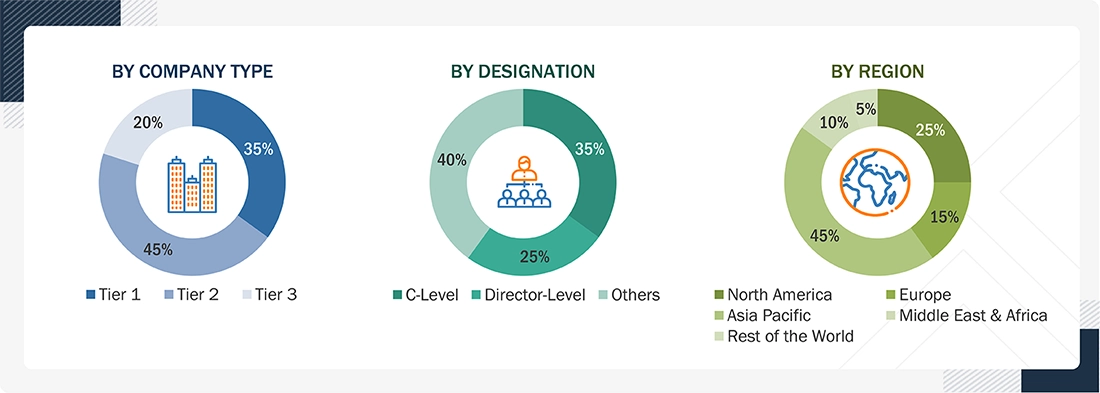
Extensive primary research was conducted after gathering key insights regarding the aircraft electrical systems market through secondary research. Several primary interviews were conducted with industry experts from demand and supply sides, including OEMs, Tier 1 suppliers, electrical component manufacturers, aviation consultants, and MRO service providers across major regions, such as North America, Europe, Asia Pacific, the Middle East, Africa, and Latin America. Primary data was collected through structured questionnaires, emails, and telephonic discussions to validate market assumptions, segment sizing, growth drivers, and future adoption trends.
Breakdown of Primary Respondents:
To know about the assumptions considered for the study, download the pdf brochure
Market Size Estimation
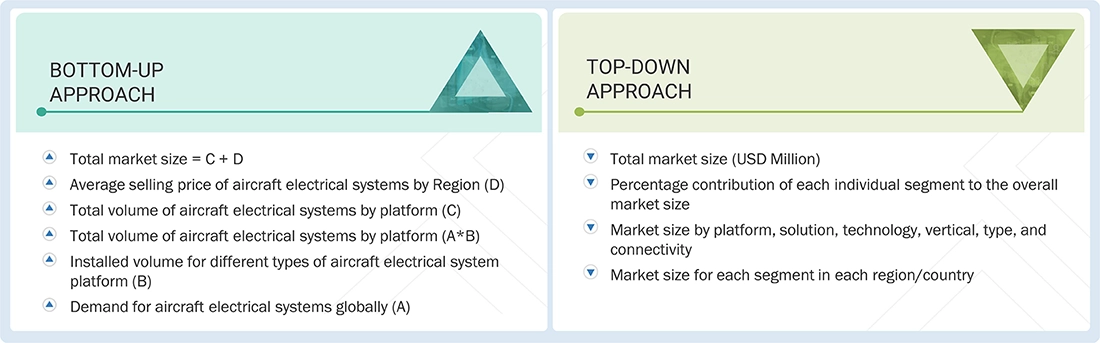
Top-Down and Bottom-Up Approaches
The top-down and bottom-up approaches were used to estimate and validate the size of the aircraft electrical systems market. The research methodology used to estimate the size of the market included the following details:
- Key players in the aircraft electrical systems market were identified through secondary research, and their market shares were determined through a combination of primary and secondary research. This included a study of the annual and financial reports of the top market players, as well as extensive interviews with leaders, including directors, engineers, electrical system architects, marketing executives, and other key stakeholders of leading companies operating in the market.
- All percentage shares, splits, and breakdowns were determined using secondary sources and verified through primary sources.
- All possible parameters that affect the markets covered in this research study were accounted for, viewed in extensive detail, verified through primary research, and analyzed to obtain the final quantitative and qualitative data on the aircraft electrical systems market. This data was consolidated, enhanced with detailed inputs, analyzed, and presented in this report.
Data Triangulation
After determining the overall market size, the total market was divided into several segments and subsegments. The data triangulation and market breakdown procedures explained below were implemented, wherever applicable, to complete the overall market engineering process and arrive at the estimated market numbers for the market segments and subsegments. The data was triangulated by studying various factors and trends from the demand and supply sides. Additionally, the market size was validated using top-down and bottom-up approaches.
Market Definition
An aircraft electrical system includes four main functionalities: Power generation, power conversion, power distribution, and energy storage. The system mainly consists of power sources, such as batteries and generators; components, such as conversion devices, control devices, and protection devices; and power distribution systems, such as cables and wires.
The system provides energy to the main electric loads, which include motors & actuators, subsystem controllers, lighting, avionics systems, and heating devices. Aircraft equipment that commonly uses the electrical system as a source of energy includes fuel gauges, air conditioning, ice protection, flight control systems, utilities, and landing gear, among others.
Stakeholders
- Raw Material Suppliers (Copper, aluminum, composites, insulation materials)
- Electrical Component Manufacturers (generators, converters, inverters, batteries, EWIS)
- Aircraft Electrical System Manufacturers
- Power Electronics and Energy Storage Providers
- System Integrators (Tier 1 and Tier 2 Suppliers)
- Avionics and Mission System Suppliers
- Distributors and Component Supply Partners
- Maintenance, Repair, and Overhaul (MRO) Companies
- Aircraft OEMs (Commercial, Business, Military, AAM, UAV)
- Government and Regulatory Agencies (FAA, EASA, ICAO, DoD)
- Research and Development Organizations and Testing Laboratories
Report Objectives
- To define, describe, and forecast the size of the aircraft electrical systems by solution, application, aircraft type, propulsion technology, point of sale, and region
- To forecast the sizes of market segments with respect to key countries in the following regions: North America, Europe, Asia Pacific, Middle East, Latin America, and Africa
- To identify and analyze drivers, restraints, opportunities, and challenges influencing the growth of the market
- To identify industry trends, market trends, and technology trends currently prevailing in the market
- To provide an overview of the regulatory landscape with respect to global aircraft electrical system regulations
- To analyze micro markets with respect to individual growth trends, prospects, and their contribution to the overall market
- To analyze opportunities in the market for stakeholders by identifying key market trends
- To profile key market players and comprehensively analyze their market shares and core competencies
- To analyze the degree of competition in the market by identifying growth strategies, such as agreements, acquisitions, partnerships, collaborations, and product launches, adopted by leading market players
- To identify detailed financial positions, key products, and unique selling points of leading market players.
Get the Full Aircraft Electrical Systems Market Report
Full forecast, segment splits, and company analysis for all Aircraft Electrical Systems Market.
- Canada Aircraft Electrical Systems Market
- US Aircraft Electrical Systems Market
- France Aircraft Electrical Systems Market
- Germany Aircraft Electrical Systems Market
- UK Aircraft Electrical Systems Market
- Italy Aircraft Electrical Systems Market
- Spain Aircraft Electrical Systems Market
- China Aircraft Electrical Systems Market
- India Aircraft Electrical Systems Market
- Japan Aircraft Electrical Systems Market
- Australia Aircraft Electrical Systems Market
- South Korea Aircraft Electrical Systems Market
- Brazil Aircraft Electrical Systems Market
- Mexico Aircraft Electrical Systems Market
- UAE Aircraft Electrical Systems Market
- Saudi Arabia Aircraft Electrical Systems Market
- Turkey Aircraft Electrical Systems Market
- Qatar Aircraft Electrical Systems Market
- South Africa Aircraft Electrical Systems Market
- Nigeria Aircraft Electrical Systems Market
- Rest Of Europe Aircraft Electrical Systems Market
- Rest Of Asia Pacific Aircraft Electrical Systems Market
- Rest Of Latin America Aircraft Electrical Systems Market
Need a Tailored Report?
Customize this report to your needs
Get 10% FREE Customization
Customize This Report
