
Japan Aircraft Sensors Market (2025-2030)

The Japan Aircraft Sensors Market was valued at $108.2 Million in 2025 and projected to reach to $161.7 Million by 2030, representing a compound annual growth rate of 8.4%. Japan's aircraft sensors market is poised for sustained expansion, driven by the country's strong aerospace manufacturing base and commitment to fleet modernization.


| Market Size in | USD 26.32 MN |
| Market Forecast in | |
| CAGR | |
| Forecast Period | |
| Units Considered | Value (USD MN) |
Japan Aircraft Sensors Market Trends and Insights
- Japan's aerospace sector, driven by domestic aircraft manufacturing and modernization of commercial fleets, is a key contributor to this expansion.
- The country's advanced technological capabilities and investment in next-generation aircraft systems position Japan as a critical hub for sensor innovation in the Asia Pacific region. Japan's aircraft sensors market growth is underpinned by increasing demand for real-time monitoring systems, safety compliance requirements, and the integration of IoT-enabled sensors in modern aircraft.
- Japan's leading aerospace manufacturers and suppliers are investing heavily in sensor technologies for engine monitoring, structural health assessment, and avionics systems.
- The 8.4% compound annual growth rate reflects Japan's commitment to maintaining competitive advantage in aerospace manufacturing and the rising adoption of predictive maintenance solutions across Japan's commercial and defense aviation sectors..
Key Market Statistics
- CAGR (2025-2030) 8.4% CAGR
- Market Size, 2025 ~USD 108.2 Million
- Forecast, 2030 ~USD 161.7 Million
- Country Japan
Japan Aircraft Sensors Market Overview
Strong CAGR Growth :
Japan's aircraft sensors market is growing at 8.4% CAGR from 2025-2030, significantly outpacing the global average of 4.9%, reflecting robust domestic demand and technological advancement.
Domestic Aircraft Manufacturing :
Japan's aerospace sector, including Mitsubishi Aircraft and regional manufacturers, drives sensor demand through new aircraft development and integration of advanced avionics systems.
Fleet Modernization Initiative :
Japanese commercial airlines are actively modernizing aging fleets with next-generation aircraft equipped with advanced sensor technologies for improved safety and efficiency.
Technological Innovation Hub :
Japan's advanced technological capabilities and R&D investments position it as a leader in developing cutting-edge aircraft sensor solutions for both domestic and export markets.
Japan Aircraft Sensors Market Dynamics
- The market's 8.4% CAGR reflects increasing investments in next-generation aircraft systems and sensor technologies by domestic manufacturers and airlines.
- Japan's position as a technology leader in aerospace innovation, combined with growing demand for enhanced safety and operational efficiency, will continue to fuel market growth through 2030.
- Strategic partnerships between Japanese aerospace companies and global OEMs further strengthen the market's trajectory..
Market Ecosystem
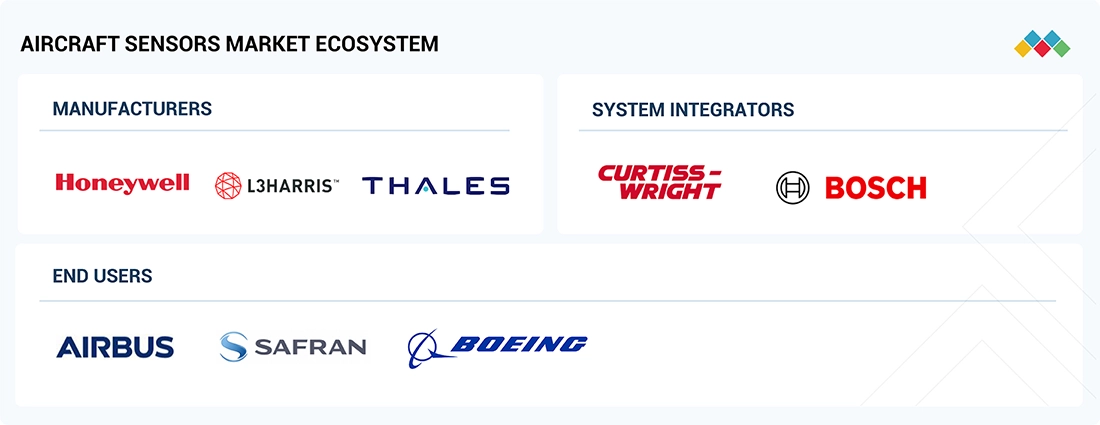
Aircraft Sensors Market: COMMERCIAL USE CASES ACROSS INDUSTRIES
| COMPANY | USE CASE DESCRIPTION | BENEFITS |
|---|---|---|
 |
Engine vibration/temperature sensors powering predictive maintenance on turbofans. | Cuts unplanned AOG and extends time-on-wing through early fault detection. |
 |
Air-data and angle-of-attack sensors help the flight computer keep the aircraft within safe limits. | Smoother handling and lower risk of stalls. |
 |
Landing-gear load sensors adjust braking and monitor touchdown quality. | Shorter stopping distances and less wear on brakes and tires. |
 |
Radar, infrared, and terrain sensors work together to warn of obstacles and rising ground in poor visibility. | Safer approaches and departures with a lower chance of terrain collisions. |
 |
GPS and attitude sensors generate a synthetic outside view on cockpit displays. | Better pilot orientation and reduced workload in cloud or at night. |
Logos and trademarks shown above are the property of their respective owners. Their use here is for informational and illustrative purposes only.
Related Ecosystem
Aviation
- Narrow Body Aircraft
- Wide Body Aircraft
- Military Helicopters
- Special Mission Aircraft
- Fighter Aircraft
- HONEYWELL INTERNATIONAL INC.
- COLLINS AEROSPACE
- Thales group
- Safran group
- HEICO Corporation
Sensors And Control
- Sensors
- Image Sensors
- Temperature Sensors
- Pressure Sensors
- Flow Sensors
- BAUMER ELECTRIC AG
- HONEYWELL INTERNATIONAL INC.
- Lenovo
- Stmicroelectronics
- Texas Instruments Incorporated
Key Takeaways
- Japan's aircraft sensors market is valued at USD 108.2 million in 2025 and is projected to reach USD 161.7 million by 2030, representing an 8.4% CAGR.
- Japan's advanced manufacturing capabilities and aerospace industry investments are driving demand for sophisticated sensor technologies in commercial and defense applications.
- Predictive maintenance and real-time aircraft monitoring systems are key growth drivers in Japan's market, supported by IoT integration and digital transformation initiatives.
- Japan's position as a regional aerospace hub strengthens its aircraft sensors market, with domestic manufacturers and international partnerships fueling innovation and market expansion.
Aircraft Sensors Market Report Scope
| Report Metric | Details |
|---|---|
| Base Year | 2025 |
| Fastest Growing Segment | ADVANCED AIR MOBILITY (Aircraft Type) |
| Forecast Period | 2025–2030 |
| Growth Rate | CAGR of 4.9% from 2025 to 2030 |
| Largest Segment | WIRELESS (Connectivity) |
| Market Size Base Year (Billions) | ~USD 7.35 (2025) |
| Revenue Forecast (Billions) | ~USD 9.33 (2030) |
| Segments Covered | Type, Application, Aircraft Type, Engine/Propulsion, Cabin & Cargo Environmental Control, Aerostructure & Flight Control, Flight Deck, End Use, Connectivity, Business & General Aviation |
Japan Aircraft Sensors Market Report Segmentation
10 segment dimensions are covered across the global market.
By Type
- Flow Sensors
- Force Sensors
- Gps Sensors
- Level Sensors
- Motion Sensors
- Optical Sensors
- Position And Displacement Sensors
- Pressure Sensors
- Proximity Sensors
- Radar Sensors
- Smoke Detection Sensors
- Speed Sensors
- Temperature Sensors
- Torque Sensors
By Application
- Aerostructures & Flight Controls
- Cabin & Cargo Environmental Controls
- Engine/Propulsion
- Flight Decks
- Fuel, Hydraulic, And Pneumatic Systems
- Landing Gear Systems
- Weapon Systems
By Aircraft Type
- Advanced Air Mobility
- Air Ambulances & Medical Emergency Vehicles
- Air Shuttles & Air Metros
- Air Taxis
- Business & General Aviation
- Business Jets
- Cargo Air Vehicles
- Commercial Aviation
- Commercial Helicopters
- Fighter Aircraft
- Fixed-Wing Hybrid Vtol Uavs
- Fixed-Wing Uavs
- Last-Mile Delivery Vehicles
- Light Aircraft
- Military Aviation
- Military Helicopters
- Narrow-Body Aircraft
- Personal Aerial Vehicles
- Regional Transport Aircraft
- Rotary-Wing Uavs
- Special Mission Aircraft
- Transport Aircraft
- Unmanned Aerial Vehicles
- Wide-Body Aircraft
By Engine/Propulsion
- Gps Sensors
- Position And Displacement Sensors
- Pressure Sensors
- Radar Sensors
- Temperature Sensors
By Cabin & Cargo Environmental Control
- Level Sensors
- Other Sensors
- Position And Displacement Sensors
- Pressure Sensors
- Proximity Sensors
- Temperature Sensors
By Aerostructure & Flight Control
- Other Sensors
- Position And Displacement Sensors
- Pressure Sensors
- Radar Sensor
- Speed Sensors
- Temperature Sensors
By Flight Deck
- Flow Sensors
- Other Sensors
- Position And Displacement Sensors
- Pressure Sensors
- Proximity
- Temperature Sensors
By End Use
- Aftermarket
- OEM
By Connectivity
- Wired
- Wireless
By Business & General Aviation
- Business Jets
- Light Aircraft
Target Audience
- Aircraft Sensor Manufacturers : Manufacturers need Japan-specific market data to identify growth opportunities, understand local competition, and develop targeted strategies for the high-growth Japanese aerospace market.
- Japanese Aerospace OEMs : Domestic aircraft manufacturers require detailed market insights to optimize sensor sourcing strategies, evaluate supplier capabilities, and plan technology integration for new aircraft programs.
- Commercial Airlines & MRO Providers : Japanese carriers and maintenance providers need market intelligence to plan fleet upgrades, evaluate sensor technologies for modernization, and optimize operational efficiency investments.
- Investment & Private Equity Firms : Investors targeting Japan's aerospace sector require comprehensive market data to evaluate investment opportunities, assess growth potential, and identify acquisition targets in the sensor supply chain.
- Technology & Consulting Firms : Consultants advising aerospace clients need Japan-specific market analysis to develop strategic recommendations, support business case development, and guide technology adoption decisions.
Key Companies in the Japan Aircraft Sensors Market
| Company | HQ | Ownership | Strongest segments |
|---|---|---|---|
| HINDUSTAN AERONAUTICS LIMITED | India | Public Company | Military aircraft (fixed-wing) and trainers,Helicopters (utility and combat),Engines (turbofan, turboshaft) and powerplants, |
| LIEBHERR-INTERNATIONAL AG | Switzerland | Private Company | Earthmoving (excavators, wheel loaders, crawler loaders/tractors, pipelayers, telescopic handlers),Mobile and Crawler Cranes,Tower Cranes and Concrete Technology, |
| ROLLS-ROYCE HOLDINGS PLC. | United Kingdom | Public Company | Civil Aerospace (large commercial, regional, business aviation + services),Defence (military aero, naval, submarine nuclear + services),Power Systems (mtu onsite power and propulsion), |
| LEIDOS | United States | Public Company | National Security & Digital,Defense Systems,Health & Civil, |
| MEMSCAP | France | Public Company | Aerospace and defense pressure sensors, transducers, and switches,Medical and biomedical domes, line-sets, and pressure accessories,Optical communications MEMS variable optical attenuator chips, |
| RDF CORPORATION | South Africa | Public Investment Firm | Retail (SA and Poland),Office (primarily South Africa),Industrial and Logistics, |
| HEICO | United States | Public Company | Jet engine and aircraft component replacement parts (PMA and related),MRO and repair/overhaul services,Aerospace and defense electronic components and subsystems, |
| CYIENT | India | Public Company | Digital, Engineering & Technology,Design Led Manufacturing,Others (Networks, Geospatial, Niche Platforms), |
| HONEYWELL INTERNATIONAL INC. | United States | Public Company | Industrial Automation,Building Automation,Energy and Sustainability Solutions (UOP and related), |
| SAFRAN | France | Public Company | Aerospace Propulsion,Aircraft Equipment, Defense and Aerosystems,Aircraft Interiors, |
| TE CONNECTIVITY LTD. | Ireland | Public Company | Automotive and Transportation Connectivity,Industrial and Harsh-Environment Connectivity,Data, 5G, and IoT Connectivity, |
| MEGGITT PLC | United Kingdom | Private Company | Airframe Systems (brakes, wheels, ice protection, radomes, flight displays),Engine Systems (health monitoring, sensors, composites, valves),Energy & Equipment (power, thermal, ammunition handling, trainers), |
| AMETEK INC. | United States | Public Company | Process, analytical, and industrial instruments (EIG),Aerospace and defense sensors, power, and embedded systems (EIG),Power quality, metering, UPS, programmable power, EMC test (EIG), |
| LOCKHEED MARTIN CORPORATION | United States | Public Company | Aeronautics,Missiles and Fire Control,Rotary and Mission Systems, |
| WOODWARD | United States | Public Company | Aerospace OEM content (fuel systems, actuation, valves, sensors),Aerospace aftermarket MRO and services,Industrial turbine and engine controls (actuators, valves, injection, ignition), |
| RTX | United States | Public Company | Collins Aerospace (avionics, interiors, mission systems, aftermarket),Pratt & Whitney (commercial and military engines, APU, MRO),Raytheon (sensors, effectors, C2, space and cyber solutions), |
| THALES | France | Public Company | Defence & Security Systems (air defence, C4ISR, EW, optronics, protection),Aerospace & Space (avionics, ATM, IFE, satellite-based tech),Digital Identity & Security (banking, IAM, biometrics, secure IoT), |
| L3HARRIS TECHNOLOGIES, INC. | United States | Public Company | Space & Mission Systems (SMS),Communications & Spectrum Dominance (CSD),Missile Solutions (MSL), |
| THE BOSCH GROUP | Germany | Private Company | Mobility (powertrain, chassis, electronics, aftermarket, steering),Industrial Technology (drive, control, actuators, process and packaging),Consumer Goods (power tools, garden tools, appliances), |
| TRIMBLE INC. | United States | Public Company | Construction and owner software (BIM, VDC, project management),Machine control and field systems for construction equipment,Positioning services (VRSNow, RTX, xFill and related), |
| CURTISS-WRIGHT CORPORATION | United States | Public Company | Aerospace & Industrial,Defense Electronics,Naval & Power, |
| EATON CORPORATION | Ireland | Public Company | Electrical Americas,Electrical Global,Aerospace, |
HINDUSTAN AERONAUTICS LIMITED
Hindustan Aeronautics Limited is an Indian public company founded in 1940 that employs 22,033 people. The company operates in the aerospace and defense sectors.
LIEBHERR-INTERNATIONAL AG
Liebherr-International AG is a Swiss private company established in 1949 with 54,609 employees. The company operates across multiple industrial sectors.
ROLLS-ROYCE HOLDINGS PLC.
Rolls-Royce Holdings PLC is a British public company founded in 1884 with 43,162 employees. The company specializes in aerospace and defense engineering.
LEIDOS
Leidos is a United States-based public company founded in 1969 with 50,000 employees. The company provides engineering, IT, and scientific solutions primarily for government and commercial clients.
MEMSCAP
MEMSCAP is a French public company founded in 1997 with 55 employees. The company specializes in micro-electromechanical systems (MEMS) technology.
RDF CORPORATION
RDF Corporation is a South African public investment firm founded in 1999 with 424 employees. The company operates as an investment and holding company.
HEICO
HEICO is a United States-based public company founded in 1957 with 11,100 employees. The company manufactures and distributes electronic and aerospace components.
CYIENT
Cyient is an Indian public company founded in 1991 with 12,049 employees. The company provides engineering, IT, and digital services.
HONEYWELL INTERNATIONAL INC.
Honeywell International Inc. is a United States-based public company founded in 1885 with 101,000 employees. The company operates across aerospace, building technologies, performance materials, and safety solutions.
SAFRAN
Safran is a French public company founded in 1896 with 103,710 employees. The company specializes in aerospace propulsion, equipment, and defense systems.
TE CONNECTIVITY LTD.
TE Connectivity Ltd. is an Ireland-based public company founded in 1941 with 80,000 employees. The company manufactures connectivity and sensor solutions for multiple industries.
MEGGITT PLC
Meggitt PLC is a British private company founded in 1947 with 9,270 employees. The company manufactures aerospace and defense components and systems.
AMETEK INC.
AMETEK Inc. is a United States-based public company founded in 1930 with 22,500 employees. The company manufactures electronic instruments and electromechanical devices.
LOCKHEED MARTIN CORPORATION
Lockheed Martin Corporation is a United States-based public company founded in 1912 with 123,000 employees. The company is a leading global security and aerospace company.
WOODWARD
Woodward is a United States-based public company founded in 1870 with 10,200 employees. The company designs and manufactures control systems and components for aerospace and industrial applications.
RTX
RTX is a United States-based public company founded in 1934 with 180,000 employees. The company is a major aerospace and defense contractor providing advanced systems and services.
THALES
Thales is a French public company founded in 1893 with 82,111 employees. The company provides aerospace, defense, and security solutions and technologies.
L3HARRIS TECHNOLOGIES, INC.
L3Harris Technologies, Inc. is a United States-based public company founded in 1895 with 45,000 employees. The company provides advanced defense and commercial technologies across space, air, land, and sea domains.
THE BOSCH GROUP
The Bosch Group is a German private company founded in 1886 with 412,774 employees. The company operates across automotive, industrial, consumer goods, and energy technology sectors.
TRIMBLE INC.
Trimble Inc. is a United States-based public company founded in 1978 with 11,500 employees. The company provides positioning, modeling, and analytics solutions for various industries.
CURTISS-WRIGHT CORPORATION
Curtiss-Wright Corporation is a United States-based public company founded in 1929 with 9,100 employees. The company manufactures aerospace and defense products and systems.
EATON CORPORATION
Eaton Corporation is an Ireland-based public company founded in 1911 with 97,303 employees. The company provides electrical, hydraulic, and mechanical power management solutions.
Reasons to Buy this Report
- Market Size & Growth Data : Access precise valuation of Japan's aircraft sensors market at USD 108.2M (2025) with detailed 5-year forecasts to USD 161.7M (2030), enabling accurate investment and expansion planning.
- Competitive Landscape Analysis : Identify key Japanese and international sensor manufacturers operating in the market, understand their market positioning, and assess competitive dynamics specific to Japan's aerospace sector.
- Domestic Manufacturing Insights : Gain deep understanding of Japan's aircraft manufacturing ecosystem, including Mitsubishi Aircraft and regional producers, and their sensor procurement strategies and technology requirements.
- Fleet Modernization Opportunities : Capitalize on Japan's active fleet modernization programs by understanding upgrade cycles, sensor technology adoption rates, and procurement timelines for commercial and regional aircraft.
- Technology & Innovation Trends : Stay informed on Japan's advanced sensor technology developments, R&D initiatives, and next-generation avionics integration, positioning your business ahead of market evolution.
Frequently asked questions
What is the current size of Japan's aircraft sensors market?
Japan's aircraft sensors market is valued at USD 108.2 million in 2025 and is expected to grow to USD 161.7 million by 2030.
What is the growth rate of Japan's aircraft sensors market?
Japan's aircraft sensors market is growing at a compound annual growth rate (CAGR) of 8.4% from 2025 to 2030.
What are the main drivers of growth in Japan's aircraft sensors market?
Key drivers include increasing demand for predictive maintenance, real-time monitoring systems, safety compliance requirements, IoT integration, and modernization of Japan's commercial and defense aircraft fleets.
Which sectors are contributing most to Japan's aircraft sensors market?
Japan's commercial aviation, defense aerospace, and aircraft manufacturing sectors are primary contributors, supported by investments in next-generation aircraft systems and sensor technologies.
How does Japan's aircraft sensors market compare to the global market?
Japan's market is growing at 8.4% CAGR, outpacing the global aircraft sensors market growth rate of 4.9%, reflecting Japan's strong aerospace sector and technological advancement.
RESEARCH METHODOLOGY
This research study extensively uses secondary sources, directories, and databases, such as Hoovers, Bloomberg Businessweek, and Factiva, to identify and collect relevant information on the aircraft sensors market. Primary sources included industry experts from the core and related industries, preferred suppliers, manufacturers, solution providers, technology developers, alliances, and organizations related to all segments of the industry’s value chain. All primary sources were interviewed to obtain and verify critical qualitative and quantitative information and assess the prospects of the aircraft sensors market. A deductive approach, also known as the top-down approach, has been used to forecast the size of different market segments.
Secondary Research
The ranking of companies operating in the aircraft sensors market has been arrived at based on the secondary data made available through paid and unpaid sources, the analysis of product portfolios of major companies in the market, and their ratings based on their performance and quality. Primary sources have further validated these data points.
Secondary sources referred to for this research study include government sources, such as corporate filings that included annual reports, investor presentations, and financial statements of trade, business, and professional associations. Secondary data has been collected and analyzed to determine the overall market size, which various primary respondents have further validated.
Primary Research
Extensive primary research has been conducted after obtaining information about the aircraft sensors market scenario through secondary research. Several primary interviews have been conducted with market experts from the demand and supply sides across various regions: North America, Europe, Asia Pacific, Latin America, and Africa. Approximately 40% of the primary interviews have been from the demand side, while 60% have been from the supply side. This primary data has been collected through questionnaires, emails, and telephonic interviews.
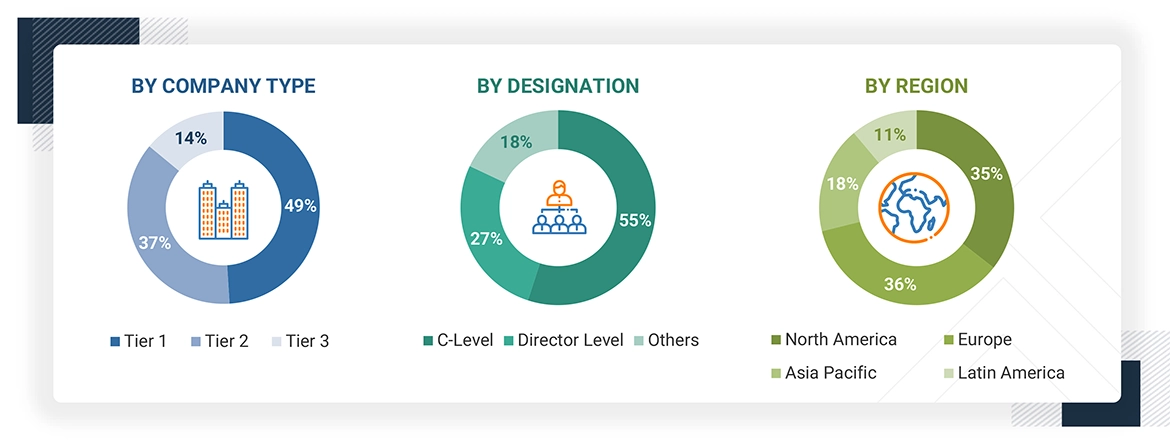
Note 1: C-level executives include the CEO, COO, and CTO, among others.
Note 2: Others include sales, marketing, and product managers.
Note 3: The tiers of the companies have been defined based on their total revenue as of 2024.
Tier 1 = > USD 1 billion, Tier 2 = USD 100 million to USD 1 billion, and Tier 3 = < USD 100 million
To know about the assumptions considered for the study, download the pdf brochure
Market Size Estimation
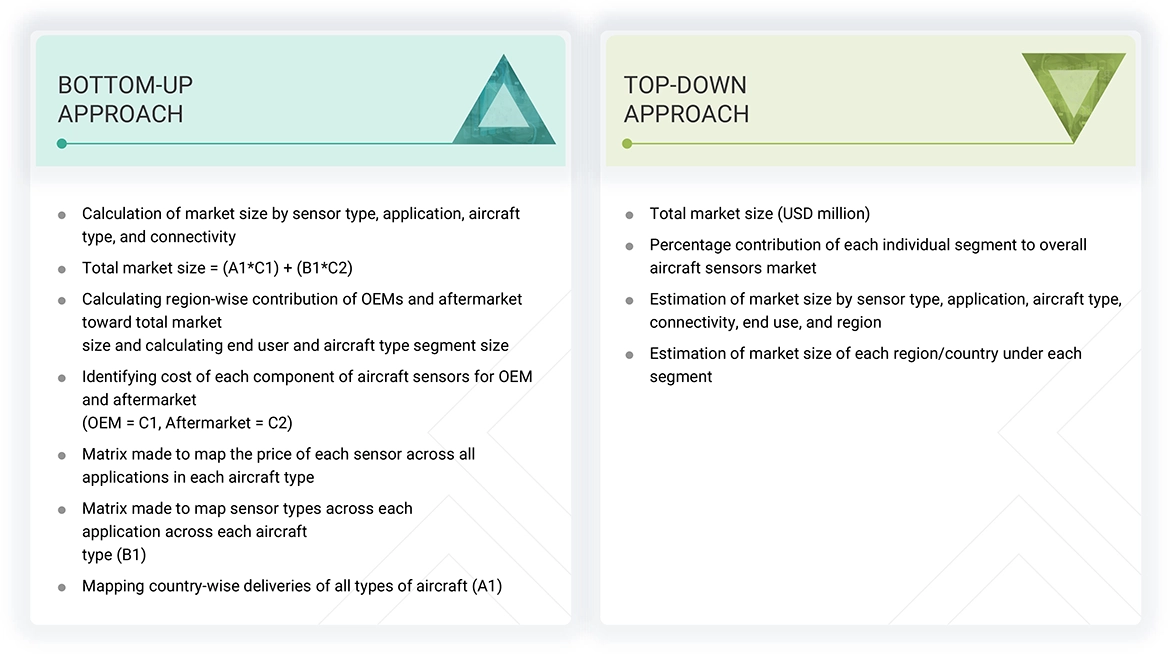
The top-down and bottom-up approaches have been used to estimate and validate the size of the aircraft sensors market. The figures depicted below represent the overall market size estimation process employed for this study on the aircraft sensors market. The key players in the market have been identified through extensive secondary research. This includes the study of annual and financial reports of the top market players and extensive interviews with leaders, including chief executive officers (CEOs), directors, and marketing executives of leading companies operating in the market. All percentage shares, splits, and breakdowns have been determined using secondary sources and verified through primary sources.
Key market players were identified through secondary research, and their market share was All possible parameters that affect the aircraft sensors market and its segments covered in this research study have been viewed in extensive detail, verified through primary research, and analyzed to obtain the final quantitative and qualitative data. This data has been consolidated, enhanced with detailed inputs, analyzed, and presented in this report.
Aircraft Sensors Market : Top-Down and Bottom-Up Approach
Data Triangulation
After arriving at the size of the aircraft sensors market from the market size estimation process explained above, the total market has been split into several segments and subsegments. To complete the overall market engineering process and arrive at the exact statistics for the market segments and subsegments, the market breakdown and data triangulation procedures have been implemented, wherever applicable. The data has been triangulated by studying various factors from the demand and supply sides. In addition, the market size has been validated using the top-down and bottom-up approaches.
Market Definition
Aircraft sensors are devices used to detect and respond to electrical or physical signals both within and outside an aircraft. Most sensors in an aircraft convert physical signals into usable electrical signals. Safe and effective aircraft handling requires feedback on a wide range of flight conditions and the state of various flight equipment and systems. A wide range of sensors continuously monitor these conditions, feeding information to flight computers for processing before being displayed to the pilot.
Key Stakeholders
- Aircraft Sensors Manufacturers
- Aircraft Sensors Wholesalers, Retailers, and Distributors
- Subcomponent Manufacturers
- Technology Support Providers
- Research Bodies
- System Integrators
- Aircraft Manufacturers
- Airline Operators
- Defense Organizations
Report Objectives
- To define, describe, and forecast the aircraft sensors market based on sensor type, application, aircraft type, end use, connectivity, and region
- To forecast the size of various segments of the market with respect to the following regions: North America, Europe, Asia Pacific, the Middle East, Latin America, and Africa
- To identify and analyze the drivers, restraints, opportunities, and challenges influencing the growth of the market
- To identify industry trends, market trends, and technology trends currently prevailing in the aircraft sensors market
- To provide an overview of the regulatory landscape with respect to aircraft sensor regulations across regions
- To analyze micromarkets with respect to individual growth trends, prospects, and their contribution to the overall market
- To analyze opportunities in the market for stakeholders by identifying key market trends
- To profile key market players and comprehensively analyze their market share and core competencies
- To evaluate the degree of competition in the market by analyzing recent developments such as contracts, agreements, and partnerships adopted by leading market players
- To identify detailed financial positions, key products, and unique selling points of leading companies in the market
- To provide a detailed competitive landscape of the market, market share analysis, and revenue analysis of key players.
Available Customizations
Along with the market data, MarketsandMarkets offers customizations to meet the specific needs of companies. The following customization options are available for the report:
Product Analysis
- Product matrix, which gives a detailed comparison of the product portfolio of each company
Regional Analysis
- Further breakdown of the market segments at the country level
Company Information
- Detailed analysis and profiling of additional market players (up to 5)
Get the Full Aircraft Sensors Market Report
Full forecast, segment splits, and company analysis for all Aircraft Sensors Market.
- US Aircraft Sensors Market
- Canada Aircraft Sensors Market
- UK Aircraft Sensors Market
- France Aircraft Sensors Market
- Germany Aircraft Sensors Market
- Italy Aircraft Sensors Market
- Russia Aircraft Sensors Market
- China Aircraft Sensors Market
- India Aircraft Sensors Market
- Australia Aircraft Sensors Market
- South Korea Aircraft Sensors Market
- UAE Aircraft Sensors Market
- Saudi Arabia Aircraft Sensors Market
- Israel Aircraft Sensors Market
- Turkey Aircraft Sensors Market
- Brazil Aircraft Sensors Market
- Mexico Aircraft Sensors Market
- South Africa Aircraft Sensors Market
- Nigeria Aircraft Sensors Market
Need a Tailored Report?
Customize this report to your needs
Get 10% FREE Customization
Customize This Report
