
North America Artificial Intelligence in Cybersecurity Market (2023-2028)

The North America Artificial Intelligence in Cybersecurity Market was valued at $3052.6 Million in 2023 and projected to reach to $8291.9 Million by 2028, representing a compound annual growth rate of 22.1%. North America is positioned as a leading market for AI-driven cybersecurity solutions, driven by substantial enterprise investment and regulatory compliance pressures.


| Market Size in | USD 26.32 MN |
| Market Forecast in | |
| CAGR | |
| Forecast Period | |
| Units Considered | Value (USD MN) |
North America Artificial Intelligence in Cybersecurity Market Trends and Insights
- The region is experiencing accelerated digital transformation and heightened security threats, driving enterprise investment in AI-powered threat detection and response solutions.
- North America's mature technology infrastructure and regulatory environment position it as a critical hub for cybersecurity innovation. By 2028, North America's market is forecast to expand significantly to $8,291.9 million, representing a compound annual growth rate of 22.1%.
- This expansion reflects North America's increasing adoption of machine learning algorithms for anomaly detection, automated incident response, and predictive threat intelligence.
- North America's concentration of leading technology vendors and cybersecurity firms continues to accelerate market development and solution sophistication. North America's dominance in the global AI cybersecurity landscape is underpinned by substantial R&D investments, stringent compliance requirements, and rising cyber threat sophistication.
- The region's enterprises are prioritizing AI-driven security platforms to address evolving attack vectors and regulatory mandates, ensuring North America maintains its position as a primary growth engine through 2028..
Key Market Statistics
- CAGR (2023-2028) 22.1% CAGR
- Market Size, 2023 ~USD 3052.6 Million
- Forecast, 2028 ~USD 8291.9 Million
- Geography North America
North America Artificial Intelligence in Cybersecurity Market Overview
Market Valuation & Growth :
North America's AI in cybersecurity market reached $3,052.6 million in 2023 with a robust 22.1% CAGR, projected to reach $8,291.9 million by 2028, outpacing global growth at 21.9%.
Digital Transformation Drivers :
Accelerated digital transformation across North American enterprises is fueling demand for AI-powered threat detection and response solutions to combat increasingly sophisticated cyber threats.
Regulatory & Infrastructure Advantage :
North America's mature technology infrastructure and stringent regulatory environment (HIPAA, GDPR compliance, SEC requirements) create strong incentives for advanced AI-driven cybersecurity investments.
Enterprise Security Investment :
Rising cybersecurity budgets among North American organizations reflect heightened awareness of AI-enabled threats and the critical need for intelligent, automated threat mitigation capabilities.
North America Artificial Intelligence in Cybersecurity Market Dynamics
- The region's sophisticated threat landscape and digital-first business models are accelerating adoption of machine learning-based threat detection, behavioral analytics, and autonomous response systems.
- Financial services, healthcare, and government sectors are particularly active in deploying AI cybersecurity technologies. Looking ahead to 2028, North America's market is expected to nearly triple in value, supported by continued digital infrastructure expansion, cloud migration initiatives, and evolving regulatory frameworks.
- The convergence of AI advancement, zero-trust architecture adoption, and managed security service provider (MSSP) offerings will further propel market growth, with North American enterprises maintaining their position as early adopters of next-generation cybersecurity innovations..
Market Ecosystem
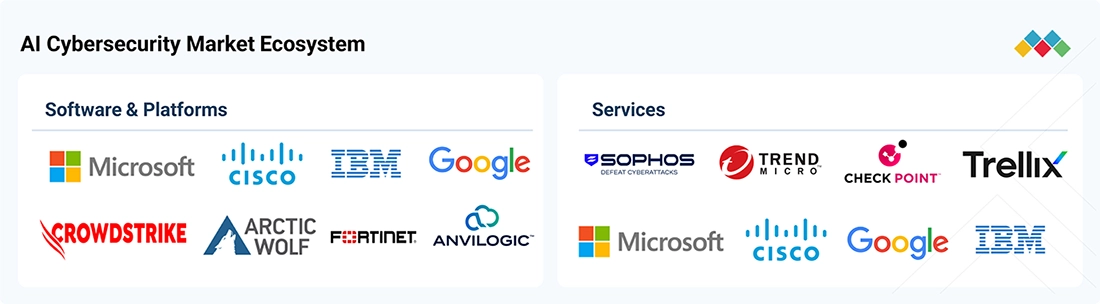
AI CYBERSECURITY MARKET: COMMERCIAL USE CASES ACROSS INDUSTRIES
| COMPANY | USE CASE DESCRIPTION | BENEFITS |
|---|---|---|
 |
St. Luke’s University Health Network deployed Microsoft Security Copilot agents to automate phishing alert triage, analyze security alerts, and support incident investigation and reporting. | Saved nearly 200 analyst hours monthly, automated thousands of false-positive alerts, reduced incident-reporting time from hours to minutes, and improved analyst productivity |
 |
Relay Network implemented SentinelOne's Singularity Data Lake and Purple AI to centralize security data, enable natural-language threat hunting, and improve cloud threat detection across AWS infrastructure. | Improved security visibility by 100%, reduced issue-detection time by 50%, decreased manual threat-detection efforts by 80%, and accelerated security investigations |
 |
Village Roadshow deployed Palo Alto Networks Cortex XSIAM to consolidate security operations, unify XDR, SIEM, SOAR, and attack surface management, and automate threat detection and response. | Reduced security costs by 23%, freed 500 work hours monthly, consolidated 1,400 cases into 20 actionable issues, and achieved a 2-minute median resolution time |
 |
Bluebird Group deployed Darktrace's Self-Learning AI and Autonomous Response to detect anomalous email behavior, identify known and unknown phishing threats, and automate threat containment. | Identified and neutralized phishing threats, reduced manual security analysis, enabled rapid autonomous containment, and allowed IT teams to focus on strategic security activities |
 |
Coop deployed Vectra AI with Managed Detection and Response services to improve security visibility, prioritize genuine threats, reduce security noise, and strengthen proactive threat investigation. | Reduced security noise by 98%, saved approximately 55,000 investigation hours, improved threat visibility, prioritized genuine attacks, and reduced the security team's workload |
Logos and trademarks shown above are the property of their respective owners. Their use here is for informational and illustrative purposes only.
Related Ecosystem
Cyber Security
- Cloud Security
- Biometric Systems
- Data Loss Prevention (DLP)
- Multi-Factor Authentication
- Security Analytics
- International Business Machines Corporation
- Cisco Systems, Inc.
- MITSUI BUSSAN SECURE DIRECTIONS INC
- MICROSOFT CORPORATION
- Allot Ltd.
Information System And Analytics
- Machine Learning
- Natural Language Processing (NLP)
- Sensors
- Software as A Service (SaaS)
- Data Loss Prevention (DLP)
- International Business Machines Corporation
- MICROSOFT CORPORATION
- Amazon.com, Inc.
- Oracle Corporation
Security And Surveillance
- Face Recognition
- Video Surveillance as A Service (VSaaS)
- Voice Recognition
- Fingerprint Recognition
- IRIS Recognition
- HONEYWELL INTERNATIONAL INC.
- Thales group
- HID-GLOBAL
- Lenovo
- AXIS COMMUNICATIONS
Key Takeaways
- North America's AI cybersecurity market reached $3,052.6 million in 2023 and is projected to grow to $8,291.9 million by 2028 at a 22.1% CAGR.
- North America's enterprises are increasingly deploying machine learning-based threat detection and automated incident response capabilities to combat sophisticated cyber threats.
- North America's regulatory landscape, including HIPAA, PCI-DSS, and state privacy laws, is driving mandatory adoption of advanced AI-powered security solutions.
- North America's concentration of leading cybersecurity vendors and technology companies accelerates innovation and market consolidation in AI-driven security platforms.
Artificial Intelligence in Cybersecurity Market Report Scope
| Report Metric | Details |
|---|---|
| Base Year | 2023 |
| Fastest Growing Segment | COMPUTER VISION (Technology) |
| Forecast Period | 2023–2028 |
| Growth Rate | CAGR of 21.9% from 2023 to 2028 |
| Largest Segment | SOLUTION (Offering) |
| Market Size Base Year (Billions) | ~USD 22.51 (2023) |
| Revenue Forecast (Billions) | ~USD 60.6 (2028) |
| Segments Covered | Offering, Type, Deployment Mode, Security Type, Infrastructure Security, Technology, Application, Subapplication |
North America Artificial Intelligence in Cybersecurity Market Report Segmentation
8 segment dimensions are covered across the global market.
By Offering
- Hardware
- Services
- Solution
By Type
- Accelerators
- Application Program Interface
- Asic
- Consulting Services
- Deep Learning
- Deployment & Integration
- Fpga
- Gpu
- Machine Learning Framework
- Managed Services
- Mpu
- Network
- Neural Networks
- Other Processors
- Platforms
- Processors
- Professional Services
- Reinforcement Learning
- Software
- Storage
- Supervised Learning
- Support & Maintenance
- Tpu
- Unsupervised Learning
By Deployment Mode
- Cloud
- On-Premises
By Security Type
- Application Security
- Data Security
- Infrastructure Security
- Other Security Types
By Infrastructure Security
- Cloud Security
- Endpoint Security
- Network Security
- Other Infrastructure Security
By Technology
- Computer Vision
- Context-Aware Computing
- Machine Learning
- Natural Language Processing
By Application
- Anomaly Detection
- Automated Threat Intelligence
- Automation & Orchestration
- Chatbot Security
- Data Loss Prevention
- Facial Recognition
- Fraud Detection
- Identity & Access Management
- Image Recognition
- Intrusion Detection/Prevention System
- Named Entity Recognition (Ner)
- Natural Language Generation
- Natural Language Understanding
- Object Detection
- Other Applications
- Risk & Compliance Management
- Security & Vulnerability Management
- Security Surveillance Optimization
- Sentiment Analysis
- Text Analysis
- Threat Hunting
- Unified Threat Management
- Video Analysis
By Subapplication
- Access Policy Enforcement
- Audit Trail Generation
- Automated Compliance Auditing
- Bandwidth Management
- Bot Identification
- Breach Risk Prediction
- Configuration Management
- Content Discovery & Classification
- Data Encryption & Tokenization
- Data Leak Detection
- Endpoint Detection & Response (Edr)
- Gateway Antivirus
- Geolocation Analysis
- Identity Governance & Administration (Iga)
- Incident Response Planning
- Insider Threat Detection
- Multi-Factor Authentication (Mfa)
- Network Monitoring & Reporting
- Other Data Loss Prevention Applications
- Other Fraud Detection Applications
- Other Identity & Access Management Applications
- Other Risk & Compliance Management Applications
- Other Security & Vulnerability Management Applications
- Patch Management
- Pattern Recognition
- Phishing Detection
- Regulatory Compliance Reporting
- Security Information & Event Management (Siem)
- Single Sign-On (Sso)
- Spam Filtering
- Threat Modeling
- Transaction Monitoring
- User Activity Monitoring
- User Provisioning & Deprovisioning
- Vulnerability Scanning & Assessment
Target Audience
- Cybersecurity Solution Vendors : AI and cybersecurity vendors need North America-specific market data to assess market size, identify customer segments, benchmark against competitors, and develop region-tailored product roadmaps.
- Enterprise Security Decision-Makers : CISOs and security leaders require market insights to justify AI cybersecurity investments, evaluate vendor solutions, understand industry benchmarks, and align spending with regulatory requirements.
- Private Equity & Investment Firms : Investors evaluating cybersecurity and AI technology companies need North America market data to assess growth potential, identify acquisition targets, and forecast returns in this high-growth region.
- Managed Security Service Providers (MSSPs) : MSSP operators need regional market analysis to understand demand drivers, competitive positioning, service differentiation opportunities, and customer acquisition strategies in North America.
- Technology Consultants & Analysts : Consulting firms and research analysts require detailed North America market intelligence to advise clients on cybersecurity strategy, vendor selection, and technology investment priorities.
Key Companies in the North America Artificial Intelligence in Cybersecurity Market
| Company | HQ | Ownership | Strongest segments |
|---|---|---|---|
| DEUTSCHE TELEKOM AG | Germany | Public Company | Mobile services (retail and wholesale),Fixed-network & broadband services,ICT, cloud, and digital solutions, |
| ALTRAN | France | Private Company | Engineering and R&D services,Organization and IT systems consulting,Embedded systems and next-gen connectivity projects, |
| LARSEN & TOUBRO LTD. | India | Public Company | Infrastructure Projects (buildings, transport, heavy civil, T&D, water, minerals & metals),Energy Projects (clean energy, oil & gas, refineries, petrochemicals, offshore wind, CarbonLite),Hi-Tech Manufacturing (nuclear, green hydrogen, defense, aerospace, precision and electronics, electrolysers), |
| PARSONS | United States | Public Company | Federal Solutions – Cyber, Intelligence, and Electronic Warfare,Federal Solutions – Space, Missile Defense, and C2,Federal Solutions – Border, Biometrics, and Environmental Remediation, |
| ATOS SE | France | Public Company | Infrastructure & Cloud Managed Services,Digital Workplace & End-User Services,Business & Platform Integration / Applications, |
| NVIDIA | United States | Public Company | Data Center AI Compute & Networking,Gaming GPUs (GeForce),Professional Visualization (RTX/Workstations), |
| INTEL | United States | Public Company | Client Computing Group (client and commercial CPUs, discrete client GPUs, edge and connectivity),Data Center and AI (server CPUs, discrete GPUs, networking),Intel Foundry (wafer fabrication, substrates, related services), |
| AMD | United States | Public Company | Data Center (EPYC, Instinct, Pensando, Alveo, AI infrastructure),Client (Ryzen, Ryzen AI, desktop and mobile CPUs),Gaming and Graphics (Radeon, Radeon Pro, semi-custom SoCs), |
| SAMSUNG ELECTRONICS CO., LTD | South Korea | Public Company | Smartphones, tablets, wearables, and accessories (DX mobile),Semiconductors (memory, foundry, system LSI, toll processing),TVs, displays, and digital signage (DX + SDC), |
| MICRON TECHNOLOGY | United States | Public Company | DRAM (cloud, data center, PC, graphics, mobile, automotive, embedded),NAND Components & Managed NAND (including MCPs, UFS, eMMC),SSD (data center, client, automotive & industrial), |
| IBM | United States | Public Company | Software (Hybrid Cloud and AI Platforms),Consulting,Infrastructure, |
| MICROSOFT CORPORATION | United States | Public Company | Productivity and Business Processes,Intelligent Cloud,Personal Computing, |
| PALO ALTO NETWORKS | United States | Public Company | Network Security (Strata, VM-Series, CN-Series, subscriptions),Cloud Security (Prisma Cloud, Code to Cloud, Prisma Access SASE),Security Operations (Cortex XSIAM, XDR, XSOAR, Xpanse, Unit 42), |
| CROWDSTRIKE | United States | Public Company | Endpoint & Cloud Workload Protection (Falcon core),Managed Security & Threat Intelligence,Identity, Data Protection & SaaS Security, |
| GEN DIGITAL | United States | Public Company | Consumer endpoint security & performance (Norton, Avast, AVG, Avira, CCleaner),Identity protection & restoration (LifeLock, MoneyLion-linked, reputation services),Online privacy & VPN, |
DEUTSCHE TELEKOM AG
Deutsche Telekom AG is a German public telecommunications company founded in 1995 with 196,586 employees.
ALTRAN
Altran is a French private engineering and consulting company founded in 1970 with 50,124 employees.
LARSEN & TOUBRO LTD.
Larsen & Toubro Ltd. is an Indian public multinational conglomerate founded in 1938 with 55,662 employees.
PARSONS
Parsons is a publicly traded American engineering and construction company founded in 1944 with 21,000 employees.
ATOS SE
Atos SE is a French public information technology and consulting company founded in 1997.
NVIDIA
NVIDIA is an American public technology company founded in 1993 with 42,000 employees.
INTEL
Intel is an American public semiconductor company founded in 1968 with 85,100 employees.
AMD
AMD is an American public semiconductor company founded in 1969 with 31,000 employees.
SAMSUNG ELECTRONICS CO., LTD
Samsung Electronics Co., Ltd. is a South Korean public electronics conglomerate founded in 1969 with 128,735 employees.
MICRON TECHNOLOGY
Micron Technology is an American public semiconductor and memory company founded in 1978 with 53,000 employees.
IBM
IBM is an American public technology and consulting company founded in 1911 with 264,300 employees.
MICROSOFT CORPORATION
Microsoft Corporation is an American public software and technology company founded in 1975 with 228,000 employees.
PALO ALTO NETWORKS
Palo Alto Networks is an American public cybersecurity company founded in 2005 with 21,491 employees.
CROWDSTRIKE
CrowdStrike is an American public cybersecurity company founded in 2011 with 11,157 employees.
GEN DIGITAL
Gen Digital is an American public cybersecurity and digital safety company founded in 1982 with 3,900 employees.
Countries within North America - compare and drill down
| Country | 2025 size (native) |
|---|
Country market size visualization
Reasons to Buy this Report
- Regional Market Sizing & Forecasts : Obtain precise North America-specific market valuations ($3,052.6M in 2023, $8,291.9M in 2028) and segment breakdowns to benchmark competitive positioning and identify growth opportunities in this high-value region.
- Regulatory & Compliance Insights : Understand how North American regulatory frameworks (HIPAA, SEC, state privacy laws) drive AI cybersecurity adoption and shape enterprise procurement strategies across verticals.
- Competitive Landscape Analysis : Gain detailed intelligence on North American vendors, market share distribution, and competitive strategies to inform partnership, acquisition, or market entry decisions.
- Vertical-Specific Demand Patterns : Access North America-focused analysis of AI cybersecurity adoption across financial services, healthcare, government, and enterprise sectors to tailor solutions and marketing strategies.
- Investment & Growth Strategy : Leverage North America's 22.1% CAGR and market expansion trajectory to develop targeted go-to-market strategies, resource allocation plans, and revenue forecasts for the region.
Frequently asked questions
What is the current size of North America's AI cybersecurity market?
North America's AI cybersecurity market was valued at $3,052.6 million in 2023 and is expected to reach $8,291.9 million by 2028.
What is the projected growth rate for North America's AI cybersecurity market?
North America's AI cybersecurity market is projected to grow at a compound annual growth rate (CAGR) of 22.1% from 2023 to 2028.
What are the primary drivers of growth in North America's AI cybersecurity market?
North America's market growth is driven by increasing cyber threat sophistication, regulatory compliance requirements, digital transformation initiatives, and enterprise demand for automated threat detection and response solutions.
Which industries are leading AI cybersecurity adoption in North America?
North America's financial services, healthcare, government, and technology sectors are leading adopters of AI-powered cybersecurity solutions due to stringent regulatory requirements and high-value data assets.
How does North America's market compare to global AI cybersecurity growth?
North America's 22.1% CAGR is comparable to the global market's 21.9% CAGR, reflecting North America's significant contribution to worldwide AI cybersecurity market expansion.
RESEARCH METHODOLOGY
Secondary research was conducted to collect information useful for this technical, market-oriented, and commercial study of the AI cybersecurity market. The next step involved validating these findings, assumptions, and sizing with industry experts across the value chain using primary research. Different approaches, including top-down and bottom-up methods, were employed to estimate the total market size. After that, the market breakup and data triangulation procedures were used to estimate the market size of the segments and subsegments of the AI cybersecurity market.
Secondary Research
During the secondary research process, various secondary sources were consulted to identify and collect information relevant to the study. The secondary sources included annual reports, press releases, investor presentations of AI cybersecurity vendors, forums, certified publications, and whitepapers. The secondary research was mainly used to obtain key information about the industry’s supply chain, the total pool of key players, market classification and segmentation according to industry trends to the bottom-most level, regional markets, and key developments from both market- and technology-oriented perspectives, all of which were further validated by primary sources.
Primary Research
In the primary research process, various primary sources from both the supply and demand sides were interviewed to obtain qualitative and quantitative information for this report. The primary sources from the supply side included various industry experts, including chief executive officers (CEOs), vice presidents (VPs), marketing directors, technology and innovation directors, and related key executives from various key companies and organizations operating in the AI cybersecurity market.
In the market engineering process, top-down and bottom-up approaches were extensively used, along with several data triangulation methods, to perform market estimation and forecasting for the overall market segments and subsegments listed in this report. Extensive qualitative and quantitative analysis was performed on the complete market engineering process to list key information/insights throughout the report.
After the complete market engineering process (including calculations for market statistics, market breakups, market size estimations, market forecasts, and data triangulation), extensive primary research was conducted to gather information and verify and validate the critical numbers arrived at. The primary research was also conducted to identify the segmentation types, industry trends, competitive landscape of AI cybersecurity market players, and key market dynamics, such as drivers, restraints, opportunities, challenges, and key strategies.
Following is the breakup of the primary study:
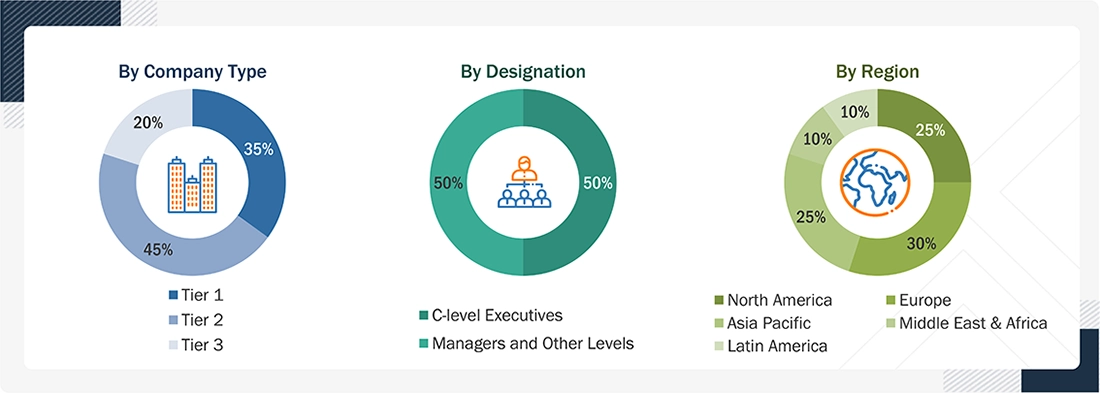
Note: Tier 1 companies receive revenues higher than USD 10 billion; Tier 2 companies' revenues range between USD 1 and 10 billion; and Tier 3 companies' revenues range between USD 500 million and USD 1 billion. Other designations include sales, marketing, and product managers.
To know about the assumptions considered for the study, download the pdf brochure
Market Size Estimation
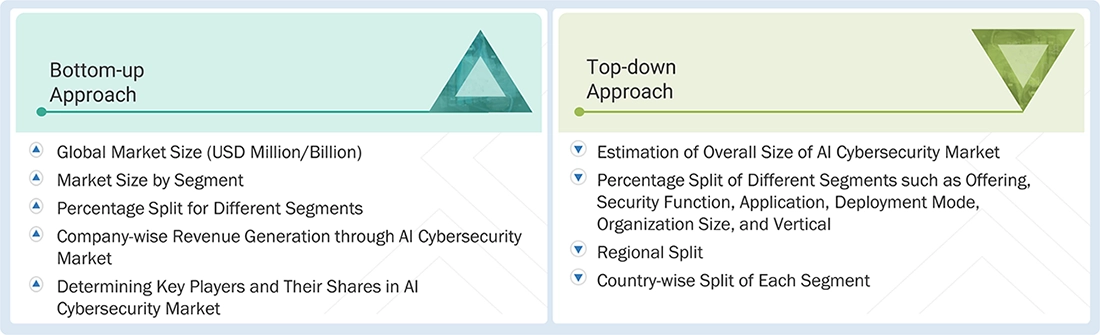
Top-down and bottom-up approaches were employed to estimate and validate the size of the AI cybersecurity market, as well as the size of various dependent subsegments within the overall AI cybersecurity market. The research methodology used to estimate the market size includes the following details: critical players in the market were identified through secondary research, and their market shares in the respective regions were determined through primary and secondary research. This entire procedure involved studying the annual and financial reports of the top market players, and extensive interviews were conducted with key industry leaders, including CEOs, VPs, directors, and marketing executives, to gather valuable insights.
All percentage splits and breakdowns were determined using secondary sources and verified through primary sources. All possible parameters that affect the market covered in this research study were accounted for, viewed in extensive detail, verified through primary research, and analyzed to get the final quantitative and qualitative data. This data was consolidated and added to detailed inputs and analysis from MarketsandMarkets.
AI Cybersecurity Market : Top-Down and Bottom-Up Approach
Data Triangulation
The market was split into several segments and subsegments after arriving at the overall market size using the market size estimation processes explained above. The data triangulation and market breakup procedures were employed, wherever applicable, to complete the overall market engineering process and arrive at the exact statistics of each market segment and subsegment. The data was triangulated by studying various factors and trends from both the demand and supply sides.
Market Definition
The AI cybersecurity market covers software, platforms, and services in which artificial intelligence materially enables or enhances cybersecurity detection, prevention, prediction, analysis, investigation, prioritization, response, remediation, automation, and decision support across enterprise digital environments. The market includes both AI-native and AI-enhanced security offerings and AI-enabled managed and professional services.
It excludes specialized products primarily intended to secure, govern, monitor, or protect AI models, AI applications, AI agents, and AI infrastructure, which are treated as the adjacent “Securing AI” market. General AI infrastructure and the non-AI portion of broader cybersecurity products and services are also excluded.
Key Stakeholders
- Chief Information Officers (CIOs), Chief Technology Officers (CTOs) & Chief Information Security Officers (CISOs)
- Cybersecurity Leaders, Security Operations Leaders & SOC Teams
- Chief Data Officers (CDOs), Data Scientists & AI/ML Teams
- Security Analysts, Threat Hunters & Incident Response Teams
- Security Architects, Engineers & IT Infrastructure Teams
- Threat Intelligence, Security Analytics & Detection Teams
- Vulnerability Management, Application Security & Cloud Security Teams
- AI-Enabled Cybersecurity Solution & Platform Vendors
- Threat Intelligence, Security Analytics & Security Automation Providers
- Endpoint, Network, Cloud & Application Security Providers
- Managed Security Service Providers (MSSPs) and Managed Detection and Response (MDR) Providers
- Cloud Service, AI Infrastructure & Computing Providers
- System Integrators, Cybersecurity Consultants & Professional Services Providers
- Large Enterprises & Small and Medium-sized Enterprises (SMEs)
- Government Agencies, Cybersecurity Authorities, Regulators & Critical Infrastructure Organizations
- Standards Organizations, Industry Associations & Cybersecurity Research Institutions
- Investors, Venture Capital Firms & Private Equity Firms
Report Objectives
- To define, describe, and forecast the AI cybersecurity market based on offering, security function, application, deployment mode, organization size, vertical, and region
- To provide detailed information about the major factors, such as drivers, opportunities, restraints, and challenges, influencing the growth of the market
- To forecast the size of the market segments with respect to five main regions: North America, Europe, Asia Pacific, Middle East & Africa, and Latin America
- To analyze subsegments of the market with respect to individual growth trends, prospects, and contributions to the overall market
- To profile the key players of the market and comprehensively analyze their market shares and core competencies
- To map the competitive intelligence based on company profiles, key player strategies, and game-changing developments, such as product enhancements/launches, collaborations, and acquisitions
- To track and analyze the competitive developments, such as product enhancements/launches, acquisitions, partnerships, and collaborations, in the AI cybersecurity market globally
Available customizations:
With the given market data, MarketsandMarkets offers customizations based on company-specific needs. The following customization options are available for the report:
Geographic Analysis
- Further breakup of the Asia Pacific market into countries contributing to the rest of the regional market size
- Further breakup of the North American market into countries contributing to the rest of the regional market size
- Further breakup of the Latin American market into countries contributing to the rest of the regional market size
- Further breakup of the Middle East & African market into countries contributing to the rest of the regional market size
- Further breakup of the European market into countries contributing to the rest of the regional market size
Company Information
- Detailed analysis and profiling of additional market players (up to five)
Get the Full Artificial Intelligence in Cybersecurity Market Report
Full forecast, segment splits, and company analysis for all Artificial Intelligence in Cybersecurity Market.
Need a Tailored Report?
Customize this report to your needs
Get 10% FREE Customization
Customize This Report
