
US Asset Integrity Management Market (2024-2029)

The US Asset Integrity Management Market was valued at $6810 Million in 2024 and projected to reach to $9140 Million by 2029, representing a compound annual growth rate of 6.1%. The US Asset Integrity Management Market is experiencing robust growth as semiconductor and electronics manufacturers increasingly recognize the critical importance of asset reliability and operational continuity.


| Market Size in | USD 26.32 MN |
| Market Forecast in | |
| CAGR | |
| Forecast Period | |
| Units Considered | Value (USD MN) |
US Asset Integrity Management Market Trends and Insights
- The US semiconductor and electronics sector is increasingly adopting asset integrity management solutions to ensure operational reliability, minimize downtime, and extend asset lifecycles across manufacturing facilities.
- This growth is driven by the US industry's focus on predictive maintenance, regulatory compliance, and digital transformation initiatives that enhance asset performance monitoring and risk mitigation. In the US, asset integrity management has become critical as semiconductor manufacturers face rising pressure to optimize capital expenditures and reduce unplanned maintenance costs.
- The forecast period through 2029 reflects strong demand for integrated monitoring systems, data analytics platforms, and condition-based maintenance strategies tailored to the US market's advanced manufacturing infrastructure.
- The US market's expansion is supported by increasing investments in Industry 4.0 technologies, IoT-enabled asset tracking, and AI-driven predictive analytics that enable US companies to maintain competitive advantage in global semiconductor production..
Key Market Statistics
- CAGR (2024-2029) 6.1% CAGR
- Market Size, 2024 ~USD 6810 Million
- Forecast, 2029 ~USD 9140 Million
- Country US
US Asset Integrity Management Market Overview
Market Valuation :
The US Asset Integrity Management Market is valued at $6,810 million in 2024, with strong growth trajectory driven by semiconductor manufacturing expansion and electronics sector modernization across the country.
Growth Momentum :
At a CAGR of 6.1% through 2029, the US market is outpacing the global average of 5.7%, reflecting accelerated digital transformation and regulatory compliance demands in American manufacturing facilities.
Industry Focus :
US semiconductor and electronics manufacturers are prioritizing asset integrity solutions to reduce unplanned downtime, optimize production efficiency, and maintain competitive advantage in high-precision manufacturing environments.
Forecast Growth :
The market is projected to reach $9,140 million by 2029, representing a $2,330 million increase, driven by adoption of predictive maintenance technologies and IoT-enabled asset monitoring systems across US industrial facilities.
US Asset Integrity Management Market Dynamics
- Driven by supply chain pressures, labor shortages, and the need for maximum production uptime, US companies are investing heavily in advanced monitoring and predictive maintenance solutions.
- The market's 6.1% CAGR reflects strong demand for technologies that minimize costly downtime and extend asset lifecycles. Looking ahead to 2029, the US market will be shaped by accelerating digital transformation, integration of AI and machine learning into maintenance strategies, and stricter regulatory requirements for equipment safety and environmental compliance.
- As manufacturing reshoring initiatives gain momentum and semiconductor fabs expand domestic capacity, asset integrity management solutions will become increasingly essential for maintaining competitive operations and meeting production targets..
Market Ecosystem
Related Ecosystem
Testing Inspection And Certification
- Eddy Current Testing (ECT)
- Safety Testing
- Signal Generators
- Acoustic Emission Testing (AET)
- Automated Test Equipment
- Sgs s.a.
- Intertek Group plc
- Bureau veritas s.a.
- TUV RHEINLAND AG
- TUV SUD AG
Key Takeaways
- The US Asset Integrity Management Market is valued at $6,810 million in 2024 and will reach $9,140 million by 2029, growing at a 6.1% CAGR.
- The US semiconductor and electronics industry is prioritizing predictive maintenance and digital asset monitoring to reduce operational costs and downtime.
- US manufacturers are increasingly investing in IoT, AI, and data analytics platforms to enable real-time asset performance tracking and condition-based maintenance.
- Regulatory compliance, capital optimization, and Industry 4.0 adoption are key drivers accelerating asset integrity management solution deployment across the US market.
Asset Integrity Management Market Report Scope
| Report Metric | Details |
|---|---|
| Base Year | 2024 |
| Fastest Growing Segment | CORROSION MANAGEMENT (Service Type) |
| Forecast Period | 2024-2029 |
| Growth Rate | CAGR of 5.7% from 2024 to 2029 |
| Largest Segment | NON-DESTRUCTIVE TESTING INSPECTION (Service Type) |
| Market Size Base Year (Billions) | ~USD 23.87 (2024) |
| Revenue Forecast (Billions) | ~USD 31.5 (2029) |
| Segments Covered | Service Type, Industry |
US Asset Integrity Management Market Report Segmentation
2 segment dimensions are covered across the global market.
By Service Type
- Corrosion Management
- Hazard Identification Study
- Non-Destructive Testing Inspection
- Pipeline Integrity Management
- Reliability, Availability, And Maintainability Study
- Risk-Based Inspection
- Structural Integrity Management
By Industry
- Aerospace
- Mining
- Oil & Gas
- Power
Target Audience
- US Semiconductor Manufacturers : Semiconductor fabs require detailed market intelligence to evaluate asset integrity solutions that minimize production interruptions, optimize equipment utilization, and maintain yield rates in highly competitive US markets.
- Electronics OEMs & Contract Manufacturers : US-based electronics manufacturers need market insights to benchmark their asset management strategies, identify emerging technologies, and make procurement decisions that enhance operational reliability and cost efficiency.
- Technology Solution Providers : Software and hardware vendors serving the US market require market data to understand demand trends, competitive positioning, customer needs, and growth opportunities within the semiconductor and electronics sectors.
- Industrial Equipment Suppliers : Equipment manufacturers and integrators need US-specific market analysis to align product development roadmaps, identify customer pain points, and develop solutions that address the unique requirements of American manufacturing facilities.
- Investment & Private Equity Firms : Investors evaluating opportunities in the US asset management sector require comprehensive market data to assess growth potential, competitive dynamics, and valuation benchmarks for acquisition and portfolio decisions.
Reasons to Buy this Report
- Market-Specific Sizing : Obtain precise US market valuation ($6.81B in 2024) and forecasts ($9.14B by 2029) tailored to the American semiconductor and electronics sector, enabling accurate budget allocation and investment planning.
- Competitive Benchmarking : Understand how the US market's 6.1% CAGR compares to global trends (5.7%), identifying growth opportunities and competitive advantages specific to the American manufacturing landscape.
- Sector-Specific Insights : Access detailed analysis of asset integrity management adoption patterns within US semiconductor fabs and electronics manufacturing facilities, including technology preferences and implementation challenges.
- Strategic Decision Support : Make informed decisions about market entry, expansion, or product development strategies based on comprehensive US market data, regulatory environment analysis, and industry-specific growth drivers.
- Investment Justification : Leverage credible market research to justify capital investments in asset integrity solutions, demonstrate ROI potential, and secure stakeholder buy-in for digital transformation initiatives in US operations.
Frequently asked questions
What is the current size of the US Asset Integrity Management Market?
The US Asset Integrity Management Market is valued at $6,810 million in 2024 and is expected to grow to $9,140 million by 2029.
What is the projected growth rate for the US market through 2029?
The US Asset Integrity Management Market is projected to grow at a compound annual growth rate (CAGR) of 6.1% from 2024 to 2029.
What are the primary drivers of growth in the US Asset Integrity Management Market?
Key drivers include the US industry's focus on predictive maintenance, regulatory compliance, digital transformation, IoT adoption, AI-driven analytics, and the need to optimize capital expenditures and reduce unplanned downtime.
How is the US semiconductor industry using asset integrity management solutions?
US semiconductor manufacturers are deploying integrated monitoring systems, condition-based maintenance strategies, and real-time asset performance tracking to ensure operational reliability, extend asset lifecycles, and maintain competitive advantage.
What technologies are driving asset integrity management adoption in the US?
Industry 4.0 technologies, IoT-enabled asset tracking, AI-driven predictive analytics, data analytics platforms, and cloud-based monitoring systems are the primary technologies accelerating adoption across the US market.
RESEARCH METHODOLOGY
The study involved four major activities in estimating the current size of the asset integrity management market. Exhaustive secondary research collected information on the market, peer, and parent markets. The next step was to validate these findings, assumptions, and sizing with industry experts across the value chain through primary research. Both top-down and bottom-up approaches were employed to estimate the complete market size. After that, market breakdown and data triangulation were used to estimate the market size of segments and subsegments.
Secondary Research
Various secondary sources have been referred to in the secondary research process to identify and collect information important for this study. The secondary sources include annual reports, press releases, and investor presentations of companies; white papers; journals and certified publications; and articles from recognized authors, websites, directories, and databases. Secondary research has been conducted to obtain critical information about the industry’s supply chain, the market’s value chain, the total pool of key players, market segmentation according to the industry trends (to the bottom-most level), regional markets, and key developments from market- and technology-oriented perspectives. The secondary data has been collected and analyzed to determine the overall market size, further validated by primary research.
List of major secondary sources
|
Source |
Web Link |
|
American Society of Mechanical Engineers (ASME) |
|
|
Occupational Safety and Health Administration (OSHA) |
|
|
International Energy Agency (IEA) |
Primary Research
Extensive primary research was conducted after gaining knowledge about the current scenario of the asset integrity management market through secondary research. Several primary interviews were conducted with experts from both the demand and supply sides across four major regions—North America, Europe, Asia Pacific, and RoW. This primary data was collected through questionnaires, emails, and telephonic interviews.
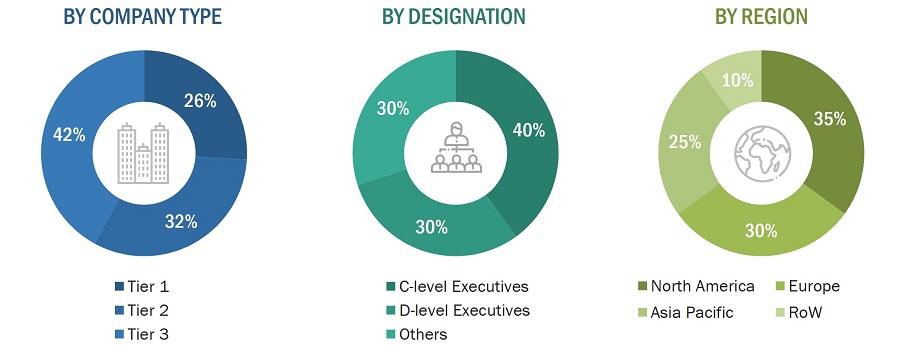
To know about the assumptions considered for the study, download the pdf brochure
Market Size Estimation
In the complete market engineering process, top-down and bottom-up approaches and several data triangulation methods have been used to perform market estimation and forecasting for the overall market segments and subsegments listed in this report. Key players in the market have been identified through secondary research, and their market shares in the respective regions have been determined through primary and secondary research. This entire procedure includes the study of annual and financial reports of the top market players and extensive interviews for key insights (quantitative and qualitative) with industry experts (CEOs, VPs, directors, and marketing executives).
All percentage shares, splits, and breakdowns have been determined using secondary sources and verified through primary sources. All the parameters affecting the markets covered in this research study have been accounted for, viewed in detail, verified through primary research, and analyzed to obtain the final quantitative and qualitative data. This data has been consolidated and supplemented with detailed inputs and analysis from MarketsandMarkets and presented in this report. The following figure represents this study’s overall market size estimation process.
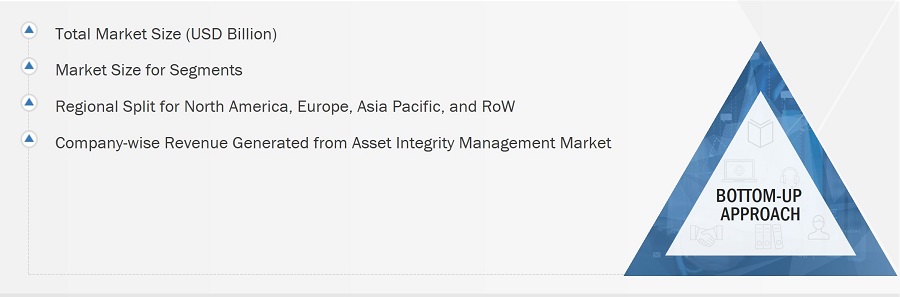
Bottom-Up Approach
The bottom-up approach was used to determine the overall size of the asset integrity management market from the revenues of the key players and their shares in the market. The overall market size was calculated based on the revenues of the key players identified in the market.
- Identifying entities in the asset integrity value chain influencing the entire asset integrity management industry
- Analyzing each entity, along with related major companies
- Identifying technology providers for the implementation of products
- Estimating the market for asset integrity management end users
- Tracking ongoing and upcoming implementation of asset integrity management service developments by various companies and forecasting the market based on these developments and other critical parameters
- Arriving at the market size by analyzing asset integrity management companies based on their countries and then combining it to get the market estimate by region
- Verifying estimates and crosschecking them through a discussion with key opinion leaders, including chief experience officers (CXOs), directors, and operation managers
Top-Down Approach
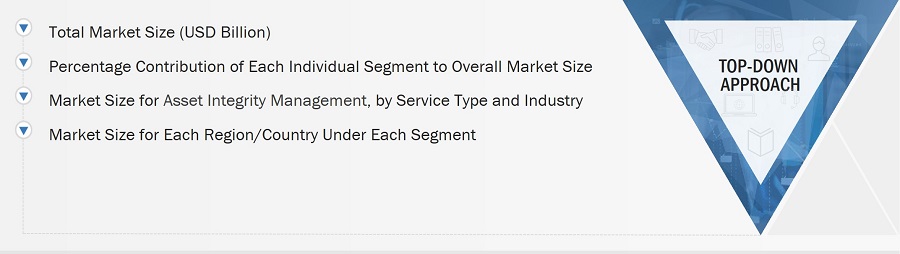
In the top-down approach, the overall market size has been used to estimate the size of individual markets (mentioned in the market segmentation) through percentage splits from secondary and primary research.
The most appropriate immediate parent market size has been used to implement the top-down approach to calculate the market size of specific segments. The top-down approach has been implemented for the data extracted from the secondary research to validate the market size obtained.
Each company’s market share has been estimated to verify the revenue shares used earlier in the top-down approach. This study has determined and confirmed the overall parent market and individual market sizes by the data triangulation method and data validation through primaries. The data triangulation method in this study is explained in the next section.
- Focusing initially on topline investments by market players in the asset integrity management ecosystem
- Calculating the market size based on the revenue generated by market players through the sales of asset integrity management
- Mapping the use of asset integrity management in different applications
- Building and developing the information related to the revenue generated by market players through key products
- Estimating the geographic split using secondary sources considering factors such as the number of players in a specific country and region, the role of major players in developing innovative products, and adoption and penetration rates for various methods and end-user industries in a particular country
Data Triangulation
After arriving at the overall market size from the estimation process explained above, the overall market has been split into several segments and subsegments. The data triangulation procedure has been employed wherever applicable to complete the overall market engineering process and arrive at the exact statistics for all segments and subsegments. The data has been triangulated by studying various factors and trends from both the demand and supply sides. Additionally, the market size has been validated using top-down and bottom-up approaches.
Market Definition
Asset Integrity Management (AIM) refers to a systematic approach that ensures the reliability, safety, and performance of critical assets throughout their operational lifecycle. It involves comprehensive strategies and practices aimed at assessing, monitoring, and maintaining the integrity of assets such as infrastructure, equipment, and facilities. By implementing risk-based inspection, non-destructive testing, corrosion management, and other techniques, AIM aims to mitigate operational risks, enhance asset lifespan, comply with regulatory requirements, and optimize asset performance and reliability, ultimately contributing to the overall operational efficiency and sustainability of industries such as oil and gas, power generation, and manufacturing.
Key Stakeholders
- Oil and Gas Refinery Companies
- Asset Integrity Management Service Providers
- Asset Integrity Software Developers
- Asset Integrity Management Consultants
- Research Organizations and Consulting Companies
- Technology Investors
- Technology Standard Organizations, Forums, Alliances, and Associations
Report Objectives
- To describe and forecast the asset integrity management market in terms of value by service type, industry, and region
- To forecast the market, in terms of value, for various segments concerning four main regions: North America, Europe, Asia Pacific, and Rest of the World (RoW)
- To provide detailed information regarding the major factors, such as drivers, restraints, opportunities, and industry-specific challenges, influencing the growth of the asset integrity management market
- To analyze the micromarkets1 concerning individual growth trends, prospects, and contributions to the total market
- To study the complete value chain and allied industry segments and perform a value chain analysis of the asset integrity management landscape
- To strategically analyze the regulatory landscape, tariff, standards, patents, Porter’s five forces, import and export scenarios, trade values, and case studies pertaining to the market under study
- To analyze the opportunities in the market for various stakeholders by identifying the high-growth segments of the asset integrity management market
- To profile the key players and comprehensively analyze their market position in terms of ranking and core competencies2, along with detailing the competitive landscape for the market leaders
- To analyze competitive developments, such as partnerships and joint ventures, mergers and acquisitions, product/service developments, expansions, and research and development, in the asset integrity management market
Available Customizations
With the given market data, MarketsandMarkets offers customizations according to the specific requirements of companies. The following customization options are available for the report:
- Detailed analysis and profiling of additional market players (up to 5)
- Additional country-level analysis of the asset integrity management market
Product Analysis
- Product matrix, which provides a detailed comparison of the product portfolio of each company in the asset integrity management market.
Get the Full Asset Integrity Management Market Report
Full forecast, segment splits, and company analysis for all Asset Integrity Management Market.
- Canada Asset Integrity Management Market
- Mexico Asset Integrity Management Market
- Germany Asset Integrity Management Market
- UK Asset Integrity Management Market
- France Asset Integrity Management Market
- Norway Asset Integrity Management Market
- Rest Of Europe Asset Integrity Management Market
- China Asset Integrity Management Market
- Japan Asset Integrity Management Market
- India Asset Integrity Management Market
- Rest Of Asia Pacific Asset Integrity Management Market
- Saudi Arabia Asset Integrity Management Market
- UAE Asset Integrity Management Market
- Kuwait Asset Integrity Management Market
- Qatar Asset Integrity Management Market
- Oman Asset Integrity Management Market
- Bahrain Asset Integrity Management Market
Need a Tailored Report?
Customize this report to your needs
Get 10% FREE Customization
Customize This Report
