
Asia Pacific Asset Management System Market (2025-2030)

The Asia Pacific Asset Management System Market was valued at $1328.3 Million in 2025 and projected to reach to $1722 Million by 2030, representing a compound annual growth rate of 5.3%. Asia Pacific's Asset Management System market is positioned for steady growth, with China and India serving as primary growth engines.


| Market Size in | USD 26.32 MN |
| Market Forecast in | |
| CAGR | |
| Forecast Period | |
| Units Considered | Value (USD MN) |
Asia Pacific Asset Management System Market Trends and Insights
- This category encompasses diverse asset classifications beyond primary equipment categories, serving niche but essential functions across semiconductor and electronics manufacturing environments.
- Other Asset Types are projected to reach $1,722.0 million by 2030, reflecting steady market maturation and increasing adoption of comprehensive asset tracking solutions. The growth trajectory of Other Asset Types demonstrates moderate but consistent expansion, driven by enterprises seeking holistic visibility across their entire asset portfolios.
- Other Asset Types benefit from broader digital transformation initiatives and the need for integrated asset lifecycle management.
- Between 2025 and 2030, Other Asset Types will capture incremental market share as organizations recognize the operational and financial benefits of managing non-core assets alongside primary equipment inventories. Other Asset Types remain underutilized in many organizations, presenting significant upside potential as awareness and standardization improve.
- The segment's 5.3% CAGR reflects both market consolidation and the emergence of specialized solutions tailored to unique asset management challenges within electronics manufacturing..
Key Market Statistics
- CAGR (2025-2030) 5.3% CAGR
- Market Size, 2025 ~USD 1328.3 Million
- Forecast, 2030 ~USD 1722 Million
- Geography Asia Pacific
Asia Pacific Asset Management System Market Overview
China's Dominance :
China leads Asia Pacific with $4,107.9 million in market size, driven by massive semiconductor manufacturing expansion and increasing adoption of advanced asset management systems across electronics production facilities.
India's Rapid Growth :
India represents a high-growth opportunity at $1,558.2 million, supported by government initiatives to boost domestic semiconductor manufacturing and rising electronics sector investments.
Japan's Established Market :
Japan contributes $1,246.5 million with mature asset management practices in electronics manufacturing, focusing on optimization and predictive maintenance technologies.
Regional CAGR Performance :
Asia Pacific's 5.3% CAGR (2025-2030) lags the global 8.4%, indicating market maturation in developed segments but significant untapped potential in emerging economies.
Asia Pacific Asset Management System Market Dynamics
- The region's semiconductor manufacturing boom, coupled with increasing digitalization initiatives, creates sustained demand for specialized asset management solutions.
- However, the 5.3% regional CAGR reflects competitive saturation in mature markets like Japan and South Korea, where optimization rather than expansion drives adoption. Looking ahead to 2030, Asia Pacific will benefit from supply chain resilience investments and nearshoring trends away from traditional Western markets.
- Emerging economies are rapidly modernizing manufacturing infrastructure, presenting significant opportunities for asset management system providers.
- Integration of IoT and AI-driven analytics will become critical differentiators in capturing market share across the region..
Market Ecosystem
Related Ecosystem
Industrial Automation
- Sensors
- Image Sensors
- Manufacturing Execution System (MES)
- Actuators
- Flow Sensors
- Siemens ag
- ABB India Limited
- Emerson Electric Co.
- HONEYWELL INTERNATIONAL INC.
- SCHNEIDER ELECTRIC SE
Industrial Iot
- Sensors
- Pressure Sensors
- Flow Sensors
- Gas Sensors
- Image Sensors
- Siemens ag
- ABB India Limited
- HONEYWELL INTERNATIONAL INC.
- Emerson Electric Co.
- SCHNEIDER ELECTRIC SE
Information System And Analytics
- Machine Learning
- Natural Language Processing (NLP)
- Sensors
- Software as A Service (SaaS)
- Data Loss Prevention (DLP)
- International Business Machines Corporation
- MICROSOFT CORPORATION
- Amazon.com, Inc.
- Oracle Corporation
Key Takeaways
- Other Asset Types will grow from $1,328.3M (2025) to $1,722.0M (2030), representing a 5.3% CAGR in the semiconductor and electronics sector.
- Other Asset Types lag the global market CAGR of 8.4%, indicating slower adoption but stable long-term demand for non-core asset tracking.
- Other Asset Types address fragmented asset portfolios, enabling organizations to achieve comprehensive visibility beyond primary equipment categories.
- Other Asset Types present significant expansion opportunities as enterprises increasingly prioritize total asset lifecycle management and operational efficiency.
Asset Management System Market Report Scope
| Report Metric | Details |
|---|---|
| Base Year | 2025 |
| Fastest Growing Segment | HEALTHCARE (End User) |
| Forecast Period | 2025–2030 |
| Growth Rate | CAGR of 8.4% from 2025 to 2030 |
| Largest Segment | CLOUD-BASED (Deployment Type) |
| Market Size Base Year (Billions) | ~USD 17.65 (2025) |
| Revenue Forecast (Billions) | ~USD 26.41 (2030) |
| Segments Covered | Offering, Technology, Type, Tag Type, End User, Organization Size, Function, Deployment Type, Asset Type |
Asia Pacific Asset Management System Market Report Segmentation
9 segment dimensions are covered across the global market.
By Offering
- Hardware
- Services
- Software/Platform
By Technology
- Barcode
- Other Technologies
- Rfid
- Uwb
- Wi-Fi
By Type
- Other Hardware
- Readers
- Tags
By Tag Type
- Active Tags
- Passive Tags
By End User
- Agriculture
- Healthcare
- Industrial Manufacturing
- Other End Users
- Process Industries
- Retail
- Transport & Logistics
- Transportation & Logistics
By Organization Size
- Large Enterprises
- Small & Medium-Sized Enterprises
By Function
- Check-In/Check-Out
- Location & Movement Tracking
- Other Functions
- Repair & Maintenance
By Deployment Type
- Cloud-Based
- On-Premises
By Asset Type
- Electronic Assets
- In-Transit Equipment
- Manufacturing Assets
- Other Asset Types
- Returnable Transport Assets
Target Audience
- Regional Sales & Business Development Managers : Need country-specific market sizing and growth rates to set realistic revenue targets, prioritize market entry strategies, and allocate sales resources across Asia Pacific territories.
- C-Suite Executives & Strategic Planners : Require regional market outlook and competitive positioning data to make informed decisions about geographic expansion, M&A opportunities, and long-term strategic investments in Asia Pacific.
- Product Development & Innovation Teams : Benefit from understanding regional market dynamics and customer needs across diverse economies to tailor asset management solutions for China, India, Japan, and emerging markets.
- Investment & Financial Analysts : Use detailed market forecasts and country-level data to evaluate investment opportunities, assess company valuations, and identify growth potential in Asia Pacific semiconductor sectors.
- Manufacturing & Operations Leaders : Need regional market intelligence to benchmark asset management practices, identify best-in-class solutions, and optimize capital expenditure decisions across Asia Pacific facilities.
Key Companies in the Asia Pacific Asset Management System Market
| Company | HQ | Ownership | Strongest segments |
|---|---|---|---|
| QINETIQ GROUP PLC | United Kingdom | Public Company | Defense and security asset management (test ranges, mission systems, in-transit equipment),Industrial manufacturing and process industries asset tracking,Infrastructure and critical facilities asset management, |
| GENPACT | Bermuda | Public Company | Manufacturing Assets & Industrial/Process Industries,In-transit Equipment & Returnable Transport Assets,Healthcare & Electronic Assets, |
| CAMERON INTERNATIONAL CORPORATION | United States | Private Company | Manufacturing Assets & Industrial/Process Assets,In-transit Equipment & Returnable Transport Assets,Electronic Assets & Instrumentation, |
| LEIDOS | United States | Public Company | Electronic and high-value assets (defense, aerospace, security systems),In-transit equipment and logistics operations,Returnable transport assets and manufacturing assets, |
| KORE WIRELESS GROUP | United States | Public Company | IoT connectivity-as-a-service for asset tracking,Connectivity enablement & SIM/device management,Managed and professional IoT services, |
| NOMURA RESEARCH INSTITUTE, LTD. | Japan | Public Company | Financial asset and collateral management IT solutions,Industrial and manufacturing asset management platforms,Retail and distribution asset tracking solutions, |
| LENOVO | China | Public Company | Barcode- and RFID-adjacent controllers (PCs, thin clients, embedded boxes),Retail and hospitality interactive endpoints (POS, kiosks, tablets),Industrial and process-industry edge compute for asset tracking, |
| ZENSAR TECHNOLOGIES LTD | India | Public Company | Electronic Assets & IT Asset Management Solutions,Manufacturing Assets (Industrial & Process Industries),Retail Asset Management (Store, DC, and Omnichannel), |
| AVERY DENNISON CORPORATION | United States | Public Company | Item-level RFID and digital identification (retail, apparel, logistics),Pressure-sensitive labels and barcodes for asset tracking,Branding, tickets, tags, and compliance labeling, |
| ZEBRA TECHNOLOGIES CORP. | United States | Public Company | Barcode-based asset management (printers, scanners, labels),RFID hardware and tags (printers, readers, RFID tags),RTLS and sensors (tags, sensors, exciters), |
| HONEYWELL INTERNATIONAL INC. | United States | Public Company | Manufacturing Assets (Industrial Automation),In-transit Equipment & Returnable Transport Assets,Electronic Assets & IT/OT Infrastructure, |
| SIEMENS AG | Germany | Public Company | Manufacturing Assets (industrial and process plants),Electronic Assets and RTLS-based tracking,Returnable Transport Assets and In-transit Equipment, |
| TRIMBLE INC. | United States | Public Company | GPS and RTLS-based equipment and fleet asset management,In-transit equipment and returnable transport asset tracking,Manufacturing and industrial asset management software, |
| MOTOROLA SOLUTIONS, INC. | United States | Public Company | GPS / RTLS-based asset tracking,RFID / Barcode asset tracking,Video-enabled asset and equipment monitoring, |
| CHECKPOINT SYSTEMS, INC. | United States | Private Company | Merchandise Availability Solutions (EAS + RFID visibility),Apparel Labeling Solutions (RFID and barcode tags/labels),Security Labels and Tagging (Alpha, Keepers, Spider Wraps, Bottle Security), |
| IMPINJ, INC. | United States | Public Company | Endpoint ICs (tags on electronic and returnable assets),Reader ICs, readers, and gateways,Software and cloud connectivity, |
| DATALOGIC S.P.A. | Italy | Public Company | Fixed retail scanners and POS imaging,Handheld scanners and mobile computers,Industrial scanners, sensors, and machine vision, |
| INFOR | United States | Private Company | Data Integration & Engineering for Asset Data,Master Data Management & Business 360 for Assets,Data Quality, Observability, and Governance for Asset Records, |
| GE HEALTHCARE | United States | Public Company | Healthcare RTLS/RFID asset tracking (clinical equipment, beds, pumps),Connected imaging and monitoring asset performance management software,Barcode-based workflow and inventory within care settings, |
| CISCO SYSTEMS, INC. | United States | Public Company | Campus and data center switching for asset backbones,Wireless (Wi-Fi/RTLS) for location and mobility,Network security, identity, and SASE for asset access control, |
QINETIQ GROUP PLC
QinetiQ Group PLC is a publicly traded British company established in 2001 that employs 7,378 people.
GENPACT
Genpact is a publicly traded company incorporated in Bermuda in 1997 with approximately 145,000 employees.
CAMERON INTERNATIONAL CORPORATION
Cameron International Corporation is a privately held American company established in 1833 with 23,000 employees.
LEIDOS
Leidos is a publicly traded defense and technology company founded in 1969 in the United States with 50,000 employees.
KORE WIRELESS GROUP
Kore Wireless Group is a publicly traded American company established in 2002 with 403 employees.
NOMURA RESEARCH INSTITUTE, LTD.
Nomura Research Institute, Ltd. is a publicly traded Japanese company founded in 1965 with 16,894 employees.
LENOVO
Lenovo is a publicly traded technology company founded in 1984 in China.
ZENSAR TECHNOLOGIES LTD
Zensar Technologies Ltd. is a publicly traded Indian company established in 1963 with 10,066 employees.
AVERY DENNISON CORPORATION
Avery Dennison Corporation is a publicly traded American company founded in 1935 with 35,000 employees.
ZEBRA TECHNOLOGIES CORP.
Zebra Technologies Corp. is a publicly traded company established in 1969 in the United States with 10,700 employees.
HONEYWELL INTERNATIONAL INC.
Honeywell International Inc. is a publicly traded American conglomerate founded in 1885 with 101,000 employees.
SIEMENS AG
Siemens AG is a publicly traded German industrial conglomerate founded in 1847 with 310,312 employees.
TRIMBLE INC.
Trimble Inc. is a publicly traded American technology company founded in 1978 with 11,500 employees.
MOTOROLA SOLUTIONS, INC.
Motorola Solutions, Inc. is a publicly traded American company established in 1928 with 23,000 employees.
CHECKPOINT SYSTEMS, INC.
Checkpoint Systems, Inc. is a privately held American company established in 1969 with 4,814 employees.
IMPINJ, INC.
Impinj, Inc. is a publicly traded American company founded in 2000 with 457 employees.
DATALOGIC S.P.A.
Datalogic S.p.A. is a publicly traded Italian company established in 1972 with 2,628 employees.
INFOR
Infor is a private software company founded in 1993 in the United States with 5,200 employees.
GE HEALTHCARE
GE Healthcare is a publicly traded American healthcare technology company founded in 2022 with 54,000 employees.
CISCO SYSTEMS, INC.
Cisco Systems, Inc. is a publicly traded American technology company founded in 1984 with 86,200 employees.
Countries within Asia Pacific - compare and drill down
| Country | 2025 size (native) |
|---|---|
| China | USD 4107.9 Million |
| Japan | USD 1246.5 Million |
| India | USD 1558.2 Million |
| South Korea | USD 982.1 Million |
| Australia & New Zealand | USD 9047.2 Million |
Country market size visualization
Reasons to Buy this Report
- Country-Level Market Intelligence : Gain detailed insights into China ($4.1B), India ($1.6B), Japan ($1.2B), and South Korea ($982M) markets with specific growth drivers and competitive dynamics unique to each economy.
- Regional Growth Trajectory Analysis : Understand why Asia Pacific's 5.3% CAGR differs from global 8.4%, identifying market maturation patterns and emerging opportunities in high-growth segments.
- Strategic Market Positioning : Benchmark your organization against regional competitors and identify optimal entry or expansion strategies across Asia Pacific's diverse semiconductor and electronics ecosystems.
- Forecast-Driven Planning : Access 2025-2030 projections showing growth from $1,328.3M to $1,722.0M, enabling data-backed investment and resource allocation decisions for Asia Pacific operations.
- Emerging Market Opportunities : Identify high-potential markets like India and Vietnam where manufacturing expansion and digitalization create first-mover advantages in asset management system adoption.
Frequently asked questions
What is included in the Other Asset Types segment?
Other Asset Types encompasses diverse asset classifications beyond primary equipment, including auxiliary tools, support infrastructure, and specialized devices used in semiconductor and electronics manufacturing that require lifecycle tracking and management.
Why is the Other Asset Types CAGR lower than the global market average?
Other Asset Types grows at 5.3% versus the global 8.4% CAGR because this segment represents mature, lower-priority asset categories with slower digital adoption rates and less aggressive modernization compared to core equipment systems.
What market size is projected for Other Asset Types by 2030?
Other Asset Types is forecasted to reach $1,722.0 million by 2030, up from $1,328.3 million in 2025, reflecting steady but measured expansion in comprehensive asset management adoption.
How do Other Asset Types contribute to overall asset management strategy?
Other Asset Types enable organizations to achieve complete asset visibility and control across their entire portfolio, reducing operational blind spots, improving compliance, and optimizing total cost of ownership beyond primary equipment investments.
What drives growth in the Other Asset Types segment?
Growth in Other Asset Types is driven by digital transformation initiatives, regulatory compliance requirements, increasing need for integrated lifecycle management, and growing recognition of the financial and operational benefits of comprehensive asset tracking.
RESEARCH METHODOLOGY
The research study involved 4 major activities in estimating the size of the asset management system market. Exhaustive secondary research has been done to collect important information about the market and peer markets. The validation of these findings, assumptions, and sizing with the help of primary research with industry experts across the value chain has been the next step. Both top-down and bottom-up approaches have been used to estimate the market size. Post which the market breakdown and data triangulation have been adopted to estimate the market sizes of segments and sub-segments.
Secondary Research
In the secondary research process, various secondary sources have been referred to for identifying and collecting information required for this study. The secondary sources include annual reports, press releases, investor presentations of companies, white papers, and articles from recognized authors. Secondary research has been mainly done to obtain key information about the market’s value chain, the pool of key market players, market segmentation according to industry trends, regional outlook, and developments from both market and technology perspectives.
Primary Research
In primary research, various primary sources from both supply and demand sides have been interviewed to obtain qualitative and quantitative insights required for this report. Primary sources from the supply side include experts such as CEOs, vice presidents, marketing directors, manufacturers, technology and innovation directors, end users, and related executives from multiple key companies and organizations operating in the asset management system market ecosystem. After interacting with industry experts, brief sessions were conducted with highly experienced independent consultants to reinforce the findings from our primary. This, along with the in-house subject matter experts’ opinions, has led us to the findings as described in the remainder of this report. The breakdown of primary respondents is as follows:
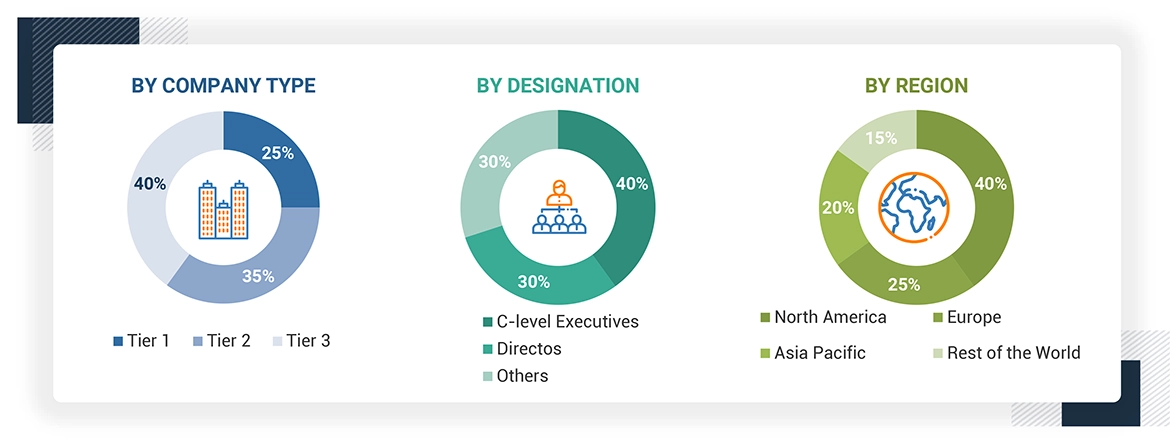
Note: “Others” includes sales, marketing, and product managers
To know about the assumptions considered for the study, download the pdf brochure
Market Size Estimation
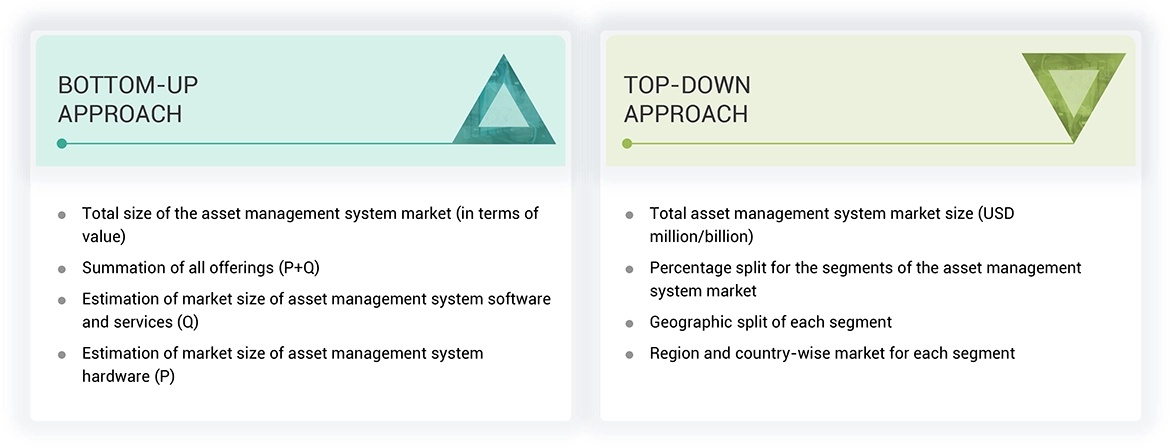
In the market engineering process, both top-down and bottom-up approaches, along with data triangulation methods, have been used to estimate and validate the size of the asset management system market and other dependent submarkets. The research methodology used to estimate the market sizes includes the following:
The bottom-up procedure has been employed to arrive at the overall size of the asset management system market.
- Identifying various asset management system hardware, software, and services provided or expected to be offered by players in the value chain
- Tracking the major manufacturers and providers of asset management systems and related services for different regions
- Estimating the asset management system market for hardware, software, and services in the respective countries of each region
- Tracking the ongoing and upcoming product launches and different inorganic strategies such as acquisitions, partnerships, and collaborations
- Forecasting the asset management system market in each region based on trade data and GDP analysis
- Conducting multiple discussions with key opinion leaders to understand the types of products, software, and services deployed by asset management system players and analyzing the break-up of the scope of work carried out by each major company
- Arriving at the market estimates by analyzing the revenues generated by asset management system manufacturers and service providers based in their locations (countries) and then combining the shares to get the market estimate for each region
- Verifying and crosschecking the estimates at every level by discussing with key opinion leaders, including CEOs, directors, and operation managers, and then finally with the domain experts at MarketsandMarkets
- Studying various paid and unpaid information sources such as annual reports, press releases, and white papers
The top-down approach has been used to estimate and validate the total size of the asset management system market.
- Focusing, initially, on the top-line investments and spending in the ecosystems of various industries. Tracking further splits based on product launches, advancements in asset management system technologies, asset management system solutions and software used for various industrial applications, and developments in the key market areas
- Representing and developing the information related to market revenue offered by key hardware, software, and service providers
- Carrying out multiple on-field discussions with key opinion leaders across each major company involved in the development of hardware and software components and services pertaining to asset management systems
- Estimating the geographic split using secondary sources based on factors such as the number of players in a specific country and region, types of products, levels of services offered, and types of software implemented.
Asset Management System Market : Top-Down and Bottom-Up Approach
Data Triangulation
After arriving at the overall market size-using the market size estimation processes as explained above-the market has been split into several segments and subsegments. To complete the entire market engineering process and arrive at the exact statistics of each market segment and subsegment, data triangulation and market breakdown procedures have been employed, wherever applicable. The data has been triangulated by studying various factors and trends from the demand and supply sides of the asset management system market.
Market Definition
An asset management system is a mix of hardware, software, and services to track, monitor, and manage physical assets. The asset management systems enhance efficiency and minimize costs by offering real-time visibility and control over assets across different industries. Some key technologies in the asset management domain include RFID (Radio Frequency Identification), Wi-Fi, ultra-wideband (UWB), and barcode, among others.
Asset management systems are primarily used in transportation, logistics, healthcare, retail, industrial manufacturing, construction, and agriculture. Their applications include inventory control in warehouses and medical devices in hospitals, fleet surveillance in transportation, and machinery oversight in factories. They help in real-time tracking to raise the efficiency level and sustainability of operations.
Key Stakeholders
- Raw Material and Component Suppliers
- OEMs
- Asset management system-based Solutions Providers
- Third-party Service Providers
- Distributors and Resellers
- Service Providers
- Regulatory Bodies
- Research and Development Institutes
- End Users
Report Objectives
- To define, describe, segment, and forecast the asset management system market size by technology, offering, asset type, and function in terms of value.
- To define, describe, segment, and forecast the asset management system market size by RFID tag type in terms of value and volume.
- To describe and forecast the asset management system market size in four key regions, namely, North America, Europe, Asia Pacific, and Rest of the World (RoW), in terms of value.
- To provide detailed information regarding the key factors such as drivers, restraints, opportunities, and challenges influencing the growth of the market.
- To analyse the asset management system value chain and ecosystem, along with the average selling price of asset management system tag types
- To strategically analyze the regulatory landscape, tariff, standards, patents, Porter’s five forces, import and export scenarios, trade values, and case studies pertaining to the market under study
- To strategically analyze micromarkets with regard to individual growth trends, prospects, and contributions to the overall market
- To analyze opportunities in the market for stakeholders by identifying high-growth segments
- To provide details of the competitive landscape for market leaders
- To analyze the impact of AI/Gen AI on the asset management system market
- To analyze the macroeconomic outlook for regions such as North America, Europe, Asia Pacific, and RoW
- To analyze strategies such as product launches, expansion, collaborations, acquisitions, partnerships, and expansions adopted by players in the asset management system market
- To profile key players in the asset management system market and comprehensively analyse their market ranking based on their revenue, market share, and core competencies.
Available Customizations
With the given market data, MarketsandMarkets offers customizations according to the specific requirements of companies. The following customization options are available for the report:
Country-wise Information:
- Country-wise breakdown for North America, Europe, Asia Pacific, and Rest of the World
Company Information:
- Detailed analysis and profiling of additional market players (up to five))
Get the Full Asset Management System Market Report
Full forecast, segment splits, and company analysis for all Asset Management System Market.
- US Asset Management System Market
- Canada Asset Management System Market
- Mexico Asset Management System Market
- UK Asset Management System Market
- Germany Asset Management System Market
- France Asset Management System Market
- Italy Asset Management System Market
- Russia Asset Management System Market
- China Asset Management System Market
- Japan Asset Management System Market
- India Asset Management System Market
- South Korea Asset Management System Market
- Rest Of Europe Asset Management System Market
Need a Tailored Report?
Customize this report to your needs
Get 10% FREE Customization
Customize This Report
