
South Korea Battery Thermal Management System Market (2024-2029)

The South Korea Battery Thermal Management System Market was valued at $333.7 Million in 2024 and projected to reach to $886.5 Million by 2029, representing a compound annual growth rate of 17.7%. South Korea's battery thermal management system market is positioned for exceptional growth through 2029, driven by the country's status as a global EV manufacturing hub and battery technology innovator.


| Market Size in | USD 26.32 MN |
| Market Forecast in | |
| CAGR | |
| Forecast Period | |
| Units Considered | Value (USD MN) |
South Korea Battery Thermal Management System Market Trends and Insights
- This represents a compound annual growth rate of 17.7%, significantly outpacing global trends, driven by South Korea's leadership in electric vehicle manufacturing and battery technology innovation.
- South Korea's automotive sector, anchored by major EV producers, is increasingly investing in advanced thermal management solutions to enhance battery performance, safety, and longevity. The expansion of South Korea's battery thermal management system market reflects the country's strategic focus on electrification and energy efficiency standards.
- South Korea's robust supply chain for battery components and thermal solutions positions the nation as a critical hub for regional and global automotive innovation.
- Between 2024 and 2029, South Korea is expected to capture growing demand from both domestic EV manufacturers and international OEMs sourcing advanced thermal technologies from the region..
Key Market Statistics
- CAGR (2024-2029) 17.7% CAGR
- Market Size, 2024 ~USD 333.7 Million
- Forecast, 2029 ~USD 886.5 Million
- Country South Korea
South Korea Battery Thermal Management System Market Overview
Market Leadership Position :
South Korea commands a dominant position in global EV battery manufacturing, with companies like LG Energy Solution and SK Innovation driving thermal management innovation. The country's 17.7% CAGR significantly exceeds the global 14.7%, reflecting its technological superiority and manufacturing scale.
Rapid Market Expansion :
The South Korean market is projected to grow from USD 333.7 million in 2024 to USD 886.5 million by 2029, representing a 165% increase. This explosive growth is fueled by aggressive EV adoption targets and government incentives supporting domestic battery technology advancement.
Government Support & Policy :
South Korea's government actively promotes battery thermal management through R&D subsidies, tax incentives, and stringent EV emission standards. These policies create a favorable ecosystem for thermal management system manufacturers and accelerate technology commercialization.
OEM Integration Demand :
Major South Korean automakers including Hyundai-Kia Group are integrating advanced thermal management systems into their EV platforms. This vertical integration trend drives demand for specialized cooling solutions and creates opportunities for component suppliers and system integrators.
South Korea Battery Thermal Management System Market Dynamics
- The 17.7% CAGR reflects strong demand from domestic automakers and battery manufacturers investing heavily in thermal efficiency to improve EV performance and safety.
- Government policies supporting electrification and domestic technology development create sustained tailwinds for market expansion. The competitive landscape will intensify as both established players and emerging startups vie for market share in this high-growth segment.
- Investment in advanced cooling technologies, liquid thermal management systems, and AI-integrated thermal solutions will define competitive advantage.
- South Korea's skilled workforce and robust supply chain ecosystem position the country as a critical hub for thermal management innovation, attracting both domestic and international investment through 2029..
Market Ecosystem
Related Ecosystem
Automotive Advance Technologies
- Battery Electric Vehicle (BEV)
- Light Commercial Vehicles (LCVs)
- Fuel Cell Electric Vehicle (FCEV)
- Hybrid Electric Vehicle (HEV)
- Internal Combustion Engine (ICE)
- BOSCH LIMITED
- Continental ag
- Visteon Corporation
- DENSO Corporation
- ZF FRIEDRICHSHAFEN AG
Automotive Electronics And Electrical Equipment
- Battery Electric Vehicle (BEV)
- Light Commercial Vehicles (LCVs)
- Fuel Cell Electric Vehicle (FCEV)
- Sensors
- Hybrid Electric Vehicle (HEV)
- BOSCH LIMITED
- DENSO Corporation
- Continental ag
- Panasonic Holdings Corporation
- Texas Instruments Incorporated
Battery And Wireless Charging
- Nickel-Cadmium Battery
- Battery Electric Vehicle (BEV)
- Energy Harvesting
- Hybrid Electric Vehicle (HEV)
- Smart Cards
- Panasonic Holdings Corporation
- MOMENTIVE PERFORMANCE MATERIALS INC.
- Lg corp
- FDK Corporation
- Samsung
Key Takeaways
- South Korea's battery thermal management system market is valued at USD 333.7 million in 2024 and is forecast to reach USD 886.5 million by 2029, representing a 17.7% CAGR.
- South Korea's strong EV manufacturing base and battery technology leadership drive accelerated adoption of advanced thermal management solutions.
- South Korea's position as a global battery supply chain hub attracts both domestic and international OEM investment in thermal management technologies.
- South Korea's regulatory focus on vehicle electrification and energy efficiency standards creates sustained demand for innovative thermal management systems through 2029.
Battery Thermal Management System Market Report Scope
| Report Metric | Details |
|---|---|
| Base Year | 2024 |
| Fastest Growing Segment | FUEL CELL ELECTRIC VEHICLES (Propulsion Type) |
| Forecast Period | 2024-2029 |
| Growth Rate | CAGR of 14.7% from 2024 to 2029 |
| Largest Segment | LITHIUM-ION BATTERIES (Battery Type) |
| Market Size Base Year (Billions) | ~USD 3.73 (2024) |
| Revenue Forecast (Billions) | ~USD 7.41 (2029) |
| Segments Covered | Technology, Battery Type, Vehicle Type, Battery Capacity, Offering, Propulsion Type |
South Korea Battery Thermal Management System Market Report Segmentation
6 segment dimensions are covered across the global market.
By Technology
- Active Systems
- Hybrid Systems
By Battery Type
- Lithium-Ion Batteries
- Solid-State Batteries
By Vehicle Type
- Commercial Vehicles
- Passenger Vehicles
By Battery Capacity
- 100-200 Kwh
- 200-500 Kwh
- <100 Kwh
- >500 Kwh
By Offering
- Btms With Battery
- Btms Without Battery
By Propulsion Type
- Battery Electric Vehicles
- Fuel Cell Electric Vehicles
- Plug-In Hybrid Electric Vehicles
Target Audience
- Automotive OEMs & Tier-1 Suppliers : South Korean and international automakers need market data to optimize thermal management sourcing strategies, negotiate with local suppliers, and align EV platform development with regional thermal performance standards.
- Battery & Energy Companies : LG Energy Solution, SK Innovation, and emerging battery manufacturers require market insights to forecast thermal management component demand, plan capacity investments, and develop integrated battery-cooling solutions.
- Thermal Management System Manufacturers : Component suppliers and system integrators need South Korea-specific market sizing to identify growth opportunities, assess competitive positioning, and develop localized product offerings for Korean OEMs.
- Investment & Private Equity Firms : Investors evaluating opportunities in South Korean automotive technology need validated market data, growth projections, and competitive landscape analysis to support M&A decisions and portfolio company valuations.
- Government & Policy Organizations : South Korean government agencies and trade bodies require market intelligence to evaluate policy effectiveness, identify technology gaps, and allocate R&D funding to maintain competitive advantage in global EV markets.
Reasons to Buy this Report
- Market Size & Growth Validation : Obtain precise market valuation for South Korea (USD 333.7M in 2024) with verified 17.7% CAGR through 2029. Critical for investment decisions, business planning, and competitive benchmarking in this high-growth Asian market.
- Regional Competitive Intelligence : Understand South Korea's unique competitive dynamics, dominated by LG Energy Solution, SK Innovation, and Hyundai-Kia integration strategies. Identify market gaps and positioning opportunities specific to Korean manufacturers and supply chains.
- Government Policy & Incentive Mapping : Access detailed analysis of South Korean government support mechanisms, R&D subsidies, and EV adoption policies driving thermal management demand. Essential for regulatory compliance and strategic partnership development.
- OEM Partnership Opportunities : Leverage insights into Hyundai-Kia Group's thermal management requirements and integration timelines. Identify supplier qualification criteria and technology standards needed to penetrate South Korea's premium automotive segment.
- Technology Trend Forecasting : Anticipate emerging thermal management technologies prioritized by South Korean manufacturers, including liquid cooling systems and AI-integrated solutions. Stay ahead of innovation cycles and align product development with market demands.
Frequently asked questions
What is the current market size of battery thermal management systems in South Korea?
South Korea's battery thermal management system market was valued at USD 333.7 million in 2024.
What is the projected market size for South Korea's battery thermal management system market by 2029?
South Korea's battery thermal management system market is projected to reach USD 886.5 million by 2029.
What is the CAGR for South Korea's battery thermal management system market?
South Korea's battery thermal management system market is expected to grow at a compound annual growth rate of 17.7% from 2024 to 2029.
Why is South Korea's battery thermal management system market growing faster than the global average?
South Korea's market growth is driven by the country's dominant position in EV manufacturing, advanced battery technology capabilities, and stringent electrification regulations that require sophisticated thermal solutions.
Which industries are driving demand for battery thermal management systems in South Korea?
South Korea's automotive and transportation sector, particularly electric vehicle manufacturers and battery producers, are the primary drivers of battery thermal management system demand.
RESEARCH METHODOLOGY
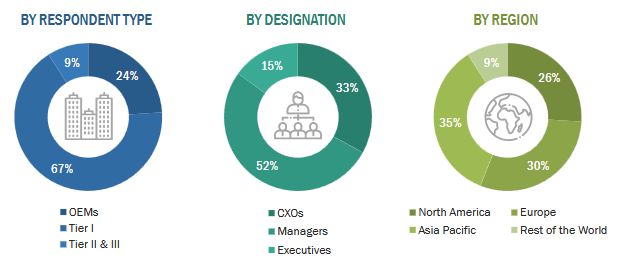
The research study involved extensive secondary sources, such as company annual reports/presentations, industry association publications, magazine articles, directories, technical handbooks, World Economic Outlook, trade websites, technical articles, and databases, to identify and collect information on the battery thermal management system market. Primary sources, such as experts from related industries, automobile OEMs, and suppliers, were interviewed to obtain and verify critical information and assess the growth prospects and market estimations.
Secondary Research
Secondary sources for this research study include corporate filings, such as annual reports, investor presentations, and financial statements; trade, business, and professional associations; whitepapers, marklines, and the OICA (International Organization of Motor Vehicle Manufacturers); certified publications; articles by recognized authors; directories; and databases. Secondary data was collected and analyzed to determine the overall market size, further validated by primary research.
Primary Research
Extensive primary research was conducted after understanding the BTMS market scenario through secondary research. Several primary interviews were conducted with market experts from the demand side (vehicle manufacturers, country-level government associations, and trade associations) and the supply side (BTMS manufacturers, component providers, and system integrators). The regions considered for the research include North America, Europe, the Asia Pacific, and the Rest of the World. Approximately 17% and 83% of primary interviews were conducted from the demand and supply sides. Primary data was collected through questionnaires, emails, and telephonic interviews. In the canvassing of primaries, various departments within organizations, such as sales, operations, and marketing, were covered to provide a holistic viewpoint in this report.
After interacting with industry experts, brief sessions were conducted with highly experienced independent consultants to reinforce the findings from the primaries. This, along with the in-house subject matter experts’ opinions, led to the findings described in this report.
To know about the assumptions considered for the study, download the pdf brochure
Market Size Estimation
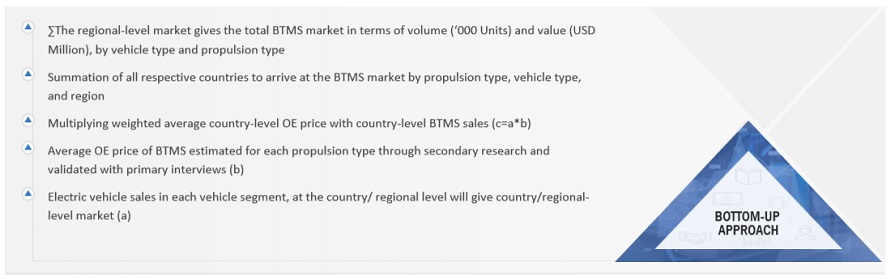
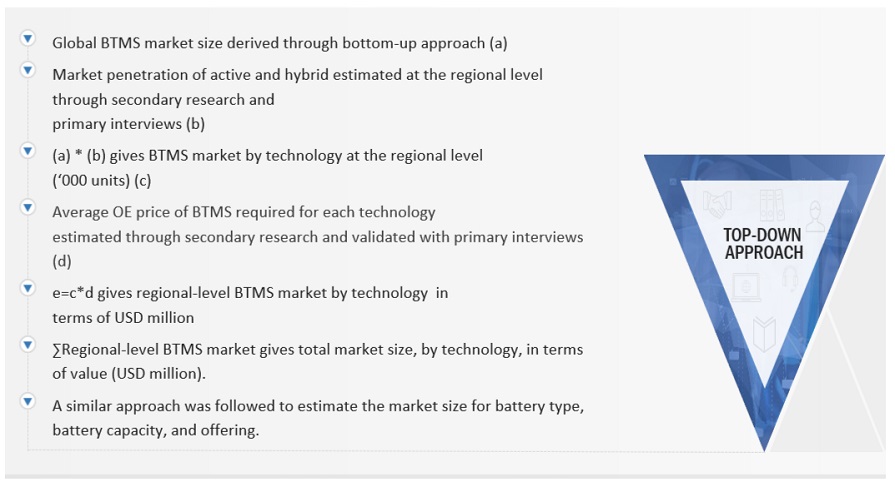
A detailed market estimation approach was followed to estimate and validate the volume and value of the BTMS market and other submarkets, as mentioned below.
- Key players in the BTMS market were identified through secondary research. Their global market share was determined through primary and secondary research.
- The research methodology included studying the annual and quarterly financial reports & regulatory filings of major market players and interviews with industry experts for detailed market insights.
- All major penetration rates, percentage shares, splits, and breakdowns for the BTMS market across end users were determined using secondary sources and verified through primary sources.
- All key macro indicators affecting the revenue growth of the market segments and subsegments were accounted for, viewed in extensive detail, verified through primary research, and analyzed to get the validated and verified quantitative & qualitative data.
- The gathered market data was consolidated and added with detailed inputs, analyzed, and presented in this report.
Global BTMS Market Size: Bottom-Up Approach
To know about the assumptions considered for the study, Request for Free Sample Report
Global BTMS Market Size: Top-Down Approach
Data Triangulation
After arriving at the overall market size through the aforementioned methodology, the BTMS market was split into several segments and subsegments. The data triangulation procedure was employed, wherever applicable, to complete the overall market engineering process and arrive at the exact market value for key segments and subsegments. The extrapolated market data was triangulated by studying various macro indicators and regional trends from both the demand- and supply-side participants.
Market Definition
BTMS Market: According to Grayson Thermal Systems, BTMS encompasses technologies and solutions that help regulate and control the temperature of batteries in electric vehicles, specifically battery electric (BEV), plug-in hybrid electric vehicles (PHEVs), and fuel cell electric (FCEV) vehicles. These systems help maintain optimal battery performance, range, and service life by ensuring that batteries operate within a specified temperature range. BTMS includes various components such as cooling systems, heating systems, insulation materials, sensors, and control algorithms to efficiently manage battery temperatures under different operating conditions.
Key Stakeholders
- Automobile Original Equipment Manufacturers (OEM)
- Automotive electronics system integrators
- Automotive Parts Manufacturers’ Association (APMA)
- Electric Drive Transportation Association (EDTA)
- Electric power infrastructure suppliers
- Electric Vehicle Association of Asia Pacific (EVAAP)
- Electric vehicle hardware suppliers
- Manufacturers of automotive wireless charging systems for EVs
- Manufacturers of electric vehicle charging system
- Society of Manufacturers of Electric Vehicles (SMEV)
- World Electric Vehicle Association (WEVA)
Report Objectives
- To segment and forecast the size of the battery thermal management system (BTMS) market in terms of volume (thousand units) and value (USD million)
- To define, describe, and forecast the size of the BTMS market based on technology type, battery type, vehicle type, battery capacity, offering, propulsion, and region
- To analyze regional markets for growth trends, prospects, and their contribution to the overall market
- To segment and forecast the market size, by technology (active, passive, and hybrid)
- To segment and forecast the market size, by battery type (lithium-ion and solid state)
- To segment and forecast the market size, by vehicle type (passenger vehicles and commercial vehicles)
- To segment and forecast the market size, by battery capacity (<100 kWh, 100–200 kWh, 200–500 kWh, and >500 kWh)
- To segment and forecast the market size, by offering (BTMS with battery and BTMS without battery)
- To segment and forecast the market size, by propulsion type (battery electric vehicles, plug-in hybrid electric vehicles, and fuel cell electric vehicles)
- To forecast the market size by region (North America, Europe, Asia Pacific, and Rest of the World)
- To analyze technological developments impacting the market
- To provide detailed information about the major factors influencing the market growth (drivers, challenges, restraints, and opportunities)
- To strategically analyze the market, considering individual growth trends, prospects, and contributions to the total market
- To study the following concerning the market (Value chain analysis, Ecosystem analysis, Technology analysis, HS code, Case study analysis, patent analysis, Regulatory analysis, Key stakeholders and buying criteria, and key conferences and events.)
- To estimate the following with respect to the BTMS market (Pricing analysis, propulsion type, by region, and market ranking analysis).
- To strategically profile key players and comprehensively analyze their market ranking and core competencies
- To analyze the impact of the recession on the market
- To track and analyze competitive developments such as deals, product developments, expansions, and other developments carried out by key industry participants.
Available Customizations
With the given market data, MarketsandMarkets offers customizations in accordance to the company’s specific needs.
- BTMS MARKET, BY VEHICLE TYPE AT THE COUNTRY LEVEL (FOR COUNTRIES NOT COVERED IN THE REPORT)
COMPANY INFORMATION:
- Profiling of additional market players (Up to 5)
Get the Full Battery Thermal Management System Market Report
Full forecast, segment splits, and company analysis for all Battery Thermal Management System Market.
- China Battery Thermal Management System Market
- India Battery Thermal Management System Market
- Japan Battery Thermal Management System Market
- France Battery Thermal Management System Market
- Germany Battery Thermal Management System Market
- Norway Battery Thermal Management System Market
- UK Battery Thermal Management System Market
- Sweden Battery Thermal Management System Market
- Netherlands Battery Thermal Management System Market
- Canada Battery Thermal Management System Market
- US Battery Thermal Management System Market
- UAE Battery Thermal Management System Market
- Egypt Battery Thermal Management System Market
- South Africa Battery Thermal Management System Market
- Rest Of Europe Battery Thermal Management System Market
- Rest Of Asia Pacific Battery Thermal Management System Market
Need a Tailored Report?
Customize this report to your needs
Get 10% FREE Customization
Customize This Report
