
US Battery Thermal Management System Market (2024-2029)

The US Battery Thermal Management System Market was valued at $1536.7 Million in 2024 and projected to reach to $3607.4 Million by 2029, representing a compound annual growth rate of 15.3%. The US Battery Thermal Management System Market is poised for substantial growth through 2029, driven by the accelerating electrification of the automotive sector and increasing consumer demand for reliable EV performance.


| Market Size in | USD 26.32 MN |
| Market Forecast in | |
| CAGR | |
| Forecast Period | |
| Units Considered | Value (USD MN) |
US Battery Thermal Management System Market Trends and Insights
- This expansion reflects the US automotive industry's accelerating shift toward electric vehicles and the critical need for advanced thermal solutions to optimize battery performance and longevity.
- The US market is driven by stringent regulatory requirements, consumer demand for extended EV range, and manufacturer investments in next-generation battery technologies. Thermal management systems are essential for maintaining optimal battery operating temperatures in US electric vehicles, directly impacting efficiency, safety, and lifespan.
- The US market's 15.3% compound annual growth rate significantly outpaces global trends, positioning the country as a key innovation hub for battery cooling and heating solutions.
- Between 2024 and 2029, the US is expected to see increased adoption of liquid cooling systems, phase-change materials, and integrated thermal architectures across major OEM platforms. The competitive landscape in the US is characterized by partnerships between automotive manufacturers and specialized thermal management suppliers, alongside growing investment in R&D facilities.
- US-based companies and international players are establishing production capacity to meet rising demand from both legacy automakers transitioning to EV platforms and emerging EV manufacturers establishing US operations..
Key Market Statistics
- CAGR (2024-2029) 15.3% CAGR
- Market Size, 2024 ~USD 1536.7 Million
- Forecast, 2029 ~USD 3607.4 Million
- Country US
US Battery Thermal Management System Market Overview
Market Valuation Growth :
The US Battery Thermal Management System Market is valued at $1,536.7 million in 2024, with a projected CAGR of 15.3%, reaching $3,607.4 million by 2029, demonstrating strong market expansion driven by EV adoption.
EV Adoption Acceleration :
The US automotive industry's rapid transition to electric vehicles is creating unprecedented demand for advanced thermal management solutions to ensure optimal battery performance, safety, and extended vehicle lifespan.
Regulatory Compliance Pressure :
Stringent US environmental regulations and fuel efficiency standards are compelling automakers to invest heavily in battery thermal management technologies to meet compliance requirements and reduce emissions.
Technology Innovation Hub :
The US market is witnessing significant innovation in liquid cooling systems, phase-change materials, and AI-driven thermal optimization, positioning American manufacturers as leaders in next-generation thermal solutions.
US Battery Thermal Management System Market Dynamics
- Major automakers are prioritizing thermal management investments to enhance battery efficiency, reduce charging times, and extend battery life, creating lucrative opportunities for solution providers.
- The market will benefit from technological advancements in cooling technologies and growing partnerships between automotive OEMs and thermal management specialists.
- Additionally, the expansion of EV charging infrastructure and government incentives for electric vehicle adoption will further stimulate market demand.
- By 2029, the market is expected to more than double in value, reflecting the critical importance of thermal management in the EV ecosystem..
Market Ecosystem
Related Ecosystem
Automotive Advance Technologies
- Battery Electric Vehicle (BEV)
- Light Commercial Vehicles (LCVs)
- Fuel Cell Electric Vehicle (FCEV)
- Hybrid Electric Vehicle (HEV)
- Internal Combustion Engine (ICE)
- BOSCH LIMITED
- Continental ag
- Visteon Corporation
- DENSO Corporation
- ZF FRIEDRICHSHAFEN AG
Automotive Electronics And Electrical Equipment
- Battery Electric Vehicle (BEV)
- Light Commercial Vehicles (LCVs)
- Fuel Cell Electric Vehicle (FCEV)
- Sensors
- Hybrid Electric Vehicle (HEV)
- BOSCH LIMITED
- DENSO Corporation
- Continental ag
- Panasonic Holdings Corporation
- Texas Instruments Incorporated
Battery And Wireless Charging
- Nickel-Cadmium Battery
- Battery Electric Vehicle (BEV)
- Energy Harvesting
- Hybrid Electric Vehicle (HEV)
- Smart Cards
- Panasonic Holdings Corporation
- MOMENTIVE PERFORMANCE MATERIALS INC.
- Lg corp
- FDK Corporation
- Samsung
Key Takeaways
- The US Battery Thermal Management System Market will nearly double from $1,536.7M (2024) to $3,607.4M (2029), driven by rapid EV adoption and regulatory mandates.
- The US market's 15.3% CAGR outpaces the global average of 14.7%, reflecting the country's leadership in electric vehicle manufacturing and innovation.
- Liquid cooling systems and advanced thermal architectures are becoming standard in US EV platforms to enhance battery performance and extend vehicle range.
- Strategic partnerships between US OEMs and thermal management suppliers are accelerating product development and market penetration across the US automotive sector.
Battery Thermal Management System Market Report Scope
| Report Metric | Details |
|---|---|
| Base Year | 2024 |
| Fastest Growing Segment | FUEL CELL ELECTRIC VEHICLES (Propulsion Type) |
| Forecast Period | 2024-2029 |
| Growth Rate | CAGR of 14.7% from 2024 to 2029 |
| Largest Segment | LITHIUM-ION BATTERIES (Battery Type) |
| Market Size Base Year (Billions) | ~USD 3.73 (2024) |
| Revenue Forecast (Billions) | ~USD 7.41 (2029) |
| Segments Covered | Technology, Battery Type, Vehicle Type, Battery Capacity, Offering, Propulsion Type |
US Battery Thermal Management System Market Report Segmentation
6 segment dimensions are covered across the global market.
By Technology
- Active Systems
- Hybrid Systems
By Battery Type
- Lithium-Ion Batteries
- Solid-State Batteries
By Vehicle Type
- Commercial Vehicles
- Passenger Vehicles
By Battery Capacity
- 100-200 Kwh
- 200-500 Kwh
- <100 Kwh
- >500 Kwh
By Offering
- Btms With Battery
- Btms Without Battery
By Propulsion Type
- Battery Electric Vehicles
- Fuel Cell Electric Vehicles
- Plug-In Hybrid Electric Vehicles
Target Audience
- Automotive OEMs : US-based and international automakers need detailed market intelligence to optimize battery thermal management investments, improve EV performance competitiveness, and meet regulatory compliance standards in the American market.
- Thermal Management Solution Providers : Manufacturers and suppliers of cooling systems, heat exchangers, and thermal materials require US market data to identify growth opportunities, benchmark against competitors, and develop region-specific product strategies.
- EV Battery Manufacturers : Battery producers operating in or targeting the US market need insights into thermal management trends to ensure their products integrate seamlessly with advanced cooling solutions and meet OEM specifications.
- Investment & Private Equity Firms : Investors evaluating opportunities in the US automotive and EV sectors require comprehensive market analysis to assess growth potential, identify acquisition targets, and make informed capital allocation decisions.
- Technology & Innovation Companies : Startups and established tech firms developing AI-driven thermal optimization, advanced materials, and IoT-enabled monitoring systems need US market data to validate demand and guide product commercialization strategies.
Reasons to Buy this Report
- Market Size & Growth Validation : Confirm the US market opportunity with precise valuation data ($1,536.7M in 2024) and verified CAGR projections (15.3%), enabling confident investment and resource allocation decisions for the next five years.
- Competitive Landscape Intelligence : Gain detailed insights into US-specific competitive dynamics, key market players, and their strategic positioning within the thermal management sector to identify partnership and acquisition opportunities.
- Regulatory & Compliance Roadmap : Understand stringent US environmental regulations and compliance requirements driving thermal management adoption, helping you align product development and market entry strategies with regulatory expectations.
- Customer Segmentation & Demand Drivers : Access granular data on US automotive OEMs, Tier-1 suppliers, and EV manufacturers to identify high-value customer segments and tailor solutions to specific thermal management needs and pain points.
- Strategic Growth Planning : Leverage US-specific market forecasts and trend analysis to develop targeted go-to-market strategies, pricing models, and product roadmaps that capitalize on the projected market expansion through 2029.
Frequently asked questions
What is the current size of the US Battery Thermal Management System Market?
The US Battery Thermal Management System Market was valued at $1,536.7 million in 2024 and is projected to reach $3,607.4 million by 2029.
What is the expected growth rate for the US market through 2029?
The US market is expected to grow at a compound annual growth rate (CAGR) of 15.3% from 2024 to 2029, outpacing the global average of 14.7%.
Why is thermal management critical for US electric vehicles?
Thermal management systems maintain optimal battery operating temperatures in US EVs, directly improving efficiency, safety, longevity, and driving range-key factors influencing consumer adoption.
Which thermal technologies are gaining traction in the US market?
Liquid cooling systems, phase-change materials, and integrated thermal architectures are increasingly adopted in US EV platforms to enhance battery performance and meet manufacturer specifications.
What factors are driving growth in the US Battery Thermal Management System Market?
Key drivers include accelerating EV adoption, stringent regulatory requirements, consumer demand for extended range, manufacturer R&D investments, and the establishment of US production capacity by major suppliers.
RESEARCH METHODOLOGY
The research study involved extensive secondary sources, such as company annual reports/presentations, industry association publications, magazine articles, directories, technical handbooks, World Economic Outlook, trade websites, technical articles, and databases, to identify and collect information on the battery thermal management system market. Primary sources, such as experts from related industries, automobile OEMs, and suppliers, were interviewed to obtain and verify critical information and assess the growth prospects and market estimations.
Secondary Research
Secondary sources for this research study include corporate filings, such as annual reports, investor presentations, and financial statements; trade, business, and professional associations; whitepapers, marklines, and the OICA (International Organization of Motor Vehicle Manufacturers); certified publications; articles by recognized authors; directories; and databases. Secondary data was collected and analyzed to determine the overall market size, further validated by primary research.
Primary Research
Extensive primary research was conducted after understanding the BTMS market scenario through secondary research. Several primary interviews were conducted with market experts from the demand side (vehicle manufacturers, country-level government associations, and trade associations) and the supply side (BTMS manufacturers, component providers, and system integrators). The regions considered for the research include North America, Europe, the Asia Pacific, and the Rest of the World. Approximately 17% and 83% of primary interviews were conducted from the demand and supply sides. Primary data was collected through questionnaires, emails, and telephonic interviews. In the canvassing of primaries, various departments within organizations, such as sales, operations, and marketing, were covered to provide a holistic viewpoint in this report.
After interacting with industry experts, brief sessions were conducted with highly experienced independent consultants to reinforce the findings from the primaries. This, along with the in-house subject matter experts’ opinions, led to the findings described in this report.
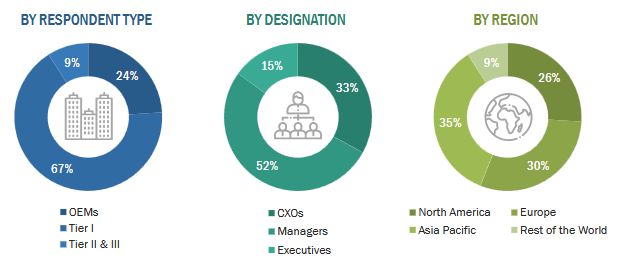
To know about the assumptions considered for the study, download the pdf brochure
Market Size Estimation
A detailed market estimation approach was followed to estimate and validate the volume and value of the BTMS market and other submarkets, as mentioned below.
- Key players in the BTMS market were identified through secondary research. Their global market share was determined through primary and secondary research.
- The research methodology included studying the annual and quarterly financial reports & regulatory filings of major market players and interviews with industry experts for detailed market insights.
- All major penetration rates, percentage shares, splits, and breakdowns for the BTMS market across end users were determined using secondary sources and verified through primary sources.
- All key macro indicators affecting the revenue growth of the market segments and subsegments were accounted for, viewed in extensive detail, verified through primary research, and analyzed to get the validated and verified quantitative & qualitative data.
- The gathered market data was consolidated and added with detailed inputs, analyzed, and presented in this report.
Global BTMS Market Size: Bottom-Up Approach
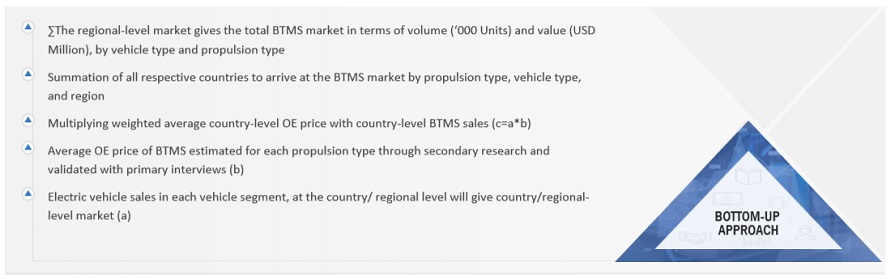
To know about the assumptions considered for the study, Request for Free Sample Report
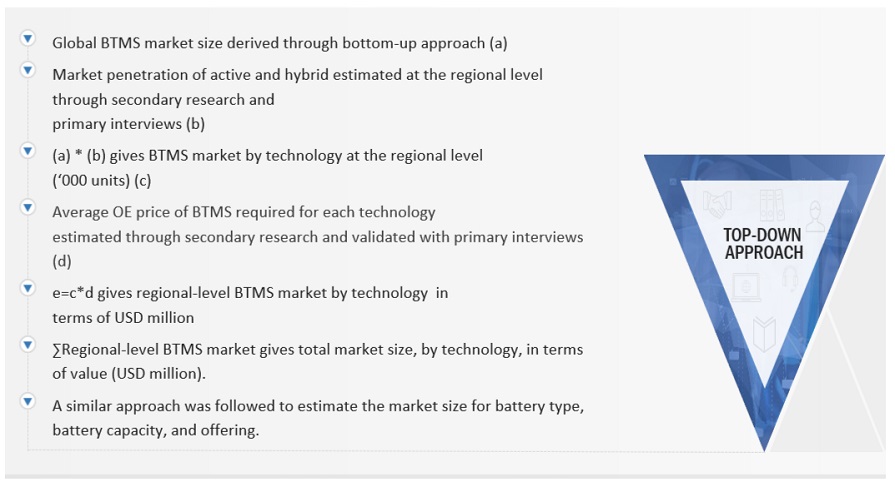
Global BTMS Market Size: Top-Down Approach
Data Triangulation
After arriving at the overall market size through the aforementioned methodology, the BTMS market was split into several segments and subsegments. The data triangulation procedure was employed, wherever applicable, to complete the overall market engineering process and arrive at the exact market value for key segments and subsegments. The extrapolated market data was triangulated by studying various macro indicators and regional trends from both the demand- and supply-side participants.
Market Definition
BTMS Market: According to Grayson Thermal Systems, BTMS encompasses technologies and solutions that help regulate and control the temperature of batteries in electric vehicles, specifically battery electric (BEV), plug-in hybrid electric vehicles (PHEVs), and fuel cell electric (FCEV) vehicles. These systems help maintain optimal battery performance, range, and service life by ensuring that batteries operate within a specified temperature range. BTMS includes various components such as cooling systems, heating systems, insulation materials, sensors, and control algorithms to efficiently manage battery temperatures under different operating conditions.
Key Stakeholders
- Automobile Original Equipment Manufacturers (OEM)
- Automotive electronics system integrators
- Automotive Parts Manufacturers’ Association (APMA)
- Electric Drive Transportation Association (EDTA)
- Electric power infrastructure suppliers
- Electric Vehicle Association of Asia Pacific (EVAAP)
- Electric vehicle hardware suppliers
- Manufacturers of automotive wireless charging systems for EVs
- Manufacturers of electric vehicle charging system
- Society of Manufacturers of Electric Vehicles (SMEV)
- World Electric Vehicle Association (WEVA)
Report Objectives
- To segment and forecast the size of the battery thermal management system (BTMS) market in terms of volume (thousand units) and value (USD million)
- To define, describe, and forecast the size of the BTMS market based on technology type, battery type, vehicle type, battery capacity, offering, propulsion, and region
- To analyze regional markets for growth trends, prospects, and their contribution to the overall market
- To segment and forecast the market size, by technology (active, passive, and hybrid)
- To segment and forecast the market size, by battery type (lithium-ion and solid state)
- To segment and forecast the market size, by vehicle type (passenger vehicles and commercial vehicles)
- To segment and forecast the market size, by battery capacity (<100 kWh, 100–200 kWh, 200–500 kWh, and >500 kWh)
- To segment and forecast the market size, by offering (BTMS with battery and BTMS without battery)
- To segment and forecast the market size, by propulsion type (battery electric vehicles, plug-in hybrid electric vehicles, and fuel cell electric vehicles)
- To forecast the market size by region (North America, Europe, Asia Pacific, and Rest of the World)
- To analyze technological developments impacting the market
- To provide detailed information about the major factors influencing the market growth (drivers, challenges, restraints, and opportunities)
- To strategically analyze the market, considering individual growth trends, prospects, and contributions to the total market
- To study the following concerning the market (Value chain analysis, Ecosystem analysis, Technology analysis, HS code, Case study analysis, patent analysis, Regulatory analysis, Key stakeholders and buying criteria, and key conferences and events.)
- To estimate the following with respect to the BTMS market (Pricing analysis, propulsion type, by region, and market ranking analysis).
- To strategically profile key players and comprehensively analyze their market ranking and core competencies
- To analyze the impact of the recession on the market
- To track and analyze competitive developments such as deals, product developments, expansions, and other developments carried out by key industry participants.
Available Customizations
With the given market data, MarketsandMarkets offers customizations in accordance to the company’s specific needs.
- BTMS MARKET, BY VEHICLE TYPE AT THE COUNTRY LEVEL (FOR COUNTRIES NOT COVERED IN THE REPORT)
COMPANY INFORMATION:
- Profiling of additional market players (Up to 5)
Get the Full Battery Thermal Management System Market Report
Full forecast, segment splits, and company analysis for all Battery Thermal Management System Market.
- China Battery Thermal Management System Market
- India Battery Thermal Management System Market
- Japan Battery Thermal Management System Market
- South Korea Battery Thermal Management System Market
- France Battery Thermal Management System Market
- Germany Battery Thermal Management System Market
- Norway Battery Thermal Management System Market
- UK Battery Thermal Management System Market
- Sweden Battery Thermal Management System Market
- Netherlands Battery Thermal Management System Market
- Canada Battery Thermal Management System Market
- UAE Battery Thermal Management System Market
- Egypt Battery Thermal Management System Market
- South Africa Battery Thermal Management System Market
- Rest Of Europe Battery Thermal Management System Market
- Rest Of Asia Pacific Battery Thermal Management System Market
Need a Tailored Report?
Customize this report to your needs
Get 10% FREE Customization
Customize This Report
