
Russia Automotive Brake System Market (2023-2028)

The Russia Automotive Brake System Market was valued at $2868.2 Million in 2023 and projected to reach to $3176.5 Million by 2028, representing a compound annual growth rate of 2.1%. Russia's automotive brake system market is positioned for steady growth as domestic vehicle production continues its recovery trajectory.


| Market Size in | USD 26.32 MN |
| Market Forecast in | |
| CAGR | |
| Forecast Period | |
| Units Considered | Value (USD MN) |
Russia Automotive Brake System Market Trends and Insights
- Russia's brake system market reflects moderate expansion driven by domestic vehicle production recovery and aftermarket demand following geopolitical disruptions.
- The market in Russia remains resilient despite supply chain challenges, with both OEM and replacement brake components sustaining steady demand through 2028. The automotive brake system sector in Russia is characterized by a shift toward localized manufacturing and supply chains as international partnerships evolve.
- Russia's market growth is supported by aging vehicle fleets requiring maintenance and repair services, alongside gradual modernization of domestic automotive production capabilities.
- By 2028, Russia is expected to maintain its position as a significant regional market within the Rest of World segment, with brake system innovations and cost-effective solutions tailored to local market conditions driving incremental expansion..
Key Market Statistics
- CAGR (2023-2028) 2.1% CAGR
- Market Size, 2023 ~USD 2868.2 Million
- Forecast, 2028 ~USD 3176.5 Million
- Country Russia
Russia Automotive Brake System Market Overview
Market Valuation :
Russia's automotive brake system market was valued at USD 2,868.2 million in 2023, with projected growth to USD 3,176.5 million by 2028, reflecting steady domestic market recovery.
Moderate Growth Trajectory :
The Russian market exhibits a CAGR of 2.1% through 2028, significantly lower than the global rate of 5.1%, indicating slower but resilient expansion amid geopolitical challenges.
Domestic Production Recovery :
Russia's brake system market is driven by recovery in domestic vehicle manufacturing and increased focus on local production capabilities following international supply chain disruptions.
Aftermarket Demand Strength :
Robust aftermarket demand for brake components supports market resilience, as vehicle owners prioritize maintenance and replacement parts for existing vehicle fleets across Russia.
Russia Automotive Brake System Market Dynamics
- The market benefits from increased investment in local manufacturing facilities and a growing emphasis on aftermarket services, which compensates for slower new vehicle sales.
- Consumer focus on vehicle safety and maintenance ensures sustained demand for quality brake components.
- However, geopolitical uncertainties and supply chain complexities may continue to moderate growth rates compared to global benchmarks.
- The market is expected to maintain its resilience through 2028, supported by domestic consumption patterns and regional automotive industry stabilization..
Market Ecosystem
Related Ecosystem
Automotive Systems
- Light Commercial Vehicles (LCVs)
- Battery Electric Vehicle (BEV)
- Hybrid Electric Vehicle (HEV)
- Agricultural Tractors
- Fuel Cell Electric Vehicle (FCEV)
- BOSCH LIMITED
- DENSO Corporation
- Continental ag
- ZF FRIEDRICHSHAFEN AG
- TENNECO
Locomotives And Rolling Stock
- Sensors
- Passenger Information System (PIS)
- Cartesian Robots
- Flow Sensors
- Gas Sensors
- Siemens ag
- Alstom s.a.
- Hitachi, Ltd.
- Knorr-bremse ag
- SYSTRA LTD.
Key Takeaways
- Russia's automotive brake system market is valued at USD 2,868.2 million in 2023 with projected growth to USD 3,176.5 million by 2028.
- Russia's market exhibits a modest 2.1% CAGR, reflecting steady but constrained growth compared to global expansion rates.
- Russia's brake system demand is driven by aftermarket replacement needs from aging vehicle fleets and localized OEM production recovery.
- Russia's market positioning within Rest of World reflects regional supply chain adaptation and cost-competitive manufacturing strategies.
Automotive Brake System Market Report Scope
| Report Metric | Details |
|---|---|
| Base Year | 2023 |
| Fastest Growing Segment | BEVS (Electric Vehicle Type) |
| Forecast Period | 2023-2028 |
| Growth Rate | CAGR of 5.1% from 2023 to 2028 |
| Largest Segment | ABS (Technology) |
| Market Size Base Year (Billions) | ~USD 23.47 (2023) |
| Revenue Forecast (Billions) | ~USD 30.1 (2028) |
| Segments Covered | Brake Type, Technology, Vehicle Type, Actuation Type, Component, Application, Electric Vehicle Type |
Russia Automotive Brake System Market Report Segmentation
7 segment dimensions are covered across the global market.
By Brake Type
- Disc Brakes
- Drum Brakes
- Dynamic Brakes
- Hydraulic Wet Brakes
- Hydrostatic Brakes
By Technology
- Abs
- Aeb
- Ebd
- Esc
- Tcs
By Vehicle Type
- Buses
- Disc Brakes
- Drum Brakes
- Light Commercial Vehicles
- Passenger Cars
- Trucks
By Actuation Type
- Hydraulic
- Pneumatic
By Component
- Brake Caliper
- Brake Disc Rotor
- Brake Pad
- Brake Shoe
- Master Cylinder
By Application
- Agricultural Tractors
- Construction Equipment
- Mining Equipment
By Electric Vehicle Type
- Bevs
- Phevs
Target Audience
- Automotive Suppliers & Manufacturers : Brake system component manufacturers and suppliers need Russia-specific market data to optimize production capacity, localize supply chains, and identify partnership opportunities in the recovering domestic market.
- Aftermarket Distributors & Retailers : Aftermarket parts distributors require detailed insights into Russia's replacement brake component demand, consumer preferences, and regional distribution channel dynamics to maximize market penetration.
- Investment & Private Equity Firms : Investment professionals evaluating opportunities in Russia's automotive sector need comprehensive market analysis, growth projections, and risk assessments to guide capital allocation decisions.
- OEM Strategy & Planning Teams : Original equipment manufacturers planning Russian market operations require localized brake system market data to inform product development, pricing strategies, and manufacturing location decisions.
- Market Research & Consulting Professionals : Research analysts and consultants serving automotive clients need Russia-specific market cutout data to support client advisory work, competitive benchmarking, and regional market assessments.
Reasons to Buy this Report
- Localized Market Intelligence : Gain deep insights specific to Russia's automotive brake system market, including domestic production recovery patterns and regional supply chain dynamics that differ from global trends.
- Aftermarket Opportunity Assessment : Understand the robust aftermarket demand landscape in Russia, identifying growth opportunities in replacement parts, maintenance services, and customer retention strategies for brake components.
- Competitive Positioning Strategy : Develop targeted market entry or expansion strategies by analyzing Russia's unique growth drivers, geopolitical factors, and local manufacturing capabilities affecting brake system suppliers.
- Investment Decision Support : Make informed investment decisions with accurate market sizing, CAGR projections through 2028, and risk assessments specific to Russia's automotive sector resilience and recovery trajectory.
- Demand Forecasting Accuracy : Leverage Russia-specific market data to improve demand forecasting models, inventory planning, and resource allocation for brake system manufacturers and distributors operating in the region.
Frequently asked questions
What is the current size of Russia's automotive brake system market?
Russia's automotive brake system market was valued at USD 2,868.2 million in 2023 and is expected to reach USD 3,176.5 million by 2028.
What is the projected growth rate for Russia's brake system market?
Russia's automotive brake system market is projected to grow at a compound annual growth rate (CAGR) of 2.1% from 2023 to 2028.
What factors are driving growth in Russia's brake system market?
Russia's market growth is driven by aftermarket demand from aging vehicle fleets, domestic production recovery, and localized supply chain development.
How does Russia's brake system market compare to global trends?
Russia's 2.1% CAGR is lower than the global average of 5.1%, reflecting regional supply chain constraints and geopolitical factors affecting market expansion.
What is the forecast market size for Russia's brake systems by 2028?
Russia's automotive brake system market is forecasted to reach USD 3,176.5 million by 2028, representing an increase of USD 308.3 million from 2023 levels.
RESEARCH METHODOLOGY
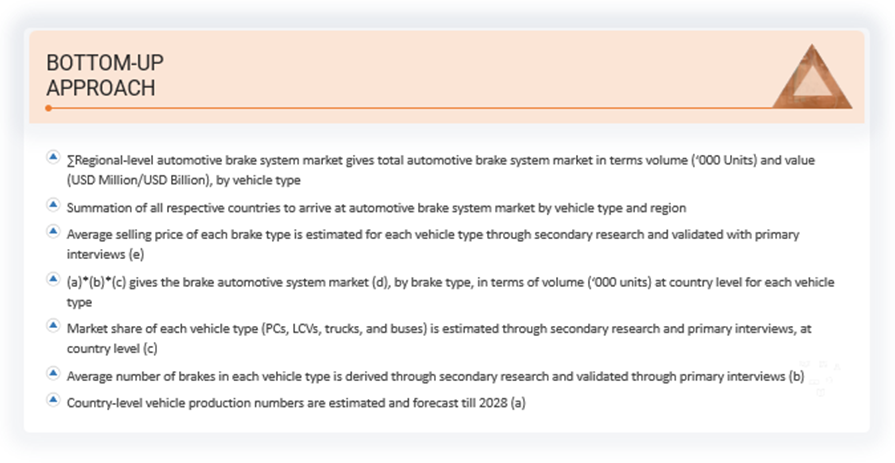
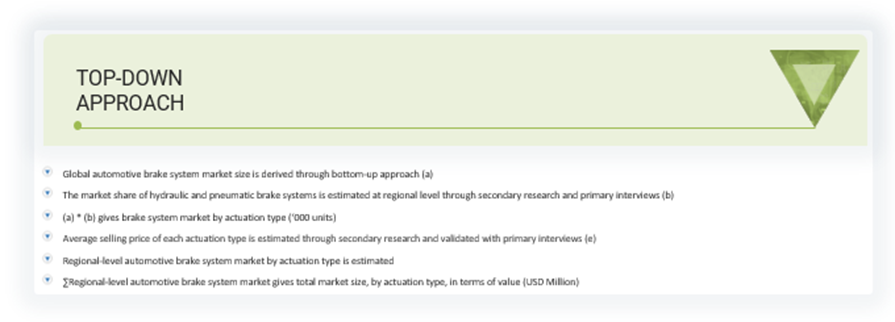
The study involved four major activities in estimating the current size of the automotive brake system market. Exhaustive secondary research was done to collect information on the market, peer, and parent markets. The next step was to validate these findings and assumptions and size them with industry experts across value chains through primary research. The bottom-up and top-down approaches were employed to estimate the complete market size. After that, market breakdown and data triangulation processes were used to estimate the market size of segments and subsegments.
Secondary Research
In the secondary research process, various secondary sources have been used to identify and collect information useful for an extensive commercial study of the automotive brake system market. The secondary sources referred to in this research study include Organisation Internationale des Constructeurs d'Automobiles (OICA), MEMA Brake Manufacturers Council (BMC), Automotive Component Manufacturers Association of India (ACMA); corporate filings (such as annual reports, investor presentations, and financial statements); and trade, business, and automotive associations. Additionally, secondary research has been carried out to understand the average selling prices of disc and drum brakes by vehicle type, historic sales of new vehicles, and vehicle parc. Secondary data has been collected and analyzed to determine the overall market size, further validated by primary research.
Primary Research
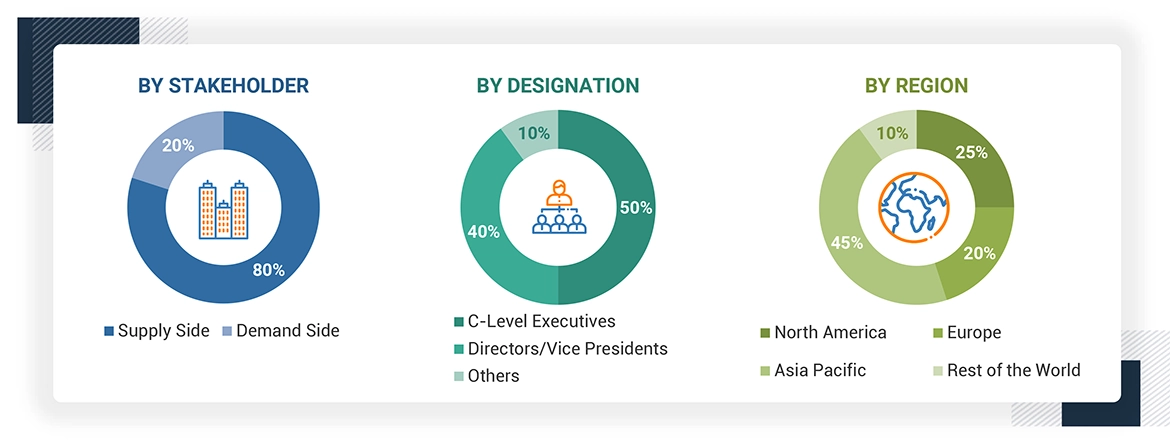
In the primary research process, various primary sources from both the supply and demand sides were interviewed to obtain qualitative and quantitative information on the market. The primary sources from the supply side included industry experts such as CXOs, vice presidents, directors from business development, marketing, product development/innovation teams, and related key executives from various key companies. Various system integrators, industry associations, independent consultants/industry veterans, and key opinion leaders were also interviewed.
Primary interviews have been conducted to gather insights such as ICE vehicle and off-highway equipment sales forecast, disc & drum brake market penetration & forecast, future technology trends, and upcoming technologies in the automotive brake system industry. Data triangulation was then done with the information gathered from secondary research. Stakeholders from the demand and supply side have been interviewed to understand their views on the points mentioned above.
Primary interviews have been conducted with market experts from the demand and supply side across four major regions: North America, Europe, Asia Pacific, and the Rest of the World. Primary data has been collected through questionnaires, emails, and telephonic interviews. In canvassing primaries, we have strived to cover various departments within organizations, such as sales and operations, to provide a holistic viewpoint in our report.
After interacting with industry experts, we have also conducted brief sessions with highly experienced independent consultants to reinforce the findings from our primaries. This and the in-house subject matter experts’ opinions have led us to the findings described in the remainder of this report.
To know about the assumptions considered for the study, download the pdf brochure
Market Size Estimation
A detailed market estimation approach was followed to estimate and validate the value of the automotive brake system market and other dependent submarkets, as mentioned below:
- Key players in the automotive brake system market were identified through secondary research, and their global market shares were determined through primary and secondary research.
- The research methodology included studying annual and quarterly financial reports, regulatory filings of significant market players (public), and interviews with industry experts for detailed market insights.
- All industry-level penetration rates, percentage shares, splits, and breakdowns for the automotive brake system were determined using secondary sources and verified through primary sources.
- All key macro indicators affecting the revenue growth of the market segments and subsegments have been accounted for, viewed in extensive detail, verified through primary research, and analyzed to get the validated and verified quantitative and qualitative data.
- The gathered market data was consolidated and added with detailed inputs, analyzed, and presented in this report.
- Qualitative aspects such as market drivers, restraints, opportunities, and challenges have been considered while calculating and forecasting the market size.
AUTOMOTIVE BRAKE SYSTEM MARKET (ON- & OFF-HIGHWAY): BOTTOM-UP APPROACH
To know about the assumptions considered for the study, Request for Free Sample Report
AUTOMOTIVE BRAKE SYSTEM MARKET: TOP-DOWN APPROACH
Data Triangulation
After arriving at the overall market size, the market was split into several segments and sub-segments using the market size estimation processes explained above. Where applicable, data triangulation and market breakdown procedures were employed to complete the overall market engineering process and determine each market segment's and sub-segments exact statistics. The data was triangulated by studying various factors and trends.
Market Definition
According to Warner Brake, a typical brake system consists of an ABS control module, disc brakes, drum brakes, brake pedal, emergency brake, wheel speed sensors, brake booster, and master cylinder. Disc brakes are usually found on the front wheels and feature brake pads that press against a disc (rotor) when the brake pedal is applied to stop the vehicle. The pads are attached to a brake caliper assembly that frames the rotor. Located on the vehicle's rear, drum brakes feature wheel cylinders, brake shoes, and a brake drum. When the brake pedal is pressed, the brake shoes are forced into the brake drum by the wheel cylinders, bringing the vehicle to a stop.
According to WABCO, anti-lock braking systems (ABS) are active safety systems that assist drivers in situations where road friction, curvature, and vehicle speed result in unfavorable wheel slips. The system automatically intervenes to help keep the vehicle stable and controllable across various maneuvers.
Stakeholders
- Sales Head
- Marketing Head
- Design Manager
- R&D Head
Report Objectives
-
To define, segment, analyze, and forecast (2023–2028) the automotive brake system market size in terms of volume (units) and value (USD million) based on:
- By Brake Type (Disc Brake and Drum Brake)
- By Brake Technology [(antilock braking system (ABS), traction control system (TCS), electronic stability control (ESC), electronic brakeforce distribution (EBD), and automatic emergency braking (AEB)]
- By Actuation (Pneumatic and Hydraulic)
- By Component Type (Master Cylinders, Brake Pads, Brake Shoes, Brake Calipers, and Brake Disc Rotors)
- By Vehicle Type (Passenger Cars, Light Commercial Vehicles (LCVs), Trucks, and Buses)
- Off-Highway By Application (Construction Equipment, Mining Equipment, and Agricultural Tractors)
- Off-Highway By Brake Type (Hydrostatic Brakes, Hydraulic Wet Brakes, Dynamic Brakes, and Others)
- Regenerative Brake System By Electric Vehicle Type (Battery Electric Vehicle (BEV), and Plug-in Hybrid Electric Vehicle (PHEV))
- All-terrain vehicle brake system market By Region (Asia Pacific, Europe, North America, and Rest of the World)
- By Region (North America, Europe, Asia Pacific, and the Rest of the World (RoW))
- To analyze the recession's impact on the automotive brake system market
- To understand the market dynamics (drivers, restraints, opportunities, and challenges) of the automotive brake system market
-
To study the following concerning the market
- Supply Chain Analysis
- Market Ecosystem
- Technology Analysis
- Trade Analysis
- Case Study Analysis
- Patent Analysis
- Buying Criteria
- Regulatory Landscape
- Impact of autonomous/electric vehicles on automotive brake system
-
To estimate the following with respect to the market
- Average Price Analysis
- Market Share Analysis
- To analyze the competitive landscape and prepare a competitive evaluation quadrant for the global automotive brake system market players.
- To analyze recent developments, alliances, joint ventures, mergers & acquisitions, new product launches, and other activities carried out by key automotive brake system market industry participants.
Available Customizations
With the given market data, MarketsandMarkets offers customizations in accordance with the company’s specific needs.
The following customization options are available for the report:
ALL-TERRAIN VEHICLE BRAKE SYSTEM MARKET, BY BRAKE TYPE
- Disc Brakes
- Drum Brakes
Note: The automotive brake system market for all-terrain vehicles, by brake type, will be further offered at the regional level for regions:
Asia Pacific, Europe, North America, and Rest of the World.
AUTOMOTIVE HYDRAULIC DISC BRAKE SYSTEM MARKET, BY REGION
- Asia Pacific
- Europe
- North America
- Rest of the World
HYDRAULIC DRUM BRAKE SYSTEM MARKET, BY REGION
- Asia Pacific
- Europe
- North America
- Rest of the World
PNEUMATIC DRUM BRAKE SYSTEM MARKET, BY REGION
- Asia Pacific
- Europe
- North America
- Rest of the World
PNEUMATIC DISC BRAKE SYSTEM MARKET, BY REGION
- Asia Pacific
- Europe
- North America
- Rest of the World
Get the Full Automotive Brake System Market Report
Full forecast, segment splits, and company analysis for all Automotive Brake System Market.
- China Automotive Brake System Market
- India Automotive Brake System Market
- Japan Automotive Brake System Market
- South Korea Automotive Brake System Market
- Germany Automotive Brake System Market
- France Automotive Brake System Market
- Spain Automotive Brake System Market
- Italy Automotive Brake System Market
- UK Automotive Brake System Market
- Canada Automotive Brake System Market
- Mexico Automotive Brake System Market
- US Automotive Brake System Market
- Brazil Automotive Brake System Market
- Turkey Automotive Brake System Market
- Rest Of Europe Automotive Brake System Market
- Rest Of Asia Pacific Automotive Brake System Market
Need a Tailored Report?
Customize this report to your needs
Get 10% FREE Customization
Customize This Report
