
Rest Of Asia Pacific Automotive Communication Protocol Market (2026-2031)

The Rest Of Asia Pacific Automotive Communication Protocol Market was valued at $27.1 Million in 2026 and projected to reach to $43.8 Million by 2031, representing a compound annual growth rate of 7.1%. Rest Of Asia Pacific's automotive communication protocol market is positioned for substantial expansion, growing from USD 27.1 million in 2026 to USD 43.8 million by 2031.


| Market Size in | USD 26.32 MN |
| Market Forecast in | |
| CAGR | |
| Forecast Period | |
| Units Considered | Value (USD MN) |
Rest Of Asia Pacific Automotive Communication Protocol Market Trends and Insights
- Rest Of Asia Pacific represents a critical emerging market for automotive communication technologies, driven by rapid vehicle electrification, increasing adoption of connected vehicle platforms, and expanding manufacturing capabilities across the region.
- The 7.1% compound annual growth rate reflects Rest Of Asia Pacific's accelerating demand for advanced in-vehicle networking solutions and standardized communication protocols. Rest Of Asia Pacific's automotive sector is transitioning toward sophisticated communication architectures to support autonomous driving features, vehicle-to-everything (V2X) connectivity, and real-time data exchange.
- Rest Of Asia Pacific manufacturers and suppliers are investing heavily in protocol standardization and interoperability frameworks to meet both domestic and export market requirements.
- The forecast period through 2031 positions Rest Of Asia Pacific as a high-growth region, with increasing OEM partnerships and localized technology development driving market expansion..
Key Market Statistics
- CAGR (2026-2031) 7.1% CAGR
- Market Size, 2026 ~USD 27.1 Million
- Forecast, 2031 ~USD 43.8 Million
- Country Rest Of Asia Pacific
Rest Of Asia Pacific Automotive Communication Protocol Market Overview
Rapid Vehicle Electrification :
Rest Of Asia Pacific is witnessing accelerated EV adoption, driving demand for advanced communication protocols to manage battery systems, charging infrastructure, and vehicle-to-grid connectivity across emerging automotive markets.
Connected Vehicle Expansion :
Growing smartphone penetration and digital infrastructure investments in Rest Of Asia Pacific are enabling connected vehicle platforms, requiring robust communication protocols for real-time data exchange and IoT integration.
Manufacturing Growth :
Expanding automotive manufacturing hubs across Rest Of Asia Pacific countries are increasing demand for standardized communication protocols to support production efficiency, supply chain integration, and quality control systems.
Strong CAGR Performance :
Rest Of Asia Pacific's 7.1% CAGR significantly outpaces the global 4.1% growth rate, reflecting the region's emerging market dynamics and accelerating adoption of next-generation automotive technologies.
Rest Of Asia Pacific Automotive Communication Protocol Market Dynamics
- This 7.1% CAGR reflects the region's transition toward electrified and connected vehicles, supported by government initiatives promoting EV adoption and smart transportation infrastructure development. The market's growth is underpinned by increasing vehicle production capacity, rising consumer demand for connected features, and regulatory requirements for vehicle safety and emissions monitoring.
- As automotive manufacturers establish regional hubs and local suppliers develop protocol expertise, Rest Of Asia Pacific will emerge as a critical market for communication technology innovation and deployment..
Market Ecosystem
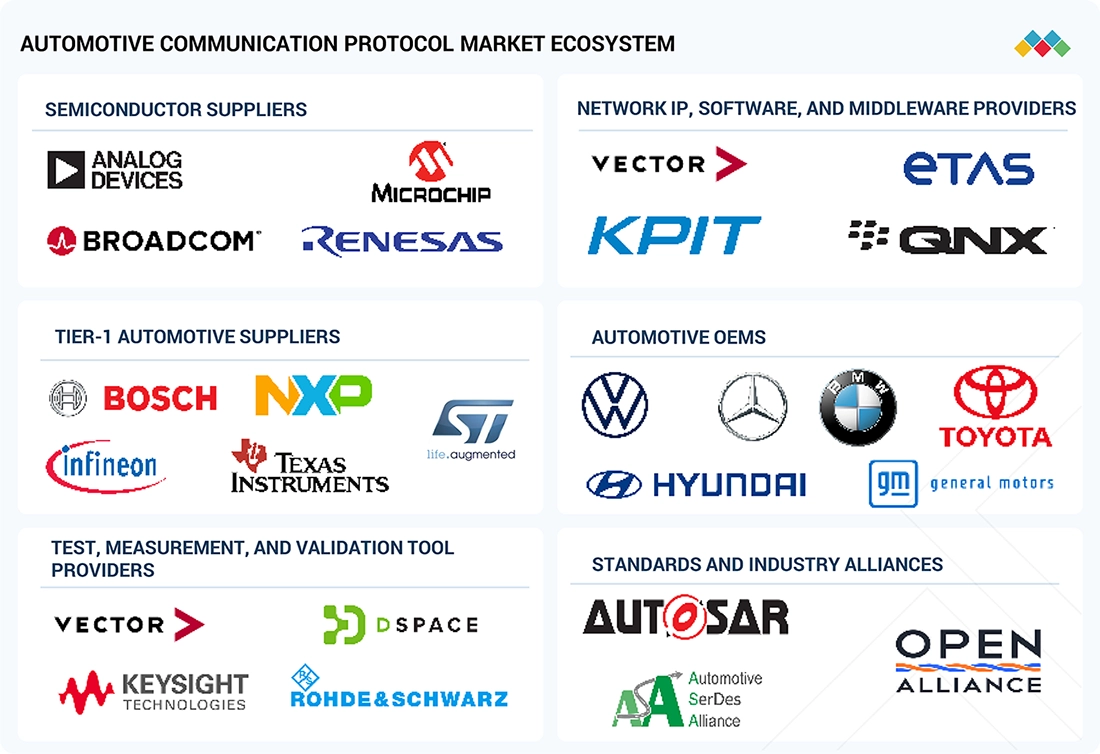
AUTOMOTIVE COMMUNICATION PROTOCOL MARKET: COMMERCIAL USE CASES ACROSS INDUSTRIES
| COMPANY | USE CASE DESCRIPTION | BENEFITS |
|---|---|---|
 |
Develops CAN, CAN FD, and automotive Ethernet solutions for powertrain, chassis, and ADAS communication across passenger and commercial vehicles. | Ensures reliable real-time communication, improves vehicle safety, and supports scalable E/E architectures. |
 |
Supplies automotive Ethernet PHYs, CAN/LIN transceivers, and secure gateway controllers for zonal vehicle architectures. | Enables high-bandwidth data transfer, enhances cybersecurity readiness, and supports centralized vehicle computing. |
 |
Provides CAN, LIN, and FlexRay transceivers integrated with safety microcontrollers for ADAS and body electronics. | Improves functional safety compliance (ISO 26262), reduces latency, and enhances system robustness. |
 |
Offers automotive-grade CAN FD, LIN, and Ethernet PHY solutions for EV battery management and infotainment systems. | Supports high data throughput, improves signal integrity, and lowers power consumption. |
 |
Develops automotive communication ICs for vehicle networking, including CAN FD and in-vehicle Ethernet. | Enhances communication reliability, enables future-proof networking, and supports software-defined vehicle platforms. |
Logos and trademarks shown above are the property of their respective owners. Their use here is for informational and illustrative purposes only.
Related Ecosystem
Key Takeaways
- Rest Of Asia Pacific's automotive communication protocol market will grow from USD 27.1 million (2026) to USD 43.8 million (2031), representing a 7.1% CAGR.
- Rest Of Asia Pacific is accelerating adoption of connected vehicle technologies and V2X communication standards to support autonomous driving capabilities.
- Rest Of Asia Pacific manufacturers are prioritizing protocol standardization and interoperability to enhance competitiveness in global automotive supply chains.
- Rest Of Asia Pacific's expanding EV production and localized R&D investments are key drivers of communication protocol market growth through 2031.
Automotive Communication Protocol Market Report Scope
| Report Metric | Details |
|---|---|
| Base Year | 2026 |
| Fastest Growing Segment | ELECTRIC (Propulsion) |
| Forecast Period | 2026–2031 |
| Growth Rate | CAGR of 4.1% from 2026 to 2031 |
| Largest Segment | ICE (Propulsion) |
| Market Size Base Year (Billions) | ~USD 7.79 (2026) |
| Revenue Forecast (Billions) | ~USD 9.52 (2031) |
| Segments Covered | Protocol Type, Vehicle Class, Application, Propulsion |
Rest Of Asia Pacific Automotive Communication Protocol Market Report Segmentation
4 segment dimensions are covered across the global market.
By Protocol Type
- Can
- Ethernet
- Flexray
- Lin
By Vehicle Class
- Economy
- Luxury
- Mid-Size
By Application
- Body Control & Comfort
- Infotainment & Communication
- Powertrain
- Safety & ADAS
- Telematics
By Propulsion
- Electric
- ICE
Target Audience
- Automotive OEMs & Suppliers : Manufacturers and component suppliers need Rest Of Asia Pacific market intelligence to optimize product development, localize communication protocols, and capture emerging vehicle electrification opportunities.
- Technology & Software Providers : Communication protocol developers and automotive software companies require regional market data to identify adoption trends, customize solutions, and establish partnerships with local automotive ecosystems.
- Investment & Private Equity Firms : Investors evaluating automotive technology opportunities in Rest Of Asia Pacific need market sizing, growth projections, and competitive dynamics to assess portfolio companies and acquisition targets.
- Government & Regulatory Bodies : Policy makers and transportation authorities in Rest Of Asia Pacific require market insights to develop EV infrastructure standards, communication protocol regulations, and connected vehicle frameworks.
- Consulting & Strategy Firms : Business consultants advising automotive clients on regional expansion need Rest Of Asia Pacific-specific market data to develop credible strategies, competitive analyses, and market entry recommendations.
Key Companies in the Rest Of Asia Pacific Automotive Communication Protocol Market
| Company | HQ | Ownership | Strongest segments |
|---|---|---|---|
| MCLAREN GROUP | United Kingdom | Private Company | Luxury Vehicle Class – Protocol Content,Safety & ADAS Communication Domains,Powertrain Communication Domains, |
| AT&S | Austria | Public Company | Safety & ADAS automation lines,Powertrain electronics automation (ICE and EV),Connected factory software and digital solutions, |
| X-FAB | Germany | Public Company | CAN / CAN FD transceiver-related wafers,LIN and low-speed body network wafers,Automotive Ethernet and high-speed PHY wafers, |
| ALTRAN | France | Private Company | Economy Vehicle Class,Mid-size Vehicle Class,Luxury Vehicle Class, |
| PRYSMIAN S.P.A | Italy | Public Company | CAN and LIN cabling for economy and mid-size ICE,High-speed Ethernet and FlexRay cabling for Safety & ADAS,Powertrain cabling for EV high-voltage and data networks, |
| SOITEC | United States | Public Company | Power-SOI for automotive power electronics (ICE and EV),AUTO FD-SOI for radar, processors, and mixed-signal controllers,Auto Smartsic and power substrates for EV inverters and chargers, |
| NXP SEMICONDUCTORS | Netherlands | Public Company | CAN / CAN FD interface and system ICs,LIN and low-speed networking ICs,Automotive Ethernet PHYs, switches, and processors, |
| ROBERT BOSCH GMBH | India | Private Company | CAN-based controllers and transceivers,LIN nodes and body electronics,Automotive Ethernet for ADAS and infotainment, |
| INFINEON TECHNOLOGIES AG | Germany | Public Company | CAN / CAN FD transceivers and MCUs,LIN transceivers and MCUs,FlexRay and legacy high-reliability networks, |
| STMICROELECTRONICS | Switzerland | Public Company | CAN / CAN-FD MCUs and transceivers,LIN transceivers and mixed-signal ASSPs,Automotive Ethernet PHYs / controllers, |
| TEXAS INSTRUMENTS INCORPORATED | United States | Public Company | CAN / CAN-FD transceivers & controllers,LIN transceivers & system basis chips,Automotive Ethernet PHYs & switches, |
| RENESAS ELECTRONICS CORPORATION | Japan | Public Company | CAN / CAN FD MCUs and transceivers,LIN MCUs and transceivers,Automotive Ethernet (PHYs, switches, controllers), |
| MICROCHIP TECHNOLOGY INC. | United States | Public Company | CAN / CAN-FD MCUs and transceivers,LIN MCUs and transceivers,Automotive Ethernet, USB, and interface products, |
| ELMOS SEMICONDUCTOR SE | Germany | Public Company | LIN transceivers and LIN-based LED/motor control ICs,CAN and LIN/CAN interface ICs,Sensor ICs for ultrasonic, ToF, and ambient sensing, |
| BROADCOM | United States | Public Company | Automotive Ethernet (backbone, ADAS, infotainment),CAN / CAN-FD controllers and gateways,FlexRay and other legacy high-speed protocols, |
| ANALOG DEVICES, INC. | United States | Public Company | CAN / CAN FD transceivers and interface ICs,LIN transceivers and interface ICs,Automotive Ethernet PHY/AFE and timing, |
| ALPS ALPINE CO., LTD. | Japan | Public Company | Economy vehicles (all protocols, all applications),Mid-size vehicles (all protocols, all applications),Luxury vehicles (all protocols, all applications), |
| TE CONNECTIVITY | Ireland | Public Company | CAN / LIN-related interconnect and harness content,Ethernet and high-speed data interconnect for ADAS and infotainment,FlexRay and other legacy high-reliability bus content, |
MCLAREN GROUP
McLaren Group is a British automotive and technology company founded in 1963, operating as a private enterprise with 2,627 employees. The company is known for its involvement in motorsports and high-performance vehicle manufacturing.
AT&S
AT&S is an Austrian electronics manufacturer founded in 1978, operating as a public company with 7,000 employees. The company specializes in printed circuit board production and related technologies.
X-FAB
X-FAB is a German semiconductor foundry established in 1992, operating as a public company with 4,300 employees. The company provides analog and mixed-signal semiconductor manufacturing services.
ALTRAN
Altran is a French engineering and consulting services company founded in 1970, operating as a private enterprise with 50,124 employees. The company provides digital transformation and technology consulting across multiple industries.
PRYSMIAN S.P.A
Prysmian S.p.A. is an Italian cable and wire manufacturer founded in 1879, operating as a public company with 33,824 employees. The company is a global leader in energy and telecommunications cable systems.
SOITEC
Soitec is a United States-based semiconductor company founded in 1992, operating as a public company with 1,961 employees. The company specializes in engineered substrates and semiconductor materials.
NXP SEMICONDUCTORS
NXP Semiconductors is a Dutch semiconductor manufacturer founded in 2006, operating as a public company with 32,169 employees. The company designs and produces semiconductors for automotive, industrial, and consumer applications.
ROBERT BOSCH GMBH
Robert Bosch GmbH is an Indian subsidiary of a global engineering and technology company founded in 1886, operating as a private enterprise with 412,774 employees. The company provides automotive, industrial, and consumer products and services.
INFINEON TECHNOLOGIES AG
Infineon Technologies AG is a German semiconductor manufacturer founded in 1952, operating as a public company with 56,500 employees. The company specializes in semiconductors for automotive, industrial, and security applications.
STMICROELECTRONICS
STMicroelectronics is a Swiss semiconductor manufacturer founded in 1987, operating as a public company with 48,000 employees. The company designs and manufactures a broad range of semiconductor products for various markets.
TEXAS INSTRUMENTS INCORPORATED
Texas Instruments Incorporated is a United States-based semiconductor company founded in 1930, operating as a public company with 33,000 employees. The company designs and manufactures analog and embedded processing semiconductors.
RENESAS ELECTRONICS CORPORATION
Renesas Electronics Corporation is a Japanese semiconductor manufacturer founded in 2002, operating as a public company with 21,907 employees. The company produces microcontrollers, analog semiconductors, and power management solutions.
MICROCHIP TECHNOLOGY INC.
Microchip Technology Inc. is a United States-based semiconductor company founded in 1989, operating as a public company with 17,900 employees. The company designs and manufactures microcontrollers, analog semiconductors, and related products.
ELMOS SEMICONDUCTOR SE
Elmos Semiconductor SE is a German semiconductor company founded in 1984, operating as a public company with 1,271 employees. The company specializes in analog and mixed-signal semiconductors for automotive and industrial applications.
BROADCOM
Broadcom is a United States-based semiconductor company founded in 1961, operating as a public company with 33,000 employees. The company designs and manufactures semiconductors for infrastructure, broadband, and connectivity applications.
ANALOG DEVICES, INC.
Analog Devices, Inc. is a United States-based semiconductor company founded in 1965, operating as a public company with 24,500 employees. The company designs and manufactures analog, mixed-signal, and digital signal processing semiconductors.
ALPS ALPINE CO., LTD.
Alps Alpine Co., Ltd. is a Japanese electronics manufacturer founded in 1948, operating as a public company with 25,924 employees. The company produces electronic components and modules for automotive, industrial, and consumer applications.
TE CONNECTIVITY
TE Connectivity is an Irish electronics and connectivity company founded in 1941, operating as a public company with 80,000 employees. The company designs and manufactures connectors, sensors, and network solutions for multiple industries.
Reasons to Buy this Report
- Regional Market Sizing & Forecasts : Obtain precise market valuations and growth projections specific to Rest Of Asia Pacific, enabling accurate budget allocation and investment decisions for regional expansion strategies.
- Competitive Landscape Analysis : Identify key protocol standards, technology providers, and market players dominating Rest Of Asia Pacific, helping you benchmark competitive positioning and partnership opportunities.
- Growth Driver Insights : Understand region-specific catalysts including EV adoption rates, manufacturing expansion, and regulatory frameworks driving 7.1% CAGR in Rest Of Asia Pacific markets.
- Technology Adoption Trends : Analyze emerging communication protocol preferences, connected vehicle penetration, and IoT integration patterns unique to Rest Of Asia Pacific automotive ecosystems.
- Strategic Market Entry Planning : Leverage detailed Rest Of Asia Pacific insights to develop targeted go-to-market strategies, identify high-potential sub-regions, and prioritize resource allocation for maximum ROI.
Frequently asked questions
What is the market size of automotive communication protocols in Rest Of Asia Pacific?
Rest Of Asia Pacific's automotive communication protocol market is valued at USD 27.1 million in 2026 and is forecast to reach USD 43.8 million by 2031.
What is the growth rate for Rest Of Asia Pacific's automotive communication protocol market?
Rest Of Asia Pacific's automotive communication protocol market is projected to grow at a compound annual growth rate (CAGR) of 7.1% from 2026 to 2031.
What factors are driving growth in Rest Of Asia Pacific's automotive communication protocol market?
Rest Of Asia Pacific's market growth is driven by vehicle electrification, increasing connected vehicle adoption, autonomous driving development, V2X technology deployment, and localized manufacturing expansion.
Which communication protocols are most relevant in Rest Of Asia Pacific?
Rest Of Asia Pacific automotive manufacturers are adopting CAN, LIN, FlexRay, MOST, and emerging Ethernet-based protocols to support advanced vehicle connectivity and autonomous features.
How is Rest Of Asia Pacific positioned compared to other Asia Pacific regions?
Rest Of Asia Pacific represents a high-growth emerging segment within Asia Pacific, with rapid industrialization, increasing OEM investments, and growing demand for standardized communication architectures supporting the region's automotive transformation.
RESEARCH METHODOLOGY
This research study involved the extensive use of secondary sources, such as company annual reports/presentations, industry association publications, automotive magazine articles, directories, technical handbooks, the World Economic Outlook, trade websites, technical articles, and databases, to identify and collect information on the automotive communication protocol market. In-depth interviews were conducted with various primary respondents, including key industry participants, subject-matter experts, C-level executives of key market players (automotive communication protocol provider), and industry consultants, among other experts, to obtain and verify critical qualitative and quantitative information and assess market prospects.
Secondary Research
In the secondary research process, various secondary sources were used to identify and collect information on the market for this study. Secondary sources included annual reports, press releases, and investor presentations of companies; whitepapers, certified publications, and articles from recognized authors; directories; databases; and articles from recognized associations and government publishing sources.
Primary Research
Extensive primary research was conducted after understanding the automotive communication protocol market scenario through secondary research. Several primary interviews were conducted with market experts from both demand-side vehicle manufacturers (in terms of component supply), country-level government associations, trade associations, and supply-side OEMs and component manufacturers across three major regions: North America, Europe, and Asia Pacific. Approximately 25% and 75% of primary interviews were conducted from the demand and supply sides, respectively. Primary data was collected through questionnaires, emails, and telephonic interviews. In the canvassing of primaries, various departments within organizations, such as sales, operations, and administration, were covered to provide a holistic viewpoint in the report.
The following is a breakdown of the primary respondents:
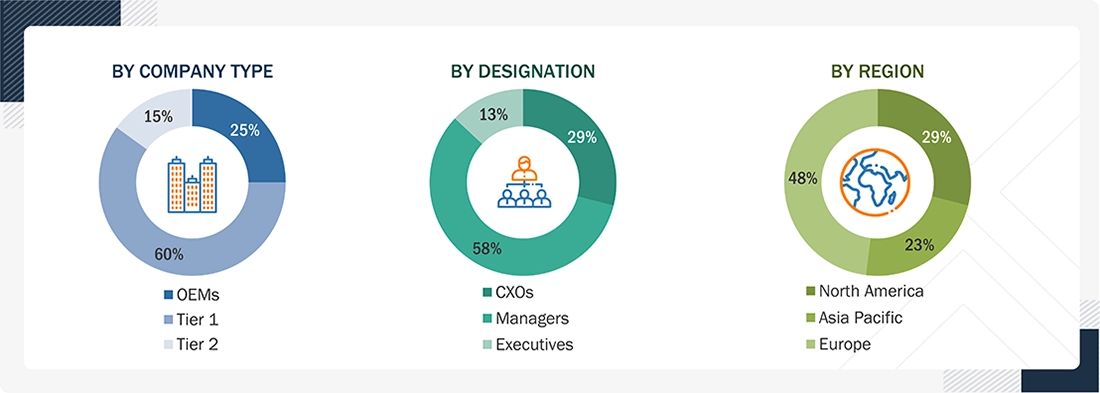
Note: The tiers of companies are based on the supply chain of the market. Tier 1 companies are automotive communication protocol providers.
To know about the assumptions considered for the study, download the pdf brochure
Market Size Estimation
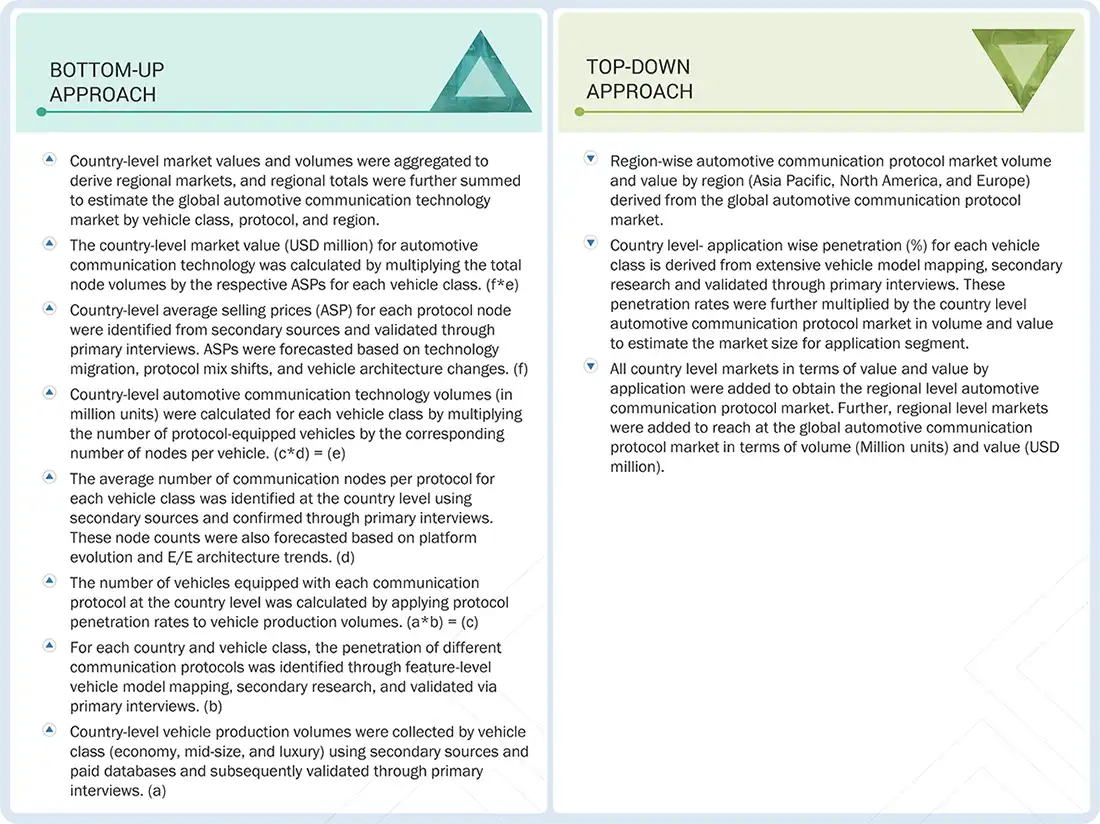
A bottom-up and top-down approach was used to estimate and validate the total size of the automotive communication protocol market. This method was also used extensively to estimate the size of various subsegments in the market. The research methodology used to estimate the market size includes the following:
Data Triangulation
After arriving at the overall market size using the market size estimation processes as explained above, the market was split into several segments and subsegments. To complete the overall market engineering process and arrive at the exact statistics of each market segment and subsegment, data triangulation and market breakdown procedures were employed, wherever applicable. The data was triangulated by studying various factors and trends from both the demand and supply sides.
Market Definition
Automotive communication protocols are in-vehicle networking standards such as CAN, LIN, FlexRay, and Automotive Ethernet. These protocols govern how ECUs communicate within passenger cars. They support a wide range of applications, from low-speed body electronics to safety-critical and high-bandwidth systems. The selection of a protocol depends on requirements such as data rate, latency, reliability, and system cost.
Key Stakeholders
- Automotive Ethernet switch and connectivity solution providers
- Automotive network transceiver and PHY suppliers
- Automotive research organizations and standardization bodies
- Automotive Tier-1 suppliers
- Autonomous driving platform providers
- In-vehicle networking software and protocol stack providers
- Passenger vehicle manufacturers
- Semiconductor and microcontroller manufacturers
- System integrators and vehicle architecture solution providers
- Testing, validation, and compliance tool providers
Report Objectives
- To segment and forecast the automotive communication protocol market in terms of volume (million units) and value (USD million)
- To analyze regional markets for growth trends, prospects, and their contribution to the overall market
- To define, describe, and forecast the market based on protocol, application, propulsion, vehicle class, and region
- To segment and forecast the market by vehicle class (economy, mid-size, and luxury)
- To segment and forecast the market by application (powertrain, body control & comfort, infotainment & communication, safety & ADAS, and telematics)
- To segment and forecast the market by propulsion type (ICE and EV)
- To segment and forecast the market by protocol (LIN, CAN, FlexRay, and Ethernet)
- To forecast the market by region (Asia Pacific, Europe, and North America)
- To provide qualitative information on applications, including central computing units, audio amplifiers, zonal controllers, and display
- To provide qualitative information on protocols such as OPENGMSL, FPD, A-PHY, GVIF, HSMT, A2B, ASA, and APIX
- To analyze technological developments impacting the market
- To provide detailed information about the major factors influencing market growth (drivers, challenges, restraints, and opportunities)
- To strategically analyze the market, considering individual growth trends, prospects, and contributions to the total market
- To study the following concerning the market
- Supply Chain Analysis
- Ecosystem Analysis
- Technology Analysis
- Trade Analysis
- Case Study Analysis
- Patent Analysis
- Regulatory Landscape
- Average Selling Price Analysis
- Impact of AI/Gen AI
- Trend and Disruption Impact
- Key Stakeholders and Buying Criteria
- Key Conferences and Events
- Sustainability initiatives
- To strategically profile key players and comprehensively analyze their market share and core competencies
- To track and analyze competitive developments, such as product launches, deals, expansions, and others, carried out by key market players
Available customizations:
With the given market data, MarketsandMarkets offers customizations in accordance with the company’s specific needs.
Automotive Communication Protocol Market, by Application, at Country Level
Automotive Communication Protocol Market, by Protocol, at Country Level
Company Information:
Profiling of additional market players (up to five)
Get the Full Automotive Communication Protocol Market Report
Full forecast, segment splits, and company analysis for all Automotive Communication Protocol Market.
- China Automotive Communication Protocol Market
- India Automotive Communication Protocol Market
- Japan Automotive Communication Protocol Market
- South Korea Automotive Communication Protocol Market
- Germany Automotive Communication Protocol Market
- France Automotive Communication Protocol Market
- UK Automotive Communication Protocol Market
- Spain Automotive Communication Protocol Market
- Canada Automotive Communication Protocol Market
- US Automotive Communication Protocol Market
- Rest Of Europe Automotive Communication Protocol Market
Need a Tailored Report?
Customize this report to your needs
Get 10% FREE Customization
Customize This Report
