
US Automotive Heat Shield Market (2025-2030)

The US Automotive Heat Shield Market was valued at $1562.2 Million in 2025 and projected to reach to $1599.9 Million by 2030, representing a compound annual growth rate of 0.3%. The US automotive heat shield market demonstrates resilience despite modest growth, supported by ongoing regulatory pressures and the automotive industry's transition toward electrification.


| Market Size in | USD 26.32 MN |
| Market Forecast in | |
| CAGR | |
| Forecast Period | |
| Units Considered | Value (USD MN) |
US Automotive Heat Shield Market Trends and Insights
- The US market remains a critical segment within North America's automotive thermal management ecosystem, driven by regulatory compliance, vehicle electrification trends, and the need for enhanced engine efficiency.
- Despite the slow growth trajectory, the US continues to maintain steady demand for heat shield solutions across light-duty and commercial vehicle platforms. In the US, heat shield adoption is primarily influenced by stricter emissions standards, underbody thermal protection requirements, and the transition toward hybrid and electric powertrains.
- The market's conservative growth rate reflects market maturity and the standardization of heat shield components across major original equipment manufacturers (OEMs).
- The US automotive heat shield market remains resilient, with manufacturers focusing on lightweight materials and cost optimization to maintain competitiveness through 2030..
Key Market Statistics
- CAGR (2025-2030) 0.3% CAGR
- Market Size, 2025 ~USD 1562.2 Million
- Forecast, 2030 ~USD 1599.9 Million
- Country US
US Automotive Heat Shield Market Overview
Market Valuation :
The US automotive heat shield market is valued at $1,562.2 million in 2025, with steady growth projected to $1,599.9 million by 2030, representing a conservative 0.3% CAGR reflecting market maturity and saturation.
Regulatory Compliance Driver :
US emissions standards and thermal management regulations continue to mandate advanced heat shield solutions in vehicles, ensuring consistent demand from OEMs seeking to meet EPA and NHTSA compliance requirements.
EV Transition Impact :
Vehicle electrification in the US market is reshaping heat shield demand, with battery thermal management and electric motor cooling creating new application opportunities despite traditional ICE market decline.
Engine Efficiency Focus :
US manufacturers prioritize enhanced engine efficiency and fuel economy standards, driving adoption of advanced heat shield materials and designs to optimize thermal performance and reduce overall vehicle weight.
US Automotive Heat Shield Market Dynamics
- OEMs continue investing in thermal management solutions to improve vehicle efficiency and meet stringent environmental standards.
- The 0.3% CAGR reflects a mature market where growth is incremental rather than transformative, driven by replacement cycles and new vehicle launches rather than market expansion. Looking ahead to 2030, the US market will be shaped by accelerating EV adoption, which introduces distinct thermal management challenges compared to traditional combustion engines.
- Suppliers focusing on innovative materials, lightweight solutions, and battery thermal protection systems will capture emerging opportunities.
- Market consolidation among Tier-1 suppliers and strategic partnerships with EV manufacturers will define competitive dynamics in this evolving landscape..
Market Ecosystem
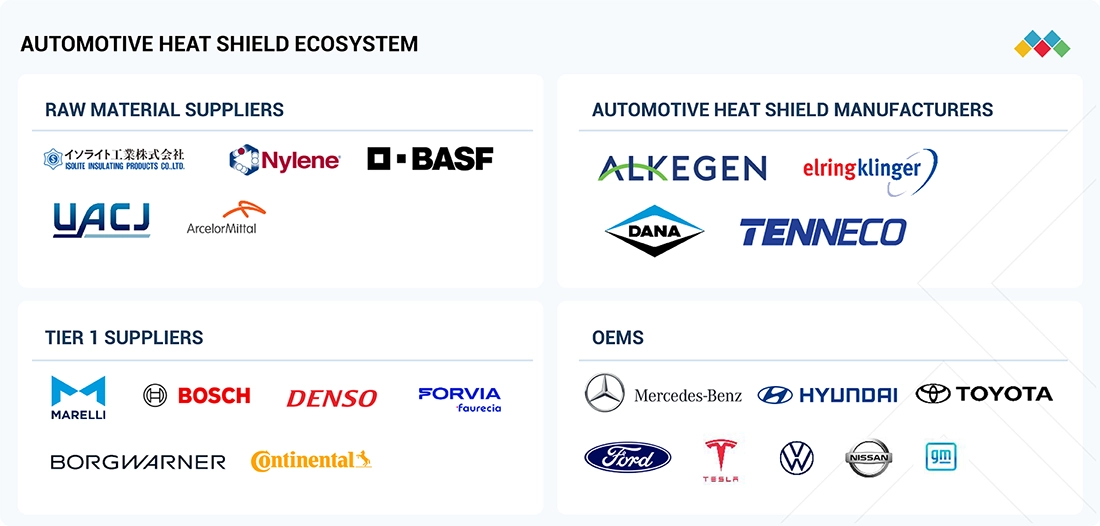
Automotive Heat Shield Market: COMMERCIAL USE CASES ACROSS INDUSTRIES
| COMPANY | USE CASE DESCRIPTION | BENEFITS |
|---|---|---|
 |
Manufactures multilayer aluminum/composite heat shields for turbochargers and exhausts in ICEs and hybrids/EVs | Improved thermal management, enhanced fuel efficiency, extended component lifespan, compliance with emission norms |
 |
Develops lightweight, high-temperature resistant heat shields for battery enclosures and power electronics in EVs | Increased EV safety and reliability, protection of sensitive electrical components, efficient thermal dissipation |
 |
Provides custom acoustic and thermal shielding systems for engines, underbody, and bulkheads in premium vehicles | Noise and heat reduction, greater passenger comfort, protection of interior electronics, premium positioning |
 |
Supplies underbody shields and thermal-acoustic insulation for various OEMs, tailored for both ICE and electric cars | Enhanced energy efficiency, occupant comfort, reduced NVH (noise, vibration, harshness), regulatory compliance |
Logos and trademarks shown above are the property of their respective owners. Their use here is for informational and illustrative purposes only.
Related Ecosystem
Automotive Materials
- Light Commercial Vehicles (LCVs)
- Battery Electric Vehicle (BEV)
- Hybrid Electric Vehicle (HEV)
- Fuel Cell Electric Vehicle (FCEV)
- Agricultural Tractors
- GORKOVSKY AVTOMOBILNY ZAVOD
- AISIN CORPORATION
- Continental ag
- Basf se
- BOSCH LIMITED
Engine Engine System Exhaust
- Light Commercial Vehicles (LCVs)
- Agricultural Tractors
- Battery Electric Vehicle (BEV)
- Hybrid Electric Vehicle (HEV)
- Sensors
- TENNECO
- GORKOVSKY AVTOMOBILNY ZAVOD
- Titan Company Limited
- AISIN CORPORATION
- TI AUTOMOTIVE
Key Takeaways
- The US automotive heat shield market is valued at $1,562.2 million in 2025 with a projected value of $1,599.9 million by 2030.
- The US market exhibits a low growth rate of 0.3% CAGR, indicating market maturity and standardized component adoption across OEMs.
- In the US, regulatory compliance and vehicle electrification are primary drivers of heat shield demand across passenger and commercial segments.
- The US market is characterized by intense competition and a focus on lightweight, cost-effective thermal management solutions.
Automotive Heat Shield Market Report Scope
| Report Metric | Details |
|---|---|
| Base Year | 2025 |
| Fastest Growing Segment | FCEV (Electric Vehicle Type) |
| Forecast Period | 2025–2030 |
| Growth Rate | CAGR of 0.6% from 2025 to 2030 |
| Largest Segment | PASSENGER CARS (Vehicle Type) |
| Market Size Base Year (Billions) | ~USD 12.16 (2025) |
| Revenue Forecast (Billions) | ~USD 12.53 (2030) |
| Segments Covered | Product Type, Application, Function, Material Type, Vehicle Type, Electric Vehicle Type |
US Automotive Heat Shield Market Report Segmentation
6 segment dimensions are covered across the global market.
By Product Type
- Double Shell
- Sandwich
- Single Shell
By Application
- Battery Packs
- Engine Compartment Heat Shield
- Exhaust System Heat Shield
- Fuel Cell Stacks
- Motors
- Power Electronics
- Transmission Systems
- Turbocharger Heat Shield
- Under-Bonnet Heat Shield
- Under-Chassis Heat Shield
By Function
- Acoustic
- Non-Acoustic
By Material Type
- Metallic
- Non-Metallic
By Vehicle Type
- Heavy Commercial Vehicles
- Light Commercial Vehicles
- Passenger Cars
By Electric Vehicle Type
- Bev
- Fcev
- Phev
Target Audience
- OEM Procurement Teams : US automotive manufacturers need precise market data to optimize heat shield sourcing strategies, negotiate supplier contracts, and plan thermal management solutions for new vehicle platforms and EV transitions.
- Tier-1 Automotive Suppliers : Heat shield manufacturers and thermal management solution providers require US-specific market intelligence to identify growth opportunities, assess competitive positioning, and develop product roadmaps aligned with OEM demands.
- Investment & Private Equity Firms : Investors evaluating automotive thermal management companies need detailed US market analysis to assess growth potential, valuation benchmarks, and strategic acquisition targets within the North American supply chain.
- Market Entry & Expansion Teams : New entrants and international suppliers planning US market entry require comprehensive market sizing, regulatory insights, and competitive landscape data to develop effective go-to-market strategies.
- Strategic Business Planners : Corporate strategy and business development professionals need US market forecasts and trend analysis to inform long-term planning, capital allocation, and portfolio decisions in the automotive thermal management sector.
Key Companies in the US Automotive Heat Shield Market
| Company | HQ | Ownership | Strongest segments |
|---|---|---|---|
| AISIN SEIKI CO LTD | Japan | Public Company | Engine & under-bonnet applications,Exhaust & under-chassis applications,Turbocharger applications, |
| THYSSENKRUPP AG | Germany | Public Company | Engine applications,Exhaust applications,Under-bonnet and under-chassis, |
| UFP TECHNOLOGIES, INC | United States | Public Company | Application – Engine,Application – Exhaust,Application – Under-bonnet, |
| RHEINMETALL AG | Germany | ||
| NOVELIS, INC | United States | Private Company | Engine and under-bonnet heat shield aluminum sheet,Exhaust and turbocharger heat shield aluminum sheet,Under-chassis and underbody shield aluminum sheet (incl. EV platforms), |
| DONALDSON COMPANY, INC | United States | Public Company | Engine application heat shields,Exhaust and turbocharger heat shields,Under-bonnet and under-chassis heat shields, |
| TENNECO INC. | United States | Private Company | Engine heat shields,Exhaust heat shields,Under-bonnet heat shields, |
| DANA LIMITED | United States | Public Company | Engine applications,Exhaust applications,Under-bonnet, |
| ELRINGKLINGER AG | Germany | Public Company | Engine and Exhaust Shields (incl. turbocharger-focused),Under-bonnet and Under-chassis Shields,Single-shell Heat Shields, |
| AUTONEUM | Switzerland | Public Company | Engine and exhaust heat shields,Under-bonnet and hoodliners,Under-chassis and underbody shields, |
| ALKEGEN | United States | Private Company | Application – Engine & Turbocharger,Application – Exhaust,Application – Under-bonnet / Under-chassis, |
| TECHNOL EIGHT GROUP | Japan | Private Company | Engine heat shields,Exhaust heat shields,Under-bonnet heat shields, |
| THAI SUMMIT GROUP | Thailand | Private Company | Single-shell heat shields,Double-shell heat shields,Sandwich heat shields, |
| ASPEN AEROGELS, INC. | United States | Public Company | Battery-pack and under-floor thermal barriers (EV-focused heat shields),Under-bonnet and firewall insulation (non-acoustic, high-performance),Exhaust and turbocharger adjacent insulation, |
| FUTABA INDUSTRIAL CO., LTD. | Japan | Public Company | Exhaust heat shields,Under-chassis and under-bonnet heat shields,Engine and turbocharger heat shields, |
| DUPONT | United States | Public Company | Engine applications,Exhaust applications,Under-bonnet applications, |
AISIN SEIKI CO LTD
AISIN SEIKI CO LTD is a Japanese public company founded in 1943 with 113,292 employees, making it a major industrial manufacturer.
THYSSENKRUPP AG
THYSSENKRUPP AG is a German public company established in 1811 with 90,916 employees, operating as a large diversified industrial conglomerate.
UFP TECHNOLOGIES, INC
UFP TECHNOLOGIES, INC is a publicly traded company based in the United States, founded in 1963 with 4,846 employees.
RHEINMETALL AG
Insufficient data provided for company description.
NOVELIS, INC
NOVELIS, INC is a private company based in the United States, founded in 2004 with 13,250 employees.
DONALDSON COMPANY, INC
DONALDSON COMPANY, INC is a publicly traded American company established in 1915 with 15,000 employees.
TENNECO INC.
TENNECO INC. is a private company based in the United States, founded in 1930 with 71,000 employees.
DANA LIMITED
DANA LIMITED is a publicly traded American company established in 1969 with 59,000 employees.
ELRINGKLINGER AG
ELRINGKLINGER AG is a German public company founded in 1879 with 8,542 employees.
AUTONEUM
AUTONEUM is a Swiss public company established in 1901 with 16,101 employees.
ALKEGEN
ALKEGEN is a private company based in the United States, founded in 1891 with 1,044 employees.
TECHNOL EIGHT GROUP
TECHNOL EIGHT GROUP is a Japanese private company established in 1948 with 499 employees.
THAI SUMMIT GROUP
THAI SUMMIT GROUP is a private company based in Thailand, founded in 1977.
ASPEN AEROGELS, INC.
ASPEN AEROGELS, INC. is a publicly traded American company established in 2001 with 854 employees.
FUTABA INDUSTRIAL CO., LTD.
FUTABA INDUSTRIAL CO., LTD. is a Japanese public company founded in 1935 with 10,104 employees.
DUPONT
DUPONT is a publicly traded American company founded in 2015 with 15,000 employees.
Reasons to Buy this Report
- Accurate US Market Sizing : Obtain precise valuation data specific to the US market ($1,562.2M in 2025) with detailed forecasts through 2030, enabling accurate budgeting and investment decisions for US-focused automotive suppliers and OEMs.
- Regulatory Landscape Intelligence : Understand how US-specific emissions standards, EPA regulations, and NHTSA requirements drive heat shield adoption and compliance strategies, critical for manufacturers navigating the complex American regulatory environment.
- EV Transition Strategy : Gain insights into how vehicle electrification is reshaping thermal management needs in the US market, identifying new opportunities in battery cooling, electric motor protection, and next-generation heat shield applications.
- Competitive Positioning : Benchmark your US operations against market trends, identify growth segments within the mature market, and develop targeted strategies to capture share in replacement cycles and new EV platform launches.
- Supply Chain Planning : Make informed decisions on US manufacturing capacity, supplier relationships, and material sourcing strategies based on detailed market projections and demand drivers specific to the American automotive sector.
Frequently asked questions
What is the current size of the US automotive heat shield market?
The US automotive heat shield market is valued at $1,562.2 million in 2025 and is expected to grow to $1,599.9 million by 2030.
What is the growth rate of the US automotive heat shield market?
The US automotive heat shield market is growing at a compound annual growth rate (CAGR) of 0.3% from 2025 to 2030.
What factors drive demand for heat shields in the US automotive market?
In the US, demand is driven by emissions regulations, underbody thermal protection requirements, vehicle electrification, and the need for enhanced engine efficiency.
Which vehicle segments dominate the US heat shield market?
The US market is dominated by light-duty vehicles and commercial vehicles, with OEMs standardizing heat shield components across platforms.
What materials are commonly used in US automotive heat shields?
The US market increasingly favors lightweight materials such as aluminum, stainless steel, and composite solutions to reduce vehicle weight and improve thermal performance.
RESEARCH METHODOLOGY
The study encompassed four primary tasks to determine the present and future scope of the automotive heat shield market. Initially, extensive secondary research was conducted to gather data on the market, its related sectors, and overarching industries. Subsequently, primary research involving industry experts across the value chain corroborated and validated these findings and assumptions. The complete market size was estimated by using both top-down and bottom-up methodology. Following this, a data triangulation approach was utilized to determine the size of specific segments and subsegments within the market.
Secondary Research
In the secondary research process, various secondary sources such as company annual reports/presentations, press releases, industry association publications [for example, International Organization of Motor Vehicle Manufacturers (OICA), National Highway Traffic Safety Administration (NHTSA), International Energy Association (IEA)], articles, directories, technical handbooks, trade websites, technical articles, and databases (such as Marklines and Factiva) have been used to identify and collect information useful for an extensive commercial study of the global automotive heat shield market.
Primary Research
In the primary research process, various primary sources from both the supply and demand sides were interviewed to obtain qualitative and quantitative information on the market. The primary sources from the supply side included various industry experts, such as CXOs, vice presidents, directors from business development, marketing, product development/innovation teams, and related key executives from various key companies. Various system integrators, industry associations, independent consultants/industry veterans, and key opinion leaders were also interviewed.
Primary interviews have been conducted to gather insights such as sizing estimates on the automotive heat shield market and forecast, future technology trends, and upcoming technologies in the market. Data triangulation of all these points was done using the information gathered from secondary research and model mapping. Stakeholders from the demand and supply sides have been interviewed to understand their views on the abovementioned points.
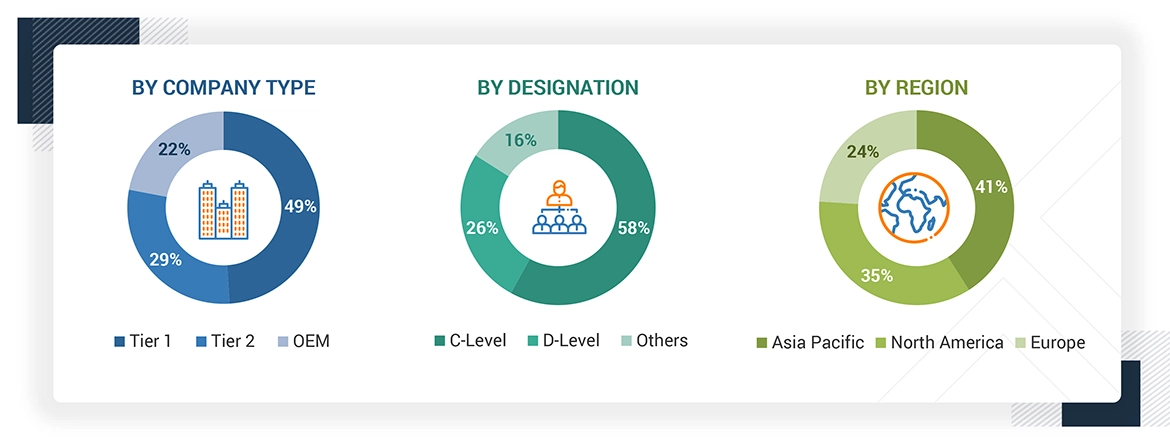
Note 1: Others include sales managers, marketing managers, and product managers.
Note 2: Tier 1 companies’ revenues are more than USD 10 billion; tier 2 companies’ revenues range between USD 1 and 10 billion; and tier 3 companies’ revenues range between USD 500 million and USD 1 billion.
Source: Industry Experts
To know about the assumptions considered for the study, download the pdf brochure
Market Size Estimation
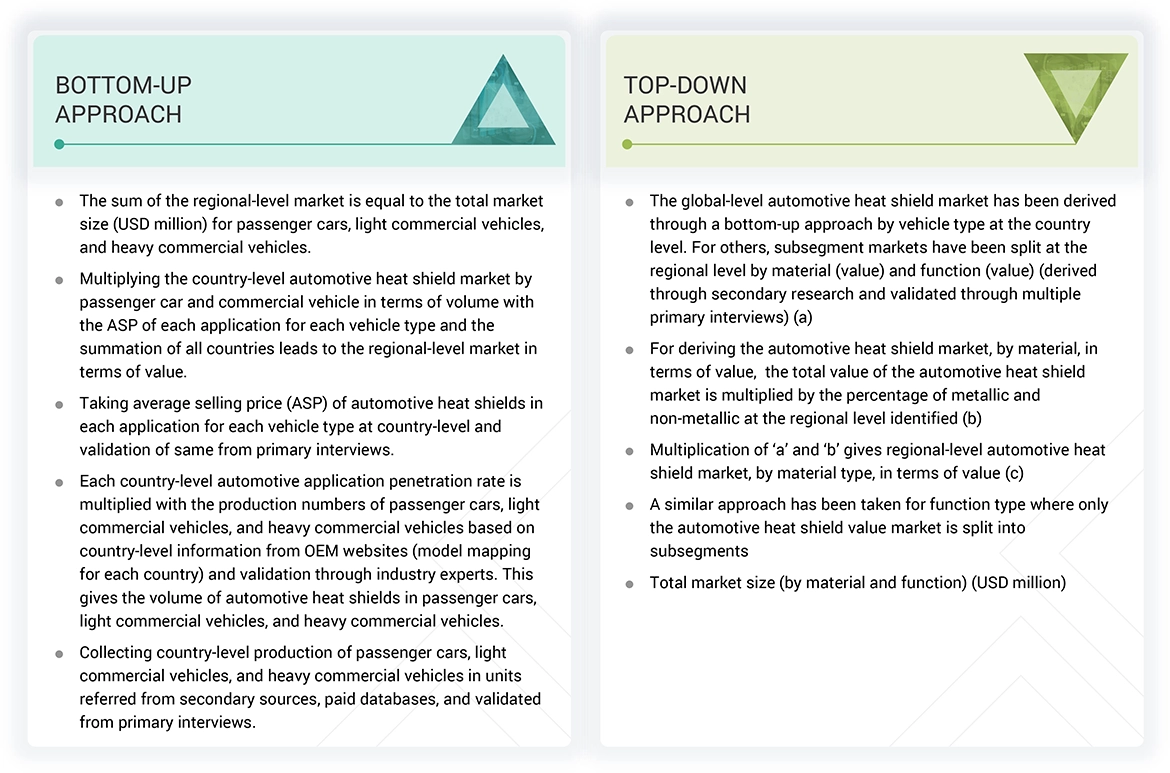
Both top-down and bottom-up approaches were used to estimate and validate the total size of the automotive heat shield market. These methods were also used extensively to estimate the size of various subsegments in the market. The research methodology used to estimate the market size includes the following:
Automotive Heat Shield Market : Top-Down and Bottom-Up Approach
Data Triangulation
After arriving at the overall market size—using the market size estimation processes as explained above—the market was split into several segments and subsegments. Data triangulation was employed to complete the overall market engineering process and arrive at the exact statistics of each market segment and subsegment, wherever applicable. The data was triangulated by studying various factors and trends from both the demand and supply sides.
Market Definition
Automotive heat shields are protective barriers designed to prevent heat from engine components, exhaust systems, or other high-temperature areas from affecting surrounding parts. They help enhance vehicle performance, safety, and durability by managing heat dissipation efficiently.
Stakeholders
- Automotive component manufacturers
- Associations, forums, and alliances related to automobiles
- Automotive original equipment manufacturers
- Automotive investors
- Automotive heat shield manufacturers
- Raw material suppliers for automotive heat shields
- Government agencies and policymakers
- Traders and distributors of automotive heat shields
Report Objectives
-
To define, segment, and forecast the size of the automotive heat shield market in terms of value (USD million) from 2025 to 2032, based on the following:
- Product type (single shell, double shell, and sandwich)
- Application (exhaust system heat shield, turbocharger heat shield, under bonnet heat shield, engine compartment heat shield, and under chassis heat shield)
- Function (acoustic and non-acoustic)
- Material type (metallic and non-metallic)
- Vehicle type (passenger cars, light commercial vehicles, and heavy commercial vehicles)
- Electric vehicle type (battery electric vehicles, plug-in hybrid electric vehicles, and fuel-cell electric vehicles)
- Region (Asia Pacific, Europe, North America, and Rest of the World)
- To identify and analyze key drivers, restraints, opportunities, and challenges influencing market growth
- To strategically analyze the market for individual growth trends, prospects, and contributions to the total market
-
To study the following with respect to the market
- Value chain analysis
- Ecosystem analysis
- Technology analysis
- Trade analysis
- Pricing analysis
- Case study analysis
- Patent analysis
- Regulatory framework
- Key stakeholders and buying criteria
- MnM insight on the average weight of heat shields in passenger car
- To strategically profile key players and comprehensively analyze their market share and core competencies
- To analyze the opportunities for stakeholders and the competitive landscape for market leaders
- To track and analyze competitive developments such as deals (collaboration, agreement, and acquisition), product launches/developments, expansions, and other activities undertaken by the key industry participants
Available Customizations
With the given market data, MarketsandMarkets offers customizations in accordance with company-specific needs.
Product Analysis
- Automotive heat shield market, by application, at country level
- Automotive heat shield market, by product type, at country level
Company Information
- Profiling of additional market players (up to five)
Get the Full Automotive Heat Shield Market Report
Full forecast, segment splits, and company analysis for all Automotive Heat Shield Market.
- China Automotive Heat Shield Market
- India Automotive Heat Shield Market
- Japan Automotive Heat Shield Market
- South Korea Automotive Heat Shield Market
- Thailand Automotive Heat Shield Market
- Germany Automotive Heat Shield Market
- France Automotive Heat Shield Market
- UK Automotive Heat Shield Market
- Spain Automotive Heat Shield Market
- Russia Automotive Heat Shield Market
- Turkey Automotive Heat Shield Market
- Italy Automotive Heat Shield Market
- Canada Automotive Heat Shield Market
- Mexico Automotive Heat Shield Market
- Brazil Automotive Heat Shield Market
- Iran Automotive Heat Shield Market
- South Africa Automotive Heat Shield Market
- Rest Of Europe Automotive Heat Shield Market
- Rest Of Asia Pacific Automotive Heat Shield Market
Need a Tailored Report?
Customize this report to your needs
Get 10% FREE Customization
Customize This Report
