
South Korea Automotive Interior Market (2026-2031)

The South Korea Automotive Interior Market was valued at $92272 Million in 2026 and projected to reach to $106709 Million by 2031, representing a compound annual growth rate of 2.1%. South Korea's automotive interior market is poised for steady expansion through 2031, supported by the country's robust manufacturing ecosystem and the presence of global automotive leaders.


| Market Size in | USD 26.32 MN |
| Market Forecast in | |
| CAGR | |
| Forecast Period | |
| Units Considered | Value (USD MN) |
South Korea Automotive Interior Market Trends and Insights
- South Korea, as a leading automotive manufacturing hub in Asia Pacific, continues to drive demand for advanced interior components including seating systems, dashboard assemblies, and infotainment solutions.
- The market in South Korea is supported by the country's strong automotive production base and the presence of major OEMs and Tier-1 suppliers. Growth in South Korea's automotive interior market through 2031 is underpinned by increasing vehicle electrification, rising consumer demand for premium cabin experiences, and technological integration in vehicle interiors.
- South Korea's focus on electric vehicle (EV) adoption and autonomous driving capabilities is reshaping interior design and material requirements.
- The market in South Korea reflects broader Asia Pacific trends while maintaining distinct characteristics driven by local manufacturing excellence and export-oriented production strategies..
Key Market Statistics
- CAGR (2026-2031) 2.1% CAGR
- Market Size, 2026 ~USD 92272 Million
- Forecast, 2031 ~USD 106709 Million
- Country South Korea
South Korea Automotive Interior Market Overview
Market Valuation :
South Korea's automotive interior market is valued at $92.3 billion USD in 2026, with projected growth to $106.7 billion USD by 2031, driven by the country's position as a leading automotive manufacturing hub in Asia Pacific.
Steady Growth Trajectory :
The market demonstrates a CAGR of 2.1% from 2026 to 2031, slightly below the global average of 2.2%, reflecting South Korea's mature automotive sector with consistent demand for interior component upgrades.
Advanced Component Demand :
South Korean manufacturers are increasingly investing in premium seating systems, sophisticated dashboard assemblies, and advanced infotainment integration, reflecting consumer preference for high-quality interior features.
Manufacturing Excellence :
As home to major automotive OEMs and Tier-1 suppliers, South Korea's interior market benefits from technological innovation, strong supply chain infrastructure, and export-driven production capabilities.
South Korea Automotive Interior Market Dynamics
- The market will benefit from increasing consumer demand for premium interior features, electrification of vehicles, and integration of advanced connectivity solutions.
- South Korean manufacturers are focusing on lightweight materials, sustainable production practices, and smart interior technologies to maintain competitive advantage in the global market.
- The transition toward electric vehicles will create new opportunities for innovative interior designs and functional components tailored to EV architectures..
Market Ecosystem
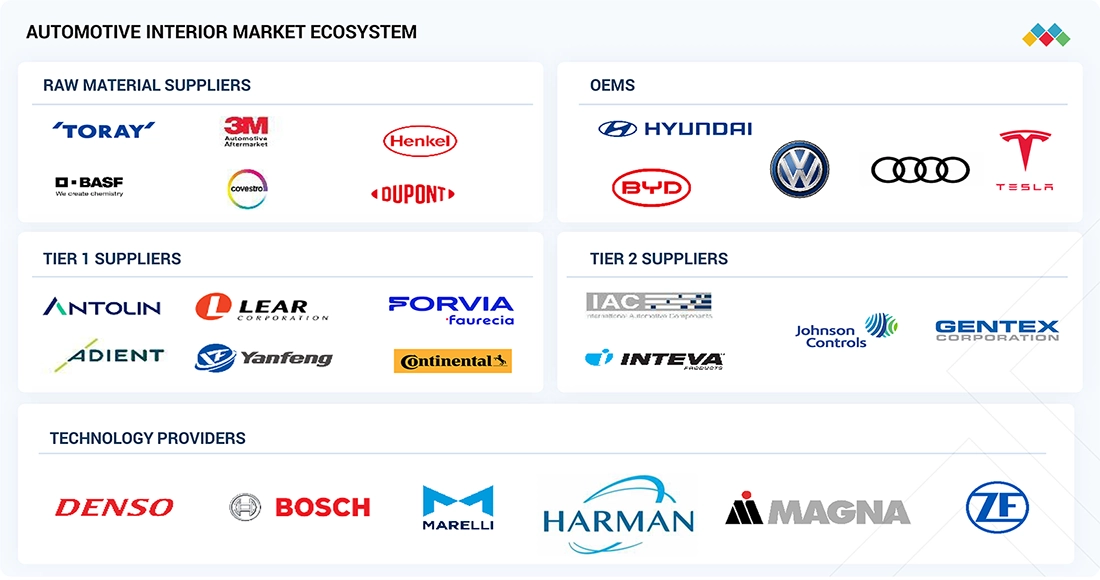
AUTOMOTIVE INTERIOR MARKET: COMMERCIAL USE CASES ACROSS INDUSTRIES
| COMPANY | USE CASE DESCRIPTION | BENEFITS |
|---|---|---|
 |
Development of sustainable interior materials and smart cockpit solutions integrating large displays and connected systems | Enhances in-cabin experience, reduces environmental impact, and supports lightweight vehicle design |
 |
Deployment of smart seating systems with integrated sensors, memory functions, and wellness features | Improves passenger comfort, enables personalization, and enhances long-distance driving experience |
 |
Integration of intelligent cockpit systems with digital interfaces, ambient lighting, and modular interior designs | Enables immersive user interaction, improves cabin aesthetics, and supports flexible interior layouts |
 |
Development of connected seating and electrical distribution systems for software-defined interiors | Enhances connectivity, supports real-time data integration, and improves system efficiency |
 |
Deployment of advanced HMI solutions including head-up displays (HUDs), driver monitoring systems, and large curved displays | Improves driver safety, reduces distraction, and delivers real-time information for better decision-making |
Logos and trademarks shown above are the property of their respective owners. Their use here is for informational and illustrative purposes only.
Related Ecosystem
Body Exterior Interior
- Battery Electric Vehicle (BEV)
- Fuel Cell Electric Vehicle (FCEV)
- Light Commercial Vehicles (LCVs)
- Hybrid Electric Vehicle (HEV)
- Agricultural Tractors
- AISIN CORPORATION
- Magna International Inc.
- GORKOVSKY AVTOMOBILNY ZAVOD
- BOCAR
- Continental ag
Key Takeaways
- South Korea's automotive interior market is valued at $92.3 billion USD in 2026 and will reach $106.7 billion USD by 2031 at a 2.1% CAGR.
- South Korea's strong OEM presence and Tier-1 supplier ecosystem drive continuous innovation in seating, dashboard, and infotainment technologies.
- EV electrification and autonomous vehicle development in South Korea are creating new interior design and material specifications.
- South Korea's export-oriented automotive manufacturing strategy positions the country as a critical supplier for global automotive interior components.
Automotive Interior Market Report Scope
| Report Metric | Details |
|---|---|
| Base Year | 2026 |
| Fastest Growing Segment | AUTONOMOUS CAR (Level Of Autonomy) |
| Forecast Period | 2026–2031 |
| Growth Rate | CAGR of 2.2% from 2026 to 2031 |
| Largest Segment | PASSENGER CAR (Ice Vehicle Type) |
| Market Size Base Year (Billions) | ~USD 186.43 (2026) |
| Revenue Forecast (Billions) | ~USD 207.86 (2031) |
| Segments Covered | Component Type, Vehicle Type, Component, Ice Vehicle Type, Electric Vehicle Type, Level Of Autonomy, Material Type, Passenger Car Class |
South Korea Automotive Interior Market Report Segmentation
8 segment dimensions are covered across the global market.
By Component Type
- Center Console
- Center Stack
- Dome Module
- Door Panel
- Head-Up Display
- Headliner
- Instrument Cluster
- Interior Lighting
- Rear Seat Entertainment
- Rear-Seat Entertainment
- Seat
By Vehicle Type
- Bev
- Fcev
- Hev
- Phev
By Component
- Center Console
- Center Stack
- Dome Module
- Door Panel
- Head-Up Display
- Headliner
- Instrument Cluster
- Interior Lighting
- Rear-Seat Entertainment
- Seat
By Ice Vehicle Type
- Heavy Commercial Vehicle
- Light Commercial Vehicle
- Passenger Car
By Electric Vehicle Type
- Battery Electric Vehicle
- Fuel Cell Electric Vehicle
- Hybrid Electric Vehicle
- Plug-In Hybrid Electric Vehicle
By Level Of Autonomy
- Autonomous Car
- Non-Autonomous Car
- Semi-Autonomous Car
By Material Type
- Carbon Fiber Composite
- Composites
- Fabric
- Fabric/Textile
- Glass Fiber Composite
- Leather
- Leather/Leatherette
- Metal
- Metals
- Polycarbonate And Acrylonitrile Butadiene Styrene
- Polypropylene (Pp)
- Polyurethane (Pu)
- Pvc/Thermoplastics
- Vinyl
- Wood
By Passenger Car Class
- Economic Car
- Economy Car
- Luxury Car
- Mid-Segment Car
Target Audience
- Automotive OEMs & Manufacturers : South Korean and international automotive manufacturers need detailed market intelligence to optimize interior component sourcing, plan production capacity, and align product development with regional market demands.
- Tier-1 & Tier-2 Suppliers : Component suppliers require market-specific data to identify growth opportunities, benchmark competitive positioning, and develop targeted strategies for seating, dashboard, and infotainment system contracts in South Korea.
- Investment & Private Equity Firms : Investors evaluating opportunities in South Korea's automotive sector need comprehensive market analysis to assess growth potential, identify acquisition targets, and make informed capital allocation decisions.
- Market Research & Consulting Firms : Research organizations require detailed South Korea-specific data to support client advisory services, competitive analysis, and strategic recommendations for automotive interior market participants.
- Government & Trade Organizations : Policy makers and trade bodies need market intelligence to develop industry strategies, support local manufacturers, and understand South Korea's position in the global automotive interior supply chain.
Key Companies in the South Korea Automotive Interior Market
| Company | HQ | Ownership | Strongest segments |
|---|---|---|---|
| JABIL | United States | Public Company | Regulated Industries (healthcare, automotive, packaging),Intelligent Infrastructure (5G, cloud, networking, industrial),Connected Living & Digital Commerce, |
| GAZ | Russia | Public Company | Gas business (upstream, midstream, sales),Oil and refined products,Electric power and heat, |
| AISIN SEIKI CO LTD | Japan | Public Company | Automatic, CVT, and manual transmissions,eAxle and electrified mobility systems,Brakes, steering, doors, roofs, and body systems, |
| METHODE ELECTRONICS | United States | Public Company | Electronic controls and power distribution,Power conversion solutions,Sensors and actuators, |
| AUTONEUM HOLDING AG | Switzerland | Public Company | Underbody and exterior shields (under body shields, wheelhouse liners, battery shields, heatshields),Engine and e-motor encapsulations, frunks, outer dashes, hoodliners, engine top covers,Interior floor systems (inner dashes, carpets, floor insulators, inner wheelhouse and trunk floor insulators, |
| GRAMMER AG | Germany | Public Company | Commercial vehicle driver and passenger seats,Offroad and industrial vehicle seats,Passenger car interior components, |
| ILLINOIS TOOL WORKS INC. | United States | Public Company | Automotive OEM,Food Equipment,Test & Measurement and Electronics, |
| INTERNATIONAL AUTOMOTIVE COMPONENTS | Luxembourg | Private Company | Instrument panels and consoles,Door systems,Headliners and overhead systems, |
| KENWOOD CORPORATION | Japan | Private Company | Car electronics (audio, navigation, in-dash systems),Land mobile and professional radio systems,Amateur radio and low power transceivers, |
| NISSAN MOTOR CORPORATION | Japan | Public Company | ICE passenger vehicles and light commercial vehicles,Electrified vehicles and powertrains (including EVs and hybrids),Sales financing and related financial services, |
| SRG GLOBAL | Australia | Public Company | Maintenance and Industrial Services,Engineering and Construction,Software and Digital / AI Solutions, |
| FORVIA | France | Public Company | Seating,Interiors,Clean Mobility, |
| LEAR CORPORATION | United States | Public Company | Complete Seating Systems,Seat Components, Trim, and Surface Materials,E-Systems: Wire Harnesses & Power Distribution, |
| ADIENT PLC. | Ireland | Public Company | Complete seating systems,Seat structures and mechanisms,Foam and metal frames, |
| CONTINENTAL AG | Germany | Public Company | Passenger and light truck tires,Truck, bus, and specialty vehicle tires,Industrial products (hoses, conveyor belts, air springs, drive belts), |
| ANTOLIN | Spain | Private Company | Headliners and Overhead Systems,Door Panels and Trim Components,Cockpit, Instrument Panel, and HMI/Electronic Systems, |
| MOTHERSON | India | Public Company | Wiring Harness and Electrical Distribution,Modules and Polymer Products,Vision Systems (Mirrors and Camera Monitoring), |
| TOYOTA BOSHOKU CORPORATION | Japan | Public Company | Automobile seats (complete systems, frames, recliners, rails),Interior and exterior components (door trims, headliners, carpets, bumpers, liners),Filters and ICE powertrain components, |
| ROBERT BOSCH GMBH | Germany | Private Company | Mobility (automotive systems and aftermarket),Industrial Technology (drive, control, packaging),Consumer Goods (power tools and appliances), |
| HYUNDAI MOBIS | South Korea | Public Company | Auto Parts – Modules (chassis, cockpit, front-end, bumpers),Auto Parts – Electrification (power conversion, drive, battery, 48V),Auto Parts – Autonomous driving, safety, braking, steering, |
| DENSO CORPORATION | Japan | Public Company | Thermal and HVAC systems,Powertrain systems (ICE, hybrid, EV, fuel cell),Safety and cockpit systems, |
| ZF FRIEDRICHSHAFEN AG | Germany | Private Company | Passenger car driveline, chassis, and safety systems,Commercial vehicle, truck, trailer, bus, and fleet systems,Industrial applications (construction, agriculture, marine, wind, rail, material handling), |
| PANASONIC HOLDINGS CORPORATION | Japan | Public Company | HVAC & CC (air conditioners, heat pumps, ventilation, showcases),Energy (cylindrical lithium-ion, dry and storage batteries),Electric Works (lighting, wiring devices, solar PV, fuel cells, building materials), |
| VALEO | France | Public Company | Power (thermal systems, EV cooling, HVAC, air quality),Brain (ADAS, sensors, lidar, connectivity, access),Light (lighting systems and wiper systems), |
JABIL
Jabil is a United States-based public company founded in 1966 that employs 135,000 people. The company operates as a major manufacturing and supply chain solutions provider.
GAZ
GAZ is a Russian public company founded in 1993 with 468,000 employees. The company is a major automotive manufacturer.
AISIN SEIKI CO LTD
Aisin Seiki Co Ltd is a Japanese public company founded in 1943 employing 113,292 people. The company is a leading automotive parts supplier.
METHODE ELECTRONICS
Methode Electronics is a United States-based public company founded in 1946 with 6,650 employees. The company manufactures electronic components and assemblies.
AUTONEUM HOLDING AG
Autoneum Holding AG is a Swiss public company founded in 1901 employing 16,407 people. The company is a leading provider of acoustic and thermal management solutions for vehicles.
GRAMMER AG
Grammer AG is a German public company founded in 1880 with 11,400 employees. The company manufactures automotive interior components and seating systems.
ILLINOIS TOOL WORKS INC.
Illinois Tool Works Inc. is a United States-based public company founded in 1912 employing 43,000 people. The company manufactures diversified products and engineered systems.
INTERNATIONAL AUTOMOTIVE COMPONENTS
International Automotive Components is a Luxembourg-based private company founded in 2006 with 27,000 employees. The company is a global supplier of automotive interior systems.
KENWOOD CORPORATION
Kenwood Corporation is a Japanese private company founded in 1946 with 4,691 employees. The company manufactures audio and electronic equipment.
NISSAN MOTOR CORPORATION
Nissan Motor Corporation is a Japanese public company founded in 1933 employing 120,079 people. The company is a major global automobile manufacturer.
SRG GLOBAL
SRG Global is an Australian public company founded in 1961. The company operates in the automotive and industrial sectors.
FORVIA
Forvia is a French public company founded in 1914 employing 106,513 people. The company is a leading global automotive technology supplier.
LEAR CORPORATION
Lear Corporation is a United States-based public company founded in 1917 employing 164,300 people. The company is a major global supplier of automotive seating and electrical systems.
ADIENT PLC.
Adient PLC is an Ireland-based public company founded in 2016 with 65,000 employees. The company is a leading global automotive seating supplier.
CONTINENTAL AG
Continental AG is a German public company founded in 1871 with 22,076 employees. The company manufactures automotive components and systems.
ANTOLIN
Antolin is a Spanish private company founded in 1959 with 18,444 employees. The company specializes in automotive interior components.
MOTHERSON
Motherson is an India-based public company founded in 1975 employing 93,971 people. The company is a major automotive component supplier.
TOYOTA BOSHOKU CORPORATION
Toyota Boshoku Corporation is a Japanese public company founded in 1918 employing 45,521 people. The company manufactures automotive interior systems and components.
ROBERT BOSCH GMBH
Robert Bosch GmbH is a German private company founded in 1886 employing 412,774 people. The company is a leading global supplier of automotive technology and industrial solutions.
HYUNDAI MOBIS
Hyundai Mobis is a South Korean public company founded in 1977. The company is a major automotive parts and components supplier.
DENSO CORPORATION
Denso Corporation is a Japanese public company founded in 1949 employing 154,716 people. The company is a leading global supplier of automotive components and systems.
ZF FRIEDRICHSHAFEN AG
ZF Friedrichshafen AG is a German private company founded in 1915 employing 145,909 people. The company is a major global supplier of driveline and chassis technology.
PANASONIC HOLDINGS CORPORATION
Panasonic Holdings Corporation is a Japanese public company founded in 1918 employing 183,685 people. The company manufactures electronics, batteries, and automotive components.
VALEO
Valeo is a French public company founded in 1923 employing 87,115 people. The company is a leading global automotive supplier of thermal, visibility, and powertrain systems.
Reasons to Buy this Report
- Market-Specific Sizing & Forecasts : Access precise valuation data for South Korea's automotive interior market with detailed projections through 2031, enabling accurate financial planning and investment decisions specific to this key Asian manufacturing hub.
- Competitive Landscape Intelligence : Understand the competitive dynamics among South Korean OEMs and Tier-1 suppliers, including market share analysis and strategic positioning of local and international players in the region.
- Technology & Innovation Insights : Gain detailed analysis of advanced interior technologies being developed and adopted in South Korea, including EV-specific designs, smart features, and sustainable material innovations driving market differentiation.
- Supply Chain & Manufacturing Trends : Identify opportunities within South Korea's automotive supply chain, including manufacturing capabilities, export potential, and partnerships with global OEMs seeking high-quality interior component suppliers.
- Strategic Market Entry & Expansion : Develop informed strategies for entering or expanding operations in South Korea's automotive interior market with comprehensive insights into regulatory environment, consumer preferences, and growth opportunities.
Frequently asked questions
What is the current size of South Korea's automotive interior market?
South Korea's automotive interior market is estimated at $92.3 billion USD in 2026.
What is the projected market size for South Korea's automotive interior market by 2031?
South Korea's automotive interior market is forecast to reach $106.7 billion USD by 2031.
What is the CAGR for South Korea's automotive interior market?
South Korea's automotive interior market is expected to grow at a CAGR of 2.1% from 2026 to 2031.
What are the primary drivers of growth in South Korea's automotive interior market?
Key growth drivers in South Korea include vehicle electrification, premium cabin demand, advanced infotainment integration, and autonomous vehicle development.
Why is South Korea significant in the global automotive interior market?
South Korea is a major automotive manufacturing hub with leading OEMs and Tier-1 suppliers that supply both domestic and global markets with advanced interior components.
RESEARCH METHODOLOGY
Exhaustive secondary research was conducted to collect information on the market, the peer market, and the parent market. The data was validated by industry experts across value chains through primary research. The top-down approach was employed to estimate the complete market size. Thereafter, market breakdown and data triangulation were used to estimate the market size of segments and subsegments.
Secondary Research
In the secondary research process, various secondary sources were used to identify and collect information on the automotive interior market for this study. Secondary sources for this research study include corporate filings, such as annual reports, investor presentations, and financial statements; trade, business, and professional associations; whitepapers and automotive software-related journals; certified publications; articles by recognized authors; directories; and databases. Secondary research has been used to obtain key information about the industry's supply chain, the overall pool of key players, market classification and segmentation according to industry trends to the bottom-most level, regional markets, and key developments from the market- and technology-oriented perspectives.
Primary Research
Extensive primary research has been conducted following an understanding of the global automotive interior market through secondary research. Several primary interviews have been conducted with market experts from both the demand (OEMs/vehicle manufacturers) and supply (component manufacturers, module manufacturers, material providers, and system integrators) sides across four major regions, namely, North America, Europe, Asia Pacific, and the Rest of the World. Approximately 22% of the experts involved in primary interviews have been from the demand side, and 78% have been from the supply side of the industry. Primary data has been collected through questionnaires, emails, and telephonic interviews. Several primary interviews have been conducted with departments across organizations, such as sales, operations, and administration, to provide a holistic perspective in the report.
Following interactions with industry participants, brief sessions have been conducted with experienced independent consultants to reinforce the findings from the primary interviews. This, along with the opinions of in-house subject matter experts, has led to the findings outlined in the remainder of this report.
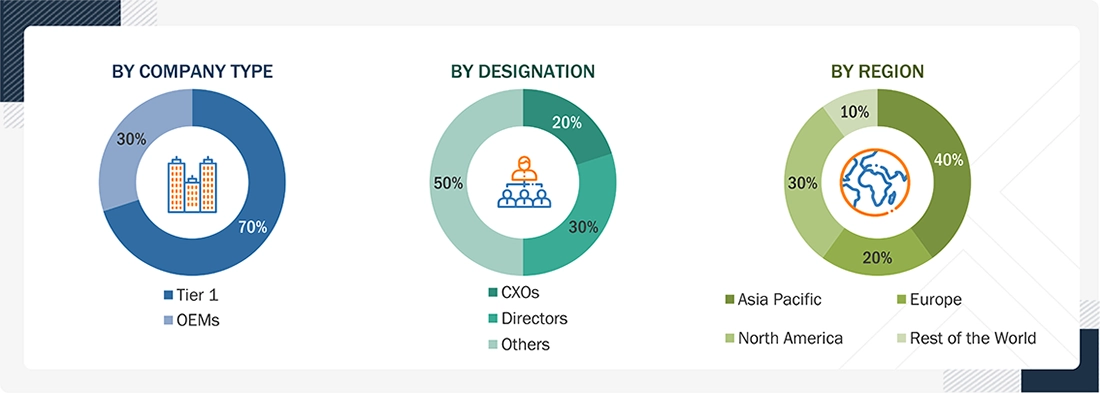
Note: Tiers of companies are based on the value chain of the automotive interior market; revenues of companies have not been considered. Tier 1 companies are component manufacturers. Other designations include sales, marketing, and product managers.
To know about the assumptions considered for the study, download the pdf brochure
Market Size Estimation
The bottom-up and top-down approaches have been used to estimate and validate the size of the global automotive interior market. In these approaches, vehicle production statistics for each vehicle type (passenger, light commercial, and heavy commercial) in a country have been considered.
A detailed market estimation approach has been followed to estimate and validate the volume and value of the automotive interior market and other dependent submarkets, as mentioned below:
- Key players in the automotive interior market have been identified through secondary research, and their global market shares have been determined through both primary and secondary research.
- The research methodology includes analyzing annual and quarterly financial reports & regulatory filings from major market players, as well as conducting interviews with industry experts to obtain detailed market insights.
- All major penetration rates, percentage shares, splits, and breakdowns for the automotive interior market across different countries and regions have been determined using secondary sources and verified through primary sources.
- All key macro indicators affecting the revenue growth of the market segments and subsegments have been accounted for, viewed in extensive detail, verified through primary research, and analyzed to get the validated and verified quantitative & qualitative data.
- The gathered market data has been consolidated, supplemented with detailed inputs, analyzed, and presented in this report.
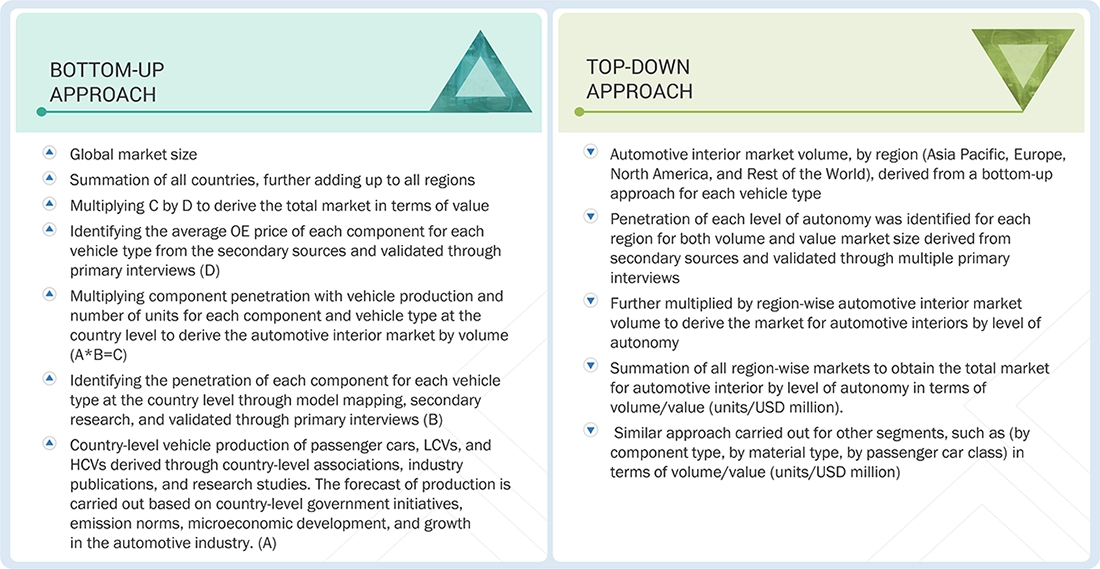
Data Triangulation
All percentage shares, splits, and breakdowns have been determined using secondary sources and verified through primary sources. All parameters affecting the markets covered in this research study have been accounted for, viewed in extensive detail, verified through primary research, and analyzed to obtain the final quantitative and qualitative data. This data has been consolidated and enhanced with detailed inputs and analysis from MarketsandMarkets and presented in the report. The following figure illustrates the overall market size estimation process used in this study.
Market Definition
Automotive interiors refer to the interior components of a vehicle's cabin/body, including the center stack, door panels, seats, instrument cluster, lighting, headliner, dome module, center console, and other components.
Key Stakeholders
- Original Equipment Manufacturers (OEMs)
- Tier 1 Component Manufacturers, Tier 2 Raw Material Suppliers
- ADAS/Occupant Safety Solution Suppliers
- Augmented Reality HUD Technology Providers
- Automobile Organizations/Associations
- Automotive Center Stack Manufacturers
- Automotive Cockpit Manufacturers
- Automotive Component Manufacturers
- Automotive Display Suppliers
- Automotive Electronic Hardware Suppliers
- Automotive Electronic System Integrators
- Automotive Instrument Cluster Manufacturers
- Automotive Interior System Manufacturers
- Automotive Seats Manufacturers
- Automotive Smart Display Panel Manufacturers
- Automotive SoC and ECU Manufacturers
- Automotive Upholstery Suppliers
- Country-specific Automotive Associations
- European Automobile Manufacturers Association (ACEA)
- EV and EV Component Manufacturers
- Government & Research Organizations
- HUD Technology Providers
- National Highway Traffic Safety Administration (NHTSA)
- Regulatory Bodies
- Smart Display Technology Providers
- Software Providers
- Traders, Distributors, and Suppliers of Automotive Interior Components
- Vehicle Safety Regulatory Bodies
Report Objectives
-
To define, describe, and project the automotive interior market in terms of volume
(thousand units) and value (USD million/billion) - To define, describe, and forecast the market on the basis of component type, material type, passenger car class, electric vehicle (EV) type, level of autonomy, ICE vehicle type, and region
- To analyze the regional markets for growth trends, prospects, and their contribution to the overall market
- To segment and forecast the market on the basis of component type: instrument cluster, HUD, center stack, rear seat entertainment, interior lighting (dashboard light, glove box light, reading light, dome light, rear view mirror interior light, engine component light, passenger area light, driver area light, footwell light, and others), door panel, seat (standard seat; only powered; only heated; powered and heated seat; powered, heated and ventilated seat; powered, heated & memory seat; powered heated, ventilated, & memory seat; and powered, heated, ventilated, massage, and memory seat), dome module, headliner, center console, adhesive & tapes, upholstery, and others
- To segment and forecast the market on the basis of material type: leather, fabric, vinyl, wood, glass fiber composite, carbon fiber composite, and metal
- To segment and forecast the market on the basis of passenger car class: mid-segment car, luxury car, and economy car
- To segment and forecast the market on the basis of electric vehicle type: battery electric vehicle (BEV), fuel cell electric vehicle (FCEV), hybrid electric vehicle (HEV), and plug-in hybrid electric vehicle (PHEV)
- To segment and forecast the market on the basis of the level of autonomy: non-autonomous cars, semi-autonomous cars, and autonomous cars
- To segment and forecast the market on the basis of ICE vehicle type: passenger car (PC), light commercial vehicle (LCV), and heavy commercial vehicle (HCV)
- To forecast the market size, by volume and value, with respect to four regions: North America, Europe, Asia Pacific, and the Rest of the World (RoW)
- To provide detailed information regarding the major factors influencing market growth (drivers, restraints, opportunities, and challenges)
- To strategically analyze markets with respect to individual growth trends, future prospects, and contribution to the total market
- To analyze the opportunities for stakeholders and the details of the competitive landscape for market leaders
- To study the following with respect to the market:
- Impact of AI/Gen AI
- Trend and Disruption Impact
- Supply Chain Analysis
- Ecosystem Analysis
- Technology Analysis
- Case Study Analysis
- Patent Analysis
- Investment Scenario
- Trade Analysis
- Regulatory Landscape
- Key Stakeholder and Buying Criteria
- Key Conferences and Events
- Average Selling Price Analysis
- Impact of EU-FTA trade deal on the automotive & transportation industry
- Impact of the Israel-Iran war on the automotive & transportation industry
- To strategically profile key players and comprehensively analyze their market share and core competencies
- To track and analyze competitive developments such as deals (joint ventures, mergers & acquisitions, partnerships, collaborations), product developments, and other activities carried out by key industry participants
Available customizations:
With the given market data, MarketsandMarkets offers customizations in accordance with a company’s specific needs.
- Automotive Interior Market, by Electric Vehicle Type at Country Level
- Automotive Interior Market, by ICE Vehicle Type at Country Level (for countries not covered in the report)
Company Information
- Profiling of Additional Market Players (Up to 3)
Get the Full Automotive Interior Market Report
Full forecast, segment splits, and company analysis for all Automotive Interior Market.
- China Automotive Interior Market
- Japan Automotive Interior Market
- India Automotive Interior Market
- Thailand Automotive Interior Market
- Germany Automotive Interior Market
- France Automotive Interior Market
- UK Automotive Interior Market
- Spain Automotive Interior Market
- Italy Automotive Interior Market
- Russia Automotive Interior Market
- Turkey Automotive Interior Market
- Canada Automotive Interior Market
- Mexico Automotive Interior Market
- US Automotive Interior Market
- Brazil Automotive Interior Market
- Iran Automotive Interior Market
- South Africa Automotive Interior Market
Need a Tailored Report?
Customize this report to your needs
Get 10% FREE Customization
Customize This Report
