
South Korea Automotive Radar Market (2026-2031)

The South Korea Automotive Radar Market was valued at $3728.8 Million in 2026 and projected to reach to $11455.4 Million by 2031, representing a compound annual growth rate of CAGR 17.4%. South Korea's automotive radar market is positioned for exceptional growth, driven by the country's established automotive manufacturing base and technological expertise.


| Market Size in | USD 26.32 MN |
| Market Forecast in | |
| CAGR | |
| Forecast Period | |
| Units Considered | Value (USD MN) |
South Korea Automotive Radar Market Trends and Insights
- This 17.4% compound annual growth rate reflects South Korea's position as a leading automotive technology hub, driven by the country's advanced manufacturing capabilities and strong presence of global automotive suppliers.
- South Korea's investment in autonomous vehicle development and advanced driver-assistance systems (ADAS) is accelerating radar adoption across the region. The South Korean automotive radar market benefits from the country's established automotive ecosystem, including major OEMs and Tier-1 suppliers investing heavily in sensor technology.
- South Korea's regulatory environment and consumer demand for safety features are propelling radar system integration into both premium and mid-segment vehicles.
- Between 2026 and 2031, South Korea is expected to capture significant market share within Asia Pacific, supported by technological innovation and export-oriented manufacturing strategies that position the country as a critical hub for radar component production and integration..
Key Market Statistics
- CAGR (2026-2031) CAGR 17.4%
- Market Size, 2026 ~USD 3728.8 Million
- Forecast, 2031 ~USD 11455.4 Million
- Country South Korea
South Korea Automotive Radar Market Overview
Rapid Market Expansion :
South Korea's automotive radar market is projected to grow from $3,728.8 million in 2026 to $11,455.4 million by 2031, representing a robust 17.4% CAGR driven by increasing adoption of advanced driver assistance systems (ADAS) in domestic and export vehicles.
Technology Leadership Hub :
South Korea's position as a global automotive technology leader, home to major OEMs like Hyundai and Kia, combined with a strong ecosystem of Tier-1 suppliers, accelerates radar technology innovation and market penetration across the region.
Government Support & Regulations :
South Korean government initiatives promoting autonomous vehicle development and stricter vehicle safety regulations mandate advanced radar systems, creating sustained demand growth throughout the forecast period.
Export Market Opportunity :
South Korea's automotive radar suppliers leverage the country's manufacturing excellence to serve global markets, with domestic production capabilities supporting both regional demand and international export growth.
South Korea Automotive Radar Market Dynamics
- The 17.4% CAGR reflects strong demand from domestic OEMs implementing ADAS and autonomous driving features across their vehicle portfolios.
- Hyundai and Kia's global expansion strategies necessitate advanced radar systems, while government policies supporting vehicle electrification and autonomous technology development create favorable market conditions. The market's trajectory is further supported by South Korea's robust supply chain ecosystem and R&D investments in next-generation radar technologies.
- As the country strengthens its position in autonomous vehicle development and exports advanced automotive components globally, radar system adoption will accelerate.
- Strategic partnerships between local suppliers and international automotive players will enhance market competitiveness and drive innovation, positioning South Korea as a critical hub for automotive radar technology development and manufacturing through 2031..
Market Ecosystem
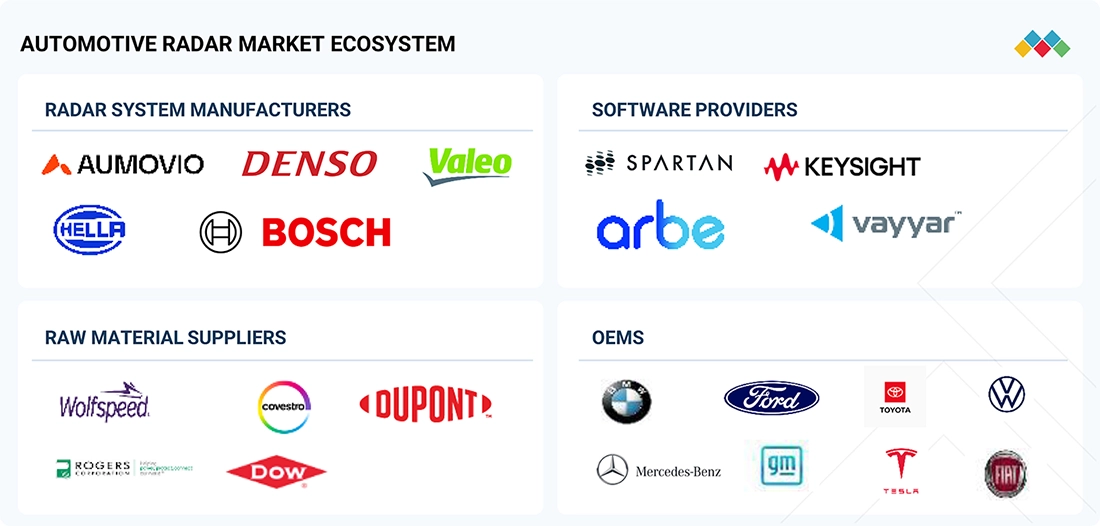
AUTOMOTIVE RADAR MARKET SIZE, SHARE, FORECAST, REPORT: COMMERCIAL USE CASES ACROSS INDUSTRIES
| COMPANY | USE CASE DESCRIPTION | BENEFITS |
|---|---|---|
 |
Develops short-, mid-, and long-range radar sensors for ADAS features such as adaptive cruise control (ACC), automatic emergency braking (AEB), and blind-spot detection in passenger vehicles | Improves vehicle safety, enables collision avoidance, and supports higher levels of driving automation |
 |
Provides 77 GHz radar systems for autonomous driving and cross-traffic alert in both passenger and commercial vehicles | Enhances object detection accuracy, supports all-weather sensing, and improves road safety |
 |
Supplies high-resolution imaging radar for Level 2+ to Level 3 autonomous driving systems, including highway pilot functions | Enables precise environment mapping, improves decision-making capability, and supports semi-autonomous driving |
 |
Integrates radar sensors into centralized ADAS platforms for sensor fusion with cameras and LiDAR | Enhances perception reliability, reduces system redundancy, and supports scalable autonomous architectures |
 |
Develops compact radar modules for parking assistance, blind spot monitoring, and urban driving assistance systems | Improves low-speed maneuvering safety, reduces parking-related accidents, and enhances driver convenience |
Logos and trademarks shown above are the property of their respective owners. Their use here is for informational and illustrative purposes only.
Related Ecosystem
Automotive Advance Technologies
- Battery Electric Vehicle (BEV)
- Light Commercial Vehicles (LCVs)
- Fuel Cell Electric Vehicle (FCEV)
- Hybrid Electric Vehicle (HEV)
- Internal Combustion Engine (ICE)
- BOSCH LIMITED
- Continental ag
- Visteon Corporation
- DENSO Corporation
- ZF FRIEDRICHSHAFEN AG
Driving Support Security
- Battery Electric Vehicle (BEV)
- Hybrid Electric Vehicle (HEV)
- Light Commercial Vehicles (LCVs)
- Fuel Cell Electric Vehicle (FCEV)
- Blind Spot Detection (BSD)
- BOSCH LIMITED
- Continental ag
- DENSO Corporation
- Magna International Inc.
- ZF FRIEDRICHSHAFEN AG
Key Takeaways
- South Korea's automotive radar market will grow from $3,728.8M (2026) to $11,455.4M (2031), representing a 17.4% CAGR.
- South Korea's advanced automotive manufacturing ecosystem and OEM presence drive strong radar technology adoption and innovation.
- South Korea's focus on autonomous vehicles and ADAS integration accelerates demand for sophisticated radar systems across vehicle segments.
- South Korea is positioned as a critical Asia Pacific hub for radar component production, export, and supply chain integration.
Automotive Radar Market Report Scope
| Report Metric | Details |
|---|---|
| Base Year | 2026 |
| Fastest Growing Segment | HEAVY COMMERCIAL VEHICLE (Vehicle Type) |
| Forecast Period | 2026–2031 |
| Growth Rate | CAGR of 20.7% from 2026 to 2031 |
| Largest Segment | PASSENGER CAR (Vehicle Type) |
| Market Size Base Year (Billions) | ~USD 7.24 (2026) |
| Revenue Forecast (Billions) | ~USD 18.55 (2031) |
| Segments Covered | Vehicle Type, Ev Type, Frequency, Range |
South Korea Automotive Radar Market Report Segmentation
4 segment dimensions are covered across the global market.
By Vehicle Type
- Heavy Commercial Vehicle
- Light Commercial Vehicle
- Passenger Car
By Ev Type
- Battery Electric Vehicle
- Fuel Cell Electric Vehicle
- Hybrid Electric Vehicle
- Plug-In Hybrid Electric Vehicle
By Frequency
- 2X-Ghz
- 7X-Ghz
By Range
- Long-Range Radar
- Medium-Range Radar
- Short-Range Radar
Target Audience
- Automotive OEMs & Suppliers : South Korean and international automotive manufacturers need market intelligence to optimize radar system sourcing, understand local supplier capabilities, and align product development with regional demand trends.
- Radar Technology Providers : Sensor manufacturers and radar system developers require detailed South Korea market data to identify growth opportunities, competitive positioning, and customer requirements among domestic OEMs and Tier-1 suppliers.
- Investment & Private Equity Firms : Investors evaluating opportunities in South Korea's automotive technology sector need market sizing, growth projections, and competitive analysis to assess portfolio companies and identify acquisition targets.
- Government & Policy Makers : South Korean government agencies and industry associations require market data to inform autonomous vehicle policies, safety regulations, and technology development initiatives supporting the automotive sector.
- Market Research & Consulting Firms : Research organizations and consultants serving automotive clients need country-specific market data, forecasts, and competitive intelligence to support strategic advisory and client deliverables.
Key Companies in the South Korea Automotive Radar Market
| Company | HQ | Ownership | Strongest segments |
|---|---|---|---|
| JABIL | United States | Public Company | Regulated Industries (Healthcare, Medical Devices, Automotive, Packaging),Intelligent Infrastructure (5G, Wireless, Cloud, Networking, Storage, Industrial),Connected Living and Digital Commerce (Connected Devices, Mobility, Digital Print, Retail, Smart Buildings), |
| MELEXIS NV | Belgium | Public Company | Magnetic, current, and inductive position sensor ICs,Speed, pressure, temperature, optical, and tire monitoring sensor ICs,Time-of-flight ICs, |
| COBHAM PLC | United Kingdom | Private Company | Airborne communications and connectivity,Mission systems and high-reliability electronics,Space and deep ocean communications, |
| TOWER SEMICONDUCTOR LTD | Israel | Public Company | Analog & Mixed-Signal CMOS / RF CMOS / SiGe,CMOS Image Sensors & Non-Imaging Sensors,Power Management & Integrated Power Platforms, |
| MCLAREN GROUP | United Kingdom | Private Company | GT,Supercars,Ultimate, |
| TOYODA GOSEI CO., LTD | Japan | Public Company | Weatherstrips,Functional components (fuel tank, battery, engine, chassis, drivetrain),Interior and exterior plastics (grilles, ducts, filler pipes), |
| MITSUBISHI ELECTRIC CORPORATION | Japan | Public Company | Factory Automation & Industrial Systems,Building Systems (Elevators, Escalators, BMS),Air Conditioning, Refrigeration & Home Equipment, |
| AUMOVIO SE | Germany | Public Company | Software-defined mobility platforms & virtualization,Safety engineering & ADAS solutions,Hardware & build-to-print services, |
| HELLA GMBH & CO. KGAA | Germany | Public Company | Lighting,Electronics,Lifecycle Solutions, |
| ROBERT BOSCH GMBH | India | Private Company | Mobility (gasoline, diesel, chassis control, electrical drives, automotive electronics, aftermarket, steering),Industrial Technology (drive, control, actuators, process and packaging solutions),Consumer Goods (power tools, garden tools, household appliances, industrial tools, measuring equipment), |
| MAGNA INTERNATIONAL INC. | Canada | Public Company | Body Exteriors & Structures,Power & Vision (ADAS, electronics, lighting),Seating Systems, |
| DENSO CORPORATION | Japan | Public Company | Thermal and HVAC systems,Powertrain systems (gasoline, diesel, hybrid, EV, fuel cell),Safety and cockpit systems, |
| APTIV | Ireland | Public Company | Electrical Distribution Systems,Engineered Components (Connection Systems and Interconnects),Advanced Safety and User Experience / Smart Vehicle Compute and Software, |
| NXP SEMICONDUCTORS | Netherlands | Public Company | Automotive MCUs, processors, and analog/RF,Industrial & IoT MCUs, connectivity, and sensors,Mobile & secure connectivity (NFC, UWB, security controllers), |
| INFINEON TECHNOLOGIES AG | Germany | Public Company | Automotive (microcontrollers, power, sensors, connectivity),Green Industrial Power (IGBTs, SiC, power modules),Power & Sensor Systems (MOSFETs, GaN, sensors, USB, RF), |
| VALEO | France | Public Company | Power (thermal systems and EV thermal management),Brain (ADAS, lidar, connectivity, access),Light (lighting and wiper systems), |
| ZF FRIEDRICHSHAFEN AG | Germany | Private Company | Passenger car driveline, chassis, and safety systems,Commercial vehicle, truck, bus, trailer, and LCV systems,Industrial technology and off-highway (construction, agriculture, marine, wind, rail), |
| TEXAS INSTRUMENTS INCORPORATED | United States | Public Company | Analog – Power,Analog – Signal Chain,Embedded Processing (MCUs, processors, connectivity, radar), |
| RENESAS ELECTRONICS CORPORATION | Japan | Public Company | Microcontrollers and Microprocessors,Analog, Mixed-Signal, and Power (incl. PMICs, drivers, power discretes),Automotive-specific Products and Sensors, |
| HL KLEMOVE | South Korea | Private Company | Brake control electronics,Steering and suspension controls,Sensors and emissions control ECUs, |
JABIL
Jabil is a United States-based public company founded in 1966 that employs 135,000 people. The company operates as a major manufacturing and supply chain solutions provider.
MELEXIS NV
Melexis NV is a Belgian public company founded in 1988 with 2,000 employees, operating in the semiconductor and microelectronics sector.
COBHAM PLC
Cobham PLC is a United Kingdom-based private company founded in 1889 that employs 10,037 people, with a long history in aerospace and defense industries.
TOWER SEMICONDUCTOR LTD
Tower Semiconductor Ltd is an Israeli public company founded in 1993 with 5,613 employees, specializing in semiconductor manufacturing and foundry services.
MCLAREN GROUP
McLaren Group is a United Kingdom-based private company established in 1963 with 2,627 employees, known for its operations in automotive and motorsports.
TOYODA GOSEI CO., LTD
Toyoda Gosei Co., Ltd is a Japanese public company founded in 1949 with 41,304 employees, operating in automotive components and materials.
MITSUBISHI ELECTRIC CORPORATION
Mitsubishi Electric Corporation is a Japanese public company founded in 1921 with 150,386 employees, operating across multiple industrial and consumer electronics sectors.
AUMOVIO SE
Aumovio SE is a German public company founded in 2024 with 31,054 employees.
HELLA GMBH & CO. KGAA
Hella GmbH & Co. KGAA is a German public company founded in 1899 with 33,639 employees, specializing in automotive lighting and electronics.
ROBERT BOSCH GMBH
Robert Bosch GmbH is a private company founded in 1886 with 412,774 employees, operating as a major supplier of automotive and industrial technology.
MAGNA INTERNATIONAL INC.
Magna International Inc. is a Canadian public company founded in 1957 with 156,000 employees, serving as a leading global automotive supplier.
DENSO CORPORATION
Denso Corporation is a Japanese public company founded in 1949 with 154,716 employees, specializing in automotive components and systems.
APTIV
Aptiv is an Irish public company founded in 2011 with 140,000 employees, focused on automotive technology and mobility solutions.
NXP SEMICONDUCTORS
NXP Semiconductors is a Netherlands-based public company founded in 2006 with 32,169 employees, operating in semiconductor design and manufacturing.
INFINEON TECHNOLOGIES AG
Infineon Technologies AG is a German public company founded in 1952 with 56,500 employees, operating as a major semiconductor manufacturer.
VALEO
Valeo is a French public company founded in 1923 with 87,115 employees, serving as a global automotive supplier of components and systems.
ZF FRIEDRICHSHAFEN AG
ZF Friedrichshafen AG is a German private company founded in 1915 with 145,909 employees, specializing in driveline and chassis technology.
TEXAS INSTRUMENTS INCORPORATED
Texas Instruments Incorporated is a United States-based public company founded in 1930 with 33,000 employees, operating as a major semiconductor manufacturer.
RENESAS ELECTRONICS CORPORATION
Renesas Electronics Corporation is a Japanese public company founded in 2002 with 21,907 employees, specializing in semiconductor design and manufacturing.
HL KLEMOVE
HL Klemove is a South Korean private company founded in 2008 with 333 employees.
Reasons to Buy this Report
- Market-Specific Growth Insights : Gain detailed understanding of South Korea's unique 17.4% CAGR trajectory, distinct from global 20.7% growth, with country-specific drivers including domestic OEM strategies and regulatory environment analysis.
- Competitive Landscape Intelligence : Identify key South Korean suppliers, Tier-1 manufacturers, and emerging players dominating the $3.7B market, with strategic positioning analysis for market entry or expansion decisions.
- OEM Strategy & Demand Forecasting : Understand Hyundai and Kia's radar technology roadmaps, ADAS implementation timelines, and export-driven demand patterns to forecast supply chain requirements and partnership opportunities.
- Regulatory & Policy Framework : Access comprehensive analysis of South Korean government initiatives, safety regulations, and autonomous vehicle policies driving mandatory radar adoption and market growth through 2031.
- Investment & Partnership Opportunities : Identify high-growth segments, emerging technology areas, and strategic partnership opportunities within South Korea's automotive radar ecosystem for investors and technology providers.
Frequently asked questions
What is the current size of South Korea's automotive radar market?
South Korea's automotive radar market is valued at $3,728.8 million in 2026 and is projected to reach $11,455.4 million by 2031.
What is the growth rate of South Korea's automotive radar market?
South Korea's automotive radar market is expected to grow at a compound annual growth rate (CAGR) of 17.4% from 2026 to 2031.
What factors are driving growth in South Korea's automotive radar market?
South Korea's automotive radar market growth is driven by advanced manufacturing capabilities, strong OEM and Tier-1 supplier presence, regulatory support for safety features, and significant investment in autonomous vehicle and ADAS technologies.
How does South Korea's automotive radar market compare to other Asia Pacific countries?
South Korea represents a significant portion of the Asia Pacific automotive radar market, leveraging its established automotive ecosystem, technological innovation, and export-oriented manufacturing to capture substantial regional market share.
What role does South Korea play in global automotive radar supply chains?
South Korea functions as a critical hub for automotive radar component production, integration, and export, supporting both domestic OEMs and global automotive manufacturers with advanced sensor technology solutions.
RESEARCH METHODOLOGY
This research study involved the extensive use of secondary sources, such as company annual reports/presentations, industry association publications, automotive magazine articles, directories, technical handbooks, the World Economic Outlook, trade websites, technical articles, and databases, to identify and collect information on the automotive radar market. In-depth interviews were conducted with various primary respondents, including key industry participants, subject-matter experts (SMEs), C-level executives of key market players (automotive radar provider), and industry consultants, among other experts, to obtain and verify critical qualitative and quantitative information and assess market prospects.
Secondary Research
During the secondary research process, various secondary sources were consulted to gather information for the study. These sources included annual reports, press releases, investor presentations, white papers, and certified publications. Secondary research was used to obtain key details about the industry’s value chain, the market’s monetary flow, the major players, market classification, and segmentation based on industry trends, regional markets, and key developments from both market- and technology-oriented perspectives.
Primary Research
Extensive primary research was conducted after understanding the automotive radar market scenario through secondary research. Several primary interviews were conducted with market experts from both demand-side vehicle manufacturers (in terms of component supply), country-level government associations, trade associations, and supply-side OEMs and component manufacturers across three major regions: North America, Europe, the Asia Pacific, and the Rest of the World. Approximately 35% and 65% of primary interviews were conducted from the demand and supply sides, respectively. Primary data was collected through questionnaires, emails, and telephonic interviews. In the canvassing of primaries, various departments within organizations, such as sales, operations, and administration, were covered to provide a holistic viewpoint in the report.
In the canvassing of primaries, various departments within organizations, such as sales, operations, and marketing, were covered to provide a holistic viewpoint in the report. After interacting with industry experts, brief sessions were conducted with experienced independent consultants to reinforce the findings from the primaries. This, along with the opinions of in-house subject matter experts, led to the findings, as described in the remainder of this report.
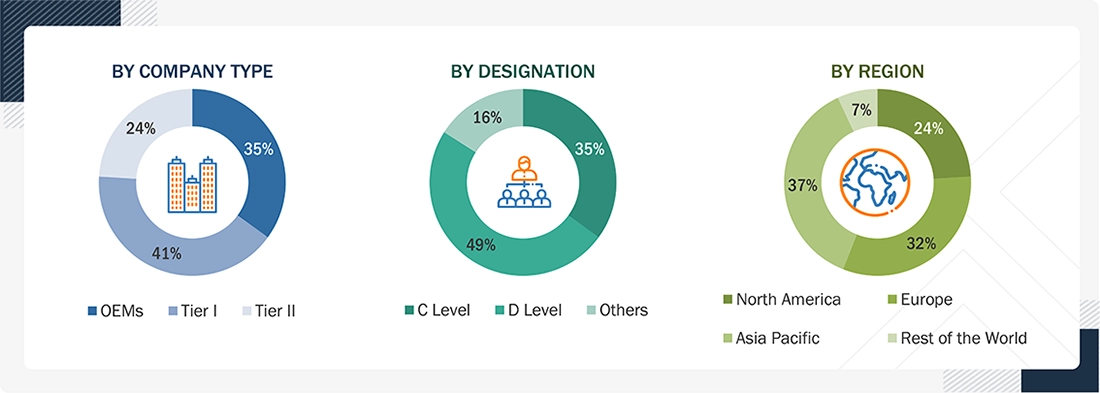
Note: The tiers of companies are based on the supply chain of the automotive radar market. Tier I companies are automotive radar providers.
To know about the assumptions considered for the study, download the pdf brochure
Market Size Estimation
The bottom-up and top-down approaches were used to estimate and validate the total size of the automotive radar market. This method was also used extensively to estimate the size of various subsegments in the market. The research methodology used to estimate the market size includes the following:
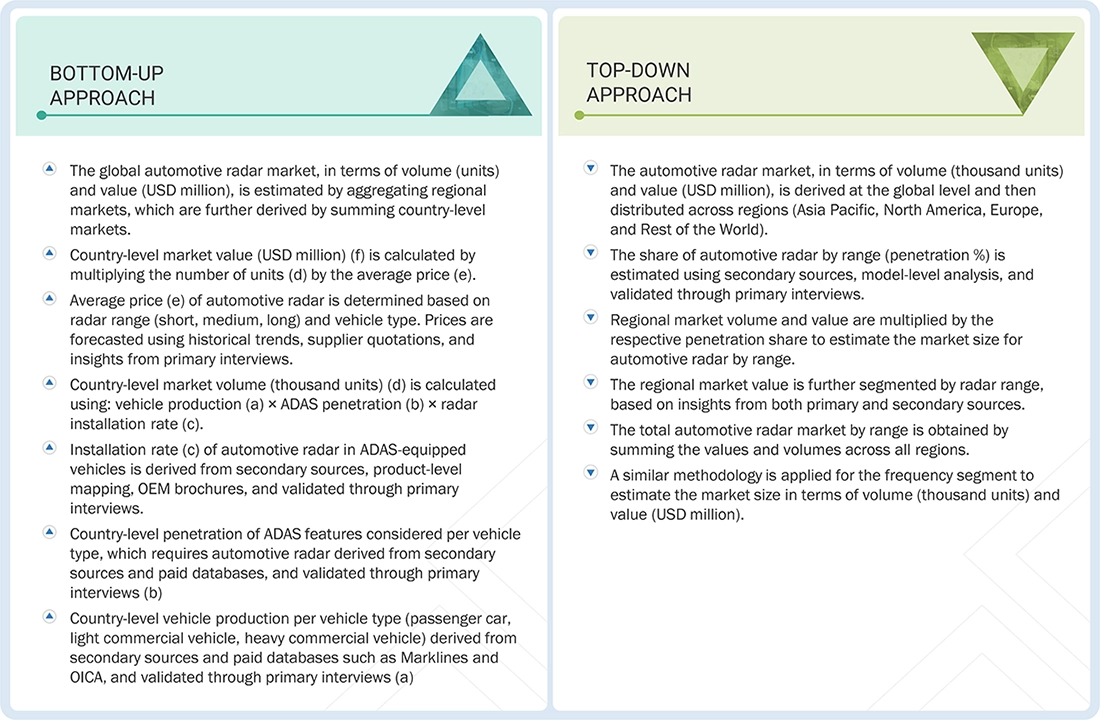
Data Triangulation
After arriving at the overall market size using the market size estimation processes as explained above, the market was split into several segments and subsegments. To complete the overall market engineering process and arrive at the exact statistics of each market segment and subsegment, data triangulation and market breakdown procedures were employed, wherever applicable. The data was triangulated by studying various factors and trends from both the demand and supply sides.
Market Definition
The word radar is an acronym derived from ‘radio detection and ranging.’ It is a device or an electronic system that detects and tracks objects at certain distances. A radar can detect any change within its covered range with the help of radio energy traveling at the speed of light. Whenever an object travels through the observed range, short bursts of radio energy are transmitted, reflected off a target or an object, and returned as an echo. The form of the electromagnetic signal radiated by the radar depends on the type of information required for the target.
According to Renesas Electronics Corporation, radar is a well-known technology that relies on sending and receiving electromagnetic waves to measure, detect, and locate obstacles in the environment. Radar is specially indicated for automotive applications, as vehicles are good reflectors for electromagnetic waves, and thus, their distance, position, and velocity can be determined accurately.
The automotive radar sensor is an object-detection device that uses radio waves to determine the range, altitude, direction, and speed of objects within the range of the vehicle. It provides long to short-range functionality, allowing automotive systems to monitor the environment around the vehicle to help prevent crashes. It can be used to detect, search, and track pedestrians, obstacles, motor vehicles, and terrain. The automotive radar is applicable for blind spot detection, adaptive cruise control, lane change assist, and crash avoidance, among others.
Key Stakeholders
- ADAS Integrators
- ADAS/Occupant Safety Solution Suppliers
- American Automobile Association (AAA)
- Automobile Original Equipment Manufacturers (OEMs)
- Automotive Radar Manufacturers
- Automotive Radar Component Manufacturers
- Automotive Software and Platform Providers
- Autonomous Driving Platform Providers
- Brazilian Association of Automotive Vehicle Manufacturers
- Comité des Constructeurs Français d'Automobiles (CCFA)
- China Association of Automobile Manufacturers (CAAM)
- Canadian Automobile Association
- Canadian Automobile Dealers Association (CADA)
- EV and EV Component Manufacturers
- Government & Research Organizations
- Japan Automobile Manufacturers Association (JAMA)
- Korea Automobile Manufacturers Association (KAMA)
- National Highway Traffic Safety Administration (NHTSA)
- Vehicle Safety Regulatory Bodies
- Verband der Automobilindustrie (VDA)
Report Objectives
- To segment and forecast the automotive radar market in terms of volume (thousand units) and value (USD Million)
- To define, describe, and forecast the market based on vehicle type, range, frequency, electric vehicle (EV) type, application, mounting, and region
- To segment and forecast the market by vehicle type (passenger car, light commercial vehicle, and heavy commercial vehicle)
- To segment and forecast the market by range (short-range radar, medium-range radar, long-range radar)
- To segment and forecast the market by frequency (2X-GHz and 7X-GHz)
- To segment and forecast the market by EV type [battery electric vehicle (BEV), plug-in electric vehicle (PHEV), fuel cell electric vehicle (FCEV), and hybrid electric vehicle (HEV)]
- To segment and forecast the market by mounting (in-cabin and exterior)
- To provide qualitative insights on the market based on application [adaptive cruise control (ACC), autonomous emergency braking (AEB), blind spot detection (BSD), forward collision warning (FCW), intelligent parking assistance (IPA), cross traffic alert (CTA), lane departure warning system (LDW), and traffic jam assist (TJA)]
- To forecast the market by region (North America, Europe, the Asia Pacific, and the Rest of the World)
- To analyze technological developments impacting the market
- To provide detailed information about the major factors influencing market growth (drivers, challenges, restraints, and opportunities)
- To strategically analyze the market, considering individual growth trends, prospects, and contributions to the total market
- To study the following concerning the market
- Supply chain analysis
- Ecosystem analysis
- Technology analysis
- HS code
- Case study analysis
- Patent analysis
- Regulatory landscape
- Key stakeholders and buying criteria
- Key conferences and events
- To estimate the following with respect to the market:
- Pricing Analysis
- By Range
- By Region
- Market Share Analysis
- To strategically profile key players and comprehensively analyze their market share and core competencies
- To analyze the impact of the 2025 US tariffs on the market
- To provide technological advancements, AI-driven impact, patents, innovations, and future applications
- To provide the impact of Generative AI (GenAI) on the market
- To track and analyze competitive developments, such as deals, product developments, and expansions, carried out by key industry participants
Available customizations:
With the given market data, MarketsandMarkets offers customizations in accordance with the company’s specific needs.
- Automotive Radar Market, By Range, at THE Country Level
- Automotive Radar Market, By Frequency, at THE Country Level
- Company Information :
- Profiling of additional market players (up to 5)
Get the Full Automotive Radar Market Report
Full forecast, segment splits, and company analysis for all Automotive Radar Market.
- China Automotive Radar Market
- Japan Automotive Radar Market
- India Automotive Radar Market
- Thailand Automotive Radar Market
- Indonesia Automotive Radar Market
- France Automotive Radar Market
- Germany Automotive Radar Market
- Spain Automotive Radar Market
- UK Automotive Radar Market
- Russia Automotive Radar Market
- Turkey Automotive Radar Market
- Canada Automotive Radar Market
- Mexico Automotive Radar Market
- US Automotive Radar Market
- Brazil Automotive Radar Market
- South Africa Automotive Radar Market
- Rest Of Europe Automotive Radar Market
- Rest Of Asia Pacific Automotive Radar Market
Need a Tailored Report?
Customize this report to your needs
Get 10% FREE Customization
Customize This Report
