
Asia Pacific Automotive V2X Market (2023-2028)

The Asia Pacific Automotive V2X Market was valued at $302.4 Million in 2023 and projected to reach to $6348.2 Million by 2028, representing a compound annual growth rate of 54.5%. Asia Pacific's automotive V2X market is poised for transformative growth, expanding from USD 302.4 million in 2023 to USD 6,348.2 million by 2028.


| Market Size in | USD 26.32 MN |
| Market Forecast in | |
| CAGR | |
| Forecast Period | |
| Units Considered | Value (USD MN) |
Asia Pacific Automotive V2X Market Trends and Insights
- Asia Pacific's 54.5% compound annual growth rate significantly outpaces global trends, driven by rapid urbanization, government mandates for connected vehicle infrastructure, and aggressive adoption of autonomous driving technologies across China, Japan, South Korea, and India.
- Asia Pacific's dominance reflects the region's position as a global automotive manufacturing hub and early adopter of 5G and intelligent transportation systems. Key markets within Asia Pacific are investing heavily in V2X standardization and deployment frameworks.
- Asia Pacific's regulatory environment, particularly in China and the European-aligned standards in Japan and South Korea, is accelerating OEM integration of vehicle-to-everything communication.
- By 2028, Asia Pacific is expected to capture a substantial share of global V2X revenue, supported by smart city initiatives and government incentives for connected vehicle ecosystems..
Key Market Statistics
- CAGR (2023-2028) 54.5% CAGR
- Market Size, 2023 ~USD 302.4 Million
- Forecast, 2028 ~USD 6348.2 Million
- Geography Asia Pacific
Asia Pacific Automotive V2X Market Overview
Explosive Regional Growth :
Asia Pacific's V2X market is expanding at 54.5% CAGR, significantly outpacing the global rate of 51.9%, driven by massive investments in smart city infrastructure and connected vehicle ecosystems across the region.
China's Market Dominance :
China leads Asia Pacific with USD 9,203 million in market size, representing the largest V2X adoption globally. Government mandates and 5G rollout accelerate vehicle-to-everything connectivity deployment across major urban centers.
Government-Mandated Infrastructure :
Regulatory frameworks in China, Japan, and South Korea are driving mandatory V2X implementation in new vehicles, creating a standardized ecosystem that accelerates technology adoption and interoperability across the region.
Autonomous Driving Catalyst :
Rapid urbanization and aggressive autonomous vehicle development programs position Asia Pacific as the global leader in V2X integration, with connected infrastructure essential for safe autonomous fleet operations in dense metropolitan areas.
Asia Pacific Automotive V2X Market Dynamics
- This explosive trajectory reflects the region's commitment to smart transportation infrastructure, with China, Japan, and South Korea spearheading technology adoption through government mandates and 5G deployment.
- The convergence of urbanization, autonomous vehicle development, and regulatory requirements creates unprecedented demand for vehicle-to-infrastructure and vehicle-to-vehicle communication systems. The region's competitive advantage stems from early regulatory adoption, substantial government investment in connected infrastructure, and the presence of major automotive and technology manufacturers.
- India and Southeast Asian markets present emerging opportunities as urbanization accelerates and governments prioritize smart city initiatives.
- Strategic partnerships between OEMs, telecom providers, and technology firms will define market leadership, with Asia Pacific establishing itself as the global benchmark for V2X implementation and autonomous vehicle readiness..
Market Ecosystem
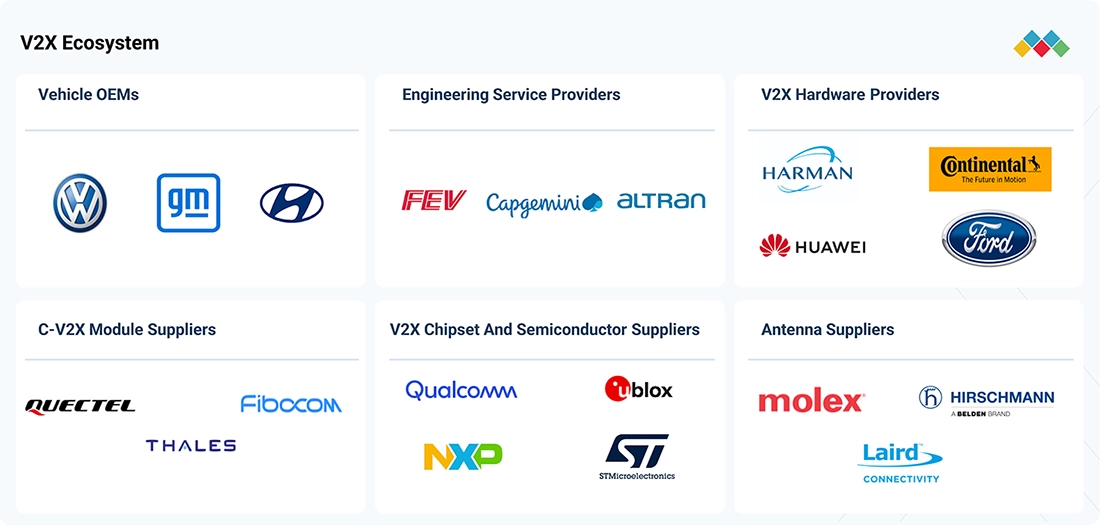
V2X MARKET: COMMERCIAL USE CASES ACROSS INDUSTRIES
| COMPANY | USE CASE DESCRIPTION | BENEFITS |
|---|---|---|
 |
Develops C V2X chipsets, connectivity platforms, and communication technologies that enable vehicle-to-vehicle, vehicle-to-infrastructure, and vehicle-to-pedestrian communication. | Low latency communication, improved road safety, real-time hazard alerts, and support for connected and automated vehicles. |
 |
Provides automotive connectivity solutions, connected vehicle platforms, and V2X technologies for communication between vehicles and surrounding infrastructure. | Enhanced driver awareness, improved traffic safety, real-time information sharing, and seamless vehicle connectivity. |
 |
Develops intelligent vehicle connectivity solutions, C V2X technologies, and communication infrastructure supporting connected transportation and intelligent road systems. | Improved traffic management, reduced collision risks, enhanced road efficiency, and reliable communication between vehicles and infrastructure. |
 |
Supplies automotive V2X chipsets, secure communication technologies, and semiconductor solutions for onboard vehicle units and roadside infrastructure. | Secure data exchange, low latency communication, improved intersection safety, and support for intelligent transportation systems. |
 |
The company name requires confirmation. If this refers to an automotive technology or connectivity supplier, its use case should be aligned with its specific V2X products and services. | Benefits depend on the company's actual V2X portfolio and should be verified before inclusion in the report. |
Logos and trademarks shown above are the property of their respective owners. Their use here is for informational and illustrative purposes only.
Related Ecosystem
Automotive Advance Technologies
- Battery Electric Vehicle (BEV)
- Light Commercial Vehicles (LCVs)
- Fuel Cell Electric Vehicle (FCEV)
- Hybrid Electric Vehicle (HEV)
- Internal Combustion Engine (ICE)
- BOSCH LIMITED
- Continental ag
- Visteon Corporation
- DENSO Corporation
- ZF FRIEDRICHSHAFEN AG
Connected Car
- Light Commercial Vehicles (LCVs)
- Battery Electric Vehicle (BEV)
- Fuel Cell Electric Vehicle (FCEV)
- Cellular Network
- Sensors
- BOSCH LIMITED
- Visteon Corporation
- Jabil Inc.
- DENSO Corporation
- VALENS SEMICONDUCTOR LTD.
Semi Autonomous And Autonomous Vehicle
- Light Commercial Vehicles (LCVs)
- Battery Electric Vehicle (BEV)
- Fuel Cell Electric Vehicle (FCEV)
- Internal Combustion Engine (ICE)
- Fuel Cell
- BOSCH LIMITED
- Visteon Corporation
- Continental ag
- DENSO Corporation
- Infineon technologies ag
Key Takeaways
- Asia Pacific's Automotive V2X market will grow from USD 302.4M (2023) to USD 6,348.2M (2028), representing a 54.5% CAGR.
- China leads Asia Pacific adoption, driven by government V2X mandates and 5G infrastructure rollout supporting connected vehicle ecosystems.
- Asia Pacific's growth rate of 54.5% significantly exceeds the global CAGR of 51.9%, positioning the region as the fastest-growing V2X market.
- Smart city initiatives and autonomous vehicle development in Japan, South Korea, and India are accelerating V2X technology deployment across Asia Pacific.
Automotive V2X Market Report Scope
| Report Metric | Details |
|---|---|
| Base Year | 2023 |
| Fastest Growing Segment | C-V2X (Connectivity) |
| Forecast Period | 2023-2028 |
| Growth Rate | CAGR of 51.9% from 2023 to 2028 |
| Largest Segment | PASSENGER CARS (Vehicle Type) |
| Market Size Base Year (Billions) | ~USD 0.51 (2023) |
| Revenue Forecast (Billions) | ~USD 4.12 (2028) |
| Segments Covered | Offering, Communication, Propulsion, Technology, Vehicle Type, Connectivity |
Asia Pacific Automotive V2X Market Report Segmentation
6 segment dimensions are covered across the global market.
By Offering
- Hardware
- Software
By Communication
- V2G
- V2I
- V2P
- V2V
By Propulsion
- EV
- ICE
By Technology
- Automated Driver Assistance
- Backing
- Emergency Vehicle Notification
- Fleet & Asset Management
- Intelligent Traffic System
- Line Of Sight
- Non-Line Of Sight
- Parking Management System
- Passenger Information System
By Vehicle Type
- Commercial Vehicles
- Passenger Cars
By Connectivity
- C-V2X
- Dsrc
Target Audience
- Automotive OEMs : Strategic planning for V2X integration across Asia Pacific production facilities and market launches, with country-specific regulatory requirements and competitive positioning data essential for product development roadmaps.
- Telecom & Infrastructure Providers : Identify V2X infrastructure investment opportunities and 5G deployment priorities across Asia Pacific markets, with detailed market sizing and government mandate timelines for network planning and capital allocation.
- Technology & Semiconductor Companies : Understand regional demand for V2X chipsets, software platforms, and connectivity solutions, with market forecasts by country enabling targeted product development and partnership strategies in Asia Pacific's fastest-growing automotive tech segment.
- Government & Policy Makers : Benchmark Asia Pacific V2X adoption policies against regional peers, with market data supporting smart city infrastructure planning, autonomous vehicle regulations, and connected transportation ecosystem development initiatives.
- Investment & Private Equity Firms : Evaluate V2X technology and infrastructure investment opportunities across Asia Pacific with country-level market sizing, growth projections, and competitive landscape analysis for portfolio companies and strategic acquisitions.
Countries within Asia Pacific - compare and drill down
| Country | 2025 size (native) |
|---|---|
| China | USD 9203 Million |
| Japan | USD 466 Million |
| South Korea | USD 523 Million |
| India | USD 272 Million |
Country market size visualization
Reasons to Buy this Report
- Regional Market Dominance Insights : Gain comprehensive understanding of Asia Pacific's 54.5% CAGR trajectory and identify which countries—China, Japan, South Korea, and India—offer the highest growth and investment opportunities in V2X technology.
- Competitive Landscape Analysis : Understand regional OEM strategies, government regulatory frameworks, and technology partnerships shaping V2X adoption across Asia Pacific's diverse automotive markets and regulatory environments.
- Government Mandate Tracking : Access detailed intelligence on mandatory V2X implementation policies in China, Japan, and South Korea, enabling strategic planning for compliance, market entry, and infrastructure investment decisions.
- 5G Infrastructure Correlation : Analyze the direct relationship between 5G rollout timelines and V2X deployment across Asia Pacific, identifying optimal market entry windows and technology partnership opportunities by country.
- Autonomous Vehicle Readiness : Evaluate Asia Pacific's V2X infrastructure maturity for autonomous vehicle deployment, with country-specific assessments of connected ecosystem readiness and regulatory compliance pathways.
Frequently asked questions
What is the projected size of the Asia Pacific Automotive V2X market by 2028?
The Asia Pacific Automotive V2X market is projected to reach USD 6,348.2 million by 2028, growing from USD 302.4 million in 2023.
What is the CAGR for Asia Pacific's Automotive V2X market?
Asia Pacific's Automotive V2X market is expected to grow at a compound annual growth rate of 54.5% from 2023 to 2028.
Which countries are driving V2X adoption in Asia Pacific?
China, Japan, South Korea, and India are the primary drivers of V2X adoption in Asia Pacific, supported by government mandates, 5G infrastructure, and smart city initiatives.
How does Asia Pacific's V2X growth compare to global trends?
Asia Pacific's 54.5% CAGR exceeds the global average of 51.9%, making it the fastest-growing region for Automotive V2X technology.
What factors are accelerating V2X deployment in Asia Pacific?
Key drivers include government V2X mandates, 5G network expansion, autonomous vehicle development, smart city projects, and OEM investment in connected vehicle technologies.
RESEARCH METHODOLOGY
Various secondary sources, directories, and databases were used to identify and collect information for an extensive V2X market study. The study involved four main activities in estimating the current size of the V2X market: secondary research, validation through primary research, assumptions, and market analysis. The research study involved various secondary sources, such as company annual reports/presentations, industry association publications, automotive wiring harness magazine articles, directories, technical handbooks, World Economic Outlook, trade websites, technical articles, and databases, which were used to identify and collect information for an extensive study of the V2X market. Primary sources like experts from automotive OEMs, Tier 1 suppliers, and V2X providers were interviewed to obtain and verify critical information and assess prospects and market estimations.
Secondary Research
Secondary sources referred to for this research study included automotive V2X industry organizations; corporate filings such as annual reports, investor presentations, and financial statements; trade and business whitepapers and databases; and articles from recognized associations and government publishing sources. The secondary data was collected and analyzed to arrive at the overall market size, which was further validated by primary research.
Primary Research
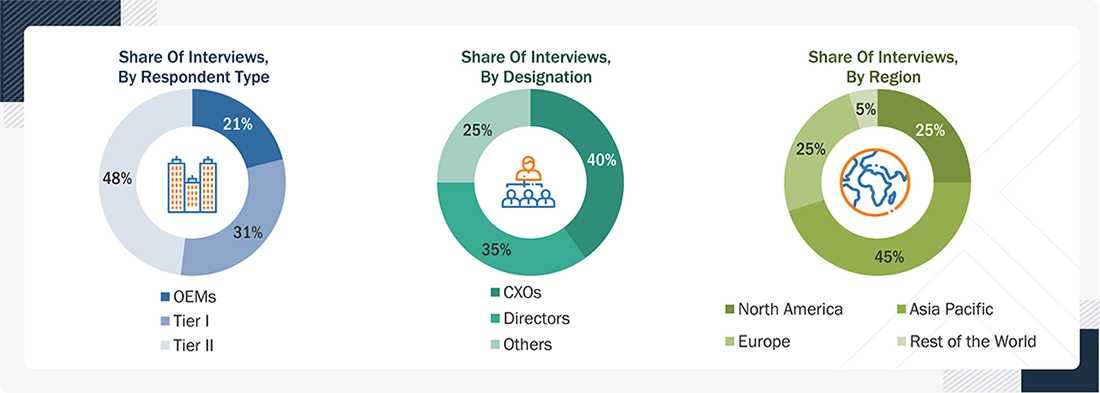
Extensive primary research was conducted after acquiring an understanding of this market scenario through secondary research. Several primary interviews were conducted with market experts from the demand- and supply-side OEMs (in terms of component supply, country-level government associations, and trade associations) and component manufacturers across four major regions, namely, Asia Pacific- 35%, Europe- 25%, North America- 25%, and the Rest of the World-5%. Approximately 60% and 40% of primary interviews were conducted from the demand and supply sides, respectively. Primary data was collected through questionnaires, emails, LinkedIn, and telephonic interviews. In the canvassing of primary data, various departments within organizations, such as sales, operations, and administration, were consulted to provide a holistic viewpoint in our report.
Brief sessions with highly experienced independent consultants were conducted to reinforce findings from primaries after interacting with industry experts. This, along with the in-house subject matter experts’ opinions, led to the findings described in the remainder of this report.
In the primary research process, various primary sources from the supply and demand sides were interviewed to obtain qualitative and quantitative information for the report. The primary sources from the supply side included industry experts, such as Vice Presidents (VPs), marketing directors, technology and innovation directors, and related key executives from various key companies and organizations. The primary sources from the demand side included end users, such as Chief Information Officers (CIOs), consultants, service professionals, technicians and technologists, and managers at public and investor-owned utilities.
Breakdown of Primary Interviews
To know about the assumptions considered for the study, download the pdf brochure
Market Size Estimation
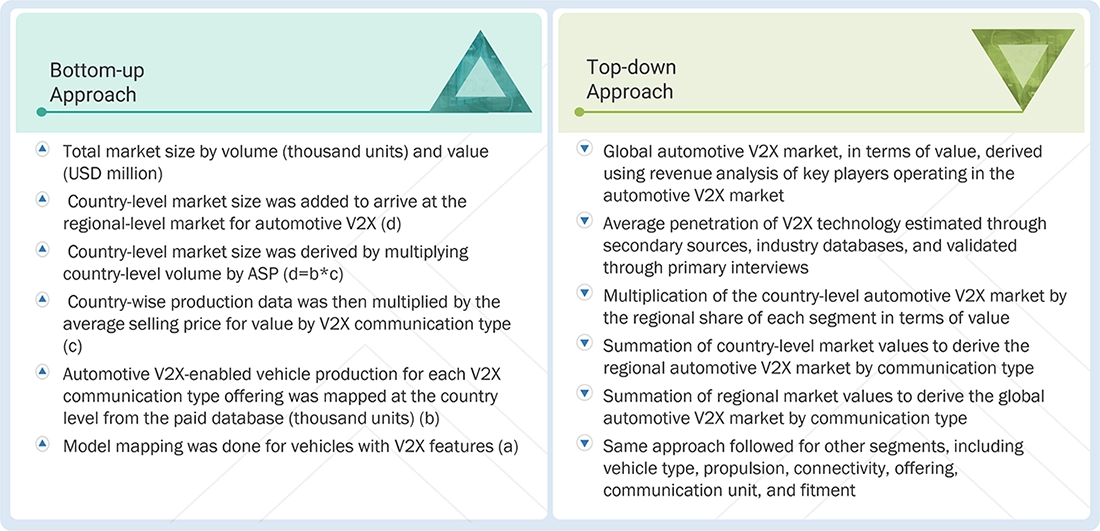
The V2X market was estimated and validated using both top-down and bottom-up approaches. In the top-down approach, the global V2X market value was derived through revenue analysis of key market players. V2X penetration rates are estimated using secondary research, industry databases, and primary interviews. Country-level market values were allocated to individual segments based on their respective shares, aggregated to derive regional market values, and consolidated to estimate the global market by communication type. The same approach was followed for other segments, including vehicle type, propulsion, connectivity, offering, communication unit, and fitment. In the bottom-up approach, country-level V2X-enabled vehicle volumes were identified using paid databases, vehicle production data, secondary research, and OEM model mapping. Vehicle production volumes are multiplied by the average selling price of V2X communication systems to estimate market size by communication type in terms of volume (thousand units) and value (USD million). Country-level estimates were aggregated to derive regional market values. Both approaches were cross-validated through primary interviews with OEMs, Tier 1 suppliers, V2X module manufacturers, and industry experts to establish the final V2X market estimate.
V2X Market: Top-Down and Bottom-Up Approach
Data Triangulation
After arriving at the overall market size using the market size estimation processes as explained above, the market was split into several segments and subsegments. To complete the overall market engineering process and arrive at the exact statistics of each market segment and subsegment, data triangulation and market breakdown procedures were employed, wherever applicable. The data was triangulated by studying various factors and trends from both the demand and supply sides.
Market Definition
According to NXP Semiconductors (Netherlands), V2X technology enables cars to communicate with their surroundings and makes driving safer and more efficient for everyone. V2X is communication technology that helps connect vehicles with infrastructure and thus facilitates the implementation of an intelligent transport system. It allows vehicles to communicate with the moving traffic system in their surrounding environment. It operates at 5.9GHz frequency globally.
Key Stakeholders
- Automotive Original Equipment Manufacturers (OEMs)
- Electronic Design Automation (EDA) and Internet Protocol (IP) Core Vendors
- Navigation Devices and GPS Manufacturers
- ODM and OEM Technology Solution Providers
- Regulatory and Transportation Authorities
- Software Providers
- V2X Providers
- Organizations, Forums, Alliances, and Associations
- State & National Regulatory Authorities
-
V2X Network Providers
Report Objectives
-
To segment and forecast the V2X market in terms of value (USD million) and volume (thousand units)
- By offering (hardware and software)
- By V2X charging type (V2L, V2H, and V2G)
- By propulsion (ICE and EV)
- By V2X communication Type (V2I, V2V+V2I, V2V+V2N, and V2V+V2I+V2N)
- By region (Asia Pacific, Europe, North America, and Rest of the World)
-
To segment and forecast the V2X market in terms of volume (thousand units)
- By connectivity [dedicated short-range communications (DSRC) and cellular V2X]
- By vehicle type (passenger cars and commercial vehicles)
-
To segment the V2X market qualitatively
- By unit (on-board unit and roadside unit)
- By fitment (plug and play, retrofit, integrated fitment)
- By technology (automated driver assistance, intelligent traffic system, emergency vehicle notification, passenger information system, fleet and asset management, parking management system, line of sight, non-line of sight, and backing)
- To analyze regional markets for growth trends, prospects, and their contribution to the overall market
- To define, describe, and forecast the size of the V2X market with respect to growth trends and prospects, and determine the contribution of the segments to the total market
- To provide detailed information regarding the major factors (drivers, challenges, restraints, and opportunities) influencing market growth
- To strategically analyze markets with respect to individual growth trends, prospects, and contribution to the total market
- To analyze opportunities for stakeholders and the competitive landscape for market leaders
-
To study the following with respect to the market -
- Supply chain analysis
- Ecosystem analysis
- Pricing analysis
- Technology analysis
- HS code
- Case study analysis
- Patent analysis
- Impact of AI
- Impact of 2026 India-EU FTA
- Regulatory landscape
- Key stakeholders and buying criteria
- Key conferences & events
- Bill of materials
- V2X spectrum allocation
- V2X technology regulatory direction
- C-ITS & automated driving regulations
- To strategically profile key players and comprehensively analyze their market share and core competencies
- To track and analyze competitive developments such as deals (mergers & acquisitions, partnerships, collaborations), product developments, and other activities carried out by key industry participants
Available customizations:
With the given market data, MarketsandMarkets offers customizations in line with company-specific needs.
- V2X market, by charging, at the country level (for regions covered in the report)
- V2X market, by propulsion, at the country level (for the countries, an addition of up to 3, in the report)
Company Information
- Profiling of additional market players (up to 5)
Get the Full Automotive V2X Market Report
Full forecast, segment splits, and company analysis for all Automotive V2X Market.
- China Automotive V2X Market
- Japan Automotive V2X Market
- South Korea Automotive V2X Market
- India Automotive V2X Market
- Germany Automotive V2X Market
- France Automotive V2X Market
- Spain Automotive V2X Market
- Italy Automotive V2X Market
- UK Automotive V2X Market
- Canada Automotive V2X Market
- Mexico Automotive V2X Market
- US Automotive V2X Market
- Brazil Automotive V2X Market
- Argentina Automotive V2X Market
Need a Tailored Report?
Customize this report to your needs
Get 10% FREE Customization
Customize This Report
