
Asia Pacific Biocides Market (2024-2029)

The Asia Pacific Biocides Market was valued at $2082 Million in 2024 and projected to reach to $2701 Million by 2029, representing a compound annual growth rate of 5.34%. The Asia Pacific biocides market is positioned for sustained expansion through 2029, driven by accelerating industrialization, stringent water quality regulations, and rising awareness of microbial contamination risks.


| Market Size in | USD 26.32 MN |
| Market Forecast in | |
| CAGR | |
| Forecast Period | |
| Units Considered | Value (USD MN) |
Asia Pacific Biocides Market Trends and Insights
- Asia Pacific's biocides sector is driven by rapid industrialization, increasing water treatment demands, and expanding agricultural activities across the region.
- The 5.34% compound annual growth rate reflects Asia Pacific's strong momentum, outpacing the global average of 4.9%, as countries invest in antimicrobial solutions for healthcare, food preservation, and industrial applications. Asia Pacific's biocides market benefits from rising awareness of hygiene standards and regulatory compliance in manufacturing and food processing sectors.
- The region's growing middle-class population and urbanization trends are fueling demand for biocide-based consumer products and disinfectants.
- Asia Pacific's competitive landscape includes both multinational corporations and regional players capitalizing on cost advantages and localized distribution networks to capture market share through 2029..
Key Market Statistics
- CAGR (2024-2029) 5.34% CAGR
- Market Size, 2024 ~USD 2082 Million
- Forecast, 2029 ~USD 2701 Million
- Geography Asia Pacific
Asia Pacific Biocides Market Overview
Market Valuation & Growth :
Asia Pacific biocides market valued at USD 2,082 million in 2024, expanding to USD 2,701 million by 2029 at a 5.34% CAGR, outpacing the global growth rate of 4.9%.
China's Market Dominance :
China leads the Asia Pacific region with USD 386.91 million market size, representing the largest biocides consumption driven by manufacturing and water treatment infrastructure expansion.
Industrialization & Water Treatment :
Rapid industrialization across Asia Pacific coupled with increasing water treatment demands and expanding agricultural activities are primary growth catalysts for the biocides sector.
Emerging Market Opportunities :
India (USD 83.73M), Japan (USD 128.96M), and Indonesia (USD 34.7M) present significant growth opportunities as developing economies invest in sanitation and industrial hygiene solutions.
Asia Pacific Biocides Market Dynamics
- Key growth drivers include increased investments in wastewater treatment infrastructure, agricultural intensification, and food preservation demands across emerging economies.
- China's manufacturing dominance and India's rapid industrial growth will continue anchoring regional expansion. The region's 5.34% CAGR reflects stronger momentum compared to global averages, supported by favorable demographics, urbanization trends, and government initiatives promoting environmental sustainability.
- Biocide applications in cooling systems, paints, coatings, and personal care products will expand alongside industrial output.
- Strategic partnerships and localized production facilities will enhance market penetration in Southeast Asian markets..
Market Ecosystem
Related Ecosystem
Speciality Chemicals
- Corrosion Inhibitors
- Polyetheretherketone (PEEK)
- Acrylonitrile Butadiene Styrene (ABS)
- Epoxy Resin
- Polycarbonate
- Basf se
- DOW CHEMICAL COMPANY
- Evonik industries ag
- Clariant ag.
- Solvay sa
Water Purification
- Corrosion Inhibitors
- Cartridge Filters
- Fiberglass
- Reverse Osmosis
- Acetone
- Veolia
- Basf se
- CALGON CARBON CORPORATION
- SOLENIS
- Kemira oyj
Fandb Additives
- Dairy Products
- Bakery Products
- Polyglycerol Esters
- Microorganism
- Carbohydrates
- AZELIS HOLDINGS SA
- Archer-Daniels-Midland Company
- Amway
- UNILEVER PLC
- DuPont de Nemours, Inc.
Key Takeaways
- Asia Pacific biocides market valued at USD 2,082M in 2024, expanding to USD 2,701M by 2029 at 5.34% CAGR
- Asia Pacific's growth rate of 5.34% exceeds the global CAGR of 4.9%, driven by industrialization and water treatment investments
- Asia Pacific demand is fueled by rising hygiene awareness, regulatory compliance, and expanding agricultural and food processing sectors
- Asia Pacific's competitive environment features multinational and regional players leveraging cost advantages and localized distribution networks
Biocides Market Report Scope
| Report Metric | Details |
|---|---|
| Base Year | 2024 |
| Fastest Growing Segment | -MUNICIPAL WATER TREATMENT (Application) |
| Forecast Period | 2024-2029 |
| Growth Rate | CAGR of 4.9% from 2024 to 2029 |
| Largest Segment | NON-OXIDIZING BIOCIDES (Type) |
| Market Size Base Year (Billions) | ~USD 9.68 (2024) |
| Revenue Forecast (Billions) | ~USD 12.3 (2029) |
| Segments Covered | Type, Application |
Asia Pacific Biocides Market Report Segmentation
2 segment dimensions are covered across the global market.
By Type
- Non-Oxidizing Biocides
- Other Biocide Types
- Other Types
- Oxidizing Biocides
By Application
- Industrial & Institutional Cleaning And Home Care
- Other Applications
- Paints & Coatings
- Water Treatment
- Wood Preservatives
- -Mining
- -Municipal Water Treatment
- -Oil & Gas
- -Other Water Treatment Applications
- -Power Plants
- -Pulp & Paper
- -Swimming Pools
Target Audience
- Chemical Manufacturers & Suppliers : Biocide producers and chemical companies need Asia Pacific market intelligence to identify growth opportunities, optimize production capacity, and develop region-specific product formulations.
- Water Treatment Operators : Municipal and industrial water treatment facilities require market insights to forecast biocide demand, evaluate supplier options, and plan procurement strategies across Asia Pacific.
- Agricultural & Food Processing Companies : Agribusinesses and food manufacturers need regional biocides data to understand preservation requirements, regulatory compliance, and market trends in rapidly growing Asian markets.
- Investment & Private Equity Firms : Investors evaluating opportunities in chemicals and materials sector require Asia Pacific market analysis to assess growth potential, competitive positioning, and acquisition targets.
- Government & Regulatory Bodies : Environmental agencies and policymakers need market data to develop water quality standards, industrial regulations, and sustainability initiatives aligned with Asia Pacific growth trends.
Countries within Asia Pacific - compare and drill down
| Country | 2025 size (native) |
|---|---|
| China | USD 386.91 Million |
| India | USD 83.73 Million |
| Japan | USD 128.96 Million |
| South Korea | USD 44.6 Million |
| Indonesia | USD 34.7 Million |
| Australia And New Zealand | USD 74.7 Million |
| Rest Of Asia Pacific | USD 110.8 Million |
Country market size visualization
Reasons to Buy this Report
- Regional Market Segmentation : Detailed breakdown of Asia Pacific biocides market by country, application, and product type, enabling precise market targeting and localized business strategy development.
- Competitive Landscape Analysis : Comprehensive insights into key players operating across Asia Pacific, their market shares, product portfolios, and strategic initiatives specific to the region's dynamics.
- Growth Driver Identification : In-depth analysis of region-specific growth catalysts including industrialization rates, regulatory frameworks, water treatment investments, and agricultural expansion patterns.
- Country-Level Market Data : Individual market valuations for China, India, Japan, South Korea, Indonesia, and Australia/New Zealand enabling comparative analysis and investment prioritization.
- Forecast Accuracy & Reliability : Validated projections through 2029 with transparent methodology, supporting long-term strategic planning, capacity expansion, and market entry decisions for Asia Pacific operations.
Frequently asked questions
What is the current size of the Asia Pacific biocides market?
The Asia Pacific biocides market is valued at USD 2,082 million in 2024 and is projected to reach USD 2,701 million by 2029.
What is the growth rate for Asia Pacific biocides?
Asia Pacific's biocides market is growing at a CAGR of 5.34% from 2024 to 2029, outpacing the global average of 4.9%.
What drives demand for biocides in Asia Pacific?
Asia Pacific biocides demand is driven by rapid industrialization, water treatment needs, agricultural expansion, hygiene awareness, and regulatory compliance requirements across manufacturing and food processing sectors.
Which countries are key markets in Asia Pacific for biocides?
Major Asia Pacific biocides markets include China, India, Japan, Southeast Asia, and South Korea, driven by industrial growth and increasing consumer demand for antimicrobial products.
Who are the main competitors in Asia Pacific's biocides market?
Asia Pacific's biocides market includes multinational corporations and regional players who leverage cost advantages, local expertise, and established distribution networks to serve diverse end-use industries.
RESEARCH METHODOLOGY
The study involved four major activities in estimating the market size for biocides market. Intensive secondary research was done to gather information on the market, the peer market, and the parent market. The next step was to validate these findings, assumptions, and sizing with industry experts across the value chain through primary research. Both top-down and bottom-up approaches were employed to estimate the complete market size. Post that, the market breakdown and data triangulation procedures were used to estimate the market size of the segments and subsegments.
Secondary Research
Secondary sources used in this study included annual reports, press releases, and investor presentations of companies; white papers; certified publications; articles from recognized authors; and gold standard & silver standard websites such as Factiva, ICIS, Bloomberg, and others. The findings of this study were verified through primary research by conducting extensive interviews with key officials such as CEOs, VPs, directors, and other executives. The breakdown of profiles of the primary interviewees is illustrated in the figure below:
Primary Research
The biocides market comprises several stakeholders, such as raw material suppliers, end-product manufacturers, and regulatory organizations in the supply chain. The demand side of this market is characterized from key opinion leaders in various applications for the biocides. The supply side is characterized by advancements in technology and diverse application industries. Various primary sources from both the supply and demand sides of the market were interviewed to obtain qualitative and quantitative information.
Breakdown Of Primary Participants
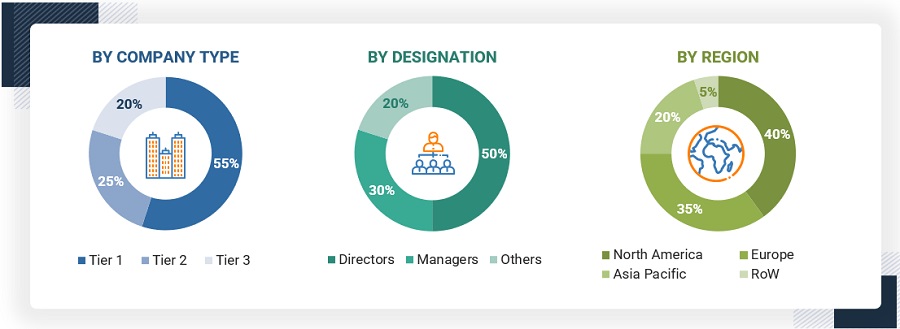
Note: Tier 1, Tier 2, and Tier 3 companies are classified based on their market revenue in 2023/2024 available in the public domain, product portfolios, and geographical presence.
Other designations include consultants and sales, marketing, and procurement managers.
To know about the assumptions considered for the study, download the pdf brochure
|
COMPANY NAME |
DESIGNATION |
|
LANXESS AG |
Global Strategy & Innovation Manager |
|
Veolia Group |
Technical Sales Manager |
|
Arxada AG |
Senior Supervisor |
|
Ecolab Inc. |
Production Supervisor |
|
Nouryon |
Production Manager |
Market Size Estimation
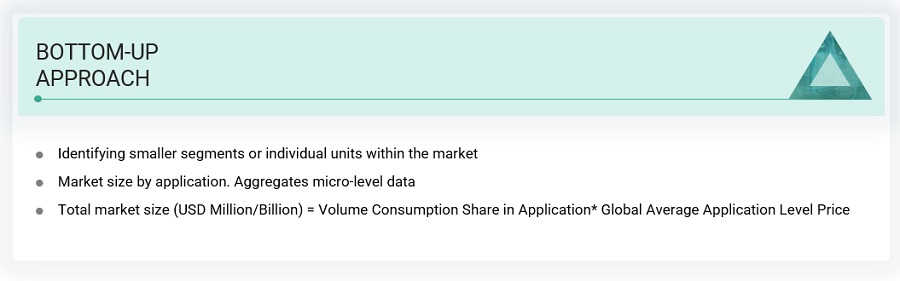
Bottom-up approaches were used to estimate and validate the total size of the biocides market. These methods were also used extensively to estimate the size of various subsegments in the market. The research methodology used to estimate the market size includes the following:
- The key players in the industry have been identified through extensive secondary research.
- The supply chain of the industry has been determined through primary and secondary research.
- All percentage shares, splits, and breakdowns have been determined using secondary sources and verified through primary sources.
- All possible parameters that affect the markets covered in this research study have been accounted for, viewed in extensive detail, verified through primary research, and analyzed to obtain the final quantitative and qualitative data.
Biocides market: Bottom-Up Approach
To know about the assumptions considered for the study, Request for Free Sample Report
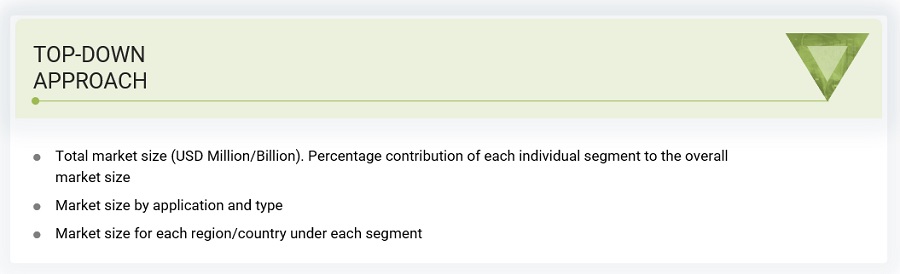
Biocides market: Top-Down Approach
Data Triangulation
After arriving at the overall market size—using the market size estimation processes as explained above—the market was split into respective segments and subsegments. To realize the overall market engineering process and arrive at the exact statistics of each market segment and subsegment, the data triangulation, and market breakdown procedures were employed, wherever applicable. The data was triangulated by studying several factors and trends from both the demand and supply sides in the biocides industry.
Market Definition
Biocides are substances used to kill or inhibit all harmful life forms when introduced in sufficient concentration and duration. They are primarily used to kill harmful organisms and control bacterial or fungal growth.
According to the DG Health and Consumers of European Commission, Biocides Directive (98/8/EC), biocidal products are intended to destroy, render harmless, prevent the action of or otherwise exert a controlling effect on any harmful organism by chemical or biological means. The directive range covers 23 product types, from drinking water disinfectants, wood preservatives, and insecticides to antifouling products.
Key Stakeholders
- Biocides manufacturers
- Raw material manufacturers
- Government planning commissions and research organizations
- Industry associations
- Applications
- R&D institutions
Report Objectives
- To analyze and forecast the size of the biocides market in terms of value
- To provide detailed information regarding key factors, such as drivers, restraints, challenges, and opportunities influencing the growth of the market
- To define, describe, and segment the biocides market based on type and application
- To forecast the size of the market segments for regions such as Asia Pacific, North America, Europe, Middle East & Africa, and South America
- To strategically analyze the segmented markets with respect to individual growth trends, prospects, and contribution to the overall market
- To identify and analyze opportunities for stakeholders in the market
- To strategically profile key players and comprehensively analyze their core competencies
Available Customizations
Along with the given market data, MarketsandMarkets offers customizations according to the company’s specific needs. The following customization options are available for the report:
Regional Analysis
- Further breakdown of a region with respect to a particular country or additional type and application
Company Information
- Detailed analysis and profiles of additional market players (up to five)
Get the Full Biocides Market Report
Full forecast, segment splits, and company analysis for all Biocides Market.
- China Biocides Market
- India Biocides Market
- Japan Biocides Market
- South Korea Biocides Market
- Indonesia Biocides Market
- Germany Biocides Market
- France Biocides Market
- Italy Biocides Market
- UK Biocides Market
- Russia Biocides Market
- Canada Biocides Market
- Mexico Biocides Market
- US Biocides Market
- Iran Biocides Market
- South Africa Biocides Market
- Brazil Biocides Market
- Argentina Biocides Market
- Rest Of Europe Biocides Market
- Australia And New Zealand Biocides Market
- Rest Of Asia Pacific Biocides Market
- GCC Biocides Market
- - Rest Of GCC Biocides Market
- Rest Of South America Biocides Market
Need a Tailored Report?
Customize this report to your needs
Get 10% FREE Customization
Customize This Report
