
Brazil Biopesticides Market (2024-2029)

The Brazil Biopesticides Market was valued at $513.8 Million in 2024 and projected to reach to $1079 Million by 2029, representing a compound annual growth rate of 16.0%. Brazil's biopesticides market is positioned for exceptional growth through 2029, driven by the country's commitment to sustainable agricultural practices and strong regulatory backing for biological solutions.


| Market Size in | USD 26.32 MN |
| Market Forecast in | |
| CAGR | |
| Forecast Period | |
| Units Considered | Value (USD MN) |
Brazil Biopesticides Market Trends and Insights
- This accelerated growth in Brazil reflects increasing adoption of sustainable agricultural practices and regulatory support for biological pest management solutions across the country's vast agricultural sector.
- Brazil's position as a global agricultural powerhouse drives demand for innovative crop protection technologies that align with environmental and food safety standards. The biopesticides market in Brazil is propelled by rising awareness among farmers regarding the benefits of reduced chemical residues, improved soil health, and premium pricing for sustainably produced commodities.
- Brazil's diverse crop portfolio—including sugarcane, coffee, soybeans, and citrus—creates multiple application opportunities for biocontrol agents, microbial pesticides, and plant-based formulations.
- Between 2024 and 2029, Brazil is expected to consolidate its leadership in Latin America's biopesticides adoption, driven by both domestic consumption and export-oriented agricultural production..
Key Market Statistics
- CAGR (2024-2029) 16.0% CAGR
- Market Size, 2024 ~USD 513.8 Million
- Forecast, 2029 ~USD 1079 Million
- Country Brazil
Brazil Biopesticides Market Overview
Market Valuation & Growth :
Brazil's biopesticides market reached USD 513.8 million in 2024 and is projected to grow to USD 1,079.0 million by 2029, driven by a robust 16% CAGR, outpacing the global growth rate of 15.2%.
Regulatory Support & Policy :
Brazilian government initiatives promoting sustainable agriculture and biological pest management have created a favorable regulatory environment, accelerating market adoption across major agricultural regions.
Agricultural Expansion :
Brazil's vast agricultural landscape and position as a global agricultural powerhouse provide significant opportunities for biopesticide penetration across sugarcane, coffee, soybean, and fruit production sectors.
Sustainability Adoption :
Increasing farmer awareness of environmental concerns and consumer demand for sustainably-produced crops are driving rapid adoption of biological pest management solutions throughout Brazil's farming communities.
Brazil Biopesticides Market Dynamics
- The 16% CAGR reflects growing farmer adoption across Brazil's diverse agricultural sectors, including sugarcane, coffee, and soybean production.
- Market expansion is supported by increasing environmental consciousness among producers and rising international demand for sustainably-sourced Brazilian agricultural products. The forecast growth to USD 1.08 billion by 2029 indicates substantial market maturation and investment opportunities.
- Key drivers include technological advancements in biopesticide formulations, expanding distribution networks, and integration with precision agriculture practices.
- Brazil's position as a global agricultural leader positions it as a critical market for biopesticide manufacturers seeking to establish regional presence and capitalize on Latin America's sustainability transition..
Market Ecosystem
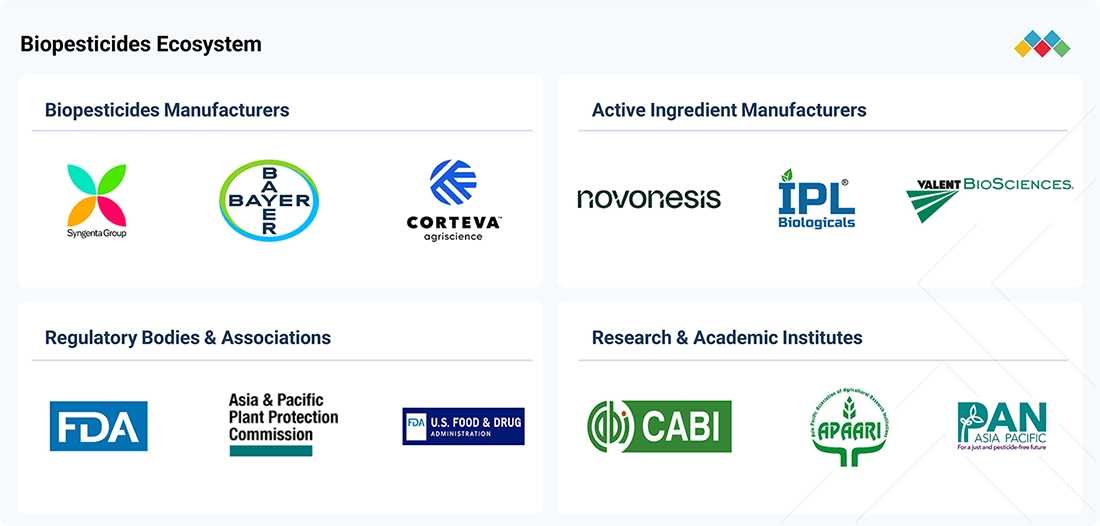
BIOPESTICIDES MARKET: COMMERCIAL USE CASES ACROSS INDUSTRIES
| COMPANY | USE CASE DESCRIPTION | BENEFITS |
|---|---|---|
 |
Application of microbial bioinsecticides in corn and soybean farming | Enhances targeted pest control, minimizes residues, and supports sustainable row-crop systems |
 |
Use of Bacillus-based biofungicides in fruits and vegetables | Strengthens disease management, improves crop quality, and meets residue-free requirements |
 |
Integration of botanical and microbial biopesticides in specialty crops | Provides broad-spectrum protection and supports IPM while reducing synthetic pesticide use |
 |
Use of biofungicides and seed-applied biologicals in cereals and grains | Improves early-stage protection, enhances plant vigor, and promotes sustainable crop production |
Logos and trademarks shown above are the property of their respective owners. Their use here is for informational and illustrative purposes only.
Related Ecosystem
Agricultural Biologicals
- Bionematicides
- Auxins
- Cytokinins
- Ethylene
- Humic Substances
- NICHINO INDIA PVT LTD.
- Corteva, Inc.
- Basf se
- AZELIS HOLDINGS SA
- BAYER AG
Agrochemicals
- Phosphatic Fertilizers
- Potassic Fertilizers
- Fungicides
- Anticoagulant Rodenticides
- Ammonium Nitrate
- AZELIS HOLDINGS SA
- Basf se
- Origin Enterprises plc
- MITSUI AGRO BUSINESS SACO
- SNF HOLDING COMPANY INC.
Key Takeaways
- Brazil's biopesticides market will more than double from USD 513.8M (2024) to USD 1,079.0M (2029) at a 16.0% CAGR.
- Brazil's agricultural diversity across sugarcane, coffee, soybeans, and citrus creates extensive biopesticide application opportunities.
- Regulatory support and sustainability mandates in Brazil are accelerating farmer adoption of biological pest management solutions.
- Brazil is positioned to lead Latin American biopesticides growth through export-driven demand and domestic market expansion.
Biopesticides Market Report Scope
| Report Metric | Details |
|---|---|
| Base Year | 2024 |
| Fastest Growing Segment | SEED TREATMENT (Mode Of Application) |
| Forecast Period | 2024–2029 |
| Growth Rate | CAGR of 15.2% from 2024 to 2029 |
| Largest Segment | MICROBES (Source) |
| Market Size Base Year (Billions) | ~USD 7.72 (2024) |
| Revenue Forecast (Billions) | ~USD 15.66 (2029) |
| Segments Covered | Type, Source, Formulation, Mode Of Application, Crop Type, Function |
Brazil Biopesticides Market Report Segmentation
6 segment dimensions are covered across the global market.
By Type
- Bacillus
- Bacillus Firmus
- Bacillus Thuringiensis
- Bacteria
- Baculovirus
- Beauveria Bassiana
- Berries
- Biofungicides
- Bioherbicides
- Bioinsecticides
- Bionematicides
- Citrus Fruits
- Corn
- Dry Granules
- Emulsifiable Concentrates
- Fungi
- Leafy Vegetables
- Metarhizium Anisopliae
- Organic Acids & Others
- Other Biopesticides
- Other Cereals & Grains
- Other Fruits & Vegetables
- Other Oilseeds & Pulses
- Other Species
- Other Types
- Paecilomyces Lilacinus
- Parasitoids
- Pasteuria Species
- Plant Extracts
- Pome Fruits
- Predators
- Protozoa
- Pseudomonas
- Rice
- Root & Tuber Vegetables
- Semiochemicals
- Soluble Liquid Concentrates
- Soybean
- Streptomyces
- Sunflower
- Suspension Concentrates
- Trichoderma
- Verticillium Lecanii
- Virus
- Water–Dispersible Granules
- Wettable Powders
- Wheat
By Source
- Beneficial Insects & Other Macrobials
- Beneficial Insects And Other Macrobials
- Biochemicals
- Microbes
By Formulation
- Dry
- Liquid
By Mode Of Application
- Foliar Spray
- Other Modes Of Application
- Seed Treatment
- Soil Treatment
By Crop Type
- Cereals & Grains
- Fruits & Vegetables
- Oilseeds & Pulses
- Other Crop Types
By Function
- Biofungicides
- Bioherbicides
- Bioinsecticides
- Bionematicides
- Other Biopesticides
Target Audience
- Biopesticide Manufacturers & Suppliers : Evaluate Brazil's market potential, identify distribution channels, and develop localized product strategies to capture share in this rapidly expanding 16% CAGR market with USD 1.08B opportunity by 2029.
- Agricultural Input Distributors : Understand Brazil-specific demand patterns, regional preferences, and growth hotspots to optimize inventory management, supplier partnerships, and sales strategies across the country's diverse farming regions.
- Investment & Private Equity Firms : Assess investment opportunities in Brazil's biopesticides sector with validated market sizing, growth trajectories, and competitive dynamics to identify acquisition targets and portfolio companies.
- Agribusiness Consultants & Advisors : Provide clients with authoritative Brazil market data, trend analysis, and forecasts to support strategic recommendations on sustainable agriculture adoption and biopesticide integration strategies.
- Government & Policy Organizations : Leverage market intelligence on Brazil's biopesticides sector to inform agricultural policy development, sustainability initiatives, and regulatory frameworks supporting biological pest management adoption.
Key Companies in the Brazil Biopesticides Market
| Company | HQ | Ownership | Strongest segments |
|---|---|---|---|
| SOJITZ CORPORATION | Japan | Public Company | Automotive, Industrial Machinery, and Transportation Equipment,Metals, Coal, and Mineral Resources,Chemicals, Resins, and Advanced Materials, |
| DOW CHEMICAL COMPANY | United States | Private Company | Packaging & Specialty Plastics (PE, elastomers, EVA),Industrial Intermediates & Infrastructure (ethylene derivatives, cellulose ethers),Performance Materials & Coatings (acrylic emulsions, additives), |
| TESSENDERLO GROUP | Belgium | Public Company | Agro (crop nutrients and crop protection),Bio-Valorization (gelatin, collagen, proteins, fats),Industrial Solutions (water treatment and industrial chemicals), |
| MITSUI & CO., LTD. | Japan | Public Company | Energy (LNG, oil, petroleum products, coal, uranium, low-carbon fuels),Mobility, Digital & Infrastructure,Chemicals (gas/basic chemicals, performance monomers, materials, electronics), |
| BOREALIS AG | Austria | Private Company | Polyethylene solutions,Polypropylene solutions,Recyclates and circular packaging materials, |
| NUFARM LIMITED | Australia | Public Company | |
| BASF SE | Germany | Public Company | |
| BAYER AG | Germany | Public Company | Crop Science,Pharmaceuticals,Consumer Health, |
| CORTEVA | United States | Public Company | |
| FMC CORPORATION | United States | Public Company | Insecticides,Herbicides,Fungicides, |
| UPL | India | Public Company | Crop Protection (herbicides, fungicides, insecticides, acaricides, seed treatment, adjuvants, fumigants, public health),Seeds (Advanta, Alta Seeds, Pacific Seeds, Hannaford),Bio-solutions and ProNutiva programs, |
| SUMITOMO CHEMICAL CO., LTD. | Japan | Public Company | Agro & Life Solutions,ICT & Mobility Solutions,Advanced Medical Solutions, |
| NUFARM | Australia | Public Company | Herbicides,Fungicides,Insecticides, |
| BIOCERES CROP SOLUTIONS | Argentina | Public Company | Seed and Integrated Products (including HB4),Crop Nutrition (inoculants, bio-inductors, biological and microgranulated fertilizers),Crop Protection (Rizoderma, adjuvants, herbicides, insecticides, fungicides, baits), |
SOJITZ CORPORATION
Sojitz Corporation is a Japanese public company founded in 1862 with 26,789 employees. The company operates as a diversified trading and investment corporation.
DOW CHEMICAL COMPANY
The Dow Chemical Company is a United States-based private company established in 1897 with 34,600 employees. It is a major producer of chemicals and materials.
TESSENDERLO GROUP
Tessenderlo Group is a Belgian public company established in 1919 with 6,945 employees. The company operates in the chemical and agricultural industries.
MITSUI & CO., LTD.
Mitsui & Co., Ltd. is a Japanese public company founded in 1947 with 55,463 employees. The company is a major diversified trading and investment corporation.
BOREALIS AG
Borealis AG is an Austrian private company founded in 1994 with 5,887 employees. The company is a producer of polyolefins and base chemicals.
NUFARM LIMITED
Nufarm Limited is an Australian public company founded in 1916 with 3,046 employees. The company is a leading provider of crop protection and specialty seeds.
BASF SE
BASF SE is a German public company founded in 1865 with 106,428 employees. The company is one of the world's largest chemical producers.
BAYER AG
Bayer AG is a German public company founded in 1863 with 87,757 employees. The company operates in pharmaceuticals, crop science, and consumer health.
CORTEVA
Corteva is a United States public company founded in 1802 with 21,500 employees. The company is a leading provider of seeds, crop protection, and digital agriculture solutions.
FMC CORPORATION
FMC Corporation is a United States public company founded in 1883 with 5,500 employees. The company produces agricultural sciences and specialty chemicals.
UPL
UPL is an Indian public company founded in 1969 with 12,000 employees. The company is a global provider of crop protection products and solutions.
SUMITOMO CHEMICAL CO., LTD.
Sumitomo Chemical Co., Ltd. is a Japanese public company founded in 1913 with 27,491 employees. The company operates in chemicals, petrochemicals, and agricultural products.
NUFARM
Nufarm is an Australian public company founded in 1916 with 3,046 employees. The company is a leading provider of crop protection and specialty seeds.
BIOCERES CROP SOLUTIONS
Bioceres Crop Solutions is an Argentine public company founded in 2001 with 751 employees. The company develops and commercializes crop biotechnology solutions.
Reasons to Buy this Report
- Market Size & Growth Validation : Access precise market valuation data for Brazil's biopesticides sector with verified 16% CAGR projections through 2029, enabling confident investment and expansion decisions in this high-growth market.
- Competitive Landscape Intelligence : Understand Brazil-specific market dynamics, key players, and competitive positioning to identify partnership opportunities and market entry strategies tailored to the Brazilian agricultural ecosystem.
- Regulatory & Policy Insights : Gain detailed knowledge of Brazilian government support mechanisms, regulatory frameworks, and sustainability initiatives driving biopesticide adoption to navigate compliance and leverage policy tailwinds.
- Sector-Specific Opportunity Analysis : Identify high-potential agricultural segments in Brazil (sugarcane, coffee, soybeans) with detailed penetration rates and growth forecasts to prioritize market entry and product development strategies.
- Strategic Planning & Forecasting : Utilize comprehensive 5-year market projections and trend analysis specific to Brazil to develop accurate business plans, resource allocation strategies, and long-term growth roadmaps.
Frequently asked questions
What is the projected market size of biopesticides in Brazil by 2029?
Brazil's biopesticides market is projected to reach USD 1,079.0 million by 2029, more than doubling from USD 513.8 million in 2024.
What is the CAGR for Brazil's biopesticides market from 2024 to 2029?
Brazil's biopesticides market is expected to grow at a compound annual growth rate of 16.0% between 2024 and 2029.
Which crops in Brazil drive biopesticides demand?
Brazil's major crops including sugarcane, coffee, soybeans, and citrus are primary drivers of biopesticides adoption and market growth.
Why is Brazil's biopesticides market growing faster than the global average?
Brazil's 16.0% CAGR exceeds the global 15.2% rate due to strong regulatory support, export-oriented agriculture, and farmer demand for sustainable pest management solutions.
What factors are accelerating biopesticides adoption in Brazil?
Regulatory mandates, sustainability requirements for export markets, reduced chemical residue concerns, and premium pricing for sustainably produced commodities are driving adoption in Brazil.
RESEARCH METHODOLOGY
The study involved four major activities in estimating the current size of the biopesticides market. Exhaustive secondary research was done to collect information on the market, peer market, and parent market. The next step was to validate these findings, assumptions, and sizing with industry experts across the value chain through primary research. Both top-down and bottom-up approaches were employed to estimate the complete market size. After that, market breakdown and data triangulation were used to estimate the market size of segments and subsegments.
Secondary Research
This research study involved the extensive use of secondary sources—directories and databases such as Bloomberg Businessweek and Factiva—to identify and collect information useful for a technical, market-oriented, and commercial study of the biopesticides market.
In the secondary research process, various sources such as annual reports, press releases & investor presentations of companies, white papers, certified publications, articles from recognized authors, gold & silver standard websites, directories, and databases were referred to identify and collect information. This research study involved the extensive use of secondary sources—directories and databases such as Bloomberg Businessweek and Factiva—to identify and collect information useful for a technical, market-oriented, and commercial study of the biopesticides market.
Secondary research was mainly used to obtain key information about the industry’s supply chain, the total pool of key players, and market classification and segmentation as per the industry trends to the bottom-most level, regional markets, and key developments from both market- and technology-oriented perspectives.
Primary Research
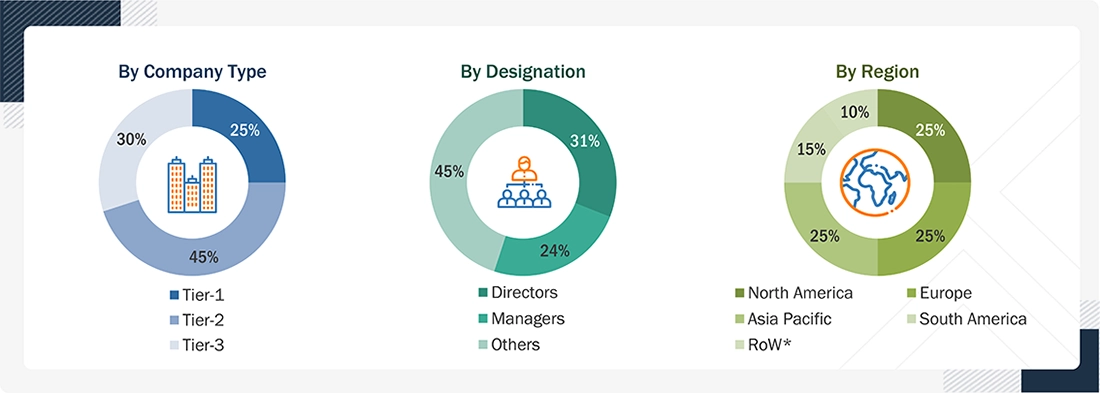
Extensive primary research was conducted after obtaining information regarding the global biopesticides market scenario through secondary research. Several primary interviews were conducted with market experts from both the demand and supply sides across major countries of North America, Europe, Asia Pacific, South America, and RoW. Primary data was collected through questionnaires, emails, and telephonic interviews. The primary sources from the supply side included various industry experts, such as Chief X Officers (CXOs), Vice Presidents (VPs), Directors from business development, marketing, research, and development teams, and key opinion leaders. Primary interviews were conducted to gather insights such as market statistics, data on revenue collected from the products and services, market breakdowns, market size estimations, market forecasting, and data triangulation. Primary research also helped in understanding the various trends related to global biopesticides core material, shell material, method, technology, and application. Stakeholders from the demand side, such as research institutions and universities, and third-party vendors, were interviewed to understand the buyer’s perspective on the service, and their current usage of encapsulation and the outlook of their business, which will affect the overall market.
To know about the assumptions considered for the study, download the pdf brochure
Note: The three tiers of the companies are defined based on their total revenues in 2023 or 2024, as per the availability of financial data: Tier 1: Revenue > USD 1 billion; Tier 2: USD 100 million ≤ Revenue ≤ USD 1 billion; Tier 3: Revenue < USD 100 million.
|
COMPANY NAME |
DESIGNATION |
|
Corteva Agriscience (US) |
R&D Expert |
|
BASF SE (Germany) |
Sales Manager |
|
Bayer CropSciences (Germany) |
Manager |
|
Syngenta Group (Switzerland) |
Sales Manager |
|
FMC Corporation (US) |
Marketing Manager |
Market Size Estimation
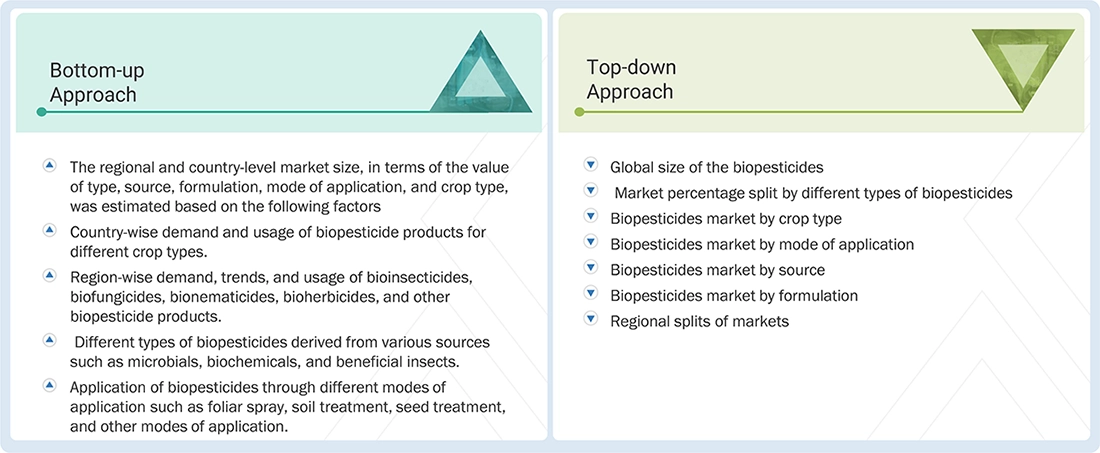
Both the top-down and bottom-up approaches were used to estimate and validate the total size of the biopesticides market. These approaches were also used extensively to determine the size of various subsegments in the market. The research methodology used to estimate the market size includes the following details:
- The key players in the industry and the overall markets were identified through extensive secondary research.
- All shares, splits, and breakdowns were determined using secondary sources and verified through primary sources.
- All possible parameters that affect the market covered in this research study were accounted for, viewed in extensive detail, verified through primary research, and analyzed to obtain final quantitative and qualitative data.
- The research included the study of reports, reviews, and newsletters of top market players, along with extensive interviews for opinions from leaders, such as CEOs, directors, and marketing executives.
Biopesticides Market : Top-Down and Bottom-Up Approach
Data Triangulation
After arriving at the overall market size from the estimation process explained above, the total market was split into several segments and subsegments. Data triangulation and market breakdown procedures were employed, wherever applicable, to estimate the overall biopesticides market and arrive at the exact statistics for all segments and subsegments. The data was triangulated by studying various factors and trends from the demand and supply sides. Along with this, the market size was validated using both the top-down and bottom-up approaches.
Market Definition
Biopesticides have pesticide properties originating from natural living organisms, including microorganisms, plants, and animals. Biopesticides are gaining prominence due to their safer and eco-friendly
ature.The Environmental Protection Agency has defined biopesticides as follows:
“Biopesticides include naturally occurring substances that control pests (biochemical pesticides), microorganisms that control pests (microbial pesticides), and pesticidal substances produced by plants containing added genetic material (plant-incorporated protectants) or PIPs.”
Key Stakeholders
- Agriculture pesticide manufacturers & suppliers
- Associations and industry bodies
- Biopesticide manufacturers & suppliers
- Biopesticide traders, retailers, and distributors
- Commercial research & development (R&D) institutions
- Venture capitalists and investors
- Government, regulatory bodies, and research organizations
- Technology providers to biopesticide & microbial companies
- Public hygiene organizations, government regulatory institutions, and food safety agencies
-
Associations and industry bodies:
- Food and Agriculture Organization (FAO)
- European Food Safety Authority (EFSA)
- British Pest Control Association (BPCA)
- National Pest Management Association (NPMA)
- National Pest Technicians Association
- Confederation of European Pest Management Association (CEPA)
- International associations and industry bodies such as Biopesticide Industry Alliance (BPIA) and the International Biocontrol Manufacturers Association (IBMA)
- Organisation for Economic Co-operation and Development (OECD)
Report Objectives
- Determining and projecting the size of the biopesticides market with respect to type, crop type, mode of application, source, formulation, and region
- Identifying the attractive opportunities in the market by determining the largest and fastest-growing segments
- Providing detailed information about the key factors influencing the market growth (drivers, restraints, opportunities, and industry-specific challenges)
- Providing the regulatory framework and market entry process related to the biopesticides market
- Analyzing the micro markets with respect to individual growth trends, prospects, and their contribution to the total market
Customization Options
With the given market data, MarketsandMarkets offers customizations according to company-specific scientific needs.
The following customization options are available for the report:
- Additional country-level analysis of the space sensors and actuators market
- Profiling of other market players (up to five)
Product Analysis
- Products Matrix, which gives a detailed comparison of the service portfolio of each company
Geographic Analysis
With the given market data, MarketsandMarkets offers customizations according to company-specific scientific needs
- Further breakdown of the Rest of Europe global biopesticides market into key countries
- Further breakdown of the Rest of Asia Pacific global biopesticides market into key countries
- Further breakdown of the Rest of South America global biopesticides market into key countries
Company Information
- Detailed analyses and profiling of additional market players (up to five)
Get the Full Biopesticides Market Report
Full forecast, segment splits, and company analysis for all Biopesticides Market.
- US Biopesticides Market
- Canada Biopesticides Market
- Mexico Biopesticides Market
- France Biopesticides Market
- Germany Biopesticides Market
- Spain Biopesticides Market
- Italy Biopesticides Market
- UK Biopesticides Market
- Netherlands Biopesticides Market
- Russia Biopesticides Market
- China Biopesticides Market
- India Biopesticides Market
- Japan Biopesticides Market
- Australia Biopesticides Market
- Thailand Biopesticides Market
- Indonesia Biopesticides Market
- Argentina Biopesticides Market
- Chile Biopesticides Market
Need a Tailored Report?
Customize this report to your needs
Get 10% FREE Customization
Customize This Report
