
US Catheters Market (2025-2030)

The US Catheters Market was valued at $4846.7 Million in 2025 and projected to reach to $7748.8 Million by 2030, representing a compound annual growth rate of 9.8%. The US catheters market is positioned for sustained expansion through 2030, driven by demographic trends, healthcare spending capacity, and technological advancement.


| Market Size in | USD 26.32 MN |
| Market Forecast in | |
| CAGR | |
| Forecast Period | |
| Units Considered | Value (USD MN) |
US Catheters Market Trends and Insights
- This 9.8% compound annual growth rate reflects strong demand driven by an aging population, rising prevalence of chronic diseases, and advancing catheter technologies across the US healthcare system.
- The US market benefits from high healthcare spending, sophisticated medical infrastructure, and widespread adoption of minimally invasive procedures. In the US, catheter utilization spans multiple clinical applications including cardiovascular interventions, urological procedures, and critical care management.
- The US market is characterized by significant innovation in catheter design, materials, and functionality, with major manufacturers investing heavily in product development.
- Between 2025 and 2030, the US is expected to see accelerated adoption of specialty catheters and digital health integration, positioning the country as a key growth engine within the global catheters market..
Key Market Statistics
- CAGR (2025-2030) 9.8% CAGR
- Market Size, 2025 ~USD 4846.7 Million
- Forecast, 2030 ~USD 7748.8 Million
- Country US
US Catheters Market Overview
Market Valuation :
The US catheters market is valued at $4,846.7 million in 2025, with projections reaching $7,748.8 million by 2030, representing a robust 9.8% CAGR driven by healthcare infrastructure investments and clinical adoption.
Aging Population Impact :
The US demographic shift toward an aging population significantly drives catheter demand, as elderly patients require increased cardiovascular interventions, urological procedures, and critical care management across hospitals and outpatient facilities.
Chronic Disease Prevalence :
Rising incidence of diabetes, cardiovascular diseases, and renal disorders in the US population necessitates expanded catheterization procedures, creating sustained demand for specialized catheter products and advanced delivery systems.
Technological Innovation :
US manufacturers lead in developing next-generation catheters with improved biocompatibility, antimicrobial coatings, and minimally invasive designs, supported by strong R&D investment and favorable regulatory pathways through FDA approval processes.
US Catheters Market Dynamics
- The 9.8% CAGR reflects strong adoption of advanced catheter technologies across interventional cardiology, urology, and critical care settings.
- Healthcare providers are increasingly investing in catheter-based procedures as cost-effective alternatives to traditional surgery, supported by favorable reimbursement policies and clinical evidence demonstrating improved patient outcomes.
- The US market benefits from established distribution networks, robust hospital infrastructure, and continuous innovation from leading medical device manufacturers..
Market Ecosystem
Related Ecosystem
Key Takeaways
- The US catheters market will grow from $4,846.7M (2025) to $7,748.8M (2030) at a 9.8% CAGR, outpacing global growth.
- US demand is driven by aging demographics, chronic disease prevalence, and high adoption of minimally invasive procedures.
- The US market leads in catheter innovation, with manufacturers developing advanced materials and specialty designs.
- Digital health integration and smart catheter technologies are expected to accelerate US market expansion through 2030.
Catheters Market Report Scope
| Report Metric | Details |
|---|---|
| Base Year | 2025 |
| Fastest Growing Segment | NEUROVASCULAR CONDITIONS (Indication) |
| Forecast Period | 2025-2030 |
| Growth Rate | CAGR of 8.5% from 2025 to 2030 |
| Largest Segment | HOSPITALS (End User) |
| Market Size Base Year (Billions) | ~USD 30.59 (2025) |
| Revenue Forecast (Billions) | ~USD 45.99 (2030) |
| Segments Covered | Type, Indication, End User |
US Catheters Market Report Segmentation
3 segment dimensions are covered across the global market.
By Type
- Angiography Catheters
- Cardiovascular Catheters
- Central Venous Catheters
- Coronary Balloon Catheters
- Dialysis Catheters
- Electrophysiology Catheters
- External Catheters
- Guiding Catheters
- Hemodialysis Catheters
- Implantable Ports
- Indwelling Catheters
- Intermittent Catheters
- Intrauterine Insemination Catheters
- Intravenous Catheters
- Ivus/Oct Catheters
- Midline Peripheral Catheters
- Neurovascular Catheters
- Non-Tunneled Central Venous Catheters
- Other Cardiovascular Catheters
- Other Specialty Catheters
- Peripheral Intravenous Catheters
- Peripherally Inserted Central Catheters
- Peritoneal Dialysis Catheters
- Pressure & Hemodynamic Catheters
- Skin-Tunneled Central Venous Catheters
- Specialty Catheters
- Temperature Monitoring Catheters
- Urinary Catheters
- Urological Catheters
By Indication
- Blood Transfusion
- Cardiac Diseases
- Iv Medication Delivery & Fluid Management
- Kidney Diseases
- Neurovascular Conditions
- Other Indications
- Urinary Conditions
- Vascular Diseases
By End User
- Ambulatory Surgery Centers
- Diagnostic Imaging Centers
- Hospitals
- Long-Term Care Facilities
- Other End Users
- Outpatient Clinics
US: CATHETERS MARKET, BY END USER, 2023–2030
| Segment | 2023 | 2024 | 2025 | 2026 | 2028 | 2029 | 2030 | CAGR (%) |
|---|---|---|---|---|---|---|---|---|
| AMBULATORY SURGERY CENTERS | 1350.4 | 1440.3 | 1562.8 | 1703.8 | 2056.4 | 2267.8 | 2506.3 | 9.9 |
| DIAGNOSTIC IMAGING CENTERS | 711.7 | 759 | 816.1 | 881.6 | 1044.6 | 1141.4 | 1249.9 | 8.9 |
| HOSPITALS | 5780.8 | 6165.6 | 6646.7 | 7199.8 | 8577.8 | 9398.3 | 10319.7 | 9.2 |
| LONG-TERM CARE FACILITIES | 1088.1 | 1160.5 | 1224 | 1297.2 | 1479.4 | 1585.8 | 1703.7 | 6.8 |
| OTHER END USERS | 460.1 | 490.7 | 522.8 | 559.8 | 651.5 | 705.5 | 765.6 | 7.9 |
| OUTPATIENT CLINICS | 441.3 | 470.7 | 498.9 | 531.3 | 611.9 | 659.1 | 711.6 | 7.4 |
| TOTAL | 9832.4 | 10486.7 | 11271.2 | 12173.5 | 14421.5 | 15757.9 | 17256.9 | 8.9 |
Target Audience
- Medical Device Manufacturers : US-based and international catheter manufacturers need market sizing, competitive benchmarking, and growth forecasts to guide R&D investments, product launches, and market expansion strategies in the lucrative American healthcare market.
- Healthcare Investors & PE Firms : Investment professionals require validated market data, growth trajectories, and segment analysis to evaluate acquisition targets, portfolio companies, and investment opportunities within the US catheter and medical device sector.
- Hospital & Healthcare Systems : US hospital networks and healthcare providers need market intelligence on catheter innovations, supplier trends, and cost-effectiveness data to optimize procurement strategies, clinical protocols, and patient care delivery.
- Distributors & Suppliers : Medical device distributors and supply chain partners require US market forecasts, demand projections, and segment growth rates to optimize inventory management, supplier relationships, and distribution network planning.
- Regulatory & Consulting Firms : Healthcare consultants, regulatory advisors, and policy analysts need comprehensive US market data to support client advisory services, regulatory submissions, market entry strategies, and healthcare industry analysis.
Reasons to Buy this Report
- Market Size & Growth Validation : Obtain precise US market valuation ($4.8B in 2025) and verified 9.8% CAGR projections through 2030, enabling accurate financial forecasting and investment decision-making specific to the American catheter sector.
- Competitive Landscape Intelligence : Understand market dynamics, key US manufacturers, competitive positioning, and market share distribution to identify partnership opportunities, acquisition targets, and competitive advantages within the American healthcare system.
- Segment & Application Insights : Access detailed breakdown of US catheter applications across cardiology, urology, oncology, and critical care, enabling targeted product development, marketing strategies, and resource allocation for specific clinical segments.
- Regulatory & Reimbursement Analysis : Gain insights into FDA approval pathways, Medicare/insurance reimbursement trends, and US healthcare policy impacts on catheter adoption, pricing strategies, and market entry requirements for new products.
- Growth Driver Identification : Leverage data on aging demographics, chronic disease prevalence, hospital capacity expansion, and technological adoption rates in the US to identify high-growth opportunities and emerging market segments.
Frequently asked questions
What is the current size of the US catheters market?
The US catheters market is valued at $4,846.7 million in 2025 and is projected to reach $7,748.8 million by 2030.
What is the growth rate of the US catheters market?
The US catheters market is growing at a compound annual growth rate (CAGR) of 9.8% from 2025 to 2030.
What factors are driving growth in the US catheters market?
Key drivers include an aging US population, rising prevalence of chronic diseases, increased adoption of minimally invasive procedures, and continuous innovation in catheter technology.
Which catheter types are most prevalent in the US market?
The US market includes cardiovascular catheters, urological catheters, and critical care catheters, with cardiovascular applications representing a significant segment.
How does the US catheters market compare to global trends?
The US market grows at 9.8% CAGR, exceeding the global average of 8.5%, reflecting higher healthcare spending and advanced medical infrastructure in the US.
RESEARCH METHODOLOGY
This study involved the extensive use of primary and secondary sources. The research process involved the study of various factors affecting the catheters market to identify segmentation types, industry trends, key players, competitive landscape, key market dynamics, and key player strategies.
Secondary Research
This research study involved the usage of comprehensive secondary sources, such as directories; databases such as Bloomberg Business, Factiva, and Dun & Bradstreet; white papers; annual reports; company house documents; investor presentations; and SEC filings of companies. Secondary research was used to identify and collect information useful for an extensive, technical, market-oriented, and commercial study of the catheters market. It was also used to obtain important information about the key players, market classification, segmentation according to industry trends to the bottommost level, and key developments related to market and technology perspectives. A database of the key industry leaders was also prepared using secondary research.
Primary Research
In the primary research process, various sources from the supply and demand sides were interviewed to obtain qualitative and quantitative information for this report. Primary sources from the supply side include project/sales/marketing/business development managers, presidents, CEOs, vice presidents, chairpersons, chief operating officers, chief strategy officers, directors, chief information officers, chief medical information officers related to the catheters market. Primary sources from the demand side include healthcare professionals from hospitals, ambulatory surgical centers (ASCs), long-term care facilities, diagnostic imaging centers, outpatient clinics, and other end users.
A breakdown of the primary respondents is provided below:
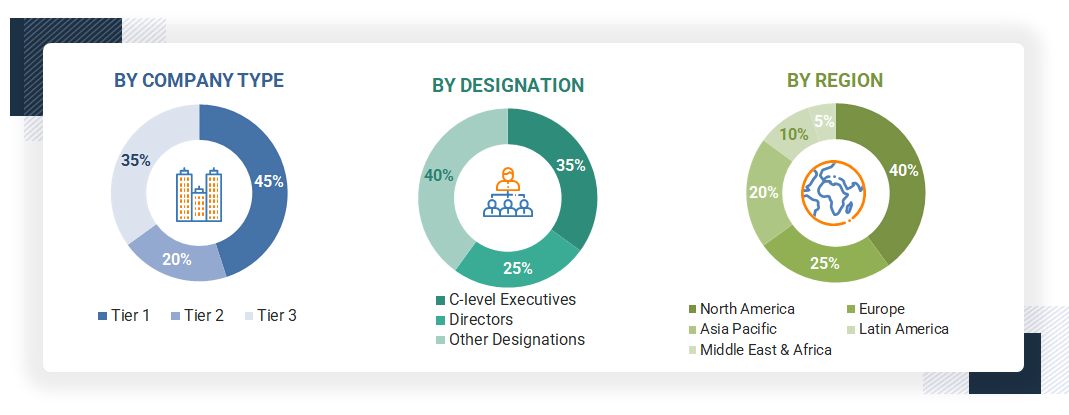
Note 1: C-level Executives include CEOs, COOs, CTOs, and VPs.
Note 2: Other Designations include Sales, Marketing, and Product Managers.
Note 3: The tiers above are defined based on the companies’ total revenue as of 2024. Here are the categories considered:
Tier 1 = > USD 1 billion; tier 2 = USD 500 million to USD 1 billion; and tier 3 = < USD 500 million
To know about the assumptions considered for the study, download the pdf brochure
Market Size Estimation
The total size of the catheters market was arrived at after triangulating data from three different approaches, as mentioned below. After each approach, the weighted average of the three approaches was taken based on the level of assumptions used in each approach.
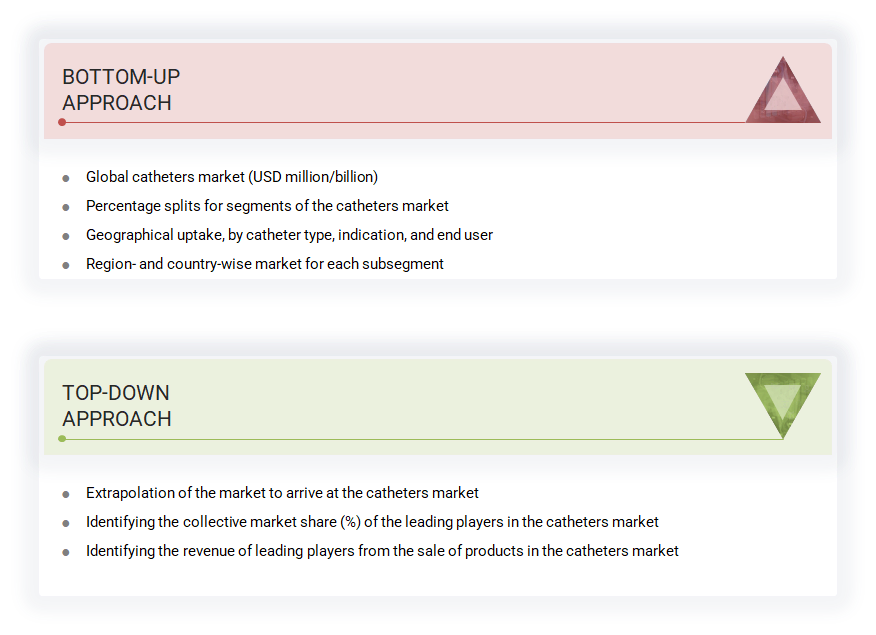
Data Triangulation
After arriving at the market size, the total market was divided into several segments and subsegments. Data triangulation and market breakdown procedures were employed wherever applicable to complete the overall market engineering process and arrive at the exact statistics for all segments and subsegments.
Market Definition
The catheters market comprises a wide range of medical devices designed as thin, flexible tubes inserted into the body to perform therapeutic or diagnostic functions. Catheters are used to deliver medications, fluids, or gases and to drain bodily fluids across multiple specialties, such as cardiology, urology, neurology, and gastroenterology. They are commonly utilized in procedures, such as angioplasty, dialysis, urinary drainage, and intravenous access, which makes them essential tools in modern medical practice. Most catheters are single-use and sterile and are used in various care settings, including hospitals, outpatient clinics, ambulatory centers, and home care.
Stakeholders
- Catheter Manufacturers
- Medical Device Companies
- Cardiologists
- Interventional Radiologists
- Urologists
- Vascular Surgeons
- Hospitals
- Ambulatory Surgical Centers (ASCs)
- Outpatient Clinics
- Long-term Care Facilities
- Emergency Medical Service (EMS) Providers
- Research Institutions
- Academic Medical Centers
- Contract Manufacturing Organizations (CMOs)
- Regulatory Authorities (e.g., FDA, EMA)
- Healthcare Procurement Organizations
- Medical Device Distributors and Suppliers
- Health Insurance Providers
Report Objectives
- To define, describe, and forecast the size of the catheters market, by type, indication, end user, and region
- To provide detailed information about the key factors, such as drivers, restraints, opportunities, challenges, and industry trends, influencing the market growth
- To strategically analyze the regulatory scenario, value chain analysis, supply chain analysis, Porter’s five forces analysis, ecosystem analysis, trade analysis, pricing analysis, patent analysis, impact of AI on the catheters market, trends/disruption impacting customers’ business, and impact of the 2025 US tariff on the market
- To analyze the micromarkets concerning individual growth trends, prospects, and contributions to the overall catheters market
- To analyze market opportunities for stakeholders and provide details of the competitive landscape for key players
- To strategically profile the key players in this market and comprehensively analyze their market share and core competencies
- To strategically analyze the catheters market for five regions, namely North America, Europe, Asia Pacific, Latin America, and the Middle East & Africa
- To track and analyze competitive developments, such as product launches and approvals, acquisitions, partnerships, collaborations, and expansions in the catheters market
Get the Full Catheters Market Report
Full forecast, segment splits, and company analysis for all Catheters Market.
- Canada Catheters Market
- Germany Catheters Market
- UK Catheters Market
- France Catheters Market
- Spain Catheters Market
- Italy Catheters Market
- Japan Catheters Market
- China Catheters Market
- India Catheters Market
- Australia Catheters Market
- South Korea Catheters Market
- Brazil Catheters Market
- Mexico Catheters Market
- Rest Of Europe Catheters Market
- Rest Of Asia Pacific Catheters Market
- Other GCC Countries Catheters Market
- Rest Of Latin America Catheters Market
- Saudi Arabia Catheters Market
- UAE Catheters Market
- GCC Countries Catheters Market
Need a Tailored Report?
Customize this report to your needs
Get 10% FREE Customization
Customize This Report
