
Asia Pacific Cathode Materials Market (2025-2030)

The Asia Pacific Cathode Materials Market was valued at $27884.9 Million in 2025 and projected to reach to $48767.1 Million by 2030, representing a compound annual growth rate of 11.8%. Asia Pacific's cathode materials market is poised for exceptional growth, driven by the region's dominance in lithium-ion battery manufacturing and accelerating electric vehicle adoption.


| Market Size in | USD 26.32 MN |
| Market Forecast in | |
| CAGR | |
| Forecast Period | |
| Units Considered | Value (USD MN) |
Asia Pacific Cathode Materials Market Trends and Insights
- In 2025, Asia Pacific's cathode materials market is estimated at USD 27,884.9 million, driven by rapid battery manufacturing expansion and electric vehicle adoption across the region.
- By 2030, Asia Pacific is forecast to reach USD 48,767.1 million, reflecting a compound annual growth rate of 11.8%, outpacing global growth trends. The region's leadership stems from concentrated battery production capacity, particularly in China, South Korea, and Japan, where major EV and energy storage manufacturers operate.
- Asia Pacific's cathode materials market benefits from established supply chains, technological innovation, and government incentives supporting clean energy transitions.
- Rising demand for lithium-ion batteries in consumer electronics, electric vehicles, and grid-scale energy storage continues to propel Asia Pacific's market expansion through 2030. Asia Pacific's competitive advantage in cathode materials manufacturing, coupled with increasing investments in battery technology and mineral processing infrastructure, positions the region as the primary growth engine for the global market.
- Strategic partnerships and vertical integration among Asia Pacific producers further strengthen market consolidation and supply security..
Key Market Statistics
- CAGR (2025-2030) 11.8% CAGR
- Market Size, 2025 ~USD 27884.9 Million
- Forecast, 2030 ~USD 48767.1 Million
- Geography Asia Pacific
Asia Pacific Cathode Materials Market Overview
Market Dominance :
Asia Pacific commands over 45% of the global cathode materials market, with China alone accounting for USD 22,570.6 million in 2025, establishing the region as the undisputed leader in battery material production.
Rapid EV Expansion :
Electric vehicle adoption across Asia Pacific is accelerating cathode material demand, with India, South Korea, and Japan emerging as key growth drivers alongside China's established manufacturing ecosystem.
Strong CAGR Performance :
Asia Pacific's cathode materials market is projected to grow at 11.8% CAGR from 2025 to 2030, outpacing the global average of 11.5%, driven by battery manufacturing capacity expansion and renewable energy storage initiatives.
Supply Chain Integration :
The region benefits from vertically integrated supply chains, with Taiwan and Malaysia playing critical roles in processing and refining cathode materials for global battery manufacturers.
Asia Pacific Cathode Materials Market Dynamics
- China's established production infrastructure, combined with India's emerging battery sector and South Korea's advanced material technologies, creates a robust ecosystem for cathode material demand.
- Government incentives for EV adoption and renewable energy storage across the region are expected to sustain double-digit growth through 2030. The market will benefit from increasing localization of battery supply chains, reducing dependency on imports and strengthening regional competitiveness.
- Investment in cathode material processing facilities, particularly in India and Southeast Asia, will unlock new growth opportunities.
- Strategic partnerships between battery manufacturers and material suppliers will further consolidate Asia Pacific's position as the global hub for cathode material innovation and production..
Market Ecosystem
Related Ecosystem
Electric Hybrid Vehicles
- Battery Electric Vehicle (BEV)
- Fuel Cell Electric Vehicle (FCEV)
- Light Commercial Vehicles (LCVs)
- Hybrid Electric Vehicle (HEV)
- Agricultural Tractors
- Visteon Corporation
- BOSCH LIMITED
- Byd company ltd.
- Tesla, Inc.
- FORD MOTOR COMPANY
Equipment Machine And Tooling
- Wastewater Treatment
- Air Cooled Heat Exchangers
- Diaphragm Pumps
- Fiberglass
- HVAC System
- Alfa Laval Corporate AB
- Veolia
- Johnson Controls International plc
- Daikin Industries,Ltd.
- Parker-Hannifin Corporation
Mining Minerals And Metals
- Wastewater Treatment
- Fiberglass
- Light Commercial Vehicles (LCVs)
- Nitrogen
- Acetic Acid
- LHOIST S.A
- SEVERSTAL JSC
- ArcelorMittal S.A.
- TW METALS, INC.
- Linde plc
Key Takeaways
- Asia Pacific cathode materials market will grow from USD 27,884.9 million in 2025 to USD 48,767.1 million by 2030 at an 11.8% CAGR.
- Asia Pacific's dominance is driven by concentrated EV manufacturing and battery production capacity in China, South Korea, and Japan.
- Rising demand for lithium-ion batteries across electric vehicles, consumer electronics, and energy storage applications fuels Asia Pacific market expansion.
- Asia Pacific's established supply chains and technological innovation position the region as the global market's primary growth engine through 2030.
Cathode Materials Market Report Scope
| Report Metric | Details |
|---|---|
| Base Year | 2025 |
| Fastest Growing Segment | -LFP (Material) |
| Forecast Period | 2025-2030 |
| Growth Rate | CAGR of 11.5% from 2025 to 2030 |
| Largest Segment | AUTOMOTIVE (End-Use) |
| Market Size Base Year (Billions) | ~USD 37.8 (2025) |
| Revenue Forecast (Billions) | ~USD 65.15 (2030) |
| Segments Covered | Material, Battery Type, End Use, End-Use, End-Use Industry |
Asia Pacific Cathode Materials Market Report Segmentation
5 segment dimensions are covered across the global market.
By Material
- Lco
- Lead Dioxide Cathode Materials
- Lfp
- Lithium-Ion Cathode Materials
- Lmo
- Nca
- Nmc
- Other Cathode Materials
- -Lco
- -Lfp
- -Lmo
- -Nca
- -Nmc
By Battery Type
- Lead-Acid
- Lithium-Ion
- Other Battery Types
By End Use
- Automotive
- Consumer Electronics
- Industrial
- Other End Uses
By End-Use
- Automotive
- Consumer Electronics
- Industrial
- Other End Uses
By End-Use Industry
- Motive Industrial Batteries
- Stationary Industrial Batteries
Target Audience
- Battery Manufacturers : Optimize sourcing strategies and supply chain planning by understanding Asia Pacific cathode material availability, pricing trends, and supplier capabilities across China, India, and Southeast Asia.
- EV Producers : Align production roadmaps with regional cathode material supply forecasts to ensure cost-effective battery sourcing and support accelerating EV manufacturing expansion across Asia Pacific markets.
- Material & Mining Companies : Identify processing and refining opportunities in high-growth Asia Pacific markets, particularly in India and Malaysia, where cathode material demand is expanding faster than global averages.
- Investment & Private Equity Firms : Evaluate M&A and investment opportunities in Asia Pacific's cathode material sector, leveraging market size data and growth forecasts to identify undervalued assets and emerging players.
- Government & Policy Makers : Develop evidence-based policies for battery manufacturing incentives and supply chain localization by understanding Asia Pacific's market structure, growth drivers, and competitive positioning.
Countries within Asia Pacific - compare and drill down
| Country | 2025 size (native) |
|---|---|
| China | USD 22570.6 Million |
| India | USD 7832.4 Million |
| South Korea | USD 4021.6 Million |
| Japan | USD 3394.2 Million |
| Taiwan | USD 1630.2 Million |
| Malaysia | USD 1616.1 Million |
Country market size visualization
Reasons to Buy this Report
- Regional Market Dominance Insights : Understand why Asia Pacific controls 45%+ of global cathode material demand and how China's manufacturing leadership influences regional and global market dynamics through detailed competitive analysis.
- Country-Level Granularity : Access market size data for six key Asia Pacific nations including China (USD 22.6B), India (USD 7.8B), and South Korea (USD 4.0B) to identify high-growth opportunities and market entry strategies.
- EV & Battery Adoption Trends : Leverage Asia Pacific-specific insights on electric vehicle adoption rates, battery manufacturing capacity expansions, and government incentives driving cathode material demand across the region.
- Supply Chain & Investment Opportunities : Identify emerging processing hubs in India, Malaysia, and Taiwan, and understand vertical integration strategies that create competitive advantages for cathode material suppliers in Asia Pacific.
- 2030 Growth Forecasting : Plan long-term strategies with Asia Pacific's projected growth to USD 48.8B by 2030 at 11.8% CAGR, enabling informed capital allocation and market expansion decisions.
Frequently asked questions
What is the estimated size of Asia Pacific's cathode materials market in 2025?
Asia Pacific's cathode materials market is estimated at USD 27,884.9 million in 2025, representing the largest regional market globally.
What is the projected market size for Asia Pacific cathode materials by 2030?
Asia Pacific's cathode materials market is forecast to reach USD 48,767.1 million by 2030, growing at an 11.8% CAGR from 2025.
Which countries drive Asia Pacific's cathode materials market growth?
China, South Korea, and Japan are the primary drivers of Asia Pacific's cathode materials market due to their dominant battery manufacturing and EV production capabilities.
What factors are accelerating Asia Pacific's cathode materials demand?
Key drivers include rapid EV adoption, expanding battery manufacturing capacity, government clean energy incentives, and growing energy storage applications across Asia Pacific.
How does Asia Pacific's cathode materials CAGR compare to global growth?
Asia Pacific's 11.8% CAGR slightly exceeds the global cathode materials market CAGR of 11.5%, reflecting the region's accelerated growth trajectory.
RESEARCH METHODOLOGY
The research encompassed four primary actions in assessing the present market size of cathode materials. Comprehensive secondary research was conducted to gather information on the market, the peer market, and the parent market. The subsequent stage involved corroborating these findings, assumptions, and dimensions with industry specialists throughout the cathode materials value chain via primary research. The total market size is ascertained using both top-down and bottom-up methodologies. Subsequently, market segmentation analysis and data triangulation were employed to ascertain the dimensions of the market segments and subsegments.
Secondary Research
The research approach employed to assess and project the cathode materials market begins with the collection of revenue data from prominent suppliers using secondary research. In the course of the secondary research, many secondary sources, such as D&B Hoovers, Bloomberg BusinessWeek, Factiva, the World Bank, and industry magazines, were utilized to identify and compile information for this study. The secondary sources comprised annual reports, press releases, and investor presentations from corporations; white papers; accredited periodicals; writings by esteemed authors; announcements from regulatory agencies; trade directories; and databases. Vendor offerings have been considered to ascertain market segmentation.
Primary Research
The cathode materials market includes various stakeholders, such as manufacturers, suppliers, traders, associations, and regulatory organizations. On the demand side, the market is characterized by multiple end-use sectors, including automotive, consumer electronics, industrial applications, and others. The supply side is defined by technological advancements. To gather qualitative and quantitative information, interviews were conducted with various primary sources from both the supply and demand sides of the market.
Below is a breakdown of the primary respondents:
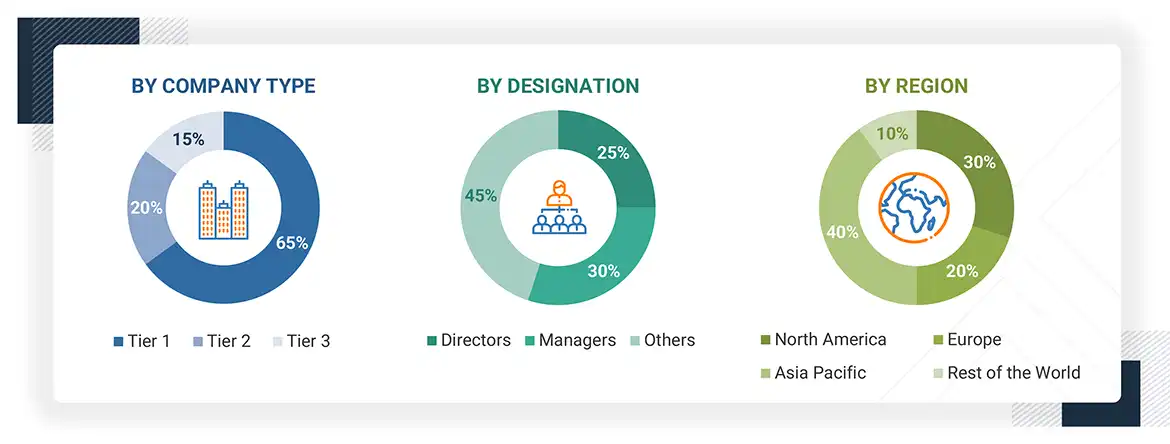
To know about the assumptions considered for the study, download the pdf brochure
Market Size Estimation
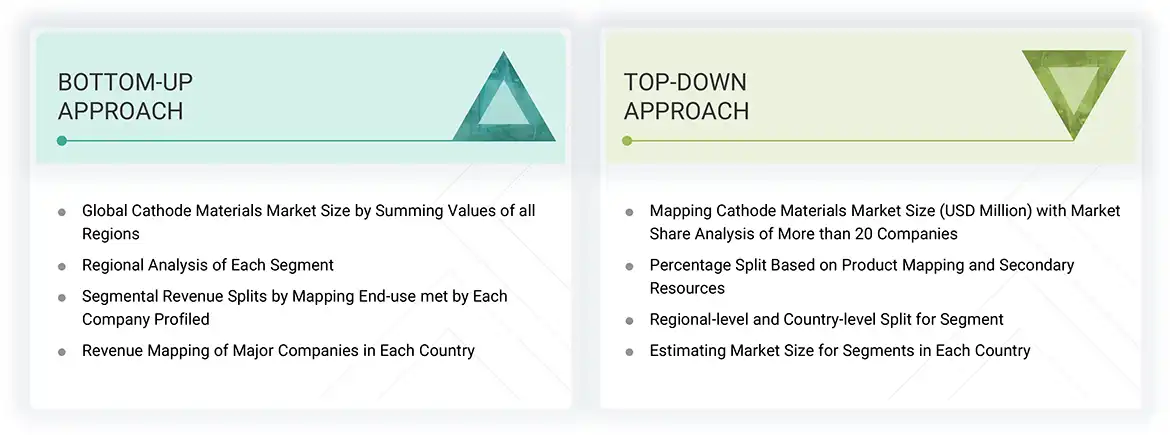
Both the top-down and bottom-up approaches were used to estimate and validate the total size of the cathode materials market. These methods were also used extensively to determine the size of various subsegments in the market. The research methodology used to estimate the market size included the following:
- The key players were identified through extensive primary and secondary research
- The value chain and market size of the cathode materials market, in terms of value, were determined through primary and secondary research
- All percentage shares, splits, and breakdowns were determined using secondary sources and verified through primary sources
- All possible parameters that affect the market covered in this research study were accounted for, viewed in extensive detail, verified through primary research, and analyzed to obtain the final quantitative and qualitative data
- The research included the study of reports, reviews, and newsletters of top market players, along with extensive interviews for opinions from key leaders, such as CEOs, directors, and marketing executives
Global Cathode Materials Market Size: Bottom-up and Top-down Approach
Data Triangulation
After arriving at the overall market size using the market size estimation processes as explained above, the market was split into several segments and subsegments. To complete the overall market engineering process and arrive at the exact statistics of each market segment and subsegment, data triangulation and market breakdown procedures were employed, wherever applicable. The market size was calculated globally by summing up the country-level and regional-level data.
Market Definition
Cathode materials are active chemical compounds that make up the positive electrode of a rechargeable battery and serve as the main source and host for lithium ions during charge and discharge cycles. These materials, classified by material type such as lithium nickel manganese cobalt (NMC), lithium iron phosphate (LFP), nickel cobalt aluminum (NCA), lithium cobalt oxide (LCO), and lithium manganese oxide (LMO), directly determine a battery’s energy density, voltage, safety, and cycle life. Cathode materials are produced through specific manufacturing processes, including solid-state synthesis, co-precipitation, and other advanced techniques, to ensure purity, structural stability, and consistent performance. They are used across multiple battery types, primarily lithium-ion but also in certain lead-acid and next-generation chemistries, and support diverse end-use industries such as automotive, consumer electronics, stationary energy storage, and industrial power systems. By enabling the electrochemical reactions that store and release electrical energy, cathode materials form the core component that defines the efficiency and reliability of modern rechargeable batteries.
Stakeholders
- Cathode Material Manufacturers
- Cathode Material Suppliers
- Cathode Material Traders, Distributors, and Suppliers
- Investment Banks and Private Equity Firms
- Raw Material Suppliers
- Government and Research Organizations
- Consulting Companies/Consultants in the Chemicals and Materials Sectors
- Industry Associations
- Contract Manufacturing Organizations (CMOs)
- NGOs, Governments, Investment Banks, Venture Capitalists, and Private Equity Firms
Report Objectives
- To define, describe, and forecast the size of the global cathode materials market in terms of volume and value
- To provide detailed information regarding the key factors, such as drivers, restraints, opportunities, and industry-specific challenges, influencing the growth of the global cathode materials market
- To analyze and forecast the size of various segments (material, battery type, and end-use) of the cathode materials market based on five major regions—North America, Asia Pacific, Europe, and the Rest of the World—along with key countries in each of these regions
- To analyze recent developments and competitive strategies, such as agreements, partnerships, product launches, and joint ventures, to draw the competitive landscape of the market
- To strategically profile the key players in the market and comprehensively analyze their core competencies
Get the Full Cathode Materials Market Report
Full forecast, segment splits, and company analysis for all Cathode Materials Market.
- China Cathode Materials Market
- South Korea Cathode Materials Market
- Japan Cathode Materials Market
- India Cathode Materials Market
- Taiwan Cathode Materials Market
- Malaysia Cathode Materials Market
- Canada Cathode Materials Market
- Mexico Cathode Materials Market
- US Cathode Materials Market
- Germany Cathode Materials Market
- UK Cathode Materials Market
- France Cathode Materials Market
- Brazil Cathode Materials Market
- Rest Of Europe Cathode Materials Market
- Rest Of Asia Pacific Cathode Materials Market
- Other Countries Cathode Materials Market
Need a Tailored Report?
Customize this report to your needs
Get 10% FREE Customization
Customize This Report
