
Australia Clinical Communication & Collaboration Market (2025-2030)

The Australia Clinical Communication & Collaboration Market was valued at $55 Million in 2025 and projected to reach to $103.2 Million by 2030, representing a compound annual growth rate of 13.4%. Australia's Clinical Communication & Collaboration Market is positioned for sustained expansion as healthcare providers invest in digital transformation initiatives.


| Market Size in | USD 26.32 MN |
| Market Forecast in | |
| CAGR | |
| Forecast Period | |
| Units Considered | Value (USD MN) |
Australia Clinical Communication & Collaboration Market Trends and Insights
- This 13.4% compound annual growth rate reflects Australia's increasing adoption of digital health solutions and integrated communication platforms across healthcare facilities.
- Australia's healthcare sector is prioritizing interoperability and real-time clinical collaboration to enhance patient outcomes and operational efficiency. The Australian market is driven by regulatory support, rising healthcare digitalization, and growing demand for secure messaging and team coordination tools.
- Australia's hospitals and clinics are investing heavily in clinical communication infrastructure to streamline workflows and reduce communication delays.
- By 2030, Australia is expected to solidify its position as a key adopter of advanced clinical collaboration technologies in the Asia Pacific region..
Key Market Statistics
- CAGR (2025-2030) 13.4% CAGR
- Market Size, 2025 ~USD 55 Million
- Forecast, 2030 ~USD 103.2 Million
- Country Australia
Australia Clinical Communication & Collaboration Market Overview
Market Valuation Growth :
Australia's Clinical Communication & Collaboration Market is valued at $55.0 million in 2025, with projections reaching $103.2 million by 2030, representing an 87.6% total growth over five years.
Strong CAGR Performance :
The Australian market is growing at 13.4% CAGR, outpacing the global average of 13.02%, indicating accelerated digital health adoption within the country's healthcare infrastructure.
Digital Health Integration :
Australian healthcare facilities are increasingly implementing integrated communication platforms to enhance inter-departmental collaboration, driven by government digital health initiatives and regulatory compliance requirements.
Healthcare Modernization :
Australia's healthcare sector is prioritizing modern communication solutions to improve patient outcomes, reduce operational inefficiencies, and meet the demands of an aging population requiring coordinated care delivery.
Australia Clinical Communication & Collaboration Market Dynamics
- The 13.4% CAGR reflects growing recognition of communication platforms' role in improving clinical workflows, patient safety, and operational efficiency across hospitals, aged care facilities, and primary care networks.
- Government support for digital health infrastructure and increasing interoperability standards are key growth catalysts. By 2030, the market's expansion to $103.2 million will be driven by rising adoption among regional and rural healthcare providers, integration with electronic health records systems, and demand for mobile-first collaboration solutions.
- Australian healthcare organizations are increasingly recognizing that seamless clinical communication reduces medical errors, accelerates decision-making, and enhances care coordination across multiple care settings..
Market Ecosystem
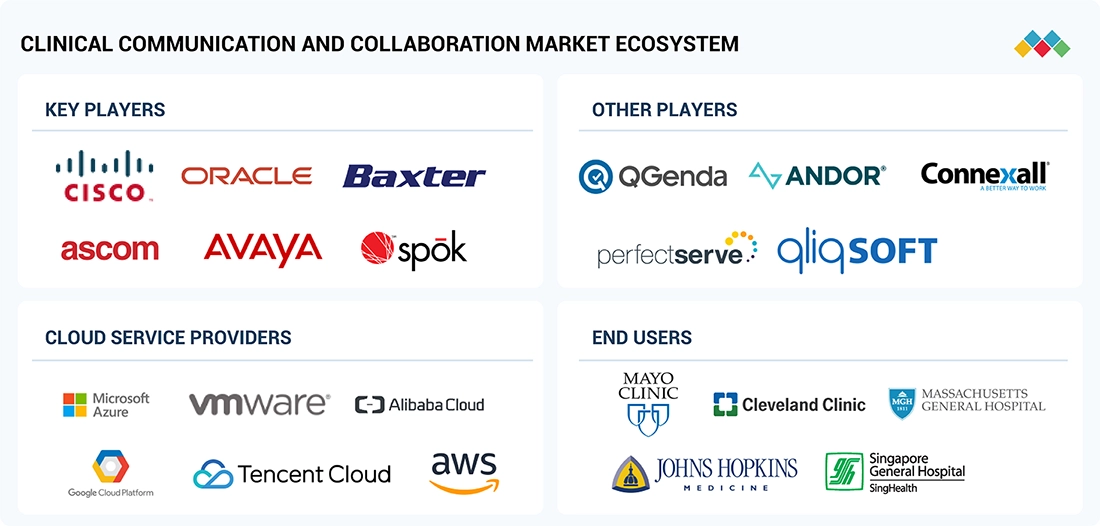
clinical-communication-collaboration-market: COMMERCIAL USE CASES ACROSS INDUSTRIES
| COMPANY | USE CASE DESCRIPTION | BENEFITS |
|---|---|---|
 |
Unified clinical communication platform: Secure voice, video, text, mobile communications, and alerts, enabling seamless team collaboration and mobile workflows for care providers. | Strengthens care team coordination, supports mobile care delivery, boosts workflow efficiency, and enhances patient outcomes through improved real-time communication. |
 |
HIPAA-compliant care team messaging, telehealth, and real-time clinical workflow integration, including remote patient monitoring and care coordination tools. | Enables safer, context-aware care team collaboration, supports virtual monitoring, accelerates decision-making, and improves care transitions and patient management. |
 |
Voalte platform for mobile clinical communication: nurse call integration, patient engagement, and alert management with analytics for hospital teams. | Improves timely response to patient needs, enhances staff collaboration and patient satisfaction, and enables visibility into patient safety and care risks. |
 |
Secure, unified communications across clinical teams and patients via chat, voice, video, automated workflows, and EHR integration for streamlined operations. | Increases operational efficiency, improves patient access and coordination, enhances patient satisfaction, and reduces manual communication errors. |
 |
Automated clinical messaging, secure nurse-call integration, and workflow coordination for alerts, consults, and test results across health systems. | Streamlines communication workflows, improves clinician satisfaction, boosts responsiveness, and reduces communication gaps to support better patient care. |
Logos and trademarks shown above are the property of their respective owners. Their use here is for informational and illustrative purposes only.
Related Ecosystem
Healthcare It
- Computed Tomography (CT)
- Machine Learning
- Magnetic Resonance Imaging (MRI)
- Natural Language Processing (NLP)
- Predictive Analytics
- CERNER CORPORATION
- PHILIPS HEALTHCARE
- Oracle Corporation
- GE HealthCare Technologies Inc.
- Siemens healthineers
Key Takeaways
- Australia's Clinical Communication & Collaboration Market will nearly double from $55.0M (2025) to $103.2M (2030), representing a 13.4% CAGR.
- Australia's healthcare providers are accelerating digital transformation initiatives to improve clinical workflows and patient safety through integrated communication platforms.
- Australia's regulatory environment and emphasis on healthcare interoperability are key drivers supporting sustained market expansion through 2030.
- Australia is positioned as a leading Asia Pacific market for clinical collaboration adoption, driven by advanced healthcare infrastructure and technology investment.
Clinical Communication & Collaboration Market Report Scope
| Report Metric | Details |
|---|---|
| Base Year | 2025 |
| Fastest Growing Segment | TELEHEALTH PLATFORMS (Type) |
| Forecast Period | 2025–2030 |
| Growth Rate | CAGR of 13.02% from 2025 to 2030 |
| Largest Segment | INTEGRATED SOLUTIONS (Integration Type) |
| Market Size Base Year (Billions) | ~USD 2.88 (2025) |
| Revenue Forecast (Billions) | ~USD 5.32 (2030) |
| Segments Covered | Platform, Component, Type, Deployment Model, Application, Integration Type, End User |
Australia Clinical Communication & Collaboration Market Report Segmentation
7 segment dimensions are covered across the global market.
By Platform
- Collaboration Platforms
- Messaging Platforms
- Other Platforms
- Voice Communication Platforms
By Component
- Hardware
- Services
- Software
By Type
- Android
- Badges
- Clinical Alerting & Notification Software
- Collaborative Care Platforms
- Consulting & Training Services
- Dedicated Desktop Computers
- Dedicated Smartphones & Tablets
- Implementation & Integration Services
- Interactive Whiteboards
- Ios
- Nurse Call Systems
- Physician & Nurse Scheduling Systems
- Support & Maintenance Services
- Telehealth Platforms
- Two-Way Radios
- Voice-Over Ip (Voip) Handsets
- Voip Handsets
- Wearable Communication Devices
- Workstations On Wheels
- Workstations On Wheels (Wows)
By Deployment Model
- Cloud-Based Models
- Hybrid Models
- On-Premise Models
By Application
- Lab & Radiology Communication
- Nurse Communication
- Other Applications
- Patient Communication & Emergency Alerts
- Physician Communication
By Integration Type
- Integrated Solutions
- Standalone Solutions
By End User
- Ambulatory Care Centers
- Ambulatory Surgery Centers (Ascs)/Ambulatory Care Centers (Accs)
- Diagnostic & Imaging Centers
- Hospitals & Clinics
- Long-Term Care Facilities
- Nursing Centers
- Other End Users
AUSTRALIA: CLINICAL COMMUNICATION AND COLLABORATION MARKET, BY END USER, 2023–2030
| Segment | 2023 | 2024 | 2025 | 2026 | 2027 | 2028 | 2029 | 2030 | CAGR (%) |
|---|---|---|---|---|---|---|---|---|---|
| AMBULATORY SURGERY CENTERS (ASCS)/AMBULATORY CARE CENTERS (ACCS) | 5.3 | 5.9 | 6.5 | 7.3 | 8.3 | 9.4 | 10.8 | 12.4 | 13.6 |
| DIAGNOSTIC & IMAGING CENTERS | 3.3 | 3.6 | 4 | 4.5 | 5 | 5.7 | 6.5 | 7.4 | 13.2 |
| HOSPITALS & CLINICS | 19.3 | 21.4 | 23.9 | 26.9 | 30.5 | 34.8 | 39.9 | 45.9 | 14 |
| LONG-TERM CARE FACILITIES | 7.2 | 8 | 8.9 | 10 | 11.3 | 12.9 | 14.7 | 16.9 | 13.8 |
| NURSING CENTERS | 4.1 | 4.5 | 5 | 5.6 | 6.2 | 7.1 | 8 | 9.1 | 12.9 |
| OTHER END USERS | 5.7 | 6.1 | 6.7 | 7.4 | 8.1 | 9.1 | 10.1 | 11.4 | 11.2 |
| TOTAL | 44.8 | 49.5 | 55 | 61.6 | 69.5 | 79 | 90 | 103.2 | 13.4 |
Target Audience
- Healthcare IT Vendors : Clinical communication software providers need Australia-specific market data to assess market size, identify growth opportunities, and develop localized product strategies for Australian healthcare organizations.
- Hospital & Health System Executives : Australian hospital administrators and CIOs require market insights to justify clinical communication platform investments, benchmark against peers, and align technology adoption with national digital health priorities.
- Private Equity & Investors : Investment firms evaluating healthcare technology opportunities in Australia need detailed market forecasts, growth drivers, and competitive dynamics to assess investment returns and portfolio company potential.
- Healthcare Consultants : Management consultants advising Australian healthcare providers on digital transformation need market data to support recommendations, validate business cases, and guide technology selection decisions.
- Government & Policy Makers : Australian health department officials and policy makers need market intelligence to understand digital health adoption trends, inform regulatory frameworks, and evaluate the effectiveness of digital health initiatives.
Key Companies in the Australia Clinical Communication & Collaboration Market
| Company | HQ | Ownership | Strongest segments |
|---|---|---|---|
| MAYO CLINIC | United States | Foundation/Charitable Institution | Specialty Clinical Care (Cardiology, Neurology, Oncology-adjacent, Surgery),Other Clinical Services (Primary, Outpatient, Diagnostics),Education (Degree, CME, Health Sciences), |
| CISCO SYSTEMS, INC. | United States | Public Company | Switching and Routing (Campus, Data Center, Branch, Carrier),Security (Network Security, SASE, Identity, Threat Detection and Response),Collaboration (Webex Suite, Devices, Contact Center, CPaaS), |
| ORACLE | United States | Public Company | Cloud SaaS (Fusion ERP/EPM/SCM/HCM, NetSuite, Oracle Health, CX),Cloud Infrastructure & Autonomous Database,On-premise Licenses & License Support, |
| SPOK INC. | United States | Public Company | Paging hardware (GenA and other pagers),Messaging subscriptions and wireless services,Spok Care Connect software suite, |
| AVAYA LLC | United States | Private Company | Unified Communications & Collaboration (on-prem and hybrid),Contact Center platforms (on-prem and hybrid),OneCloud UCaaS and CCaaS, |
| ASCOM | Switzerland | Public Company | Nurse call and monitoring systems (teleCARE IP, Telligence, wander management),Clinical workflow and orchestration software (Digistat, Unite, Ofelia, SmartSense),Mobile devices (smartphones, DECT, VoWiFi phones, pagers), |
| MICROSOFT | United States | Public Company | Azure and other cloud services,Microsoft 365 Commercial (incl. Teams, security, Copilot),LinkedIn, |
| EVERBRIDGE | United States | Private Company | Critical Event Management Platform & Mass Notification,Risk Intelligence & Traveler Risk Management,Safety Compliance, e911 & Lone Worker Solutions, |
| IMPRIVATA, INC. | United States | Private Company | Enterprise Access Management & Single Sign-On,Multi-Factor Authentication & E-Prescribing of Controlled Substances,Privileged Access & Vendor/Customer PAM, |
MAYO CLINIC
Mayo Clinic is a charitable healthcare institution founded in 1863 in the United States. It operates as a foundation-based organization dedicated to patient care, medical research, and education.
CISCO SYSTEMS, INC.
Cisco Systems, Inc. is a publicly traded technology company founded in 1984 with 86,200 employees. The company specializes in networking hardware, software, and telecommunications equipment.
ORACLE
Oracle is a publicly traded software and database company founded in 1977 with 141,000 employees. It provides enterprise software solutions, cloud computing services, and database management systems.
SPOK INC.
Spok Inc. is a publicly traded company founded in 1986 with 382 employees. It provides communication and workflow solutions for healthcare and other industries.
AVAYA LLC
Avaya LLC is a private company founded in 2007 with 7,090 employees. It provides unified communications, contact center, and networking solutions for enterprises.
ASCOM
Ascom is a publicly traded Swiss company founded in 1996 with 1,376 employees. It specializes in mobile communication and workflow solutions for healthcare and enterprise sectors.
MICROSOFT
Microsoft is a publicly traded technology company founded in 1975 with 228,000 employees. It develops and sells software, cloud services, gaming platforms, and hardware products globally.
EVERBRIDGE
Everbridge is a private company founded in 2002 with 1,577 employees. It provides critical event management and enterprise safety software solutions.
IMPRIVATA, INC.
Imprivata, Inc. is a private company founded in 2001 with 471 employees. It provides identity and access management solutions for healthcare organizations.
Reasons to Buy this Report
- Australia-Specific Market Sizing : Access precise valuation data for Australia's market ($55.0M in 2025, $103.2M in 2030) to benchmark investments, allocate budgets, and identify growth opportunities specific to the Australian healthcare landscape.
- Competitive Landscape Intelligence : Understand which clinical communication platforms are gaining traction in Australia, identify key market players, and assess competitive positioning to inform go-to-market strategies for Australian healthcare providers.
- Regional Growth Drivers : Discover Australia-specific factors driving the 13.4% CAGR, including government digital health policies, regulatory requirements, and healthcare facility modernization initiatives unique to the Australian market.
- Investment Decision Support : Make informed investment decisions with detailed forecasts through 2030, segment analysis by healthcare facility type, and insights into adoption rates across urban, regional, and rural Australian healthcare settings.
- Strategic Planning Resources : Develop targeted expansion strategies for Australia with data on emerging technologies, integration trends with EHR systems, and customer needs specific to Australian hospitals, aged care, and primary care networks.
Frequently asked questions
What is the current size of Australia's Clinical Communication & Collaboration Market?
Australia's Clinical Communication & Collaboration Market is valued at $55.0 million in 2025 and is projected to reach $103.2 million by 2030.
What is the growth rate for Australia's Clinical Communication & Collaboration Market?
Australia's market is growing at a compound annual growth rate (CAGR) of 13.4% from 2025 to 2030.
What factors are driving growth in Australia's Clinical Communication & Collaboration Market?
Key drivers include Australia's healthcare digitalization initiatives, regulatory support for interoperability, demand for secure clinical messaging, and investment in integrated communication platforms across healthcare facilities.
How does Australia's market compare to the global Clinical Communication & Collaboration Market?
Australia's 13.4% CAGR slightly exceeds the global average of 13.02%, indicating stronger regional adoption and investment in clinical collaboration technologies.
Which healthcare segments in Australia are adopting clinical communication solutions?
Australia's hospitals, clinics, and integrated healthcare networks are primary adopters, focusing on secure messaging, team coordination, and workflow optimization to enhance patient outcomes.
RESEARCH METHODOLOGY
This market research study primarily relied on secondary sources, directories, and databases to collect information for this technical, market-oriented, and financial analysis of the clinical communication and collaboration market. In-depth interviews were conducted with various primary respondents, including key industry participants, subject-matter experts (SMEs), C-level executives from major market players, and industry consultants, among others, to gather and verify critical qualitative and quantitative data and assess market prospects. The size of the clinical communication and collaboration market was estimated using multiple secondary research methods and confirmed with inputs from primary research to determine the final market size.
Secondary Research
The secondary research process involved extensively using secondary sources, including directories, databases (such as Bloomberg Businessweek, Factiva, and D&B Hoovers), white papers, annual reports, company house documents, investor presentations, and SEC filings of companies. Some non-exclusive secondary sources include the World Health Organization (WHO), the Organization for Economic Co-operation and Development (OECD), Healthcare Information and Management Systems Society (HIMSS), Centers for Disease Control and Prevention (CDC), ClinicalTrials.gov, expert interviews, and MarketsandMarkets analysis.
Secondary research was conducted to gather information for the detailed, technical, market-focused, and commercial analysis of the clinical communication and collaboration market. It was also used to collect key information about major players, market classification, and segmentation based on industry trends, down to the most detailed level, along with significant developments related to market and technology perspectives. Additionally, a database of leading industry players was compiled using secondary research.
Primary Research
During the primary research process, various sources from the supply and demand sides were interviewed to gather qualitative and quantitative information for this report. Primary sources mainly include industry experts from core and related industries, preferred suppliers, manufacturers, distributors, technology developers, researchers, and organizations involved in all segments of this industry’s value chain. In-depth interviews were conducted with various primary respondents, including key industry participants, subject-matter experts (SMEs), C-level executives of leading market players, and industry consultants, among other specialists, to obtain and verify critical qualitative and quantitative information, as well as assess prospects.
Primary research was conducted to identify segmentation types, industry trends, key players, and key market dynamics such as drivers, restraints, opportunities, challenges, and strategies adopted by key players.
After completing the market engineering process- which includes calculations for market statistics, market breakdown, size estimations, forecasting, and data triangulation- extensive primary research was carried out. This research aimed to gather information and verify the key numbers obtained during the market analysis. Additionally, primary research was used to identify different types of market segmentation, analyze industry trends, evaluate the competitive landscape of clinical communication and collaboration offered by various players, and understand key market dynamics such as drivers, restraints, opportunities, challenges, industry trends, and strategies employed by key market players.
In the complete market engineering process, the top-down and bottom-up approaches, along with several data triangulation methods, were extensively used to estimate and forecast the market segments and subsegments listed in this report. Extensive qualitative and quantitative analysis was conducted on the entire market engineering process to identify key information and insights throughout the report.
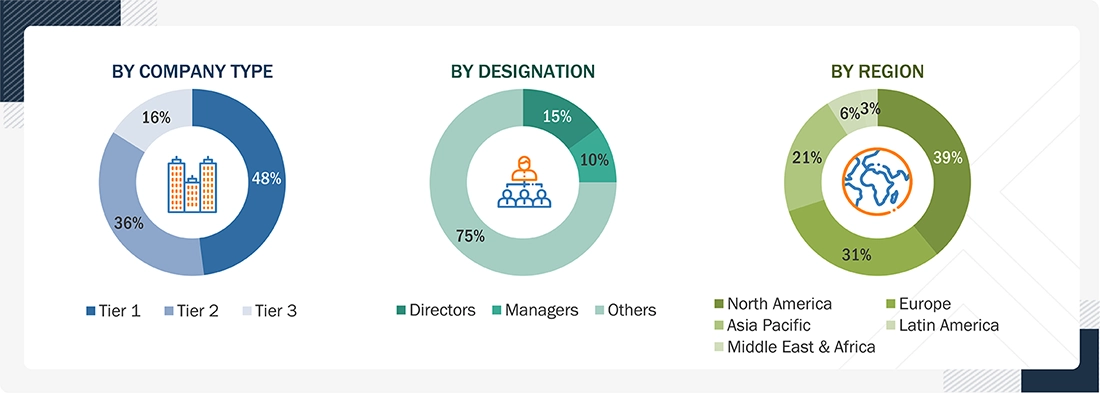
Note 1: Other designations include sales, marketing, and product managers.
Note 2: Tiers are defined based on a company’s total revenue, as of 2024: Tier 1 = >USD 1 billion, Tier 2 = USD 500 million to USD 1 billion, and Tier 3 = USD 500 million.
To know about the assumptions considered for the study, download the pdf brochure
Market Size Estimation
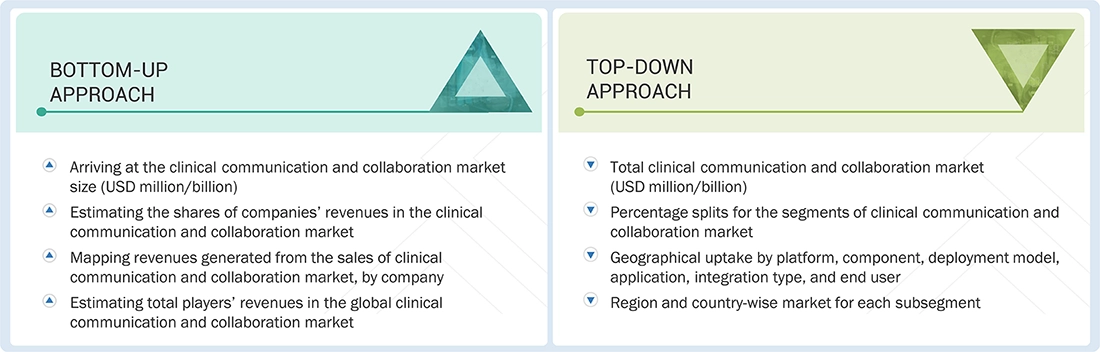
The market size estimates and forecasts in this study are based on a combination of the bottom-up approach (revenue share analysis of leading players) and the top-down approach (evaluation of utilization, adoption, and penetration trends by offering, functionality, deployment, therapeutic area, trial phase, end user, and region).
Clinical Communication & Collaboration Market : Top-Down and Bottom-Up Approach
Data Triangulation
After determining the overall market size from the estimation process described above, the clinical communication and collaboration market was divided into various segments and subsegments. To finalize the overall market analysis and obtain accurate statistics for all segments and subsegments, data triangulation and market breakdown techniques were used whenever applicable. The data was cross-verified by examining different factors and trends from both the demand and supply sides of the clinical communication and collaboration market.
Market Definition
Clinical communication and collaboration refer to digital platforms and software applications that facilitate efficient and secure communication among healthcare organizations to streamline care coordination processes. These solutions encompass a range of features, including secure messaging, voice and video calling, clinical alerting, task management, and telehealth capabilities, enabling healthcare providers to communicate in real-time, share critical patient information, and make informed clinical decisions.
Key Stakeholders
- Clinical Communication and Collaboration Vendors
- Medical Device Manufacturers
- Alarm System Developers
- Technology Companies
- Government Bodies/Municipal Corporations
- Regulatory Bodies
- Healthcare Service Providers
- Clinical/Physician Centers
- Healthcare Professionals
- Health IT Providers
- Healthcare Associations/Institutes
- Assisted Living Centers/Nursing Homes
- Ambulatory Care Centers
- Distributors and Resellers
- Maintenance and Support Service Providers
- Integration Service Providers
- Healthcare Payers
- Advocacy Groups
- Data Security and Privacy Experts
- Standards and Certification Organizations
- Researchers and Academia
- Industry Associations and Trade Groups
Report Objectives
- To define, describe, and forecast the clinical communication and collaboration market by Platform, component, deployment model, application, integration type, end user, and region
- To provide detailed information regarding the major drivers, restraints, opportunities, and challenges influencing market growth
- To strategically analyze micromarkets with respect to individual growth trends, prospects, and contributions to the overall clinical communication and collaboration market
- To analyze market opportunities for stakeholders and provide details of the competitive landscape for key players
- To forecast the size of the clinical communication and collaboration market in five main regions (and their respective countries): North America, Europe, the Asia Pacific, the Middle East & Africa, and Latin America
- To provide key industry insights, such as supply chain, regulatory, patent, and recession impact analysis.
- To profile the key players in the market and comprehensively analyze their core competencies
- To track and analyze competitive developments, such as product launches & upgrades, collaborations, partnerships, acquisitions, investments, contracts, agreements, alliances, mergers, funding, and expansions of the leading players in the market
- To benchmark players within the market using the company evaluation matrix, which analyzes market players on various parameters within the broad categories of business strategy, market share, and product offering
Available Customizations:
With the given market data, MarketsandMarkets offers customizations to meet the company’s specific needs. The following customization options are available for the report:
Geographic Analysis
- Further breakdown of the Rest of European clinical communication and collaboration market into Denmark, Norway, and others
- Further breakdown of the Rest of Asia Pacific clinical communication and collaboration market into Vietnam, Pakistan, New Zealand, and others
- Further breakdown of the Rest of Latin American clinical communication and collaboration market into Argentina, Chile, Colombia, and others
- Further breakdown of the Rest of Middle East & Africa clinical communication and collaboration market into Egypt, Nigeria, Israel, and others
Get the Full Clinical Communication & Collaboration Market Report
Full forecast, segment splits, and company analysis for all Clinical Communication & Collaboration Market.
- China Clinical Communication & Collaboration Market
- India Clinical Communication & Collaboration Market
- South Korea Clinical Communication & Collaboration Market
- Brazil Clinical Communication & Collaboration Market
- Mexico Clinical Communication & Collaboration Market
- Saudi Arabia Clinical Communication & Collaboration Market
- UAE Clinical Communication & Collaboration Market
- South Africa Clinical Communication & Collaboration Market
- Rest Of Europe Clinical Communication & Collaboration Market
- Rest Of Asia Pacific Clinical Communication & Collaboration Market
- US Clinical Communication & Collaboration Market
- Canada Clinical Communication & Collaboration Market
- UK Clinical Communication & Collaboration Market
- Germany Clinical Communication & Collaboration Market
- France Clinical Communication & Collaboration Market
- Spain Clinical Communication & Collaboration Market
- Italy Clinical Communication & Collaboration Market
- Japan Clinical Communication & Collaboration Market
Need a Tailored Report?
Customize this report to your needs
Get 10% FREE Customization
Customize This Report
