
Indonesia Cold Chain Monitoring Market (2025-2030)

The Indonesia Cold Chain Monitoring Market was valued at $29.2 Million in 2025 and projected to reach to $87.7 Million by 2030, representing a compound annual growth rate of 24.6%. Indonesia's cold chain monitoring market is positioned for exceptional growth as the country modernizes its logistics infrastructure and strengthens pharmaceutical distribution networks.


| Market Size in | USD 26.32 MN |
| Market Forecast in | |
| CAGR | |
| Forecast Period | |
| Units Considered | Value (USD MN) |
Indonesia Cold Chain Monitoring Market Trends and Insights
- This represents a compound annual growth rate of 24.6%, significantly outpacing global market growth of 12.6%.
- Indonesia's accelerating adoption of temperature-sensitive logistics solutions is driven by increasing pharmaceutical distribution, food safety regulations, and expanding e-commerce cold chain infrastructure across the archipelago. The market growth in Indonesia reflects rising demand from healthcare providers, food manufacturers, and logistics operators seeking real-time monitoring capabilities for perishable goods.
- Indonesia's strategic position as a major Southeast Asian hub for pharmaceutical and agricultural exports is fueling investment in advanced cold chain technologies.
- Between 2025 and 2030, Indonesia is expected to capture significant market share within the Asia Pacific region, supported by government initiatives promoting food safety standards and vaccine distribution networks..
Key Market Statistics
- CAGR (2025-2030) 24.6% CAGR
- Market Size, 2025 ~USD 29.2 Million
- Forecast, 2030 ~USD 87.7 Million
- Country Indonesia
Indonesia Cold Chain Monitoring Market Overview
Explosive Growth Trajectory :
Indonesia's cold chain monitoring market is expanding at 24.6% CAGR, nearly double the global rate of 12.6%, reflecting the country's rapid digitalization of logistics infrastructure and regulatory compliance demands.
Pharmaceutical Distribution Surge :
Increasing pharmaceutical distribution networks across Indonesia's archipelago are driving demand for temperature-sensitive monitoring solutions, particularly for vaccine distribution and biologics requiring strict cold chain integrity.
Market Valuation Growth :
The Indonesian market is projected to grow from USD 29.2 million in 2025 to USD 87.7 million by 2030, representing a 200% increase in market value over five years as adoption accelerates across sectors.
Regional Infrastructure Development :
Indonesia's expanding e-commerce and food delivery sectors are creating new cold chain requirements, while government initiatives to improve healthcare logistics are catalyzing investment in monitoring technologies.
Indonesia Cold Chain Monitoring Market Dynamics
- The 24.6% CAGR significantly outpaces global trends, driven by increasing healthcare demands, regulatory compliance requirements, and the expansion of temperature-sensitive product distribution across the archipelago.
- Rising investments in cold storage facilities and IoT-enabled monitoring systems are creating substantial opportunities for market participants. The forecast period through 2030 will see accelerated adoption as Indonesia's middle class expands and healthcare accessibility improves.
- Government support for vaccine distribution networks and food safety standards will further propel market growth.
- Companies entering the Indonesian market can capitalize on early-mover advantages in a rapidly developing ecosystem with limited competition compared to mature markets..
Market Ecosystem
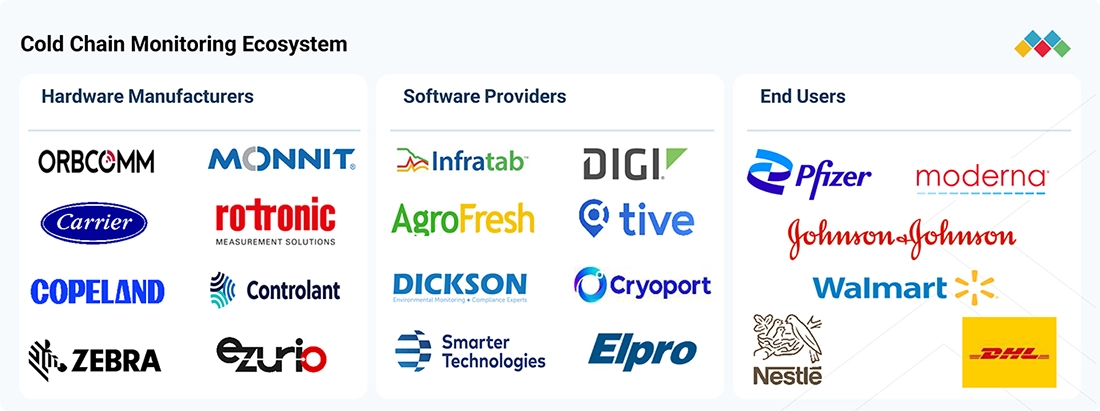
COLD CHAIN MONITORING MARKET SIZE, SHARE & TRENDS: COMMERCIAL USE CASES ACROSS INDUSTRIES
| COMPANY | USE CASE DESCRIPTION | BENEFITS |
|---|---|---|
 |
Carrier provides connected cold-chain solutions through its refrigeration, digital-platform, and cargo-monitoring offerings. Its solutions enable temperature-controlled transport and monitoring across the cold chain, while Lynx Fleet provides centralized visibility into connected refrigeration systems and Sensitech solutions support monitoring of temperature-sensitive cargo such as food, pharmaceuticals, and biologics from origin to destination. | Enables end-to-end cold-chain visibility | Supports real-time monitoring of temperature-sensitive cargo | Helps reduce product loss and temperature-related disruptions | Improves refrigeration asset visibility and operational control |
 |
Controlant provides IoT-based real-time monitoring for pharmaceutical supply chains through its monitoring devices and cloud-based platform. Its solutions track temperature, location, shipment status, and quality data, with configurable alerts for temperature excursions and automated reporting. Its Saga devices support continuous monitoring across cold, ambient, dry-ice, and cryogenic environments. | Enables real-time shipment visibility | Provides immediate temperature-excursion alerts | Supports pharma-compliant monitoring and reporting | Improves product integrity and traceability | Enables proactive intervention during shipments |
 |
Cryoport provides temperature-controlled supply-chain solutions for cell therapy, gene therapy, biologics, animal health, and reproductive medicine. Its Smartpak Condition Monitoring System and Cryoportal platform provide near-real-time monitoring of temperature, location, orientation, and other shipment conditions, with proactive alerts and continuous shipment visibility. | Enables continuous shipment monitoring | Supports proactive risk management | Provides temperature, location, and handling visibility | Improves traceability and compliance | Helps protect temperature-sensitive biological materials |
 |
Testo offers cold-chain monitoring through solutions such as testo Saveris and testo 184 data loggers. Its systems monitor and document temperature and humidity in refrigerated storage, while transport solutions enable continuous temperature recording for temperature-sensitive food and pharmaceutical products. Testo Cloud enables centralized access to measurement data and alarm notifications. | Enables automated temperature monitoring | Supports continuous cold-chain documentation | Provides alerts when temperature limits are exceeded | Supports food-safety and pharmaceutical compliance | Reduces manual monitoring and documentation effort |
 |
ORBCOMM provides IoT-enabled cold-chain monitoring for refrigerated trailers, containers, and other assets. Its ReeferTrak solution enables two-way temperature monitoring and control, while its cold-chain telematics solutions provide real-time visibility, automated alarms, and temperature data for refrigerated transportation across road, rail, and sea. | Enables real-time temperature monitoring and control | Provides automated alarms for temperature deviations | Improves refrigerated asset visibility | Supports regulatory compliance and temperature-data retention | Helps reduce cargo spoilage and operating costs |
Logos and trademarks shown above are the property of their respective owners. Their use here is for informational and illustrative purposes only.
Related Ecosystem
Industrial Automation
- Sensors
- Image Sensors
- Manufacturing Execution System (MES)
- Actuators
- Flow Sensors
- ABB India Limited
- Siemens ag
- Emerson Electric Co.
- HONEYWELL INTERNATIONAL INC.
- SCHNEIDER ELECTRIC SE
Key Takeaways
- Indonesia's cold chain monitoring market will grow from USD 29.2M (2025) to USD 87.7M (2030) at a 24.6% CAGR, outpacing global growth rates.
- Indonesia's pharmaceutical and food export sectors are primary drivers of cold chain monitoring adoption and technology investment.
- Government food safety regulations and vaccine distribution initiatives are accelerating cold chain infrastructure development across Indonesia.
- Indonesia's position as a Southeast Asian logistics hub positions the country for sustained market expansion through 2030.
Cold Chain Monitoring Market Report Scope
| Report Metric | Details |
|---|---|
| Base Year | 2025 |
| Fastest Growing Segment | SOFTWARE (Offering) |
| Forecast Period | 2025-2030 |
| Growth Rate | CAGR of 12.6% from 2025 to 2030 |
| Largest Segment | HARDWARE (Offering) |
| Market Size Base Year (Billions) | ~USD 8.31 (2025) |
| Revenue Forecast (Billions) | ~USD 15.04 (2030) |
| Segments Covered | Temperature Type, Offering, Type, Application, Logistics |
Indonesia Cold Chain Monitoring Market Report Segmentation
5 segment dimensions are covered across the global market.
By Temperature Type
- Chilled
- Frozen
By Offering
- Hardware
- Software
By Type
- Airways
- Biobanks
- Blast Freezers
- Cloud-Based
- Cold Containers
- Fruits & Vegetables
- Meat & Seafood
- Medicines & Drugs
- Networking Devices
- On-Premises
- Poultry & Dairy Products
- Processed Foods
- Railways
- Rfid Devices
- Roadways
- Sensors & Data Loggers
- Sensors And Data Loggers
- Telematics & Telemetry Devices
- Vaccines
- Warehouses
- Waterways
By Application
- Chemicals
- Food & Beverages
- Other Applications
- Pharmaceuticals & Healthcare
By Logistics
- Storage
- Transportation
INDONESIA: COLD CHAIN MONITORING MARKET, BY APPLICATION, 2025–2030
| Segment | 2025 | 2026 | 2027 | 2028 | 2029 | 2030 | CAGR (%) |
|---|---|---|---|---|---|---|---|
| CHEMICALS | 4.1 | 4.7 | 5.3 | 6.1 | 7 | 8 | 14.3 |
| FOOD & BEVERAGES | 71.4 | 85.4 | 102.9 | 124.4 | 149.8 | 179.5 | 20.3 |
| OTHER APPLICATIONS | 6.9 | 7.7 | 8.6 | 9.6 | 10.5 | 11.4 | 10.4 |
| PHARMACEUTICALS & HEALTHCARE | 29.2 | 36.2 | 45.3 | 56.7 | 70.7 | 87.7 | 24.6 |
| TOTAL | 111.6 | 134 | 162.1 | 196.8 | 238 | 286.6 | 20.8 |
Target Audience
- Cold Chain Technology Providers : Manufacturers and vendors of temperature monitoring systems, IoT sensors, and tracking solutions need Indonesia-specific market data to identify growth opportunities and develop localized product strategies for the rapidly expanding market.
- Pharmaceutical & Healthcare Companies : Pharmaceutical distributors and healthcare logistics providers require detailed market insights to optimize cold chain operations, ensure regulatory compliance, and capitalize on Indonesia's growing vaccine and biologics distribution networks.
- Logistics & Supply Chain Operators : Third-party logistics providers and supply chain companies need market intelligence to invest in cold chain infrastructure, upgrade monitoring capabilities, and compete effectively in Indonesia's high-growth logistics sector.
- Private Equity & Investors : Investment firms and venture capital funds evaluating opportunities in Indonesian logistics and healthcare infrastructure require validated market data and growth projections to support investment thesis development and portfolio decisions.
- Government & Policy Makers : Indonesian government agencies and regulatory bodies need market research to inform healthcare logistics policies, vaccine distribution strategies, and cold chain infrastructure development initiatives aligned with market growth trends.
Reasons to Buy this Report
- Market Entry Strategy : Gain comprehensive insights into Indonesia's high-growth cold chain market to develop targeted entry strategies, identify key distribution channels, and understand local regulatory requirements before competitors establish market presence.
- Investment Decision Support : Access detailed market sizing and growth projections to support investment decisions in Indonesian cold chain infrastructure, technology providers, and logistics companies with validated 24.6% CAGR forecasts through 2030.
- Competitive Positioning : Understand Indonesia-specific market dynamics, emerging competitors, and customer segments to position products and services effectively against local and international players in this rapidly expanding market.
- Sector-Specific Opportunities : Identify high-potential segments including pharmaceutical distribution, food logistics, and healthcare infrastructure where cold chain monitoring solutions are experiencing accelerated adoption and premium pricing.
- Risk Mitigation : Evaluate Indonesia's regulatory landscape, infrastructure challenges, and market maturity to develop risk-aware business plans and identify partnerships necessary for successful market penetration and sustainable growth.
Frequently asked questions
What is the current size of Indonesia's cold chain monitoring market?
Indonesia's cold chain monitoring market was valued at USD 29.2 million in 2025 and is projected to grow to USD 87.7 million by 2030.
What is the growth rate of Indonesia's cold chain monitoring market?
Indonesia's cold chain monitoring market is growing at a compound annual growth rate (CAGR) of 24.6% from 2025 to 2030.
What sectors are driving cold chain monitoring demand in Indonesia?
Indonesia's pharmaceutical distribution, food manufacturing, agricultural exports, and e-commerce logistics sectors are primary drivers of cold chain monitoring adoption.
How does Indonesia's market growth compare to global trends?
Indonesia's 24.6% CAGR significantly exceeds the global cold chain monitoring market CAGR of 12.6%, reflecting stronger regional demand and investment.
What factors support Indonesia's cold chain monitoring market expansion?
Government food safety regulations, vaccine distribution initiatives, rising pharmaceutical exports, and expanding e-commerce infrastructure support Indonesia's market growth.
RESEARCH METHODOLOGY
The study involved four major activities in estimating the current size of the global cold chain monitoring market. Extensive secondary research was conducted to gather information on the cold chain monitoring ecosystem, including monitoring solution providers, sensor and device manufacturers, IoT and connectivity providers, refrigeration equipment companies, logistics service providers, system integrators, distributors, and end users. This was followed by primary research with industry stakeholders across the value chain, including cold chain monitoring solution providers, technology developers, component suppliers, logistics companies, pharmaceutical and food companies, cold storage operators, refrigerated transportation providers, and end users, to validate assumptions and market sizing. Both top-down and bottom-up approaches were used to estimate the overall market size. Market breakdowns and data triangulation techniques were then applied to determine the size of individual segments and subsegments by offering, temperature type, temperature range, application, end user, and region. Secondary and primary sources were jointly used to support a comprehensive technical, commercial, and competitive analysis of the global market.
Secondary Research
Various secondary sources were referred to during the secondary research process to identify and collect information relevant to the cold chain monitoring market. These sources included annual reports, company presentations, press releases, product catalogs, technical datasheets, industry publications, company websites, trade directories, and government databases. Secondary research was conducted to obtain key insights into the market’s supply chain, value chain, competitive landscape, and segmentation by offering, temperature type, application, end user, and region. It also helped assess industry trends, adoption of cold chain monitoring solutions across pharmaceuticals & healthcare, food & beverages, logistics, cold storage, retail, and refrigerated transportation, and advancements in IoT-enabled sensors, real-time monitoring, GPS tracking, cloud platforms, telematics, and automated alert systems. The collected information was further analyzed to assess market dynamics and validate market assumptions, which were subsequently refined through primary research with industry experts and key stakeholders.
Primary Research
Extensive primary research was conducted after gaining knowledge about the current scenario of the cold chain monitoring market through secondary research. Several primary interviews were conducted with experts from the demand and supply sides across four major regions: North America, Europe, Asia Pacific, and RoW. This primary data was collected through questionnaires, emails, and telephonic interviews.
Breakdown of Primary Interviews
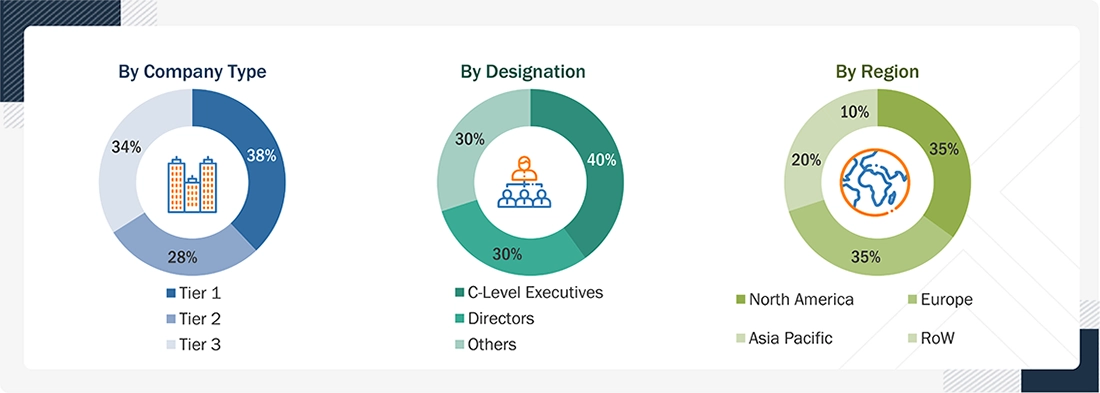
Note: The three tiers of the companies are defined based on their total revenue in 2025: Tier 1 - revenue greater than or equal to USD 1 billion; Tier 2 - revenue between USD 100 million and USD 1 billion; and Tier 3 revenue less than or equal to USD 100 million. Other designations include sales managers, marketing managers, and product managers.
To know about the assumptions considered for the study, download the pdf brochure
Market Size Estimation
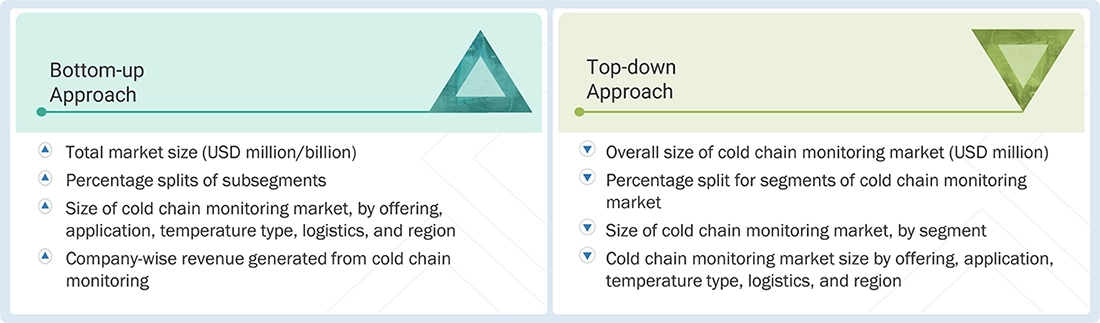
Both top-down and bottom-up approaches were used to estimate and validate the total size of the cold chain monitoring market. These methods have also been used extensively to estimate the size of various subsegments of the market. The following research methodology was used to estimate the market size:
- Major players in the cold chain monitoring market and related markets were identified through extensive secondary research.
- The industry’s value chain and market size in terms of value and volume were determined through primary and secondary research processes.
- All percentage shares, splits, and segment-level breakdowns were determined using secondary sources and verified through primary research and data triangulation.
Cold Chain Monitoring Market: Top-Down and Bottom-Up Approach
Data Triangulation
After arriving at the overall size of the cold chain monitoring market through the market size estimation process, the total market was divided into relevant segments and subsegments. Data triangulation and market breakdown procedures were employed, wherever applicable, to complete the market engineering process and derive the statistics for each segment and subsegment. The data were triangulated by evaluating factors and trends from the demand and supply sides, including technology adoption, monitoring requirements, application needs, cold chain infrastructure development, pharmaceutical and food supply chains, refrigerated transportation, and regional trends.
The analysis considered key cold chain monitoring technologies such as temperature sensors, data loggers, IoT-enabled monitoring devices, GPS tracking, wireless connectivity, cloud platforms, telematics, and automated alert systems, along with hardware, software, and services across storage and transportation applications. Along with this, the market size was validated using top-down and bottom-up approaches to ensure consistency across the overall market and individual segments.
Market Definition
Cold chain monitoring refers to technologies and solutions used to measure, record, track, and monitor temperature and other environmental conditions of temperature-sensitive products throughout storage and transportation. Cold chain monitoring solutions can provide real-time or periodic information on temperature, location, humidity, shipment status, and equipment conditions and can generate alerts when predefined conditions are exceeded. These solutions are used across pharmaceuticals & healthcare, food & beverages, logistics, cold storage, retail, and other temperature-sensitive applications. Depending on monitoring requirements and operating conditions, cold chain monitoring systems can incorporate temperature sensors, data loggers, wireless devices, GPS trackers, IoT connectivity, cloud-based platforms, telematics, and automated alert systems.
Cold chain monitoring plays a crucial role across pharmaceutical and vaccine distribution, food storage and transportation, refrigerated logistics, cold warehouses, healthcare facilities, and temperature-controlled supply chains. These solutions enable continuous condition monitoring, temperature-excursion detection, shipment visibility, traceability, compliance, and timely corrective action. Cold chain monitoring systems are commonly integrated with refrigerated trucks and containers, cold storage facilities, warehouse management systems, refrigeration equipment, logistics platforms, and supply chain management systems. A typical cold chain monitoring system may consist of temperature and environmental sensors, data loggers or connected monitoring devices, communication modules, gateways, cloud-based software, dashboards, alert mechanisms, and associated analytics, with its configuration varying according to temperature range, monitoring frequency, connectivity, application, regulatory requirements, and operating environment.
Key Stakeholders
- Cold chain warehousing and storage providers
- Logistics and transportation companies
- Temperature-sensitive goods producers
- Large-scale farmers and fisheries
- Retailers, supermarkets, and hypermarkets
- Hospitals, clinics, and pharmacies
- Sensor and IoT device manufacturers
- Cold chain software and analytics providers
- Cold chain equipment manufacturers
- Automation and robotics solution providers
- Government and regulatory authorities
- Industry associations and standardization bodies
- Research and academic institutions
- Investors and venture capital firms
Report Objectives
- To define, segment, and forecast the size of the cold chain monitoring market, by temperature type, offering, logistics, application, and region, in terms of value
- To forecast the market size for the hardware segment in terms of volume
- To forecast the size of various segments for four regions: North America, Asia Pacific, Europe, and RoW, in terms of value
- To offer detailed information on drivers, restraints, opportunities, and challenges influencing market growth
- To provide a detailed overview of the cold chain monitoring market value chain
- To strategically analyze the micromarkets regarding individual growth trends, prospects, and contributions to the overall market
- To study the impact of AI/Gen AI and US tariffs on the market under study, along with the macroeconomic outlook for each region
- To analyze opportunities for various stakeholders by identifying the high-growth segments of the market
- To benchmark the key players and analyze their market position in terms of revenue, market share, and core competencies, and provide a detailed competitive landscape for the market leaders
- To analyze competitive developments such as product/service launches, partnerships, collaborations, and acquisitions carried out by players in the cold chain monitoring market
Available customizations:
With the given market data, MarketsandMarkets offers customizations according to the company’s specific needs. The following customization options are available for the report:
Company Information
-
Detailed analysis and profiling of additional market players (up to 5)
Get the Full Cold Chain Monitoring Market Report
Full forecast, segment splits, and company analysis for all Cold Chain Monitoring Market.
- US Cold Chain Monitoring Market
- Canada Cold Chain Monitoring Market
- Mexico Cold Chain Monitoring Market
- Germany Cold Chain Monitoring Market
- UK Cold Chain Monitoring Market
- France Cold Chain Monitoring Market
- Spain Cold Chain Monitoring Market
- Italy Cold Chain Monitoring Market
- Poland Cold Chain Monitoring Market
- China Cold Chain Monitoring Market
- Japan Cold Chain Monitoring Market
- South Korea Cold Chain Monitoring Market
- India Cold Chain Monitoring Market
- Australia Cold Chain Monitoring Market
- Malaysia Cold Chain Monitoring Market
- Thailand Cold Chain Monitoring Market
- Vietnam Cold Chain Monitoring Market
- Nordic Countries Cold Chain Monitoring Market
- Rest Of Europe Cold Chain Monitoring Market
- Rest Of Asia Pacific Cold Chain Monitoring Market
- Bahrain Cold Chain Monitoring Market
- Kuwait Cold Chain Monitoring Market
- Oman Cold Chain Monitoring Market
- Qatar Cold Chain Monitoring Market
- Rest Of The Middle East Cold Chain Monitoring Market
- Saudi Arabia Cold Chain Monitoring Market
- United Arab Emirates (UAE) Cold Chain Monitoring Market
- Rest Of Africa Cold Chain Monitoring Market
- South Africa Cold Chain Monitoring Market
Need a Tailored Report?
Customize this report to your needs
Get 10% FREE Customization
Customize This Report
