
Nigeria Combined Heat and Power Market (2025-2030)

The Nigeria Combined Heat and Power Market was valued at $137.7 Million in 2025 and projected to reach to $165.8 Million by 2030, representing a compound annual growth rate of CAGR 3.8%. Nigeria's Combined Heat and Power market is positioned for moderate but consistent growth through 2030, driven by industrial demand for energy efficiency and cost reduction.


| Market Size in | USD 26.32 MN |
| Market Forecast in | |
| CAGR | |
| Forecast Period | |
| Units Considered | Value (USD MN) |
Nigeria Combined Heat and Power Market Trends and Insights
- Nigeria's energy sector is increasingly adopting CHP systems as a means to improve operational efficiency and reduce energy costs across industrial and commercial applications.
- The market growth in Nigeria is driven by rising electricity demand, industrial expansion, and the need for reliable backup power solutions in a region facing intermittent grid supply. Nigeria's CHP market reflects the country's broader energy transition and industrial modernization efforts.
- Between 2025 and 2030, Nigeria is expected to see steady adoption of combined heat and power technologies in manufacturing, oil and gas, and hospitality sectors.
- Nigeria's focus on energy security and cost optimization positions CHP systems as a strategic investment for large-scale industrial operators seeking to enhance productivity while managing operational expenses.
- The moderate growth trajectory in Nigeria underscores both the market's potential and the infrastructure and regulatory challenges that continue to shape deployment rates..
Key Market Statistics
- CAGR (2025-2030) CAGR 3.8%
- Market Size, 2025 ~USD 137.7 Million
- Forecast, 2030 ~USD 165.8 Million
- Country Nigeria
Nigeria Combined Heat and Power Market Overview
Market Valuation :
Nigeria's CHP market is valued at USD 137.7 million in 2025, with steady growth driven by industrial efficiency demands and rising energy costs across manufacturing and commercial sectors.
Growth Trajectory :
The market is projected to reach USD 165.8 million by 2030, representing a CAGR of 3.8%, outpacing broader energy sector growth as businesses prioritize operational efficiency.
Industrial Adoption :
Nigerian manufacturers and commercial enterprises are increasingly deploying CHP systems to reduce energy expenditure, improve reliability, and meet sustainability objectives in a challenging power environment.
Energy Security Driver :
Nigeria's persistent power supply challenges and high electricity tariffs are accelerating CHP adoption as industries seek independent, cost-effective energy solutions for continuous operations.
Nigeria Combined Heat and Power Market Dynamics
- The country's manufacturing sector, particularly in oil and gas, chemicals, and food processing, is increasingly recognizing CHP systems as critical infrastructure for operational continuity and expense management.
- Rising electricity costs and unreliable grid supply are compelling businesses to invest in on-site power generation solutions. The market outlook remains positive as Nigeria's government continues promoting energy efficiency initiatives and industrial modernization.
- However, growth is tempered by capital investment constraints, limited financing options, and the need for technical expertise.
- Strategic partnerships with international CHP providers and government incentives for renewable-integrated systems will likely accelerate market penetration beyond 2030..
Market Ecosystem
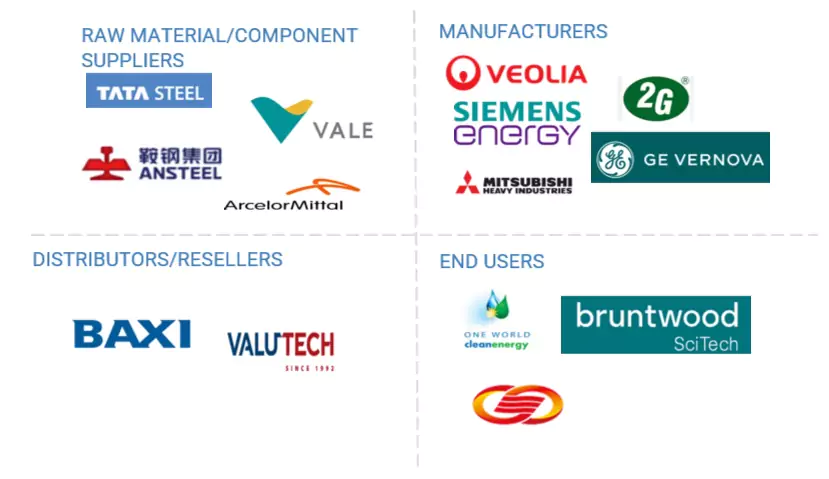
combined heat and power market: COMMERCIAL USE CASES ACROSS INDUSTRIES
| COMPANY | USE CASE DESCRIPTION | BENEFITS |
|---|---|---|
 |
Deploys CHP systems in industrial plants to utilize waste heat for both electricity and process heating | Lower fuel costs, reduced carbon emissions |
 |
Implements CHP in power generation operations to supply both electricity and high-temperature steam for continuous operations | Improved reliability of power supply, reduced operational costs |
 |
Installs CHP units in commercial science parks and research facilities to supply electricity, heating, and cooling for labs and office spaces | Increased energy resilience, decreased utility costs |
Logos and trademarks shown above are the property of their respective owners. Their use here is for informational and illustrative purposes only.
Related Ecosystem
Decarbonization
- Battery Electric Vehicle (BEV)
- Energy Management Systems
- Fuel Cell
- Fuel Cell Electric Vehicle (FCEV)
- Geographical Information System (GIS)
- TotalEnergies SE
- Siemens ag
- Mitsui & Co., Ltd.
- General Electric Company
- Thyssenkrupp ag
Power Infrastructure
- Geographical Information System (GIS)
- Cogeneration
- Battery Electric Vehicle (BEV)
- Cellular Network
- Fuel Cell
- Siemens ag
- ABB India Limited
- SCHNEIDER ELECTRIC SE
- General Electric Company
- Eaton Corporation plc
Key Takeaways
- Nigeria's CHP market is valued at USD 137.7 million in 2025 and will reach USD 165.8 million by 2030 at a 3.8% CAGR.
- Nigeria's industrial sector, particularly oil and gas and manufacturing, is the primary driver of CHP adoption and market expansion.
- Nigeria's unreliable grid infrastructure creates strong demand for CHP systems as backup and primary power solutions.
- Nigeria's CHP market growth is constrained by capital costs, limited financing options, and regulatory barriers that slow technology deployment.
Combined Heat and Power Market Report Scope
| Report Metric | Details |
|---|---|
| Base Year | 2025 |
| Fastest Growing Segment | MICROTURBINE (Prime Mover) |
| Forecast Period | 2025-2030 |
| Growth Rate | CAGR of 5.3% from 2025 to 2030 |
| Largest Segment | NATURAL GAS (Fuel) |
| Market Size Base Year (Billions) | ~USD 32.04 (2025) |
| Revenue Forecast (Billions) | ~USD 41.48 (2030) |
| Segments Covered | Capacity, End User, Fuel, Prime Mover |
Nigeria Combined Heat and Power Market Report Segmentation
4 segment dimensions are covered across the global market.
By Capacity
- 11 To 150 Mw
- 11-150 Mw
- 151 To 300 Mw
- 151-300 Mw
- Above 300 Mw
- Up To 10 Mw
By End User
- Commercial
- Industrial
- Residential
- Utilities
By Fuel
- Biogas/Biomass
- Coal
- Diesel
- Natural Gas
- Nuclear
- Other Fuels
By Prime Mover
- Fuel Cell
- Gas Turbine
- Microturbine
- Other Prime Movers
- Reciprocating Engine
- Steam Turbine
NIGERIA: COMBINED HEAT AND POWER MARKET, BY END USER, 2025–2030
| Segment | 2025 | 2026 | 2027 | 2028 | 2029 | 2030 | CAGR (%) |
|---|---|---|---|---|---|---|---|
| COMMERCIAL | 16.5 | 16.7 | 16.9 | 17.2 | 17.5 | 17.8 | 1.6 |
| INDUSTRIAL | 78.6 | 81.3 | 84.4 | 87.8 | 91.6 | 95.8 | 4.1 |
| RESIDENTIAL | 19.1 | 19.5 | 19.9 | 20.5 | 21.1 | 21.8 | 2.7 |
| UTILITIES | 23.6 | 24.7 | 25.9 | 27.2 | 28.7 | 30.4 | 5.2 |
| TOTAL | 137.7 | 142.1 | 147.1 | 152.7 | 158.9 | 165.8 | 3.8 |
Target Audience
- CHP Equipment Manufacturers : Manufacturers need Nigeria-specific market data to assess demand potential, identify key industrial customers, and develop localized product strategies for the growing efficiency-focused segment.
- Energy Solution Providers : Service providers and system integrators require detailed market insights to target high-value industrial clients, understand competitive positioning, and forecast revenue opportunities in Nigeria.
- Industrial Facility Operators : Manufacturing and commercial enterprises need market intelligence to benchmark CHP adoption trends, evaluate ROI potential, and make informed capital investment decisions for energy independence.
- Investment & Finance Firms : Investors and financial institutions require market sizing and growth projections to evaluate funding opportunities, assess portfolio companies, and identify emerging energy efficiency trends in Nigeria.
- Government & Policy Bodies : Energy regulators and policymakers need market data to design incentive programs, assess industrial energy efficiency potential, and develop strategic energy security initiatives for Nigeria.
Reasons to Buy this Report
- Market Size & Growth Data : Access precise valuation figures for Nigeria's CHP market (USD 137.7M in 2025) and verified forecasts through 2030, enabling accurate investment planning and competitive positioning.
- Nigeria-Specific Insights : Gain localized intelligence on industrial adoption patterns, sector-specific demand drivers, and regional barriers unique to Nigeria's energy landscape and business environment.
- Investment Decision Support : Leverage detailed market analysis to identify high-potential customer segments, geographic hotspots, and technology preferences specific to Nigerian manufacturers and commercial operators.
- Competitive Intelligence : Understand market dynamics, emerging competitors, and differentiation opportunities within Nigeria's CHP sector to develop targeted go-to-market strategies.
- Risk & Opportunity Assessment : Evaluate growth catalysts, regulatory environment, financing challenges, and expansion opportunities specific to Nigeria's industrial and energy sectors.
Frequently asked questions
What is the market size of Combined Heat and Power in Nigeria?
Nigeria's Combined Heat and Power market is valued at USD 137.7 million in 2025 and is projected to reach USD 165.8 million by 2030.
What is the growth rate of Nigeria's CHP market?
Nigeria's CHP market is expected to grow at a compound annual growth rate (CAGR) of 3.8% from 2025 to 2030.
Which industries drive CHP adoption in Nigeria?
Nigeria's oil and gas, manufacturing, hospitality, and commercial sectors are the primary drivers of CHP system adoption and market growth.
Why is CHP technology important for Nigeria?
Nigeria's unreliable electricity grid and high energy costs make CHP systems critical for industrial operators seeking energy security, cost reduction, and operational efficiency.
What challenges does Nigeria's CHP market face?
Nigeria's CHP market faces challenges including high capital investment requirements, limited access to financing, regulatory uncertainty, and insufficient technical expertise for system installation and maintenance.
RESEARCH METHODOLOGY
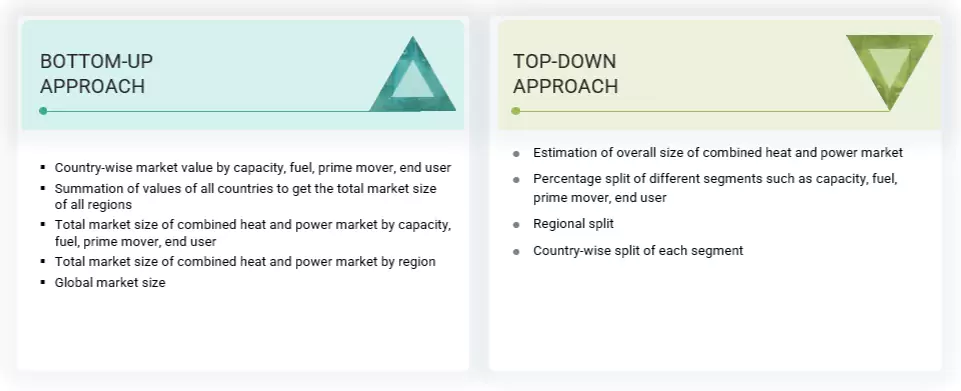
The study involved major activities in estimating the current size of the combined heat and power market. Exhaustive secondary research was done to collect information on the peer and parent markets. The next step was to validate these findings, assumptions, and sizing with industry experts across the value chain through primary research. Both top-down and bottom-up approaches were employed to estimate the complete market size. Thereafter, market breakdown and data triangulation were used to estimate the market size of the segments and subsegments.
Secondary Research
This research study on the combined heat and power market involved the use of extensive secondary sources, directories, and databases, such as Hoovers, Bloomberg, Businessweek, Factiva, International Energy Agency, and BP Statistical Review of World Energy, to identify and collect useful information for a technical, market-oriented, and commercial study of the global combined heat and power market. The other secondary sources included annual reports, press releases, and investor presentations of companies, white papers, certified publications, articles by recognized authors, manufacturer associations, trade directories, and databases.
Primary Research
The combined heat and power market comprises stakeholders such as combined heat and power manufacturers, technology providers, and support providers in the supply chain. The demand side of this market is characterized by the rising demand for energy-efficient systems in countries due to increasing needs for sustainability, reduced carbon emissions, and cost-effective power generation. The supply side is characterized by rising demand for contracts from industrial users and utilities, and mergers & acquisitions among big players. Various primary sources from both the supply and demand sides of the market were interviewed to obtain qualitative and quantitative information. The following is the breakdown of primary respondents:
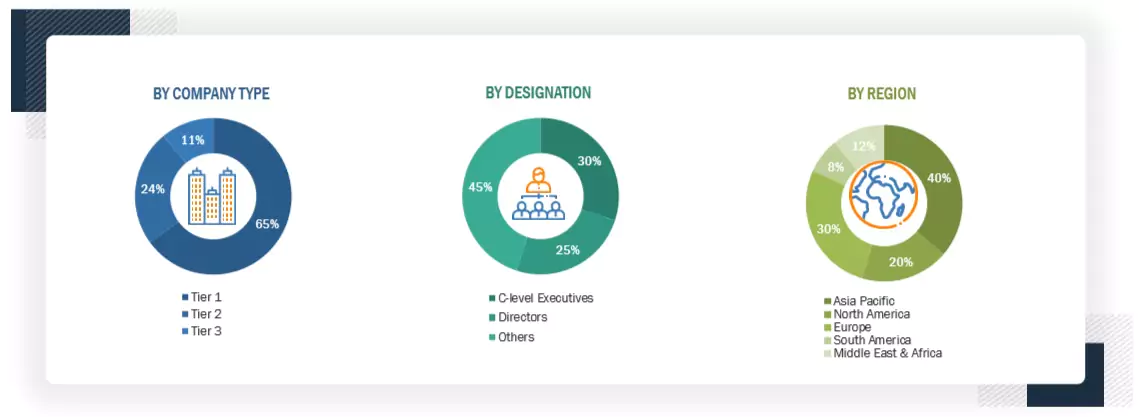
Note: “Others” include sales managers, engineers, and regional managers
The tiers of the companies are defined based on their total revenue as of 2024: Tier 1: >USD 1 billion, Tier 2:
USD 500 million–1 billion, and Tier 3:
To know about the assumptions considered for the study, download the pdf brochure
Market Size Estimation
Both the top-down and bottom-up approaches were used to estimate and validate the size of the combined heat and power market and its dependent submarkets. The key players in the market were identified through secondary research, and their market share in the respective regions was obtained through primary and secondary research. The research methodology includes the study of the annual and financial reports of top market players and interviews with industry experts, such as chief executive officers, vice presidents, directors, sales managers, and marketing executives, for key quantitative and qualitative insights related to the combined heat and power market.
Combined Heat and Power Market : Top-Down and Bottom-Up Approach
Data Triangulation
After arriving at the overall market size from the estimation process explained above, the total market has been split into several segments and subsegments. To complete the overall market engineering process and arrive at the exact statistics for all the segments and subsegments, the data triangulation and market breakdown processes have been employed, wherever applicable. The data has been triangulated by studying various factors and trends from both the demand and supply sides. Along with this, the market has been validated using both the top-down and bottom-up approaches.
Market Definition
Combined heat and power (CHP) is an energy-efficient technology that generates electricity and captures the heat that would otherwise be wasted to provide useful thermal energy, such as steam or hot water. This steam or hot water, in turn, can be used for heating, cooling, and other domestic and industrial processes. CHP can be implemented for different types of prime movers, such as gas turbines, steam turbines, reciprocating engines, fuel cells, and microturbines. CHP, also called cogeneration, can be used in an individual facility/building or a district energy/utility resource. CHP systems are typically employed at facilities where there is a need for electricity and thermal energy. It provides benefits such as a reduction in dependency on grid support due to on-site electricity generation, enhanced reliability, reduced costs of energy and initial setup, increased resiliency against power disruption, and reduction in harmful emissions. CHP systems can handle critical electrical and thermal loads during grid power outages. Microturbines are a type of combustion turbine that produces both heat and electricity on a relatively small scale.
Stakeholders
- Consulting companies in energy sector
- Distributed energy associations
- Environmental associations
- EPC contractors for CHP
- Manufacturers of fuel cells and microturbines
- Manufacturers of gas and steam turbines
- Government and research organizations
- Investment banks
- Power companies
- Manufacturers of reciprocating engines
Report Objectives
- To describe and forecast the combined heat and power market based on capacity, prime mover, fuel, end user, and region in terms of value
- To describe and forecast the combined heat and power market based on region in terms of volume
- To describe and forecast the combined heat and power market for various segments with respect to five main regions: North America, Europe, Asia Pacific, South America, and the Middle East & Africa, in terms of value
- To provide detailed information regarding the drivers, restraints, opportunities, and challenges influencing the growth of the market
- To provide a detailed overview of the combined heat and power value chain analysis, use case analysis, key stakeholders and buying criteria, patent analysis, trade analysis, tariff analysis, regulations and codes, pricing analysis, Porter’s five forces analysis, impact of AI, and US Tariff impact
- To strategically analyze micromarkets1 with respect to individual growth trends, prospects, and contributions to the total market
- To analyze opportunities in the market for various stakeholders by identifying high-growth segments
- To strategically profile key players and comprehensively analyze their market position in terms of ranking and core competencies2, along with detailing the market’s competitive landscape
- To analyze growth strategies adopted by market players, such as joint ventures, partnerships, mergers & acquisitions, contracts, agreements, and product launches in the combined heat and power market
Micromarkets1 are defined as the segments and subsegments of the combined heat and power market included in the report.
Core competencies2 of companies are captured in terms of their key developments and product portfolios, as well as the key strategies adopted by them to sustain their position in the combined heat and power market.
Available Customizations
MarketsandMarkets offers customizations according to the specific needs of the companies with the given market data.
The following customization options are available for the report:
Product Analysis
- Product matrix, which gives a detailed comparison of the product portfolio of each company
Geographic Analysis as per Feasibility
- Further breakdown of the eFuse, by country
Company Information
- Detailed analysis and profiling of additional market players (up to five)
Get the Full Combined Heat and Power Market Report
Full forecast, segment splits, and company analysis for all Combined Heat and Power Market.
- US Combined Heat and Power Market
- Canada Combined Heat and Power Market
- Mexico Combined Heat and Power Market
- France Combined Heat and Power Market
- Germany Combined Heat and Power Market
- Italy Combined Heat and Power Market
- UK Combined Heat and Power Market
- Russia Combined Heat and Power Market
- China Combined Heat and Power Market
- Japan Combined Heat and Power Market
- South Korea Combined Heat and Power Market
- Australia Combined Heat and Power Market
- India Combined Heat and Power Market
- Saudi Arabia Combined Heat and Power Market
- UAE Combined Heat and Power Market
- South Africa Combined Heat and Power Market
- Turkey Combined Heat and Power Market
- Brazil Combined Heat and Power Market
- Argentina Combined Heat and Power Market
- Rest Of Europe Combined Heat and Power Market
- Rest Of Asia Pacific Combined Heat and Power Market
- Algeria Combined Heat and Power Market
- GCC Combined Heat and Power Market
- Rest Of GCC Combined Heat and Power Market
- Rest Of South America Combined Heat and Power Market
Need a Tailored Report?
Customize this report to your needs
Get 10% FREE Customization
Customize This Report
